
Normal view

There are new articles available, click to refresh the page.
Before yesterdayMain stream

Tech In Plain Sight: Meet The Robot That Does CPR

10 September 2026 at 10:00

Usually in Tech In Plain Sight, we talk about technology you probably see every day, even if you don’t notice it. But we hope you don’t get to see one of the latest crop of medical robots, such as the LUCAS chest compression system. If you watch the popular TV series “The Pitt”, though, you may have caught a glimpse of one of these medical marvels. They aren’t fiction. They are very real devices.

Calling them robots might be stretching the definition a little. They don’t roam the halls looking for patients. But once attached to someone in cardiac arrest, they can take over one of the most important — and physically demanding — parts of CPR: chest compressions.

Keep The Blood Moving

When someone’s heart stops pumping blood, time is critical. CPR doesn’t normally restart the heart on its own. Instead, chest compressions produce enough blood flow to keep oxygen reaching the brain and heart while rescuers work on the underlying problem and, when appropriate, use a defibrillator.

Doing that well is harder than it looks on television. Current American Heart Association guidelines call for adult chest compressions 100 to 120 times per minute, at least 5 cm deep but generally no deeper than 6 cm, while allowing the chest to recoil fully between compressions. Interruptions should be kept to a minimum.

That’s hard physical work. In fact, studies show compression depth begins to fall after only about 90 to 120 seconds, which is one reason CPR teams normally swap compressors every two minutes. But a robot doesn’t get tired.

Meet LUCAS

LUCAS stands for Lund University Cardiopulmonary Assist System, reflecting the device’s origins in Lund, Sweden. Early versions entered clinical use around 2002-2003 and were pneumatically powered. Later versions replaced the compressed-gas system with an electric motor and battery.

The current LUCAS 3 looks something like a small drill press straddling the patient as you can see in the video below. A backplate goes beneath the torso, and a frame locks onto it. An electrically driven piston presses a suction-cup-like pad against the sternum. Internally, the motor drives a belt and ball screw that moves the piston up and down.

Factory settings are around 102 compressions per minute and roughly 53 mm compression depth for a typical adult, although parameters can be configured.

Beyond tirelessness, another obvious advantage is that LUCAS doesn’t need hands. Medics can deal with ventilation, drugs, defibrillation, IV access, and the dozens of other things occurring during a cardiac arrest. More importantly, the device can keep compressing while a patient is being carried, wheeled through corridors, or transported in an ambulance — situations where doing good manual CPR is awkward and sometimes dangerous to the practitioner.

So Does It Save More People?

You might reasonably expect perfectly regular machine CPR to beat a tired human. Large randomized trials haven’t demonstrated that, however. The 4,471-patient PARAMEDIC trial found 30-day survival of 6.3% with LUCAS versus 6.8% with manual CPR, not a statistically significant difference. The 2,589-patient LINC trial similarly found essentially identical four-hour survival — 23.6% versus 23.7% — and no significant improvement in longer-term neurological outcomes.

That doesn’t make the machines useless. It says something slightly different: high-quality mechanical CPR hasn’t proven superior to high-quality manual CPR as a routine replacement. The International Liaison Committee on Resuscitation currently recommends against routine mechanical CPR, while specifically noting that it can be a reasonable alternative when sustained manual compressions are impractical or would endanger the practitioner.

One issue is setup. Installing the machine adds a time penalty: compressions must stop briefly while the backplate and mechanism are positioned. Good training is essential to keep that interruption short. Another problem is that some studies show potential links to higher rates of internal chest injuries, such as bleeding around the lungs. There have also been rare device malfunctions or power failures that can compromise care.

Not The Only Game In Town

LUCAS isn’t alone. ZOLL’s AutoPulse takes a very different mechanical approach. Instead of a piston pushing on one spot, a motor tightens a broad load-distributing band around the patient’s chest.

There’s also the German corpuls cpr, which returns to the piston idea but uses a cantilevered single-arm mechanism. That leaves much of the chest unobstructed and makes the system useful during procedures such as cardiac catheterization.

So perhaps these aren’t quite the autonomous robot doctors science fiction promised us. But when your heart has stopped, and a machine is tirelessly pumping your chest a hundred times a minute while the medical team works around it, you probably won’t complain. We hope you don’t have to find out.

We’ve seen DIY devices, though certifying medical devices for actual use isn’t for the faint of heart. Robots can also help train humans to do better CPR.

Featured image is a still from the instructional video “Physio-Control LUCAS 3 Chest Compression System – Hospital Use” by MFI Medical.

Tech in Plain Sight: Vacuum Blood Collection

24 August 2026 at 13:00

If you’re blessed enough that you haven’t had blood drawn in a while, you might not have thought much about the process. You might imagine that a needle goes in, a syringe is drawn back, and the venous blood is thusly collected. Indeed, it can be done that way.

However, there is an altogether niftier and more efficient method of fast blood collection for pathology testing. It’s all about using vacuum and smart design to ease the work of phlebotomists, while maintaining a sterile and safe environment.

Vacuum, Contained

These days, if you get blood collected for testing, there’s a plenty good chance you’ll have it drawn into a vacutainer. It’s named as a portmanteau of “vacuum” and “container” because that’s fundamentally what the system relies upon. A vacutainer is a glass or plastic tube which holds a vacuum inside, sealed with a stopper. That vacuum can be used to help extract fluids to be stored inside the container—namely, blood, in most cases.

A blood draw taking place with a vacutainer. The needle unit is inserted into the vein, while the vacutainer tube is slid into the housing to draw blood out. Credit: public domain

The method of use is relatively straightforward. A vacutainer needle is inserted into a patient’s vein to access the blood. The vacutainer needle does not have a typical syringe draw. Instead, the back end of the needle sits inside a plastic housing which accepts vacutainer tubes. There is a flexible rubber seal on the back end of the needle so blood doesn’t leak out when no tube is connected.

When a vacutainer tube is inserted into the housing, the vacutainer needle pierces the stopper of the tube. The vacuum inside then draws blood from the vein into the tube for collection. When full, the tube can be removed and it self-seals as the needle comes out of the stopper. Another tube can be quickly clipped into the vacutainer needle housing to draw further blood if more is needed, without leaks or mess causing contamination issues.

A series of vacutainer tubes filled with blood for testing. The different colored caps indicate different additive content, which preserves the blood under ideal conditions for different types of testing. Credit: Tannim101

Vacutainer tubes are, by design, single use. They’re manufactured to capture a set quantity of blood for testing, based on the level of vacuum in the tube at the time it is sealed, and are disposed of after use. Labels are often included on the tubes allowing patient information to stay with the blood itself. Tubes have a shelf life, as with most medical paraphernalia, in particular since they may not maintain vacuum indefinitely.

The tubes are also typically filled with various additives in order to best preserve and prepare the blood while it awaits testing, and stoppers are color-coded to indicate this. The precise additives used are highly dependent on the testing required. A tube for a standard blood culture draw will typically be filled with sodium polyanethol sulfonate, which acts as an anti-coagulant, with growth media also present for microorganisms.

Coagulation tests will use tubes with sodium citrate inside, while a test for lead will often use a tube with sodium EDTA chelator inside. Some basic blood component tests will use a plain tube with no additives, while others are highly specific—tuberculosis testing often uses purpose-made tubes with antigen additives ready to go. Some tubes include special serum-separating agents which help with splitting blood into its component parts when shaken or centrifuged, useful for certain tests that look at different blood cell types individually.

A package of vacuum blood draw tubes, with the purple cap indicating K2 EDTA additives inside. Credit: via Amazon
A vacutainer needle hooked up to a housing. The needle inside the housing typically has a rubber sheath which stops blood flow when no tube is inserted. This allows tubes to be hot-swapped for drawing multiple quantities of blood from a patient. Credit: via Amazon

If you’ve ever dared to watch while having your blood drawn in this manner, the technology can look quite swish. The tubes are easy to hotswap without leaking any blood and several tubes can be filled in under a minute once the phlebotomist has found an appropriate vein.

However, the technology is not particularly new. It was developed all the way back in 1947 by Joseph Kleiner, though other vacuum-based blood draw techniques existed previously. His goal in developing the technology was to ease patient discomfort and reduce the spillage of blood. This stemmed from his experience seeing his terminally-ill wife suffer multiple needle punctures whenever multiple blood tests were required, and seeing the mess caused when syringes were emptied into test tubes for processing and testing. His inspiration was seeing vacuum-sealed tubes used by the military to transport blood during World War II; the product he developed would later reach the market in 1949. They had the benefit of keeping the blood from exposure to air, reduced the number of punctures required along with the chance of needle stick injuries and infection, and ensured blood was collected in standard volumes and conditions, which aided clinical accuracy. Plastic versions were developed by medical supplier Becton Dickinson in the 1960s, and have become widely popular in the phlebotomy field since.

If you’re not in the medical field, and you’ve managed to avoid regular blood tests, you probably haven’t even noticed vacutainers. Alternatively, you might simply live in an area where their use is uncommon, or you’ve just been intently looking away while your blood has been drawn. In any case, they remain a neat little bit of technology that makes a messy, hazardous, medical process as clean and tidy as possible.

Featured image: “Drawing Test tubes different colors” by [Goldmund100].

Smartphones and the Next Generation of Hearing Aids

By: Tom Nardi
18 August 2026 at 10:00

If you don’t actually need one, you’d be forgiven for thinking a hearing aid just makes everything louder for the wearer. Especially since there are plenty of shady products out there which will do exactly that for just four easy payments of $29.99. But the reality is considerably more complex, as a proper hearing aid needs to be capable of selectively enhancing certain frequencies while squashing down others.

The technical challenges involved in pulling that off in a device small enough to fit inside the human ear and run off of a tiny battery are considerable — and while there’s undoubtedly been some degree of artificial price inflation going on over the years, there’s a reason proper hearing aids have been so much more expensive than their “As Seen on TV” counterparts. These same challenges are also why DIY and open source hardware hearing aids have struggled to gain much traction.

But over the last few years the situation has changed. In 2022 the United States Food and Drug Administration (FDA) established the framework by which hearing aids could be sold over the counter (OTC). Although they’re generally less capable than their prescription counterparts and not suitable for individuals with profound hearing loss, the wide commercial availability of OTC hearing aids has kicked off a competition between manufacturers to deliver more affordable devices.

That competition entered a new phase earlier this month when the FDA granted approval for Samsung’s Galaxy Earbuds to fall under the same category. This follows a similar decision made about Apple’s AirPods back in 2024. The two biggest players in the smartphone market being able to offer their earbuds as OTC hearing aids represents a unique value proposition. Not only are they priced for mass market consumption, but many individuals who would be interested in purchasing an OTC hearing aid will already own them and need only to enable the feature with a software update.

Given how different the situation is today than even just five years ago it’s worth asking just what qualifies as a over-the-counter hearing aid, and how the shifting definition of these devices can inform the community’s efforts to develop open hardware solutions.

What is a Hearing Aid, Anyway?

We’ve already covered what a hearing aid isn’t, but before we go too much further it’s a good idea to clarify what exactly a hearing aid does in comparison to a simple audio amplifier, which in the industry are officially known as Personal Sound Amplification Products (PSAPs). This is a topic we’ve touched on previously here at Hackaday, but the short version is that since the 1980s or so, the frequencies that a hearing aid amplifies have been tailored to match the specific auditory deficiencies of the wearer.

Traditionally, getting a hearing aid prescribed would require going to an audiologist and getting an audiogram. This chart plots the results of a hearing test, and shows how well the patient can hear various frequencies. With this data, it’s possible to quantify the severity of a patient’s hearing loss and determine where a hearing aid could improve the situation. This information could then be programmed into a hearing aid to provide a bespoke amplification profile that takes into account the needs of the wearer.

It’s worth noting that this is only in the context of relatively modern digital hearing aids, essentially those created after the introduction of solid state electronics. Prior to that point, hearing aids were closer to what we would now consider PSAPs and amplified incoming audio indiscriminately.

Defining a Middle Ground

With this in mind, the primary difference between a prescription hearing aid and an OTC model is that the audiologist is cut out of the loop. That means there’s no audiogram, and in turn no data to program the hearing aid’s filters with. The specifics of this does vary from model to model, and both Samsung and Apple offer some basic audio testing tools that can help the user fine-tune their experience. But at this point, no OTC hearing aid product is capable of diagnosing the wearer’s hearing to the same level as a comprehensive hearing test performed by an audiologist

That being the case, it might seem like an OTC hearing aid is just a PSAP. But in their ruling, the FDA established the formal requirements for a device that falls somewhere in the middle. The full document, Medical Devices; Ear, Nose, and Throat Devices; Establishing Over-the-Counter Hearing Aids, comes in at around 200 pages if you’re looking for some light reading.

Fortunately, the agency provides a boiled-down list of what features a device must have to meet the definition of an OTC hearing aid. Some of the requirements have to do with the packaging and marketing of the product, which of course are important for a medical device, but it’s the technical parameters that we’re interested in.

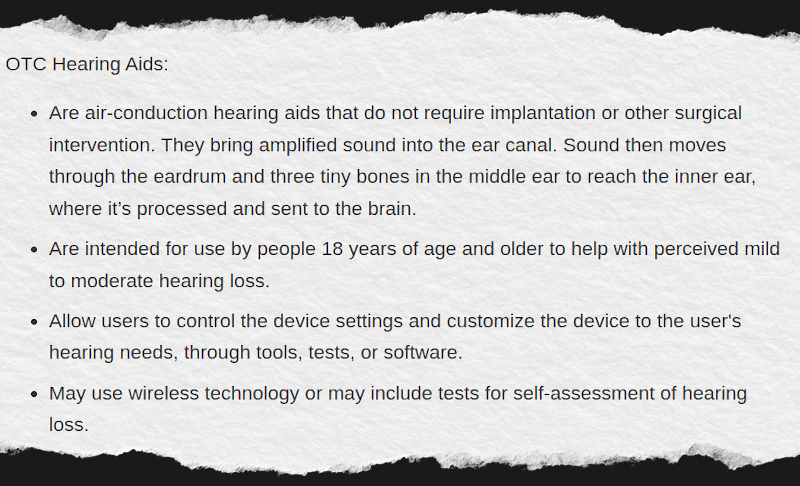
The FDA specifies that all OTC hearing aids must use air-conduction, that is, operate with a speaker inserted into the ear canal. The alternative would be bone conduction, which is generally used in cases with more profound hearing loss. The devices must also allow users to adjust, at least to some degree, the output to match their specific needs.

The intention with this second requirement goes deeper than a simple volume control as you’d have in an PSAP. In lieu of the sort of tailored output a prescription hearing aid would offer, the OTC device can offer a selection of pre-defined audio filter profiles which the user could flip through. At the risk of oversimplifying things, it’s a bit like the audio presets for different genres of music that modern headphones and earbuds usually offer in that the user can cycle through different profiles to find what best matches the current environment.

When combined with the acknowledgement that OTC hearing aids can utilize wireless technology to communicate with another device, it’s not hard to see how the smartphone fits into the equation. While a stand-alone device is capable of meeting the requirements necessary for OTC hearing aid classification, being able to connect to the user’s phone to easily switch between audio profiles on the fly makes for a greatly improved user experience. Additionally, by playing tones through the earbuds, software on the phone can perform a hearing test on the user — the results of which can be used to fine-tune the output beyond what’s possible with simple presets.

Hackers, Take Note

Of course, anyone looking to build an open source hearing aid probably isn’t looking for FDA approval. The goal is likely to make the technology cheaper and more accessible, especially in areas where getting a commercially produced hearing aid may be difficult. As such, the new over-the-counter classification may not seem terribly important for folks like us.

But that doesn’t mean we can’t pick up some tips from what companies like Samsung, Apple, and Jabra are doing. By bringing the user’s smartphone into the mix, they have made hearing aids more accessible and easier to operate. Instead of trying to pack all of the functionality directly into the wearable, using a smartphone to do some of that heavy lifting opens up a lot of new possibilities. There are naturally trade-offs when switching a hardware problem for a software one, especially when dealing with mobile operating systems, but it may be a compromise worth making if it means getting this sort of assistive tech to more people that need it.

❌
❌