One reason that Linux has struggled to gain desktop users is the perception that the Linux desktop is a mess. Apps look too different from each other, and command-line elitists rule the system. The way the Linux desktop is the way it is largely stems from Linux's predecessor, Unix, and some design choices made in the '60s, '70s, and '80s.
You’ve probably seen people committing their env files to GitHub without noticing it. When you’re looking for a job as a coder, that mistake alone is significant enough to get you rejected if it happens during the technical portion. And if it ever happened to you, it’s happened to plenty of others too.
Today we’ll look at TruffleHog. It’s a tool that scans Git repositories and their full history for secrets that got committed by accident. It uses high entropy checks with custom regular expressions to catch strings that look like API keys, tokens, passwords and other sensitive data. You can point it at one repository or use a GitHub or GitLab API to hit a lot of projects in one go.
A developer can delete a key from the latest commit, but it will still live in Git’s past. With those credentials, you access services without making much noise.
Installation
First install git-dumper and TruffleHog. The Python package and the GitHub release are not the same, so pay attention to which one you’re on.
kali > pip3 install git-dumper
kali > pip3 install trufflehog
We’ll use git-dumper when we find an exposed .git directory and then run TruffleHog against that dump. Leaked .git folders are still common.
Dump a Repository
Some servers leave the entire .git directory open. Below you can see a website where it was fully accessible.
Dump it by giving git-dumper the URL and a local folder for the files.
kali > git-dumper http://example.com/.git dump
Other websites block the directory listing but still serve some of the files.
Git-dumper can pull every object, commit and reference it can reach.
kali > git-dumper http://example.com/.git/ dump
Everything will be stored in the dump folder.
Analyzing the Repositories
Once the dump is on disk, run TruffleHog against it. By default it runs entropy-based matching. That can help, but it shouldn’t be the only mode you know. In our case, regex with entropy off gave us more results.
kali > trufflehog --regex --entropy NO dump
In one of the files we found database credentials.
You can also install TruffleHog from the GitHub release and scan the filesystem directly:
kali > curl -sSfL https://raw.githubusercontent.com/trufflesecurity/trufflehog/main/scripts/install.sh | sh -s -- -b /usr/local/bin

kali > trufflehog filesystem /home/kali/Documents/dump
This build is fine for tuning your scans, but it often makes more noise and false positives, so just be aware of it.
Other Ways to Analyze Repositories
Depending on which build you’re using, try these flags to change what you get in the output.
Scan a repo for verified secrets:
kali > trufflehog git https://github.com/trufflesecurity/test_keys --results=verified,unknown
Verified means TruffleHog checked these finding live against the service API (AWS, GitHub and so on). Unknown is both high entropy and regex hits that it couldn’t confirm.
Same scan with JSON output:
kali > trufflehog git https://github.com/trufflesecurity/test_keys --results=verified,unknown --json
Scan a GitHub repo including issues and pull requests:
kali > trufflehog github --repo=https://github.com/trufflesecurity/test_keys --issue-comments --pr-comments
That digs into issues, comments, PR bodies and comments. You can find leaks in discussions too.
Scan a local Git repo:
kali > trufflehog git file://test_keys --results=verified,unknown
Useful when you’ve compromised a dev Linux machine with multiple projects on it. There’s a better chance of finding something locally than pushed to GitHub, although both can happen, as you now know.
Summary
We had an external pentest where several services were accessible but no credentials could be found. Surprisingly, some developers had kept projects they were doing for the company publicly accessible on GitHub. Eventually we found a working pair and got into a database.
TruffleHog can be really helpful here. Sensitive files sometimes get exposed without the publisher even knowing it. We’re humans and we make mistakes. Offensive or defensive, the point is the same.
The commander and pilot of NASA's Artemis II mission have gained a new distinction five months after splashing down from the Moon: They're not fully retiring from the space agency.
Reid Wiseman and Victor Glover are the first astronauts to join NASA's emeritus program, enabling them to continue to support the work being done at Johnson Space Center in Houston. They will remain available to train and mentor the current workforce while still being able to pursue employment and opportunities outside of NASA.
"I have asked NASA ... to not use the term 'retire' as much, but technically emeritus is a retirement program," Glover told collectSPACE.com on Wednesday. "It's something we have typically done for scientists when they have groundbreaking research, and they want to go back to academia to teach or to research and publish."
Sixty years after television audiences first tuned in to see the voyages of the Starship Enterprise, an astronaut on board the International Space Station has paid tribute to Star Trek by flying the badge of the franchise's latest fictional captain.
Expedition 75 flight engineer Sophie Adenot with European Space Agency (ESA) donned the Delta badge originally worn by actor Anson Mount for a video recorded from aboard the space station. Mount portrays Christoper Pike in the Paramount+ streaming series Star Trek: Strange New Worlds. Paramount and ESA both released the clip on their Instagram feeds.
"For 60 years, Star Trek has brought us stories of friendship and exploration. I'm wearing Captain Pike's badge aboard the ISS in celebration of continuing the real world work of science and exploration," said Adenot. "For me, exploration and science are about curiosity and cooperation daring to go a little farther together, learning from what we discover and build, and turning that knowledge into a better future for everyone."
The programming world isn't just about Rust or TypeScript, and huge swaths of the economy rely on systems and technologies we rarely think about. These represent an opportunity, and dying languages that carry a lot of weight may offer the best of them. If niche technologies spark your interest, then this one's for you.
The first Japanese citizen to launch into space, Toyohiro Akiyama was also the first commercially sponsored cosmonaut and the world's first journalist to file reports while on a spaceflight.
Akiyama, 84, died last Wednesday, August 26, of lower gastrointestinal bleeding, news agencies in Japan reported. A funeral was held with his close relatives in attendance.
As a correspondent for the Tokyo Broadcasting System (TBS), Akiyama was chosen out of his 162 fellow employees who applied to fly to space in celebration of the network's 40th anniversary. He trained at the Gagarin Cosmonaut Training Center in Star City, located outside of Moscow, and was assigned to the Soyuz TM-11 crew.
Over the centuries there have been an incredible number of purported medical devices released onto the market, with some having more outrageous claims than others. Released in the 1910s and produced into the 1920s, the Farador electrotherapeutic device claimed to be a thermoelectric device that would cure all disease conditions. In a recent video over at the [Our Own Devices] channel we get an in-depth look at this device and its usage instructions.
It’s a thermoelectric generator. Sort of. (Credit: Our Own Devices, YouTube)
On the Smithsonian’s website you can see the version they’ve got. It’s not identical, but the working principle remains the same — after bypassing the whole ‘is this the right treatment’ questionnaire because it’s a cure-all device, you take the main metal device and its connected electrodes out of the box.
Unlike similar devices of the era that applied an actual electrical current using batteries or similar, this Farador purportedly uses thermoelectric power generation, but there’s no clear hot or cold side to what would be the generator. Despite this, about 20-30 mV can be measured across the electrodes, so surely it’s working?
As it turns out, the Farador is just one of many fake medical devices that cloned the original Electropoise. Naturally such devices have been disassembled by many over the past decades, and as it turns out they are all empty inside, or at least devoid of any mechanisms. Much like many of such fake medical devices today, they mostly bank on the placebo effect. This placebo effect can be so strong that it’s even a confounding factor in real medical trials and medicine.
The more involved and complex the purported medical treatment seems, the stronger the effect tends to be. For the Farador the complex instructions, apparently high-tech thermoelectric generator and such all help to create the illusion and could thus be construed to be the main feature of this product.
For the first time in decades, NASA has rolled out one of its iconic astronaut training aircraft with a bold, new look.
The space agency debuted a new livery on one of its T-38 jets in celebration of its program to return astronauts to the Moon. The Artemis design retains nods to what made the "white rocket" immediately recognizable, but adds a new colorway and painted graphics to make clear where NASA is headed.
"This new 'Artemis' livery has a black and white paint scheme with blue and red stripes that separate those two paint schemes," said Sean Brady, who proposed and designed the new livery while serving as the T-38 project pilot in NASA's Aircraft Operations Division (AOD), part of the Flight Operations Directorate at Johnson Space Center in Houston. "The Artemis program logo in the back and a picture of the Moon is on the left and right side of the rear fuselage."
Last time we found out the idea of space stations is surprisingly old. By the 1950s, everyone knew we’d be working in beautiful space stations that rotated like a wheel to give us the illusion of gravity. Of course, that didn’t happen. But we did get some practical space stations, even before the current crop. The road to get there, though, was predictably bumpy.
Convair: From TASSEL to MARS
Convair had been studying multi-person orbital stations under Krafft Ehricke since the late 1950s. One result was TASSEL, an acronym for the Three Astronaut Space System Experimental Laboratory. Proposed in 1960, TASSEL was a three-man laboratory intended for an Atlas-Centaur launch into a roughly 200-nautical-mile orbit and missions lasting two or three weeks.
Around the same time, the Air Force asked contractors for proposals for a Military Test Space Station, or MTSS. Convair was one of five companies selected for the study in 1960. The surviving record suggests that Convair’s TASSEL work fed directly into its MTSS proposal.
Then Convair did something unusual for an era overflowing with beautiful paintings of spacecraft that never existed: they built theirs. Well, sort of.
During late 1960 and early 1961, the company constructed a full-scale ground mockup called the Manned Astronomical Research Station, or MARS. The station itself was about ten feet in diameter and fourteen feet high, with two floors for working, cooking, housekeeping, and sanitary facilities. A Mercury-like reentry capsule beneath it brought the whole assembly to about 28 feet tall. You can see a contemporary video about the program below. There’s also a cache of photos and a post by [The Space Review] explaining it all.
MARS obviously wasn’t going to orbit, but that wasn’t the point. Engineers could use it to work on the less photogenic parts of putting people in orbit: life support, oxygen consumption, water regeneration, contaminant monitoring, controls, displays, and simply discovering whether people and equipment actually fit where the drawings said they would. Crews later spent as long as 30 hours inside the mockup.
Exactly where MARS fits among Convair’s various proposals is still being pieced together. Archival evidence indicates that it grew out of TASSEL and closely overlapped Convair’s submission for the Air Force MTSS program. Photographs in the San Diego Air and Space Museum archive are even identified as “MTSS/MARS.” Whatever name was on the proposal of the week, by 1961 Convair had progressed from drawing space stations to building a high-fidelity example on the ground.
Olympus and MOL
Olympus was nearly 140,000 pounds, 150 feet wide, and each arm provided 35,000 cubic feet (NASA).
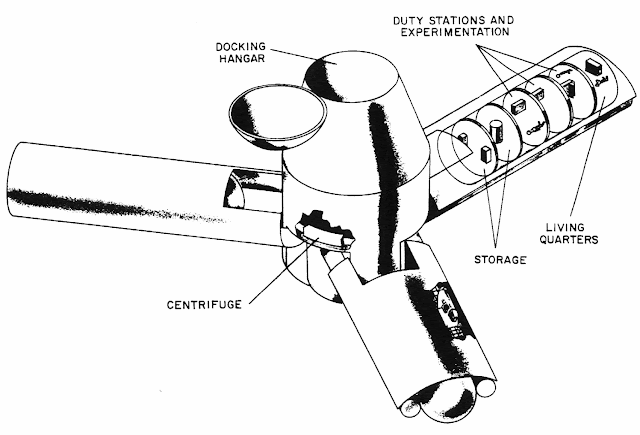
NASA wasn’t far behind. In 1962, Edward Olling at the Manned Spacecraft Center proposed Project Olympus. It would have been an 18-person station intended for launch around 1966 or 1967. It wasn’t the classic doughnut. Instead, three long arms extended from a large central hub, and rotation would provide different artificial-gravity levels at different distances from the center. The station would orbit about 300 nautical miles above Earth.
This is especially interesting because Olympus wasn’t a far-future colony study. It was being considered while Mercury was still flying. Then President Kennedy gave NASA a somewhat more pressing assignment involving the Moon.
Olympus joined the large pile of spacecraft that looked great in presentations.
The U.S. Air Force had another station that got considerably closer to hardware: the Manned Orbiting Laboratory, or MOL. Approved in 1965, MOL would have put two military astronauts into a polar-orbiting station attached to a modified Gemini spacecraft (Gemini B). Its actual classified purpose was high-resolution reconnaissance. You can see some silent footage of some of the hardware in the video below.
They selected astronauts. They built hardware. They modified a Gemini capsule with the unnerving idea of putting a hatch through its heat shield so the crew could crawl into the laboratory behind it. MOL was canceled in 1969 without a crewed station ever flying.
Meanwhile, docking — one of the basic tricks required to make stations useful — was becoming real.
Dock of the Bay
On January 16, 1969, Soyuz 4 and Soyuz 5 docked in orbit. There was no pressurized tunnel connecting them. So Yevgeny Khrunov and Aleksei Yeliseyev put on spacesuits, climbed outside Soyuz 5, traveled across the docked spacecraft, and climbed into Soyuz 4. Two spacecraft had effectively become a tiny space station, but changing rooms required going outside.
Apollo 9 flew less than two months later and provides an interesting parallel. The command module and lunar module could dock, and crews could normally transfer internally. But what if the tunnel couldn’t be used? NASA planned to demonstrate a contingency EVA transfer from the lunar module to the command module.
Rusty Schweickart was supposed to perform the exercise, but space sickness caused NASA to shorten his EVA. He tested the lunar EVA suit and portable life-support backpack from the LM porch while Dave Scott partially exited the command module, but the complete external transfer was never performed.
Salyut and Almaz
On April 19, 1971, the Soviet Union launched Salyut 1, the first actual space station. The first crew failed to dock successfully. The second crew, Soyuz 11, spent more than three weeks aboard, but all three cosmonauts died during reentry when their Soyuz depressurized. There is some video from Salyut 1, but no audio.
The Salyut name also concealed a second program. Some of the stations were civilian Salyuts, while others were military Almaz reconnaissance stations similar in purpose to MOL. Salyut 2, 3, and 5 belonged to the Almaz line, although Salyut 2 failed before a crew could arrive.
Later Salyut stations gained a second docking port. That was a huge improvement because Progress cargo ships could bring supplies and fuel while a Soyuz remained attached as the crew’s ride home. Long-duration spaceflight was becoming practical rather than heroic improvisation. Of course, none of them rotated.
Skylab
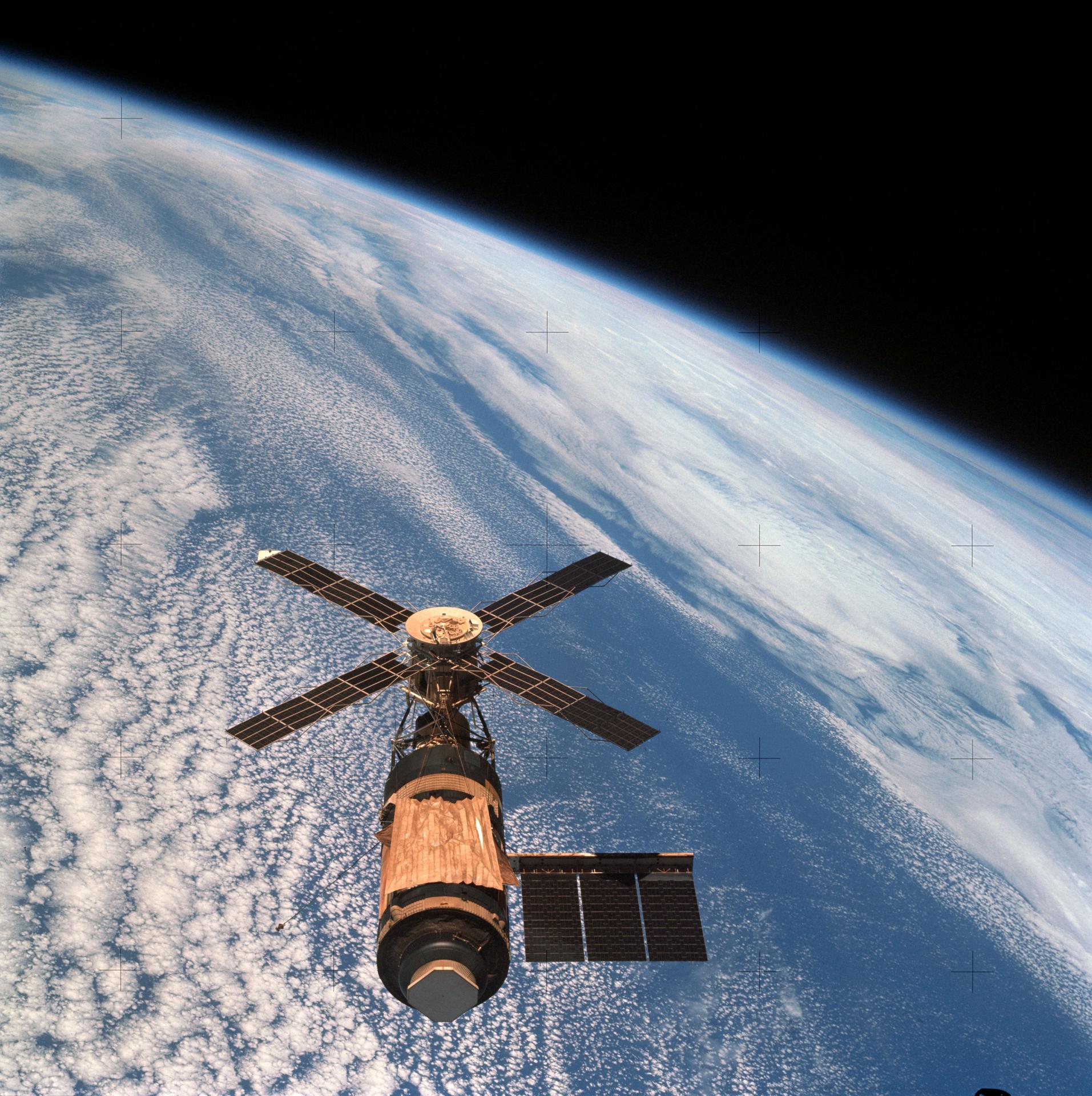
Skylab as the last crew says goodbye (NASA).
The United States took a different route. Skylab was essentially an enormous converted Saturn V upper stage. Launched in 1973, it gave its crews something previous spacecraft had lacked: room.
Three crews occupied Skylab, staying as long as 84 days. They conducted solar astronomy, Earth observations, medical studies, and experiments designed to determine what happens when human beings spend months rather than days in weightlessness. After all, why build a giant rotating station if people could simply learn to live without gravity?
Then again, we learned that long-term microgravity isn’t free. Bones, muscles, cardiovascular systems, eyes, and assorted other bits of the human body complain when they don’t have proper gravity. Still, a nonrotating station was far easier to build, so rotating wheels stayed on the drawing board.
Freedom Isn’t Free
By the 1980s, NASA was ready to try again. In his 1984 State of the Union address, President Ronald Reagan directed NASA to build a permanently occupied space station within a decade. What eventually became known as Space Station Freedom was supposed to be a large modular facility assembled by the Space Shuttle.
It would support research, Earth observation, satellite servicing, and eventually serve as a staging point for missions beyond Earth orbit.
Freedom went through redesign after redesign as costs and requirements fought each other. It did not rotate. While NASA redesigned Freedom, the Soviets quietly launched something considerably more important.
Peace In Orbit
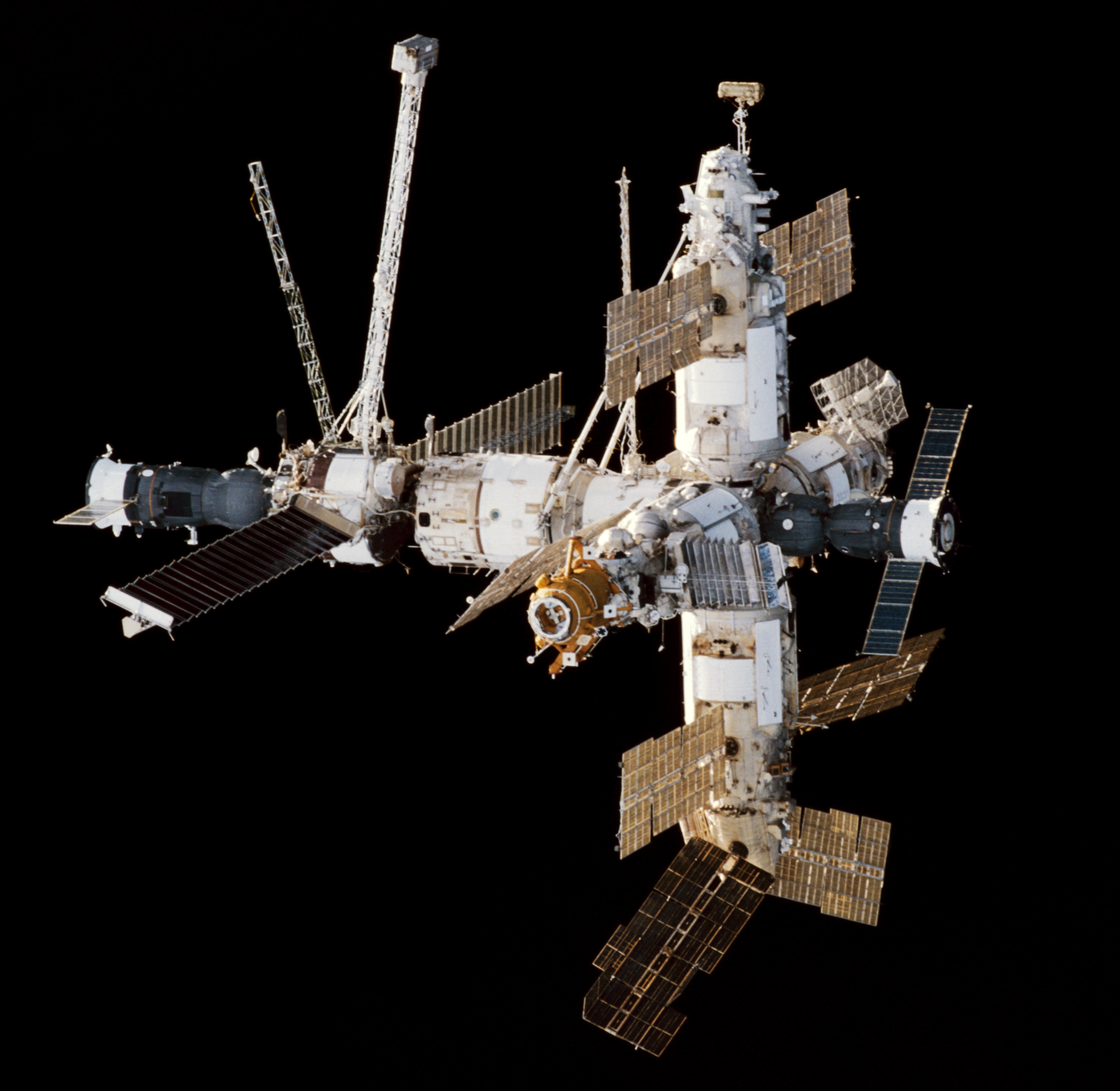
Mir seen from STS-89 (NASA).
On February 20, 1986, the Soviet Union launched the core module of Mir.
The name means “peace,” although the Russian word can also mean “world.” Unlike the earlier Salyuts, Mir was designed from the beginning as a modular station. Additional laboratory and equipment modules arrived over the years and docked around its core.
It looked nothing like Noordung’s wheel. It looked more like somebody had been assembling an enormous machine in a garage and kept finding useful places to bolt things on.
Mir represented decades of incremental Soviet experience: Soyuz, docking, Salyut, Progress, long-duration crews, orbital repairs, and modular construction. It demonstrated that a space station could become not merely a spacecraft but a place — one that crews could maintain, modify, repair, and inhabit for months at a time.
Where’s My Wheel?
That may be the most surprising thing about the history of space stations. The rotating station wasn’t some goofy 1950s science-fiction invention. Serious engineers were proposing artificial gravity before anyone had launched anything into orbit. Oberth discussed rotating stations in 1923. Noordung drew a remarkably complete wheel station in 1929. Von Braun made the concept famous in the 1950s. NASA seriously studied rotating stations in the 1960s. The physics works.
We’ve simply never needed artificial gravity badly enough to pay the cost.
If you can tolerate microgravity, a station can be a collection of pressure vessels, trusses, solar arrays, and docking ports. If you insist on one g at a comfortable rotation rate, suddenly you are contemplating a structure hundreds or perhaps thousands of meters across.
Still, Edward Everett Hale put people aboard an artificial moon in 1869. Noordung put them aboard a rotating wheel in 1929. Kubrick had airline passengers walking around one in 1968. So after more than a century and a half of talking about space stations, I have only one question: When do I finally get my rotating space station?
Using the special pens to remove the wax coating on the template. (Credit: Old Typerwriters and Calculators, YouTube)
Document duplication has been a highly desirable feature, long before medieval monks slaved over yet another illuminated manuscript by flickering candle light. Fortunately one part of the Industrial Revolution was the invention of machines like Cyclostyle copying machines, which covered a range of manual and automated devices. One such crank-powered device from 1890 is demonstrated in this video.
The Cyclostyle and neo-Cyclostyle copying system was quite simple yet elegant: by removing the wax coating on a special piece of paper ink from a screen-printing system could be pressed through the resulting template, and allow for repeat copies to be made.
With the machine demonstrated in the video the ink is applied to the top rollers, with the lower roller inking itself on them during the retraction cycle, before applying the fresh ink to the screen on the cycle following the insertion of a fresh piece of paper to print on. With this method many copies of the design on the waxed template could be made before it had to be replaced, which would have saved countless hours of work by artists.
After the machine in the video more advanced designs were developed, some of which we covered previously. These would automate more parts of the process, making it faster and more precise, before being replaced by newer technologies.
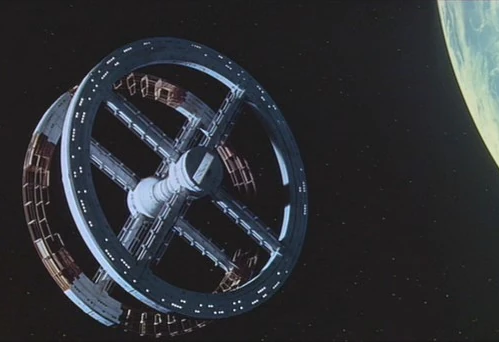
People have lived in space stations for decades now, but something is wrong with them. Where are the big rotating wheels? You know the ones. They show up in old paintings of the future and, perhaps most memorably, in 2001: A Space Odyssey. Spin a great wheel in space, and people can stroll around inside with something that feels suspiciously like gravity. It seems like an obvious idea.
It is also an old idea. Much older than actual spaceflight, in fact. But to find the beginning of the space station, we have to go back to a time when powered aircraft were still several decades in the future.
A Moon Made of Bricks
In 1869, Edward Everett Hale published The Brick Moon in The Atlantic Monthly. The moon in question wasn’t natural. Hale imagined building a 200-foot-diameter sphere made from bricks and putting it into orbit as a navigation aid. Sailors could sight it and use its known orbit to determine their longitude. There was only one small problem: the thing was accidentally launched with people aboard.
That makes The Brick Moon generally regarded as not only the first fictional artificial satellite, but also the first fictional space station. Hale followed it in 1870 with Life on the Brick Moon, describing how the accidental colonists got along up there.
Hale didn’t have rockets. He proposed flinging the thing into the sky with giant flywheels, but, then again, it was 1869, so we’re inclined to cut him some slack. As the 19th century turned into the 20th, however, people started doing the math.
Konstantin Tsiolkovsky is best remembered for putting rocket flight on a sound theoretical footing. The Russian schoolteacher wrote extensively about orbital flight and space habitation, envisioning people living in orbit long before anyone had demonstrated that a liquid-fueled rocket actually worked. His ideas included rotating habitats to provide artificial gravity.
Hermann Oberth’s 1923 book Die Rakete zu den Planetenräumen — The Rocket into Planetary Space — Oberth went beyond fiction and seriously considered a permanently inhabited station. He envisioned it being periodically supplied by smaller rockets, serving as an observation and communications platform, and even acting as a jumping-off point for trips farther into space. He also suggested spinning the station to give the crew artificial gravity.
Enter The Wheel
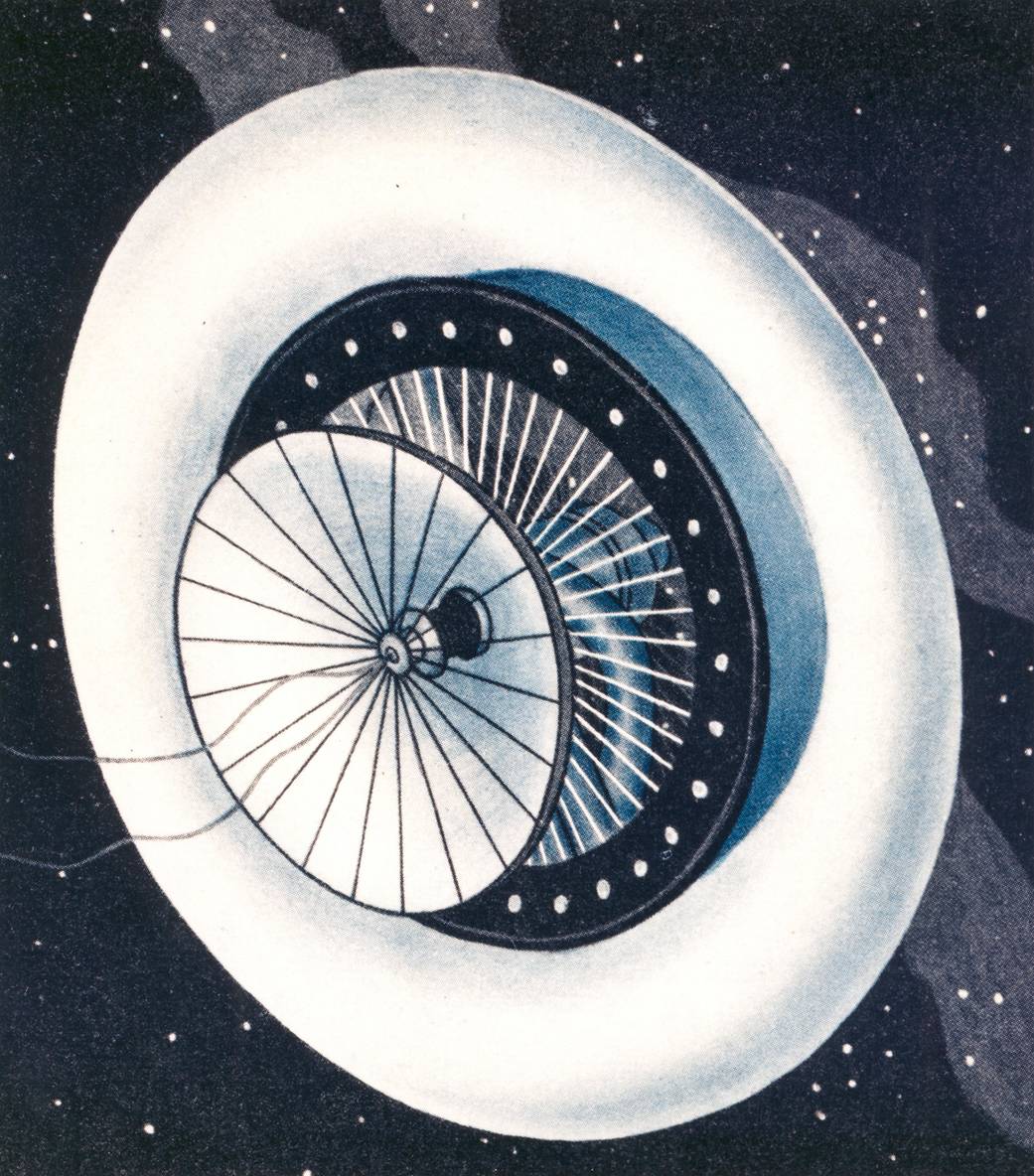
Noordung’s space station concept from his 1929 book.
But the space station that looks like the space station in your head probably comes from a different Hermann. Herman Potočnik was an Austro-Hungarian army officer and engineer who wrote under the name Hermann Noordung. In 1929, he published Das Problem der Befahrung des Weltraums, translated by NASA many years later as The Problem of Space Travel: The Rocket Motor.
Noordung didn’t merely say, “We should have a space station.” He drew one. His station consisted of several components, but the memorable one was the Wohnrad — literally the habitation wheel. Living quarters occupied a rotating ring connected to a central hub. Rotation provided artificial gravity, while other portions of the complex could remain weightless. He considered power, communications, observing Earth, astronomy, docking, and the practical business of living in orbit. NASA calls his work one of the first detailed technical designs for a space station.
If you have seen Wernher von Braun’s famous wheel station from the 1950s, you may notice something. Von Braun certainly knew Noordung’s work — he had cited it years earlier — and the family resemblance between Noordung’s 1929 Wohnrad and the wheel station that von Braun and Willy Ley presented to American readers in Collier’s in 1952 is hard to miss. The only place we have found the articles is the reprints in Horizons, by the AIAA (start with page 46).
Whatever the exact family tree, von Braun was the man who put the wheel-shaped station into American popular culture. In 1952 he described a 250-foot-class rotating station in Collier’s, accompanied by some gorgeous Chesley Bonestell artwork. A few years later he took the idea to television with Walt Disney.
If you’ve never seen these, they are worth your time. Disney’s 1955 Man in Space and Man and the Moon let von Braun explain a remarkably detailed vision of rockets, orbital stations, and trips to the Moon to a mass television audience. A generation of kids grew up expecting this stuff. What happened?
Gravity, More Or Less
The attraction of the wheel is simple. You can’t really make gravity, at least not without bringing along a planet-sized lump of mass, but acceleration will do nicely. Stand on the inside of a rotating ring, and the floor keeps accelerating you toward the axis. In your rotating frame, it feels as though something is pushing you outward against the floor.
The acceleration is a=ω2r where (r) is the radius and (ω) is the angular velocity. Sadly, the numbers explain part of the problem.
If you want one Earth gravity at the floor, you need to either spin fast or have a large ring. For example, at 1 RPM the ring has to be 1.79 km in diameter. Speed up to 2 RPM, and you can get away with 447 meters. At 4 RPM, you are down to 112 meters.
Seems like you could just keep going faster, but there’s a problem. Four RPM doesn’t sound very fast until you are inside the thing moving your head around.
Humans can adapt to rotation, but increasing the speed makes Coriolis effects increasingly noticeable. Move your head, climb a ladder toward the hub, throw something, or even walk spinward instead of anti-spinward, and the results aren’t quite what your inner ear expects. NASA artificial-gravity studies have often used approximately four RPM as an important practical region for human tolerance, although this isn’t a hard physical limit and training matters.
There’s also a gravity gradient. Your feet are farther from the axis than your head, so they weigh slightly more. Make the radius large enough, and you won’t notice. Make the station small enough, and things get strange quickly. So bigger is better except when it comes to cost, of course.
Space Station V, still under construction. Note the window placement.
There is another oddity that movies sometimes get wrong. The outside circumference of the wheel is the floor. “Down” is away from the hub. Imagine a tire in space. You aren’t walking around on one of the flat sidewalls with the axle beside you. You are walking around the inside of the tread. So when a movie gives you a nice conventional room with a picture window on what looks like the outer wall, stop and think about where gravity ought to be pointing. Depending on the geometry, that window would probably be underfoot.
Stanley Kubrick got this wonderfully right in 2001: A Space Odyssey. Both Space Station V and the rotating centrifuge aboard Discovery make “down” follow the rotation. The famous jogging sequence works precisely because the circular wall of the set becomes the floor as the camera watches.
Next Time
Next time, I’ll look at early attempts to make a space station ranging from TASSEL, MTSS, and MARS to real Soviet and U.S. stations that had varying degrees of success. Spoiler alert: none of them are going to rotate for gravity.
Of course, people didn’t just imagine space stations. They also imagined moon bases, both fictional and actual.
The View from Above: The Gemini Visual Acuity Experiments
Astronauts L. Gordon Cooper Jr. and Charles “Pete” Conrad Jr. (shown here) participated in visual experiments during the Gemini V mission in August 1965.
Credits: NASA/L. Gordon Cooper Jr.
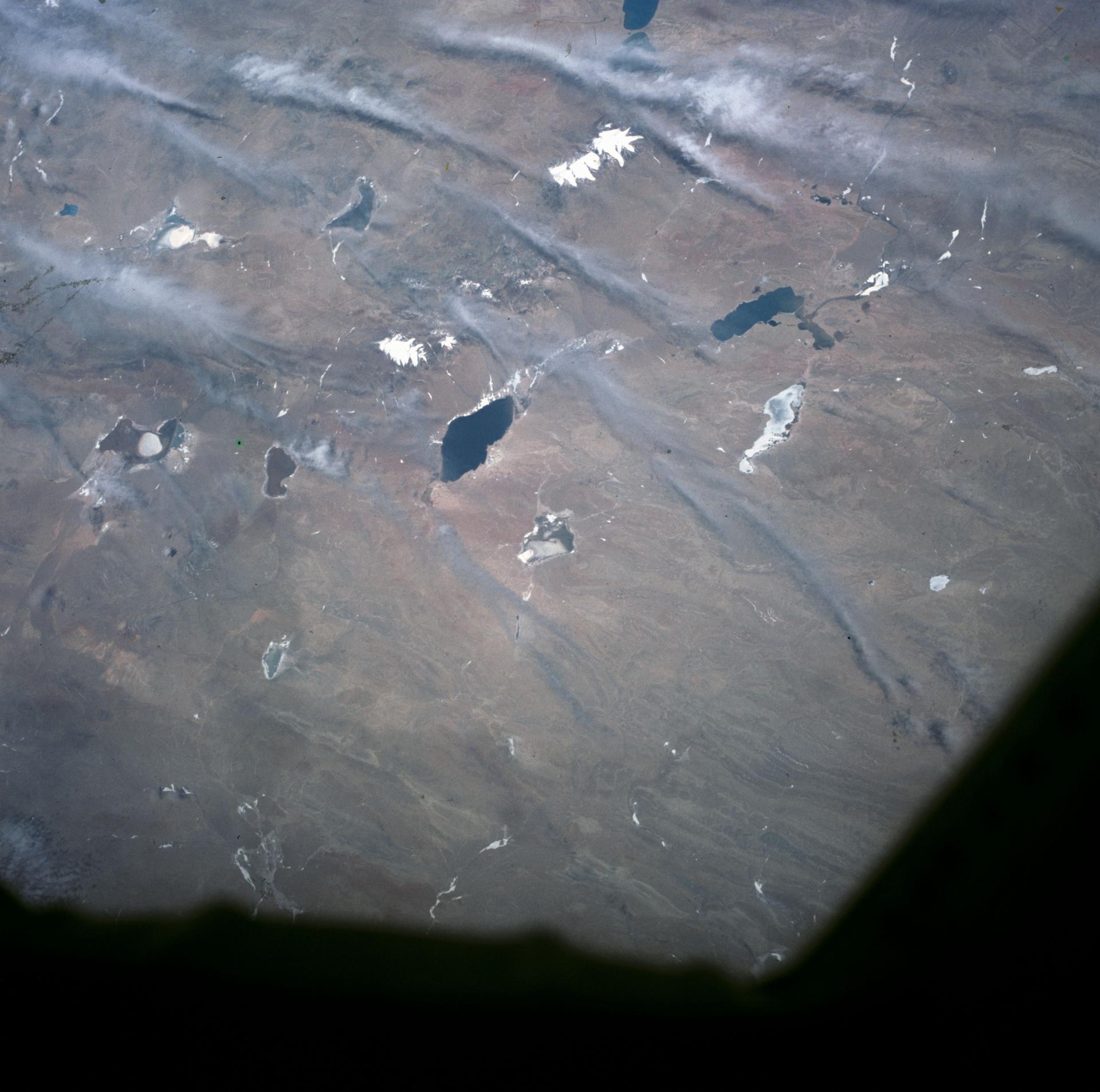
NASA astronaut L. Gordon Cooper, Jr. took 29 color photographs of the Earth with a 70mm camera as he orbited our planet during the Mercury-Atlas 9 mission in May 1963. Cooper’s view from the window of his Faith 7 spacecraft was spectacular, and he reported that he could see vehicles motoring on dirt roads, smoke-belching trains, and the tops of houses.
Researchers and members of the public had their doubts. Could Cooper actually see objects on the Earth’s surface in such fine detail while orbiting 100 miles above the planet? Some vision experts assumed that astronauts with 20/20 vision could not clearly see objects with sides less than 150 feet long at orbital altitudes. Although Cooper reportedly had exceptional 20/12 vision, certainly he could not see a white automobile kicking up a dust cloud near the U.S.-Mexico border as he claimed. Cooper, however, was not alone in his assertions. Other Mercury astronauts also reported seeing objects on the Earth in striking detail.
During his 22-orbit Mercury-Atlas 9 spaceflight in May 1963, L. Gordon Cooper Jr. took photos from the Faith 7 spacecraft including this one showing lakes in Western Tibet.
NASA
These claims caused mental health professionals to question the sanity of NASA’s first astronauts. A story in Air Force and Space Digest noted that some psychiatrists speculated that “weightlessness was causing the astronauts to hallucinate and that the space program was in for serious trouble.” While mental health experts considered the effects of space flight on the brain, visual acuity experts mulled over the Mercury astronauts’ assertions and developed an experiment to determine what they could see on Earth from space.
Putting Astronaut Vision to the Test
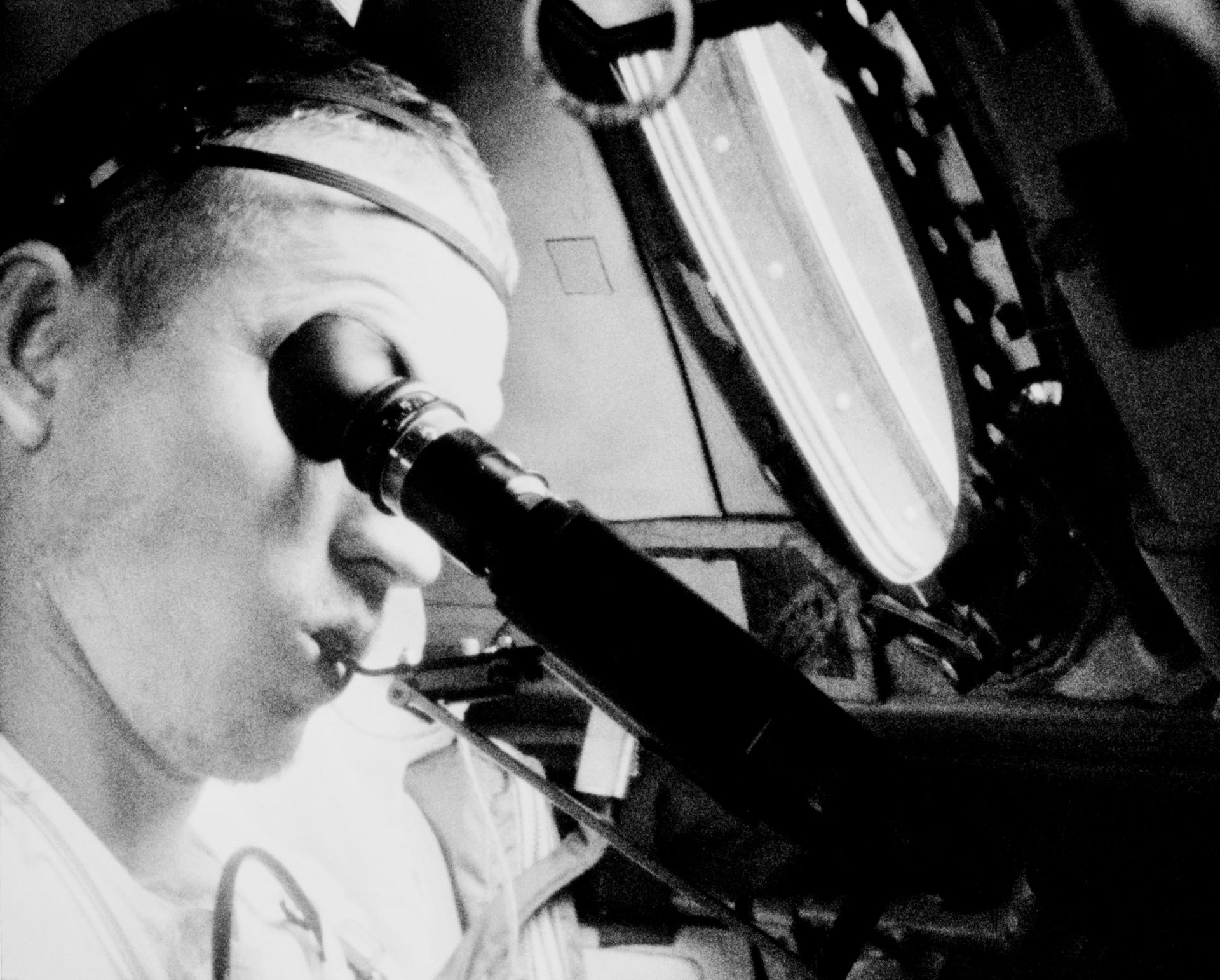
NASA and its partners developed two visual acuity experiments and conducted them during the crewed Gemini V and Gemini VII missions. The first experiment involved looking through an optical device reminiscent of binoculars. Test subjects looked through the eyepieces to see an assortment of rectangles in various positions and levels of contrast. They were then asked to identify the directional orientation of the rectangles.
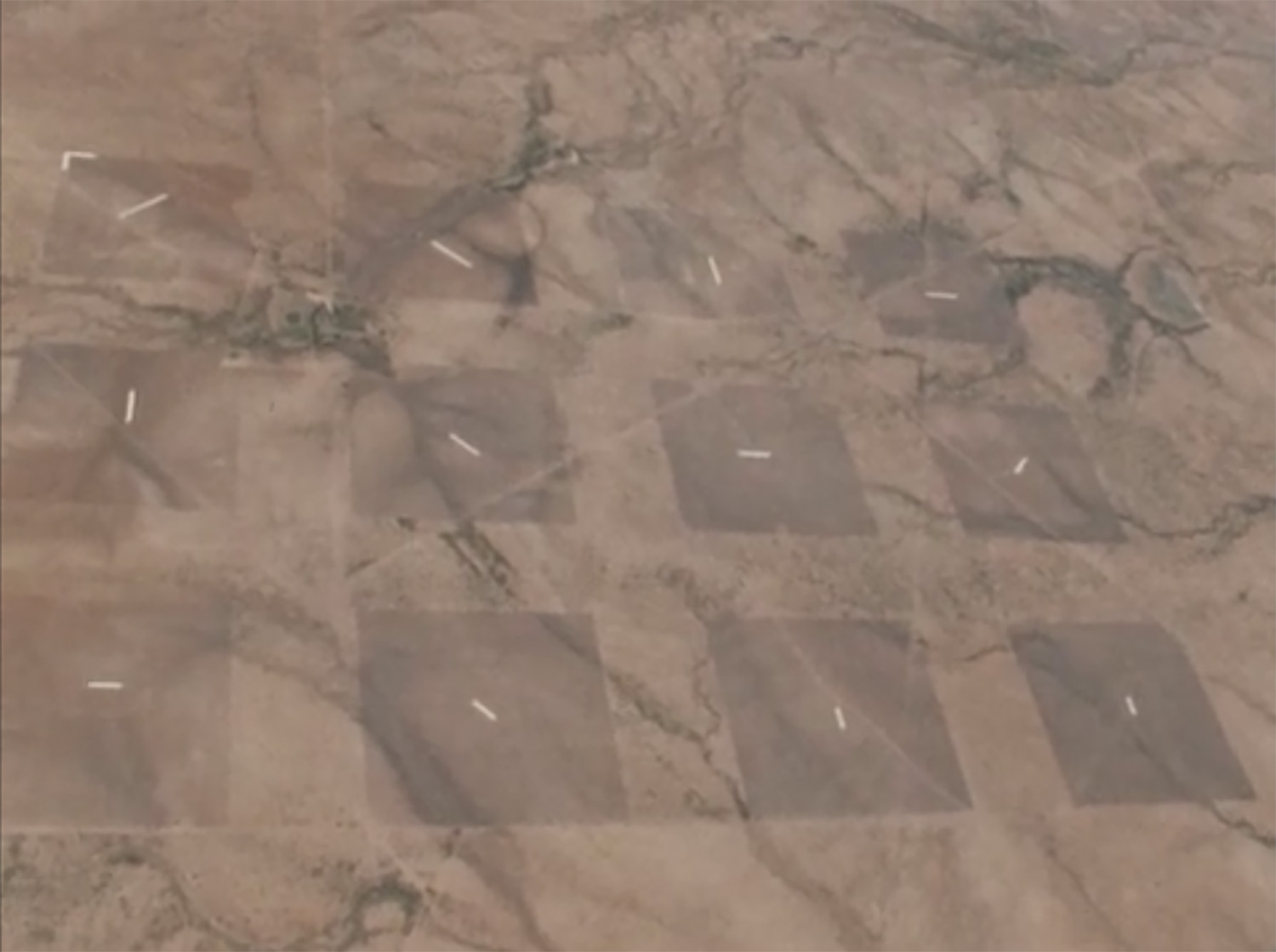
Another part of the experiment involved creating two enormous terrestrial eye charts composed of gigantic white rectangles. The rectangles, created by the Dow Chemical Corporation, ranged in size from roughly 150 to 600 feet long. The experiment team placed one set of rectangles on dark tilled soil in Laredo, Texas and another near Carnarvon, Australia, and asked Gemini V and VII astronauts to identify their directional orientation from orbit. This visual acuity tool was nicknamed the “Eye-Q” chart.
In-Flight Vision Testing Instrument
Drawing illustrating a Gemini astronaut using the In-Flight Vision Tester.
NASA
Gemini V Visual Acuity Experiment
This illustration shows the intended orientation of the Gemini spacecraft as it orbited over the “Eye-Q” ground observation sites.
NASA
Cloudy conditions, sunlight scattered by the window of the Gemini spacecraft, and unfavorable orbital orientations during overflight all impacted the astronauts’ views of the ground-based experiments. Nevertheless, during some orbital revolutions, astronauts on both missions were able to see portions of the ground site near Laredo.
Aerial view of the visual acuity experiment’s ground site in Laredo, Texas.
NASA
Their reports on the Laredo “Eye-Q” site, combined with the results of the binocular-like vision tester experiments conducted before, during, and after the flight, revealed that astronauts could in fact see roads and ships with following wakes from orbit. The experiments also determined that an astronaut’s vision did not deteriorate during a two-week spaceflight.1
Astronaut Frank Borman, Gemini VII command pilot, participates in a vision experiment using the in-flight visual acuity device during the two-week mission in December 1965.
NASA
Implications
Determining what features on Earth astronauts could accurately see from orbit was about much more than sanity checking astronaut reports. Understanding what human eyes could see from space, as well as seeing the photographs taken on NASA’s early crewed missions had huge implications for geologists, geographers, oceanographers, and others studying our planet.
The scientific community’s interest in the recollections and photographs of the Earth’s surface as seen by the Mercury and Gemini astronauts motivated NASA and its partners to advocate for new Earth-observing instruments. NASA, the U.S. Geological Survey, the Office of Naval Research, and the U.S. Department of Agriculture noted that surface images of the Earth captured from above could be used to inventory crops, map geological features, monitor natural disasters, and better understand the ocean’s processes.
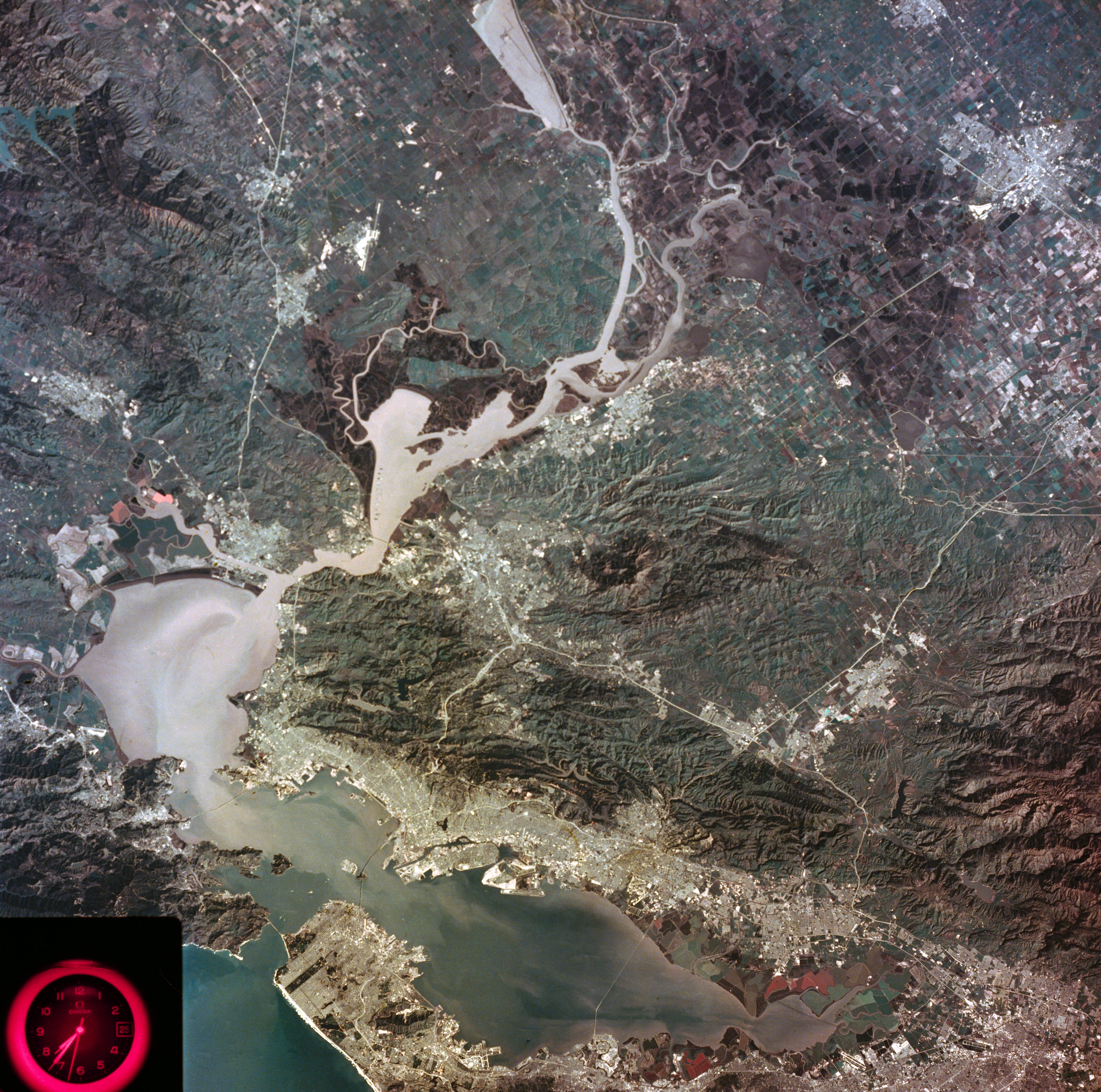
This photograph of the San Francisco Bay area of California was taken as part of the Skylab Earth Resources Experiment Package in January 1974.
NASA
The promise of these real-world applications motivated the creation of the Earth Resources Technology Satellite (ERTS), later renamed Landsat 1. Launched by NASA in 1972, the data from Landsat 1’s camera and multi-spectral scanner were used along with data from the agency’s Earth Resources Aircraft Program to monitor the oceans, agricultural fields, natural disaster sites, and more.
In the six decades since America’s first pioneering human spaceflights, NASA has continued to observe the Earth from orbit, aircraft, and even ground level in a continuing quest to help solve problems here on Earth.
Here’s a historical hack for you: you have a big, rolling pressurized kettle, also known as a steam locomotive. It needs water to make up for the steam constantly chuff-chuff-chuffing away, or bad things happen. How do you get water from an unpressurized tender into a high pressure boiler with no moving parts? What you need is a some way to inject steam with no moving parts — a steam injector, if you will. [Marc Flint] found that the steam injectors were the hardest part of a loco to understand, so he made a video for all of us once he’d figured it out.
The steam injector isn’t a new idea. [Henri Griffard] came up with it back in the 1850s to replace expensive and maintenance-hungry pumps. It’s rather ingenious and uses the fluid mechanics uncovered by another European bloke by the name of Bernoulli. First, the high-pressure steam from the boiler goes through a converging-diverging nozzle to drop its pressure and speed its flow up, just as you’d guess if you’ve seen Bernoulli’s laws. Even more vacuum-inducing is the presence of water: the steam, already cooled by its expansion, hits the water in the pipe open to the tender, and condenses into it, shrinking a couple of orders of magnitude, creating a vacuum that draws in no small quantity of feed water. That one we did not expect from Bernoulli, but it makes sense. So how to get from below atmospheric pressure to the 180-odd PSI or more in the boiler?
Well, the water is now moving at a good clip, between the Venturi effect and the momentum gained from absorbing that steam, so another converging nozzle is the trick. Bernoulli’s law, once more! A one-way valve lets the now-pressurized water into the boiler, with a gap in between to dump water while the pressure builds up. It’s a clever trick, and since the steam coming from the boiler makes it back inside along with at least some of its heat energy, it’s much more efficient in both coal and water than running a pump. It’s also a bit of a head scratcher how it works unless someone sits you down to explain it, so we’re glad [Marc] did.
Not many of us are likely to use this knowledge directly — unless we’re firing up a 90 year old boiler or building a new steam locomotive — but seeing how great engineers of years past made use of basic physical laws can serve both as education and inspiration.
Powered machinery started the industrial revolution, and it was automation that kicked it up another notch in the 20th century. The ability for machines to make things by themselves spurred increased output and in turn boosted economic growth. The concept became widely popular for manufacturers to implement, as any change with serious economic benefit tends to do. Fast forward to today, and advanced robots and fancy machine vision systems running on powerful computers are the norm in modern factories which create the many wonderful products that we all purchase, use, and enjoy.
Once upon a time, though, things weren’t so sophisticated. [Nicola Cimmino] came to Hackaday Europe 2026 to tell us all about a remarkably simple 1-bit CPU that used to run factories.
Logic, But Make It Cheap!
Nicola Cimmino used to frequent a facility that used to recycle electronic waste, which sold old bits and pieces of hardware by the kilo. Many times, Nicola would pick up odd boards with an eye to repurposing components for future projects. Eventually, one unremarkable looking chip caught his attention—the Motorola MC14500B. This chip was rather unique, being a rather simple processor with just 16 instructions and a 1-bit data bus.
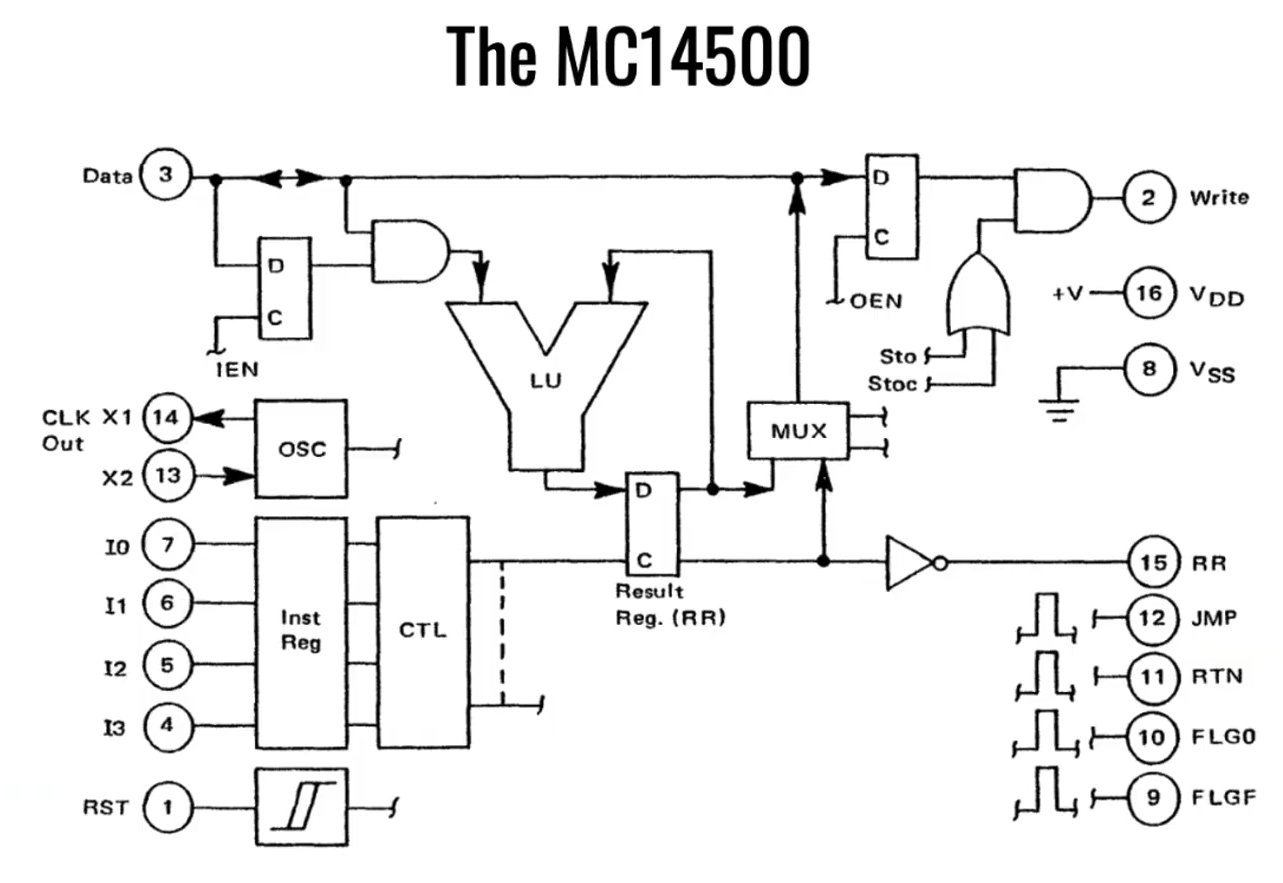
The simple architecture of Motorola’s basic 1-bit chip. Credit: talk slides
It’s worth examining the era in which this chip existed. Intel dropped the 4-bit 4004 in 1971, with the famous 8-bit 8080 landing in 1974. The Zilog Z80 came along in 1976, similarly an 8-bit design. And yet, when Motorola released the MC14500 in 1977, it landed with a rather slimline 1-bit design instead. Nicola notes that this likely came down to price, since populating a chip with more transistors cost more money quite significantly back in the 1970s. If the job could be done with less, it would make the part cheaper and thus more popular in the market. Bearing this out, Nicola explains that a 1976 Zilog Z80 used 8,500 transistors and cost around $200 USD, while an MC14500 used just 500 transistors and could be had in 1977 for the bargain price of just $5 USD.
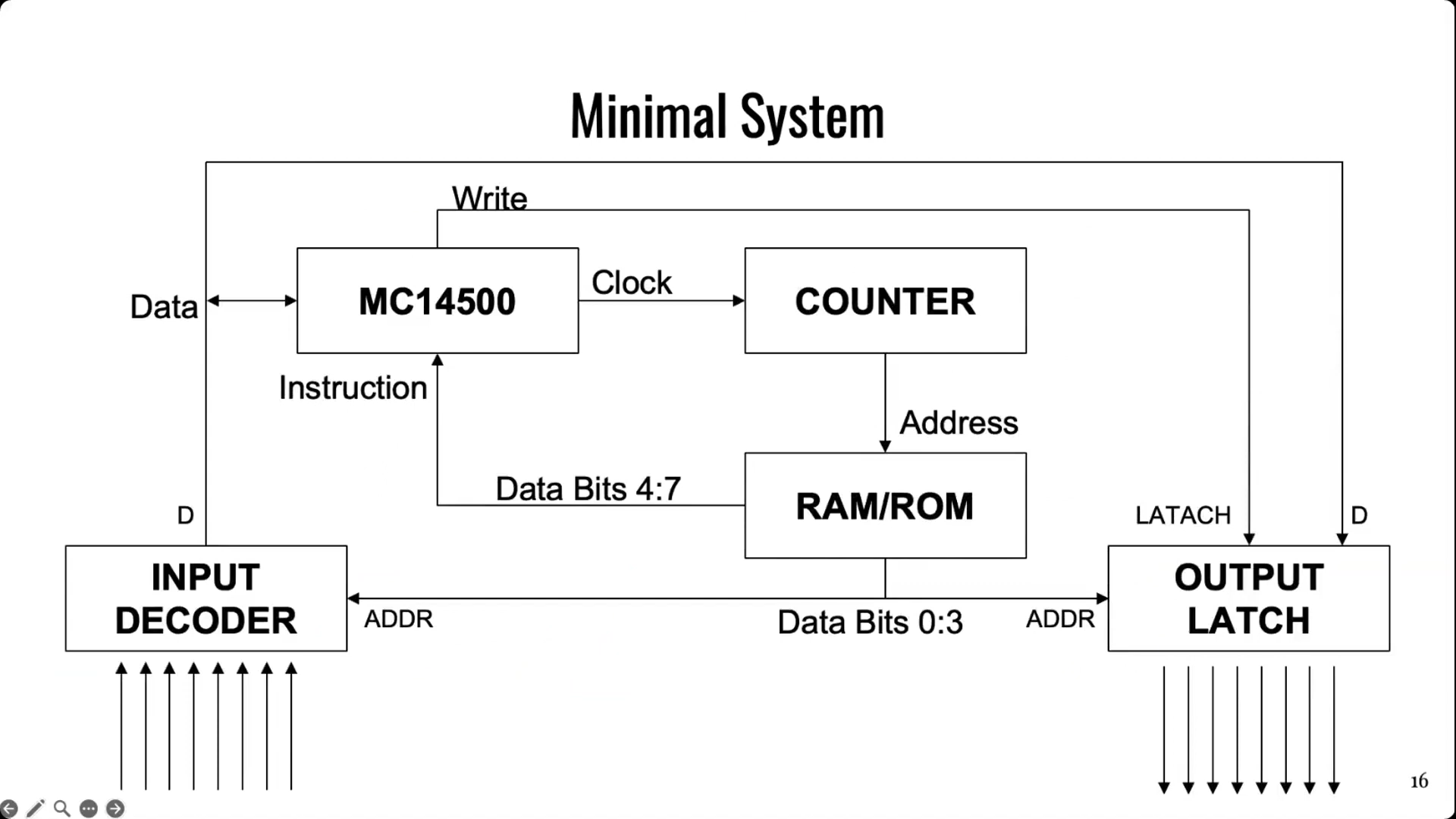
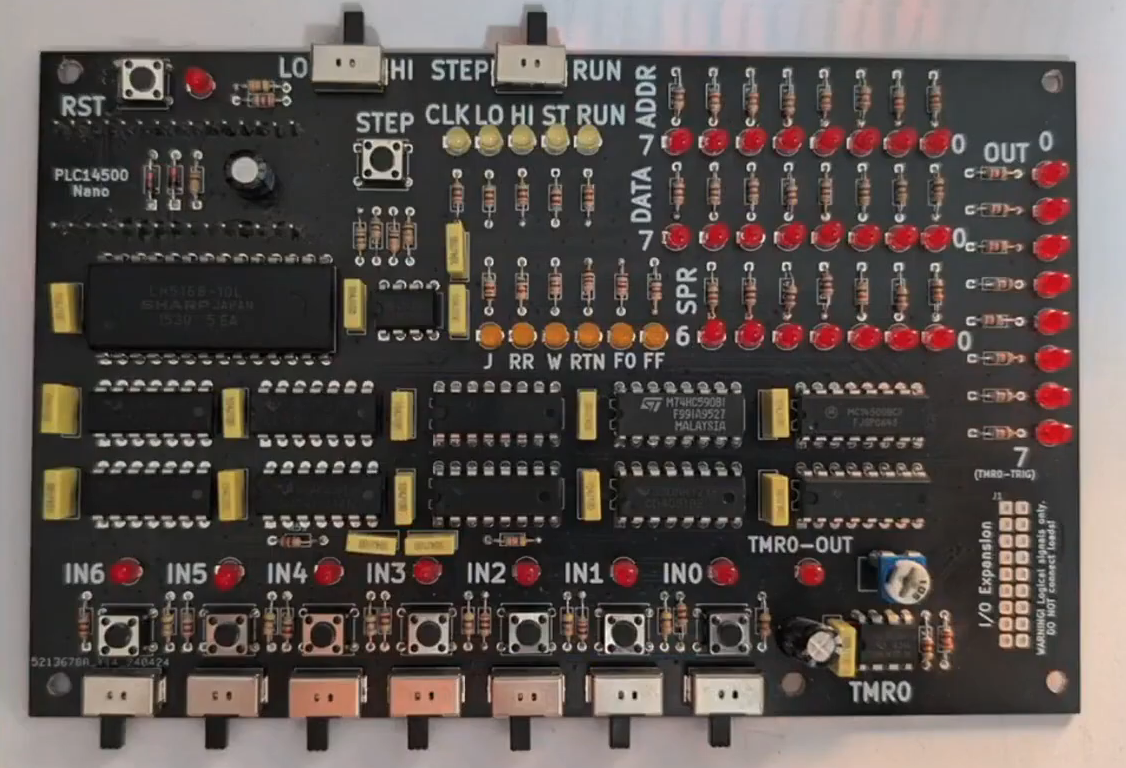
It doesn’t take much supporting hardware to get an MC14500 up and running. Notably, though, there is no memory or program counter on board, so those have to be added externally. Credit: talk slides
Back in the mid-1970s, automation in industry often consisted of simple logic that was handled by cabinets full of relays. This took plenty of bulk, required hard-wiring everything, and also involved plenty of electromechanical parts that could wear out. Changing logic required manually rewiring things which could be fussy and tedious at the best of times. In those days, the Programmable Logic Controller was just coming into use, developed to be a reprogrammable system for industrial automation tasks that was more flexible and reconfigurable just by reprogramming it.
The MC14500 sprung up as a useful tool at this time, powering a great many programable industrial systems. It was designed to offer the bare minimum requirements for its application, while leaving extraneous hardware for designers to implement if and when it was needed. The architecture is simple enough for Nicola to explain with a single slide. The chip came with a 1-bit logic unit, operating with a result register, a 1-bit accumulator and the data bus. A minimal system could be lashed up with the MC14500, a counter, some external RAM or ROM (since none was onboard), and an input decoder and output latch of 8 bits each. This setup would only allow for doing combinational logic, since there is nowhere to store the current state of the system. However, hooking some outputs back to the inputs could allow for sequential logic, since it would allow for storing the current state of the system via those outputs. Nicola then steps through various other configurational changes to addressing and system architecture that could be made to optimize the MC14500 for use in different ways.
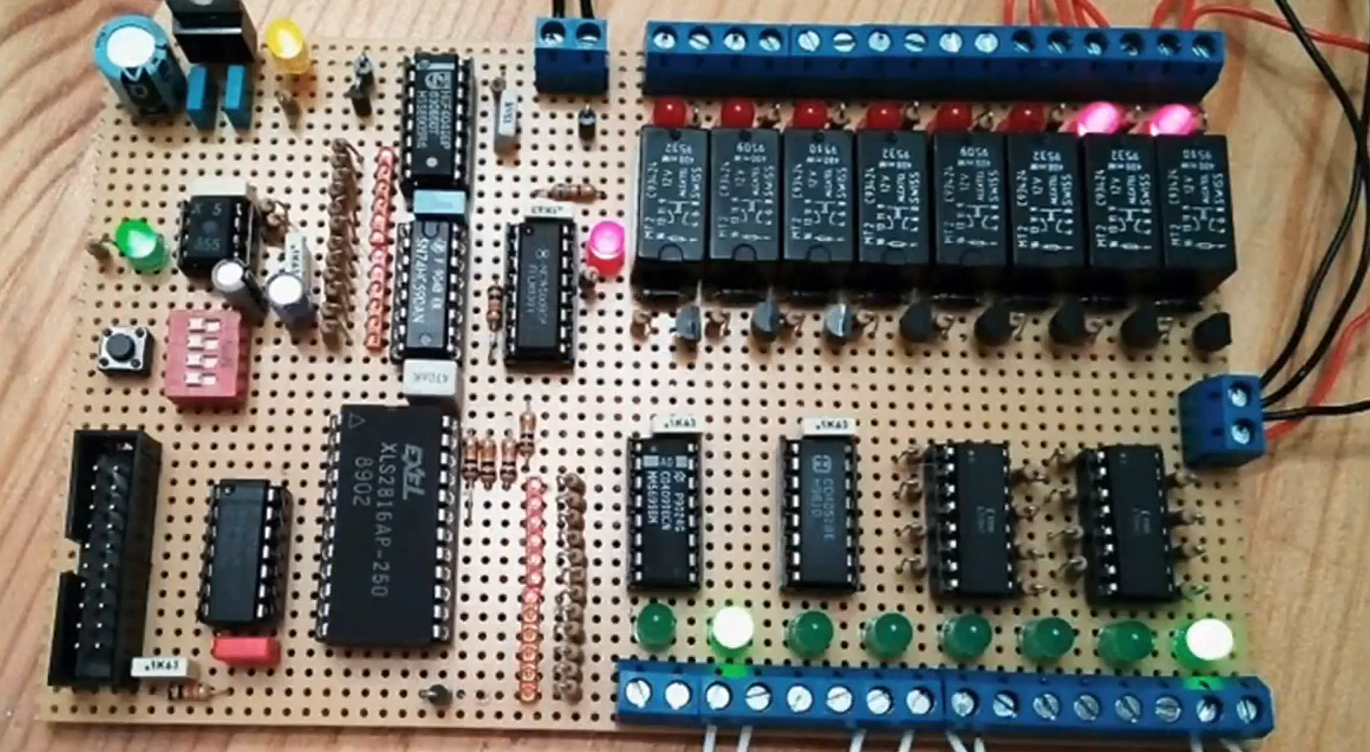
Nicola built a homebrew MC14500 system, allowing him to get to grips with the classic chip. Credit: talk slidesA more polished version came later, built on a custom PCB. Credit: talk slides
If you wanted to get to grips with using an MC14500 in industrial contexts, you would do well to pay attention to this talk, even if it came out some 40 years past the part’s heyday. Beyond the basic system architecture, Nicola explains how to use the limited instruction set, and how to get such a system executing simple programs in ladder logic, which remains somewhat of an industrial standard to this day. Beyond that, he steps up to more complex logic, like if/else conditionals and the use of some of the weirder instructions of the chip. He then shows off the hardware he built himself—both a breadboarded MC14500 setup built with wirewrap, and a more polished version on a custom PCB.
It’s not every day you get to learn about the nitty-gritty details of working with industrial hardware from the ground up. And yet, that’s exactly what Nicola brought to Hackaday Europe 2026. It’s an excellent primer on the topic, and also simply just good fun if you’re a fan of electronics and logic itself!
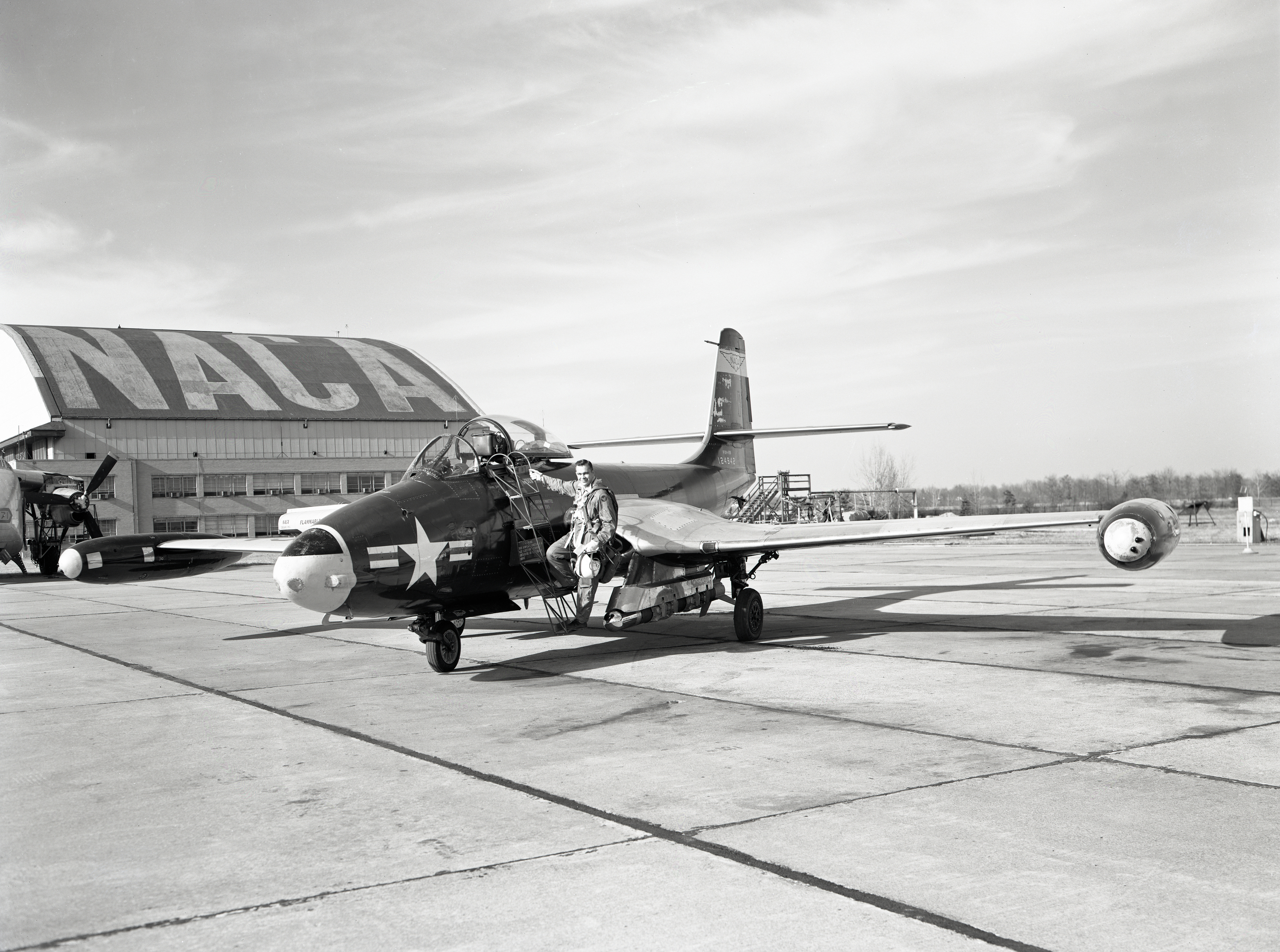
William “Bill” Swann, one of the first-generation pilots at the National Advisory Committee for Aeronautics’ Flight Propulsion Research Laboratory (predecessor to NASA’s Glenn Research Center in Cleveland), prepares to board a McDonnell F2H-2B airplane on Nov. 6, 1956.
Credit: NASA
Many of NASA’s most important aerospace breakthroughs that began in the laboratory were ultimately proven in the sky. For decades, experts at NASA’s Glenn Research Center in Cleveland conducted flight tests — piloting aircraft into targeted environments such as icing clouds and carefully defined atmospheric routes. This approach allowed them to collect measurements directly in flight, providing critical data that linked laboratory theories to practical performance.
The center’s flight research dates to the 1940s, when NASA Glenn was known as the Aircraft Engine Research Laboratory for the National Advisory Committee for Aeronautics, NASA’s predecessor agency. During World War II, engineers and pilots worked to improve aircraft performance and increase high-altitude reliability. In the mid-to-late-1940s, flight research helped make early jet and ramjet engines practical. Later, Glenn’s flight programs helped improve the efficiency and environmental performance of aircraft engines — primarily conventional jet engines.
Behind those early flight programs was a pioneering group of pilots who helped establish NASA Glenn’s reputation for airborne research. The center’s first generation of pilots, including Howard Lilly, Joseph Walker, William Swann, and William “Ed” Gough, helped lay the groundwork for more than two dozen other Glenn pilots, including future astronauts Neil A. Armstrong and Fred Haise.
Together with Glenn’s researchers, engineers, and support staff, these pilots established airborne research capabilities that NASA continues to rely on today. Their work demonstrated how flight testing could bridge the gap between laboratory research and real-world performance.
“These missions transformed aircraft into flying laboratories,” said Mark Russell, a NASA safety officer and pilot who served as the former acting chief of Aircraft Operations at Glenn. “They bridged the gap between ground testing and full-scale flight, proving the measurements needed to connect theory with performance. The testing also helped validate technologies and procedures later used aboard spacecraft and orbital missions.”
Research workhorses
From the start, NASA put its aircraft to work on a wide range of research challenges.
For decades, NASA Glenn aircraft have been used to study in-flight icing hazards, collecting data that has helped make commercial aviation safer. For nearly 40 years, NASA Glenn’s De Havilland DHC-6 Twin Otter served as the center’s workhorse for icing research, gathering data that helped shape modern aviation safety standards.
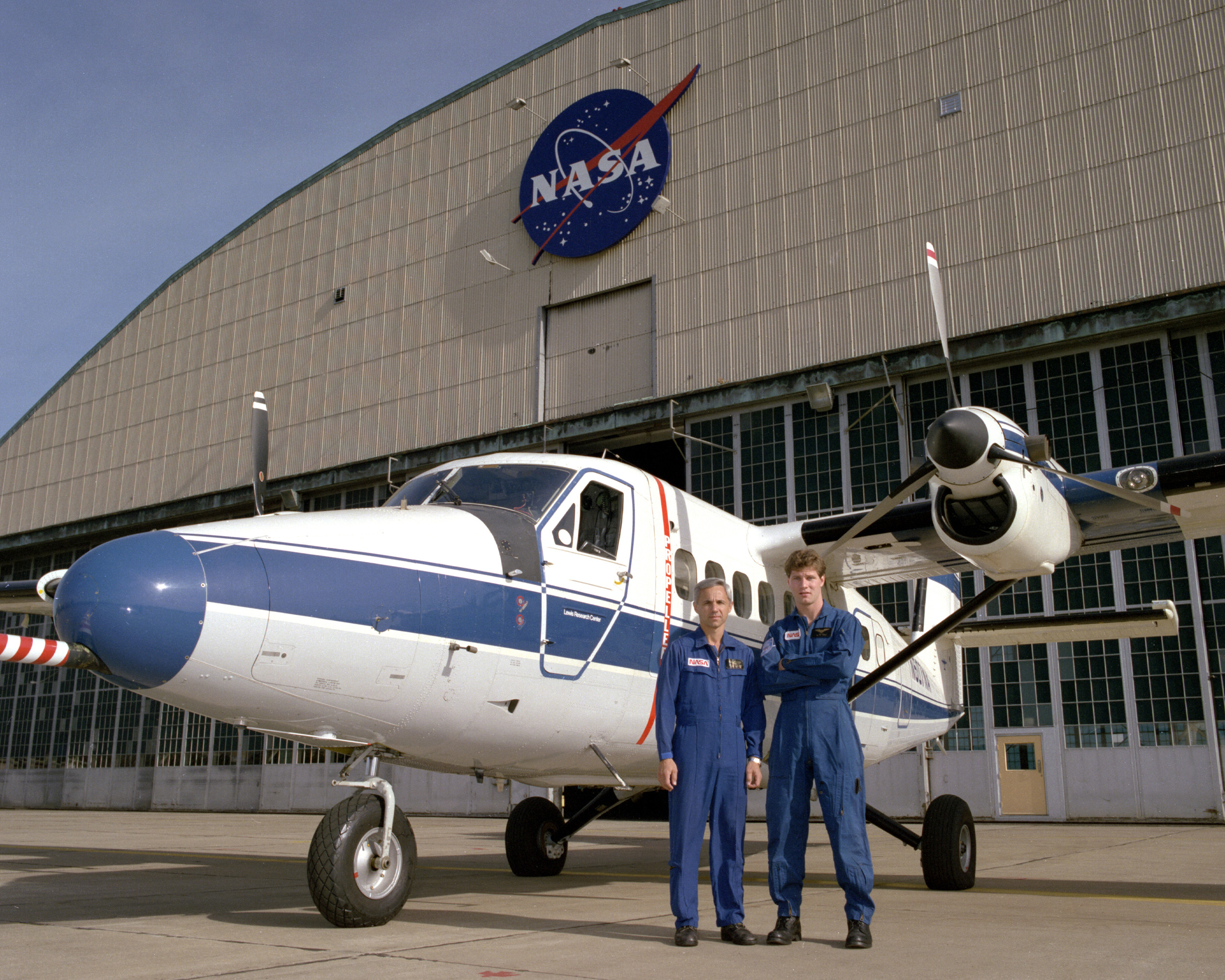
Pilot Richard Ranaudo, left, and engineer Thomas Ratvasky with the De Havilland Twin Otter at NASA’s Glenn (then Lewis) Research Center in Cleveland on Feb. 23, 1993. The aircraft helped advance global aviation safety by defining the precise atmospheric physics of supercooled clouds and validating critical modern technologies used to predict, detect, and prevent in-flight icing hazards.
Credit: NASA/Tom Jares
Beyond improving aviation safety, Glenn’s flight research also explored new propulsion technologies that could transform the future of flight. Today, researchers are exploring hydrogen as an aviation fuel. But NASA Glenn helped show its potential viability decades ago using its Martin B-57B Canberra aircraft. After developing a hydrogen fuel system for the B-57B, a team tested it safely from February to April 1957. The flights showed the system’s reliable operation and advanced efficiency, marking a major milestone in aviation technology.
Flight testing also supported technologies destined for use beyond Earth, helping researchers evaluate hardware under conditions that closely resembled space. Beginning in 1963, the center began a program to test and measure how well solar cells worked under conditions similar to those in space. Using specially modified airplanes, including Learjets, NASA conducted flights to help recreate some of the sunlight and atmospheric conditions that solar cells would experience outside Earth’s atmosphere. The program lasted decades, supporting space technology calibration through numerous high-altitude flights and adapting to newer aircraft over time.
Researchers later applied these airborne capabilities to environmental science, extending their value beyond aviation and space technology. Using the Twin Otter and S-3B Viking over the Great Lakes, researchers tracked harmful algal blooms on Lake Erie by measuring changes in water color and composition. The data improved satellite systems used to monitor water quality and ecosystem health.
Glenn’s research aircraft also played an important role in preparing technologies and experiments for spaceflight through microgravity testing. NASA Glenn advanced microgravity research through in-flight testing using specially modified aircraft, such as its DC-9, to create short periods of weightlessness during parabolic maneuvers. These flights allowed researchers to study how fluids, combustion, materials, and experimental equipment behaved in near-zero gravity before experiments were conducted in space.
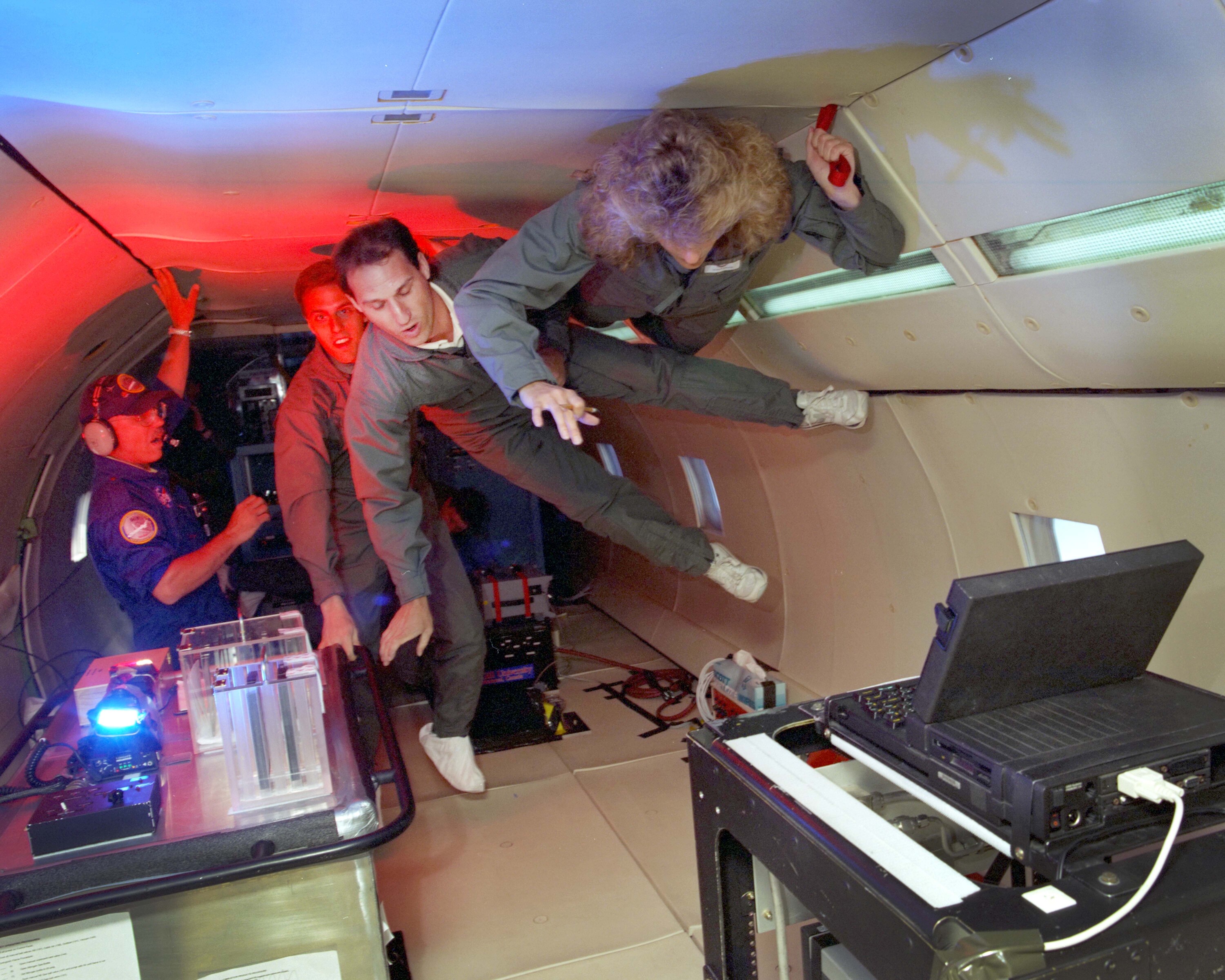
NASA’s Glenn (then Lewis) Research Center in Cleveland conducted microgravity research using the DC-9 airplane. Pictured, back to front, John Yaniec, Mike Mahn, Michael Capelety, and Susan Motil conduct microgravity research during a flight on July 10, 1996.
Credit: NASA/Quentin Schwinn
Recent breakthroughs
Other significant accomplishments enabled by Glenn’s flight research include supporting the development and testing of sustainable aviation technologies, including research related to more fuel-efficient engines and sustainable aviation fuels, and advancing in-flight instrumentation and measurement techniques used across aeronautics research.
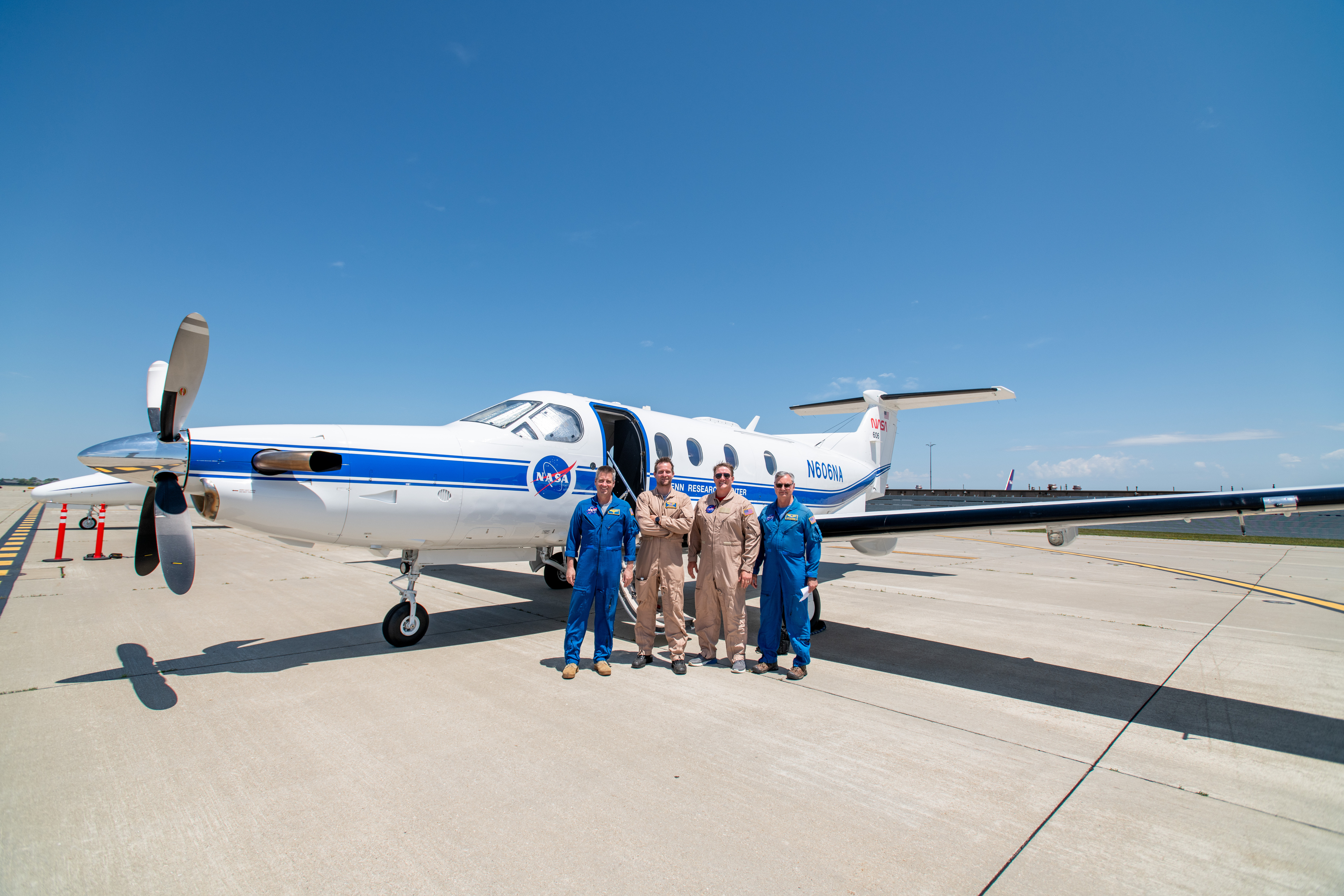
In 2024, Glenn’s Flight Operations participated in an optical communications study using the center’s Pilatus PC-12 NG aircraft. This mission successfully demonstrated the ability to transmit large volumes of data through a laser communication system across NASA’s legacy infrastructure. The work contributed to NASA’s broader effort to advance optical communications for future missions. NASA further tested optical communications on the Artemis II mission and effectively transmitted substantial amounts of data from the Orion capsule to multiple ground stations over the course of the 10-day journey.
A team at NASA’s Glenn Research Center in Cleveland streamed 4K video footage from a Pilatus airplane to the International Space Station and back for the first time using optical, or laser, communications. Pictured on June 13, 2024, left to right, James Demers, Adam Wroblewski, Shaun McKeehan, and Kurt Blakenship.
Credit: NASA/Sara Lowthian-Hanna
As NASA’s flight research enterprise evolved, the agency also restructured how it manages its research aircraft. In October 2025, NASA streamlined its aircraft flight operations, relocating its aircraft from Glenn to NASA’s Armstrong Flight Research Center in Edwards, California. NASA Glenn continues its important icing and propulsion research and communications technology development in collaboration with Armstrong.
From its historical roots in wartime engine development to modern work on aircraft safety, Glenn’s airborne research has consistently moved innovative ideas from the laboratory to real-world application. For more than eight decades, NASA Glenn has transformed ideas first proven in the laboratory into innovations validated in the sky — a legacy that continues to shape the future of aviation and space exploration.
March 17, 1943
Researchers at the National Advisory Committee for Aeronautics’ Aircraft Engine Research Laboratory (AERL), the historical name for NASA’s Glenn Research Center in Cleveland, prepare to embark on the first AERL flight test using the Martin B-26C airplane at the center on March 17, 1943.
Credit: NASA
April 21, 1946
These aircraft were used in the 1940s for research at the National Advisory Committee for Aeronautics’ Aircraft Engine Research Laboratory in Cleveland (the predecessor to NASA’s Glenn Research Center). This photo was taken on April 21, 1946.
Credit: NASA
April 13, 1976
Pilots and staff recognize the 100th research flight of the F-106B Delta Dart aircraft at NASA’s Glenn (then Lewis) Research Center in Cleveland on April 13, 1976. From left to right, John Burke, Casey Blaze, Thomas Mayher, Bernard Smith, William Bohrer, William Wildenhein, James Potantus, Maurice Collier, James Cery, Joseph Sikosky, Jack Salzman, Earl Boyer, Frank Hvizdos, Anthony Mastronuzzi, Carl Hembly, Gary Thomas, Carl McLucas, and Russell Hart. Previously used by the U.S. Air Force, the plane was converted to test supersonic nozzle and inlet variations.
Credit: NASA
July 14, 1997
NASA Glenn (then Lewis) Research Center’s aircraft fleet consisted of a, clockwise from bottom, T-34 Mentor, De Havilland Twin Otter, McDonnell Douglas DC-9, North American OV-10A, and Learjet, pictured here on July 14, 1997.
Credit: NASA/Christopher Lynch
June 13, 2018
Mark Russell, a NASA safety officer and pilot who served as the former acting chief of Aircraft Operations at NASA’s Glenn Research Center in Cleveland, climbs into a T-34 Mentor aircraft on June 13, 2018.
ChatGPT's new Computer History feature stores Mac activity locally, but OpenAI now warns that its files aren't encrypted and may be accessible to other programs.
ChatGPT can now remember recent activity across Mac apps and websites, helping users pick up unfinished work, understand workflows and turn repetitive tasks into reusable AI skills.
Microsoft introduced Mico last October as “your AI companion.” It’s now exiting Copilot’s core voice experience. (Microsoft Image)
Microsoft has spent decades putting characters into its software and then sending them off into retirement. Now joining Bob, Clippy and Cortana in the great recycle bin in the sky: Mico.
The animated artificial intelligence blob (a derivation of “Microsoft Copilot”) arrived last October in Microsoft’s Copilot Fall Release, described as “expressive, customizable, and warm” — an optional presence that “listens, reacts, and even changes colors to reflect your interactions.”
Less than a year later, Microsoft is pulling Mico from Copilot’s core voice experience as part of the merger of the Copilot consumer and business apps, announced Thursday morning.
But maybe it’s more accurate to call this a semi-retirement, for now: Mico is expected to live on in some of Copilot’s education features, according to the company.
Mico reflected a bet Microsoft made about consumer AI under Mustafa Suleyman, the DeepMind and Inflection co-founder who joined as CEO of Microsoft AI in 2024: that the way to win users away from ChatGPT was warmth and personality, not just raw capability.
It didn’t turn out that way. In March, Microsoft handed oversight of Copilot to Jacob Andreou, a former Snap executive, and narrowed Suleyman’s role to building AI models. Andreou told his organization in July that Copilot should focus on “real work” and be “optimized for outcomes.”
Microsoft has been here before, repeatedly.
Microsoft Bob, released in March 1995, replaced the Windows program manager with a cartoon house — click the wall calendar to put something on your schedule, click the pen to write a letter, etc. — guided by a yellow dog named Rover.
Clippy, officially Clippit, debuted with Office 97, offering unsolicited help with whatever it thought you were doing, e.g., “It looks like you’re writing a letter. Would you like help?” For many, the answer was no. Microsoft switched the Office Assistant off by default in Office XP and removed it entirely in Office 2007.
Cortana, named for the Halo video-game AI and voiced by the same actress, arrived on Windows Phone in 2014 and Windows 10 the following year. Microsoft retired the standalone Cortana app in 2023 to make way for Copilot.
That’s not to mention Tay, the chatbot Microsoft pulled within a day in 2016 after users taught it to post racist messages, or the less-official Sydney, the AI alter ego that surfaced during early Bing Chat testing in 2023 and famously told New York Times technology columnist Kevin Roose it loved him and that he should leave his wife.
So farewell, Mico. It could have been a lot worse.
Researchers will have to take a closer look to find stronger evidence, but the findings offer a rare look into the people who lived in a wealthy Greek city.

 Login
Login