Normal view
Trump's forced coal plant extensions thrown out by judge
The use of coal to generate electricity on the US grid has been plunging for nearly two decades, and the first Trump administration was unable to affect the trend. So his second administration has attempted more aggressive interventions to prop up coal use. One of its most direct means of doing so is to order coal plants that were scheduled to close to remain open, even if there is no need for them.
The administration's justification for these orders is a statute that allows the Department of Energy (DOE) to declare an emergency in the case of wartime or a sudden shortfall in generation. A number of parties, including states where coal plants have been slated to close, have challenged this declaration. And on Friday, in the first of these cases to make its way through the courts, the declaration was judged to be contrary to the statute. While this only affects a single coal plant in Michigan, the reasoning of the decision will apply to every coal plant closure that has been blocked by the DOE.
No emergency
The decision was issued by a unanimous three-judge panel from the DC Circuit's Court of Appeals. It focuses on the J.H. Campbell Generating Plant, which was scheduled to close last year but has been kept open by a total of five emergency declarations by the DOE, each limited to 90 days by the Federal Power Act. At issue was section 202(c) of that Act, which allows the DOE to declare emergencies when the US is at war or when “an emergency exists by reason of a sudden increase in the demand for electric energy, or a shortage of electric energy.”


© UCG
Help Refine Data from Space Telescopes with Artifact InSPECtor
How do scientists studying space with data from a telescope hundreds of thousands of miles away know that what they are seeing is real? A new NASA project, Artifact InSPECtor, invites you to find out – and by doing so, to help missions like Euclid and NASA’s new Nancy Grace Roman Space Telescope answer fundamental questions about our universe.
“It’s really cool that we can help teach computers new skills,” said nine-year-old Maeve F. after trying out Artifact InSPECtor. Participants of all ages, including those as young as Maeve, can visit the project to learn how they can contribute to science by training artificial intelligence to remove errors in telescope data.
Here’s how it works.
The Euclid space telescope, a powerful observatory built by ESA (European Space Agency) with critical contributions from NASA, is collecting light from millions of distant galaxies across the universe. It will soon be joined by NASA’s Nancy Grace Roman Space Telescope, a complementary observatory that will capture a similar number of galaxies after it begins science operations, but at different distances and densities across the sky. Together, these telescopes promise to help scientists answer questions about the expansion of the universe and dark energy – the mysterious force causing this expansion.
To collect data to answer these questions, each telescope uses a special instrument called a spectrograph that works like a prism: it splits the light from each galaxy, even very distant ones, into a rainbow of colors. By studying these rainbow patterns, called spectra, scientists can figure out how far away each galaxy is, what kinds of stars it contains, and even information about the supermassive black holes at their centers.
But before that can happen, there’s a problem to solve.
Telescope data contains many “artifacts” – the general name scientists use for signals that come from things other than real astronomical objects like galaxies or stars. Artifacts can be created by light glinting off the telescope’s housing, cosmic rays striking the detector, quirks in the camera or electronics, or other sources. It’s a bit like when a smudge on your phone’s camera lens shows up in a photo, or when a glare from the Sun blocks part of your picture.
To find and remove these artifacts, astronomers have created artificial intelligence (AI) tools that learn to recognize them, similar to how your phone recognizes faces in photos. But recognizing artifacts in data from relatively new instruments is challenging work for the AI, which doesn’t always distinguish them accurately
That’s where you come in! As a volunteer with Artifact InSPECtor, you’ll look at real space telescope data from Euclid and, starting in early 2027, the Nancy Grace Roman Space Telescope. The project will teach you how to recognize artifacts in data from these telescopes. The work you do will then be used to improve the instructions guiding the AI tool. Working together, you, the AI, the scientists, and these powerful space telescopes will learn more than ever before about how our universe works.
If you want to teach computers new skills and help discover the mysteries of dark energy, use your smartphone, tablet, or computer to visit Artifact InSPECtor and begin today: https://go.nasa.gov/3Uyrguy.

Oracle tries to appease Stargate data center opponents with renewables push
Oracle’s proposed investment in 2 gigawatts of renewable energy projects for New Mexico comes as local opposition could delay development of the Project Jupiter data center that Oracle is building for OpenAI.
The two tech companies are developing the $165 billion Project Jupiter data center in Santa Teresa, New Mexico, as part of the broader Stargate AI infrastructure project announced by President Donald Trump in 2025. But Project Jupiter faces local protests and court battles over concerns about its environmental impacts—and the latest Oracle announcement on September 8 seeking proposals for renewable energy projects does not change the fact that the data center will be powered by fuel cells that consume natural gas.
“Like all matching programs, this would be synthetic in the sense that 2 GW of renewables wouldn't directly power the data center,” wrote Michael Thomas, CEO of the Cleanview data platform that tracks renewable energy and data center projects, in a LinkedIn post.


© STACK Infrastructure
This road map could help us decide whether to deploy solar geoengineering
A San Francisco nonprofit has published a detailed road map of the experiments, studies, and infrastructure that it says would be needed to make informed decisions about the use of solar geoengineering, MIT Technology Review can reveal.
Scientists have now spent half a century exploring the possibility that we could counteract climate change by releasing reflective particles into the stratosphere, mimicking the cooling effects of volcanic eruptions.
But even after at least hundreds of studies on the concept, known as stratospheric aerosol injection (SAI), big gaps remain in the scientific understanding of how well it would work and what else it might do—and there has been no systematic plan for clearing up that uncertainty.
Reflective, a research organization that funds studies on solar geoengineering, has today attempted to fill that gap with the release of its SAI Research Roadmap.
“Our mission is to equip the world with the data and tools required for informed decision-making about sunlight reflection fast enough to matter,” says Dakota Gruener, the organization’s cofounder and chief executive. “Our sense is the world may need to make very consequential decisions on timelines far shorter than our research system is prepared for.”
The hope is the exercise will guide scientific efforts and encourage philanthropies or government agencies to fund high-priority work and “responsibly accelerate research,” says Gruener.
If all the work is done in a coordinated way, it would take about a decade and cost around $370 million—and if it’s not, it would require roughly 20 years and nearly $1.4 billion, the report estimates.
While Gruener stresses that Reflective doesn’t advocate using this form of solar geoengineering, the report does make the case for conducting outdoor experiments, which would release successively larger amounts of sulfur dioxide (or materials that would convert into it) in the stratosphere to observe what happens.
That is a controversial standpoint. Since 2002, hundreds of academics have signed an open letter calling for a ban on outdoor experiments and an “international non-use agreement,” arguing that such a powerful technology could never be governed in a globally equitable way. And some signatories argue that more studies can never address one of the biggest questions about using solar geoengineering: Who gets to do it.
“The first-order questions, from my perspective, are not technical,” Aarti Gupta, co-initiator of the non-use initiative and professor of global environmental governance at Wageningen University in the Netherlands, told me in a recent on-stage interview.
“The core question is: Who would control a planet-altering technology like stratospheric aerosol injection? Who would develop it, and who would deploy it, and to what end? To serve what purposes, and whose purposes? Those questions are very fundamental, because this planet-altering technology will have winners and losers.”
‘Fast enough to matter’
Since Gruener incorporated Reflective in late 2023, the nonprofit has quickly become an important player in solar geoengineering research. It has now raised more than $20 million from a number of prominent charities and individuals, and it’s provided around $4 million to several dozen research groups. Reflective has also undertaken a handful of its own projects to promote research, including the development of an open-source solar geoengineering simulator and an online hub for collaborative research.
Earlier this year, Reflective released its SAI Uncertainties database, which identified a long list of scientific unknowns and engineering obstacles that would need to be addressed before even a small-scale solar geoengineering effort could move ahead. (I wrote about the specific scenario and the unknowns in this earlier piece.)
Some of the biggest uncertainties involve what gas or particles would make the most sense to use and what would happen once they were released in the dry stratosphere. It’s not clear, for example, whether they’d spread out in a way that maximizes the reflectivity—or clump together and quickly fall out into the troposphere, the lowest layer of Earth’s atmosphere.
The road map builds upon the database, highlighting the path to addressing most of those questions.
The road map
The initial phase in Reflective’s road map, labeled “foundational knowledge,” includes additional computer simulation studies and lab experiments designed to shed light on the potential impacts on different regions, ecosystems, and phenomena, including ocean circulation patterns, ice sheets, and crop yields.
The report also notes the need to begin developing more observational tools during this phase to improve understanding of the baseline conditions of the stratosphere—and, in turn, our ability to assess any effects from the eventual release of materials.
This first stage would last two to three years and cost $30 million to $75 million, though some of the analysis and observational work would continue into subsequent phases.
The next stage would include using modified aircraft to release 10 metric tons of sulfur dioxide into the stratosphere, four times over the course of two seasons. The full research stage could take four to eight years and cost $70 million to $150 million, the report says. The work during it may reduce uncertainty about the “cooling efficacy” of solar geoengineering, or how much the planet would cool per ton of sulfur released, by about 25%.
The experiments during the next phase would step those levels up dramatically, releasing 25,000 tons of sulfur dioxide over the course of one season, at least once but possibly twice. That research stage, which includes other work as well, would last four to 11 years, run $270 million to $1.1 billion, and decrease efficacy uncertainty by around 66%, according to the road map.
The final phase of research would be ongoing monitoring of full-scale solar geoengineering, if the world goes ahead with it. The goal would be to gather real-life data on the technology in action, update estimates of the effects in models, and spot any “unexpected or undesired consequences.”
Gruener says that the road map is intended as a Version 1, meant to be “concrete enough for people to argue with.” But Reflective intends to update the plan as it receives additional reactions from researchers and other observers, and it will invite such feedback through a mechanism on the site.
She also notes that there are firm “stage gates,” set up between the latter stages—in other words, research shouldn’t proceed to the next phase if the experiments suggest that the releases don’t have the hoped-for impact, show worrisome downsides, or fail to resolve crucial uncertainties.
“Our road map has these gates precisely because there may be points where the answer is ‘You should stop,’” she says.
Termination shock
Most observers I spoke to about the report agree that these studies could reduce uncertainty about the effectiveness of solar geoengineering and our technical ability to carry it out.
But highlighting the scientific importance of outdoor experiments won’t necessarily make them any easier to move ahead with. Several earlier proposals to carry out such experiments, including Harvard’s SCoPEx and the UK-based SPICE project, were ultimately halted amid opposition from environmentalists or policymakers.
In addition, not everyone agrees that experiments at those scales will get us to the point where we’re capable of making an “informed decision.”
Wil Burns, a research professor and legal scholar at American University and a signatory to the International Non-Use Agreement, fears that scientists won’t be able to understand the extent of the potential downsides, including impacts on the protective ozone layer and changes to regional precipitation patterns, until we’re carrying out full-fledged solar geoengineering.
“The research would give you some answers,” he says. “I just don’t think it gives you answers that are that relevant. To get to those relevant answers, you have to deploy at scale—and I just don’t think that’s ever tenable.”
That’s because, in his view, using the technology would violate principles of intergenerational equity: If the world continues emitting greenhouse gases, increased levels of solar geoengineering would merely mask the continued warming of the planet. Burns says that means future generations—people who had no say in its use—couldn’t turn it off without triggering a sudden surge of warming, known as termination shock.
“What that would do, in my mind, is put a sword of Damocles over future generations,” he says. “So even if you could, quote-unquote, ‘prove it works,’ I don’t think from an intergenerational perspective it would ever be tenable.”
(Some researchers, however, have argued that the risks of termination shock are less likely than often assumed—and that solar geoengineering could be slowly dialed down over time.)
‘The right approach’
Ilan Gur, the former CEO of the Advanced Research and Invention Agency (ARIA), the UK research department that funded 21 geoengineering research projects last year, applauds Reflective’s road map.
“Whether you’re a scientist or a policymaker or just a concerned citizen, our goal should be as quickly and efficiently as possible to answer the biggest questions scientifically that would tell us [whether] this is an approach that might work or that would never work,” he says. “We should all want to spend the effort and money to buy down that uncertainty, so my view is 100% the approach that Reflective is taking is the right one.”
Sebastian Eastham, an associate professor in sustainable aviation at Imperial College London who is leading an ARIA-funded research project exploring another approach to engineered cooling, agrees that the outdoor experiments described in the Reflective road map can’t resolve all the unknowns. But he says the map helps begin a conversation about how to make decisions concerning the use of a tool with potential benefits and risks, in the face of escalating climate dangers.
“Every hard decision that has ever been taken has been in the context of unresolved uncertainty,” he says. “That’s just the nature of things.”
Eastham adds that it’s become essential to move beyond computer simulations to address some of the key questions, arguing that appropriately designed and executed outdoor experiments can teach us so much more than millions of hours of computational processing time “that it almost becomes irresponsible to say, ‘Well, there cannot be ever any experiment.’”
The risk is “that we spin our wheels running the same computational simulations over and over and over again,” he says. That could prevent researchers from learning essential things about the effectiveness or the dangers of stratospheric aerosol injection.
Weighing the risks
Gruener says the risks that solar geoengineering could exacerbate inequality need to be considered, but notes that unchecked warming also threatens to disproportionately harm developing regions.
She also acknowledges that outdoor experiments won’t fully address the scientific unknowns but stresses that they can answer a lot—and carry little environmental risk. She notes that 10 tons of sulfur dioxide is less than 2% of the amount that the global aviation industry releases into the atmosphere each day.
“Some people will be uncomfortable with any discussion of any outdoor experiment, but if we want decisions made on good science … then these are questions that an experiment will be necessary to address,” Gruener says.
She fears that the rising dangers of climate change will put growing pressure on nations and other actors to move forward with solar geoengineering, even if no one has done the necessary research to reduce scientific uncertainty and sort out the technical challenges.
“We don’t think the alternative is decisions not happening at all,” she says. “We think the alternative is decisions being made in a panic or on lack of evidence.”

Can the US battery market untangle from China?
The US is hitting records for the rapid growth of its energy storage market. That’ll go a long way to shoring up the grid, increasing reliability and also cutting emissions, since batteries can help store energy from intermittent renewables like wind and solar.
Crucially, this is all happening with the help of cheap Chinese batteries, though there’s been a concerted effort to reduce the US’s reliance on them. Most recently, in an executive order in late August, the Trump administration declared a national emergency that essentially bans Chinese batteries from being used in grid-scale energy storage systems.
There’s an argument to be made about reducing reliance on any single source of a crucial energy technology. But all this tension raises a broader question for me: How much should countries take advantage of cheap, available tech, versus cutting off major sources to force development of their own factories even if that comes at a higher cost?
This is hardly America’s first push to move away from Chinese influence in the battery supply chain. One of the major policy tools used in recent years is restricting the tax credits designed to incentivize use of the new technologies. Limiting the types of projects that are eligible can help reduce the cost of local technologies so they’re more competitive with otherwise cheaper imported options.
Back in 2022, the US government designed the tax credits that were part of the Inflation Reduction Act to restrict where a battery’s minerals could be mined, processed, or recycled, as well as where a battery and its components were assembled.
Those tax credits underwent a makeover in 2025, but the Trump administration has taken a similar tack. New legislation requires that starting in 2026, 55% of the cost of materials used for new energy storage projects must come from outside China and other restricted countries or the projects won’t qualify for tax credits.
And we can’t forget about tariffs. Import taxes for batteries increased to 25% in January, up from 7.5%.
But the new executive order is a more drastic move. It bans the installation of “any foreign-produced bulk-power system electric equipment” that poses a national security risk. The order specifically calls out battery energy storage systems, as well as inverters and transformers.
“An outright ban was a bit of a surprise, and it does create a bit of concern for domestic players in the US,” says Shan Tomouk, energy storage and energy lead for Benchmark Mineral Intelligence, an energy industry analyst.
The move is likely to slow deployment of grid-connected energy storage projects in the near term, according to analysis from BloombergNEF, an energy consultancy. Projects could face delays as developers wait for clarity on the rules.
Depending on the detailed guidance from the Department of Energy, which is expected by the end of the year, some projects may need to find alternative sources for their cells, whether they’re domestically produced or imported from other countries. These will likely be more expensive than Chinese imports, says Isshu Kikuma, an energy storage analyst at BloombergNEF. “Worst case, those projects could get canceled,” he says.
Technically, the order applies even to existing energy storage plants, though it’s unlikely that they’ll be taken offline because of their batteries’ origin. Since most of these plants currently use Chinese batteries, enforcing the order to the letter would essentially mean removing most installed battery energy storage from the US grid, Kikuma says.
In the longer term, the US will eventually be able to meet its own demand for batteries. The country could have enough capacity by about 2030, though some factories may not ramp up or run at their full capability, meaning domestic supply won’t actually meet demand until later in the 2030s.
New factories from LG Energy Solutions, Samsung SDI, Ford, and SK On are set to come online or ramp up by next year. In an ironic twist, a slowing EV market is helping, as some factories originally designed for vehicle batteries are retooling to build cells for grid storage instead.
But it will come at a cost. Today, batteries produced in the US are still significantly more expensive than those made in China. Even switching to imports from other countries like South Korea would likely be more expensive.
This is a crucial issue that goes beyond the US and even beyond batteries. China is miles ahead of much of the rest of the world on technologies like solar panels and batteries. Through years of government support and experience with research and manufacturing, the nation is an energy powerhouse.
There’s a delicate political balance to maintain as the world figures out how to navigate this situation. There’s cheap technology on offer, which can help drastically reduce emissions and energy costs. But there can be risks associated with relying too much on any one player for crucial technologies.
This article is from The Spark, MIT Technology Review’s weekly climate newsletter. To receive it in your inbox every Wednesday, sign up here.
Massachusetts hits data centers with new clean power rules
Hunting the Wild Vibrotruck
A few weeks ago, my wife was out walking the dog, and she sent me four or five photos of small orange boxes planted all around our neighborhood. (OK, I’ll bite!) They had little cards on them explaining that they were geophones, and a QR code on them that lead to a website with all the details. Munich was getting a large-scale seismic survey to map out our underground water, with the aim of using it for geothermal heat and power in the near future.
How do you map up to five kilometers under the earth? You pound the ground, sending shockwaves downward, and then listen for their reflections. At the boundaries between different layers, the change in the speed of sound in the different media cause reflections. Calculating the time it took for a given reflection to reach you lets you figure out how deep the layer boundary is.
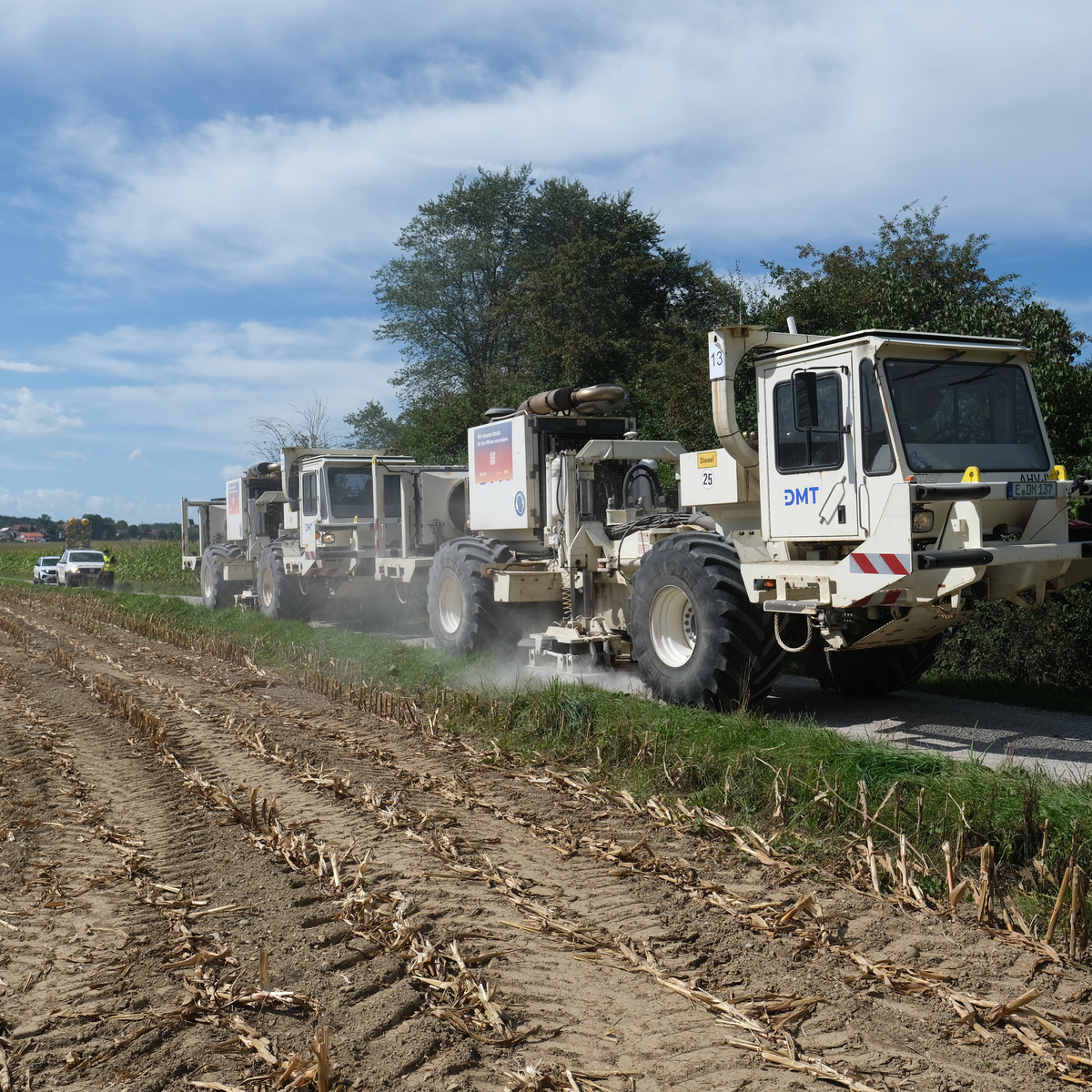
The seismic survey procedure goes like this: geophones are set out at roughly 20 m intervals in lines spaced around 300 m apart that run roughly north-south, while “vibrotrucks” drive a roughly east-west course, creating mini-earthquakes every 20 meters along the way. Covering a surface of 1,000 km^2 with over 120,000 sample locations and exciting them 86,000 times is going to take a while. Lucky for me, they started in my part of town.
Hot Water
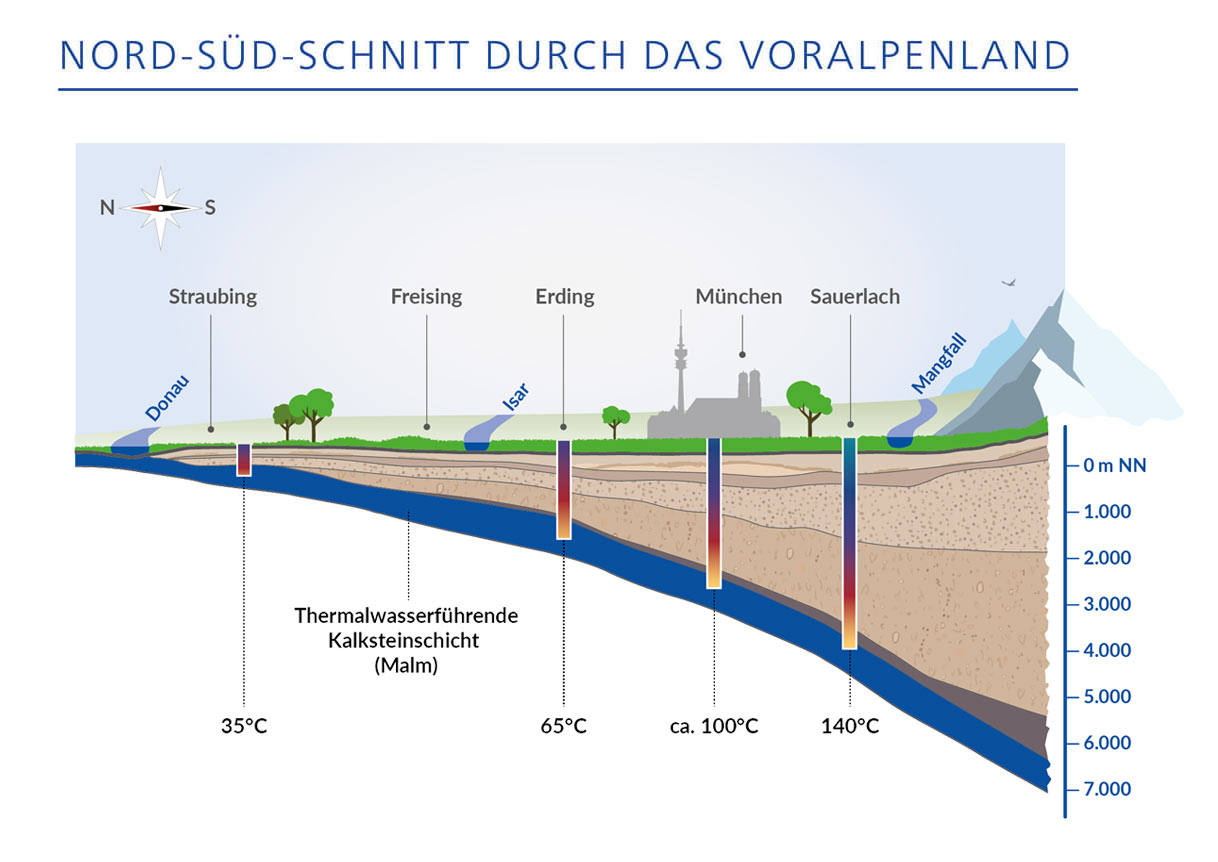
Because the earth is essentially a ball of hot molten metal with a thin and crispy outer crust, and because there is radioactive decay going on even within the crusty bit, temperatures rise as you dig down: roughly 30 °C per kilometer. And Munich has this fantastic source of water that’s folded under the earth in a layer that dates back to the Jurassic, which makes it both low in dissolved minerals and sitting just around 3 km down: at 100 °C. This turns out to be the sweet spot in terms of difficulty of drilling and heat gained from doing so.
Blessed with hot water underground, the question is how to best use it. The plan at the moment is to situate a number of geothermal plants around the city, drill relatively large bore holes at each site that reach down 1 km to 2 km, and then drill diagonally down after that to spider out into a larger source of water. This “extended reach drilling” pulls from a larger heat source, prevents cool spots, and has only recently become technologically feasible.
Which brings us to the GIGA-M study. A 3D map of the underground will help plan out where to put the geothermal plants, in which directions the runners will need to be drilled, and generally how to best coordinate the resource. There were a number of individual smaller surveys done over the last 20 years, and Munich and the surroundings already have a number of geothermal plants, but this survey aims to fill in all of the gaps.
The Hunter and His Prey
It was a Thursday morning when my wife thought she heard some pounding and humming outside. She was wrong, but it got us to look at the online map, and while they weren’t in our neighborhood just yet, they were probably within easy driving distance. I threw my camera and tripod in the car and headed out.

Out in the country, just outside of Grossdingharting (you can’t make these names up!) I spotted a plume of dust rising up from a field. Was it just a farmer tilling? Or was it a vibrotruck? I drove through the woods on a logging road, and when I came out, I was nearly face-to-face with the beasts.
They were loud, and I felt the rumble when I stepped out of the car, so I ran up and asked if I could film it. They said “sure”, and I set up the tripod. The first video I shot, apparently I hadn’t screwed the camera down hard enough in the tripod, and it vibrated loose. So I ran another 20 m further and tightened everything down.
I’m not going to lie: it was exceedingly loud and very exciting. I drove back home and couldn’t wait to review the footage.
The next morning, I heard the same sound outside my own house. They were driving vibrotrucks around in the field about a block up the street. I grabbed the camera and ran out barefoot to get footage. And then Saturday morning, while cooking blueberry pancakes for the family, they drove up my street. Am I stalking the vibrotrucks, or are they stalking me?
An engineer asked if they could stand in our front yard, so I took my chance to bombard him with questions. He seemed stoked to talk about it.
Geophones and Vibrotrucks
When you stand next to one of these things, first it shakes, and then you can hear a bassy tone, and then it rises and stops. They’re obviously doing a frequency sweep, much like you would use a sonar chirp to help disentangle the multiple reflections from one another.
The sweep means that even if they receive two reflections at once, they will hear two different pitches because one signal traveled further than the other, and comes from the earlier, lower-pitch part of the impulse. It also makes for a very easy to find signature. Correlating these times of flight across the entire array of geophones gives a 3D map of the underground layer discontinuities.
You can see from a cleaned up version of the audio that they’re sweeping from something like 6 Hz up to maybe 96 Hz. The lower end sounds like distinct hammering, and the top end a humming. Here is another video, with filtered audio. Because you feel the vibrations through your feet and in your chest, the live experience is a little bit like this with more noise. Play on good headphones or with a subwoofer for maximum effect.
Of course, the time of flight matters. I asked if each geohpone had a GPS timebase, and the friendly engineer told me that they individual geophones don’t – too expensive – but that when they install one, they connect it to a laptop with GPS that records the location and sets the geophone’s clock. When they harvest them, they record the location again, dump the time to verify that the clocks haven’t drifted too much, and then pull down all of the recorded timestamped data.
Why do they drive around in pairs? It’s simply because they make twice the vibration. The two trucks are actually synced together in phase, so they emit as one. The trucks have a GPS-disciplined clock inside, so they know exactly when they start each cycle and can derive the time-of-flight to all of the receiving geophones. The rest is math.
He also mentioned that it was too bad that I only got to experience the smaller “urban” vibrotrucks like the one outside my house. I kept my mouth shut – nobody needs to know that I’m a vibrotruck stalker.
Batteries just broke another record in the US
Battery installations hit a new record in the US in the second quarter of 2026. In total, 20.2 gigawatt-hours of new capacity came online, according to a new report. That’s enough to supply the daily electricity needs of about 700,000 homes.
The surge is putting the country on a trajectory to see 71 gigawatt-hours of batteries installed in 2026, a 20% increase over last year. This growth is being driven by a combination of cheaper batteries and an urgent need for more energy storage capacity as renewables such as solar and onshore wind power are added to the grid.
Massive, utility-scale systems are leading the way; they’re responsible for most of the record-setting quarter. Seven new gigascale battery installations (those with a capacity of over one gigawatt-hour) came online during the three-month stretch, according to the report, published by Benchmark Mineral Intelligence and the Solar Energy Industries Association.
“It really came down to a handful of big projects,” says Shan Tomouk, energy storage and energy lead for Benchmark Mineral Intelligence.
But there was also growth in the category of so-called behind-the-meter batteries, which include both residential and industrial battery storage systems. These projects, generally smaller than utility-scale installations, are typically owned and operated by homeowners or businesses rather than utilities or power providers.
In the behind-the-meter category, data centers led the way, making up about three-quarters of new batteries in the commercial sector. But residential batteries saw a sharp slowdown. These systems are often installed in homes to store power from solar panels or serve as a backup source in case of a blackout. Home installations are projected to drop by 16% in 2026 compared with last year, according to the report.
That drop happened largely because a tax credit that helped subsidize home battery systems ended in 2025, Tomouk says. Home installations should recover by the end of the decade, he adds. And tax credits for nonresidential batteries have largely survived.
Overall, batteries are a bright spot in energy right now. “This is one of the strong sectors in the US,” says Isshu Kikuma, an energy storage analyst at BloombergNEF, an energy consultancy.
As the battery market continues to grow, one major trend to keep an eye on is a move toward US-made technology. Today, nearly all the systems coming online use cells made in China, though some are put together into complete energy storage systems in the US.
Tariffs were already pushing the US energy storage industry toward domestic production. And beginning this year, energy storage tax credits required projects to limit their reliance on batteries imported from China. There’s a lot of manufacturing capacity set to come online in the US, though these factories probably won’t be able to meet demand until at least 2030 or so, Tomouk says, so prices could tick up.
With a headcount topping 800, Helion opens Seattle office in pursuit of fusion energy

Helion Energy, in its hard-charging pursuit of fusion energy, has opened an office in downtown Seattle as its headcount swells to 800 employees.
The company already occupies five buildings in Everett, Wash., where it’s headquartered, plus operations in the central Washington town of Malaga, where Helion is building what it hopes could be the world’s first commercial fusion plant.
“Who would have thought it when we founded the company in 2013 with only five of us,” said CEO and co-founder David Kirtley in a GeekWire interview, marveling at the growth.
In June, Helion announced $465 million in new funding, bringing its total capital raised to more than $1.5 billion and its valuation to 10 times that figure.
The company is racing to master fusion, which produces energy by smashing together light atoms — essentially replicating the process that powers the sun and stars. No one has been able to create a commercially viable amount of energy from fusion here on Earth, though notable progress is being made by research institutions and private companies.
The planet is increasingly hungry for abundant, clean power as data centers gobble energy and transportation, buildings and industrial processes shift toward electrification.
That has helped spike interest in fusion, and the sector globally has raised $14.24 billion since 2021, according to the Fusion Industry Association, with multiple companies predicting they’ll succeed in producing sufficient energy in the next five to 10 years. Helion has one of the most ambitious targets, aiming to reach that mark in two years.
The company is No. 1 on the GeekWire 200, a ranked index of the Pacific Northwest’s top startups.

The company’s Seattle office is 15,631 square feet in the 8th + Olive building, in a space formerly occupied by Airbnb. The move comes as Seattle pushes to bring businesses back into its core: The city’s urban neighborhoods had an office vacancy rate of 28.2% in the second quarter of this year, with downtown alone at 34.9%, according to Kidder Mathews research.
Kirtley said they’re hiring and the goal is to have 100 employees downtown working on business and operations, recruiting and finance.
Back in Everett, teams are running tests on the company’s prototype fusion device, named Polaris, and working to get a smaller fusion machine called Tiny Merge online. The startup is also ramping up a facility for assembly work where employees and automated systems will manufacture energy-carrying capacitors, semiconductor modules and other hardware. The facility is currently producing initial test pieces.
The Malaga site will be home to the Orion facility and will include three buildings: an office building, already complete and in use; a building for final assembly of components shipped from Everett, also finished; and the generator building, which will house the 50-megawatt Orion generator and associated power electronics. So far the beams are up for the last building, with the goal of getting it “weather tight” before winter, Kirtley said.
Helion is charging ahead with Orion and building its manufacturing capabilities while continuing to tackle the physics challenges of producing energy from fusion.
The plant must be operational in two years to meet Helion’s contract with Microsoft to provide energy for a nearby data center.
Google’s revived nuclear power plant gets $1.9B loan from US government
Tech Firms Plan Billion-Dollar AI Data Centers in Patagonia
Patagonia is attracting multibillion-dollar AI data center plans, but power infrastructure and connectivity gaps could determine which projects get built.
The post Tech Firms Plan Billion-Dollar AI Data Centers in Patagonia appeared first on TechRepublic.
Nuclear startup Bluecore Energy raises $50M seed round, just two months after launch
Tech Firms Plan Billion-Dollar AI Data Centers in Patagonia
Patagonia is attracting multibillion-dollar AI data center plans, but power infrastructure and connectivity gaps could determine which projects get built.
The post Tech Firms Plan Billion-Dollar AI Data Centers in Patagonia appeared first on TechRepublic.
This founder is making cheaper, cleaner steel
The steel industry isn’t exactly known for innovation. Very little has changed about purifying iron ore since the process was invented and commercialized in the 1850s.
The majority of steelmakers melt solid iron ore at dizzyingly high temperatures inside blast furnaces, where the material reacts with gases to trigger chemical reactions that remove oxygen. It then undergoes further refining to purify it before it is made into products like rebar and car frames.
The process relies on coal, and it generates roughly 7% of the carbon emissions that drive climate change—about as much as the fashion industry. Decarbonization has proved difficult: Profit margins are tight and furnaces have long service lives, making investment tough to justify.
Now Laureen Meroueh may have found a way to clean up steelmaking without driving up the price. Meroueh, the founder of Hertha Metals, invented a new furnace that simplifies the chemistry behind the process. Her method turns iron ore into refined liquid steel in a single step, and it swaps coal for natural gas. Together, those changes slash emissions by at least half, she says, and cut costs by 25% compared with steelmaking business as usual.
If it catches on, the tech could be transformative. “There’s huge value in reducing the size of this production system,” says Iryna Zenyuk, director of the National Fuel Cell Research Center at the University of California, Irvine. “They’re massive. They’re inefficient and require a lot of energy input, so even if they just save energy efficiency, that’s already a big step.”
Hertha’s approach focuses on what it can fix about the steel industry now, as opposed to waiting around for a zero-carbon system.
Still, it’s a risky endeavor, but pushing limits isn’t new for Meroueh. At 12 she was accepted into a pilot program to take college-level courses through Florida Atlantic University in lieu of a traditional secondary education. She was immediately drawn to engineering and explored topics including calculus and ocean wave energy.
Despite the rigorous coursework, she would spend hours sitting in trees and surfing, which fostered a deep appreciation for nature and a desire to safeguard it. “I don’t know how you can’t be drawn toward trying to help protect that,” she says.
Now 34, Meroueh has let that passion inform her professional goals. After finishing her PhD in mechanical engineering at MIT, she led a green hydrogen startup before founding Hertha in 2022. A first-generation Lebanese-American from an entrepreneurial family, she saw starting her own company as a typical path. “Seeing how common it is to take that jump to start your own business is what made me feel like ‘This is normal,’” she explains on a video call from her office at Hertha’s pilot plant in Conroe, Texas, just north of Houston.
That facility can produce one metric ton of steel per day. “One ton per day is a big metric for steel,” says Rajesh Swaminathan, a partner at Khosla Ventures, one of the company’s investors. (Hertha had raised about $20 million in funding as of July 2026.)
Swaminathan says the company’s scale-up is “impressive,” especially given how little the team has spent. Competitors, he notes, have created far less steel with $50 million or $100 million in funding.
Hertha’s approach focuses on what it can fix about the industry now, as opposed to waiting around for a zero-carbon system. While other approaches to making green steel center on using hydrogen to free oxygen from iron ore—a method that could one day cut or eliminate emissions—Meroueh says Hertha is content for the time being with a continued reliance on fossil fuels, mainly to keep costs down. The current Hertha plant could eventually switch to a fully decarbonized system without drastically changing the hardware, she says, if hydrogen becomes more affordable.
In the meantime, plans are underway to expand into a new plant next to the existing one. The facility is slated to produce 10,000 metric tons of high-purity steel per year and should reach full capacity by the end of 2027. By 2030, Meroueh believes, Hertha can up its output to 500,000 metric tons per year with the addition of a third site. That’s only a fraction of the approximately 80 million metric tons of steel produced annually in the US, but Zenyuk says making even one metric ton is still an achievement.
In Meroueh’s mind, the world isn’t going to outgrow its need for steel, so she’s asking another question: “How can we be smarter about how we make things … so that it’s also not going to harm us in the long term?”
Google WeatherNext 3 Delivers Hourly Forecasts at 5-Kilometer Resolution
Google DeepMind’s WeatherNext 3 delivers hourly AI weather forecasts at 5-kilometer resolution, targeting precipitation, wind and solar forecasting.
The post Google WeatherNext 3 Delivers Hourly Forecasts at 5-Kilometer Resolution appeared first on TechRepublic.
NASA’s chief talks up nuclear power during ‘Inspiration Tour’ of Northwest space ventures

REDMOND, Wash. — NASA Administrator Jared Isaacman came to Rocketdyne’s facility here today to give a pep talk to the space company’s employees — and lay out his vision for the future of America’s space effort.
Isaacman made clear that nuclear power will be a big part of that vision.
“NASA is at our best when we’re doing the near-impossible,” he said. “There is no obvious revenue model or business case for what we’re doing. We’re just out there pursuing the secrets of the universe, and nuclear or fission-powered spacecraft make sense in that it helps us extend our reach farther into the solar system.”
The pathfinder mission for NASA’s nuclear ambitions is likely to be SR-1 Freedom, a Mars probe that’s scheduled for launch in 2028. SR-1 Freedom is designed to carry a fission reactor and nuclear electric propulsion system.
Rocketdyne’s Redmond facility is working on thrusters for the system. “We built here, in Redmond, the Advanced Electric Propulsion System,” Rocketdyne CEO Kristin Houston told GeekWire before Isaacman’s talk. “It’s a 12-kilowatt Hall-thruster system, and that is going to be the propulsion element on the SR-1 Freedom. So, yeah, we’re really proud of that.”
Today’s visit was part of the Pacific Northwest leg of Isaacman’s nationwide “Inspiration Tour,” aimed at strengthening the connections between NASA and its partners. A similar tour in August brought Isaacman to Idaho National Laboratory, which will play a key role in providing the 20-kilowatt reactor for SR-1 Freedom.

In partnership with the U.S. Department of Energy, NASA is also looking into the prospects for putting a nuclear reactor on the lunar surface by 2030 as part of its Moon Base initiative. Houston said Rocketdyne is interested in playing a part in that program.
“That’s not as much out of the Redmond site, but as Rocketdyne, we’re doing a lot of investment in the power conversion and the power management and distribution design that could be used for that,” she said.
Over the course of nearly 60 years, Rocketdyne’s Redmond site has played a role in nearly every interplanetary NASA mission — and has gone through several ownership changes along the way. The company’s latest transition, including its rebranding as Rocketdyne, became official last month after AE Industrial Partners acquired a majority stake from L3Harris.
Nowadays, Rocketdyne is arguably best-known as one of the commercial partners in NASA’s Artemis moon program. “We have 21 engines on the Orion spacecraft,” Houston said. “That’s between the crew module and the service module … all built in Redmond.”
The Redmond facility oversees the refurbishment of space shuttle engines for upcoming Artemis missions and is redesigning the spacecraft’s Orion Main Engine for missions starting with Artemis 7. “Our in-space propulsion business, really based here, has the lead on the entire OME program,” Houston said. “So we’re already concurrently doing the design and test of the new engine while doing all the refurbishment.”
Isaacman said the Artemis program is one of NASA’s top priorities, in part due to geopolitical competition. The current schedule targets a crewed lunar landing in early 2028, followed by initial work on a permanent base near the moon’s south pole later that year.
“NASA is very hot,” he said. “But NASA is hot right now because we are in a great-power competition. That’s across AI, energy and infrastructure, and everything you can imagine militarily, but certainly in the domain of space. We cannot take our foot off the gas. Really, if we miss our time by a matter of months, there are only so many good parking spots in the south pole of the moon, where we want to build our moon base. Well, the Chinese want to build their moon base there, too.”
NASA is relying on Rocketdyne and other commercial partners to set a fast pace.
“For all the great companies, the partners that are contributing to our near-impossible objectives, now is absolutely the time,” Isaacman said. “Just as so many of you were probably inspired by the space race in the 1960s and what we accomplished — all those books and movies that came from it — you’re now contributing to that.”
One of the VIPs in the audience, Redmond Mayor Angela Birney, said she was energized by Isaacman’s visit. “I am so excited that Rocketdyne is on the forefront of missions in space,” she said. “For me, as a former science teacher and someone who’s so interested in encouraging innovation and development, this just feels like a fantastic day to celebrate all of that.”
Rocketdyne wasn’t Isaacman’s only scheduled stop on this week’s tour. Earlier in the week, the administrator and other federal officials paid a visit to Lawrence Livermore National Laboratory and the Castle Air Museum in California’s Central Valley. In addition to Rocketdyne, today’s visits included stopovers at United Precision Corp.’s headquarters in Washougal, Wash., Seattle’s Museum of Flight and Boeing’s Everett facility. Stoke Space is on the agenda for Friday.
After his talk, Isaacman told GeekWire that Washington state is home to a “lot of industry” that’s contributing to America’s space effort.
“It takes contributions from great talent all across the nation to contribute to our world-changing efforts,” he said, “but it just happens to be that a lot of it is here in Washington.”
Tech Moves: Microsoft names execs; DAT, Oracle and Hiya departures; new Zillow policy lead

— Aneesh Raman has taken the role of chief economic opportunity officer at Microsoft. He previously held the same title at LinkedIn, a Microsoft subsidiary where he worked for five years.
The job is focused on “helping companies, including our own, build and deploy AI tools in ways that will unlock new levels of economic opportunity and human capability for workers and workforces alike,” Raman said.
Raman, who is based in San Francisco, began his career as a TV journalist and served as a speechwriter for President Obama and other political leaders. More recently he was an adviser to Gov. Gavin Newsom and led economic impact for Facebook.

— Jenny Lay-Flurrie was promoted to corporate vice president of Microsoft‘s Trusted Technology Group. In February, she had taken the role of vice president and head of Trusted Technology, which focuses on privacy, safety, regulatory compliance, responsible AI use and related topics.
Lay-Flurrie announced the change on LinkedIn, saying that she was “honoured, humbled and a little lost for words (yes,, it does occasionally happen ;)).”
The tech leader has been with Microsoft since 2005, and led the company’s efforts on accessibility and disability inclusion for more than a decade.

— Brian Gill has resigned as chief product and technology officer for DAT Freight & Analytics, a Beaverton, Ore.-based freight company. Gill was with DAT for more than three years and previously served as CPO for Nordstrom.
In a LinkedIn post, Gill did not give specifics on his next move but said he would be “rolling up my sleeves and building the many ideas that are suddenly so much easier to bring to life.”
Gill’s other past roles include executive positions at Hotwire and nearly a decade at Expedia. Last month DAT announced multiple promotions and hires to its leadership team.

— Colin Newman has joined Zillow Group as head of public policy. He was previously director of U.S. public policy for Amazon, leading initiatives on employment, workforce transformation, AI, transportation and economic development. He first took a government affairs role with Amazon’s Audible business in 2015 and moved to Amazon five years ago.
“I look forward to leveraging my government, legal, and public policy experience to support our efforts to simplify and democratize the housing process for everyone,” Newman said. His background includes legal counsel for former New Jersey Gov. Chris Christie.

— Lisa Finnegan is returning to Microsoft as vice president and human resources business partner for the Europe, Middle East and Africa (EMEA) region. Finnegan, who is based in Dublin, was previously with LinkedIn for more than eight years, departing in March 2025. Her interim role was with Lumera HR Consulting.
“It’s a pretty incredible time to (re)join Microsoft and the opportunity to help shape the people and organisation agenda across EMEA at this critical moment is incredibly compelling,” she said.

— James Lau, chief product officer at Hiya, announced this is his last week at the Seattle startup, which battles fraudulent calls and provides technology to protect voice identity. He’s been in the role for three years and previously worked at Microsoft over multiple stints.
Lau is launching a company called Entrovox, which he describes as an AI phone team that helps insurance agencies land new customers through state-of-the-art AI voice agents, branded caller ID and smart campaigns.
“There has never been a more exciting time for building, and I am deeply passionate about voice AI. Making AI sound genuinely human is a challenge I find irresistible,” Lau said.

— Jason Wilbur has left Oracle to join OpenAI‘s Seattle office as a leader in cloud partnerships.
Wilbur was with Oracle over two stints spanning more than six years and leaves the role of senior director of product management. Past jobs include CEO at Aarno Labs, co-founder of Require Security, and senior product manager at Amazon.
— Julia Liuson was appointed to Elastic’s board of directors. Earlier this year, Liuson resigned from Microsoft after more than 34 years. She was most recently president of Microsoft’s Developer Division. San Francisco’s Elastic bills itself as the “search AI company.”

— Dan Walter was promoted to vice president of fission technology for Everett, Wash.-based Zap Energy. Walter joined Zap earlier this year as the clean power startup announced it was expanding to pursue fission micro-reactors as well as fusion-based nuclear energy. Zap is No. 11 on the GeekWire 200, a ranked index of the Pacific Northwest’s top startups.
Walter was previously at TerraPower for nearly a decade, most recently in a director role for the nuclear power company.

— Kelsey Wolf has joined next-gen battery company Group14 Technologies as director of communications and marketing. Wolf was previously the communications lead for Rad Power Bikes, the Seattle-based e-bike startup that went bankrupt and was acquired this past spring. Group14 is No. 34 on the GeekWire 200.
“I’ve spent my career telling exciting stories about technology that changes how we work, how we find home, and how we move around the world. Up next, I will get to tell stories about the technology and materials powering our world,” she said.

— Tin Can, a Seattle startup selling Wi-Fi-enabled landline phones for kids, announced three hires:
- Evan Jacobs has joined as head of engineering, previously serving as a software development manager at Amazon Web Services. Jacobs is also a startup founder.
- Quinn Hawkins was named head of communities, joining from First Street, where he was chief product officer. His background includes leadership at Redfin and Microsoft.
- Masud Khan was named staff software engineer. Past employers include Apple, Databricks, Meta and Amazon.
Tin Can, which launched last year, is No. 153 on the GeekWire 200.

— EchoMark, the Bellevue, Wash., startup using forensic watermarking to identify the source of information leaks, has named Alex Gamoran vice president of enterprise sales. Gamoran was previously at Smartsheet for nearly a decade, leaving as regional vice president of commercial sales for North America.
“It struck me that every security-conscious enterprise is going to need a solution to the types of information leaks that conventional security software is blind to — and that’s when I knew I wanted to be part of EchoMark,” Gamoran said via email.

— Sara Dutta was named director of AI innovation and partnerships for Seattle biopharmaceutical company Omeros. She previously founded the life sciences consultancy Ocilisni and was a director at Novo Nordisk, focused on external partnerships and emerging technologies.
Last year, Omeros struck a deal worth up to $2.1 billion with Novo Nordisk, giving the latter exclusive global rights to develop and commercialize a clinical-stage drug candidate that treats rare blood and kidney disorders. Omeros won Deal of the Year at this year’s GeekWire Awards.

— Rebekah Bastian announced that she is leaving mpathic as chief marketing officer. She joined the Bellevue, Wash., startup working to make AI safe in December. Bastian previously launched and was CEO of the life-and-career social platform OwnTrail. She was with Zillow Group for more than 14 years and also worked at GlowForge.
“I’m giving myself some intentional time to explore ideas and let them incubate before deciding where they lead,” she said. That could include new companies or initiatives within existing companies, and her areas of focus span “human agency, creative entrepreneurship, economic opportunity, and generally how humans find meaning and thrive in the age of AI.”
— Seattle-area wine recommendation startup Theodora has appointed Heather Stephens founding marketing lead. Stephens has worked for more than a decade in consumer and B2B marketing, demand generation, and go-to-market strategy development.
— Marc Brown, former global head of M&A and strategic investments at Microsoft and now managing director of venture capital coverage at JPMorgan, has joined the board of trustees of the Institute for Citizens & Scholars, an organization supporting civic engagement for young people.
— Adrienne Lopez, a Seattle-based marketing leader who has worked on initiatives with organizations including Meta, WhatsApp, the Gates Foundation and Microsoft, was named executive vice president of WH Inc.
— Washington Research Foundation announced its new cohort of venture analysts: Jessica Ayers, Ankit Azad, Nello Gu, Michael Malone and Elya Shamskhou. The program helps graduate students and postdoctoral fellows gain expertise in technology commercialization and entrepreneurship.
Agriculture relies on fossil fuels. It’s costing us.
If you’ve had to fill up your vehicle’s gas tank or buy a plane ticket lately, you’ve probably felt the effects of rising fossil-fuel prices. But farmers buying fertilizer for their crops are especially aware of just how far the ripple effects of the conflict in Iran have spread.
Fertilizer prices have been on a roller coaster this year, kicked off in part by trade disruptions and high prices for natural gas, a key ingredient in fertilizer production. Let’s take a closer look at why conventional fertilizer prices are so sky-high, and how a few more climate-friendly alternatives could bring farmers some relief.
As fossil-fuel prices go up, nearly all industries are affected, since most of our economy relies on these fuels to move goods and people around.
But fertilizer is even more intertwined with these fluctuations, because natural gas is used as both an energy source and a chemical input in the production of ammonia, a key fertilizer ingredient. So as natural-gas prices have spiked in recent months because of the war in Iran, fertilizer prices have followed. (It’s worth briefly noting here that fertilizer production is also a major source of greenhouse-gas emissions, accounting for about 2% of the global total.)
Fertilizer trade is being directly affected as well, since about one-third of global seaborne trade in fertilizers passes through the Strait of Hormuz, which has been effectively closed to commercial traffic because of the conflict. Access to fertilizer could get worse for some of the poorest countries around the world because of the strait’s closure, according to a report from the World Bank. While the US largely meets demand for nitrogen fertilizers with domestic production, some imports do come from the Persian Gulf.
At one point in April, the price of urea (the most commonly applied fertilizer) climbed above $850 per metric ton. That’s 80% higher than it was before the conflict and the highest level since 2022, when the Russian invasion of Ukraine and the resulting conflict caused fertilizer costs to hit record highs. Prices have come down significantly, but forecasts remain uncertain.
“There’s just this out-of-control supply chain that’s a lot more volatile than it’s ever been,” says Travis Frey, chief technology officer of Pivot Bio, a company making fertilizer with genetically edited microbes. (For more on these microbes, how they work, and what research is still needed, check out my latest story here.)
Pivot says its products are cost-competitive with chemical fertilizers today. And because they don’t use natural gas as an input, they aren’t subject to the same price spikes. When the war in Iran started, Pivot increased the volume it planned to produce, dropped prices, and allowed farmers to lock in prices for three years, Frey says.
That could be a major help for those farmers, because high prices could be here to stay for a while. Some fertilizer prices could remain high through at least 2028, according to a report from CoBank, one of the largest banks for the agriculture industry in the US.
That’s partly because the war has caused long-lasting damage: 31 ammonia plants in the Middle East have been affected or shut down completely. That’s on top of 20 ammonia plants that have been damaged in Russia in recent years.
Ongoing high prices can be extremely challenging for farmers. “The fertilizer price spikes, and because farmers have paper-thin margins, this is a real problem,” says Tim Schnabel, founder and CEO of Switch Bioworks, another company working on advanced microbe fertilizers.
Higher costs can help push food prices higher, causing all of us to pay more at the grocery store. (It’s not just fertilizer, by the way. Farmers are also getting hit with wild diesel prices this year.) As long as we’re relying on fertilizers made with fossil fuels, food prices will be tied up with energy prices.
Switch and Pivot are among the companies looking to make alternative fertilizers that use microbes to provide nitrogen to plants. There’s a limit to how much synthetic fertilizers these products can actually replace: Depending on the crop and conditions, Pivot says, its products can replace about 25% of synthetic fertilizer today, and the company hopes to reach 40% to 50% of the total. But these alternatives could be a start to untangling fossil fuels and food.
“We can’t keep doing it like this,” Switch’s Schnabel says. “There’s no way we can build a society where the basis of the food chain depends on fossil fuels.”
This article is from The Spark, MIT Technology Review’s weekly climate newsletter. To receive it in your inbox every Wednesday, sign up here.