❌

Normal view

There are new articles available, click to refresh the page.
Before yesterdayMain stream

NASA, USDA Sign Agreement Advancing Earth Science, Agriculture  
26 October 2026 at 09:54
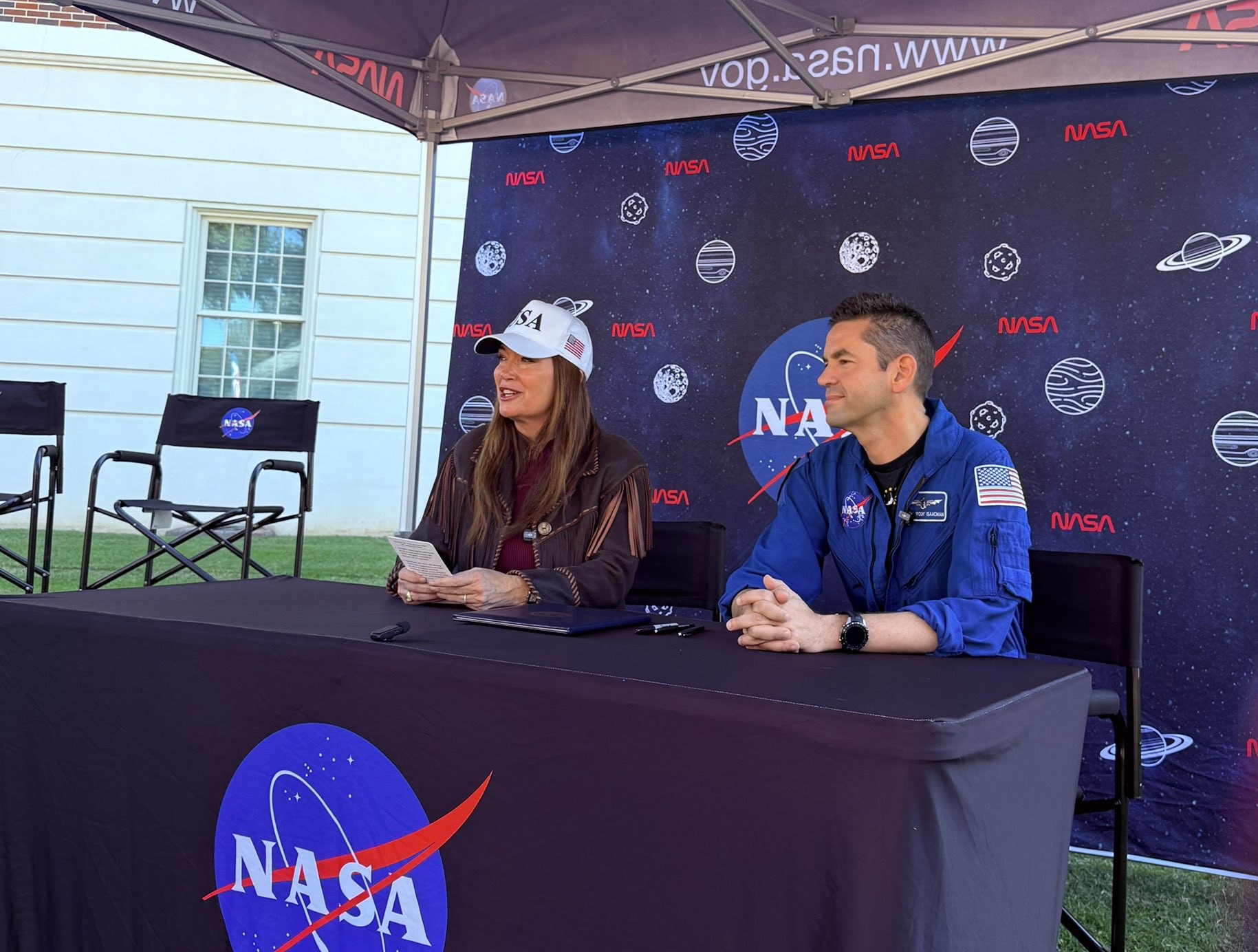
U.S. Secretary of Agriculture Brooke Rollins, left, and NASA Administrator Jared Isaacman signed a Memorandum of Understanding advancing agriculture and Earth science during an event at the University of Alabama in Tuscaloosa on Saturday, Oct. 24.
Credit: NASA

NASA and the U.S. Department of Agriculture (USDA) have signed a Memorandum of Understanding expanding cooperation in Earth observation, geospatial analytics, and advanced data technologies, supporting USDA’s data modernization plan for United States agriculture.

“NASA develops some of the most advanced sensing, computing, and analytical capabilities in the world, and we should put those tools to work wherever they can deliver meaningful outcomes for the American people,” said NASA Administrator Jared Isaacman. “By combining NASA’s Earth observation data and technical expertise with USDA’s knowledge of American agriculture, we can improve the information available to farmers and ranchers, strengthen our understanding of crop conditions and natural hazards, and pursue new high-risk, high-reward ideas that advance both science and American competitiveness.”

Isaacman and U.S. Secretary of Agriculture Brooke Rollins signed the agreement Oct. 24 during NASA’s Inspiration Tour at the University of Alabama in Tuscaloosa.

NASA and USDA’s longstanding partnership has supported collaborative research and data-sharing efforts that strengthen U.S. agriculture. The new agreement deepens this cooperation by focusing on improved data integration and enhanced coordination across Earth observation and agricultural applications.

“American farmers are the best in the world and deserve any solution we can leverage, even when it is out of this world. I am proud to announce that USDA will now work with Administrator Isaacman and NASA to utilize the full power of technology, research, and development to fortify U.S. agriculture,” said Rollins. “With this unprecedented partnership the Trump Administration is committing to a bright future of research and tech opportunities that will enhance USDA acreage and yield estimation and drive profitability for American agriculture.”

Under the new agreement, the agencies can explore activities in agricultural statistics, remote sensing science, modeling, geospatial data engineering, and super intelligence. NASA and USDA also will look at how to better align Earth observation data and analytical tools with agricultural needs, helping improve crop monitoring, acreage and yield estimates, and assessments of drought and other disasters.

The agencies will examine new approaches for managing and analyzing large datasets, strengthening USDA’s data systems while providing farmers, ranchers, and policymakers with more timely and reliable information.

For more information about NASA’s Earth science, visit:

https://science.nasa.gov/earth

-end-

Camille Gallo / Elizabeth Shaw  
Headquarters, Washington  
202-358-1600  
camille.m.gallo@nasa.gov / elizabeth.a.shaw@nasa.gov

Share

Details

Last Updated
Oct 26, 2026
Editor
Jennifer M. Dooren

NASA Armstrong Celebrates 80 Years of Flight Innovation

28 September 2026 at 15:20

On Sept. 30, 1946, five National Advisory Committee of Aeronautics (NACA) engineers arrived at Muroc Army Airfield in California’s high desert to achieve supersonic flight for the first time. In less than two years, NACA flew the X-1 aircraft faster than the speed of sound, marking an important milestone in aviation history.

Fast forward 80 years, and that former NACA outpost is now NASA’s Armstrong Flight Research Center in Edwards, California, flying the X-59 supersonic X-plane in the same skies to demonstrate that supersonic flight doesn’t have to come with a boom.

Over Armstrong’s 80-year history, the center has supported milestone missions ranging from space shuttle landings to SR-71 flights, shaping the evolution of science, aeronautics, and space research.

This Southern California NASA center is poised to lead the next era of aeronautics and human spaceflight, advancing technologies that will define the future of flight.

Fast facts

  • NASA Administrator Jared Isaacman recently named Armstrong as the agency’s Center of Excellence for Flight Test and Aircraft Operations, recognizing the center’s unmatched rigor in executing unique missions only NASA can fly.
  • To support NASA’s Artemis missions and return to the Moon, Armstrong uses research aircraft such as a 737 for astronaut suit testing, the G-III for Artemis II heat-shield data collection, and an F/A-18 aircraft that tested the autopilot for the SLS (Space Launch System) rocket.
  • NASA’s aeronautics centerpiece, the X-59, is undergoing rigorous testing and a series of flights at Armstrong to prepare for upcoming quiet supersonic demonstrations over U.S. communities.
  • NASA Armstrong has transformed commercial and military aviation — from early supersonic flight research to digital fly-by-wire — and continues working with other government agencies, industry, and academia to make flying safer, more autonomous, and more efficient.
  • The center plays a vital role in global science by flying aircraft like the ER-2, C-20A, and Gulfstream G-III/IV/V to collect critical data on wildfires, glacier melt, pollution, minerals, and more.

Behind these achievements are the engineers, pilots, technicians, and mission support teams who continue to push the boundaries of what’s possible.

For more about NASA Armstrong, visit:

https://www.nasa.gov/armstrong

-end-

Dede Dinius / Teresa Whiting
Armstrong Flight Research Center, Edwards, California
661-276-3449
darin.l.dinius@nasa.gov / teresa.whiting@nasa.gov

💾

Red, White, and Boom, the U.S. Air Force Test Center’s celebration of America’s 250th anniversary and NASA Armstrong’s commemoration of its 80th year, was Fr...
❌
❌