❌

Normal view

There are new articles available, click to refresh the page.
Before yesterdayMain stream

NASA JPL Testing Readies Voyager Technologies Lander for Moon Mission

By: albarne1
13 October 2026 at 09:00

4 min read

Preparations for Next Moonwalk Simulations Underway (and Underwater)

Engineers in white clean-room garb and hairnets guide a spacecraft suspended from a crane into a large thermal vacuum chamber inside a high-bay facility with an American flag hanging on the wall.
Engineers and technicians use a crane to position Voyager Technologies’ Griffin-1 lunar lander within the 25-Foot Space Simulator at NASA’s Jet Propulsion Laboratory on Aug. 31. The spacecraft recently completed a series of rigorous environmental tests at JPL ahead of launch to the Moon later this year.
NASA/JPL-Caltech
Engineers in white clean-room garb monitor a large spacecraft as it is hoisted by a yellow overhead crane in a hallway in a bright, high-tech laboratory. Framed photos line both sides of the hallway.
The testing team moves Voyager Technologies’ Griffin-1 through a hallway to the 25-Foot Space Simulator at JPL. The corridor features photos of the historic spacecraft that have been tested in the facility since the 1960s, from the Ranger program to NASA’s Europa Clipper.
NASA/JPL-Caltech

A commercial lander that will be at the forefront of NASA’s efforts to establish a Moon Base, humanity’s first lunar outpost, has passed a series of critical tests at the agency’s Jet Propulsion Laboratory in Southern California. The tests simulated the extreme temperatures and vacuum of space, as well as the intense shaking and ear-splitting roar of launch. Results show that Voyager Technologies’ Griffin Mission One (Griffin-1) spacecraft is ready to survive the rigors of space exploration.

As part of NASA’s CLPS (Commercial Lunar Payload Services) initiative within the Moon Base Program, Griffin-1 is expected to launch later this year aboard a SpaceX Falcon Heavy rocket. It will deliver more than 1,100 pounds (455 kilograms) of cargo to Nobile Crater near the lunar South Pole, which categorizes it as an infrastructure-class lander. Griffin-1 will carry 10 science and technology demonstrations from six countries, including the largest commercial payload ever delivered to the Moon, Astrolab’s FLIP (FLEX Lunar Innovation Platform) rover.

“NASA JPL’s Environmental Test Laboratory has been putting robotic explorers to the test since the Ranger program gave us NASA’s first up-close views of the Moon’s surface in the mid-1960s. We’re proud to provide our expertise and facilities to support this new phase of commercial lunar exploration,” said Charles Whetsel, manager, Exploration Systems Development Office at JPL.
A lunar lander equipped with dark solar panels and foil-wrapped legs sits on a platform inside a dark anechoic chamber lined with blue and gray foam spikes.
Long foam spikes that absorb sound waves and electromagnetic waves cover the walls of a specialized anechoic chamber at JPL where Voyager Technologies’ Griffin-1 underwent electromagnetic interference and electromagnetic compatibility testing.
NASA/JPL-Caltech

Griffin-1’s testing journey

Testing began in July after the 2,789-pound (1,265-kilogram) spacecraft took a cross-country road trip from Voyager Lunar Systems’ manufacturing facilities in Pittsburgh to JPL in the San Gabriel Mountain foothills. Engineers spun the spacecraft on a special table to measure its mass properties, a test that enables them to look for any unexpected wobbles as they assess how the lander will move through space. Data gathered in mass properties testing is key to understanding the spacecraft’s readiness for navigation in flight and landing on the lunar surface.

To make sure signals from the spacecraft’s electronic components don’t interfere with one another, Griffin-1 underwent electromagnetic interference and electromagnetic compatibility testing inside what’s called an anechoic chamber, in which long foam spikes line the walls to absorb sound and electromagnetic waves.

During vibration testing, hundreds of sensors monitored Griffin-1 as a “shaker table” rattled it in three directions, with increasingly intense force, to simulate the ride out of Earth’s atmosphere on a massive rocket. To mimic the roar of launch, giant horns, powered by compressed nitrogen gas, blasted the spacecraft with up to 153 decibels inside a sealed acoustic chamber.

Environmental testing took place in several clean-room facilities at JPL, culminating in the 25-Foot Space Simulator, a thermal vacuum chamber listed on the National Register of Historic Places for its role in supporting historic missions like those of the Ranger, Surveyor, Mariner, and Voyager programs. Dozens of other missions (along with plenty of upgrades to the testing facility) have followed over the decades, including the Perseverance Mars rover and Europa Clipper.

Engineers in white clean-room frocks monitor a silvery spacecraft spinning so rapidly it’s blurred on a test rig inside a bright laboratory.
Voyager Technologies’ Griffin-1 lunar lander spins on a special table in a test to measure its mass properties, which enables engineers to look for any unexpected wobbles as they assess how the vehicle will move through space. The test took place in JPL’s Environmental Test Laboratory on July 20.
NASA/JPL-Caltech
A silvery spacecraft sits on a test frame surrounded by microphones and testing equipment inside a bright white acoustic test chamber, while an engineer in a lab coat works nearby.
Microphones are arrayed around Griffin-1 on Aug. 12 during acoustic testing that mimics the intense roar of launch. Giant horns powered by compressed gaseous nitrogen blast the spacecraft with up to 153 decibels inside a sealed acoustic chamber at JPL.
NASA/JPL-Caltech

Beneath the thermal vacuum chamber’s soaring 85-foot (26-meter) ceiling, for about two weeks, Griffin-1 alternately baked at up to 167 degrees Fahrenheit (75 degrees Celsius) and froze at temperatures as low as minus 148 F (minus 100 C). This testing simulates the temperature extremes the lander will experience during its journey through the vacuum of space and its operations on the lunar surface.

“Griffin-1 is being built for a historic purpose: to deliver the infrastructure and capabilities to the Moon. Seeing the spacecraft complete this demanding environmental testing is a major milestone because it demonstrates that Griffin-1 is ready for the extreme journey ahead: launch, through deep space, to the lunar South Pole,” said John Thornton, executive vice president, Voyager. “This spacecraft represents a new era of commercial lunar exploration, where missions like Griffin-1 are laying the groundwork for the Moon Base and helping turn sustained lunar exploration from a vision into a reality.”

After proving its mettle at JPL, Griffin-1 has returned to Voyager Lunar Systems’ facility for final assembly. Next up: launch-readiness operations before shipment to Cape Canaveral.

To learn more about the Moon Base, visit:

https://www.nasa.gov/moonbase

Media Contact
Melissa Pamer
Jet Propulsion Laboratory, Pasadena, Calif.
626-314-4928
melissa.pamer@jpl.nasa.gov

2026-071
What’s Up: October 2026 Skywatching Tips from NASA

1 October 2026 at 12:58

A Meteor Shower and the Moon Near the Pleiades

See Saturn at opposition, catch the Orionid meteor shower, and watch the Moon pass close to the Pleiades, also known as the Seven Sisters.

Skywatching Highlights

  • Oct. 4: Saturn reaches opposition, making the ringed planet visible for much of the night
  • Oct. 6: A thin crescent Moon appears close to bright Jupiter before sunrise
  • Oct. 21–22: The Orionid meteor shower peaks; moonlight may interfere, so look before dawn after moonset
  • Oct. 27–28: The Moon passes near the Pleiades star cluster, also known as the Seven Sisters
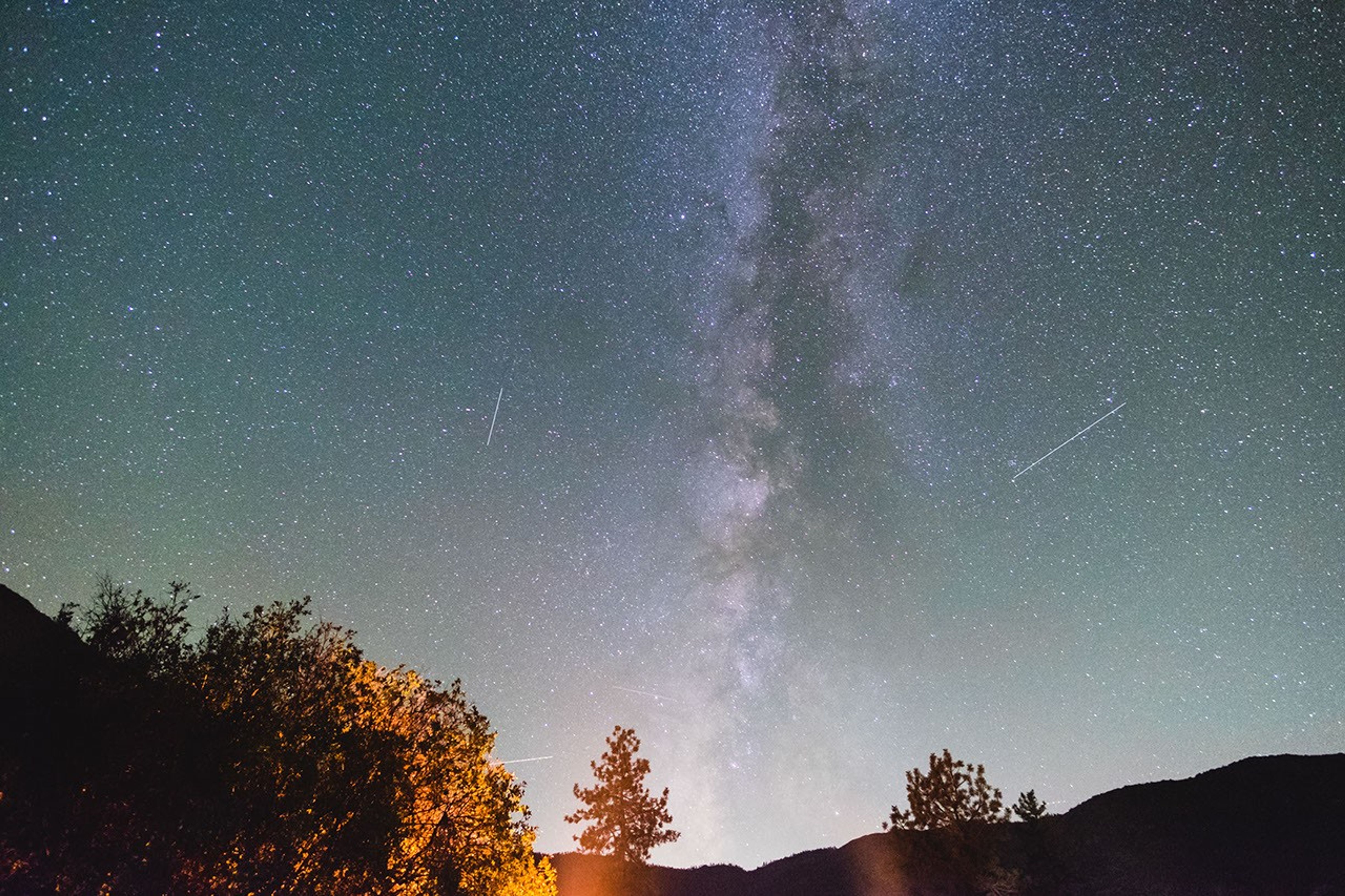
A long-exposure photograph of a clear night sky filled with countless stars, featuring the bright, dust-filled band of the Milky Way galaxy stretching vertically through the center. Faint streaks of light from meteors are visible across the sky. Along the bottom, dark silhouettes of trees and distant mountain ridges frame the horizon, with warm light glowing softly behind the foliage on the lower left.
Meteors streak across the sky during the 2017 Orionid meteor shower, with the Milky Way visible overhead.
Ben Goldstein via Flickr_CC BY-NC-SA

Transcript

Saturn takes center stage, a meteor shower lights up the sky, and the Moon visits the Seven Sisters. That’s What’s Up for October. 

A night sky chart labeled
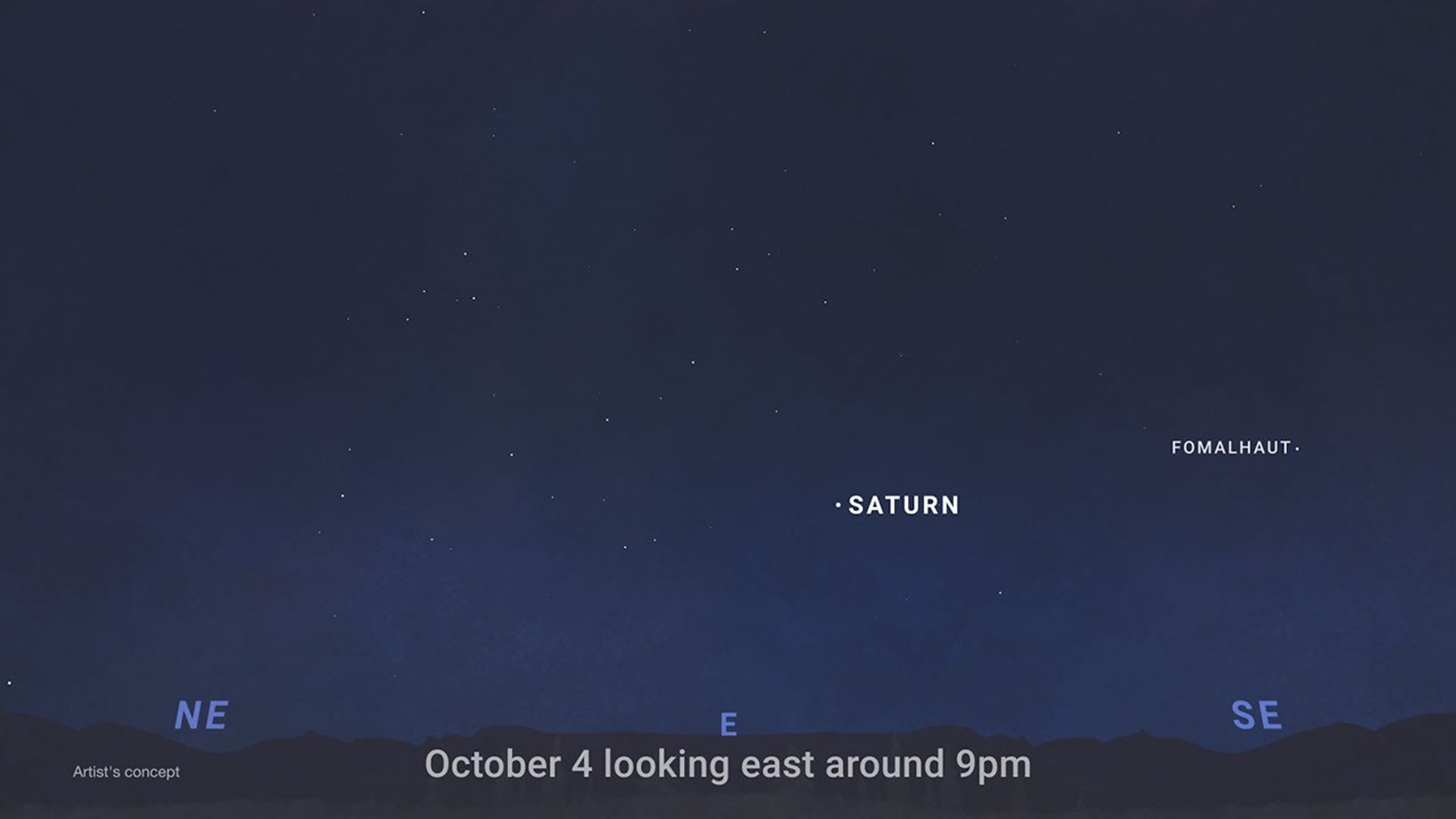
A sky chart showing Saturn above the eastern horizon on Oct. 4, 2026, around 9 p.m.
NASA/JPL-Caltech

On October 4th, Saturn reaches opposition, giving skywatchers one of the year’s best opportunities to see the ringed planet. Opposition happens when Earth passes between the Sun and Saturn. That puts Saturn opposite the Sun in our sky, so it rises around sunset and stays visible for much of the night.

Astronomers have long known about a hexagon-shaped jet stream that spans nearly 20,000 miles across Saturn’s north pole. But just last month, observations using NASA’s Hubble Space Telescope revealed a ten-sided atmospheric wave encircling the planet’s south pole. This southern hemisphere feature appears to be strengthening, giving scientists the rare opportunity to watch a giant atmospheric pattern develop.

A dark night sky chart labeled
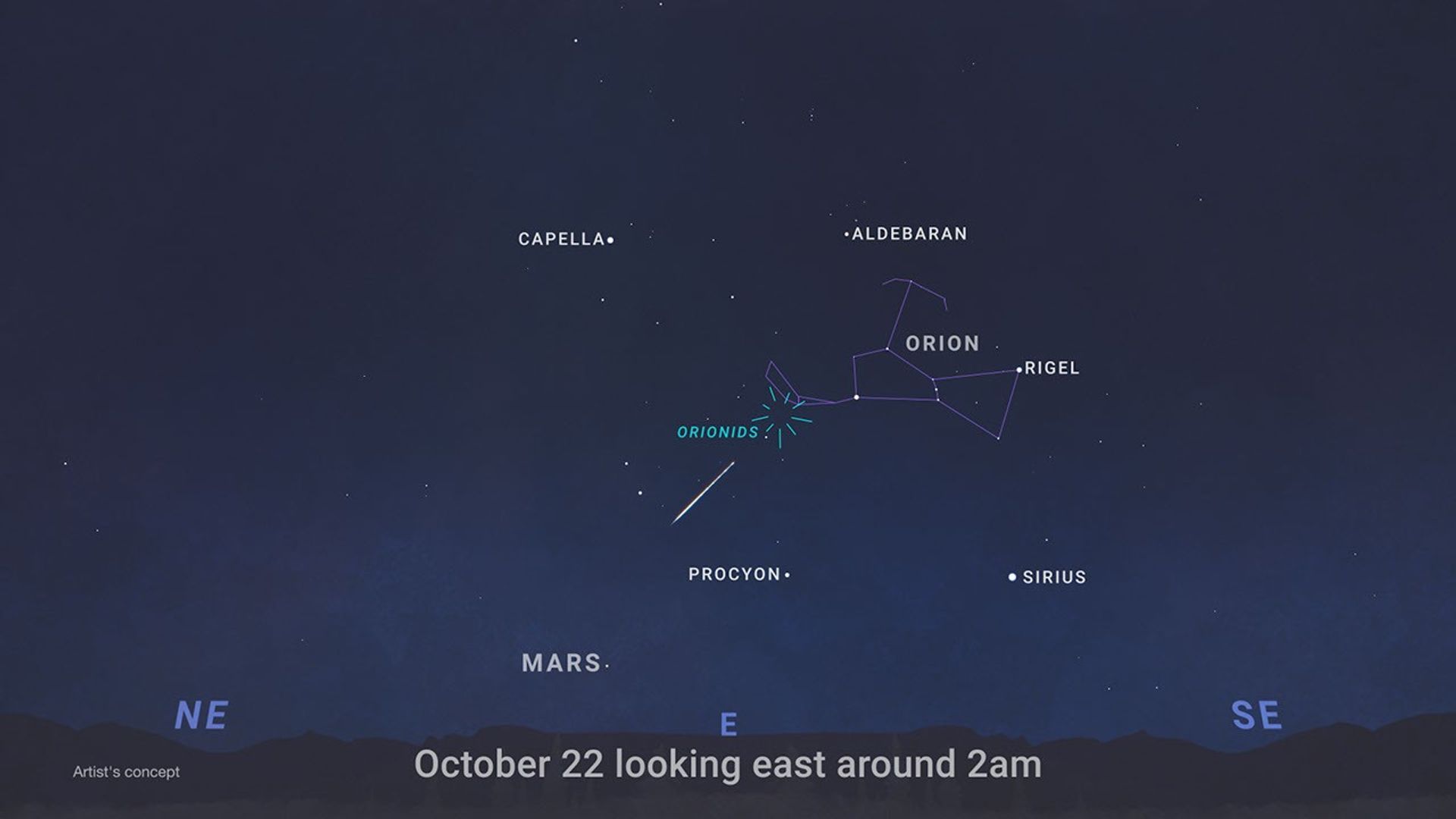
A sky chart illustrating where to view the Orionid meteor shower.
NASA/JPL-Caltech

The Orionid meteor shower peaks on the night of October 21st into the morning of October 22nd. The Orionids are created by tiny pieces of debris left behind by Halley’s Comet. They appear to radiate from the direction of Orion, but the meteors can streak across any part of the sky. A bright waxing gibbous Moon will wash out some of the fainter meteors this year. Your best chance may come in just a few hours before dawn, after the Moon sets. Find a dark location. Give your eyes time to adjust and look up.

A night sky chart labeled
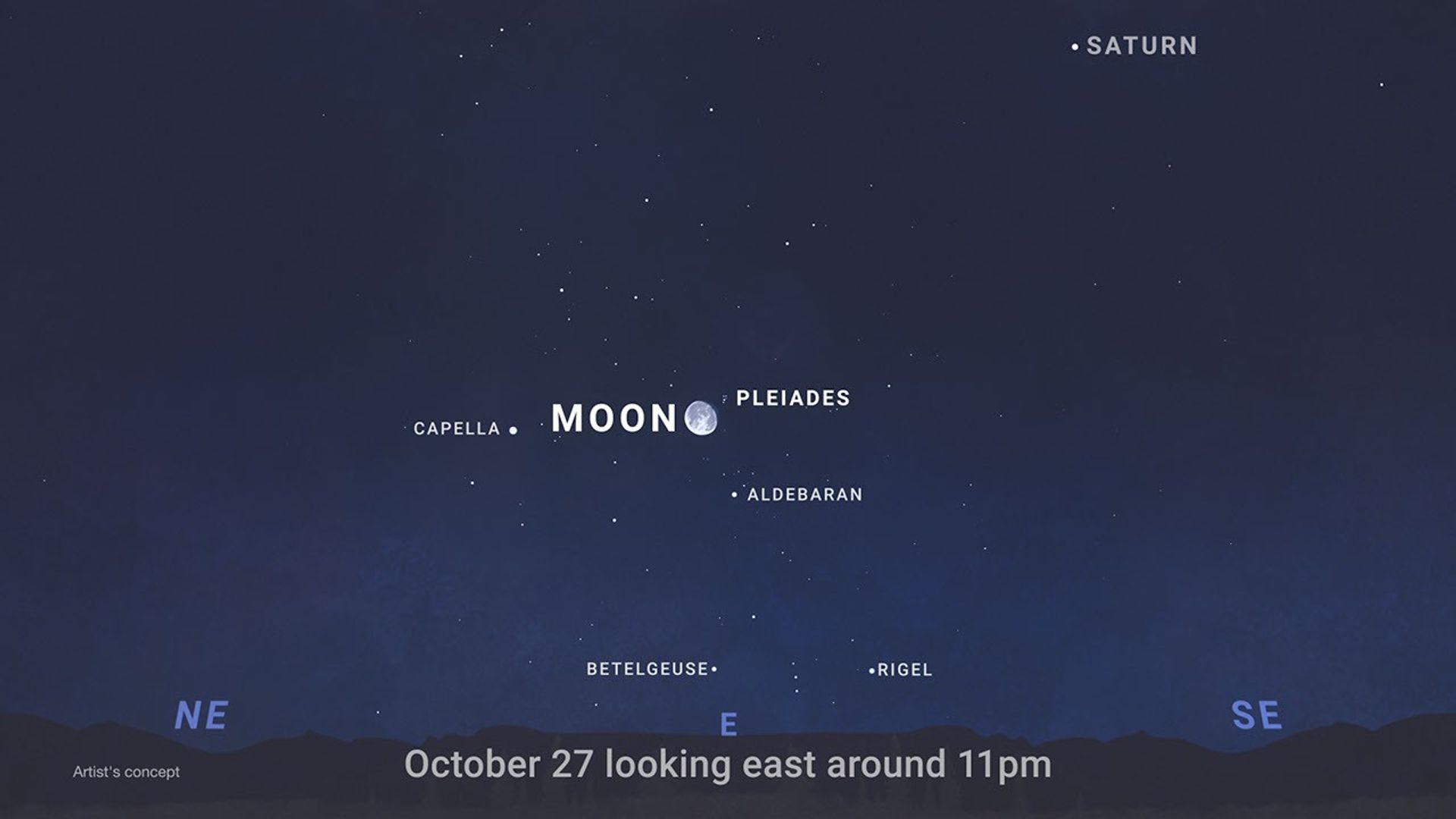
A sky chart showing the Moon next to the Pleiades on Oct. 27, 2026, looking east at around 11 p.m.
NASA/JPL-Caltech

On the night of October 27th into the 28th, look for the Moon passing close to a famous star cluster called the Pleiades, also known as the Seven Sisters. Many ancient cultures had stories associated with the Pleiades, due in part to the fact that the star cluster is visible from almost everywhere on the globe.

To spot them yourself, look east in the evening as the Moon and cluster climb higher into the night sky. The Pleiades appear as a slightly fuzzy grouping of 6 to 7 stars. They are visible to the unaided eye, but binoculars or a telescope reveal more spectacular detail.

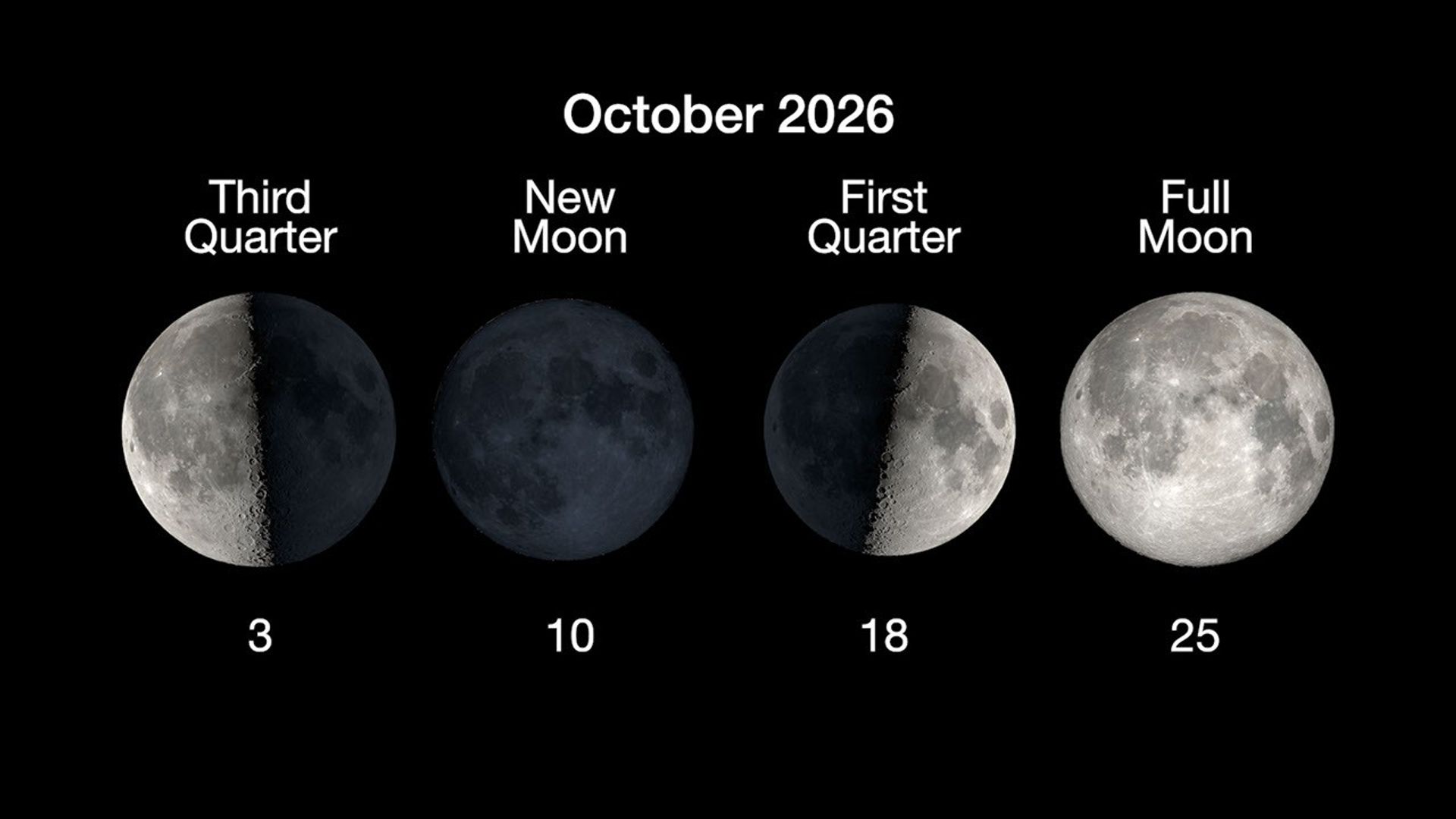
Here are the phases of the Moon for October.

An image titled
A chart showing the phases of Earth’s Moon in October 2026.
NASA/JPL-Caltech

You can stay up to date on all of NASA’s missions exploring the solar system and beyond at NASA Science.

I’m Raquel Villanueva from NASA’s Jet Propulsion Laboratory and that’s What’s Up this month.

Learn More and Get Involved

A stylized logo graphic showing silhouettes of an adult pointing toward the sky, while a child holding a telescope looks on.

Night Sky Network

The Night Sky Network is a nationwide coalition of amateur astronomy clubs bringing the science, technology, and inspiration of NASA’s missions to the general public.

The Milky Way spreads across a twilight sky over a desert landscape.

NASA Skywatching Resources

Expert skywatching tips and more from our experts.

❌
❌