Login
Login
NASA Study Finds Near-Earth Asteroid Is Actually Comet
5 min read
Preparations for Next Moonwalk Simulations Underway (and Underwater)
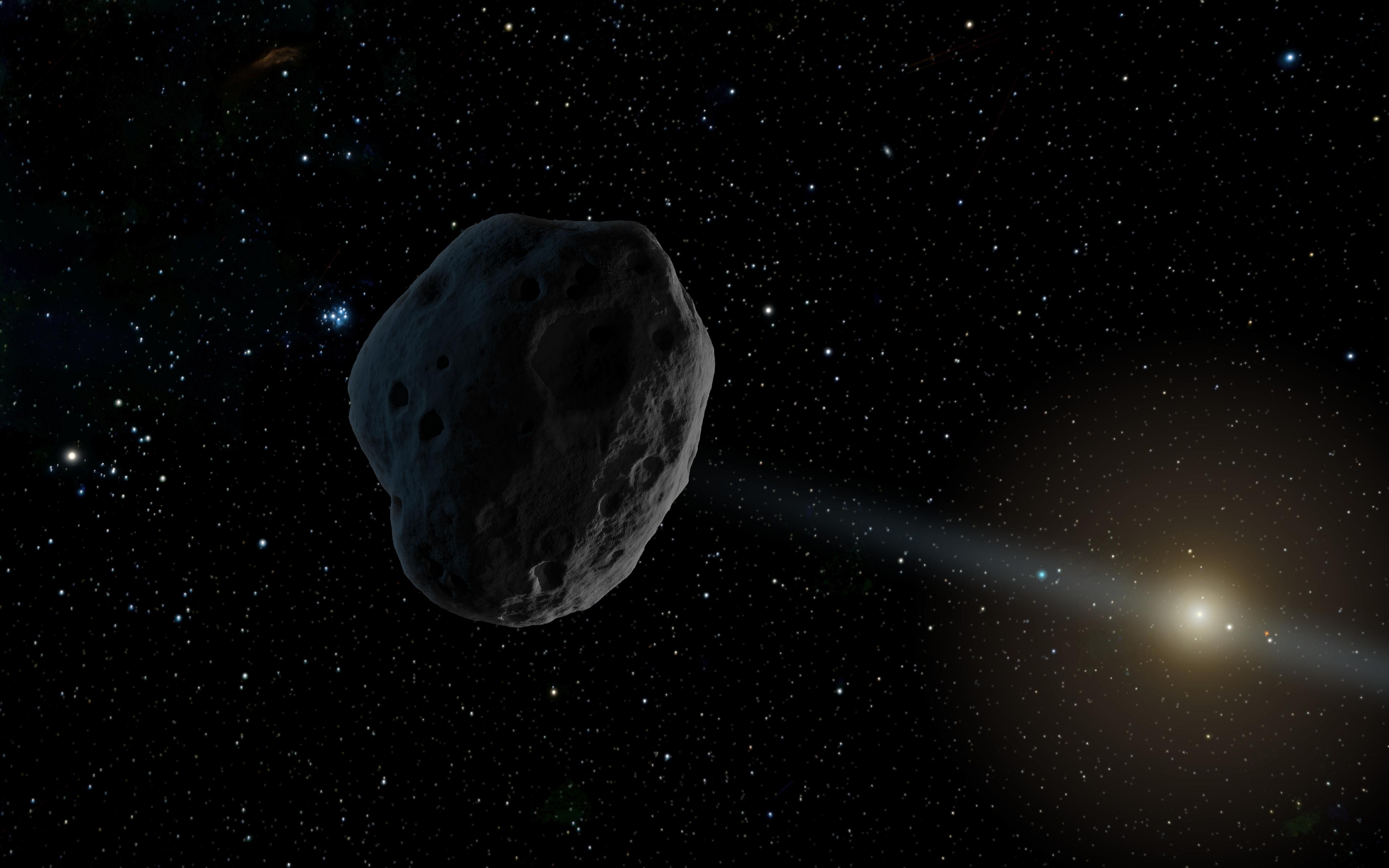
New research led by scientists at NASA’s Jet Propulsion Laboratory in Southern California has revealed the identity of a puzzling near-Earth object by precisely tracking its motion through space and using powerful observatories that image faint celestial objects.
This object has a dual personality: Past images hadn’t revealed obvious cometlike activity, suggesting it might be an asteroid, but its motion recently proved to be irregular like that of a comet. The scientists detailed their findings in a study published in the journal Nature Astronomy.
The puzzle began on Aug. 28, 2025, when the object, provisionally known as the asteroid 1998 SH2, passed safely within 2 million miles (3 million kilometers) of our planet during its 4½-year orbit around the Sun. Researchers looking to observe 1998 SH2 with NASA’s Deep Space Network (DSN) planetary radar system had calculated its position using data from previous orbits and factored in the effects that the gravity of the Sun and planets would have on its path. But when 1998 SH2 didn’t show up where they expected, they realized that something unanticipated had been influencing the object’s motion.
Object tracking
By using optical astrometry to precisely measure the object’s position in the sky, the researchers were able to identify the cause.
“After we measured the nongravitational perturbations affecting the motion of 1998 SH2 and recognized they weren’t compatible with the object being an asteroid, we suspected the object could be an active comet,” said Davide Farnocchia, a navigation engineer with NASA’s Center for Near-Earth Object Studies at JPL and study lead.
Although 1998 SH2’s orbit around the Sun had been well-tracked from 1998 to 2016, the object had completed two solar orbits without additional observations by telescopes until the 2025 DSN attempts. Analyzing all observations collected since the object’s discovery in 1998, researchers determined the perturbations to 1998 SH2’s motion and hypothesized that the object may be generating a small thrust by venting gas into space, causing it to deviate from its predicted path.
This venting results from the Sun heating ice mixed with rocky material, turning the ice into a gas. With regular comets, this activity forms a trademark bright tail and coma — the gas and dust surrounding a comet’s nucleus. But when an object produces gas and dust in much smaller quantities, its tail and coma may not be detectable to most observatories.
Tail, coma emerge
The August 2025 close approach to Earth of 1998 SH2 provided the perfect opportunity for the paper’s authors to gather observational evidence of visible cometary activity. They reached out to astronomers at the Canada-France-Hawaii Telescope, a 3.6-meter (12-foot) optical/infrared telescope near the summit of Mauna Kea, Hawaii, and the 1.5-meter (5-foot) European Southern Observatory’s Danish Telescope in La Silla, Chile, to observe. Astronomers at the powerful European Southern Observatory’s 8.2-meter (27-foot) Very Large Telescope on the Chilean mountain Cerro Paranal also tracked the object.
“The images we collected from these observatories showed a weak but clear tail, thus confirming that 1998 SH2 is, in fact, a comet,” said Olivier Hainaut, an astronomer with the European Southern Observatory and coauthor of the study. “That’s how science works — you form a hypothesis, and you set out to test it. This data is exactly what was needed to confirm our hypothesis that 1998 SH2 was a comet.”
As an outcome of the investigation, 1998 SH2 will receive an additional comet provisional designation, P/1998 SH2.
Planetary defense implications
The research also sheds light on another, even more unusual, class of objects called dark comets. Like 1998 SH2, dark comets exhibit significant irregularities, or perturbations, in their trajectory but lack other visible evidence of comet activity — there’s no coma, tail, or visible outgassing. These enigmatic objects fall into two distinct populations: larger ones with orbits similar to those of Jupiter-family comets (short period comets with highly elliptical, or eccentric, orbits), and smaller ones that orbit closer to the Sun. Since the 2016 discovery of the first dark comet, about a dozen more have been identified.
The paper’s authors suggest that many of the larger dark comets, which have orbits like 1998 SH2’s, could turn out to be regular comets if astronomers get the right opportunity to observe them with powerful telescopes capable of imaging incredibly faint objects. And by analyzing the motion of all near-Earth objects using precision astrometry data, researchers may reveal more comets that were previously designated as asteroids if they exhibit cometlike nongravitational perturbations.
“This work shows the importance of continuously tracking near-Earth objects,” said Farnocchia. “Because of outgassing, the motion of comets is more significantly perturbed than that of asteroids. Detecting these perturbations can be an important diagnostic tool for planetary defense that will help understand which objects may be comets rather than asteroids, how their orbits evolve, and how that influences their Earth impact risks.”
Hunting for near-Earth objects
NASA’s upcoming Near-Earth Object (NEO) Surveyor will collect data that can be used to support this effort. The first space survey telescope to be built for planetary defense, this next-generation mission will seek out some of the hardest-to-find near-Earth objects, such as dark asteroids and comets that don’t reflect much visible light.
NASA’s Center for Near Earth Object Studies, the Goldstone Solar System Radar Group, and NEO Surveyor all are managed by JPL and supported by the agency’s Planetary Defense Coordination Office in Washington. Caltech in Pasadena manages JPL for NASA. The DSN receives programmatic oversight from the SCaN (Space Communications and Navigation) program office, also at NASA headquarters.
More information about planetary radar, NASA’s Center for Near Earth Object Studies, and near-Earth objects can be found at:
https://www.jpl.nasa.gov/asteroid-watch
News Media Contacts
Ian J. O’Neill
Jet Propulsion Laboratory, Pasadena, Calif.
818-354-2649
ian.j.oneill@jpl.nasa.gov
Karen Fox / Molly Wasser
NASA Headquarters, Washington
202-358-1600
karen.c.fox@nasa.gov / molly.l.wasser@nasa.gov
2026-046
Details
Explore More
Discover Related Topics
Asteroids, Comets & Meteors
Asteroids, comets, and meteoroids are chunks of rock, ice, and metal left over from the formation of our solar system…

Near-Earth Observations (NEO) Program
The Near-Earth Object (NEO) Observations Program is a key element of NASA’s Planetary Defense Program, funding efforts to search for undiscovered…
Comets
Introduction Comets are cosmic snowballs of frozen gases, rock, and dust that orbit the Sun. When frozen, they are the…
NEO Surveyor
Overview Building on the success of NASA’s NEOWISE space telescope, the agency’s NEO Surveyor will be the first spacecraft built…