
Normal view

There are new articles available, click to refresh the page.
Before yesterdayGeekWire

Tech Moves: AWS government tech VP departs; Funko, Coinme and DAT Freight add to C-suite

14 August 2026 at 11:41
Dave Levy. (LinkedIn Photo)

Dave Levy, vice president of AWS Worldwide Public Sector, has left Amazon for a role at Google, according to Nextgov/FCW. An AWS spokesperson confirmed his departure; Google did not respond to a request for comment. Levy, who is based in Arlington, Va., was with AWS for more than nine years. He was previously head of U.S. government sales at Apple for 12 years.

Amazon first launched government-specific cloud infrastructure in 2011 and now supports more than 11,000 government agencies. In November, the company announced it would invest up to $50 billion to expand AI and advanced computing infrastructure for U.S. government agencies. That includes support for Top Secret, AWS Secret and AWS GovCloud (US), which serve classified and sensitive workloads.

David Appel, VP of AWS Global Government, National Security and Defense, has taken Levy’s role in an acting capacity, according to his LinkedIn account. Levy’s last day was July 31.

Kristin Hamilton. (LinkedIn Photo)

Kristin Hamilton has been named chief commercial officer for Funko, the Everett, Wash.-based makers of pop culture collectibles. Hamilton joined from Crunchyroll, a division of Sony Pictures Entertainment. She was previously at Hasbro for nearly 15 years, leaving as the consumer products division’s head of strategy and transformation. Hamilton begins work Aug. 24.

Funko has weathered financial and leadership bumps in recent years, with a quick succession of CEOs and the accumulation of significant debt. The company this month reported a strong second quarter with increased sales over the previous year.

Laurent Reichert. (Coinme Photo)

— Seattle cryptocurrency company Coinme has named Laurent Reichert as chief compliance officer, consumer protection officer and Bank Secrecy Act officer. Reichert, who is based in Miami, was previously chief compliance and risk officer for the blockchain company Paxos.

In January, Coinme announced that it had agreed to be acquired by blockchain payments company Polygon Labs. Polygon said it would also acquire wallet provider Sequence as part of a combined deal valued at more than $250 million.

Reichert praised Coinme’s currency trading platform, adding that he looks forward to “the next phase of growth, both domestically and as we move into new international markets alongside Polygon.”

DAT Freight & Analytics, a Beaverton, Ore.-based truckload freight marketplace, announced changes to its leadership team.

  • John Xiao has been promoted to chief technology officer, leading work on DAT’s tech platform, analytics and AI integration. He joined the company two years ago from Nordstrom, where he oversaw technology strategy in merchandising, supply chain and inventory management.
  • Marcus Womack, who joined DAT last year through the acquisition of his fintech startup Outgo, is now responsible for DAT’s carrier segment in addition to financial services.
  • Kary Jablonski, former CEO of Trucker Tools, which DAT acquired in 2024, continues to lead DAT’s broker business and is also responsible for marketing and customer support.

All three are based in DAT’s Seattle office. The company won GeekWire’s Workplace of the Year Award in May.

Emily Rabe. (LinkedIn Photo)

— Seattle’s Membrion has promoted Emily Rabe to vice president of technology. Rabe has been with the industrial wastewater treatment startup for six years, leading its intellectual property efforts and most strategic technology programs while also working with external technology partners.

“She has a remarkable ability to take on hard, ill-defined problems, learn quickly and put durable solutions in place,” the company said on LinkedIn.

The startup made two additional promotions: Ryan Flores has risen to senior scientist, and Michael Moreland has been promoted to senior customer success engineer.

Membrion spun out of the University of Washington a decade ago, has raised $40 million and is No. 154 on the GeekWire 200, a ranked index of the Pacific Northwest’s top startups.

— Microsoft’s Jordi Ribas has been appointed to the board of Sprinklr, a company helping global brands manage their customer experience, social media, ads and other marketing. Ribas has been with Microsoft for 26 years, currently as president of search and AI.

— Seattle biotech company Omeros has named Joseph Schocken to its board of directors. In 1987, Schocken founded the investment bank Broadmark Capital, now Tranceka Capital.

Jay Carney, who served as Amazon’s senior vice president of global corporate affairs for seven years ending in 2022, has left his position as Airbnb‘s global head of policy and communications. He did not indicate his next role.
Etzioni on AI: Claude is marking its text — Caveat Promptor!

13 August 2026 at 13:31
Anthropic will embed an invisible mark in text generated by new Claude models. (GeekWire Illustration)

Claude models launched on or after Aug. 2 embed an invisible mark in everything they write. It’s woven into the text itself, so it travels when you copy and paste. You didn’t opt in, you can’t see it, and you can’t turn it off.

Anthropic confirmed on Tuesday that it’s watermarking Claude’s output and published a support page with the details. The trigger is Article 50 of the EU AI Act, which took effect August 2, along with the Code of Practice on Transparency of AI-Generated Content. About 190 organizations signed the code, though only 82 signed the section that covers marking. Anthropic, Google, OpenAI, Meta, Microsoft and Mistral are on that list.

The rule was written in Brussels, but the effect lands on anyone using Claude anywhere.

Here’s how text watermarking works. When Claude writes a sentence, it’s constantly choosing among words that would all work fine. The watermark tilts those choices toward a pattern Anthropic’s software can recognize. Nothing is hidden between the letters or in the spaces. The pattern is the word choices, which is why it survives copy and paste.

Until now, a claim that you used AI rested on a hunch or on a style detector that guesses from tone and rhythm. This is different: a statistical test with a computable error rate.

Two things follow. First, a single sentence is too short to mark. Second, and this one the internet got wrong: when I ask Claude to fix the punctuation in a paragraph I wrote, Claude has to reproduce my words, so there’s nowhere to put a watermark.

Radio host Erick Erickson announced that he’d “ditched Grammarly for Claude for proofreading,” and now his own writing “will be watermarked that Claude did the work.” Depending on the extent of Claude’s input, he could be safe, because minor proofreading edits (i.e., punctuation) don’t make room for a watermark. 

Watermarking text raises several issues, though. A mark means Claude modified the text, not that Claude wrote it. Have it summarize or condense a memo you wrote yourself and it comes back marked, though every idea in it is yours. Beatrice Nolan noted in Fortune that a flat AI label treats someone generating a thousand fake news videos the same as a writer cleaning up a paragraph. Worse, the absence of a mark proves nothing. The results of older models, and other non-marking models, all come back “clean.”

Removal is harder than the workaround crowd assumes. Paraphrasing degrades the signal but rarely erases it, because a rewrite keeps enough of the original wording to rebuild the statistic. Researchers who tested this on similar schemes found watermarks still detectable after a strong human paraphrase, once there was enough text to work with.

Anthropic hasn’t shipped a detector. Yet. It hasn’t published a false positive rate, and hasn’t said how many words it takes. The mark is going into text that no one outside the company can read, but the marks are still consequential because they don’t expire. The essay a college freshman turns in this fall is still marked when she’s a junior and someone finally has a tool to read it.

Technical problems aside, it’s important to highlight the core problem that watermarks aim to solve. Chris Best, Substack’s CEO, put it eloquently in the July post that coined Claudefishing:

“The core problem is not people using AI, or the quality of its output. Not everything made with AI is slop, and not all slop is made with AI. The problem is when there is a mismatch between a reader’s expectation and reality, especially when they unwittingly invest their attention in something with no human thought on the other end. That’s Claudefishing.”

That’s a harm worth addressing, and it’s the one a watermark can’t reach. A mark can’t tell slop from careful work. It tells you a model was involved. What that means depends on how it was used.

Personally, I use Claude and have mixed feelings about watermarks. On the one hand, AI use should be disclosed appropriately. On the other hand, anyone determined to hide their AI use can still do so by using xAI (no watermark on Grok), or open-weight models that carry no watermarks. So what impact will the mark have in practical terms?

My conclusion is to judge the outcome, not the tool. I used Claude extensively in writing and researching this column, as I described in AI coach or AI ghostwriter, and I’m pleased with the result. Where do you stand?

How this longtime Google exec fits an insane amount of exercise into his weekly routine

13 August 2026 at 11:55
Jeff Dean, co-founder and CEO of Discovery Loop. (Photo via KDD.org)

Jeff Dean has spent decades flexing his brain to solve some of computing’s hardest problems. Turns out the Google legend and UW computer science alum has been pushing his physical limits just as hard.

In an exchange on X this week, the former Google chief scientist — who recently left the tech giant after 27 years to launch the scientific AI startup Discovery Loop — laid out a weekly training routine that looks less like a tech executive’s calendar and more like a triathlete’s.

In addition to running or biking to work three or four directions a week, Dean, 58, says he’s mixing in a couple trips to the gym, a couple yoga sessions, and a couple games of soccer in a 25-and-over league. He also does a longer run or bike ride on the weekend.

We got winded just scrolling through the comments.

Soccer (2 games/wk in my 25-and-over league), gym 2x/wk, yoga 2x/wk, run to work 3-4 directions/wk (8k each way), bike to work 3-4 directions/wk (8k each way), longer run or bike on weekend.

— Jeff Dean (@JeffDean) August 11, 2026

People wanted to know how Dean took care of his knees (squishy shoes), whether he came up with great ideas while exercising (definitely), when he showers (at work), and if he sleeps (usually seven hours).

In GeekWire’s Slack channel this morning, co-founder John Cook, a longtime soccer player, expressed his own surprise.

“He’s playing soccer twice per week in an over-25 league — that is total bad ass,” Cook wrote. “I can barely run in my over-50 league!”

Dean earned his Ph.D. in computer science from the University of Washington in 1996 before joining Google as employee No. 30. He achieved tech-legend status by helping to build the company’s core computing architecture over nearly three decades.

His new venture, Discovery Loop, is an ambitious public benefit corporation aimed at using AI to automate the scientific method — running thousands of parallel experiments to accelerate breakthroughs in fields like drug discovery, materials science, and machine learning.

Dean’s dive into his exercise routine came up because of a slide he shared at KDD 2026, a conference in Jeju, South Korea. The slide was a play-by-play of his final 48 hours at Google (Aug. 5–7), detailing the whirlwind around his departure and startup launch.

Along with breaking the news to Google colleagues and announcing the launch of Discovery Loop, Dean spent last Wednesday responding to hundreds of well wishes — while squeezing in a yoga session and a soccer game. He went to bed at 2:30 a.m. and was up at 6:30 a.m. Thursday to respond to hundreds more messages.

He was technically unemployed for exactly one second at midnight on Thursday.

He probably spent it stretching.

Indeed, it has been quite a week, so I thought I'd share it with the KDD 2026 audience! For my Google colleagues who might have sent me internal chat messages after I closed my laptop for a final time on Thursday afternoon, I apologize for my lack of response!

(Zoomed in) https://t.co/lnBtuqM0q5 pic.twitter.com/VqyLMPBDSV

— Jeff Dean (@JeffDean) August 11, 2026

Google to cut 52 employees in Washington state

5 August 2026 at 13:54
Google’s Kirkland Urban campus in Kirkland, Wash. (GeekWire File Photo / Kurt Schlosser)

Google is laying off 52 employees in Washington state, according to a state filing released Wednesday.

The job cuts include software engineers, engineering and product managers, mechatronics engineers, UX designers and recruiters located in Kirkland, Redmond and Seattle offices as well as remote employees.

The layoffs are scheduled to take effect in September and early October. The notice from Google filed with the state’s Employment Security Department did not provide an explanation for the cuts.

GeekWire has reached out to Google for comment and will update if one is forthcoming.

Business Insider reported layoffs in the Google Cloud division earlier this summer, but did not say how many jobs were impacted.

While Microsoft, Amazon and other tech companies have cut Washington employees in multiple rounds over the past year, this is Google’s the first significant reduction in the state since 2023. In January of that year, Google parent Alphabet shed 12,000 workers globally or 6% of its workforce. It did not indicate how many jobs were lost in Washington.

Washington is one of Google’s largest engineering hubs outside of its Bay Area headquarters. It opened offices in the state more than 20 years ago, with a focus on Android, Chrome, Cloud, Maps, Ads and other projects.

Zillow Group this week disclosed it is eliminating 91 jobs in Washington state, landing heavily on senior staff.

The startup idea that convinced a UW computer science legend to leave Google after 27 years

5 August 2026 at 13:23
Google veterans leaving to launch Discovery Loop, from left: Oriol Vinyals, Sanjay Ghemawat, Jeff Dean, and Quoc Le. (Discovery Loop Photo)

Speaking in June at the University of Washington Allen School commencement, AI pioneer Jeff Dean told computer science graduates how he “got the itch to join a startup in 1999,” landing at Google when it had a grand total of 20 people above what is now a T-Mobile store in Palo Alto.

Twenty-seven years later, now 58, the UW alum has the itch again.

Google announced Wednesday that Dean, its chief scientist, is leaving with three colleagues to launch Discovery Loop, a startup automating the process of scientific research: proposing experiments, running them, evaluating results, and iterating, thousands of times over.

“Imagine a future where a handful of people can conduct scientific research and engineering tasks much more rapidly, and with higher quality, than massive teams of scientists and engineers do today,” they write on their website.

Discovery Loop is based in Palo Alto, with what it describes as a lean team of its own. Joining Dean are Google senior fellow Sanjay Ghemawat, his collaborator of more than two decades; Google DeepMind research VP Oriol Vinyals; and Google Brain co-founder Quoc Le.

Google is a founding investor and will supply computing power for at least the first year. Discovery Loop is structured as a public benefit corporation, with backing from Radical Ventures and Khosla Ventures (a name Seahawks fans will recognize from the team’s incoming ownership group).

The departures came as part of a broader shakeup announced in a memo from CEO Sundar Pichai. Demis Hassabis is handing off day-to-day leadership of Google DeepMind to become its chair and Alphabet’s chief scientist, while CTO Koray Kavukcuoglu steps up as SVP, overseeing Gemini model development. Alphabet shares fell about 4% after the announcement

“After an incredible 27-year run, Jeff Dean is at a moment where he wants to try something new, and we’re excited to support him in that,” Pichai wrote.

Dean, who earned his UW computer science Ph.D. in 1996, gave no hint of his plans at the Allen School commencement. He told Wired the idea came together only in recent weeks.

But the general theme was there. Listing problems he thought worth solving, he pointed the UW graduates toward “developing tools that accelerate scientific discovery and engineering.”

“One of the beauties of software,” he said during his commencement address, “is that small groups of people can build things that have enormous impact in the world.”

New map traces Washington state’s tech ‘universe’ to a few key hubs, and shows what’s at risk

By: Ken Yeung
31 July 2026 at 09:00
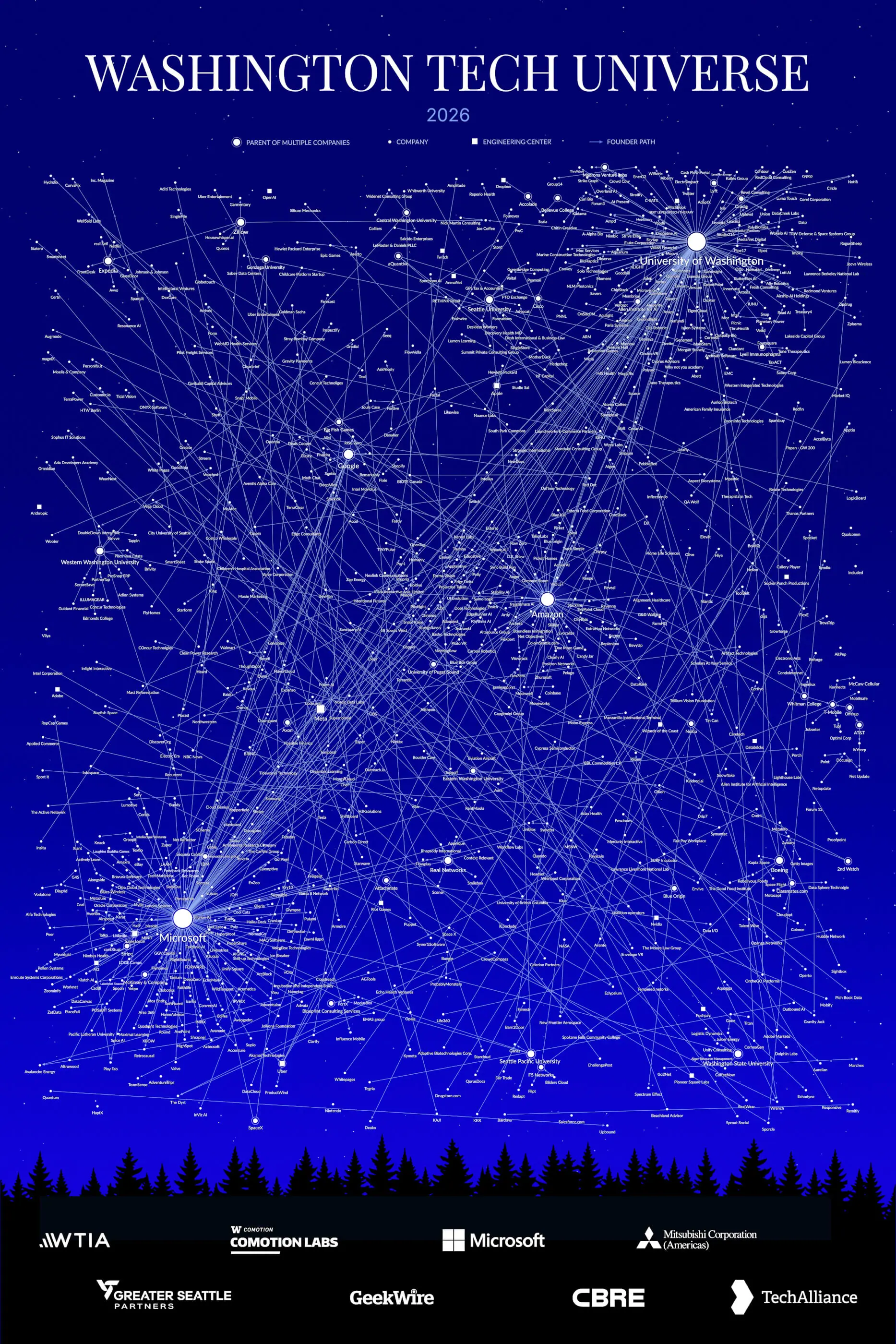
A small slice of the new “Washington Tech Universe” map. See the full version here.

How interconnected is Washington’s tech industry? Enough that a large share of the state’s companies can trace their lineage to Microsoft, the University of Washington, Amazon, and a handful of other institutions.

A new visualization from the Washington Technology Industry Association (WTIA), unveiled this week, charts those family trees. But the “Washington Tech Universe” map offers only a partial view: Washington is home to 25,000 tech companies, and just 625 are featured.

“This is not a ranker of all the best companies,” said Nick Ellingson, WTIA’s vice president of innovation and entrepreneurship, during a presentation at Seattle Tech Week. The point, he said, is to show the region’s connectivity and to make the case for investing in the community as a whole.

The “Tech Universe Map” comes 11 years after the trade group published a similar visualization. According to Ellingson, the update came because people kept asking for it, not because of a single event. It’s unrelated to WTIA’s efforts to help Washington establish a public AI narrative.

That said, the 2026 edition is markedly different from the one in 2015: The new map looks at the entire state, aiming to comprehensively chart the connections among different companies, while the prior version was limited to companies in Seattle, with a more narrow focus on acquisitions and similar data.

Microsoft and UW produce the most founders

WTIA’s data shows that today, Washington has four main founder “hubs,” with Microsoft being the largest. About a quarter of the mapped companies — 161 of 625 — have at least one founder who came out of Microsoft. UW is the second with 143 companies, followed by Amazon, which anchors 58 firms. Google rounds out the group with 20 connections, though it’s a pipeline that didn’t exist in WTIA’s 2015 map.

WTIA’s Vice President of Innovation and Entrepreneurship, Nick Ellingson, unveils the 2026 “Tech Universe Map” at the University of Washington’s Comotion Lab on July 27, 2026, explaining how to read the map. (Photo by Ken Yeung, click to enlarge)

UW isn’t the only school producing founders. WTIA’s map traces company lineages to Washington State, Western Washington, Central Washington, Eastern Washington, Whitman College, Seattle University, and Seattle Pacific. Still, UW accounts for 70% of the map’s university connections.

Broken down, the data shows that nearly two out of three companies (64%) grew out of another company listed on WTIA’s map. A third came out of a university, or out of a company that operates in Washington without being headquartered here.

Google is the clearest example of the latter since it’s based in California but has a significant presence here. Moreover, WTIA found that 44% of mapped companies had founders who previously worked at two or more Washington organizations before starting theirs.

Ellingson called the hubs “gravity wells that bend the entire region toward the next generation of founders” in the announcement.

However, he cautioned that this pipeline concentrated around four main sources could be a risk. Some of the hubs he expects to grow next, such as Google, OpenAI, Anthropic, and Nvidia, are headquartered elsewhere and maintain engineering centers here, a presence that is easier to scale back. Microsoft, Amazon, and UW aren’t going anywhere. The next generation of hubs has no such guarantee.

The Washington Tech Universe map. See the full version here.

To mitigate this risk, Ellingson called for broad community support for these hubs, saying it would keep the flywheel going.

These companies, he said, “are growing not just the jobs at their companies, but they’re creating the next employers, venture-scale startups, and tech companies that go on to build amazing things, and hire the next generation of talent here and bring more talent to the area, who then go and create their own startups.”

The next hubs are forming around AI

WTIA also recognized AI’s impact on Washington’s tech ecosystem. Although the technology was not a formal selection criterion, it became evident that AI would be a dominant theme among the featured companies. In fact, firms like Read AI, Karat, Yoodli, Outreach, and Pictory appear on the map for the first time. And Ellingson revealed that “many of the startups on the map are AI startups.”

“Twenty-three percent of the AI talent in the United States is here in Seattle,” he said.

That, along with the burgeoning startup ecosystem, is why organizations like the Allen Institute for AI (Ai2) and AI House, are poised to have large constellations of their own. AI House was formerly the AI2 Incubator. It spun out as an independent entity in 2022 and rebranded in June.

WTIA noted that Ai2 is the first research lab on its map to operate as a “founder factory.”

Other AI companies making their presence known on the “Tech Universe Map” include OpenAI and Anthropic. While not Washington-native, both AI model makers have established or expanded their outposts in the state since 2015.

Ellingson predicted that, like Ai2, both would eventually become major hubs.

How companies were selected

UW alumni Jessica Forcucci explains her design process in creating WTIA’s 2026 “Tech Universe Map.” (Photo by Ken Yeung)

To create the “Tech Universe Map,” WTIA started out with a dataset of 3,500 Washington-based tech companies with at least $1 million in funding or revenue according to PitchBook.

The group was filtered further to those that were headquartered or had notable engineering centers in the state, were still active, and had “meaningful” Washington-grown connections through founder or university lineage. The GeekWire 200 was also used in the process.

WTIA enlisted the help of UW graduate Jessica Forcucci and a team of designers to create the visualization. In brief remarks, Forcucci explained her vision for the “Tech Universe Map,” saying the goal was to “demonstrate the interconnectivity” these companies had with each other.

Predicting what the next map will look like

As Washington’s tech ecosystem evolves, Ellingson predicted there will not only be bigger constellations of AI companies, but also quantum, fusion and advanced energy, and space and defense. He believed more tech clusters will blossom statewide beyond King County.

Ellingson said WTIA is seeing real growth in Wenatchee, the Tri-Cities and Spokane. Those regional clusters are small now, he said, but he expects them to be substantial by 2031.

To make the next map happen, Ellingson urged people to open doors for others, make introductions without expecting anything in return, and give first, building community and forming new constellations.

Posters of the Tech Universe Map are available for purchase.

Note: GeekWire is a media sponsor of the Tech Universe Map project.

❌
❌