
Normal view

There are new articles available, click to refresh the page.
Before yesterdayGeekWire

McGraw Hill acquires Teachally, an AI startup for teachers led by Seattle tech vet Daniel Bernstein

2 September 2026 at 18:02
Teachally founder Daniel Bernstein is also known in Seattle tech as the founder of Sandlot Games.

Daniel Bernstein spent much of the past decade as an M&A advisor, selling other people’s software companies. This time the company was his own, and he found a buyer in McGraw Hill.

The education publishing giant on Wednesday announced the acquisition of Teachally, a small startup led by Bernstein in Bothell, Wash., that uses AI to help teachers build and customize lessons, assignments and assessments aligned to state standards.

Financial terms weren’t disclosed. The deal has closed, and all five employees have joined McGraw Hill, with Bernstein taking the title of senior advisor for Teachally integration and growth. He declined to say what the company sold for or how much it had raised, but said the outcome was good for him and his investors.

“We didn’t take in a pile of money,” Bernstein said, explaining that the company brought in a small group of angels and was able to stay focused and effective.

The five-person team is spread across three continents: Bernstein and a colleague in the Seattle area, co-founder and CTO Rushil Makkar in Melbourne, Australia, a customer success lead in Arizona and a developer in Ethiopia.

Bernstein is best known in Seattle tech circles for Sandlot Games, the game studio he started in a spare bedroom in Bothell in 2002 and sold to Digital Chocolate in 2011, after developing casual gaming hits including “Cake Mania” and “Tradewinds.” He later founded the mobile game startup UpTap.

Bernstein spent the following decade on the other side of deals, as a software M&A advisor at Corum Group and then at his own firm, Hemisphere Partners, which ran Teachally’s sale.

Teachally raised a small round from local angels about nine months ago, and later opted to try an M&A process. An edtech M&A specialist representing the company approached a small group of potential buyers, and Bernstein said he hit it off immediately with McGraw Hill over a shared view of what curriculum and instruction should look like in the age of AI.

Teachally focuses on teachers rather than students, developing technology for what the industry calls high-quality instructional materials, or HQIM, which is the standards-aligned curriculum that many states and districts have pushed schools to adopt.

The startup was working with about eight school districts at the time of the sale — fully commercialized, Bernstein said, but “still very much an early stage company.” It was named a top edtech product for curriculum and instruction by District Administration magazine in January.

Bernstein said he had to learn an entirely new industry after two decades in games. The M&A work helped: he’d taken other edtech companies to market before building one.

Teachally itself started as something else. The company was founded as EZ Reward, maker of EZ Stickerbook, a digital sticker chart teachers used to reward students and message parents. Bernstein pivoted the company about three years ago to focus on AI for teachers.

McGraw Hill, which went public last year and reported $2.1 billion in revenue in its most recent fiscal year, said the deal will let it develop and localize K-12 curriculum faster and put AI tools in front of teachers already using its content.

“This acquisition provides a great opportunity to accelerate our AI strategy in ways that directly support educators and strengthen how we develop and deliver our K–12 products globally,” said Jana Thompson, interim president of the company’s School group, in the announcement.

Teachally is now live as a McGraw Hill product, with its own page on the company’s site.

Bernstein said it’s a second exit both for him and for some of the angels who have backed him along the way. “It’s a good Seattle story once again,” he said.
Madrona’s annual IA40 list shows an AI industry splitting in two

1 September 2026 at 17:22
The winners on Madrona’s 2026 Intelligent Applications 40 list, grouped by funding stage. (Madrona Image)

Seattle-based venture capital firm Madrona released its sixth annual Intelligent Applications 40 list this week, naming 45 private AI companies (the five extras come from ties) that have collectively raised $410 billion from investors across the industry.

Three of them — Anthropic, OpenAI and Databricks — account for 92% of that total.

The uneven distribution of funding reflects a larger split in the tech industry, as the largest AI companies make huge bets on the computing capacity needed to meet demand for their models, while almost everyone else builds businesses on top of them.

The frontier labs are “increasingly funded by strategic capital from the likes of Amazon, Google, Nvidia and SoftBank rather than traditional venture,” Madrona’s Matt McIlwain and Rolanda Fu wrote in a post accompanying the list. That scale, they added, “makes every other category on this list look capital light by comparison.”

On top of that, he said, hundreds of billions of dollars are flowing into OpenAI and Anthropic.

“And what I say to both the big tech companies and to the people funding the model companies: thank you very much,” McIlwain said on Bloomberg TV, noting that the five largest tech companies will spend an estimated $750 billion in capital expenditures this year.

But even setting those big three aside, McIlwain said, the rest of the winners have raised an average of more than $800 million each. That’s a total of $34 billion combined. Companies across the list are raising far more than they used to, enough that Madrona had to redraw its own categories.

The list sorts companies by total capital raised, and this year the ceiling for “early stage” rose to $50 million, up from the $30 million threshold that held for the previous five lists. The cutoff for “emerging enablers,” its category for smaller infrastructure companies, doubled to $100 million.

“Companies across the board are raising more money, and the definition for what ‘early’ means continues to shift higher,” McIlwain and Fu wrote.

Madrona has published the IA40 since 2021 as a roster of the private companies it considers most important in building and enabling AI applications. According to the firm, this year’s list drew on input from 72 investors representing 54 venture and corporate firms, who nominated and voted on more than 450 companies, with PitchBook data factored into the scoring.

Two Seattle-area companies made this year’s list:

Last year’s list included two other Seattle-area companies in addition to Clarify.

  • OpenAI acquired one of them, Bellevue-based Statsig, for $1.1 billion in September 2025, making Statsig founder Vijaye Raji its CTO of applications.
  • Security startup Dropzone AI, which was on the list last year, did not repeat this year.

Madrona, one of the Seattle region’s largest and oldest venture capital firms, is an investor in all four — Clarify, Gradial, Statsig and Dropzone AI — although it also invests outside the region, and many of the companies on the IA40 are not in its portfolio.

Several of the companies on this year’s list have engineering centers in the Seattle region, including Anthropic, which leased 113,000 square feet in South Lake Union this year; OpenAI, which expanded to nearly 300,000 square feet in downtown Bellevue after the Statsig acquisition; and Anduril, which employs about 560 people in Bellevue and Seattle.

Databricks, the San Francisco-based data and AI company (which leased 142,000 square feet in Bellevue this year), is the only company to appear on all six IA40 lists. That said, 23 of last year’s 40 winners returned this year, a 58% repeat rate, up from 33% the year before.

McIlwain and Fu wrote that the biggest and most established companies on the list are holding their spots, noting that “the age of experimentation is giving way to an age of enterprise readiness,” with buyers and investors “paying premiums for companies that can demonstrate real ROI.”

Madrona will recognize the winners at its IA40 Summit in Seattle on Sept. 29 and 30.

Updated with Matt McIlwain’s comments to Bloomberg TV.

Washington to receive up to $339M in landmark $17B settlement over Meta social media addiction claims

26 August 2026 at 12:16
Meta must overhaul Instagram and Facebook for young users by enforcing daily time limits, turning off push notifications during school hours, and blocking access late at night. (BigStock Photo)

Washington state will receive up to $339 million as part of a historic $17.1 billion multistate settlement with Meta, resolving allegations that the tech giant intentionally designed Facebook and Instagram with addictive features that harmed youth mental health.

Attorney General Nick Brown said Wednesday that the landmark agreement delivers on core youth-safety product changes — including hard caps on daily time limits, late-night scrolling blocks, and disabled push notifications during school hours — that state lawmakers failed to pass through legislation over the past two years.

“Let me say to the young people of Washington state: This agreement shows that your health and safety is more important than Meta’s profits,” Brown said in a news release.

Under the deal, Meta must overhaul Instagram and Facebook for young users by enforcing a two-hour combined daily time limit, turning off push notifications during school hours (8 a.m. to 3 p.m.), and blocking access late at night between midnight and 6 a.m. Teen users will also get the option to switch off algorithmic feeds in favor of a chronological timeline.

The agreement resolves claims brought by a coalition of 47 states, Washington, D.C., and three territories. While Meta acknowledged the settlement could cost up to $18 billion total over 10 years, it marked a rare legal resolution for a major platform facing nationwide youth safety litigation.

Outside the landmark Big Tobacco agreements of the late 1990s, the $17.1 billion deal represents the largest state consumer protection settlement in U.S. history. State officials and tech policy experts are framing the enforcement action as a similar watershed moment for regulating algorithmic harms and digital product design.

Washington state will receive a guaranteed baseline of $237 million from the core youth-safety agreement, with its payout potentially scaling up to nearly $339 million over the next decade if other major platforms like TikTok and Snapchat adopt comparable terms.

The Attorney General’s Office plans to use the funds to cover legal costs, bolster ongoing consumer protection enforcement, and directly fund state programs tackling the youth mental health crisis driven by social media use.

The settlement also mandates an independent third-party auditor to evaluate and report Meta’s technical compliance directly to state regulators annually over the next five years. Beyond usage limits, Meta must restrict social comparison features such as targeted beauty filters, hide public “like” counts for younger users, and implement stricter age verification to prevent children under 13 from creating accounts.

In addition to the core youth-safety agreement, Washington will receive a separate $10.2 million payment resolving long-standing state claims against Meta for sharing nonpublic user data with third parties like Cambridge Analytica during the 2016 election cycle.

Oregon Attorney General Dan Rayfield announced that his state’s share will total more than $125 million over 10 years. 

In a public statement, Meta praised the agreement as setting a new benchmark for youth safety, while emphasizing that the restrictions should apply across the entire industry.

“While this is an important step, these protections will only be truly effective if our peers — TikTok and YouTube — put the same measures in place,” a Meta spokesperson said.

The agreement remains subject to final judicial approval in federal district court.

Seattle Tech Week notebook: AI, startups, and the best insights and takeaways we heard

31 July 2026 at 13:44
Seattle Tech Week attendees fill AI House at Pier 70, spilling onto the deck overlooking Elliott Bay. (GeekWire Photos / Todd Bishop)

Attending as many Seattle Tech Week events as possible and talking with as many people as I could, I was struck by the number of people looking for work and the volume of visitors from the Bay Area, including a number of investors looking to get a sense for what the regional tech scene is about.

It was hard not to imagine them being impressed with the sheer level of engagement and enthusiasm, even if they didn’t happen to catch Jacob Colker’s rallying cry. With more than 250 events (and waiting lists for many of them) it was more than any one person could take in.

It wasn’t Seattle AI Week — that’s still to come in October — but given the moment in tech and the world, the topic of artificial intelligence was naturally the main throughline of the week.

A panel that changed my perspective was early in the week, called “Foundation Models Go Vertical,” hosted by the Seattle pre-seed firm Ascend at Washington 1000 downtown. Founding general partner Kirby Winfield told the room that 600 people had tried to get in.

One of the biggest insights was from Manos Koukoumidis, CEO of Kirkland-based Oumi and a former Google Cloud AI engineering manager who led large language model efforts there.

From left: moderator Boaz Ashkenazy of the Shift AI podcast, Manos Koukoumidis of Oumi, Patrick Thompson of Clarify, Brian Hall of Mistral AI, and Ben Gaffney of OpenAI at the “Foundation Models Go Vertical” panel, hosted by Ascend. (GeekWire Photo / Todd Bishop)

Companies that are racing to build on top of the frontier models, he said, are renting a kind of intelligence that has very little to do with their own businesses.

“Enterprises are using a model that is trained on 5% of the world’s data that sits on the web, not the other 95%,” he said, referring to the data sitting inside their own organizations.

Which led him to the question (and the point) that I keep coming back to: If the intelligence at the center of the product belongs to someone else, he asked, “are you really an AI company, or an application company on top of somebody else’s intelligence?”

The next day, in the audience for a recording of the Founded & Funded podcast by Seattle Tech Week organizer Madrona, I posed the question that we debated on last week’s episode of our GeekWire Podcast: what should Seattle founders and investors make of venture numbers that rank Philadelphia, Austin, and New York ahead of them?

It was the right place to ask, given that the show featured Nizar Tarhuni, EVP for research and market intelligence at PitchBook, which tracks the numbers, and Madrona partner Sabrina Albert.

PitchBook’s Nizar Tarhuni and Madrona partner Sabrina Albert during a live recording of Madrona’s Founded & Funded podcast at Seattle Tech Week. (GeekWire Photo / Todd Bishop)

Albert pointed out that the numbers don’t capture everything. A company can have a big engineering group in Seattle, or even a co-founder here, and still be counted as a Bay Area company, she said. Large engineering offices for OpenAI and Anthropic are the latest examples.

Tarhuni made a similar point: “There’s so much talent in some of the biggest unicorns that are actually working out of Seattle,” he said. In terms of overall economic activity, he added, “there’s a lot more here that doesn’t make its way into those numbers.”

Other quotes and insights that stood out from the sessions we attended:

Patrick Thompson, CEO of Seattle-based Clarify, said his company’s Anthropic bill had tripled in three months. He has shifted spending to AWS Bedrock, citing reliability problems, and now runs smaller models locally on his own laptop for low-level work.

Madrona’s Albert, on the shift to selling outcomes: “Before, when you were thinking about traditional software, you would charge for a seat or a unit of software. But now you can really fundamentally change it. … If I deliver this outcome for you, then you can actually pay me for it.”

Ken Horenstein, founder of Pack Ventures, which invests in startups tied to the University of Washington, on the knock that Seattle is slow: research institutions here are “choosing problems that are 10, 15, 20, 50-year problems,” he said. “Sometimes people put that as a negative rap on us because we don’t go really fast and flame really bright like you might see in other markets. But I actually think that can be used as a benefit.”

Ben Gaffney, deputy general counsel at OpenAI, on the notion that AI is thinning out headcount: “Even within the legal team that I work in, we need more people. Even though we’re getting all these massive productivity gains, it isn’t like you don’t need people to supervise this stuff.”

Brian Hall, the longtime Microsoft, AWS and Google executive who became chief marketing officer at Mistral AI in June, on where this all ends up: “We’re gonna laugh when we thought that AI was gonna save us time.”

Ascend’s Winfield, on the limits of what investors provide: “If I invested in you, it’s not because I’m smart about your market. It’s because you’re smart about your market. … If you’re looking for answers from your investors, you’re in trouble.”

Karl Siebrecht, co-founder and CEO of Flexe, at a networking event, telling founders to stop networking: “Spending time as a founder trying to market yourself to investors, I think, is a fallacy. If you focus on building a valuable company … I can promise you, investors will find you.”

Molly Klein, founder and CEO of Perk Events, who runs some of GeekWire’s biggest events, on why any of this happens in the first place: “Events are hands-down the strongest business development tool that you have,” she said. “One conversation may take six emails in three weeks. At an event, it happens in 10 minutes, because you’re getting that face-to-face time.”

That pretty much summed up the week.

New map traces Washington state’s tech ‘universe’ to a few key hubs, and shows what’s at risk

By: Ken Yeung
31 July 2026 at 09:00
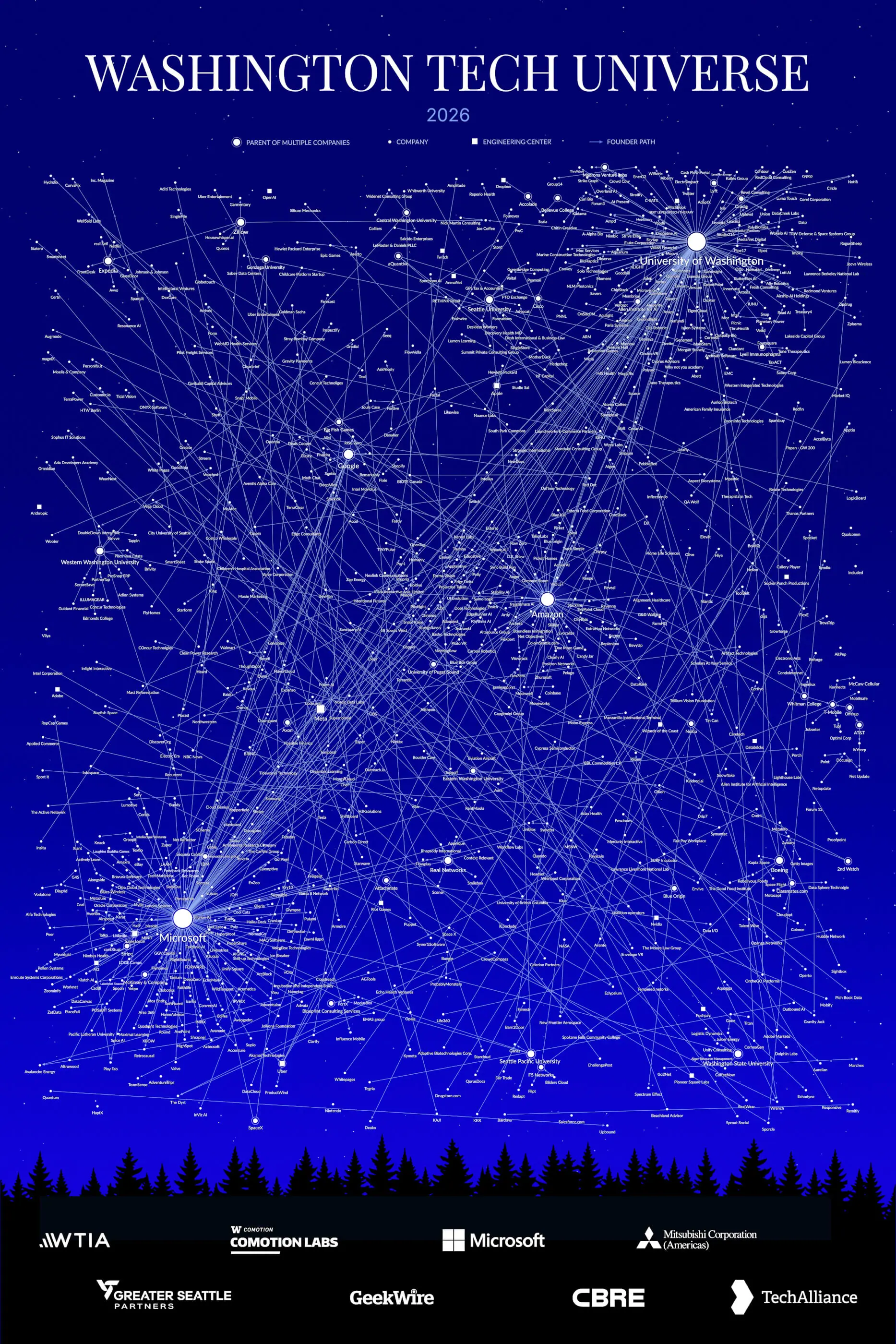
A small slice of the new “Washington Tech Universe” map. See the full version here.

How interconnected is Washington’s tech industry? Enough that a large share of the state’s companies can trace their lineage to Microsoft, the University of Washington, Amazon, and a handful of other institutions.

A new visualization from the Washington Technology Industry Association (WTIA), unveiled this week, charts those family trees. But the “Washington Tech Universe” map offers only a partial view: Washington is home to 25,000 tech companies, and just 625 are featured.

“This is not a ranker of all the best companies,” said Nick Ellingson, WTIA’s vice president of innovation and entrepreneurship, during a presentation at Seattle Tech Week. The point, he said, is to show the region’s connectivity and to make the case for investing in the community as a whole.

The “Tech Universe Map” comes 11 years after the trade group published a similar visualization. According to Ellingson, the update came because people kept asking for it, not because of a single event. It’s unrelated to WTIA’s efforts to help Washington establish a public AI narrative.

That said, the 2026 edition is markedly different from the one in 2015: The new map looks at the entire state, aiming to comprehensively chart the connections among different companies, while the prior version was limited to companies in Seattle, with a more narrow focus on acquisitions and similar data.

Microsoft and UW produce the most founders

WTIA’s data shows that today, Washington has four main founder “hubs,” with Microsoft being the largest. About a quarter of the mapped companies — 161 of 625 — have at least one founder who came out of Microsoft. UW is the second with 143 companies, followed by Amazon, which anchors 58 firms. Google rounds out the group with 20 connections, though it’s a pipeline that didn’t exist in WTIA’s 2015 map.

WTIA’s Vice President of Innovation and Entrepreneurship, Nick Ellingson, unveils the 2026 “Tech Universe Map” at the University of Washington’s Comotion Lab on July 27, 2026, explaining how to read the map. (Photo by Ken Yeung, click to enlarge)

UW isn’t the only school producing founders. WTIA’s map traces company lineages to Washington State, Western Washington, Central Washington, Eastern Washington, Whitman College, Seattle University, and Seattle Pacific. Still, UW accounts for 70% of the map’s university connections.

Broken down, the data shows that nearly two out of three companies (64%) grew out of another company listed on WTIA’s map. A third came out of a university, or out of a company that operates in Washington without being headquartered here.

Google is the clearest example of the latter since it’s based in California but has a significant presence here. Moreover, WTIA found that 44% of mapped companies had founders who previously worked at two or more Washington organizations before starting theirs.

Ellingson called the hubs “gravity wells that bend the entire region toward the next generation of founders” in the announcement.

However, he cautioned that this pipeline concentrated around four main sources could be a risk. Some of the hubs he expects to grow next, such as Google, OpenAI, Anthropic, and Nvidia, are headquartered elsewhere and maintain engineering centers here, a presence that is easier to scale back. Microsoft, Amazon, and UW aren’t going anywhere. The next generation of hubs has no such guarantee.

The Washington Tech Universe map. See the full version here.

To mitigate this risk, Ellingson called for broad community support for these hubs, saying it would keep the flywheel going.

These companies, he said, “are growing not just the jobs at their companies, but they’re creating the next employers, venture-scale startups, and tech companies that go on to build amazing things, and hire the next generation of talent here and bring more talent to the area, who then go and create their own startups.”

The next hubs are forming around AI

WTIA also recognized AI’s impact on Washington’s tech ecosystem. Although the technology was not a formal selection criterion, it became evident that AI would be a dominant theme among the featured companies. In fact, firms like Read AI, Karat, Yoodli, Outreach, and Pictory appear on the map for the first time. And Ellingson revealed that “many of the startups on the map are AI startups.”

“Twenty-three percent of the AI talent in the United States is here in Seattle,” he said.

That, along with the burgeoning startup ecosystem, is why organizations like the Allen Institute for AI (Ai2) and AI House, are poised to have large constellations of their own. AI House was formerly the AI2 Incubator. It spun out as an independent entity in 2022 and rebranded in June.

WTIA noted that Ai2 is the first research lab on its map to operate as a “founder factory.”

Other AI companies making their presence known on the “Tech Universe Map” include OpenAI and Anthropic. While not Washington-native, both AI model makers have established or expanded their outposts in the state since 2015.

Ellingson predicted that, like Ai2, both would eventually become major hubs.

How companies were selected

UW alumni Jessica Forcucci explains her design process in creating WTIA’s 2026 “Tech Universe Map.” (Photo by Ken Yeung)

To create the “Tech Universe Map,” WTIA started out with a dataset of 3,500 Washington-based tech companies with at least $1 million in funding or revenue according to PitchBook.

The group was filtered further to those that were headquartered or had notable engineering centers in the state, were still active, and had “meaningful” Washington-grown connections through founder or university lineage. The GeekWire 200 was also used in the process.

WTIA enlisted the help of UW graduate Jessica Forcucci and a team of designers to create the visualization. In brief remarks, Forcucci explained her vision for the “Tech Universe Map,” saying the goal was to “demonstrate the interconnectivity” these companies had with each other.

Predicting what the next map will look like

As Washington’s tech ecosystem evolves, Ellingson predicted there will not only be bigger constellations of AI companies, but also quantum, fusion and advanced energy, and space and defense. He believed more tech clusters will blossom statewide beyond King County.

Ellingson said WTIA is seeing real growth in Wenatchee, the Tri-Cities and Spokane. Those regional clusters are small now, he said, but he expects them to be substantial by 2031.

To make the next map happen, Ellingson urged people to open doors for others, make introductions without expecting anything in return, and give first, building community and forming new constellations.

Posters of the Tech Universe Map are available for purchase.

Note: GeekWire is a media sponsor of the Tech Universe Map project.

❌
❌