
Normal view

There are new articles available, click to refresh the page.
Before yesterdayMain stream

Seattle Tech Week notebook: AI, startups, and the best insights and takeaways we heard

31 July 2026 at 13:44
Seattle Tech Week attendees fill AI House at Pier 70, spilling onto the deck overlooking Elliott Bay. (GeekWire Photos / Todd Bishop)

Attending as many Seattle Tech Week events as possible and talking with as many people as I could, I was struck by the number of people looking for work and the volume of visitors from the Bay Area, including a number of investors looking to get a sense for what the regional tech scene is about.

It was hard not to imagine them being impressed with the sheer level of engagement and enthusiasm, even if they didn’t happen to catch Jacob Colker’s rallying cry. With more than 250 events (and waiting lists for many of them) it was more than any one person could take in.

It wasn’t Seattle AI Week — that’s still to come in October — but given the moment in tech and the world, the topic of artificial intelligence was naturally the main throughline of the week.

A panel that changed my perspective was early in the week, called “Foundation Models Go Vertical,” hosted by the Seattle pre-seed firm Ascend at Washington 1000 downtown. Founding general partner Kirby Winfield told the room that 600 people had tried to get in.

One of the biggest insights was from Manos Koukoumidis, CEO of Kirkland-based Oumi and a former Google Cloud AI engineering manager who led large language model efforts there.

From left: moderator Boaz Ashkenazy of the Shift AI podcast, Manos Koukoumidis of Oumi, Patrick Thompson of Clarify, Brian Hall of Mistral AI, and Ben Gaffney of OpenAI at the “Foundation Models Go Vertical” panel, hosted by Ascend. (GeekWire Photo / Todd Bishop)

Companies that are racing to build on top of the frontier models, he said, are renting a kind of intelligence that has very little to do with their own businesses.

“Enterprises are using a model that is trained on 5% of the world’s data that sits on the web, not the other 95%,” he said, referring to the data sitting inside their own organizations.

Which led him to the question (and the point) that I keep coming back to: If the intelligence at the center of the product belongs to someone else, he asked, “are you really an AI company, or an application company on top of somebody else’s intelligence?”

The next day, in the audience for a recording of the Founded & Funded podcast by Seattle Tech Week organizer Madrona, I posed the question that we debated on last week’s episode of our GeekWire Podcast: what should Seattle founders and investors make of venture numbers that rank Philadelphia, Austin, and New York ahead of them?

It was the right place to ask, given that the show featured Nizar Tarhuni, EVP for research and market intelligence at PitchBook, which tracks the numbers, and Madrona partner Sabrina Albert.

PitchBook’s Nizar Tarhuni and Madrona partner Sabrina Albert during a live recording of Madrona’s Founded & Funded podcast at Seattle Tech Week. (GeekWire Photo / Todd Bishop)

Albert pointed out that the numbers don’t capture everything. A company can have a big engineering group in Seattle, or even a co-founder here, and still be counted as a Bay Area company, she said. Large engineering offices for OpenAI and Anthropic are the latest examples.

Tarhuni made a similar point: “There’s so much talent in some of the biggest unicorns that are actually working out of Seattle,” he said. In terms of overall economic activity, he added, “there’s a lot more here that doesn’t make its way into those numbers.”

Other quotes and insights that stood out from the sessions we attended:

Patrick Thompson, CEO of Seattle-based Clarify, said his company’s Anthropic bill had tripled in three months. He has shifted spending to AWS Bedrock, citing reliability problems, and now runs smaller models locally on his own laptop for low-level work.

Madrona’s Albert, on the shift to selling outcomes: “Before, when you were thinking about traditional software, you would charge for a seat or a unit of software. But now you can really fundamentally change it. … If I deliver this outcome for you, then you can actually pay me for it.”

Ken Horenstein, founder of Pack Ventures, which invests in startups tied to the University of Washington, on the knock that Seattle is slow: research institutions here are “choosing problems that are 10, 15, 20, 50-year problems,” he said. “Sometimes people put that as a negative rap on us because we don’t go really fast and flame really bright like you might see in other markets. But I actually think that can be used as a benefit.”

Ben Gaffney, deputy general counsel at OpenAI, on the notion that AI is thinning out headcount: “Even within the legal team that I work in, we need more people. Even though we’re getting all these massive productivity gains, it isn’t like you don’t need people to supervise this stuff.”

Brian Hall, the longtime Microsoft, AWS and Google executive who became chief marketing officer at Mistral AI in June, on where this all ends up: “We’re gonna laugh when we thought that AI was gonna save us time.”

Ascend’s Winfield, on the limits of what investors provide: “If I invested in you, it’s not because I’m smart about your market. It’s because you’re smart about your market. … If you’re looking for answers from your investors, you’re in trouble.”

Karl Siebrecht, co-founder and CEO of Flexe, at a networking event, telling founders to stop networking: “Spending time as a founder trying to market yourself to investors, I think, is a fallacy. If you focus on building a valuable company … I can promise you, investors will find you.”

Molly Klein, founder and CEO of Perk Events, who runs some of GeekWire’s biggest events, on why any of this happens in the first place: “Events are hands-down the strongest business development tool that you have,” she said. “One conversation may take six emails in three weeks. At an event, it happens in 10 minutes, because you’re getting that face-to-face time.”

That pretty much summed up the week.
VC is changing dramatically — what’s a founder to do? 

29 July 2026 at 15:00
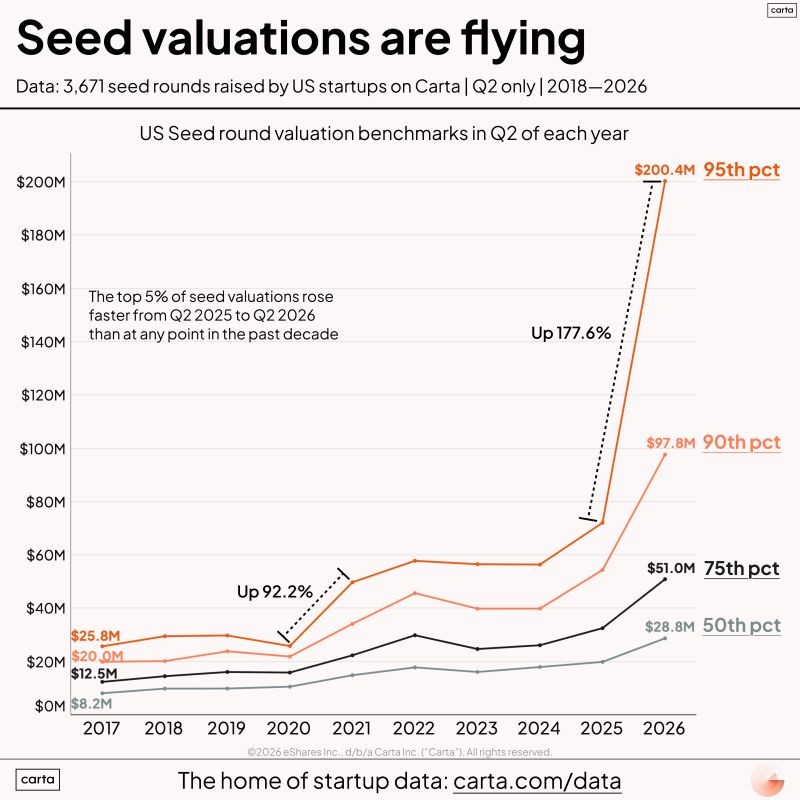
Click to enlarge. The top 5% of U.S. seed-round valuations reached $200.4 million in Q2 2026, up 177% from a year earlier, even as fewer companies were funded. (Chart: Peter Walker / Carta)

Guest Opinion: When I moved to Seattle in 2000 and started in venture capital, I read the book “The Silicon Boys: And Their Valley of Dreams,” which told the story of how venture capital drove the innovation ecosystem.

Entrepreneurs toiled day and night in their garages. Venture capitalists discovered these entrepreneurs, writing “small” checks for ownership and partnering side by side to build blue-chip companies. John Doerr of Kleiner Perkins alone backed Intuit, Netscape, Amazon, and Google. 

More than 25 years later, venture capital is going through a dramatic evolution, chasing once-in-a-lifetime IPOs like SpaceX, Anthropic and OpenAI. There is more venture capital available than ever before, and it is harder than ever for most founders to get funded, especially if you are not working on foundational AI. 

Today’s founders need to think hard about alternative financing and growth strategies, rather than relying on venture capital. But before we get to those solutions and ideas, here are just a few examples of what’s happening in the market.

Anthropic envy: The Wall Street Journal covers the story of Spark Capital’s Yasmin Razavi, a former McKinsey consultant who invested $75 million in Anthropic when much of Silicon Valley passed at a $4 billion valuation in 2023. That stake is now worth about $7 billion — nearly 100x in three years! Silicon Valley is now chasing this pattern. 

More money, fewer winners: In 2025, US venture firms deployed roughly $319 billion, according to the PitchBook-NVCA Venture Monitor. In the first half of 2026 alone, they put in $412.7 billion, more than all of 2025. Capital has never been more abundant. But according to Silicon Valley Bank, 33% of all US venture dollars went to the top 1% of companies by valuation, up from 12% in 2022. 

Seed valuations for the “right company” are at an all-time high. The bar for the next round is not a little higher. It is roughly double what it was a few years ago. 

Peter Walker from Carta tracks seed valuations over time showing that the top 5% of seed deals are up 177% year over year, rising from about $72 million to $200 million. Carta found that 30.6% of companies that raised a seed round in early 2018 reached a Series A within two years. For the 2022 cohort, that number fell to 15.4%. 

The practical takeaway for founders: The median revenue you now need to raise a Series A has roughly tripled, to about $3.5 million in ARR. 

VC for the select few: A company that would have raised easily a few years ago now can’t get funded at all. Reid Christian from CRV argues the way to raise now is to be “Legible to Capital.” Two kinds of startups are getting funded, he says: “stupidly obvious credentialed teams with a semblance of an idea” priced at $50-200M, and later-stage rounds that “don’t require any amount of thinking.” 

If the founders are the right demographic — “young, cracked, or repeat,” the right schools, “nepo, etc.” — capital finds them. Everyone else, he writes, is “just fighting pattern recognition in a lemming industry.” 

So what should a founder do?

Go for it and raise VC: If you are building the next OpenAI, go raise VC. Recruit the best team possible and swing for the fences. Make sure you execute and your growth rates match the high expectations for a 2026 VC-backed company. 

Heather Redman of Flying Fish Partners says companies “are getting pre-seed financed at ‘modest’ valuations and then going and executing like crazy to show dramatic growth … and raising great successive follow-on rounds.” 

Seattle’s Tin Can is a great example of a contrarian bet (landlines for kids) that is showing tremendous growth and follow-on VC funding success. 

Seek other sources of capital: Kirby Winfield of Ascend says, “If you don’t have reasonable confidence in hitting $3M-$5M ARR within 18-24 months of your first commercial contract you probably shouldn’t raise venture in 2026.” 

If that’s not you, that’s fine — it just means priced venture equity may be the wrong instrument. Other sources of capital to consider:

  • Angel funding: Individual angel investors write smaller checks, move faster, and don’t carry the same growth expectations or blocking rights as institutional VCs. A round assembled from angels lets you raise less, give up less ownership, and avoid the signaling trap where a lead investor’s follow-on decision dictates your next round. The tradeoff is more relationships to manage and less firepower behind you for follow-on financing — but you keep control of your own timeline.
  • Venture debt: For companies with revenue and real margins, venture debt extends runway without dilution. It’s a loan taken alongside or shortly after an equity round, repaid over time with interest. The catch: it usually assumes an equity sponsor standing behind you, and it’s debt that must be paid back, so it works best as a bridge to a clear milestone.
  • Revenue-based financing: This approach, which advances capital against your recurring revenue, is one of the fastest-growing categories in startup finance. If you have predictable revenue and real margins, you have more options than a priced equity round. Providers advance a multiple of your monthly recurring revenue and get repaid as a percentage of it. It’s built for exactly the company this market has stranded: too small for a mega-round, too healthy to need one.

Get profitable fast: The cheapest capital you will ever raise is your own revenue. The best founders are not thinking about VC or chasing the next investment milestone. They’re heads-down building their businesses. AI has made this easier than at any point in history. A small team that controls its own burn controls its own destiny. 

Aviel Ginzburg of Foundations and Founders’ Co-op offers this parting advice for founders: “Recognize that venture is just as confused as they are. We aren’t gatekeepers here, we’re getting disrupted.”

❌
❌