For as long as humans have had writing, there’s been a need to send secret messages. It is easy to think that Enigma machines and their immediate predecessors are old tech, but they are much more recent than ancient systems used by the Greeks and Romans. Even Thomas Jefferson, one of the founding fathers of the United States, was interested in encryption and is often said to have invented the Jefferson Disk machine for encryption. The truth is, the device is probably older than Jefferson, but he certainly thought about using it for secret communications.
Simple but Effective
Thomas Jefferson was, apparently, a fan of secret messages
The idea is simple. We make a series of disks. Each disk has a number on it and, around the edge, all the letters of the alphabet. The placement of each wheel with the same number is the same, but, overall, the arrangement is random. That is, all disks marked #5 might start with XCBYG, but all disks marked with #10 could start with FAYQL. You take one set of disks, and I keep the other set.
When we want to send secret messages, we agree to arrange our disks on an axle in the same order. Jefferson used a 36-disk system, so we might agree to go left to right with the odd numbers first and then the even numbers, or any other setup that we could agree on.
Encryption
Once the wheels are in place, encryption is simple. There’s a bar across the device, and you line up your message using a wheel for each letter: ENEMYCOMESBYSEA, for example. Then you look at any different row, which will now read something crazy like: FSRSSXQCGAEEFOR (plus the random letters on the rest of the disks). That’s the message you send.
Decryption
Upon receipt, you spell out the same message on the disks with the wheels in the agreed order. Once you have FSRSSXQCGAEEFOR lined up, you look at the other rows. It is a good chance that all of them will be gibberish except one. That’s the decoded message.
Of course, you could agree to shift a certain number of rows if you wanted to be sure. The order of the wheels amounts to a key, and while Jefferson wasn’t sure how secure this is, modern analysis says it is actually pretty good. If you don’t have the wheels and you don’t know the order of the wheels, it is actually excellent. If you have the wheels but don’t know the order, it is still very difficult to try all the permutations, especially without a computer.
History
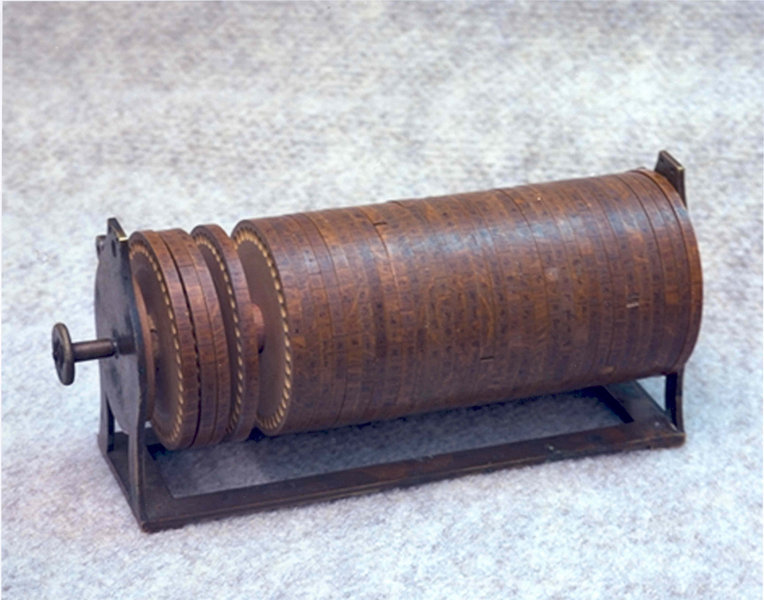
The National Cryptologic Museum has this partial device, which may or may not have been Jefferson’s
The Swede Fredrik Gripenstierna used a similar machine with 57 disks, but it had a slightly different purpose and operating principle. Jefferson described his device in the 1790s, and while he never claimed to invent it, the story has caught on that he did. Sometimes these are called Bazeries cylinders, as Etienne Bazeries had a 20-disk device in 1891, apparently independently invented.
It doesn’t appear that Jefferson or anyone else actually built the machine he described. There is an old device in the NSA museum that could be from Jefferson, but it isn’t clear that it was actually his or related to his writings.
Jefferson abandoned the scheme after learning about columnar transposition ciphers in 1803.
Use in the 20th Century
While Jefferson’s wheels never saw use, the US Military adapted Bazeries’ cylinder in 1922 and used the M-94 through 1942. The M-94 had 25 aluminum disks on a spindle.
The original prototype of the M-94 used a sliding strip arrangement instead of disks, and the Army returned to that style with the M-138A cipher machine in the 1930s. Each machine had 100 strips, and you had to select 30, further improving key security. It was used for some time, and you can see an example of it in the picture from the National Cryptologic Museum.
Everything Old is New
It is tempting to say the military used Jefferson’s wheel, but, in fact, the papers explaining the device were forgotten until 1922, and the prototype M-94s were developed between 1914 and 1917.
The system probably predates Jefferson anyway. Charles Babbage made references to disks with letters in 1854, although the exact arrangement he had in mind isn’t clear.
Of course, the Enigma and similar rotor-based machines took over during World War II. While making a disk-based code tool yourself would be easier (try styrofoam cups, like in the video below, if you don’t want to 3D print it), you can put in a bit more effort and make your own Enigma.
Have you ever found out that something you remember from your youth is now gone, and you didn’t even notice? If you are a certain age, you might feel that way when I deliver the news: You haven’t been able to buy International Reply Coupons (IRCs) at a US Post Office since early 2013. By the end of 2026, you won’t be able to buy them anywhere. The age of the IRC is over.
What’s an IRC?
An IRC from 1978 (public domain).
If that didn’t mean anything to you, you might be too young to remember, or maybe you just weren’t into shortwave listening or ham radio. Although there were other reasons to get IRCs, a radio hobby is the most likely reason a Hackday reader would have bought an IRC.
For radio purposes, here’s the problem. You’ve worked on your station for months, and one winter night, you finally pull in that rare station from Luxembourg. They’ll send you a QSL card to verify that you heard them. You only have to send them a letter telling them what time you heard them, what frequency, and some details about the program you heard. But they probably don’t want to pay the postage required to send hundreds or thousands of cards overseas.
While this is a radio-specific problem, you might find the same issue with pen pals or when trying to buy things from an overseas company.
SASE
If everyone were in the same country, the solution would be easy. Take a stamp, put it on an envelope that has your address on it, and stuff it in with the letter. Or, you could just drop a stamp or two in the letter you sent.
The problem is, US postage won’t help Radio Luxembourg. On the other hand, the effort required for you to buy postage that works in Luxembourg would have been a nightmare.
Enter the UPU
The Universal Postal Union is a UN agency that is effectively an association of post offices in 192 countries. Their charter is to facilitate mailing things worldwide.
The IRCs date back to 1906. The idea is you buy an IRC at your post office. You send it to Radio Luxembourg, or wherever. There, the mail person at the radio station could go to their post office and trade the coupon for enough local postage to send a surface letter worldwide.
Slow Death
A more recent IRC (UPU).
As demand has dwindled, post offices worldwide have quit selling IRCs. As of last year, Australia still did. But Germany, Britain, the United States, and many other countries gave up on them long ago. In fact, Britain’s Royal Mail claimed that the average post office sold less than one IRC per year at the time it threw in the towel.
UPU decided to end IRCs altogether by December 31, 2026. The end of an era and, apparently, not just for radio hobbyists. It is telling that the UPU’s recent editions of IRCs had print runs of 1,000 or even 500. So they obviously weren’t selling very many.
IRCs Other Claim to Fame
If you’ve heard of these before and you aren’t interested in radio, then it might have been in economic history. Have you heard of the Ponzi scheme? It has become a generic term for any business scheme that relies on raising money from new investors to service debt owed to old investors.
However, the original Ponzi scheme dates back to 1920, when Charles Ponzi realized he could buy IRCs in a country where they were cheap and sell them for more in another country. He was happy to accept investors, of course.
The problem is that profits are thin, and the costs of acquiring and transporting large numbers of IRCs quickly swamp most potential profits. Fluctuations in currency exchange rates take the rest.
Goodbye!
So the end of the IRC marks a closed chapter for ham radio and swindling. There were probably other uses, too, that are now consumed by electronic mail, payment systems, and the like.
You have to wonder what adventures IRCs went on during their global travels. The video below shows one’s story.
Since the first V2 rocket sailed above the Kármán line back in 1944 and right up until the modern era, the trajectory of most space-bound rockets was more or less the same: after expending their propellants they would either crash into some desolate steppe or plunge into the ocean. In either event, the rocket was disposable. The important bit up top might go on to explore the stars or send a human crew off on their mission, but the booster rocket that lifted the spacecraft out of the atmosphere was always going to be sacrificed for the cause.
But in the 1970s NASA had a wild idea: what if we didn’t smash a brand-new rocket valued at millions of dollars into the ocean every time we wanted to put something in orbit? Instead, they would build a hybrid space vehicle that blended the vertical takeoff and raw power of a rocket with the capabilities of an airplane, allowing it and whatever it was carrying to make a gentle runway landing at the end of its mission. As such, the Space Shuttle was born.
With the benefit of hindsight, we now know the Shuttle wasn’t quite the spaceflight revolution that NASA had hoped for. The age of reusable rockets didn’t truly begin until 2015, when SpaceX landed the first stage of their Falcon 9. To date they’ve repeated the feat nearly 600 times, all the while increasing the reliability and speed of their operations. Today the Falcon 9 is the most prolific launch vehicle in history, and nearly every other rocket in active development is being designed to include some element of reusability.
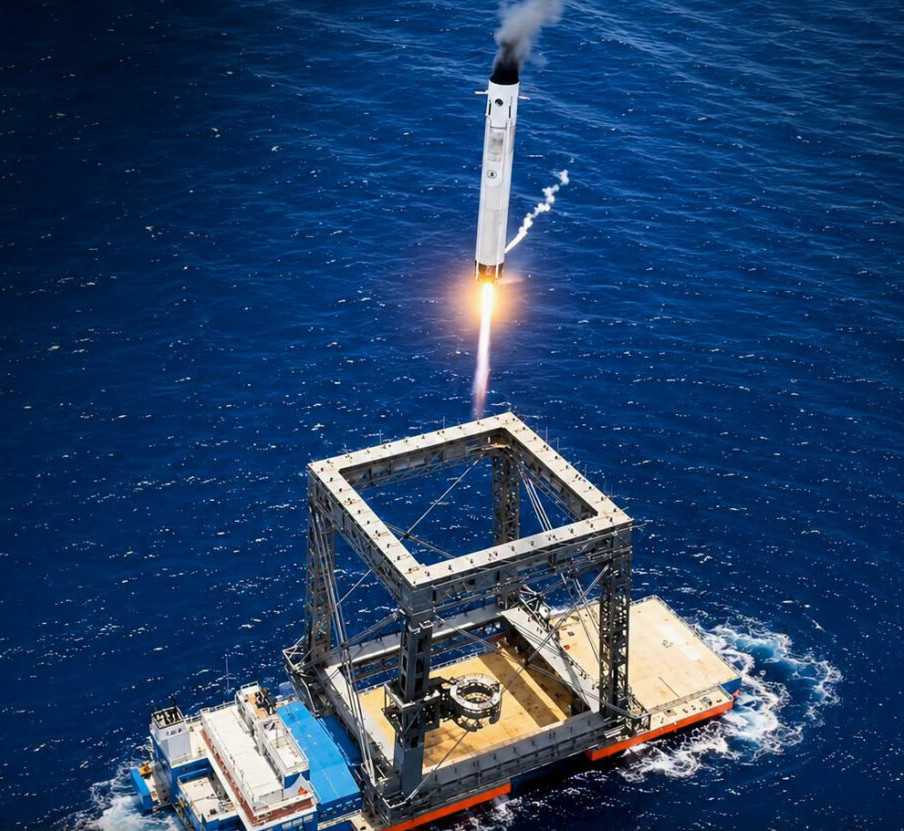
Most recently, China demonstrated that they could recover their Long March 10B rocket by gently bringing it down into what amounts to a giant butterfly net. While it might seem a bit quaint compared to rockets that land on their tails like something out of a 1950s sci-fi movie, the idea offers considerable promise.
There and Back Again
But why did it take 70+ years before we were able to regularly refly orbital-class rockets? It’s not that there’s anything inherently complex about reusing a spent rocket. Sure, there’s a case to be made that material science improvements have made the engines robust enough for repeated use. But even if you had to rebuild the engines after each flight it would still be better than slamming the whole vehicle into the ocean. Similarly, there’s nothing particularly unique about the structure of the Falcon 9 that enables it to fly multiple times — it’s a big metal tube with tanks inside of it, just like essentially every rocket that has flown before it.
The revolutionary technology demonstrated by SpaceX in 2015 didn’t have anything to do with making their rocket go up, it was that they were able to safely bring it back without damaging or physically altering it. The Falcon 9 first stage that came back to Earth was in the same condition it was when it left the launch pad eight minutes or so earlier, albeit with empty propellant tanks and a layer of soot on the outside.
As such, most of the variability we see when comparing the reuse of past, present, and future rockets comes not from how the vehicle ascends, but how it ultimately comes to rest back down on Earth.
Splashdown is Easy, But Rough
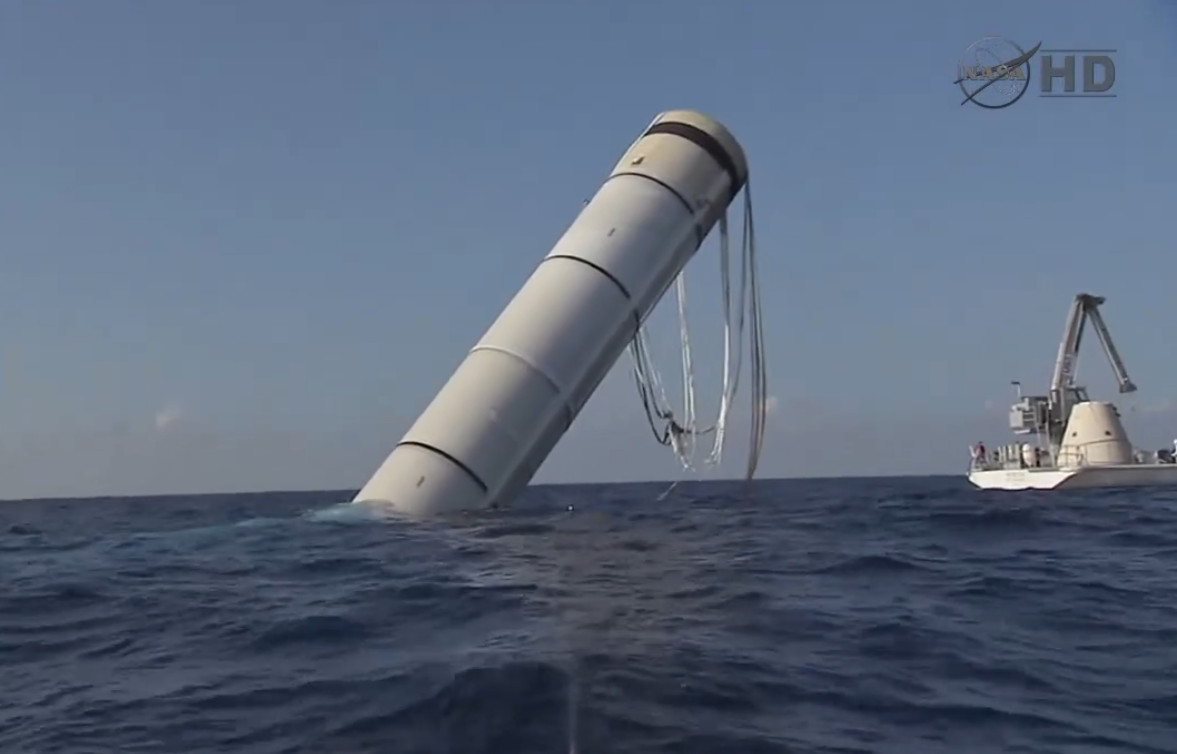
Without question, the easiest way to recover a rocket intact is to simply slow it down before it hits the surface of the ocean using parachutes This is how all American crewed capsules, and more applicably the Space Shuttle’s Solid Rocket Boosters (SRBs), have been recovered after their flights.
Once pumped out, the hollow SRBs could be towed to shore.
But even when descending under multiple huge parachutes, splashdown isn’t exactly a gentle event. It could probably best be described as “survivable”, in that the vehicle and crew will come through the experience in one piece, but neither is likely to be terribly happy about it.
The situation of course ends up being even worse for the rocket, as its structure is going to be subjected to the brunt of the impact force. Additionally, a complex aerospace vehicle getting partially submerged in salt water is a recipe for corrosion and electrical issues, to say nothing of the thermal shock the hot engines will experience when getting dunked.
One could argue that the only reason this method of recovery worked for the Shuttle SRBs is because of their relative simplicity when compared to a liquid-fueled rocket capable of independent flight. At the risk of oversimplifying the structure of the SRB, at splashdown it was effectively a hollow tube with minimal avionics and thrust vector control (TVC) hardware that could simply be replaced before the next flight.
Still, the NASA document Solid Rocket Booster (SRB) Refurbishment Practices goes over the considerable work required to bring each booster back to flight status after coming down in the ocean. Given the challenges of refurbishing the boosters, it’s perhaps unsurprising that NASA elected to forgo their reuse on the Space Launch System despite its SRBs being largely identical to their Shuttle predecessors.
Teaching Rockets New Tricks
In the very early days, while they were still trying to reach orbit with the Falcon 1, SpaceX had actually considered a Shuttle SRB-style recovery procedure. But in the end they decided to outfit the Falcon 9 with deployable landing legs and the rest, as they say, is history.
Landing legs allow a rocket to come down on effectively any flat surface, be it a concrete pad next to the launch facility or a floating platform. But there are some fairly serious drawbacks to this approach. For one thing, the requirement for precise terminal guidance means parachutes are out of the question. The rocket needs fins, attitude thrusters, or other control surfaces to come down on the center of the pad.
It also means the rocket needs to perform a propulsive landing. That is, use its own primary engines to bring its velocity on touchdown to as close to zero as possible. This in turn requires engines that can not only restart in flight — a capability that has not traditionally been required by first stage boosters — but are able to throttle down low enough to control the rocket’s descent without simply pushing it back upwards. It’s difficult to overstate how unnatural a state of operation this is for a rocket. Indeed, it’s the antithesis of how nearly every rocket has operated since the Song Dynasty started experimenting with gunpowder in the 10th century.
Even if you can accomplish all that, the true cost of landing a rocket is in the extra mass. Although the legs will be stowed away and unused for 99.8% of the rocket’s flight time, it still has to lug all that weight uphill. If that wasn’t bad enough, there’s also the extra weight of whatever control mechanism is in place to guide the rocket’s descent trajectory as well as the propellant that needs to be kept in reserve for the landing burn.
All told, landing a rocket on legs comes with a massive payload penalty. In the case of the Falcon 9, the rocket’s maximum capacity to Low Earth Orbit (LEO) in its expendable configuration is approximately 22,800 kg (50,300 lb). But when outfitted with the hardware necessary to land, that number is reduced by nearly 25% to 17,500 kg (38,600 lb).
Dropping the Dead Weight
There was a time, not so very long ago, when critics doubted the financial viability of recovering and reusing rockets like the Falcon 9. But today, reuse has gone from theoretical to standard operating procedure. Outside of a few Old Space holdouts, it’s top of mind for every launch provider and critical for remaining competitive in a fast-moving commercial market. In November, Blue Origin even managed to land their New Glenn heavy-lift rocket on only its second flight.
So at this point the question isn’t whether or not future rockets will be reusable, but rather, what is the most efficient way to achieve that reusability?
The first stage of Starship after being caught in mid-air.
With that in mind, it’s easy to see the appeal of China’s net recovery. While the rocket must still perform a propulsive descent — although in theory the necessary positional accuracy, and therefore the technical challenge, is somewhat reduced — it doesn’t need to have landing legs installed. This mass savings increases the vehicle’s useful payload capacity, which in turn makes it more profitable to operate. Achieving the same end goal while being easier and cheaper is an improvement in anyone’s book.
Admittedly, having the rocket come down in a huge net adds a certain amount of whimsy to the whole endeavor, but the overall logic is sound enough. It should also be said that SpaceX, for all the success they’ve had with landing their Falcon 9 on a set of deployable legs, are themselves planning on catching both the first and second stages of their next-generation Starship vehicle. Instead of a net, their goal is to pluck the rocket out of the air with a huge robotic pincer mechanism.
One is reminded of the old joke about how the Americans and Russians approached the problem of writing in space: NASA spent millions of dollars developing a pen that would work in microgravity, while their Russian counterparts simply used pencils. If China can demonstrate the ability to reuse a rocket they snagged in their net, the more elaborate methods of recovery employed by American rockets may one day look like a similarly overengineered solution.
Along with the many displays of outrage, gnashing of teeth and other displays of profound grief at the recent news that Sony will no longer manufacture physical game discs come 2028, we have also heard some voices pipe up with a variety of statements, such as that this decision makes game archiving basically impossible. Of course, the truth of the matter is that software archiving in general has become much harder already over the past decades, while game consoles are just late to the archiving-hostile party.
As an example, one merely has to contrast Sony’s PlayStation with e.g. the Valve Steam store and software by juggernauts like Adobe and Autodesk. Here the former moved after the Creative Suite (CS6) series of Photoshop and other tools fully over to the Creative Cloud (CC) subscription model, where DRM and constant rental software renewals are in order. Unlike that disc copy of CS6 Master Collection that will stay good practically forever, there’s nothing really to archive with Adobe’s CC software.
Similarly, with digital game downloads and their constant patches now put inside a heavily encrypted environment that relies on a special launcher, preserving video games has been turned into into a virtual nightmare for many years now.
Why Archive
Archiving is about accumulating historical records or materials. The scope and reason for a particular archive can differ, such as a company’s archive with financial records, an engineering department’s archive of technical references, or a museum’s archive of physical artefacts. Whatever the reason, the same goal applies: the maintaining or creating of a historical timeline that can be later referenced as needed.
An essential part of archives is to act as a primary reference source: where possible archives contain only the original documents and artefacts, making them as close to an objective source of history as possible. This is both extremely useful for a company when the tax office does a surprise inspection, but it is also for anyone who wishes to do any kind of historical research. This includes research into the development of a certain kind of software over the centuries and all types of related hardware.
Within the world of software archiving not much changes about this primary mission, except for the digital aspect that earns it the title of digital preservation. At least until fairly recently this meant mostly making copies of physical storage media and any associated physical media like documentation and manuals, but increasingly the subject of such preservation and archiving entails digital data that never was bound to or accompanied by any kind of physical media.
Such digital preservation is a big part of organizations like the Internet Archive, whose archives contain copies of software and games that might otherwise have been lost to the ages. The cases of retro enthusiasts coming across a floppy disk or CD containing some obscure game or set of drivers and uploading a copy to the Internet Archive are both numerous and an excellent example of digital preservation.
Other archives like the Video Game History Foundation (VGHF) have a more narrow focus, as their name implies. Their basic mission is no different, of course, with creating an archive that preserves history. Here the best part about digital preservation is that it makes it possible to create virtually infinite bit-perfect copies of the materials, making it incredibly easy to share and enjoy multimedia, gaming, and other content from these archives.
Of course, if that was all that there is to be said about digital archiving and preservation then this is basically where we could conclude merrily that all is well, and that whether software is distributed digitally or on some kind of physical storage media is of no concern. In this scenario said software can be copied around to one’s heart’s content, burned to optical media and so on without restrictions, ensuring its preservation.
With distributors of software having had fits about how easy it is to copy and distribute said software since at least the 1980s, it’s little wonder that they haven’t seen fit to rely on the fact that copyright infringement is illegal, and instead sought to make it impossible to copy the data of software. This led to a wide variety of copy restriction implementations, including on floppy disks, such as Electronic Arts’ Interlock system, while Nintendo’s game cartridges mostly relied on this more obscure format to keep people from creating their own cartridges.
In the face of these hurdles, the US Library of Congress notes that, for some software, it’s not enough to have the software on some medium, but also the console or hardware to play it on.
These copy restriction mechanisms are a form of digital restrictions management (DRM), euphemistically called ‘rights management’, since DRM only removes rights. As software became decoupled from physical media by the late 90s along with multimedia content like MP3 music, alternate DRM schemes were developed that restrict copying, generally through encryption and a convoluted decryption scheme that even includes hardware-level encryption such as High-bandwidth Digital Content Protection (HDCP).
The upshot of all these copy restriction schemes is that you have to jump through many hoops to still create a copy, whether it involves breaking a floppy copying scheme, using an HDMI splitter that accidentally forgets to re-apply HDCP before sending the content off to a capture card, catching a lucky break with a leaky DVD CSS implementation, or using the analog hole to create that ‘good enough’ copy.
Nobody buys games on DVDs anymore, however. When a digital game is provided via an online store service, how can this be preserved in a digital archive? Since all of these rely on an internet-dependent DRM scheme which fails the moment there’s an issue anywhere in the chain, or if said authentication servers are turned off in N years from now, all preservation schemes here are by definition flawed or at least legally awkward.
A Digital Void
When EA created its Interlock copy restriction scheme it was likely not concerned with whether or not copies of their games would survive into the 2020s, never mind whether anyone would still be using FDDs. It does however indicate the central problem here, one that goes far beyond a black-and-white physical media vs digital-only show-off. Especially since physical media could be argued to be flawed enough that it deserved it to die.
In today’s inevitable march towards a future in which we’re all consuming content using ‘our’ Smart Terminal Devices that rely on any number of paid subscriptions to gain access to the actual content stored on the servers of our benevolent Content Overlords, what probably rankles people the most about the PlayStation physical media announcement is less the demise of physical media and more a reminder of how much has already been taken from us.
In a statement made by VGHF director Frank Cifaldi on the end of physical PlayStation discs – and the concurrent announcement of the shutdown of the PlayStation 3 and Vita online stores – this is put in the broader context of the digital void that we’re facing, in which a large part of video game history simply cannot be legally preserved.
The Legal Conundrum
Here we have to address the rather sizeable elephant in the room, in the form of copyright infringement. Here we see large groups of very nice people in friendly online communities who carefully strip any offending DRM that may even prevent the game from working, while ensuring that the freely provided bundle is kept up to date with only the best patches and anything of relevance.
Within these communities you can find entire swathes of video game history preserved for the enjoyment of connoisseurs, including tutorials, manuals, carefully curated collections mods and extensions, plus everything else that would make a professional digital archivist salivate.
But these ‘shadow archives’ are definitely illegal according to copyright law, ergo the only option available to VGHF and other organizations that are trying to stay on the light side of the law might be to wait a few decades, see which games enter the legal grey zone of ‘abandonware‘ and see whether they’ll still get hit by DMCA takedown request in 2050 for a game that ceased being offered for sale in 2026.
Pity the poor Australians. Isolated on a jagged hunk of land far from everywhere else, these industrious people have to take two-legged flights (or more) to reach a great many destinations in the northern hemisphere. It’s expensive, time consuming, and makes planning a trip a complete headache when wars break out around popular hub airports.
One airline is trying to solve this problem. The nation’s flag carrier, Qantas, has been hard at work on Project Sunrise. The goal is to run some of the longest non-stop commercial passenger flights ever, with great effort going into solving the technical and economic challenges involved.
No Stops
When travelling from Australia’s major capital cities, flights to destinations like London, the rest of Europe, or the US, all involve stopovers in intermediate airports along the way. A great many routes stop in Dubai or Qatar, while others transit through Hong Kong, Singapore, or Thailand. The need for stopovers complicates air travel for the passenger, particularly when delays cause missed connections or baggage gets lost from one flight to another. It can also just be tedious—sometimes a stopover can last 10 hours or more, which is an incredibly uncomfortable amount of time to spend in even the nicest airport. The reason behind stopovers is simple enough—the average commercial airliner just doesn’t have the fuel range to haul many hundreds of passengers from Australia to Europe in a single hop.
Qantas has formerly run long-range routes with Boeing 787-9 aircraft, but they lack the legs to make it from east-coast capitals to major international destinations. Credit: Qantas media resources
Qantas has been trying to improve Australia’s passenger airline links for quite some time by finding ways to eliminate these tedious stopovers entirely. Thus was born Project Sunrise, which hoped to find more direct routes between popular world cities and suitable airliners that could fly those routes without stopping.
An early 2019 test flight probed the practicality of flying from New York to Sydney in a single hop. Due to the limitations of contemporary aircraft, sacrifices were made to get the flight over the line. Where the Boeing 787-9 would normally carry up to 280 passengers, the test flight would only haul 40 to save weight, and thus save fuel. No cargo was on board, and the tanks were brimmed to ensure maximum range was available. Even then, the 16,250 km route was considered to be at 115% of the plane’s normal range, and there was only 90 minutes of contingency when it came to fuel onboard if something went awry. Despite the challenges, the test was a success, and provided useful learnings on how to handle things like crew fatigue on a 19-hour continuous flight.
Qantas was also experimenting with practical revenue services at this time, too. In 2018, the airline had established a direct route from Perth to London, flying the Boeing 787-9 in a 236-seat configuration. Flying the 14,484-kilometer route was just within the practical range of the aircraft. It was a useful route that made travel easier for passengers departing Australia’s west coast, but far from the golden ideal of allowing direct flights to major international destinations from the major capitals of Melbourne and Sydney. The route has also since fell victim to geopolitical strife, as the Iran War shut down large swathes of airspace in early 2026. Qantas was forced to alter its flight paths, which added 30 to 45 minutes to the usual flight time—just enough to tip the route over the practical limitations of the aircraft’s range.
Future Goals
However, the crowing achievement of Project Sunrise is still yet to come. 39% of Australia’s population is concentrated in Sydney and Melbourne alone, with both capitals situated on the country’s east coast. It would be most advantageous from a business perspective for these cities to have direct links to major world destinations, and it would benefit the broadest swathe of Qantas’s customer base. Only, the problem comes back to geography, with these two capitals being over 16,000 kilometers from popular destinations like New York and London.
The A350-1000ULR is key to Qantas’s efforts to launch non-stop services to far-flung destinations. Picture Credit: Stuart Bailey, via Qantas media resources
Qantas has risen to the challenge, regardless. The airline challenged both Boeing and Airbus to develop aircraft intended to fly routes from Sydney, Melbourne, and Brisbane, to destinations like New York, London, Cape Town, Paris, and Rio de Janeiro. This was later whittled down to a narrower focus on the Sydney to New York and Sydney to London routes. Airbus would come out victorious, with Qantas ordering twelve examples of the Airbus A350-1000ULR. The specially-configured model features an additional rear centre fuel tank and a higher maximum take-off weight in order to fly routes up to 22 hours non-stop, along with a reduced seat configuration serving just 238 passengers. The extra range makes for a huge difference compared to more conventional routes out of Australia, which often pair two flights up to 14 hours each. The extra range of the new aircraft saves passengers both hours of flight time, along with the hours normally spent sitting around on layover in a hub airport along the way.
The new aircraft has been undertaking test flights ahead of a planned 2027 launch of revenue services. Credit: Qantas media resources
A typical flight from Sydney to New York or Sydney to London is expected to take 19 to 22 hours. The no-stop nature of the route will enable 99% of Australians to access either destination either direct, or with one-stop—such as by flying in from another major capital on a domestic flight. The flights are expected to run with a higher-than-usual ratio of premium seats, based on the expected demand for these services.
The main thing holding back the new service is aircraft delivery. Production is underway in earnest, with the first A350-1000ULR to be delivered in April 2027. Daily non-stop flights between Sydney and London will begin from October 2027, with tickets to be on sale from February.
Aircraft cabins will be optimized to have more space and amenity to keep passengers comfortable on ultra-long-range routes.
The new Project Sunrise services will be a gamechanger for many people travelling to and from Sydney, and other Australian capitals. It will relieve a major pain point—layovers—that have become a dreaded fact of life for Australians headed far abroad. It will still perhaps be some time before Australians get more direct services to a wider range of destinations, because these new services will have to prove themselves. If the passenger numbers aren’t there, the services won’t make money, and it may not prove worth the hassle to operate these ultra-long-range routes. If, however, convenience truly is king, then there may be much greater investment in this area to link Sydney and Melbourne with more cities directly. The only losers in this case will be the hub airports across the world, which will grow just a little quieter for the loss of Aussie accents in the terminal.

 Login
Login