Researchers at Gen Digital are tracking a sophisticated social engineering campaign that’s using phony NDA documents to trick employees into moving the conversation to WhatsApp and personal email accounts. The attackers targeted an employee at Gen itself, but the employee recognized that it was a scam and played along to see what the attackers would do.
With so many AI tools out there, it’s getting harder to find the ones actually worth your time. A lot of projects look alike and the differences between them can come down to minor UI tweaks. But it’s still worth digging, because every now and then you find something good.
One of the interesting projects we came across recently is Cybermes. It’s an offensive security assistant and automation framework built for bug bounty hunting, recon and reporting. It has more than 200 security playbooks and full Model Context Protocol (MCP) support. The most notable thing here is the reporting structure. The framework handles reporting really well, it has a scope.yaml file you can modify and the TUI interface looks clean.
We’ll show what the assistant can do and how well it handles the tasks.
Setting Up
Unlike PentestCode, there’s some work to do before you can start using the tool.
First, make sure you have Go installed on your Kali. The framework needs to compile tools and without Go your installation will be incomplete.
kali > sudo apt update
kali > sudo apt install go-lang
Then download the repository and run the setup script.
kali > git clone https://github.com/Zyrexnn/Cybermes.git
kali > cd Cybermes
kali > python3 -m venv venv; source venv/bin/activate
kali > chmod 777 setup.sh
kali > ./setup.sh
It’ll take a few minutes. When it’s done, run the doctor script to make sure everything is in order.
kali > python3 tools/doctor.py
After that, add your OpenRouter API key to two env files before you can start working with the tool.
kali > vim .env
kali > vim hermes/.env
Make sure you add the API key to both files, otherwise it won’t work.
kali > ./cybermes model
Finally, specify the scope in scope.yaml. We’ve got OWASP Juice Shop for the test, listening on port 3000.
Now we’re all set.
IDOR/BOLA – Terminal User Interface
The Terminal User Interface is clean and easy to work with, so we’ll start there. You might end up preferring it over the CLI version.
kali > TARGET=127_0_0_1_3000
kali > ./cybermes –tui
Our first prompt in TUI is hunting for IDOR using Nemotron 3.5 Lightning. As the model tests the target, you’ll see entries populating the screen with the commands the tool runs.
Fifteen minutes later we got our results and BOLA was confirmed.
Reporting is really the strongest side of this framework. It created a couple of files with reports and sorted them properly. As you keep hunting for bugs on the same target, all your findings get brought together in one file.
Findings are always stored in Markdown format and keep almost the same structure every time, which makes them look professional.
JWT & SQLi – Command-line Interface
Now let’s look at the CLI version and try to find more bugs.
kali > ./cybermes --cli
Our first prompt will be testing JWT:
Authorized lab only. Target http://127.0.0.1:3000/rest/user/login.
Audit authentication and JWT handling with non-destructive requests. Try the publicly documented Juice Shop demo accounts if needed (admin@juice-sh.op / admin123 and a normal user you register).

Check token claims, privilege flags, and whether a standard user can hit admin-ish REST routes.
Record only confirmed issues under reports/127_0_0_1_3000/findings/.
It took some time to reason through and test the app, then gave the results.
The same files were produced again, with PoCs and an explanation of each bug and the risks tied to it.
We also tested SQLi on search:
Authorized lab only. Audit http://127.0.0.1:3000/rest/products/search?q= for SQL injection using safe syntax and error/timing evidence. Do not dump the full database into the terminal. If confirmed, write reports/127_0_0_1_3000/findings/high_sqli_product_search.md and a minimal PoC in pocs/.
Here’s the report on our SQLi finding, looking just as good as the previous ones.
The tool passed all our tests against the Juice Shop and brought the findings together in the final report. The skills it ships with work well. You might want to go through them and add some of the ones we covered recently. We covered a repository with 83 skills and almost half of those were built by studying 681 real bug reports that people actually got paid for on HackerOne.
Summary
Cybermes has clear strengths. It’s good at reporting, it has a clean TUI and a big library of built in skills. The framework sets up quickly if you have Go installed on your Kali and it already knows which tools to work with based on those skills. That’s handy. We used OpenRouter for this test, but you can also point it at your local Ollama models. For that you’ll need a tool calling model (qwen2.5:14b). Chat only 3B models won’t cut it here.
We also invite you to join our AI for Cybersecurity training. During the training, we’ll show you different ways of using AI in cybersecurity, set up local models and solve labs. The field is evolving rapidly and the sooner you learn things, the greater the advantage you’ll have.
Threat actors are increasingly leveraging AI hallucinations to plant phishing links and other malicious content in AI output, IEEE Spectrum reports. Large language models (LLMs) sometimes fabricate information, including web domains, when answering users’ questions. Attackers are registering these hallucinated web domains to host phishing pages.
Some things just lie on the surface, while others take time to find. In OSINT, finding the right data often means digging deep. Before you reach a conclusion, there must be solid evidence to support it, and data acquisition is always the most time consuming part of this process. The success of your investigation depends on how well you can find information and connect the dots.
OpenPlanter can automate part of this process.
OpenPlanter
Essentially, OpenPlanter is a recursive language model investigation agent. It ingests different kinds of data, which can be corporate registries, campaign finance records, government contracts and more. It then resolves entities across them and surfaces connections through evidence-based analysis. You can also use it to build profiles of individuals based on publicly available information.
OpenPlanter has both a desktop GUI and a terminal interface. The second one is more convenient.
Setting Up
The setup process is quick. We just need to create a Python environment that will host the needed libraries.
kali > git clone https://github.com/ShinMegamiBoson/OpenPlanter.git
kali > cd OpenPlanter
kali > python3 -m venv venv; source venv/bin/activate
kali > pip install -e .
Once it’s done, we need to give it our API keys.
To make web searches, OpenPlanter needs the Exa API. Exa is cheap to use and gives free credits for new accounts, so you don’t have to pay upfront. OpenRouter API is also needed to run the tool. OpenRouter has free AI models, but there is a daily usage limit. Make an account there and get your free API key.
To configure keys, run this command and paste them:
kali > openplanter-agent --configure-keys
At this point, you can use the tool.
Using OpenPlanter with OpenRouter
The daily API usage limit is enough to run a couple of basic tests, like the one below.
OpenPlanter will use Exa API key to find information. Without Exa, it burns tokens faster and gives incomplete results.
Normally, the tool saves the results in a text file in the current directory, but it doesn’t always happen. Be careful and make sure you don’t lose anything.
Here is our first report.
To make things more interesting, we asked it to find a complete list of Tatneft executives. Tatneft is one of the largest oil and gas companies in Russia.
The report was well organized, but all this information is readily available on the internet, due to the size of the Russian company.
When it was asked to find more information on a specific person from the list above, it struggled to find much and ended up with some generic data and a wrong social media account. Well, maybe that person is hard to find, so we gave it a second chance and picked a unique name from the same list: Nail Ulfatovich Maganov.
kali > openplanter-agent --task "Find as much information as you can on Nail Ulfatovich Maganov who works at Tatneft. If possible, find his Vkontakte, phone number, address, email and check if his email has been in data leaks. Save the results in a text file" --provider openrouter --model openrouter/free
The results can be seen below. OpenPlanter did find his LinkedIn account and extracted information from various places.
It also found OpenSanctions records associated with Nail Maganov.
But he is a well known figure in Russia. What about regular employees at a large Russian company? We will use Sibur for this example. Founded in 1995, it’s Russia’s largest petrochemical company.
We tried two individuals. During the first attempt, the tool didn’t find the correct person. After the second attempt with a different employee, it gave the results.
It found Svetlana’s position (Head of HR). This information was in her LinkedIn account. The rest of the information deserves further validation. Keep in mind, Russia has undergone a massive data blackout, systematically dismantling its open data and public statistics infrastructure. No wonder it’s hard to find things there.
Using OpenPlanter with Ollama – Locally
OpenPlanter’s own docs push toward frontier models (GPT-5.2, Claude Opus 4.6, Cerebras Qwen3-235B), because the whole process is quite demanding. Small local models will be noticeably weaker. But we still gave it a try. The first model was Qwen3:0.6B and its first attempt didn’t produce any results. After the second attempt, it found recent vulnerabilities that Windows had.
We also tried it with Qwen3:4b, but it produced absolutely irrelevant data in its response.
We didn’t stop here and tried it again. The results were still irrelevant. Instead of making a report on Mikhail Karisalov (CEO of Sibur) it spoke about something else.
Using OpenPlanter with Ollama – Remote Servers
If you decide to rent a server with good hardware to test other models, don’t waste your time on it. We tried various models, but none of them worked well. OpenPlanter calls a model, the model replies and then it fails. The output can be seen on the screen.
Here is an example with Qwen3.6:27b. Qwen3.6:35b had the same issue.
We also tried Ornith:35B.
These models support thinking and tooling, but they can’t really do much in this case.
Terminal Interface
It’s also important to mention that there are two ways you can use OpenPlanter in the terminal. So far, you’ve seen only one. If you’re more comfortable with a chat interface, you can use the second option.
kali > openplanter-agent --provider openrouter --model openrouter/free
Here you run your prompts and tweak the tool using the available commands.
Summary
After testing the tool in various ways, we came to the conclusion that it works reliably only with OpenRouter. That’s what gave us the best results. The developers also push towards frontier models or OpenRouter. The whole process of investigation relies heavily on the Exa API. Using it with Ollama models hosted externally (VPS) will not work, as it fails silently even if you select a supported AI model.
The tool might confuse people, especially if their names are common and their social media profiles are empty. Everything it finds deserves validation. Occasionally, it may check the results, marking them HIGH, MEDIUM or LOW depending on its confidence. It doesn’t always do it, but this can be fixed if the prompt explicitly asks for it. Most importantly, OpenPlanter can still save you time.
Learn more with our AI for Cybersecurity training. During the training, we’ll show you different ways of using AI in cybersecurity, set up local models and solve tasks with it.
Many aspiring cyberwarriors write to me asking where they should start in artificial intelligence for cybersecurity and the answer is simple, Hackers-Arise! We have dozens of tutorials–and now classes– on how to apply AI to cybersecurity. In addition, we are the sponsor of the upcoming Wittgenstein Award for the best AI cybersecurity agents. This will give our students an inside look at the development of the best of the best in AI cybersecurity as our students will have an opportunity participate and use the models and agents we develop.
Beyond learning AI for cybersecurity, there is another issue. There are many platforms, models, and hardware to choose from. Comparable to Cisco at the advent of internet in the 1990’s, those who hitched their wagon to Cisco found themselves in an advantageous position regarding jobs and promotions. I want to make the case that NVIDIA is the company you should be hitching your wagon to in this new era.
As you know, NVIDIA is the most valuable company in the world! It is rapidly growing an eco-system that will exceed that of Apple and Cisco. They have quietly built an eco-system of AI that will make it very hard to dislodge them from this dominant position. Jensen Huang and NVIDIA are building an almost impenetrable wall around their eco-system assuring it will be here for years to come.
NVIDIA began as a start-up 1993 building graphics processing units (GPU) for PC gamers. Processing pixels for any graphics intensive product is very compute intensive and NVIDIA made those games come alive. Graphics processing is compute intensive as every image is made of millions of tiny polygons that the GPU must compute it’s size, color, and movement. This means crunching a vast amount of data and Jensen Huang and his colleagues developed a graphics card capable of doing all those calculations very fast through massive parallelism. GPU’s have thousands of cores capable of doing these calculations serially and simultaneously. That is the magic of NVIDIA GPU’s and it is what makes NVIDIA GPU’s the preferred chip for AI. Neural networks–the foundation of our LLM’s at this moment– are built almost entirely from matrix multiplications. This means that the same calculation needs to run over and over on different data. The NVIDIA GPU is uniquely designed for this.
Now let’s take a look at the NVIDIA eco-system that Jensen Huang is building in AI.
Major Equity Investments / Strategic Partnerships
Jensen Huang has made numerous investments in companies positioned to benefit from the coming age of AI, including:
Mellonox –in 2019 NVIDIA agrred to buy Mellanox, an Israeli maker of high-speed Infiniband and Ethernet interconnects for $6.9 billion. NVIDIA needed faster interconnects between to communicate to and from it’s super fast GPU’s and other hardware and Mellanox provided that.
ARM— the British chip designer was the next firm in NVIDIA’s cross-hairs. Jensen Huand recognized that needed powerful and efficient CPU’s to manage his systems. ARM designs RISC-based CPU’s that power the mobile world due to their unique combination of speed and efficiency. NVIDIA offered $40 billion to purchase ARM for what Huang called “the world’s premier computing company for the age of AI.” The US FTC sued to block the acquisition and NVIDIA dropped it’s pursuit of owning ARM. Instead, it holds ARM and it’s CPU’s in close partnership integrating their CPU’s in a multitude of products. Interestingly, ARM is now worth about $250 billion, 6x what Huang offered for it just 6 years ago.
OpenAI — NVIDIA and OpenAI announced a letter of intent to deploy at least 10 gigawatts of NVIDIA systems, with NVIDIA intending to invest up to $100 billion in OpenAI progressively as each gigawatt is deployed. Earlier in 2026, OpenAI raised $110 billion at a $730 billion pre-money valuation, with NVIDIA and SoftBank each investing $30 billion and Amazon investing $50 billion. NVIDIA also noted in its 10-K ( a type of disclosure required by US regulators at the SEC) that it’s finalizing an investment and partnership agreement with OpenAI, though there’s no assurance the transaction will be completed.
Anthropic — NVIDIA and Anthropic announced a deep technology partnership to optimize Claude models for NVIDIA architecture and vice versa; Anthropic’s Series H in May 2026 raised $65 billion at a $965 billion post-money valuation, making it one of NVIDIA’s two largest single-company bets alongside OpenAI.
CoreWeave — NVIDIA holds a stake with an original 7% stake (24.2 million shares) worth roughly $2 billion at IPO, plus an additional $2 billion investment in early 2026, on top of a prior $6.3 billion agreement to purchase CoreWeave’s unused computing capacity through 2032.
xAI — A structure of $7.5 billion in equity plus $12.5 billion in debt, largely through a special purpose vehicle for GPU purchases, supporting xAI’s Colossus 2 data center in Memphis.
Hugging Face — A pending acquisition-related investment of $12.9 billion.
Mistral AI — NVIDIA remains an investor alongside lead backer ASML, with Mistral valued at €11.7 billion (about $13.8 billion).
AI Infrastructure Financing
In August of this year (2026), NVIDIA announced a partnership with some of the largest financial firms in the world including Apollo, BlackRock, Brookfield, Goldman Sachs, and KKR. This partnership was designed to facilitate financing of AI infrastructure and, of course, NVIDIA GPU’s.
Venture / Ecosystem Programs
A roughly £2 billion (~$2.6 billion) UK commitment flowing through partner VCs — Accel, Air Street Capital, Balderton, Hoxton Ventures, and Phoenix Court — into startups in London, Oxford, Cambridge, and Manchester.
Similar “VC Alliance” partnerships extended to European firms including Accel, Elaia, Partech, and Sofinnova, offering DGX Cloud Lepton marketplace credits to portfolio companies.
Scale
NVIDIA has committed over $50 billion across AI labs, cloud services, data centers, and optical communications, with private company assets reaching $47.9 billion by July 2026 and about $18 billion in equity commitments still to be executed.
This list isn’t exhaustive — NVIDIA also has long-standing commercial partnerships with cloud providers (AWS, Microsoft Azure, Google Cloud, Oracle), automakers, and chip/hardware partners that function differently from these financial stakes. Let me know if you’d like me to dig into any particular category.
Summary
NVIDIA and Jensen Huang have quietly built an almost impenetrable eco-system of artificial intelligence systems through acquisitions, partnerships, and financing. Similar to the eco-system CISCO built with networking equipment at the advent of the Internet, it will be advantageous to become part of this eco-system as it will likely be dominant for the foreseeable future.
Sometimes you might run the same model twice and get different results. That often happens when you’ve upgraded it with skills. Skills are detailed text documents that lay out the tools the model should use, the approach it should take and how it should analyze the results. Good skills are practical, pulled from actual reports on HackerOne and other bug bounty platforms. A model can still lean on its own knowledge, but that’s just less efficient.
There are plenty of skills out there you might come across, but not everything can be trusted. Some skills can simply be dangerous and infect your system. To make sure they are safe, you can check them with SkillSpector by NVIDIA, so you don’t end up with anything malicious on your system.
Bug Bounty Skills
Both of these repositories do bug bounty hunting end to end, but they go about it in almost opposite ways.
The first is called Bountyforge. It’s actually just one single skill file, but it’s smart enough to split itself into eight different mini agents that all work at the same time. One looks at websites and apps, another at crypto and blockchain, others go after different angles hackers can exploit. It also checks each finding with four different tests to make sure it’s not a false alarm. Then you get a report in whatever format the bug bounty program wants.
You don’t even need Claude Code or any other coding tool for this, you can just run it right inside the regular Claude website in your browser.
The second bug bounty repository is Claude-BugHunter. It takes the opposite approach. The repo has 83 skills and almost half of those were built by studying 681 real bug reports that people actually got paid for on HackerOne. These skills aren’t locked to Claude Code either, you can use OpenCode, Codex or Hermes Agents with them.
Here are a few examples of the results we got with these skills.
API endpoints are often vulnerable and this is worth trying your luck on to see how it goes.
Another approach can be APK reverse engineering. Here we found a hardcoded RSA-2048 signing private key baked into the published APK. With that key, hackers can push a new app to the app store and infect every employee phone, getting access not just to the WiFi network at the workplace but to their personal life too. Quite dangerous.
We found an API endpoint vulnerable to an SQL injection and managed to pull the entire database.
Having skills built on real attacks keeps the model from wandering off into its own weird approaches and missing a lot of good findings.
Active Directory Skills
Claude-AD was made by ADScanPro for testing a company’s internal network. It gives your model a playbook with skills and agents built for an Active Directory assessment. The developers are upfront that it’s not an auto pwn tool. It’s meant to guide you through the assessment. Every finding can get mapped to a compliance control (DORA, NIS2 and ENS).
Claude-AD is very careful about getting caught too. It explains what a security team would actually see on their end if that technique got used. And any time it’s about to do something that would actually change things on the company’s network, it stops and asks for confirmation first.
General Cybersecurity Skills
Antropic-Cybersecurity-Skills is basically a giant reference book. It has 817 skills covering 29 areas of security work, cloud security, malware analysis, all the way down to hardware and firmware. Each skill is its own small file, so your agent will quickly pull out the two or three it actually needs for its task.
Every skill ties back to real security frameworks that companies and auditors already use (NIST CSF, MITRE ATT&CK and so on). So if your model finds a problem using one of these skills, it can also tell you exactly which official standard it violates. You can use it to justify findings to a compliance team.
SCADA Skills
On an industrial network, a clumsy scan can shut down a production line or damage physical equipment, since a lot of this gear is old and wasn’t built to handle unexpected traffic. That’s why the ICS skill by Masriyan is built to never actively touch a live industrial network. Instead, it works off network captures someone already took. It reads the file, recognizes industrial protocols by the ports they normally run on (Modbus, DNP3, Siemens S7, EtherNet/IP, OPC-UA, and more) and counts which devices are talking to each other. It then shows you write commands, these are the ones that change a value on an industrial device. That’s the traffic you want to see first.
The second mode skips network captures and instead searches for exposed industrial equipment using Shodan and Censys. The skill can also help your model reason about how an industrial network is laid out and check findings against MITRE’s ICS specific attack framework and the IEC 62443 security standard.
Science Skills
Although science isn’t really what we want to focus on here, in one of our SCADA articles we mentioned that to carry out a successful attack requires hackers to understand the technical process of the plant. That means understanding how the chemicals are produced and which units are used along the way. We also showed how vinyl acetate is produced and talked about paracetamol production.
1 kg of paracetamol at 100% purity was reported to cost €8,205, while 1 kg at 99% purity cost just €5. So even a single day of sabotage could cause serious financial damage to an enterprise.
Finding a scientist among hackers is quite a challenge, which is why Stuxnet needed a group of people from different backgrounds working toward one objective. But now hackers can just import different skills to make their attacks more devastating. K-Dense published 140 skills with access to different scientific databases and Python tools.
The real concern here isn’t ICS exploits inside the repository, there aren’t any. It’s the access to sensitive scientific data paired with an AI agent that can actually understand that data and change it.
Summary
AI skills can be a gamechanger, especially when they’re based on actual reports hackers got paid for. These skills show your model how to approach things and what tools to use during the test, so it doesn’t wander off hallucinating and inventing its own ways of testing things. That can wreck your bug bounty flow, since you’ll end up overlooking plenty of potential targets.
Simply relying on the AI to find things isn’t enough, hunters that do it keep getting a lot of dupes. You need to test things manually too. For this reason we created our Bug Bounty training to show you how to find bugs and work with the AI more efficiently.
Wireless security monitoring in the 2.4 GHz spectrum often depends on active probing, which can not only make the monitoring infrastructure vulnerable to attackers but also clutter the radio frequency environment. On the other hand, taking a passive approach by listening without transmitting allows security teams to detect malicious wireless activity more discreetly and reliably.
To put this idea into practice, the project Travel WiFi Canary was developed. This system serves as an early-warning mechanism using ESP32 microcontrollers. By operating the Wi-Fi radio in promiscuous mode, the device passively captures raw IEEE 802.11 management frames and traffic patterns. This helps identify potential threats such as deauthentication attacks, beacon spam, rogue access points often referred to as Evil Twins, and unauthorized probe requests. Eventually, it provides comprehensive insights into the wireless environment, enabling you to act proactively rather than reactively.
In this article, we will guide you through configuring, flashing, and running Travel WiFi Canary on the LilyGo T3 V1.6.1 development platform. Let’s get rolling!
What is Travel WiFi Canary?
The Travel WiFi Canary is a project that turns a low-cost ESP32 microcontroller into a passive 2.4 GHz threat-detection device. It operates continuously by alternating between active network enumeration and passive promiscuous packet capturing across specified channels.
At its core, the device’s Wi-Fi chip listens directly to raw radio signals passing through the air rather than connecting to a specific network.
When a wireless signal arrives, a fast automated responder checks the basic structure of the incoming data instantly. It identifies network management signals, such as connection requests, disconnection commands, or nearby network announcements, and separates them from standard web traffic.
To handle intense bursts of wireless activity without getting overwhelmed or missing crucial information, the chip places these flagged security signals into a temporary holding queue. This allows the main system to process and analyze the data safely in the background while keeping the hardware radio free to capture new incoming signals without interruption.
The central intelligence of the project relies on a dynamic confidence-scoring engine rather than rigid binary alerts. As the system processes the ring queues and periodic active scans, it evaluates detected anomalies against a local memory table built during the startup baseline phase.
Active scans check nearby Access Points for structural security violations. If an Access Point using an encrypted baseline protocol like WPA2 or WPA3 is detected operating without encryption, the system identifies an open clone attack. Security downgrades, unexpected vendor prefix mismatches on familiar SSIDs, or sudden disappearances of legitimate Access Points during an active open broadcast instantly contribute points to the global confidence score.
Simultaneously, the passive sniffer thread drains the lock-free queues to detect airborne attacks. Deauthentication frame floods are monitored over rolling time windows, assigning score penalties if threshold limits are breached by single sources or broadcast addresses.
The sniffer also inspects the payload fields inside beacon frames to detect Pwnagotchi signatures, parsing JSON structures hidden in vendor tags to determine if the device is operating in an active attack state.
All calculated points feed into a unified state machine. Aggregate scores between zero and two keep the device in a normal state, scores between three and five push it into a caution state, and scores of six or higher escalate the device into an active alert state.
To prevent temporary radio noise or brief packet anomalies from causing permanent alarm states, a background timer executes a score decay routine every minute. This routine gradually reduces the aggregate threat score over time, allowing the system to automatically transition back to a normal state once threat vectors clear the area. Hardware outputs, such as status LEDs or connected display controllers, continuously mirror the internal state variable to provide real-time visual monitoring.
What is LilyGo T3 V1.6.1?
The Travel WiFi Canary was initially made for the M5Stack Atom Lite development board. However, in this demonstration, I will test it on the LilyGo T3 V1.6.1.
The LilyGo T3 V1.6.1, also called the TTGO T3 LoRa32 V1.6.1, is an open-source development board designed for Internet of Things (IoT) projects and long-range RF communication. It has an ESP32 chip that allows for packet sniffing and Wi-Fi scanning. It gives us all the necessary functionality for wireless threat detection required by the Travel WiFi Canary project.
Getting Started with Travel WiFi Canary
The best way to flash the Travel WiFi Canary is by using Visual Studio Code along with the PlatformIO IDE extension. The installation process is fairly simple, so let’s move on to the next step, which is cloning the repository. I will use the modified version designed for the LilyGo T3 device. Here’s the command to do that:
Next, connect your LilyGo T3 V1.6.1 to your computer using a data-capable Micro-USB cable. In Visual Studio Code, click on the PlatformIO status bar at the bottom and select env:esp32dev. Then, you can either click the checkmark icon in the status bar or press Ctrl+Alt+B to compile the firmware.
Once that is complete, click the right arrow icon in the status bar to start the upload process. PlatformIO will automatically detect the serial port, trigger the ESP32 to enter bootloader mode via auto-reset circuitry using the DTR and RTS lines, erase the necessary flash sectors, and upload the binaries seamlessly.
After the upload is complete, you can monitor the device with the built-in command:
pio device monitor -b 115200
At this point, the state machine and scanning engine are fully operational. During its initial scan, it detected seven nearby access points, recording their SSIDs, BSSIDs, signal strengths, channels, and encryption methods in memory.
Now, let’s simulate an open clone of a known encrypted network. The README file provides the following instructions:
I created a Wi-Fi access point from my phone with the same name as the network to which my system is connected, but without a password. Let’s observe how the WiFi Canary responds.
The script successfully identified the clone and granted 4 points to the score, changing the state to caution. The rogue open clone remained active in the following 20-second scan with a strong RSSI, adding another 4 points, which brought the total score to 8 and changed the state to alert. At the 310-second mark, the decay timer activated, decreasing the score from 8 to 7. However, since the score remained above the SCORE_ALERT threshold of 6 or higher, the system continued to maintain its alert state until the threat was resolved and the score naturally decayed back to zero.
Limitations
Despite the benefits of confidence scoring in reducing unexpected alerts, the possibility of false positives still exists. This is particularly true in enterprise networks, multi-node mesh setups, and crowded public venues, which can display behaviors that resemble attack patterns. On the flip side, false negatives may arise if a skilled attacker impersonates a legitimate BSSID while carefully adjusting their transmission power to fit in with normal signal strength variations, thus evading detection.
The limitations of the physical hardware create additional coverage boundaries. Passive detection of deauthentication relies heavily on the distance from the receiving device, meaning that low-power or far-off transmitters may be beyond the reach of the antenna. Furthermore, monitoring is confined solely to the 2.4 GHz spectrum, leaving the 5 GHz and 6 GHz bands completely unmonitored.
Lastly, the design of the radio architecture leads to a temporary gap in scanning whenever the chip switches between promiscuous packet sniffing and active environment scanning, resulting in a three-second blind spot where airborne deauthentication bursts can go unnoticed.
Summary
For many travelers and remote workers, understanding whether the Wi-Fi around them is secure is crucial. Private messages and sensitive information can be easily compromised when malicious actors set up fake hotspots or disrupt local connections. A device like the Travel WiFi Canary can continuously monitor the airwaves and alert you the moment a wireless attack is detected.
This device uses active Wi-Fi scanning and passive signal listening to find threats in real time. It constantly checks nearby networks against a trusted standard to spot fake open hotspots, duplicate routers, or security issues. At the same time, it listens for harmful activities like deauthentication attacks or rogue scanning tools. When it detects a threat, it raises a danger level with an internal scoring system and triggers a clear visual alarm. This alerts you immediately, giving you a warning before your devices may face any risk.
If you’re interested in improving your knowledge of wireless security, take a look at our Wi-Fi Hacking training. This course will guide you on how to assess the security of wireless networks and equip you with modern strategies to protect them effectively.
Cloaked SEO poisoning attacks surged by 40% in the second quarter of 2026, according to researchers at Fortra. This tactic, also known as “Chameleon SEO poisoning,” uses cloaked search engine results to spread phishing sites.
We recently updated our article on ShadowBroker, which a lot of you liked. The latest release brought some new features and made the dashboard even richer.
But ShadowBroker is resource intensive and might need you to allocate a good chunk of resources to your VM, which not all systems have. Instead, there’s Osiris and it can do similar things without any installation. You can run it in the browser or host it on your Kali. Both versions are identical.
Osiris
Osiris is a global intelligence dashboard that aggregates live flight tracking, CCTV, earthquake monitoring, conflict zone mapping and 24/7 news feeds. It’s made to give you situational awareness across multiple intelligence domains. The tool was built with Next.js 16 and MapLibre GL and every data point is rendered via WebGL for 60fps performance even with thousands of concurrent entities on screen.
Dashboard
Let’s start with the live version. It’s available here.
The world looks busy once you enable all the data layers on the left side of the screen.
Camera Feeds
There’s a huge number of cameras available around the world that are free to access. They are usually scattered across different websites and don’t look nearly as good as they do on a map. The dashboard has integrated a big number of them, marked with green dots on the map.
Here’s a camera in Toronto. Looks empty at 5 am.
Aircraft Tracking
All kinds of aircraft and maritime vehicles can be tracked. Not only that, you can do a deep dive on the intel available for each one. Below you can see we picked a random flight over the UAE and the dashboard pulled up the company it belongs to, Tim Clark who is the CEO and some publicly known information on him.
You can do similar things with other objects on the map.
So if you’re monitoring military activity in a certain region, that can come in handy.
Critical Infrastructure
There are different data assets you can display by clicking the database icon on the right side of the screen. The data is relevant for various places, but mostly for the US.
Above you can see the critical infrastructure in New York (red) and nationwide (yellow).
Conflicts and Dangerous Zones
Wars, tensions and threats are differentiated by color and notes are assigned to each with a severity level.
Market Analysis
When someone loses, someone else wins. Osiris can do some Market AI overview, which you obviously shouldn’t take as legit advice. But you can see it does some basic analysis and warns of potential price spikes.
Satellite Tracking
All kinds of satellites are available on the dashboard and they can also be tracked. Here you can see Starlink flying over the Atlantic and Canada.
Malware Threats
Finally, you can view malware threats and attacks on the map. There was a big node in China linked to a lot of attacks, with more scattered around the rest of the country.
Hosting Locally
Although the live version is stable and its uptime is good, you might still want to run it locally. It’s pretty easy to set up:
kali > sudo apt install npm
kali > git clone https://github.com/simplifaisoul/osiris.git
kali > cd osiris
kali > npm audit fix --force
kali > npm run dev
Then it’ll be available at http://localhost:3000
Summary
As you can see, there are different platforms available for different setups. Having compared the two, ShadowBroker looks richer and more professional, but Osiris hosts a live version you can use without any installation and it already has most of what you’d want to test. The installation itself is quick and easy and the dashboard consumes way fewer resources than ShadowBroker. Test it yourself and see what you like.
You can learn more with us! Get our Cybersecurity Starter Bundle II and unlock WiFi Hacking, Python for Hackers, Radio Basics and other training.
A new phishing platform called “JWR” gives attackers real-time control over social engineering attacks, according to researchers at Cisco Talos. The kit livestreams the phishing page to the attacker as the victim is entering information, allowing the attacker to steer the victim’s experience and maximize the damage.
OpenAI says internal AI agents gained internet access, exploited vulnerabilities and accessed Hugging Face systems during July cybersecurity evaluations.
AI agent security depends on controlling identities, permissions, credentials and tool access so automated actions stay limited, traceable and also accountable.
Google’s Threat Intelligence Group (GTIG) is tracking a voice phishing (vishing) campaign that’s targeting hedge funds and financial firms. The researchers attribute the attacks to “UNC6671,” an extortion group formerly known as “BlackFile.” The attackers pose as IT staff informing employees of urgent, mandatory migrations.
Criminals are now selling malicious AI tools for use in cyberattacks, according to researchers at Trellix. These tools dramatically lower the barrier for unskilled crooks to launch sophisticated attacks.
The vulnerability landscape shifted significantly in Q2 2026. First, the number of registered CVEs reached an unprecedented level. This is driven primarily by the widespread adoption of AI, both for application development and search for security flaws. This resulted in entire new classes of vulnerabilities emerging, particularly in the Linux networking subsystem.
Second, security researchers have been publishing exploits for unpatched vulnerabilities more frequently. Publications like these can generate significant fallout, since they potentially open the door for attackers to target unprotected systems.
Statistics on registered vulnerabilities
This section provides statistical data on registered vulnerabilities. The data comes from Kaspersky’s vulnerability knowledge base, which draws on the CVE database as well as the Russian BDU database and GitHub Advisory (GHSA). As a result, the figures for previous reporting periods may differ from those published in earlier reports.
We examine the number of registered vulnerabilities for each month over the last five years. As the chart below shows, this number continues to surge, a trend reflected across all the databases we track. It’s driven primarily by the widespread adoption of AI tools: as we predicted in our previous report, these tools have played a major role in the discovery of vulnerabilities in third-party software. Meanwhile, these tools often contain security issues of their own. For example, OpenClaw, a popular AI project, ranked 12th among those with the highest number of vulnerabilities discovered and published in Q2, with over 200 CVEs registered during the reporting period. Finally, AI development tools are also contributing to the vulnerability landscape, since the quality of the code they produce can vary widely. Therefore, the rate at which new vulnerabilities are discovered will inevitably keep growing.
Total published vulnerabilities per month from 2022 through 2026 (download)
Next, we analyze the number of new critical vulnerabilities (CVSS > 9.0) over the same period.
Total critical vulnerabilities published per month from 2022 through 2026 (download)
As the chart shows, the number of published critical vulnerabilities jumped sharply in Q2. This is because using AI for vulnerability research makes it possible to analyze massive amounts of previously unexamined code, uncover new attack surfaces, and identify entire classes of vulnerabilities that have gone unnoticed for decades. In particular, AI was used to find a series of Dirty Frag vulnerabilities in the Linux kernel.
Exploitation statistics
This section presents statistics on vulnerability exploitation for Q2 2026. The data draws on open sources and our telemetry.
Windows and Linux vulnerability exploitation
Q2 2026 saw a new precedent in the publication of vulnerabilities in Windows components and exploits for these: researchers no longer waiting for CVE registration, let alone patches. A case in point: a researcher who goes by Nightmare Eclipse (also known as Chaotic Eclipse) published a list of new “named” vulnerabilities across various Windows subsystems. At the time the technical details were published, none of the vulnerabilities had been assigned a CVE identifier:
BlueHammer: a local privilege escalation vulnerability in Windows Defender. During signature database updates, a time-of-check to time-of-use (TOCTOU) race condition occurs, allowing an attacker to substitute the directory where temporary update files are written. The researcher published a fully functional exploit for the vulnerability.
RedSun: another logical vulnerability in Windows Defender with a working exploit. Suspicious and malicious files marked as “cloud” can be overwritten or restored to their original directory with elevated privileges. The exploit incorporates fragments of algorithms that make it possible to leverage various logical vulnerabilities in Windows, effectively combining a large number of popular exploitation techniques.
YellowKey: a vulnerability that lets the user bypass BitLocker full-disk encryption and access system data through the Windows Recovery Environment (WinRE). A fully functional exploit was also published.
GreenPlasma: a vulnerability that enables system object injection via the CTF loader for the Collaborative Translation Framework (CTFMON) service in Windows. The original publication included an exploit with limited functionality.
RoguePlanet: yet another Windows Defender vulnerability that, like BlueHammer, stems from a TOCTOU issue, this time in the engine responsible for real-time system scanning. The published exploit uses the vulnerability to overwrite the system file wermgr.exe with a malicious one.
UnDefend: another vulnerability in the Windows Defender service. This time, the exploit causes a denial of service and blocks updates.
Even though such cases remain isolated for now, we believe they’ll grow into a full-fledged trend. Early publication of exploits gives attackers an advantage over software developers, who are left with no time to fix the issues.
Veteran vulnerabilities in Windows software also remain relevant. These are the ones our solutions most frequently detect exploits for:
CVE-2018-0802: a remote code execution (RCE) vulnerability in the Equation Editor component
CVE-2017-11882: another RCE vulnerability also affecting Equation Editor
CVE-2017-0199: a vulnerability in Microsoft Office and WordPad that allows an attacker to gain control over the system
CVE-2023-38831: a vulnerability in WinRAR that involves improper handling of objects within an archive
CVE-2025-6218 (formerly ZDI-CAN-27198): another WinRAR vulnerability allowing the specification of relative paths to extract files into arbitrary directories, potentially leading to malicious command execution
CVE-2025-8088: a vulnerability similar in exploitation method to CVE-2025-6218. The attackers used NTFS Streams to circumvent controls on the directory into which files are being unpacked
The vulnerabilities listed here can be leveraged to gain initial access to a vulnerable system and for privilege escalation. This underscores the critical importance of timely software updates.
That said, the number of Windows users who encountered exploits declined slightly in Q2, hitting an 18-month low.
Dynamics of the number of Windows users encountering exploits, Q1 2025 – Q2 2026. The number of users who encountered exploits in Q1 2025 is taken as 100% (download)
Linux also hit a rough patch in Q2 2026. Specifically, the period saw the disclosure of the Dirty Frag family of vulnerabilities, which lets an attacker reliably escalate privileges within the operating system.
All the vulnerabilities published in Q2 2026 were, in one way or another, related to the Linux caching subsystem. Here are the ones being most actively exploited:
CVE-2026-31431 (Copy Fail): a local privilege escalation vulnerability in the Linux kernel that lets an unprivileged user modify the page cache and gain root privileges. Especially dangerous for cloud and containerized environments
CVE-2026-43284, CVE-2026-43500 (Dirty Frag): a family of vulnerabilities in the Linux networking subsystem (IPsec ESP and RxRPC) that lets a local user overwrite the page cache and escalate privileges to root
CVE-2026-46300 (Fragnesia): a local privilege escalation vulnerability in the Linux kernel related to packet fragment handling and the page cache mechanism. It lets an unprivileged user gain root privileges and is also classified as part of the Dirty Frag family
CVE-2026-31635 (DirtyDecrypt): a Linux kernel vulnerability that lets a local attacker escalate privileges due to improper handling of decryption operations and page cache data modification
CVE-2026-43494 (PinTheft): a Linux kernel vulnerability that lets a local user gain elevated privileges due to errors in the memory page pinning mechanism
CVE-2026-46331 (pedit COW): a vulnerability in the Linux kernel’s traffic control subsystem (tc-pedit) that exploits a flaw in copy-on-write to modify the page cache and subsequently escalate privileges to root
The vulnerabilities described above were quickly embraced by attackers. At the same time, our solutions continue to detect exploitation attempts targeting older vulnerabilities as well:
CVE-2022-0847: a vulnerability known as Dirty Pipe, which enables privilege escalation and the hijacking of running applications
CVE-2019-13272: a vulnerability caused by improper handling of privilege inheritance, which can be exploited to achieve privilege escalation
CVE-2021-22555: a heap out-of-bounds write vulnerability in the Netfilter kernel subsystem
CVE-2023-32233: another Netfilter subsystem vulnerability that allows for Use-After-Free conditions and privilege escalation through improper processing of network requests
Dynamics of the number of Linux users encountering exploits, Q1 2025 – Q2 2026. The number of users who encountered exploits in Q1 2025 is taken as 100% (download)
In Q2 2026, the number of Linux users who encountered exploits declined slightly compared to Q1. Given that a significant share of new vulnerabilities are tied to the operating system’s caching subsystem, we recommend installing patches as quickly as possible, or disabling vulnerable kernel modules if patching isn’t an option.
Most common published exploits
The distribution of published exploits by software type in Q2 2026 includes categories that haven’t appeared in the sample for a long time. For instance, we’re once again seeing exploits targeting SharePoint. It’s worth noting that while several vulnerability write-ups for Exchange and SharePoint were published during the quarter, most turned out to be fake, AI-generated research. While the articles and exploit source code themselves look fairly polished, they describe nonexistent problems in the software or its components — often close to genuinely vulnerable mechanisms — in order to mislead researchers. This type of attack is aimed at increasing the time it takes to detect real vulnerabilities. In some cases, the description of a nonexistent vulnerability came bundled with completely unrelated malware.
Distribution of published exploits by platform, Q1 2026 (download)
Distribution of published exploits by platform, Q2 2026 (download)
Vulnerability exploitation in APT attacks
We analyzed which vulnerabilities were exploited in APT attacks during Q2 2026. The rankings provided below include data based on our telemetry, research, and open sources.
TOP 10 vulnerabilities exploited in APT attacks, Q2 2026 (download)
In Q2 2026, a trend emerged in APT attacks toward exploiting new vulnerabilities right from the moment they’re published. As before, we’re also seeing a large number of zero-day vulnerabilities. The Langflow vulnerability deserves particular attention: it’s one of the first cases of an APT group exploiting AI technology, which many organizations are only just beginning to integrate. Because most of this tech is proprietary, it has a considerable number of security blind spots. Therefore, given the growing number of AI-based automation tools, we strongly recommend going beyond the usual patching and developing secure procedures for credential use and sensitive data handling in systems that rely on agents and LLMs.
C2 frameworks
In this section, we examine the most popular C2 frameworks used by APT groups and analyze the vulnerabilities targeted by the exploits that interacted with C2 agents in APT attacks.
The chart below shows the frequency of known C2 framework usage in attacks during Q2 2026, according to open sources.
TOP 10 C2 frameworks used by APTs to compromise user systems, Q2 2026 (download)
Sliver, Havoc, AdaptixC2, and Metasploit remain the most widely used C2 frameworks. After studying open sources and analyzing samples of malicious C2 agents that contained exploits, we determined that the following vulnerabilities were utilized in APT attacks involving the C2 frameworks mentioned above:
CVE-2026-35273: a vulnerability in Oracle PeopleSoft PeopleTools that security vendors classify as server-side request forgery (SSRF). The details of the vulnerability have never been disclosed, although some research covers the post-exploitation steps
CVE-2023-46604: an insecure deserialization vulnerability in Apache ActiveMQ that allows arbitrary code execution in the context of the service process
CVE-2024-12356 and CVE-2026-1731: command injection vulnerabilities in BeyondTrust software that allow an attacker to send malicious commands even without system authentication
CVE-2023-36884: a vulnerability in the Windows Search component that allows commands to be run on the system, bypassing the mark-of-the-web (MoTW) mechanism
CVE-2025-53770: an insecure deserialization vulnerability in Microsoft SharePoint that allows for unauthenticated command execution on the server
CVE-2025-8088 and CVE-2025-6218: similar directory traversal vulnerabilities in WinRAR that allow files to be extracted from an archive to a predetermined path, potentially without the archiving utility displaying any alerts to the user
These vulnerabilities show that attackers used them for initial access and privilege escalation on vulnerable systems, setting the stage for launching a C2 agent. They include both zero-day vulnerabilities and fairly well-known security issues.
LLM/AI tool vulnerabilities
This section analyzes data published in Kaspersky’s vulnerability knowledge base. We reviewed the Q2 2026 version of the knowledge base.
As mentioned above, AI tools, plugins, and technologies have proven fairly effective at automating the search for problematic code and anomalous behavior. The high speed at which new vulnerabilities are being discovered has naturally created a need to fix them just as quickly. AI is often used for this too, which increases the volume of code being generated. However, neither code written without human involvement nor AI-generated advice is always correct.
The chart below covers registered vulnerabilities in AI tools for 2025–2026.
Number of published vulnerabilities in LLMs, AI tools, and plugins with similar functionality, 2025–2026 (download)
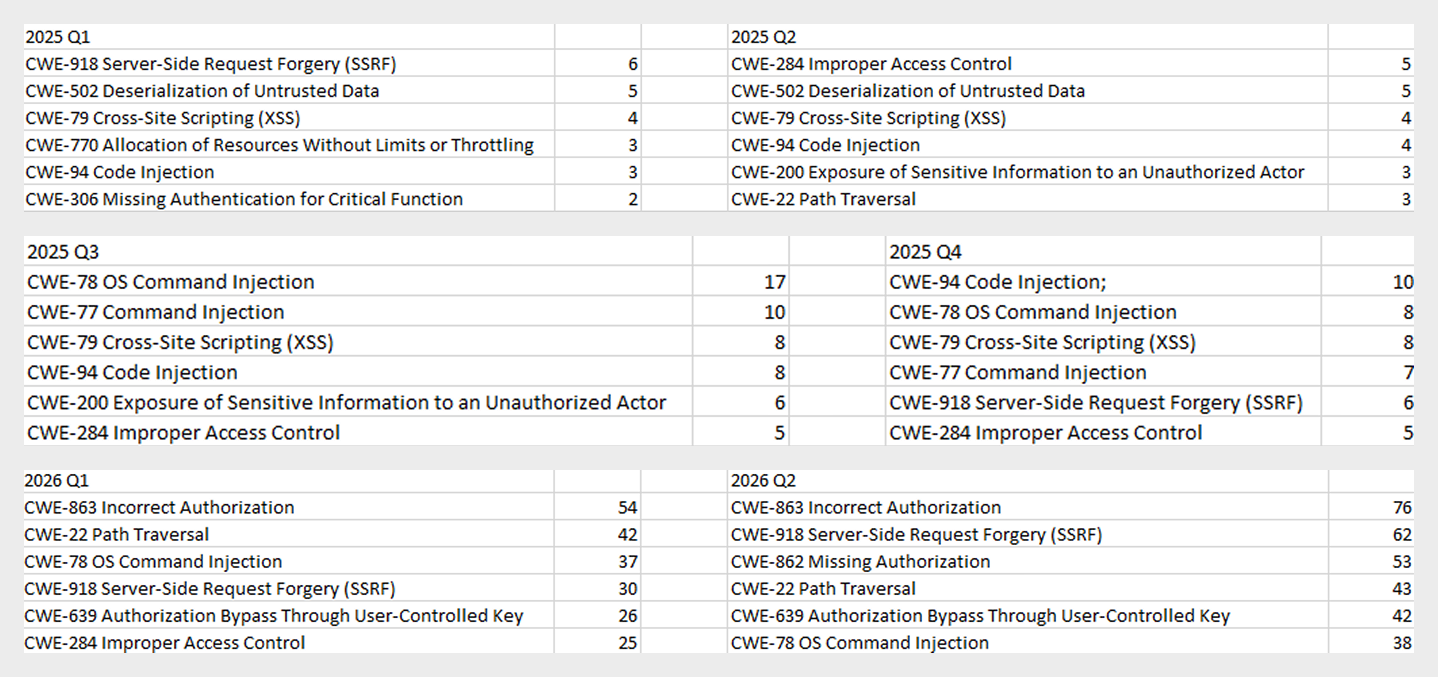
As the charts show, AI tools are racking up a substantial number of registered vulnerabilities, and that number keeps growing quarter over quarter. It’s also worth looking at how AI tool vulnerabilities break down by type, according to the CWE system:
TOP 6 vulnerability types in products that implement or use AI/LLM logic, 2025–2026
Interestingly, vulnerabilities of an undetermined type have ranked first in every quarter since the start of 2025. Traditionally-made software has the same issue, and it doesn’t look like the growing number of AI tools will fix it. It’s also notable that the list includes classes CWE developers themselves don’t recommend using for vulnerability classification, since they lump together a whole range of more specific types. CWE-284 is an example of this.
Looking at the most common classes, the key issues found in AI-related software can be summed up as follows:
Inadequate access control over critical system objects
Improper implementation of authentication and authorization mechanisms
Injections
It’s worth noting that injection-related vulnerabilities were relatively rare before AI agents took off (previously, they mostly affected web apps). Recently, though, these security issues have become relevant again.
Looking back at a year and a half of the AI boom, one conclusion stands out regarding registered vulnerabilities: AI tool developers are more focused on expanding functionality than on security. This is worth keeping in mind when using these tools. Let’s look at the projects and applications that either integrated AI tools or offered them as the core product. Below is a list of the those with the highest number of registered vulnerabilities for 2025–2026.
TOP AI/LLM-related projects by number of published vulnerabilities, 2025–2026 (download)
Notable vulnerabilities
This section highlights the most significant vulnerabilities published in Q2 2026 that have publicly available descriptions. Since the above already covers several significant vulnerabilities published during the reporting period, this section consists mainly of LLM/AI tool vulnerabilities.
CVE-2026-25253: a gatewayUrl vulnerability in OpenClaw
The issue stems from the fact that the OpenClaw user interface trusts the value of the gatewayUrl parameter passed in the URL and automatically establishes a WebSocket connection to the specified address. During this connection process, it sends an authentication token without any additional user confirmation.
The attack algorithm exploiting this vulnerability works as follows:
The application obtains a critical connection address from an external source (the gatewayUrl URL parameter), which is controlled by the attacker.
There is no validation before use.
The client automatically initiates a connection to the address specified in the parameter, which belongs to the attacker.
While connected, the application sends credentials (an access token) to the specified address.
If the attacker obtains a valid token, the consequences depend on that token’s level of access within the system. In general, this could lead to:
User session compromise
Execution of operations on the user’s behalf
Modification of the AI agent configuration
Unauthorized access to tools and resources connected to the agent
Under certain OpenClaw configurations, further compromise of the host running the agent
It’s worth noting that the risk of exploitation arises from a combination of several factors: the automatic connection and token transmission, the lack of address trust verification, and the high privileges granted to the local AI agent.
CVE-2026-41948: a path traversal vulnerability in the Dify AI platform
The vulnerability lets an authenticated user craft a request that enables the application to escape its permitted tenant and gain access to internal REST APIs that weren’t meant for that user. The root cause is insufficient normalization and validation of the URL path before it’s passed to the internal service.
Depending on the Dify configuration, the consequences can include:
Unauthorized access to internal service interfaces
Breach of isolation between workspaces
Exposure of internal service information
Conditions favorable to further attacks when combined with other vulnerabilities
The use of Dify in enterprise AI platforms is particularly risky, since internal services there tend to hold elevated privileges.
CVE-2026-45386: an improper access control vulnerability in Open WebUI
In Open WebUI, pin/unpin operations on messages are write operations, since they modify that message’s metadata (is_pinned, pinned_by, pinned_at). In vulnerable versions, however, before performing these actions, the API only checked for read access to the channel (a chat between a user or group and the AI) containing the message, not permission to modify its content. As a result, a user with a role limited to viewing messages could still change a message’s pinned status.
The vulnerability’s mechanism works as follows:
The user initiates an action that changes the state of an object.
The application treats this action as a regular read request.
Only channel view permission is checked.
The application performs a write without verifying the required user authorization.
This violates one of the fundamental principles of access control models — namely, that any operation that changes the state of data must be checked for the appropriate write or moderation permissions, regardless of whether the object itself is readable.
Although the vulnerability doesn’t lead to arbitrary code execution or compromise of sensitive data, it can affect data integrity and collaborative workflows. Potential consequences of exploitation include unauthorized pinning or unpinning of messages, disruption of channel moderators’ and administrators’ activities, changes to the display order of important information, and even the potential spread of false or misleading information by altering the channel containing a pinned message.
Open WebUI is widely used as an interface for interacting with local and enterprise LLMs. In these systems, pinned messages often contain important instructions, announcements, or tips for users. The ability to modify them with minimal privileges can disrupt collaborative workflows, cause confusion, and undermine trust in information published by administrators and moderators.
CVE-2026-45501: a vulnerability in Microsoft Exchange
The vulnerability stems from improper neutralization of user input when generating Exchange web pages. As a result, the browser may interpret specially crafted data as active content instead of plain text.
Although Microsoft categorizes the potential impact of exploiting this vulnerability as spoofing, flaws like this can lead to alteration of displayed content, imitation of trusted interfaces, actions on behalf of the user within an active session, and abuse of user trust.
It’s worth noting that issues like this are still relevant in modern software, given that mechanisms like Content Security Policy and various parsers were specifically created to help developers neutralize dangerous parts of user page content.
Conclusion and advice
Q2 brought the first significant results of AI automation adoption in software development and vulnerability hunting tools. This research shows that beyond traditional patch management, organizations now need real-time monitoring of systems and access controls, since infrastructure and everyday applications now contain far more AI functionality that could lead to compromise.
Accordingly, besides quickly detecting infrastructure vulnerabilities and managing security patches, modern enterprise-grade security solutions need to provide a broad range of preventive measures for tracking the overall health of systems and workstations. Kaspersky Next meets these requirements by combining proactive mechanisms with the ability to respond promptly to emerging threats.
Phishing is still the top initial access vector, accounting for more than half of cyberattacks observed during Q2 2026, according to a new report from Cisco Talos.
Every OSINT investigator now has access to a large language model on their desktop. This tool can quickly summarize thousands of pages or organize chaotic names and dates into a clear timeline. And this is widely accepted. But the difference between an investigator who gets useful results and one who gathers unhelpful information lies not in the model they use, but in how they interact with it.
This article explains how to create prompts that improve your OSINT work. It draws on recent academic research about prompting strategies for security tasks and insights from experienced OSINT practitioners. Let’s get rolling!
Prompt Is More Important Than the Model
Recent research on large language models in offensive security tasks highlights an important point. Methods that relied on reasoning, such as few-shot and chain-of-thought prompting, produced better results. These methods generated code that closely matched the reference examples, executed correctly, and handled various situations well.
One surprising finding was that continuously refining a prompt or asking the model to rethink its answer often resulted in worse outcomes. This happened because rephrasing the prompt misinterpreted the original task and lowered the accuracy of the output. So, repeatedly saying “try again” or “are you sure” is not an effective debugging strategy. If your first prompt was unclear, it is better to follow up with a clear and structured prompt rather than trying to steer the model to a better answer afterward.
Focus on crafting clear instructions at the beginning.
Create a Master Prompt Before You Begin
Before discussing a specific OSINT case, it’s a good practice to create a master prompt. This set of rules, though not related to the target, guides how the model should perform during the session.
This approach uses a well-known idea called anchoring. The first instructions you give to a model have a big influence on all the following interactions. If your first message includes a leading assumption, the model will consider that assumption important for the rest of the conversation, even if you didn’t mean for it to be.
A strong master prompt might look something like this.
Act as a neutral OSINT analyst. Do not treat any hypothesis as proven. Separate facts, indicators, assumptions, and conclusions. Look for evidence against a theory as actively as evidence for it. If the available data is insufficient, say so directly instead of filling the gap.
In other words, this is the initial set of instructions that the AI will follow throughout the entire time you’re working on the task. This reduces the number of errors because it explains to the model in advance exactly how to proceed and which rules to follow.
Basically, a master prompt should specify:
the role;
the goal of the task;
neutrality;
verification rules;
the response format;
a prohibition on unconfirmed conclusions and fabrications;
a requirement to distinguish facts from hypotheses;
a requirement to indicate what is missing.
And then you can set a specific task: what you’re looking for, who you’re looking for, what time period you’re covering, what sources you already have, and so on.
Ask Neutrally
One important but often overlooked issue in AI-assisted open-source intelligence is sycophancy. This happens when a model tends to agree with what the user already believes. For example, if you ask, “prove that this person is connected to this company,” the model starts with the answer you want before it even begins its search. It will look for information that confirms your belief simply because that’s what you asked for.
To fix this, you need to change how you phrase your requests. Instead of using words like “prove,” “confirm,” or “expose,” use “check” or “assess.” Don’t present your suspicions as facts. Phrases like “I already know” or “I am certain” lead the model to validate your beliefs rather than question them. Instead, ask it to build arguments for and against your theory, suggest different explanations, and counter your own ideas.
Specific Prompts You Can Use in Your Own Investigations
Theory is useful, but what most investigators actually want is something they can paste into a chat window tonight. Below are working examples for common OSINT tasks.
For digging into a person’s background, a strong prompt reads something like this.
Act as a neutral OSINT analyst. I am researching a public figure named [name], active in [industry or region]. Using only the material I provide below, build a table of confirmed facts with a source for each one. Separate anything that is an inference or a pattern from anything that is a documented fact. Flag contradictions between sources. Do not draw a conclusion about the person's character or intentions, only report what the material actually supports.
For sorting through a pile of scraped social media posts or forum threads, the goal is structure and pattern detection rather than interpretation.
Read the following set of posts and extract every name, date, location, and organization mentioned. Group them into a timeline ordered by date. Note any account that repeats phrasing found in another account, since that may indicate coordinated rather than organic activity, but do not conclude that it is coordinated, only flag it for review.
For checking a corporate or business connection, the earlier example from this article works well as a template, but it is worth repeating in full because it demonstrates every rule at once.
Assess a possible connection between [subject] and [company] between 2020 and 2025. Use only the material provided. Produce a table with columns for fact, source, supporting detail, confidence level, and what still needs verification. Search for evidence against the connection as thoroughly as evidence for it. List the weak points in the theory separately at the end.
For translating and analyzing foreign language material, always ask for the original text alongside the translation, since that preserves your ability to verify tone, sarcasm, and slang later.
Translate the following text into English. Preserve the original text beside the translation. If any phrase relies on slang, sarcasm, or local idiom that may not translate directly, mark it and explain the likely intended meaning separately from the literal translation.
For comparing multiple documents or reports covering the same event, the model’s strength is spotting overlap and divergence quickly, provided you tell it not to resolve the divergence for you.
Compare the following three reports about the same event. List every claim that all three sources agree on, every claim only one source makes, and every direct contradiction between them. Do not decide which source is correct, only present the disagreement clearly.
And for stress testing your own working theory before it goes into a report, a short adversarial prompt catches more mistakes than another hour of reading.
Here is my working theory: [state theory]. Argue against it as convincingly as you can, using only the evidence already provided in this conversation. Then list what additional evidence, if it existed, would be needed to make the theory solid.
Summary
Carefully written prompts that encourage reasoning are more effective than careless, repetitive prompts. Another important point is that a claim from the model is just a suggestion, not a fact, until you check the source yourself. Even as the tool improves, it’s still your job to decide what is a true finding and what is just a coincidence.
We also invite you to join our AI for Cybersecurity training. During the training, we’ll show you different ways of using AI in cybersecurity, set up local models and solve labs. The field is evolving rapidly and the sooner you learn things, the greater the advantage you’ll have. There’s no reason to resist AI. It’s a tool to master.

 Login
Login