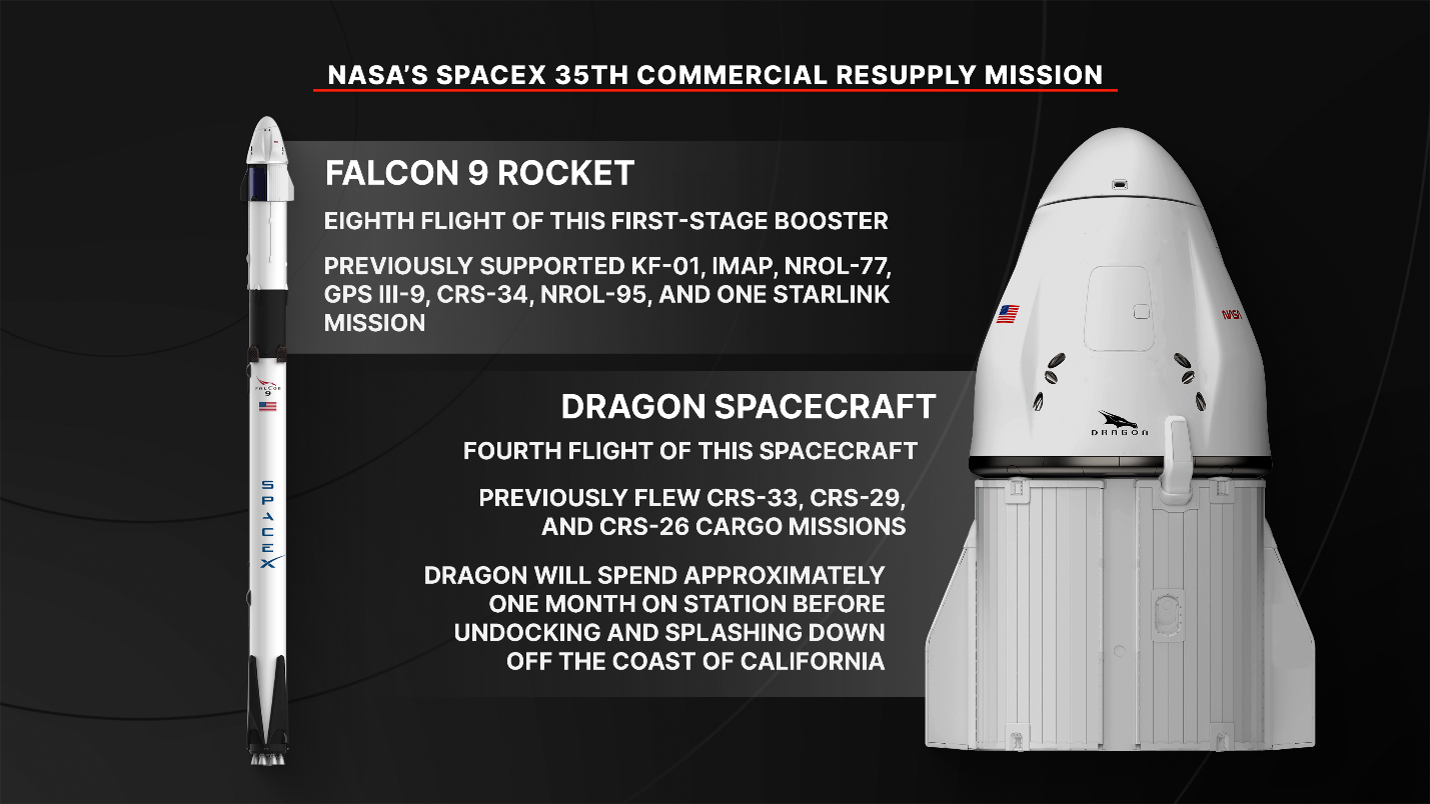
NASA’s SpaceX 35th commercial resupply mission will launch on the company’s Dragon spacecraft on the SpaceX Falcon 9 rocket to deliver research and supplies to the International Space Station.
NASA
NASA and SpaceX are targeting no earlier than Tuesday, Oct. 13 to launch scientific investigations, supplies, and equipment to the International Space Station.
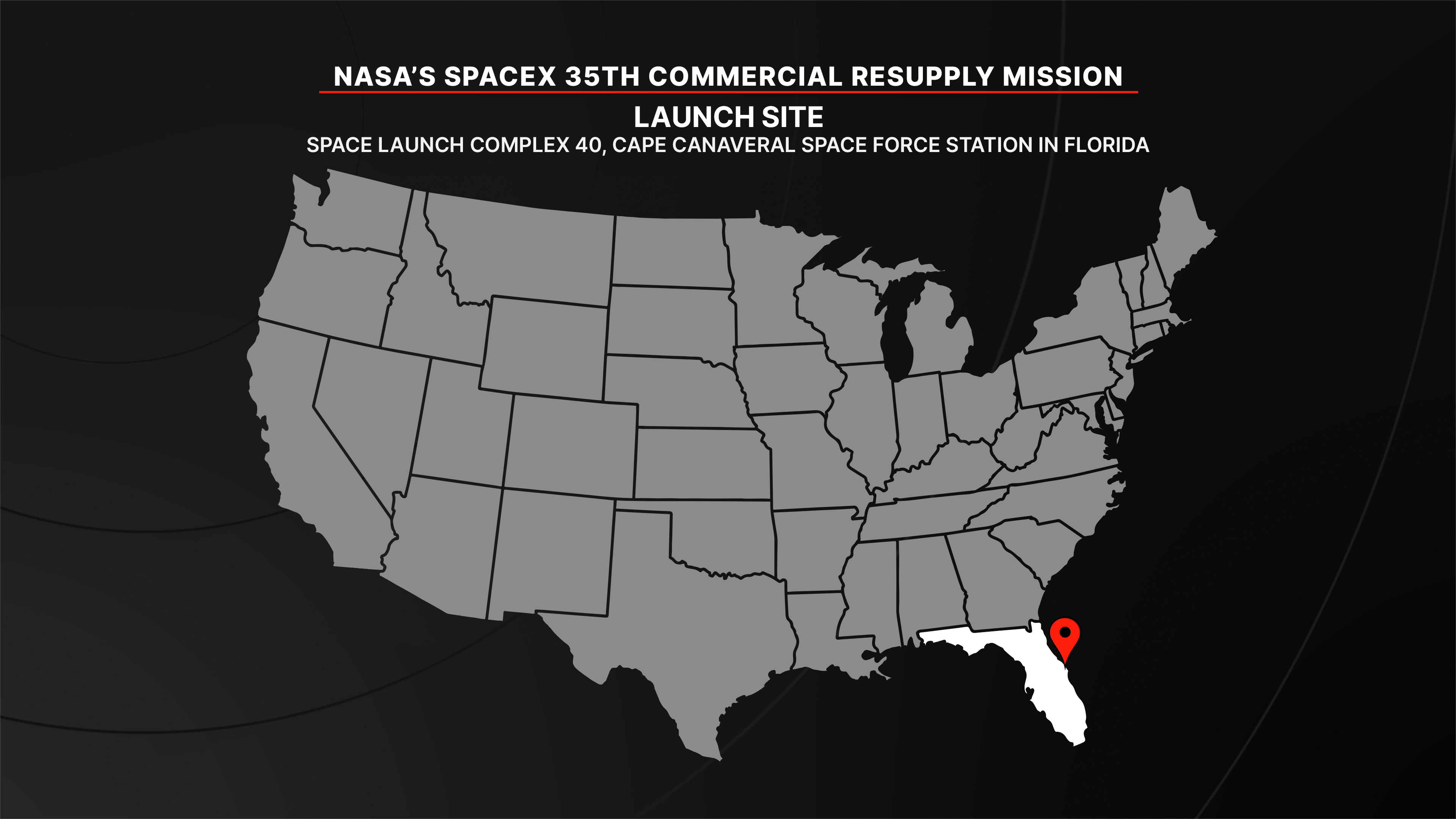
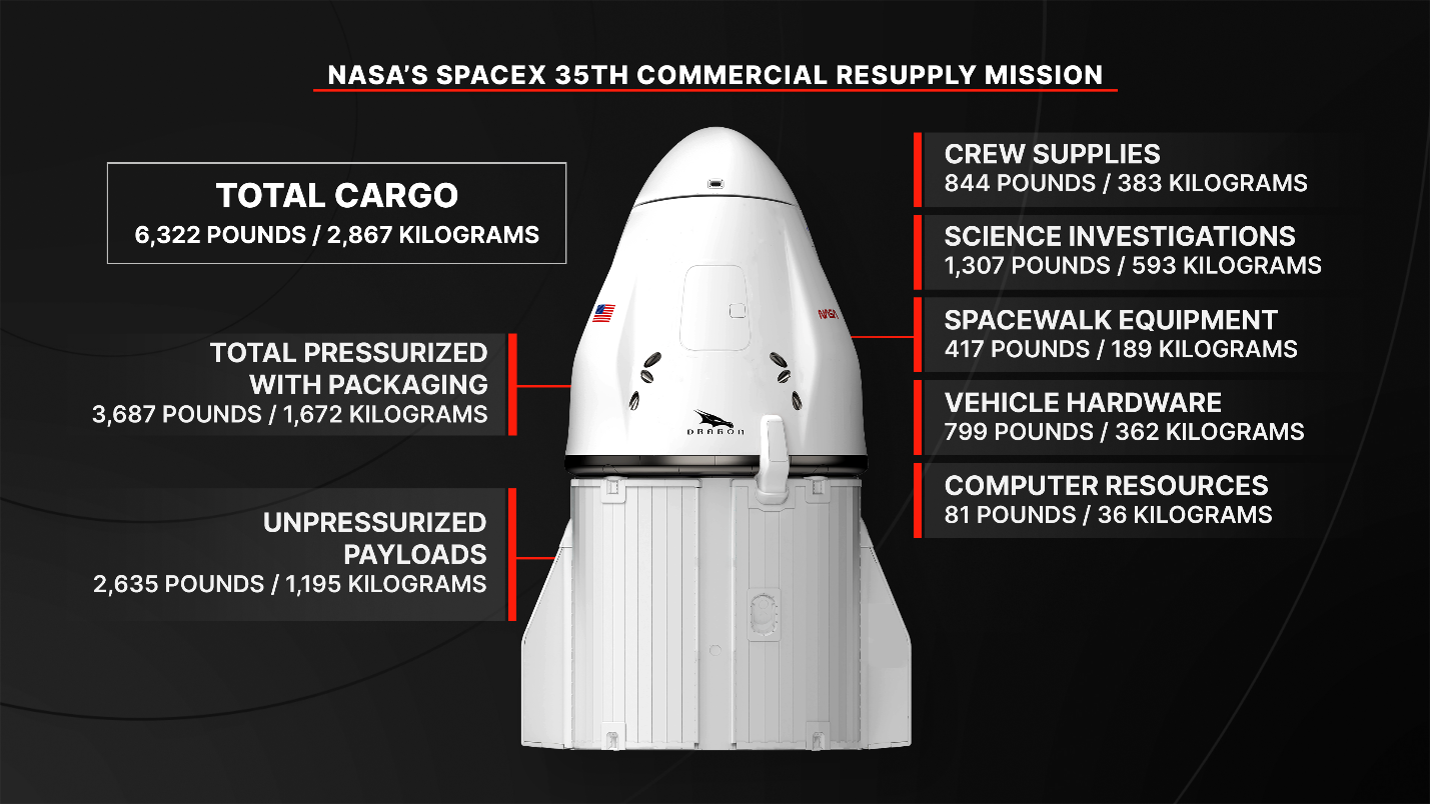
Loaded with more than 6,300 pounds of supplies, the SpaceX Dragon spacecraft will lift off aboard the company’s Falcon 9 rocket from Space Launch Complex 40 at Cape Canaveral Space Force Station in Florida. Following its arrival to the orbital complex, Dragon will autonomously dock to the space-facing port of the space station’s Harmony module.
NASA will stream launch and docking coverage through a variety of platforms. Learn where to watch online:
NASA’s SpaceX 35th commercial resupply mission will launch from Launch Complex 40 at Cape Canaveral Space Force Station in Florida.
NASA
For more than 25 years, the International Space Station has supported research by scientists from more than 110 countries, enabling more than 4,000 experiments in microgravity. Research conducted aboard the station helps advance long-duration missions to the Moon as part of the Artemis program and to Mars, while also providing multiple benefits to humanity.
Science Highlights
In addition to cargo for the crew aboard the space station, Dragon will deliver several new science experiments, including:
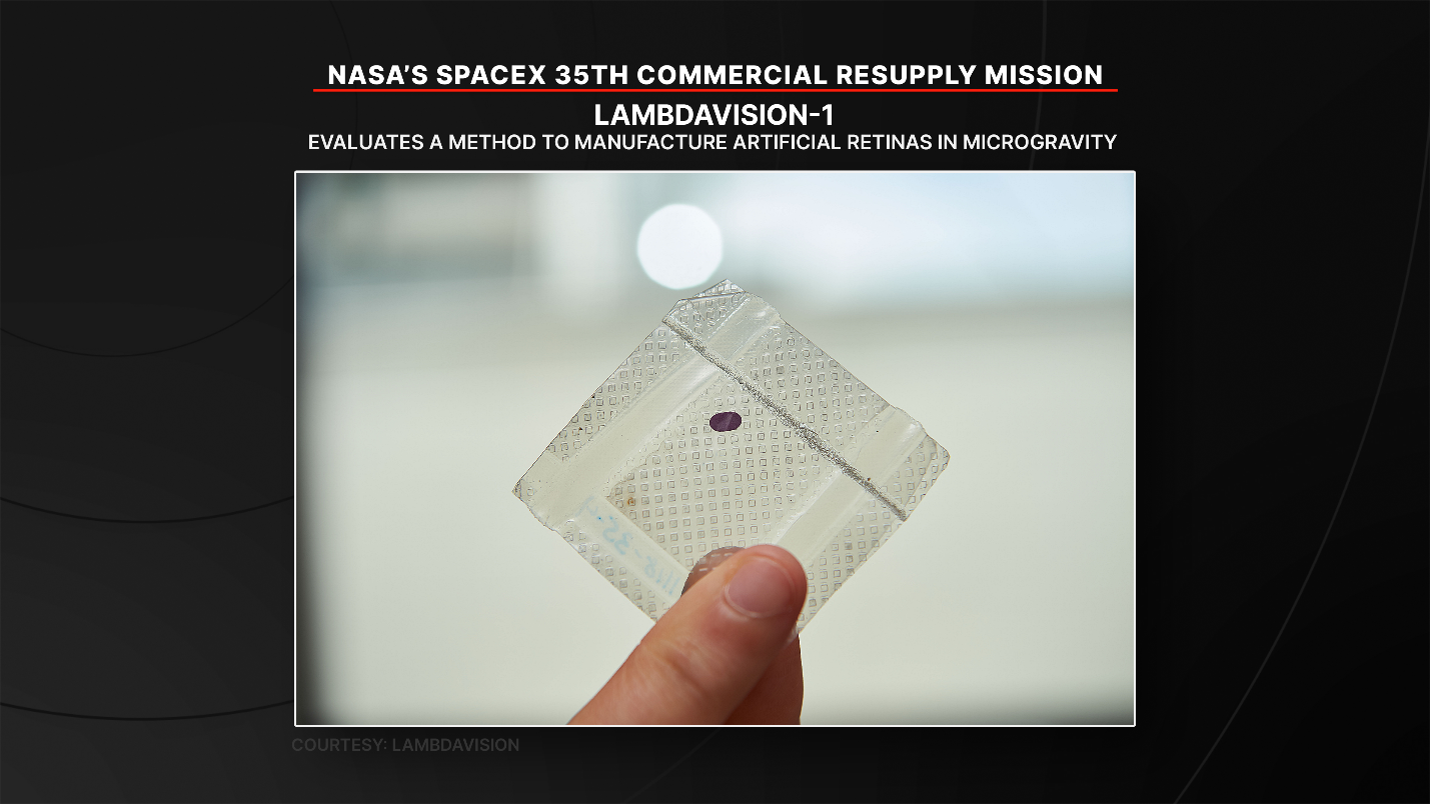
Lambda-Vision-1 studies artificial retinas in microgravity and could help patients with incurable retinal diseases on Earth.
NASA
With LambdaVision-1, NASA is testing how to manufacture artificial eye retinas in microgravity, building them one thin layer at a time. Reduced settling in microgravity may create more uniform, stable layers, potentially improving implants’ performance. These artificial retinas could help restore vision for patients with currently incurable retinal diseases on Earth.
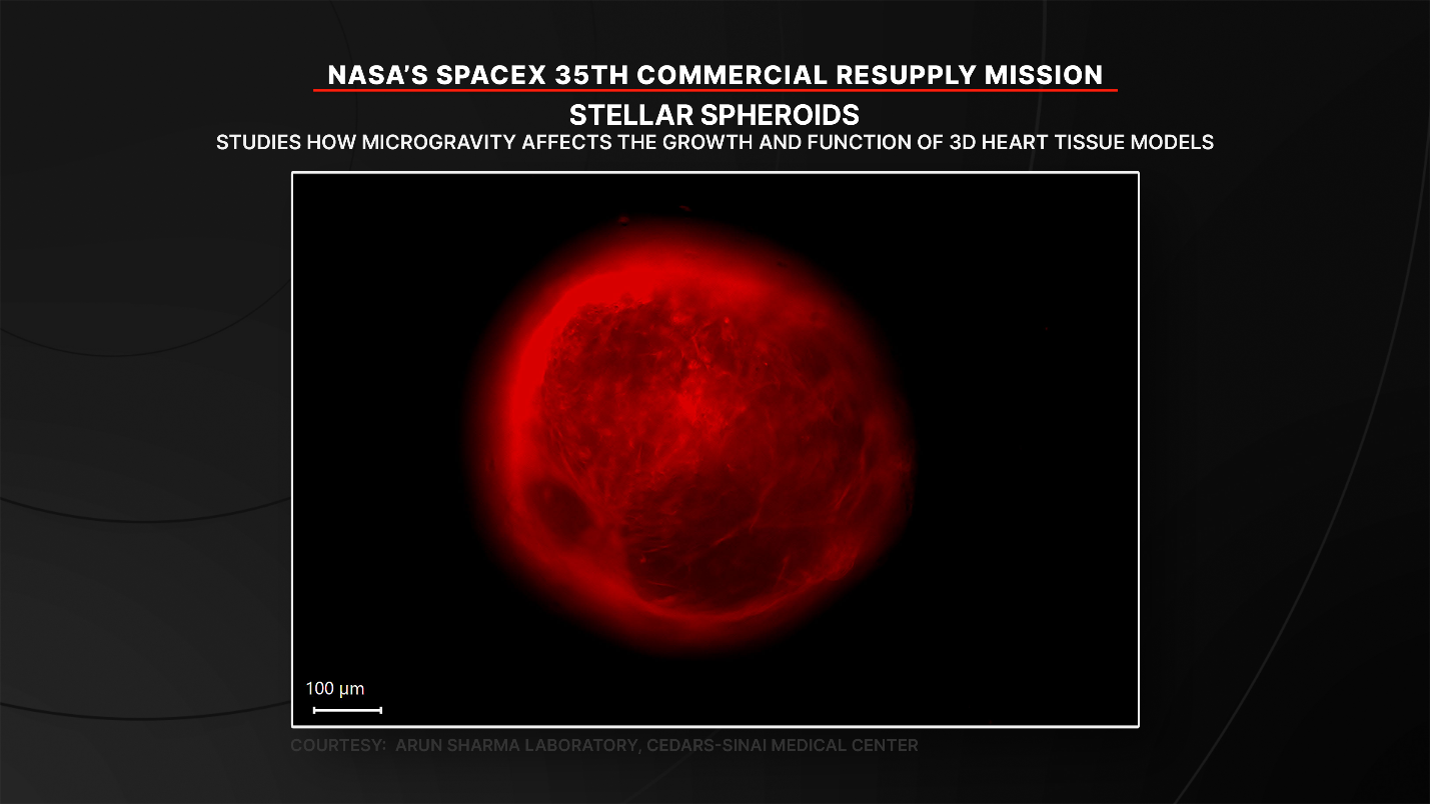
Stellar Spheroids examines growth and function of 3D heart tissues models in microgravity. Credit: NASA
NASA
NASA will use the Stellar Spheroids experiment to study how microgravity affects the growth and function of 3D human heart tissue models. Researchers will assess whether microgravity improves the formation of advanced vascular networks. Results could help researchers develop more realistic heart tissue models for disease research and support larger‑scale drug testing on future space missions.
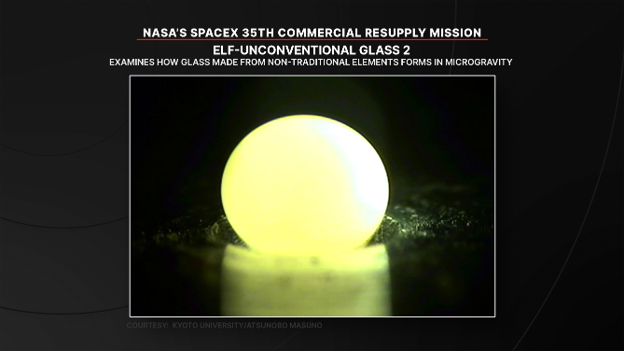
ELF-Unconventional Glass 2 studies how glass forms in microgravity when made from non-traditional elements.
NASA
Using non-traditional elements, ELF-Unconventional Glass 2 studies how glass forms in microgravity. Researchers will observe molten behavior in space, then return solid samples to Earth for detailed analysis. These unconventional glasses could offer higher strength, improved optical capabilities, and greater durability for spacecraft, habitats, and other exploration technologies.
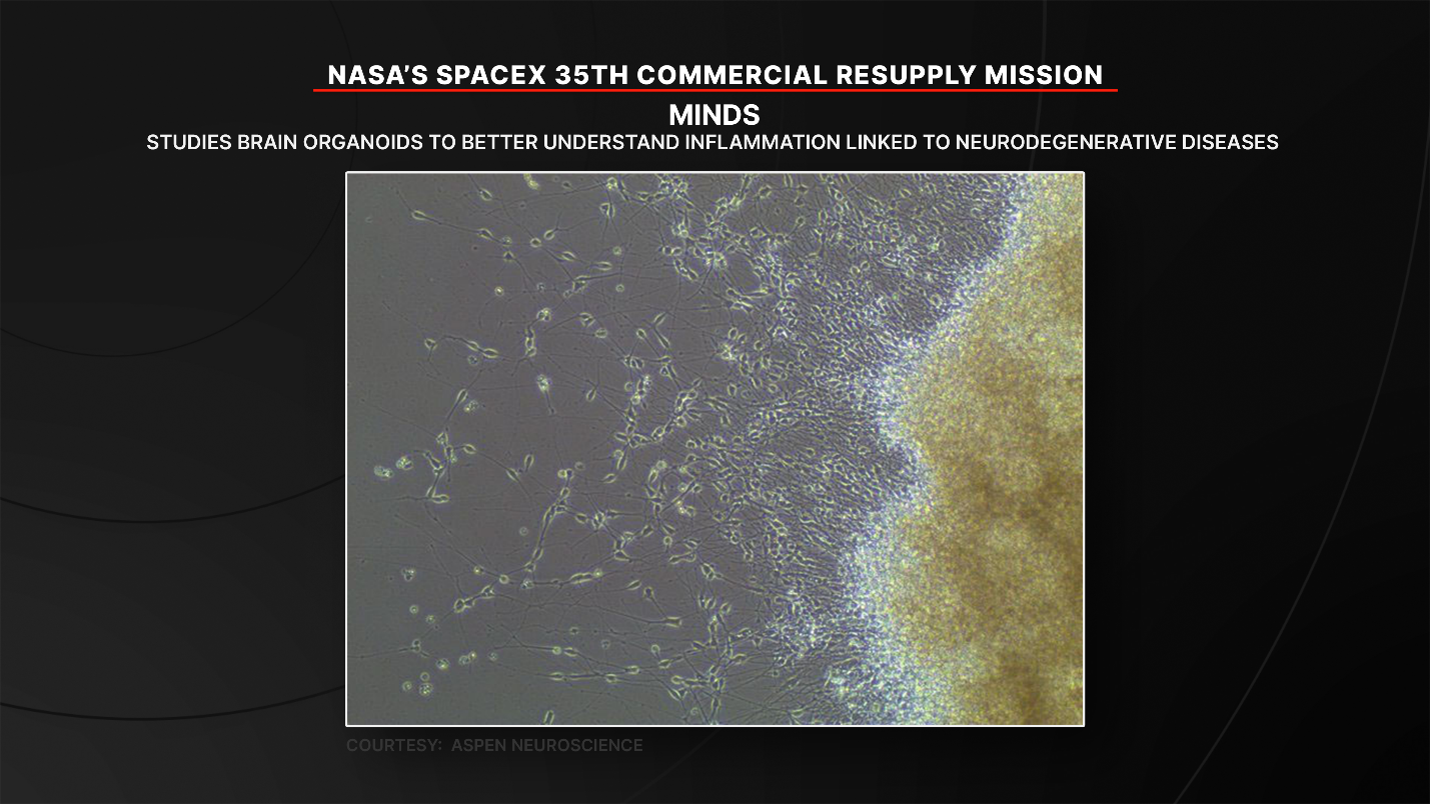
MINDS seeks to reveal new targets to treat diseases like Alzheimer’s, Parkinson’s, and multiple sclerosis.
NASA
The MINDS experiment studies brain organoids to better understand inflammation linked to neurodegenerative diseases. The investigation uses “organoid villages,” which combine cells from multiple people to better represent patient diversity. Results could help identify new treatment targets for diseases like Alzheimer’s, Parkinson’s, and multiple sclerosis.
Arrival and Return
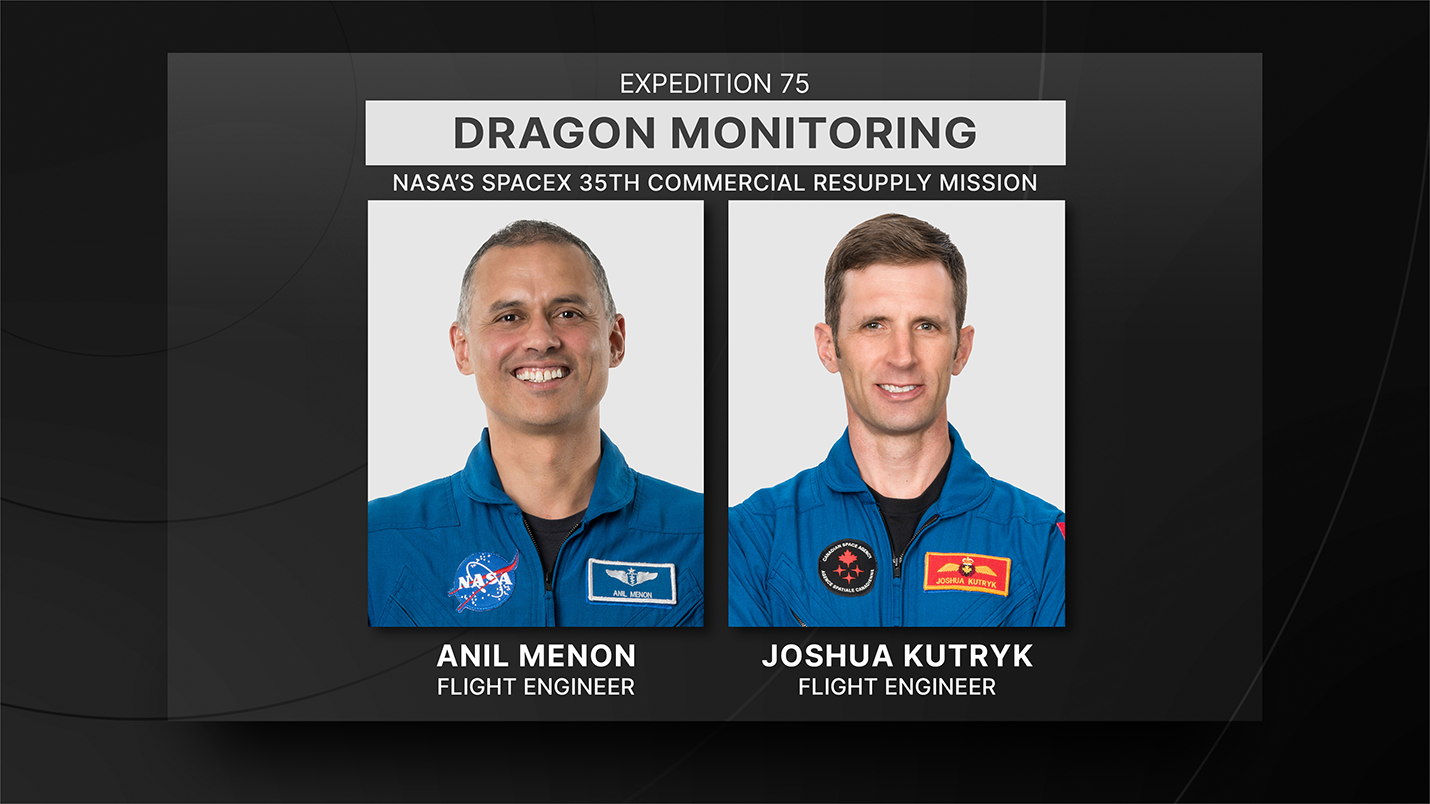
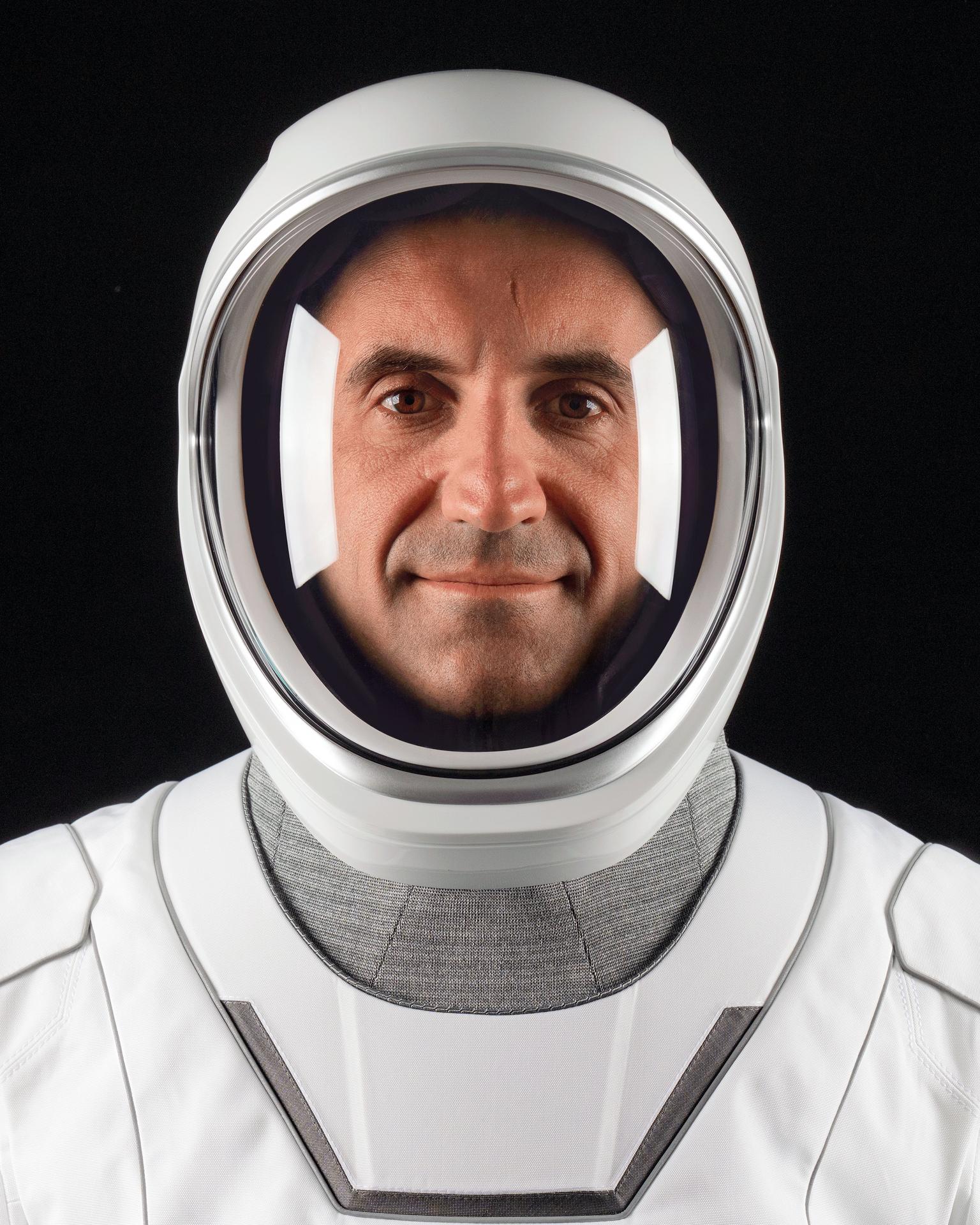
NASA astronaut Anil Menon and CSA (Canadian Space Agency) astronaut Joshua Kutryk will monitor the arrival of the SpaceX Dragon cargo spacecraft from the International Space Station.
NASA astronaut Anil Menon and CSA (Canadian Space Agency) astronaut Joshua Kutryk will monitor the Dragon spacecraft’s arrival. It will remain docked to the orbiting laboratory for about a month before splashing down in the Pacific Ocean, returning critical science and hardware to teams on Earth.
Cargo Highlights
NASA’s SpaceX 35th commercial resupply mission will launch on the company’s Dragon spacecraft on the SpaceX Falcon 9 rocket to deliver research and supplies to the International Space Station
NASA
Launch
International Space Station Roll-Out Solar Arrays (IROSA) – The final pair of IROSAs that will be installed on the space station, completing the augmentation of its power system to support critical operations, including its safe and controlled deorbit.
Collapsible Continency Urinal and supporting hardware – A demonstration and test unit supporting NASA’s Artemis III mission.
Canadarm2 joint flight support equipment – A large foam clamshell will fly empty to return the failed robotic arm joint that was replaced during a June 30 spacewalk. After its return to Earth, teams will analyze the joint on the ground.
Additional equipment launching includes a toilet dose pump, a toilet pretreat quality sensor, and a robot micro-conical tool used for space station maintenance and utilization tasks with external replacement units and payloads.
Return
When Dragon returns in mid‑November, it will bring back the failed joint on the Canadarm2 for analysis and refurbishment, a spacesuit for ground refurbishment, a fluid- and pressure-control pump assembly from the urine processor, and a filtration unit for the water processor assembly.
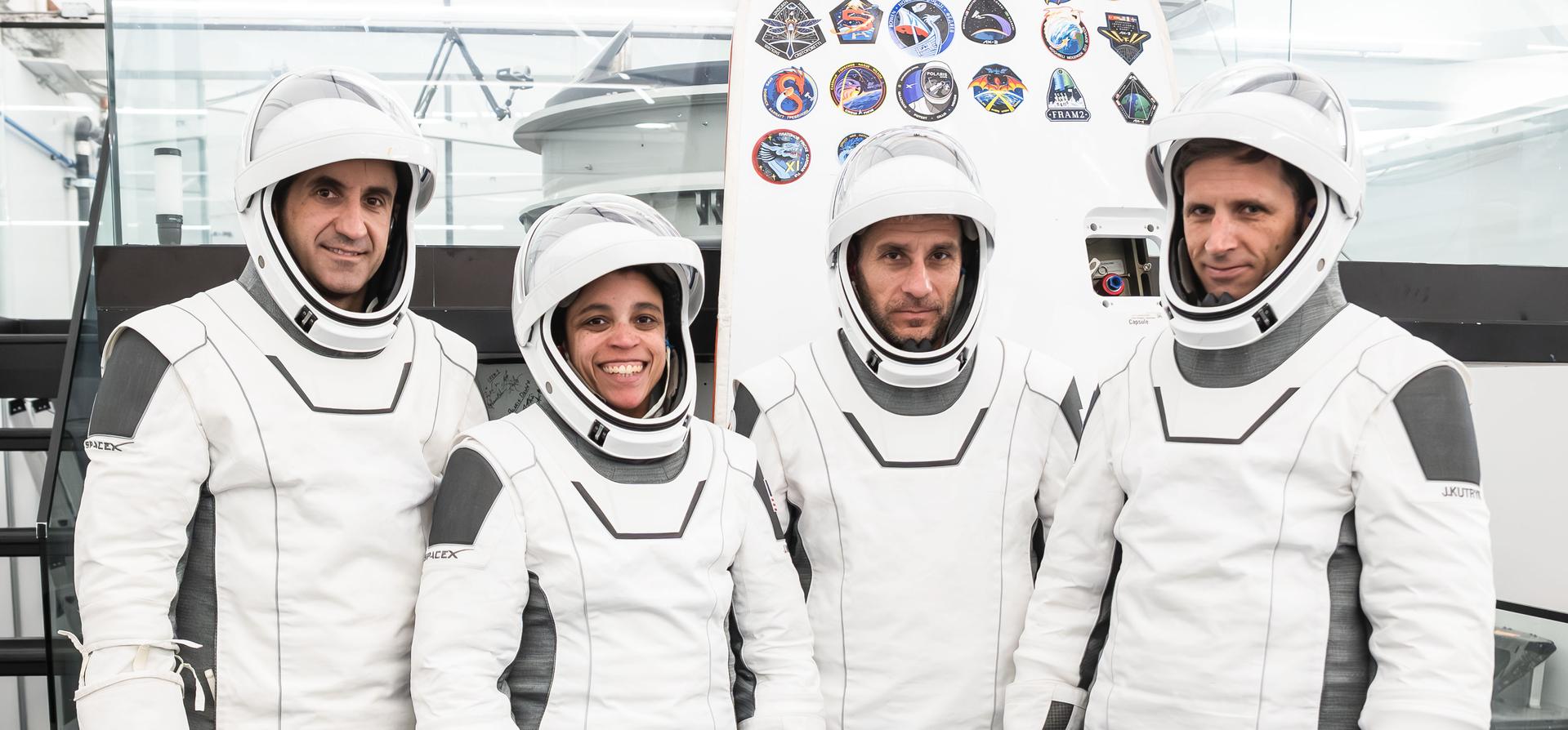
The SpaceX Crew-13 members pose for a portrait in their pressure suits during a preflight training session at the company’s headquarters in Hawthorne, California. From left are, Roscosmos cosmonaut Sergey Teteryatnikov, NASA astronauts Jessica Watkins and Luke Delaney, and CSA (Canadian Space Agency) astronaut Joshua Kutryk.
SpaceX
Four crew members are set to launch to the International Space Station as part of NASA’s SpaceX Crew-13 mission to perform research, technology demonstrations, and maintenance aboard the orbiting laboratory.
NASA astronauts Jessica Watkins and Luke Delaney will support the mission as spacecraft commander and pilot, respectively, joined by CSA (Canadian Space Agency) astronaut Joshua Kutryk and Roscosmos cosmonaut Sergey Teteryatnikov as mission specialists. Crew-13 will lift off no earlier than 11:10 a.m. EDT, Thursday, Oct. 1, from Space Launch Complex 40 at Cape Canaveral Space Force Station in Florida and join the space station’s Expedition 75 crew. Throughout its long‑duration mission, the crew will conduct science experiments to advance research and technology for future Moon and Mars missions and improve life on Earth.
“During the mission, the crew will help researchers treat heart disease and Parkinson’s disease by studying human stem-cell derived tissues that can help improve medicine, disease modeling, and pharmaceutical testing,” said Dana Weigel, manager of NASA’s Low Earth Orbit Program at the agency’s Johnson Space Center in Houston. “They also will explore crop production, which is important for longer-duration spaceflight missions, help us better understand blood flow abnormalities that we see in space, and test new diagnostic medical equipment for monitoring crew health.”
The flight is the 13th crew rotation mission with SpaceX to the space station as part of NASA’sCommercial Crew Office.
Support teams continue to progress through Dragon preflight milestones for Crew-13 and are preparing a SpaceX Falcon 9 rocket booster for its third flight. Up in orbit, NASA’s SpaceX Crew-12 is preparing to return to Earth after a brief handover once Crew-13 arrives.
After all rocket and spacecraft system checkouts are complete and all components are certified, teams will mate Dragon to Falcon 9 in SpaceX’s hangar at the launch site. The integrated spacecraft and rocket will then roll to the pad, where it will be raised vertically for a dry dress rehearsal with the crew and an integrated static fire test before launch.
The quartet will fly aboard a SpaceX Dragon spacecraft named Grace. This spacecraft previously flew in summer 2025 in support of private astronaut mission Axiom Mission 4.
Meet Crew-13
Commander Jessica Watkins
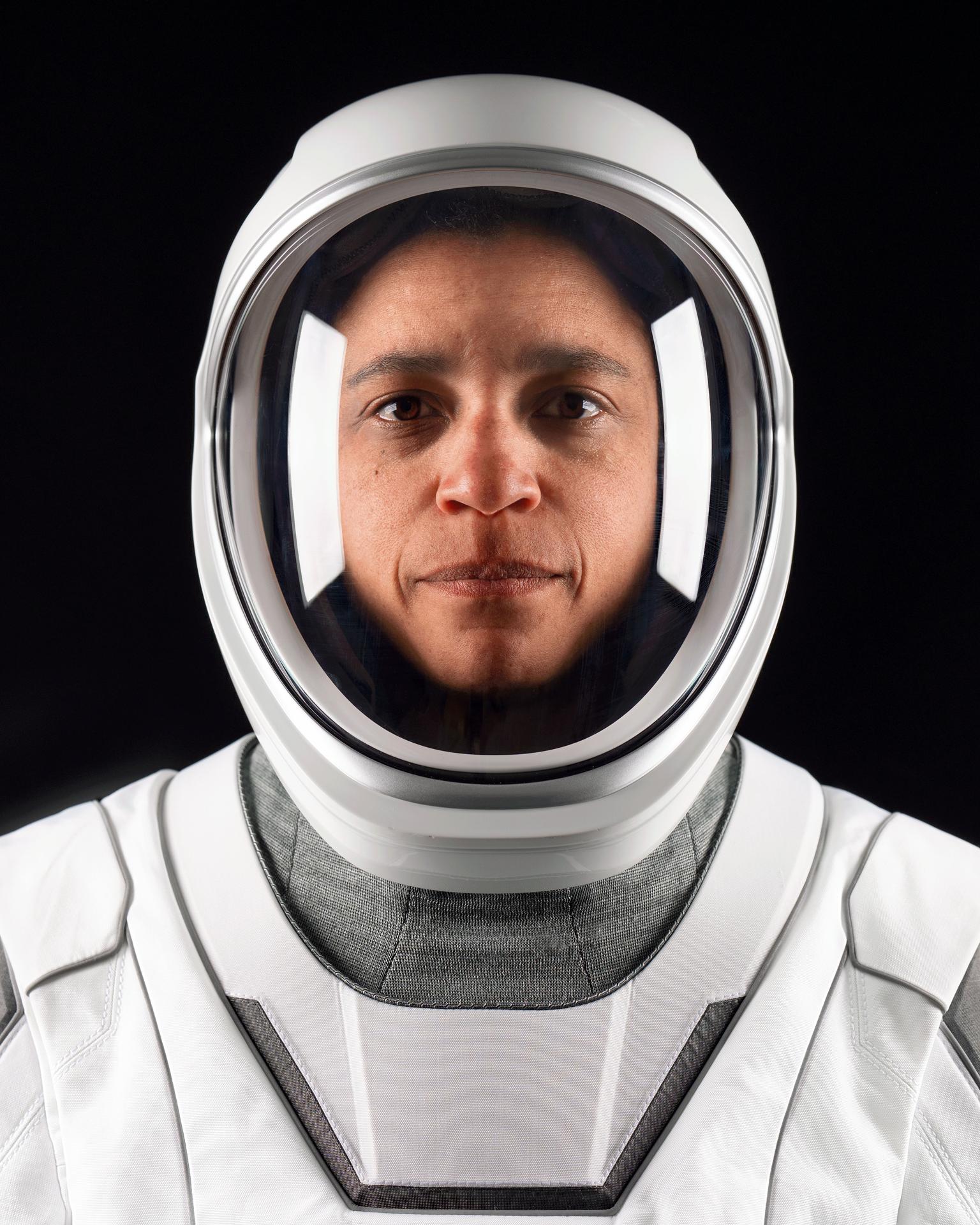
NASA astronaut Jessica Watkins, commander of NASA’s SpaceX Crew-13 mission to the International Space Station, poses for a portrait in her pressure suit at SpaceX headquarters in Hawthorne, California.
SpaceX
This will be the second flight to the space station for Watkins, who was selected as a NASA astronaut in 2017. She grew up in Lafayette, Colorado, and earned an undergraduate degree in geological and environmental sciences from Stanford University, as well as a doctorate in geology from the University of California, Los Angeles. As a geologist, Watkins studied the Martian surface and was a member of the Curiosity rover science team at NASA’s Jet Propulsion Laboratory in Southern California. She first launched to the space station aboard NASA’s SpaceX Crew-4 mission, spending a total of 170 days in space across Expeditions 67/68 in 2022. She will be the first NASA astronaut to launch twice aboard a SpaceX Dragon spacecraft. Follow Jessica on X and Instagram.
Pilot Luke Delaney
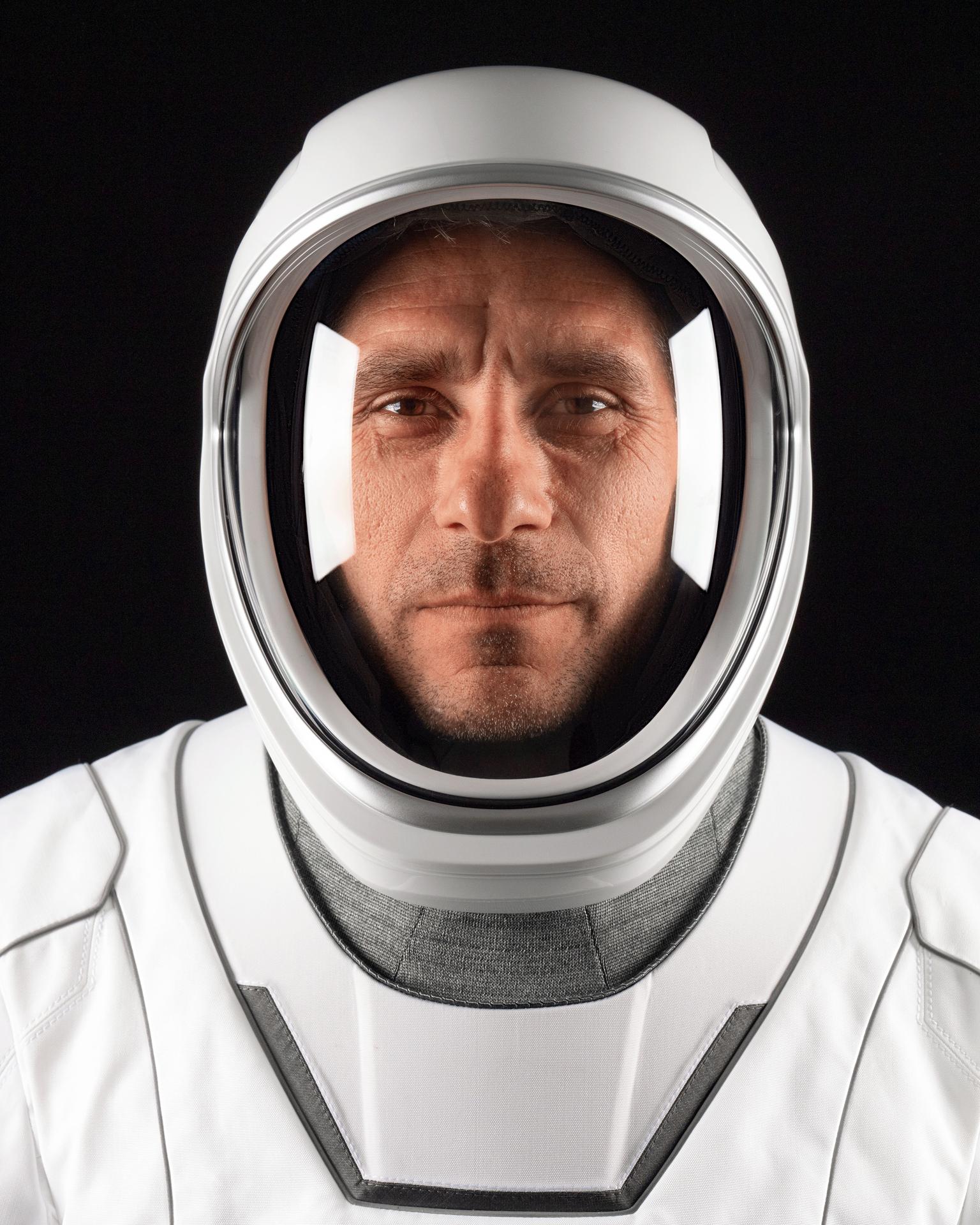
NASA astronaut Luke Delaney, pilot of NASA’s SpaceX Crew-13 mission to the International Space Station, poses for a portrait in his pressure suit at SpaceX headquarters in Hawthorne, California.
SpaceX
Selected as a NASA astronaut in 2021, Delaney earned a bachelor’s degree in mechanical engineering at the University of North Florida and a master’s degree in aerospace engineering at the Naval Postgraduate School. The Florida native is a distinguished naval aviator who participated in exercises throughout the Asia-Pacific region and flew missions in support of Operation Enduring Freedom. As a test pilot, Delaney evaluated developmental aircraft systems and served as a test pilot instructor. He also worked as a research pilot at NASA’s Langley Research Center in Hampton, Virginia, where he supported airborne science missions. This is Delaney’s first spaceflight.
Mission Specialist Joshua Kutryk
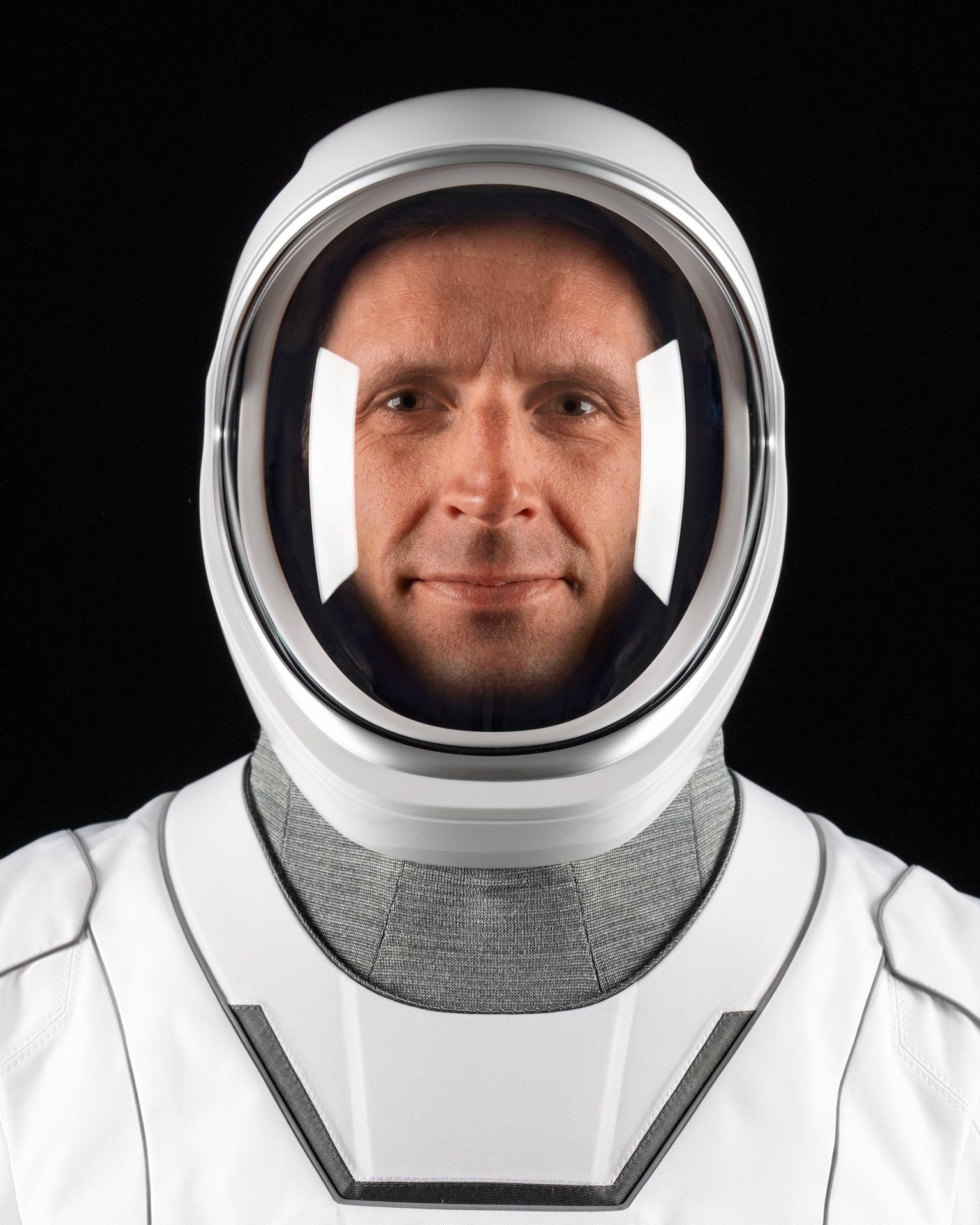
CSA (Canadian Space Agency) astronaut Joshua Kutryk, mission specialist of NASA’s SpaceX Crew-13 mission to the International Space Station, poses for a portrait in his pressure suit at SpaceX headquarters in Hawthorne, California.
SpaceX
The Crew-13 mission also is the first spaceflight for Kutryk. Prior to his selection as a CSA astronaut in 2017, he served as a CF-18 fighter pilot, flying missions in support of Canada’s NATO, U.N., and North American Aerospace Defense Command commitments. A native of Fort Saskatchewan, Alberta, Kutryk worked as an experimental and operational test pilot at the Aerospace Engineering Test Establishment in Cold Lake, Alberta. Kutryk received a bachelor’s degree in mechanical engineering from the Royal Military College of Canada in Kingston, Ontario, and is a distinguished graduate of the United States Air Force Test Pilot school in Edwards, California. He has master’s degrees in space studies, flight test engineering, and defense studies. Follow Josh on X and Instagram.
Mission Specialist Sergey Teteryatnikov
Roscosmos cosmonaut Sergey Teteryatnikov, mission specialist of NASA’s SpaceX Crew-13 mission to the International Space Station, poses for a portrait in his pressure suit at SpaceX headquarters in Hawthorne, California.
SpaceX
This mission will be Teteryatnikov’s first trip to the orbiting laboratory. He graduated from the Naval Academy, St. Petersburg, Russia, in 2011 as an engineer specializing in ship power plant operations. Before his selection as a test cosmonaut, Teteryatnikov served in various naval engineering roles, including undersea vessels and specialized engine room operations. He was selected for the Gagarin Research and Test Cosmonaut Training Center Cosmonaut Corps in 2021 and has served as a test cosmonaut since 2023.
Mission Overview
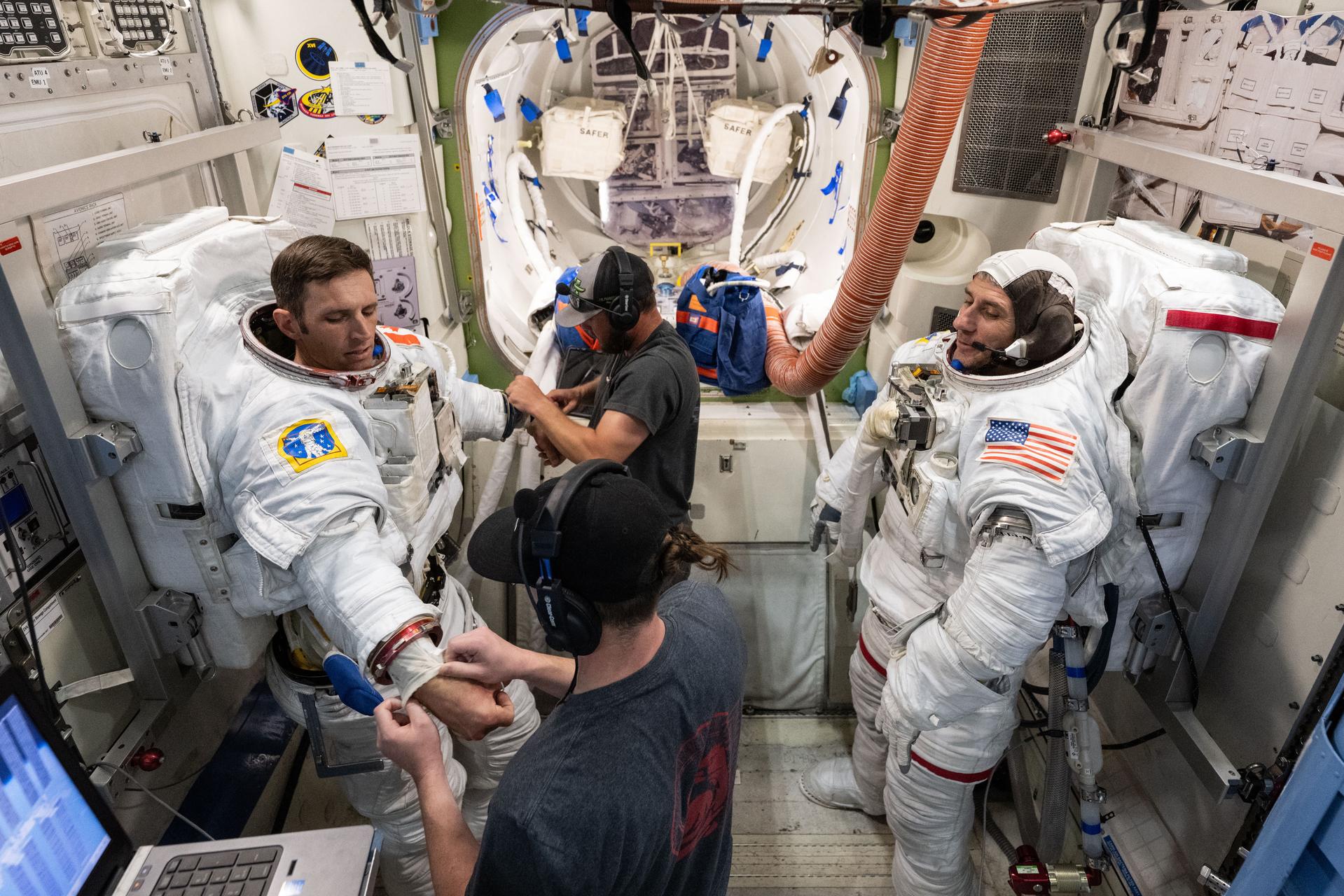
CSA (Canadian Space Agency) astronaut Josh Kutryk (left) and NASA astronaut Luke Delaney (right), with assistance from training specialists, practice suiting up in spacesuits in an International Space Station airlock simulator at Johnson Space Center’s (JSC) Space Vehicle Mockup Facility in Houston, Texas. Astronauts familiarize themselves with spacesuit systems and procedures and practice Quest airlock operations before conducting spacewalk training at JSC’s Neutral Buoyancy Laboratory in simulated microgravity.
NASA/Josh Valcarcel
Following liftoff, Falcon 9 will accelerate Dragon to approximately 17,500 mph. Once in orbit, the crew, along with NASA and SpaceX mission control, will monitor a series of maneuvers guiding Dragon to the forward-facing port of the station’s Harmony module. The spacecraft is designed to dock autonomously, but the crew can take manual control if necessary.
After docking, Crew-13 will be welcomed aboard the station by the seven-member Expedition 75 crew, including NASA astronauts Jessica Meir, Anil Menon, and Jack Hathaway, ESA (European Space Agency) astronaut Sophie Adenot, and Roscosmos cosmonauts Pyotr Dubrov, Andrey Fedyaev, and Anna Kikina. After a short handover period, the crew will bid farewell to the Dragon spacecraft carrying NASA’s SpaceX Crew-12 crew of Meir, Hathaway, Adenot, and Fedyaev.
While aboard the orbiting laboratory, Crew-13 will welcome NASA’s SpaceX’s 35th commercial resupply mission in the fall for station resupply and the delivery of International Space Station Roll-Out Solar Arrays. The crew also will welcome NASA’s Northrop Grumman Commercial Resupply Services-25 mission later this year.
For more than 25 years, people have lived and worked continuously aboard the International Space Station, advancing scientific knowledge and making research breakthroughs not possible on Earth. The space station helps NASA understand and overcome the challenges of human spaceflight, expand commercial opportunities in low Earth orbit, and build on the foundation for long-duration missions to the Moon, as part of the Artemis program, and to Mars.
Learn more about the space station, its research, and crew, at:

 Login