❌

Normal view

There are new articles available, click to refresh the page.
Before yesterdaySpace

NASA Invites Media to Crew Completion of Yearlong Mars Simulation
27 October 2026 at 15:27
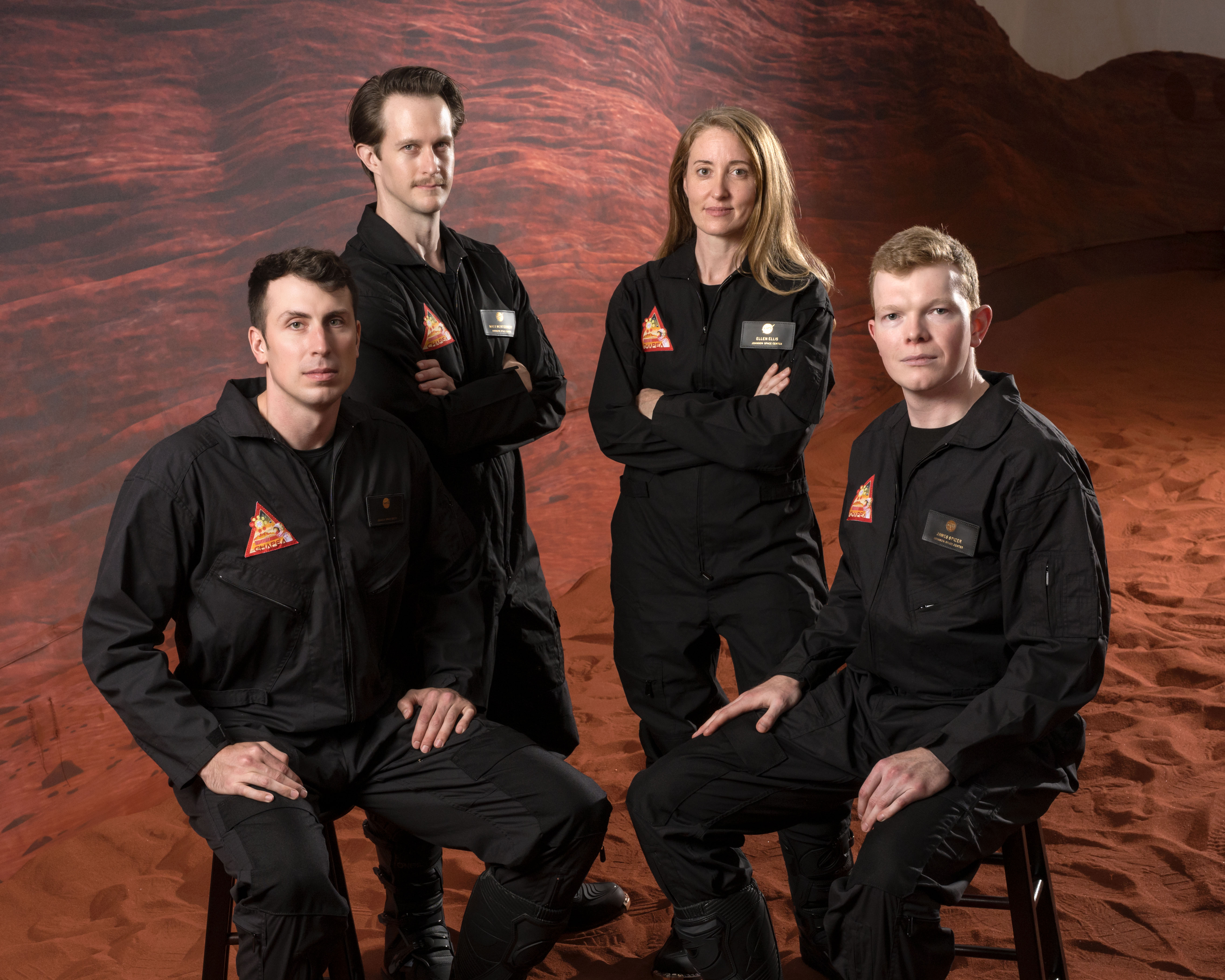
Crew Health and Performance Exploration Analog (CHAPEA) Mission 2 crew members (from left) Ross Elder, Matthew Montgomery, Ellen Ellis, and James Spicer, pose for a photo on Oct. 8, 2025.
Credit: NASA

The four volunteers who lived and worked in a simulated NASA Mars mission for more than a year will exit their habitat on Saturday, Oct. 31, after 378 days of isolation in a facility at the agency’s Johnson Space Center in Houston. Health and performance data collected from the simulation can help NASA develop methods to counter human spaceflight risks for future Artemis and Moon Base missions.

Beginning at 3 p.m. EDT, NASA will provide live coverage of the volunteers’ departure from the Crew Health and Performance Exploration Analog (CHAPEA, pronounced cha-pea’-ah) mission habitat. The exit ceremony will be streamed on NASA Johnson’s YouTube and social accounts.

Johnson Center Director Vanessa Wyche and NASA astronaut Jack Hathaway will provide remarks. The CHAPEA crew members Ross Elder, Ellen Ellis, James Spicer, and Matthew Montgomery also will provide remarks.

Media are invited to watch the CHAPEA Mission 2 ceremony live at NASA Johnson on a screen outside the hangar holding the CHAPEA facility, after which a subject matter expert will be available in person to answer questions. Media will have the opportunity to capture the moment the crew exits the building, stepping outside for the first time in more than a year.

U.S. media interested in attending the activities in person, or media interested in speaking virtually with the CHAPEA Mission 2 crew members in the days following completion of their mission, must contact the NASA Johnson newsroom no later than 2 p.m., Friday, Oct. 30, at jsc-newsroom@mail.nasa.gov.Β 

The second CHAPEA mission began on Oct. 19, 2025. Four crew members have lived and worked inside a 3D-printed 1,700-square-foot facility, simulating Mars mission operations, conducting simulated spacewalks, exercising, performing habitat maintenance, growing plants, and more, while operating under stressors that future deep space crews will likely experience. These included communication delays, resource limitations, and isolation.

Data from the mission can aid preparation for NASA’s lunar missions by optimizing food system design, efficient use of crew time, bandwidth on NASA’s Deep Space Network, and other aspects of living in deep space. In addition, data can help flight doctors and psychologists strengthen spaceflight medical care and behavioral support practices to ensure crew readiness and performance.

To learn more about NASA’s CHAPEA mission, visit:

https://www.nasa.gov/humans-in-space/chapea

-end-

Rachel Kraft
Headquarters, Washington
202-358-1600
rachel.h.kraft@nasa.gov

Kelsey Spivey
Johnson Space Center, Houston
281-483-5111
kelsey.m.spivey@nasa.gov
NASA’s Simulated Mars Crew Marks One Year Inside HabitatΒ 

By: Abby Graf
19 October 2026 at 14:01
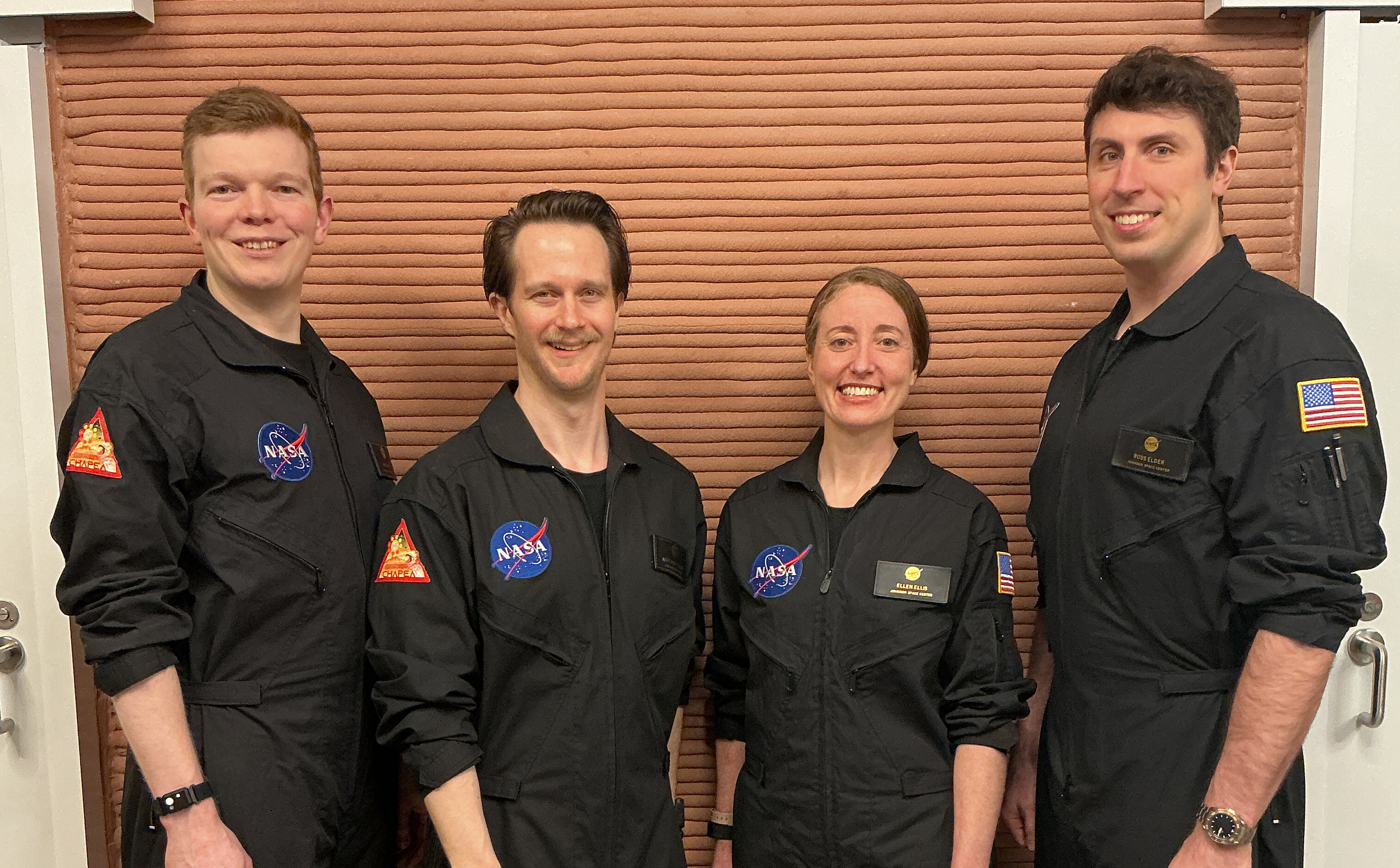
Members of NASA’s CHAPEA (Crew Health and Performance Exploration Analog) Mission 2 crew stands in their workspace after spending a year in their isolated and confined habitat at NASA’s Johnson Space Center in Houston. (from left: James Spicer, Matthew Montgomery, Ellen Ellis, and Ross Elder). Credit: NASA
Members of NASA’s CHAPEA (Crew Health and Performance Exploration Analog) Mission 2 crew stands in their workspace after spending a year in their isolated and confined habitat at NASA’s Johnson Space Center in Houston. (from left: James Spicer, Matthew Montgomery, Ellen Ellis, and Ross Elder).
NASA

The four crew members in NASA’s simulated Mars mission have spent the past year living and working in isolation in a confined habitat at NASA’s Johnson Space Center in Houston. For the past 365 days, the Crew Health and Performance Exploration Analog (CHAPEA) Mission 2 crew members have operated as though they were on the Red Planet, growing crops, managing limited resources, navigating communication delays, and conducting suited extravehicular activities on a simulated Martian surface.

Crew members include Ross Elder, mission commander; Ellen Ellis, medical officer; Matthew Montgomery, science officer; and James Spicer, flight engineer. They entered their 1,700 square foot 3D-printed habitat Oct. 19, 2025. Leading up to the one-year mark of their 378‑day mission, science teams at NASA prepared to process health and performance data collected on the crew. This critical data can help NASA balance priorities and develop methods that counter spaceflight risks during future long-duration missions on Mars.

β€œWe are extremely proud of the crew for their commitment and achievements over the last year on such a fast-paced, highly demanding mission,” said Grace Douglas, CHAPEA principal investigator. β€œThe entire CHAPEA team is excited to congratulate the crew in person.” 

The crew will exit their habitat on Saturday, Oct. 31, to conclude their mission. They will have a chance to reconnect with their families, who they’ve only spoken with via email over the course of their mission with a Mars-like communication delay. The crew will then begin two weeks of post-mission evaluations and debriefs with NASA scientists.

These debriefs and evaluations will help scientists learn what it takes for crews to adapt to the routines and demands of daily life on long-duration missions, giving NASA insight into what future explorers may need to stay healthy, productive, and connected during missions far from Earth.

For example, data could shed light on how limited food and exercise systems will influence NASA’s ability to achieve mission objectives, including spacewalks on the surface of Mars. Some data also could help NASA foster autonomy and build decision-making support systems that best aid crew with communication delays lasting up to 45 minutes each way.

β€œThis mission has been incredibly valuable in starting to teach us how to understand requirements for year-long missions, including medical and psychological care, via communication delays,” said Michael Stenger, chief scientist for NASA’s Human Research Program.β€―β€œWhen combining this Mars-realistic mission analog with a suite of physiological, psychological, and performance measures in a rigorously controlled environment, we’ll be able to translate the knowledge from these experiences to Moon Base and beyond.”

To watch the CHAPEA Mission 2 egress ceremony on Oct. 31, visit:

https://www.youtube.com/live/2MONMgAmXNU

James Spicer, Crew Health and Performance Exploration Analog (CHAPEA) Mission 2 flight engineer, participates in an extravehicular geological activity.
NASA
Ellen Ellis, CHAPEA Mission 2 medical officer, performs a medical task with Ross Elder, mission commander. Credit: NASA
Ellen Ellis, CHAPEA Mission 2 medical officer, performs a medical task with Ross Elder, mission commander.
NASA
The CHAPEA crew showcases the instruments they brought on their mission. The crew elected to include instruments as part of their personal item allowance. From left: James Spicer, Ellen Ellis, Matthew Montgomery, and Ross Elder.
NASA
CHAPEA Mission 2 crew members Ellen Ellis (left) and Ross Elder (right) conduct a maintenance task during a simulated extravehicular activity, also known as a spacewalk.
NASA
Photos that the CHAPEA Mission 2 crew arranged around a boot print in the simulated Martian sand outside their habitat.
NASA

____

NASA’s Human Research ProgramΒ 

NASA’sβ€―Human Research Programβ€―pursues methods and technologies to support safe, productive human space travel. Through science conducted in laboratories, ground-based analogs, commercial missions, the International Space Station and Artemis missions, the program scrutinizes how spaceflight affects human bodies and behaviors. Such research drives the program’sβ€―questβ€―to innovate ways that keep astronauts healthy and mission ready as human space exploration expands to the Moon, Mars, and beyond.Β 

πŸ’Ύ

Enjoy the videos and music you love, upload original content, and share it all with friends, family, and the world on YouTube.
❌
❌