I’m always on the lookout for ways I can use my 3D printing to make life a little easier, usually for minimal filament cost. I’ve been taking more chances and printing more models recently, but one recent print has proved its worth more than others.
A 4-bay NAS isn't cheap—they'll often cost you around $500 before you start including hard drives, which are now quite pricy. Even budget 2-bay NASes come in at around $200.
At one point in time, USB drives were all the rage for file transfers. I kept one in my pocket at almost all times and I had several around the house for various purposes. Over time, USB drives quietly stopped being so popular. But I still have uses for them in my homelab, so here are the main reasons why I’ll never throw away old USB drives.
AI data centers are creating new challenges for power grids. Learn how emerging reliability standards and power technologies could reshape their operations.
A rainy weekend stuck indoors is the perfect excuse to put your 3D printer to work on the house itself. While it hums along, you can line up new cabinet pulls without eyeballing them, replace that broken clip nobody sells anymore, and finally get the junk drawer under control. None of these projects need a garage full of tools, and by Sunday night something in your home will actually work better than it did on Friday.
One of the most commonly repeated SSD tips is not to fill your drive all the way up to full. It makes perfect sense, and even manufacturers will tell you to leave 10-20% empty, so you should probably listen to them.
3D printers are a fantastic tool for making basically anything you could want. This weekend, I wanted to make my house a little less annoying. So, I set out to find three things I could fix that would make my everyday life a little better, and it took me under an hour to complete.
BeamFS creator Aurelien Desbrieres is not calling for a merge, but is requesting feedback on an 18-patch proposal that takes the place of FTRFS, an earlier filesystem he proposed in April.
The Linux/Open Source blog It's FOSS reports:
Filesystems that can repair damage, like Btrfs and ZFS, usually do it by falling back on a spare copy of the data. BeamFS skips that and stores Reed-Solomon error-correcting codes inside every block. Every read gets checked against those codes, and small amounts of damage are corrected before the data reaches the application. If the filesystem can tell the damage is beyond repair, the read fails with an error instead of returning the wrong bytes...
In his technical report, ext4 and ext3 returned wrong data without any error, while Btrfs refused to read the file. BeamFS returned the correct file every time except once, when a flip hit a pointer to the file's data and it refused the read.
"Aurelien says he used Anthropic's Claude to write the code, the tool that checks the patches, and the cover letter..."
Say you want to copy a file to another folder on your Windows PC, but not for backup purposes. If you just want to have the same file appear in multiple folders, you don’t have to copy it the usual way, where each copy takes up the full amount of storage space. What you can do instead is hard link it, which makes the same file show up in another folder, indistinguishable from the original, with the benefit of this “copy” not using any extra storage.
I'm no stranger to finding weird things for my USB drives to do, such as repurposing them as "rescue drives." But this year, with the RAM shortage spilling over to every area of the PC market, I've found new ways to make good use of just about every piece of tech that I own. From a tiny file server to a retro gaming console, here's what I used my USB flash drives for in 2026.
A custom-built home is all about designing elements that feel perfectly adapted to your space and routine. With a 3D printer, you can retroactively apply this concept to the objects inside your home, to great effect.
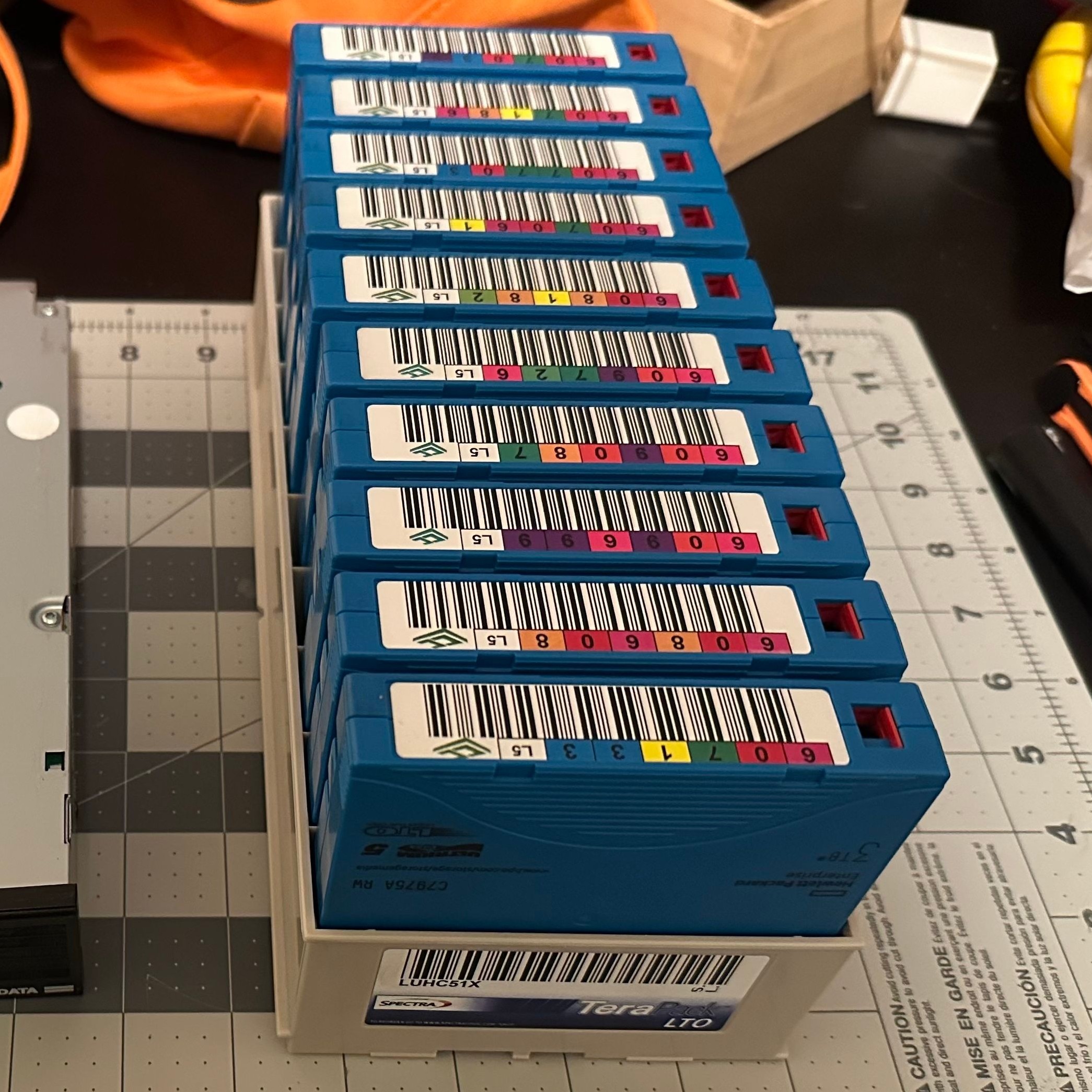
It’s one of the great mysteries of computing, how somehow in the Year Of OLlama 2026, tape remains the god of cheap storage. A while back [Ben Pettis] recounted his experience setting up an LTO-5 tape drive in his homelab, an experience which only becomes more relevant as hard drive prices stay high.
LTO-5 is already well out of date in the professional world, after all– a new server install would be debating the merits of LTO-9 versus LTO-10, but for the homelab it’s a matter of what’s affordable on the used market with decently-sized cartridges. If you can live with 1.5 TB of uncompressed data on a roughly palm-sized Linear Tape, Open cartridge then LTO-5 could be good enough. Yes, the tapes are advertized as 3TB, but that’s assuming a 2:1 compression ratio on the data, which you’re not likely to get on the photos and video that make up much of a data horder’s storage. That’s one thing [Ben] was quick to clear up for us. He also detailed his adventures with the cheaper-to-buy fiber channel model of drive.
The label would have you believe this box stores 30 TB.
Tape drives usually come with an SAS or fiber channel interface– fiber channel being, you guessed it, an optical solution unlike the SCSI-like SAS connection you may be familiar with for block storage devices. With a PCIe adapter it’s not hard to set up, provided you get the cables the right way around! That’s another detail we’re glad [Ben] shared so we can find it again if we have the same problem: with no switch in the circuit, you need a crossover cable to bring TX to RX. Which is obvious in retrospect, but obscure to those of us just learning about the standard.
The advantage, as [Ben] makes clear and everyone has always known is simply price. As of this writing, diskprices.com has 16$/TB as the lowest cost, while [Ben] was able to pick up lightly-used tapes on eBay for only 2$/TB. If you have a lot of data, those savings amortize the drive costs relatively quickly, since a used drive like [Ben]’s can be had for a few hundred bucks.
Storage vendors have been calling things “unified” for years. Sometimes that means one architecture. Sometimes it means several products sharing a management screen and a marketing budget. The term has accumulated enough baggage that a little skepticism is warranted. HPE Alletra Storage MP B10000 Release 6, announced in May, is now generally available. It brings block and file onto the same disaggregated scale-out architecture and OS code base, with independent scaling of performance and capacity and native ransomware detection across both. That’s important because enterprise storage is becoming less of an array decision and more of an architectural one. HPE was recently named a Leader in the 2026 Gartner® Magic Quadrant™ for Enterprise Storage Platforms, which provides useful context, but a quadrant is still a snapshot. GA code is where the architecture has to prove itself. Unified, but not universal The B10000 is not intended to become the answer for every file workload in the data center. Massive-scale, performance-oriented unstructured workloads such as AI, analytics, EDA and media remain better suited to HPE Alletra Storage MP X10000. The aim with the B10000 is narrower and, arguably, more useful: consolidating block and adjacent file workloads onto a common architecture without forcing customers to scale controllers and capacity together. That distinction matters. Vendors have offered “unified” storage before, but the harder question is what is actually shared underneath: protocols, scaling model, software stack and operational experience, or simply the management layer. The architecture is the product The B10000 separates compute from capacity with a “shared-everything” architecture, allowing each to scale independently rather than requiring customers to buy fixed controller-and-media increments. Release 6 extends that model across block and file while retaining a common operating environment and management plane. The interesting part is therefore not simply the addition of file protocols. It is whether customers can consolidate block and the file workloads that naturally sit alongside them without recreating the infrastructure silos they were trying to remove. Disaggregation also changes the economics. If performance and capacity requirements grow at different rates, the infrastructure can follow those curves separately rather than making one drive the other. AI moves closer to operations Release 6 also extends HPE’s AI-driven operations model. Within HPE Data Services Cloud Console, autonomous health assessments can evaluate areas such as capacity and performance, while Storage Copilot provides natural-language interaction, recommendations and the ability to take actions. Agentic Support Automation pushes that model further. Unlike legacy support approaches that depend on known issue signatures, predefined rules or thresholds, it is signature-less: AI agents continuously analyze operational behavior to detect emerging anomalies, investigate likely causes and help drive remediation—even when the specific issue has not been seen before. Capacity exhaustion is a useful example. Total system capacity can appear stable and generate no alert while a single service begins consuming capacity at an unusual rate. Traditional monitoring may not react until a threshold is crossed; agentic support automation can recognize the behavioral shift earlier, connect it to the underlying operating condition and help initiate corrective action before the change becomes a disruption. That is probably the more useful test of the increasingly fashionable word “agentic.” The question is not whether AI appears in the interface, but whether the software can move from describing an infrastructure problem toward helping resolve it. Cyber resilience becomes layered Ransomware defense follows much the same architectural logic. The B10000 now provides native real-time detection across block and file, while Zerto adds protection at the application layer and StoreOnce provides integrated data protection and recovery. No single feature solves ransomware. The more interesting model is multiple detection and recovery mechanisms operating at different points in the stack. Storage competition moves beyond the array None of this means the array is dead. Someone still has to store the bits. But the competitive unit is getting larger. Controllers, media and IOPS still matter. Increasingly, so do the operating model, cyber-resilience architecture, scaling economics and the ability to support multiple data types without multiplying infrastructure silos. The term “unified storage” has been stretched pretty far over the years. What matters now is whether the unification extends below the management layer and into the architecture itself. For more information, visit HPE Alletra Storage MP B10000 web page. Contributed by HPE
The relentless rise in memory prices may finally be losing steam, as PC and smartphone buyers reach the limits of what their budgets will allow them to pay. Taiwanese market watcher Trend Force estimates that rising DRAM contract prices drove a 59.5 percent quarter-on-quarter jump in industry revenue to $154.73 billion in calendar Q2. The analyst now expects conventional DRAM contract price growth to "moderate" to 13 to 18 percent quarter-on-quarter in Q3. That reflects a shift in demand away from high-capacity RDIMMs toward lower-capacity products, as well as "the limited ability of PC and smartphone customers to absorb further price increases." That 13 to 18 percent is still a punishing increase by any normal standard. Supplier inventories remain at historic lows, TrendForce warns, and total bit shipments are expected to grow modestly. In other words, prices are climbing more slowly and supplies are likely to remain tight for the forseeable future. The forecast follows a warning from market intelligence biz Context that European PC shipments are set to decline even more sharply as rising component costs push up system prices. Context forecasts a year-on-year decline in laptop shipments of 6.4 percent in Q3, followed by a 20 percent fall in Q4. The outlook is even worse for desktops, with shipments expected to decline around 20 percent in Q3 and almost 30 percent in Q4. Despite declining shipments, PC makers have continued to bring home the bacon, as higher prices have so far more than compensated for the fall in volumes. Earlier this year, The Register reported how Lenovo boasted it had sidestepped the fallout from the memory crisis by shifting its focus to premium devices. Context says corporate buyers are extending refresh cycles where possible and acquiring new PCs only when upgrades are unavoidable. "The PC refresh cycle has not disappeared, but the economics around it have changed," said Context senior analyst Marie-Christine Pygott. "For the channel, the opportunity is increasingly about helping customers prioritize where refreshes are essential, where devices can remain in service for longer and where investment in newer, more capable systems makes commercial sense." As for the AI PCs that manufacturers hoped would trigger a mass upgrade wave, Context says the end of Windows 10 support was the principal driver of recent buying activity, as The Register noted at the start of this year. While AI-capable PCs account for an increasing share of systems entering the European supply chain, this is mostly because AI functionality is becoming standard in newer devices. TrendForce notes that the three major memory makers continue to focus on high-end products for the AI market. Samsung benefited from its early move into HBM4 mass production, while SK hynix had the highest proportion of HBM in its total bit shipments among the three leading suppliers. Micron is prioritizing higher-priced server DRAM. That has left second-tier manufacturers such as Nanya, Winbond, and PSMC to meet demand for mature-process products such as DDR4 and DDR3. ®

 Login