Arc stops working on Mac and Windows Dec. 22, 2026. Learn how to export tabs, transfer your data, and prepare for changes to Arc Search on mobile devices.
Arc stops working on Mac and Windows Dec. 22, 2026. Learn how to export tabs, transfer your data, and prepare for changes to Arc Search on mobile devices.
For as many sensors, cameras, and computers as there are on modern cars, they ought to be a dream to poke around in and customize to one’s liking. Unfortunately they’re generally plagued by the same locked-down, proprietary software that most consumer electronics ship with, making it very difficult to interact with these systems in ways the manufacturer doesn’t approve of. There are a few exceptions to this rule, though, and [Sasha] built this system which backs up the footage from their electric car’s on-board cameras automatically to a NAS.
The system is built around a Raspberry Pi Zero 2 W which plugs directly into a USB port in the car’s glovebox. To set it up, the software only needs to be flashed onto the Pi and then it can be controlled from a smartphone. It can connect to any NAS over a variety of protocols and keeps track of what footage has been backed up, and can even automatically restart a backup if the car drives away before it has completed. It also automatically frees up space on the car’s internal drives by deleting any files that have already been synced to the NAS. All of the data is kept in the user’s control as well, and nothing leaves the LAN unless the user sets up backups to a cloud service on their own.
If you have the correct electric car and a Pi other than a Zero 2 W, [Sasha] also has a package for other Raspberry Pis that should work. Unfortunately this was designed for a specific electric car; other makes and models won’t work with this out of the box, but we hope that won’t stop others from checking out the GitHub page anyway trying to figure out what’s going on under the hoods of their car’s electrical and computer systems. Sometimes this leads to things you might not expect, like using the car itself as a video game controller.
It’s one of the great mysteries of computing, how somehow in the Year Of OLlama 2026, tape remains the god of cheap storage. A while back [Ben Pettis] recounted his experience setting up an LTO-5 tape drive in his homelab, an experience which only becomes more relevant as hard drive prices stay high.
LTO-5 is already well out of date in the professional world, after all– a new server install would be debating the merits of LTO-9 versus LTO-10, but for the homelab it’s a matter of what’s affordable on the used market with decently-sized cartridges. If you can live with 1.5 TB of uncompressed data on a roughly palm-sized Linear Tape, Open cartridge then LTO-5 could be good enough. Yes, the tapes are advertized as 3TB, but that’s assuming a 2:1 compression ratio on the data, which you’re not likely to get on the photos and video that make up much of a data horder’s storage. That’s one thing [Ben] was quick to clear up for us. He also detailed his adventures with the cheaper-to-buy fiber channel model of drive.
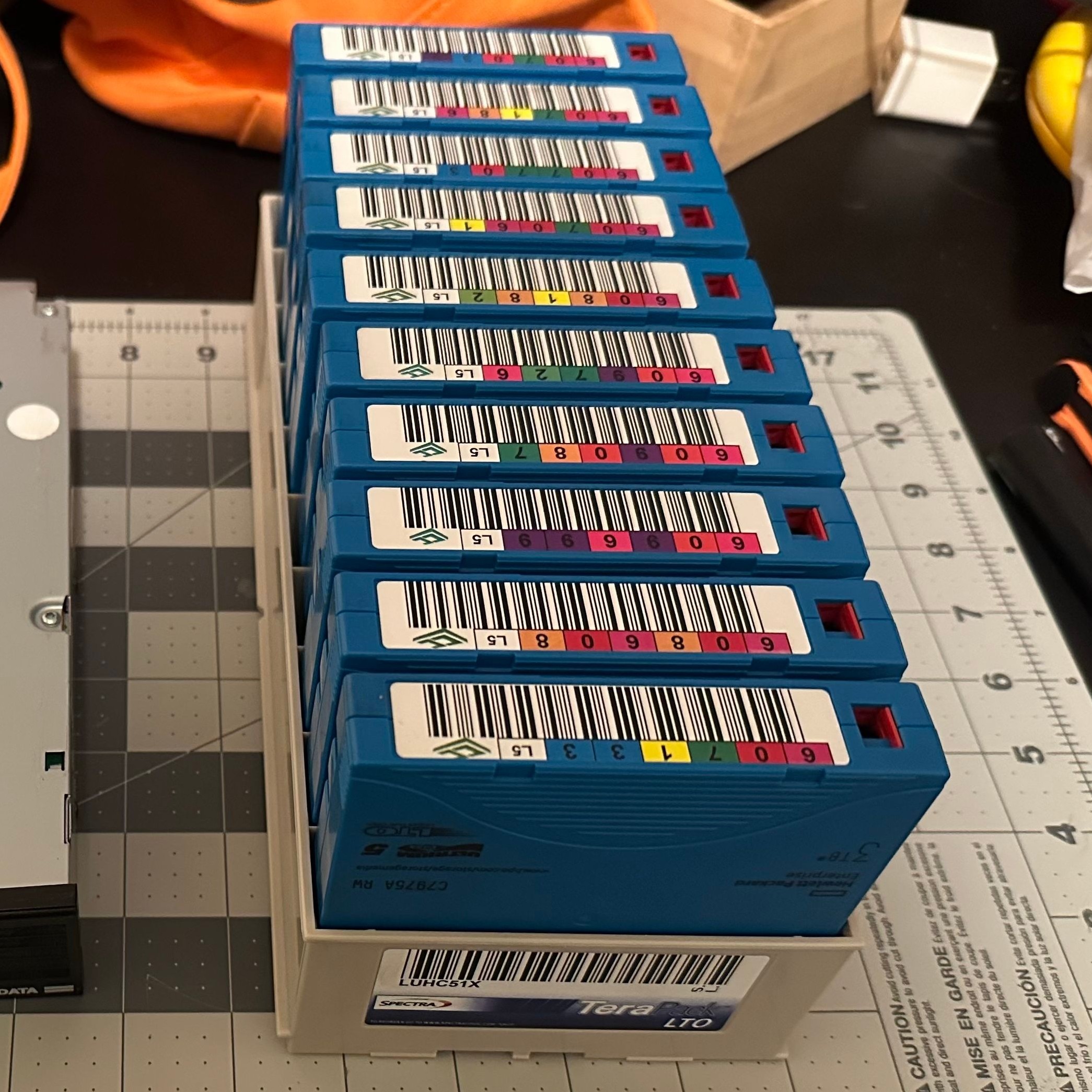
The label would have you believe this box stores 30 TB.
Tape drives usually come with an SAS or fiber channel interface– fiber channel being, you guessed it, an optical solution unlike the SCSI-like SAS connection you may be familiar with for block storage devices. With a PCIe adapter it’s not hard to set up, provided you get the cables the right way around! That’s another detail we’re glad [Ben] shared so we can find it again if we have the same problem: with no switch in the circuit, you need a crossover cable to bring TX to RX. Which is obvious in retrospect, but obscure to those of us just learning about the standard.
The advantage, as [Ben] makes clear and everyone has always known is simply price. As of this writing, diskprices.com has 16$/TB as the lowest cost, while [Ben] was able to pick up lightly-used tapes on eBay for only 2$/TB. If you have a lot of data, those savings amortize the drive costs relatively quickly, since a used drive like [Ben]’s can be had for a few hundred bucks.

 Login