AI hardware is sold out, and the companies that cut their teeth in Bitcoin mining are moving in. Luxor just raised $16 million in a round led by CMT Digital to scale its cloud platform, GPU hardware business and compute trading. Ethan Vera of Luxor and Sam Hallene of CMT Digital join BMTV to explain why Bitcoin mining expertise translates so well into AI compute.
Chapters: 00:00 Luxor Raises $16M to Take Bitcoin Mining Expertise Into AI 01:17 Why CMT Digital Backed the Luxor Team 02:54 What Bitcoin Mining Teaches AI Infrastructure 03:48 Luxor Cloud: Runners, Sandboxes and Code Review 04:51 Sandboxes for AI Agents 05:43 GPU Demand: Nvidia Sold Out for the Year 07:12 Compute Derivatives and Liquidity for AI Markets 08:12 Luxor’s Full-Stack Compute Ecosystem 10:24 Why Luxor Chose Strategic Investors 12:08 Bitcoin Mining Is Still a Core Pillar
DISCLAIMER: The views and opinions expressed in this show are those of the participants and do not necessarily reflect the official policy or position of BTC Inc., Bitcoin Magazine, or any affiliated entities. This content is provided for informational and educational purposes only and should not be construed as investment, legal, tax, or accounting advice. Nothing contained in this show constitutes a solicitation, recommendation, endorsement, or offer to buy or sell any securities or financial instruments. Viewers should consult their own advisors before making financial or business decisions.
“We believe the bottom is in.” That’s the call from Galaxy’s head of firmwide research, Alex Thorn. Bitcoin closed back above its 50-week moving average the week of September 20 and has kept that trend, and Galaxy notes that the four prior reclaims after 20-plus weeks below never closed more than 8.4% under the reclaim level in the following year. Here’s why the whole call comes down to the 50-week moving average.
DISCLAIMER: The views and opinions expressed in this show are those of the participants and do not necessarily reflect the official policy or position of BTC Inc., Bitcoin Magazine, or any affiliated entities. This content is provided for informational and educational purposes only and should not be construed as investment, legal, tax, or accounting advice. Nothing contained in this show constitutes a solicitation, recommendation, endorsement, or offer to buy or sell any securities or financial instruments. Viewers should consult their own advisors before making financial or business decisions.
A CEO whose company holds Bitcoin as its primary treasury reserve says he hates the term “Bitcoin treasury company,” and that the market is rejecting every pure treasury play except Strategy. Patrick Lowry of Samara Asset Group joins Grace Remington and Sean Hagan to explain why “digital gold” was “stupid marketing” that turned Bitcoin into an investment instead of money, and why that framing is exactly why Bitcoin dips every time the Fed talks about hiking. He lays out how Samara uses Bitcoin as working capital instead, parking venture fund commitments in it and liquidating on capital calls regardless of price.
Chapters: 0:00 “I Hate the Term Bitcoin Treasury Company”: The Market Is Rejecting Pure Plays 1:05 Why “Digital Gold” Was Stupid Marketing That Made Bitcoin an Investment 2:13 Hold vs. Use: How Samara Runs Bitcoin as Working Capital for 20+ Funds 3:59 Capital Calls Explained: Parking VC Commitments in Bitcoin Across Halving Cycles 7:17 The Hurdle Rate Problem: Why Holding Bitcoin Can Be a Disservice to Shareholders 11:46 MSCI’s Non-Operating Company Decision and the 1940 Act Loophole 13:37 Bitcoin, Ethereum and XRP: What Happens If Altcoin Treasuries Trigger a Backlash 15:21 Europe Went Backwards: BaFin, the First Bitcoin ETP and Post-Merkel Overregulation 20:20 France’s Bond Crisis and Why Germany Won’t Bail Out the French 23:30 What Rising Sovereign Yields Mean for Bitcoin and Why It Dips on Fed Hikes
DISCLAIMER: The views and opinions expressed in this show are those of the participants and do not necessarily reflect the official policy or position of BTC Inc., Bitcoin Magazine, or any affiliated entities. This content is provided for informational and educational purposes only and should not be construed as investment, legal, tax, or accounting advice. Nothing contained in this show constitutes a solicitation, recommendation, endorsement, or offer to buy or sell any securities or financial instruments. Viewers should consult their own advisors before making financial or business decisions.
Bitcoin is holding near $80K, yet the crowd has never seemed less excited and that might be the most bullish signal of all. Michael Sullivan, software engineer and author of Bitcoin Sentiment Weekly, breaks down what language-based sentiment data says about this market. He explains why excitement, conviction and desire are washed out to levels he compares to 2015, and why that looks like the early stages of a disbelief rally.
Chapters: 00:00 Michael Sullivan on Bitcoin and Currency Decay 00:58 Bitcoin’s Pullback From $86K: Is This a Disbelief Rally? 02:10 Bitcoin Sentiment Compared to 2015 and 2022 03:50 How to Tell When the Bitcoin Market Is Overheated 05:05 Measuring Excitement, Conviction and Desire in Bitcoin 06:42 The Next Bitcoin Bull Run Narrative: Bitcoin and AI 08:12 Investor Psychology: Buying Near All-Time Highs vs. DCA 09:42 Bitcoin and Traditional Finance Growing Together 10:54 Why Short-Term Bitcoin Holders Are So Frustrated 12:52 How AI’s Deflation Strengthens the Case for Bitcoin
DISCLAIMER: The views and opinions expressed in this show are those of the participants and do not necessarily reflect the official policy or position of BTC Inc., Bitcoin Magazine, or any affiliated entities. This content is provided for informational and educational purposes only and should not be construed as investment, legal, tax, or accounting advice. Nothing contained in this show constitutes a solicitation, recommendation, endorsement, or offer to buy or sell any securities or financial instruments. Viewers should consult their own advisors before making financial or business decisions.
The hash ribbon recovered on August 26 and has held for 61 days. Historically, Bitcoin was higher one year later in six of seven counted recoveries, about a 72% edge. Sean Hagan breaks down the signal, the misses (15 of 231, notably April 2021 at -17%), the January signal still 12% underwater, and why the 30-day hash rate at roughly 1.1 ZH, up 13% from July, says the worst of the miner stress is behind us. Grace Remington asks the right question: if miners left voluntarily, is the signal still reliable?
Chapters: 0:00 The Hash Ribbon Explained: Counting Miner Capitulation Days Since 2011 0:26 A New Record: 223 of 365 Days in Capitulation vs. 141 in 2012 1:01 Why This Cycle Is Different: Miners Left for $100 Billion in AI Contracts 1:48 More Like the 2021 China Ban Than 2018 or 2022 2:14 The Timing Still Fits: Capitulation Peaked 56 Days After the June 30 Low 2:37 Hash Ribbon Recovered 61 Straight Days, Hash Rate Up 13% From the Low 3:20 Price Agrees: MVRV Above Its Average and Bitcoin Above the 50-Week 3:58 Is the Signal Reliable If Miners Left Voluntarily? Higher 6 of 7 Times 5:18 Could Hash Rate Come Back From AI as the Build-Out Hits Bottlenecks? 6:52 A Backward-Looking Chart With a 70%-Plus Directional Track Record
DISCLAIMER: The views and opinions expressed in this show are those of the participants and do not necessarily reflect the official policy or position of BTC Inc., Bitcoin Magazine, or any affiliated entities. This content is provided for informational and educational purposes only and should not be construed as investment, legal, tax, or accounting advice. Nothing contained in this show constitutes a solicitation, recommendation, endorsement, or offer to buy or sell any securities or financial instruments. Viewers should consult their own advisors before making financial or business decisions.
Bitcoin tax rules have evolved, but the self-assessment system hasn’t changed. Rob Massey, who has advised on crypto taxes at Deloitte since 2012, explains why using Bitcoin as money creates “new muscle” for reporting, which wallet moves are and aren’t realization events, and why 1099s from brokers will never be the complete picture. Plus the one thing he’d ask Bitcoiners to advocate for, and it isn’t a repeal.
Chapters: 0:00 Where Bitcoin Tax Rules Stand: Self-Assessment and Barter Transactions 1:25 Broker Reporting, 1099s and Why They’ll Never Be the Full Picture 2:06 No De Minimis Exemption Has Passed: Report Everything, Small or Large 3:00 What Business Leaders Ask Now: ETFs, Leverage and Bitcoin Lending 4:07 Paying the Plumber Is Taxable and the IRS Sees Everything On Chain 5:38 What to Ask Treasury For: More Guidance on Lending, Character and Basis 6:51 Bitcoin Across Borders: No Tax Treaties, Withholding and Subpart F 8:50 How Multinationals Compare Bitcoin and Stablecoins by Payment Corridor 10:06 Unreported 2015 Pizza? Attorney, CPA, Complete Narrative, Come Clean 12:37 Proving Cost Basis After Years of Moving Coins,
DISCLAIMER: The views and opinions expressed in this show are those of the participants and do not necessarily reflect the official policy or position of BTC Inc., Bitcoin Magazine, or any affiliated entities. This content is provided for informational and educational purposes only and should not be construed as investment, legal, tax, or accounting advice. Nothing contained in this show constitutes a solicitation, recommendation, endorsement, or offer to buy or sell any securities or financial instruments. Viewers should consult their own advisors before making financial or business decisions.
Bitcoin Core just changed its security policy because AI can find bugs with a simple prompt. Jameson Lopp explains the bigger trend behind it: two and a half months of exponential growth in vulnerability discovery, attackers adopting uncensored AI models first, and security researchers who “have not been able to get a lot of rest.” He breaks down the PHP remote code execution flaw, why the fallout was smaller than expected, and why security now has to be real time and built into the development pipeline instead of a once-a-year audit.
Chapters: 0:00 Bitcoin Core Changes Its Security Policy: AI Finds Bugs With a Simple Prompt 1:04 Google’s 500,000-Qubit Estimate: Physical vs. Logical Qubits 2:00 The Quantum Timeline: “If We Have Less Than a Decade, We’re Behind” 2:57 Why We Don’t Have a Quantum Computer With More Than a Few Hundred Usable Qubits 4:26 30% of Addresses Have Exposed Keys: Who Attackers Would Target First 6:27 Why a Quantum Upgrade Will Take Years: Taproot, Consensus and Untested Cryptography 7:54 The PHP Remote Code Execution Flaw Explained 9:41 The Real Trend: Exponential AI Vulnerability Discovery and Exhausted Defenders 10:54 Security Must Be Real Time: From Annual Audits to the Development Pipeline 13:19 Hardware That Can’t Be Patched, and Why Wrench Attacks Have Topped 700
DISCLAIMER: The views and opinions expressed in this show are those of the participants and do not necessarily reflect the official policy or position of BTC Inc., Bitcoin Magazine, or any affiliated entities. This content is provided for informational and educational purposes only and should not be construed as investment, legal, tax, or accounting advice. Nothing contained in this show constitutes a solicitation, recommendation, endorsement, or offer to buy or sell any securities or financial instruments. Viewers should consult their own advisors before making financial or business decisions.
Bitcoin fell to $79K this weekend, and this week both the Fed and the Bank of Japan decide on rates. Duke Waldrop, Head of Asia Markets at UTXO Management, joins Grace Remington and Sean Hagan to explain why a yen repricing hits Bitcoin first: macro funds with yen-denominated liabilities become forced sellers, and Bitcoin’s 24/7 liquidity is where they find the exit. He also breaks down why Metaplanet is trading below the value of its own Bitcoin, why possible removal from MSCI indexes on November 30 doesn’t change the thesis, and why the bet is on the Tokyo team’s execution.
Chapters: 0:00 Bitcoin at $79K, Fed and Bank of Japan Decisions, and Metaplanet Below NAV 0:29 How Asian Investors Are Learning the Treasury Playbook 1:16 The Yen Carry Trade and Why Bitcoin Sees the Liquidity Shock First 2:12 Who Sells First If the Bank of Japan Surprises: Overleveraged Macro Funds 2:58 Metaplanet’s Nasdaq Route Through Super League and the Second Liquidity Pool 3:46 Why Metaplanet Trades Below Its Bitcoin: Bitcoin Per Share Is the Metric 4:30 Asia Is “Way Behind” on Bitcoin Preferreds 5:32 MSCI Removal on November 30: Why It Changes Nothing Fundamental 6:57 Balance Sheet Caps, Delisting and Moon Inc. 8:45 Thailand, Astra’s Cash-Flow Model, Capital Group’s 11% and “The Moon, a Million”
This video is for informational purposes only and does not constitute an offer to sell or a solicitation of an offer to buy any securities. Past performance is not indicative of future results. Investments in digital assets involve significant risk and may result in loss of capital. Both UTXO Management and BTC Inc., producer of BMTV, are owned by Nakamoto Inc. (NASDAQ: NAKA)
DISCLAIMER: The views and opinions expressed in this show are those of the participants and do not necessarily reflect the official policy or position of BTC Inc., Bitcoin Magazine, or any affiliated entities. This content is provided for informational and educational purposes only and should not be construed as investment, legal, tax, or accounting advice. Nothing contained in this show constitutes a solicitation, recommendation, endorsement, or offer to buy or sell any securities or financial instruments. Viewers should consult their own advisors before making financial or business decisions.
Instagram is testing a new longform, horizontal video format called "Features" as it pushes further into YouTube territory and expands its presence on TVs. The Verge reports: Instagram boss Adam Mosseri has been against doing longform video on the platform "for a long time," he says in a six-and-a-half-minute video (here's the widescreen version) with VP of product Tessa Lyons, saying that "one of my concerns has been, how do we make sure that we keep Instagram not just about entertainment, but about connecting with friends." If you watch a longform video, "it's a lot of Reels, photos, and carousels that you might not have sent to a friend," meaning less likes and shares. Now, though, the team is working on making shortform and longform video "symbiotic," according to Mosseri, like podcasts or comedy specials that can be both long videos and broken up into shorter ones.
The announcement of this widescreen video push also follows the launch of Instagram's TV app late last year. That app launched first as a Reels-focused experience and as a pilot for Amazon Fire TV devices in the US, but it's since expanded to Google TVs, Samsung TVs and Apple TV, and Instagram launched new features like the ability to watch Stories earlier this year.
Longtime Slashdot reader schwit1 shares a report from CBS News: Walter Koenig, the actor who played Pavel Chekov in the original "Star Trek" series and several movies, has died, his rep confirmed to CBS News. He was 90. Koenig died Sunday night at his home in the North Hollywood neighborhood of Los Angeles, talent rep Zachery McGinnis said in a statement. He died surrounded by his daughter and niece, McGinnis said.
In 'Star Trek,' Ensign Chekov was the sole member of the spaceship Enterprise bridge staff from what was the Communist bloc. His friendly, supportive presence showed how the rival nations (in the far-off future in which the show was set) were capable of working together. Speaking heavily Russian-accented English, Chekov embodied stereotypical Russian personality traits, including fierce pride, love of poetry and blind loyalty. "Through countless convention appearances and interactions with fans, he shared his kindness, wit, and appreciation with everyone fortunate enough to meet him. He understood what Star Trek meant to people and embraced the community that grew around it," McGinnis said. "Thank you, Walter, for the memories, the inspiration, and for boldly going where few have gone before."
Watch some of the Chekov's best moments on YouTube.
Seven of the largest banks in the world are now running on Coinbase infrastructure, and Brett Tejpaul, Co-CEO of Coinbase Institutional, says they’re having a “Kodak moment.” He joins Grace Remington and Sean Hagan to explain why the driver has shifted from Bitcoin ETFs to stablecoin payments now that money can move from a Citi account to USDC, across the blockchain in a second, and into a corporate account on the other side. He also gives a candid read on Bitcoin: the macro setup is great, the performance has been disappointing, and institutions aren’t yet treating it as anything but a tech trade.
Chapters: 0:00 Seven of the World’s Largest Banks Are Using Coinbase Infrastructure 1:19 From ETFs to Payments: Citi, USDC and Instant Bank-to-Blockchain Transfers 2:44 $400 Million an Hour in Stablecoins and the Banks’ “Kodak Moment” 4:38 Stablecoins Are a “Speck of Dust”: Payment Providers First, Then Banks 6:10 Agentic Commerce Arriving at the Same Time as the Big Players 6:49 Is Bitcoin Still a Leveraged Tech Trade? “Disappointing” Performance, Great Setup 8:44 Connecting U.S. Funds to Deribit’s 85% Options Market Share 11:06 The Second Wave: Net-New Entrants and Coinbase’s “Amazon to AWS” Pivot 12:57 Activating the Whole U.S. Through Coinbase Infrastructure 13:56 Quantum, 90% ETF Custody Share and “Safe Forever”
DISCLAIMER: The views and opinions expressed in this show are those of the participants and do not necessarily reflect the official policy or position of BTC Inc., Bitcoin Magazine, or any affiliated entities. This content is provided for informational and educational purposes only and should not be construed as investment, legal, tax, or accounting advice. Nothing contained in this show constitutes a solicitation, recommendation, endorsement, or offer to buy or sell any securities or financial instruments. Viewers should consult their own advisors before making financial or business decisions.
Bitcoin is holding $81K through an equity selloff, a rising 10-year and unrest in Europe, and Blockstream CMO Peter Bain calls that “a really, really strong signal.” He joins Grace Remington and Sean Hagan to explain why the technology build-out comes before the price, what Blockstream’s new Lugano hub and consulting division mean for institutional adoption, and why Switzerland’s clear rules and banking depth make it the right launch market. He also gives the first update on the Liquid Network incident: the swap service is back and users can move Bitcoin to the main chain.
Chapters: 0:00 Bitcoin Holding $81K Through the Equity Selloff Is a “Strong Signal” 0:44 Build-Out Before Price: Adoption, Stablecoins and Tokenized Equities 1:26 Blockstream’s Lugano Hub and New Consulting Division for Institutions 2:10 Why Treasury Companies Are Mostly American and Why Switzerland Is Next 3:19 Quantum Is Decades Away: Bitcoin’s Real Weak Spots 4:22 The PHP Exploit and Why Everyone Must Rethink How Software Ships 5:07 Making Bitcoin Quantum Resistant: Blockstream Research and Signature Schemes 6:18 How Consensus Reaches a Quantum Upgrade and the Bitcoin Security Consortium 7:33 Liquid Network Hack Update: Swap Service Restored, Network Back Online 8:27 Outlook Through 2027: “Poised for a Big Bull Run”
DISCLAIMER: The views and opinions expressed in this show are those of the participants and do not necessarily reflect the official policy or position of BTC Inc., Bitcoin Magazine, or any affiliated entities. This content is provided for informational and educational purposes only and should not be construed as investment, legal, tax, or accounting advice. Nothing contained in this show constitutes a solicitation, recommendation, endorsement, or offer to buy or sell any securities or financial instruments. Viewers should consult their own advisors before making financial or business decisions.
Tech stocks are selling off, and Bitcoin is holding. Today’s Chart of the Day looks at Bitcoin priced in tech stocks, the Bitcoin-to-Nasdaq ratio, which reclaimed its 200-day moving average on September 18 after 235 straight sessions below it and hasn’t closed under it since. Sean Hagan walks through why Bitcoin was higher one year after reclaims like this five of six times with a median gain of roughly 84%, why this cycle’s 62% reset was the shallowest on record, and what the 2021 fake-out looked like by comparison. He also gives his invalidation level and his $100K line in the sand.
Chapters: 0:00 Bitcoin Priced in Tech Stocks: Four Cycle Resets From 87% to 62% 0:37 The Ratio Reclaims Its 200-Day After 235 Sessions Below 1:05 Is Bitcoin Just a Leveraged Tech Bet? What the Critics Are Missing 1:49 Beta Falls to 0.75 and the Leveraged Drawdown Already Happened 2:32 How Much Confidence in a 5-of-6 Hit Rate? 15 Backtest Combinations 3:03 Above the 100, 150 and 200-Day Averages With Puell Multiple Confirming 3:52 The 2021 Fake-Out: Why Mid-Cycle Dips Aren’t Resets 4:56 The Harder Macro Backdrop: Brent at $113 and the 10-Year Near 5% 5:39 Invalidation at $76–77K and the $100K Line in the Sand 6:39 Drawdowns Along the Way and Why the Reset Is Complete
DISCLAIMER: The views and opinions expressed in this show are those of the participants and do not necessarily reflect the official policy or position of BTC Inc., Bitcoin Magazine, or any affiliated entities. This content is provided for informational and educational purposes only and should not be construed as investment, legal, tax, or accounting advice. Nothing contained in this show constitutes a solicitation, recommendation, endorsement, or offer to buy or sell any securities or financial instruments. Viewers should consult their own advisors before making financial or business decisions.
Government websites in France and Finland and hospital sites in the Netherlands are offline, Cloudflare is seeing attack traffic, and Britain’s National Cyber Security Centre is telling organizations to pull systems if they can’t patch fast. Bitcoin Magazine technical editor Shinobi joins Grace Remington and Sean Hagan to explain what broke in PHP, why memory management mistakes are the most common security flaw, and why AI finding the exploit in hours changes the pace of hacking but not its nature. He also answers the question every Bitcoiner is asking: is Bitcoin exposed?
Chapters: 0:00 The PHP Exploit Takes Government and Hospital Websites Offline 0:54 AI Found the Flaw in Hours: The “Cyber Pandemic” Warning 1:45 What Actually Broke: Memory Management Mistakes Explained 3:06 Why PHP Was Never Secure and Why This One Is Different in Scale 3:47 Is the AI Hacking Story Sensationalized? AI Does 95% of the Work 5:08 The Rough Adjustment Period and Why Shinobi Is Confident About the Other Side 6:41 No Serious Software Will Ship Without an AI Security Audit 7:23 Is Bitcoin Exposed? libsecp256k1, Bitcoin Core and Why Slow Development Was Right 9:30 Take Your Lightning Node Offline and Keep Your Coins in Cold Storage 12:09 Multisig and Sparrow Setup Checks, and Where to Follow Security Engineers
DISCLAIMER: The views and opinions expressed in this show are those of the participants and do not necessarily reflect the official policy or position of BTC Inc., Bitcoin Magazine, or any affiliated entities. This content is provided for informational and educational purposes only and should not be construed as investment, legal, tax, or accounting advice. Nothing contained in this show constitutes a solicitation, recommendation, endorsement, or offer to buy or sell any securities or financial instruments. Viewers should consult their own advisors before making financial or business decisions.
Metaplanet couldn’t make preferreds work in Japan, so it took over a U.S. company to issue them here. Allard Peng explains what that unlocks: access to the same capital pool Strategy and Strive are competing for, where STRC was one of the biggest IPOs of 2025 and it was a preferred stock. He also addresses what still needs clarity about how Metaplanet supports its U.S. subsidiary, and why the move could be accretive to common shareholders.
Chapters: 0:00 Bitcoin ETFs Pull In $1 Billion in Three Sessions While Price Stalls Under $85K 1:28 Why Bitcoin Treasury Preferreds Crashed in June: Leveraged Looping Unwinds 3:51 The Traders Holding Preferreds Below Par and What Gets Them Back 5:28 Strive’s Fixed 15% Junior Pref vs. Variable-Rate SATA 7:37 How a Preferred Trading Above Par Adds to Net Bitcoin Per Share 10:49 What Has to Happen Before a Company Buys Its First Bitcoin 12:22 When Issuing a Preferred Below Par Still Makes Sense 14:52 Metaplanet’s U.S. Listing and the Capital Pool Strategy and Strive Compete For 18:08 Elon Musk, Tesla and SpaceX’s Bitcoin, and Why Money Won’t Become Irrelevant 21:12 Should Small Businesses Hold Bitcoin?
DISCLAIMER: The views and opinions expressed in this show are those of the participants and do not necessarily reflect the official policy or position of BTC Inc., Bitcoin Magazine, or any affiliated entities. This content is provided for informational and educational purposes only and should not be construed as investment, legal, tax, or accounting advice. Nothing contained in this show constitutes a solicitation, recommendation, endorsement, or offer to buy or sell any securities or financial instruments. Viewers should consult their own advisors before making financial or business decisions.
Some disappointing, but perhaps not entirely unsurprising news this week out of Denmark — after announcing last year that they would transition away from Microsoft’s proprietary software, the realities of making it work seem to have caught the government off guard. The word is that a trial program immediately ran into problems when government employees that had been given Collabora tried to collaborate with their peers running Office, and has since been quietly abandoned.
Although there’s probably a joke to be made about different parts of the government not knowing what the other ones are talking about, the reality is that if one group of staffers can’t reliably access the data being produced by another, that’s a pretty big problem. Of course, had they simply asked us nerds, we could have advised them that these sort of issues are inevitable if you don’t fully commit to the effort.
Had the entire government moved to the Open Document Format (ODF) at once they would have avoided the issue, at least when it came to newly created documents, but obviously that’s a considerably larger undertaking than installing Collabora or OpenOffice on a few dozen machines and calling it a day. There’s no word yet on how this stumble will impact Denmark’s larger effort to free themselves of proprietary software, but we’d hazard a guess it’s not a great sign. Hopefully things go better for the Dutch.
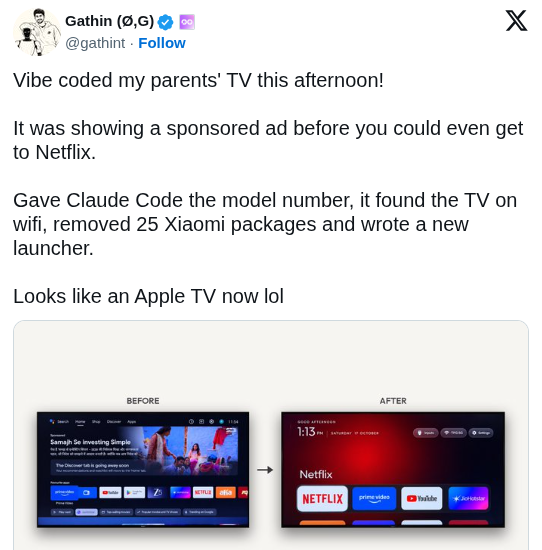
Speaking of users trying to improve their personal software situation, The Verge has an interesting article on a recent trend of frustrated users pointing AI tools like Claude at their smart TVs, with a few success stories posted to social media showing off interfaces that have been stripped of ads or replaced with something else entirely. It’s compelling stuff for anyone who’s unhappy with their current smart TV experience, but the whole thing isn’t quite as technically impressive as it might seem on the surface.
As the TV’s in question are running Android, all the AI tools need to do is connect to them over Android Debug Bridge (ADB) and uninstall any offending packages that might be providing ads, and similarly creating a customized launcher interface is a matter of spinning up an Android app and installing it over the network. The results may look like arcane magic to the uninitiated, so we appreciate The Verge pointing out that it’s all pretty basic stuff for anyone familiar with Android development.
On the subject of extracting unwanted components, a delicate operation to remove the masts of the sunken WWII cargo ship SS Richard Montgomery was completed successfully earlier this week off the coast of Sheerness, England. To those unfamiliar with this particular vessel that might not sound like a big deal, but when you’re dealing with a wreck holding an estimated 1,400 metric tons of explosives that have been deteriorating since 1944, even approaching the area needs careful planning and coordination.
Masts of the SS Richard Montgomery in 2014. Image Credit: Christine Matthews
There was a concern that the masts and their supporting structures were on the verge of collapsing into the hull of the wreck, which experts warned could potentially trigger an explosion large enough to endanger life and property. Actually removing the explosives from the ship itself will be a far larger undertaking, but at least for the time being, removing the masts has helped stabilize the situation.
Finally, if you’re looking to learn about something a little more local than a potentially explosive situation in Sheerness (apologies to anyone in Sheerness), check out Local Wikipedia. Created by [Ed Jefferson], the site lets you filter Wikipedia pages by their distance from your location or whatever other landmark you wish. By default it shows results that are within 1.5 miles, but if you don’t have anything too exciting within range it will start opening up the radius to pull in more results.
See something interesting that you think would be a good fit for our weekly Links column? Drop us a line, we’d love to hear about it.
If you’re a collector of older TVs, you’re probably facing the problem in some form of having no transmissions to tune in to. With many sets you can use a SCART or other A/V input, but nothing beats using the thing as it was intended. [BorisDigital] had exactly this problem, and since he worked in a TV transmitter control room in the 1990s, he’s made a small TV station that looks and operates like the real thing.
It’s a 10 inch rack stuffed with goodies, each of which replicates the function of a piece of broadcast gear which would have cost a small fortune back in the day. At the top is a transmitter, a relatively inexpensive board from China. Below it a clock and audio monitor powered by a Pi Pico, then a vectorscope, waveform monitor, and monitor powered by a set of Pi 5s with USB video digitisers, a pair of SD card video record/play units — yet more Raspberry Pi — and at the bottom, an automatic scheduler powered by another fruity board from Cambridge. If you’re not into TV the construction may be worth a second look. Those neat looking rack front panels are 3D printed with different filaments for the lettering, and are both robust and stylish. We can already see how this could be used in our work.
We miss analogue TV, partly because it was a wonderfully intricate technology that, beautifully, just worked. it’s a few years now since we reported on the last gasp of analogue TV in the USA, about a decade after it was turned off where this is being written.
Frustrated by intrusive ads, sluggish interfaces, and data tracking, smart TV owners are using AI coding tools and open-source projects to strip unwanted software from their televisions and build customized home screens. The Verge reports: Several vibe-coded TV-debloating projects exploded in popularity over the weekend. Cleanyourtv (known as tv-vibehack until the 19th), tv-detox, and dumbtv all claim to accomplish similar things -- remove sponsored ads, debloat the TV so it runs faster, and block unwanted data collection that tracks what you're watching -- without hacking, or rooting, the TV. By default, they all also replace the TV's built-in app launcher with simpler ones. Many users are going a step further and vibe-coding their own replacement launchers, like the Pokemon one below.
Most of the projects we've seen so far focus on TVs that run on Android and Google TV operating systems (such as TCL, Hisense, Sony, and older Amazon Fire products), using existing developer modes and the Android Debug Bridge (ADB) to tweak settings and apply (and remove) packages. According to the GitHub pages, they can also work with some Fire TV products that use a custom fork of Android (although likely not on the new Vega-based Fire TV Sticks). Because they use built-in developer tools, they don't require root access or firmware hacking, and they're reversible. Even projects that totally change the look of the interface just use Android's ability to install custom launchers -- in many cases with an assist from Claude Code or a similar tool to create the new launcher, too.

 Login