❌

Normal view

There are new articles available, click to refresh the page.
Yesterday — 28 October 2026Main stream

NASA Welcomes Vietnam as Newest Artemis Accords Signatory 
28 October 2026 at 17:50
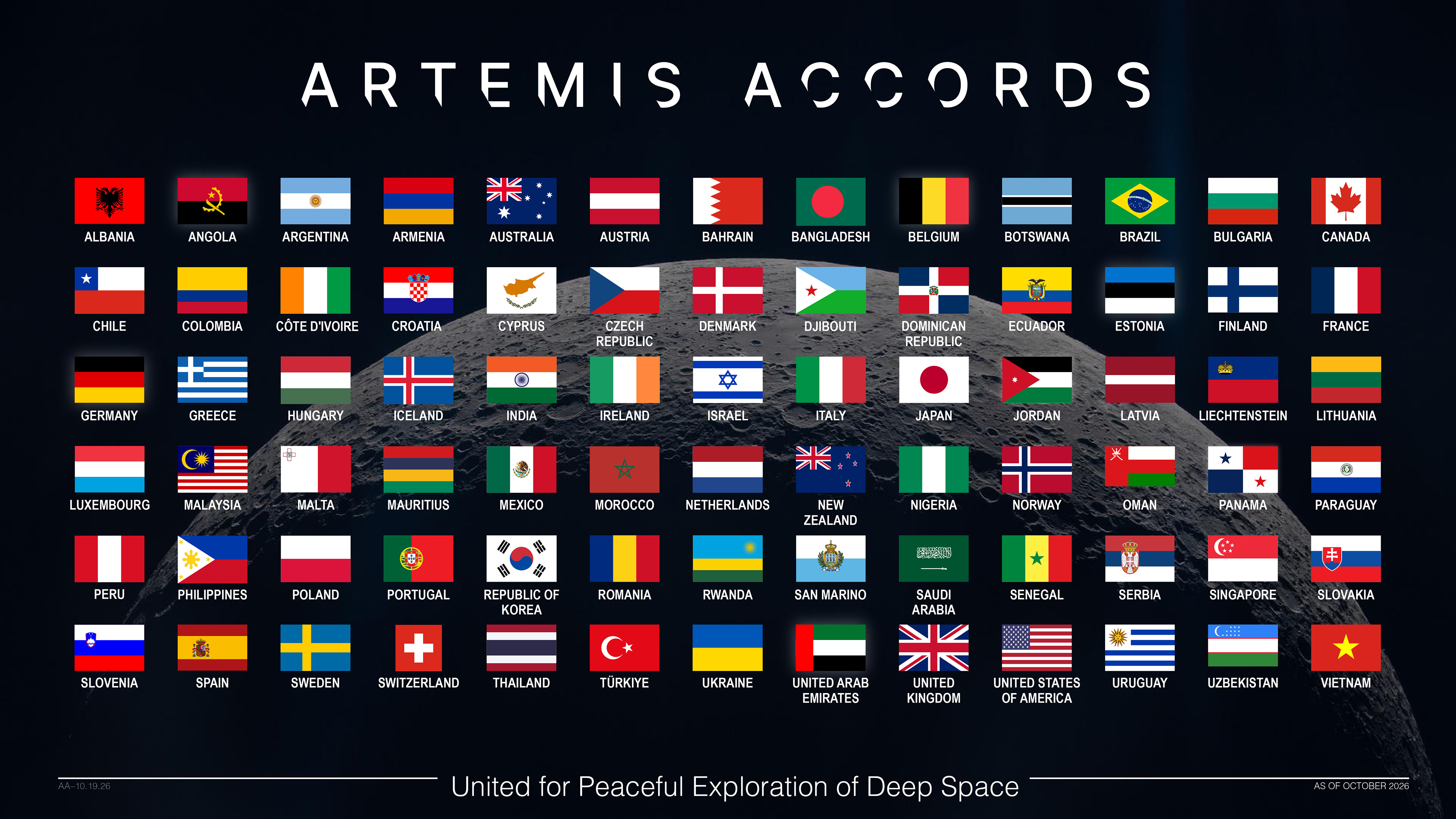
Artemis Accords flags
Credit: NASA

The Socialist Republic of Vietnam became the 78th nation to sign the Artemis Accords, joining a growing coalition of like-minded nations committed to the peaceful, transparent, and responsible exploration of space.  

“Vietnam is joining at an important point in the development of its own space program,” said NASA Deputy Administrator Matt Anderson in recorded remarks for the ceremony. “NASA and the Vietnam National Space Center have built momentum in satellite innovation, land-use research, and radar-based Earth observation. Joining the Artemis Accords opens a new chapter in that relationship. We’ve aligned on the principles. The opportunities are in front of us, and now we can build on that foundation together. We are proud to welcome Vietnam to the Artemis Accords community.” 

Vietnam’s Minister of Science and Technology Vũ Hải Quân signed the Artemis Accords on behalf of the country during the Vietnam International Digital Week in Ha Long. The United States Ambassador to Vietnam Jennifer Wicks also participated in the signing event. 

Vietnam’s decision extends the U.S.-Vietnam Comprehensive Strategic Partnership into a new frontier.  Built on more than 30 years of cooperation, the partnership spans defense, economic, law enforcement, war legacy, and technological cooperation, and it advances peace, stability, and prosperity in a free and open Indo-Pacific. 

Earlier this year, NASA partnered with Vietnam’s Vietnamese-German University to support the agency’s Soil Moisture Active Passive mission, which measures surface-soil water worldwide. Vietnam also inaugurated its National Space Center in Hanoi and is developing domestic satellite capabilities through the LOTUSat program, focusing on Earth observation, weather monitoring, and disaster response. 

In 2020, NASA and the State Department joined with seven other founding nations to establish the Artemis Accords, responding to the growing interest in lunar activities by both governments and private companies. They introduced the first set of practical principles aimed at enhancing the safety and coordination between nations as they explore the Moon, Mars, and beyond. 

Signing the Artemis Accords means committing to explore peaceably and transparently, to render aid to those in need, to enable access to scientific data that all of humanity can learn from, to ensure activities do not interfere with those of others, and to preserve historically significant sites and artifacts by developing best practices for space exploration for the benefit of all.  

More countries are expected to sign the Artemis Accords in the months and years ahead, as NASA continues its work to establish a safe, peaceful, and prosperous future in space.  

Learn more about the Artemis Accords at:  

https://www.nasa.gov/artemis-accords
Before yesterdayMain stream

NASA Welcomes Uzbekistan as Newest Artemis Accords Signatory

20 October 2026 at 10:21
Credit: NASA

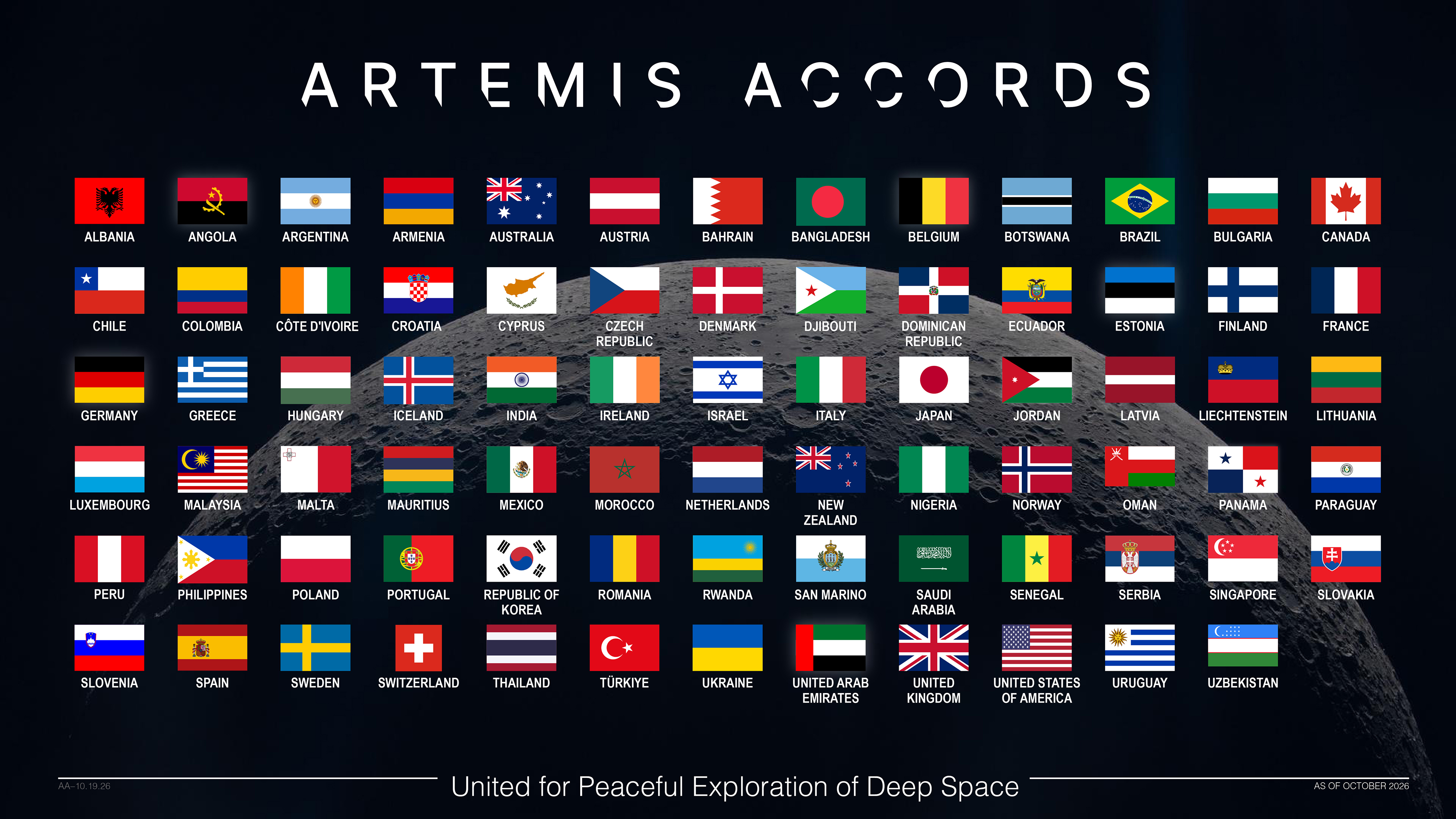
The Republic of Uzbekistan became the 77th signatory of the Artemis Accords during a ceremony in Samarkand on Monday, committing to the practical principles that guide safe, transparent, and responsible civil space exploration.

“Uzbekistan joins the Artemis Accords at a pivotal moment,” said NASA Deputy Administrator Matt Anderson. “President Trump has directed NASA to build a Moon Base and establish an enduring presence on the lunar surface. As we put the principles of the Artemis Accords into practice, we are expanding opportunities for like-minded nations around the world to contribute to humanity’s return to the Moon. Uzbekistan is a welcome addition to this growing coalition.”

Minister of Foreign Affairs of the Republic of Uzbekistan Bakhtiyor Saidov signed the Artemis Accords on behalf of the country. The signing took place during a visit by U.S. Secretary of State Marco Rubio.

Uzbekistan has increasingly engaged with NASA and the broader international space community through its development of a national space program aimed at advancing Uzbekistan’s space industry and participation in global space forums. Uzbek students also are working to develop and launch the country’s first CubeSat, or small satellite technology demonstration, by 2028.

In early October, NASA officials met with representatives from Uzbekistan’s Ministry of Digital Technologies and Uzbekistan’s space agency, Uzcosmos, during the 2026 International Astronautical Congress in Antalya, Türkiye, where the two sides discussed civil space cooperation and opportunities for increased engagement. Uzbekistan is scheduled to host the annual global space event in 2028.

In 2020, NASA and the State Department joined with seven other founding nations to establish the Artemis Accords, responding to the growing interest in lunar activities by both governments and private companies. They introduced the first set of practical principles aimed at enhancing the safety and coordination between nations as they explore the Moon, Mars, and beyond.

Signing the Artemis Accords means committing to explore peaceably and transparently, to render aid to those in need, to enable access to scientific data that all of humanity can learn from, to ensure activities do not interfere with those of others, and to preserve historically significant sites and artifacts by developing best practices for space exploration for the benefit of all. 

More countries are expected to sign the Artemis Accords in the months and years ahead, as NASA continues its work to establish a safe, peaceful, and prosperous future in space. 

Learn more about the Artemis Accords at: 

https://www.nasa.gov/artemis-accords
NASA Celebrates as Artemis Accords Surpasses 75 Signatories 

28 September 2026 at 12:26
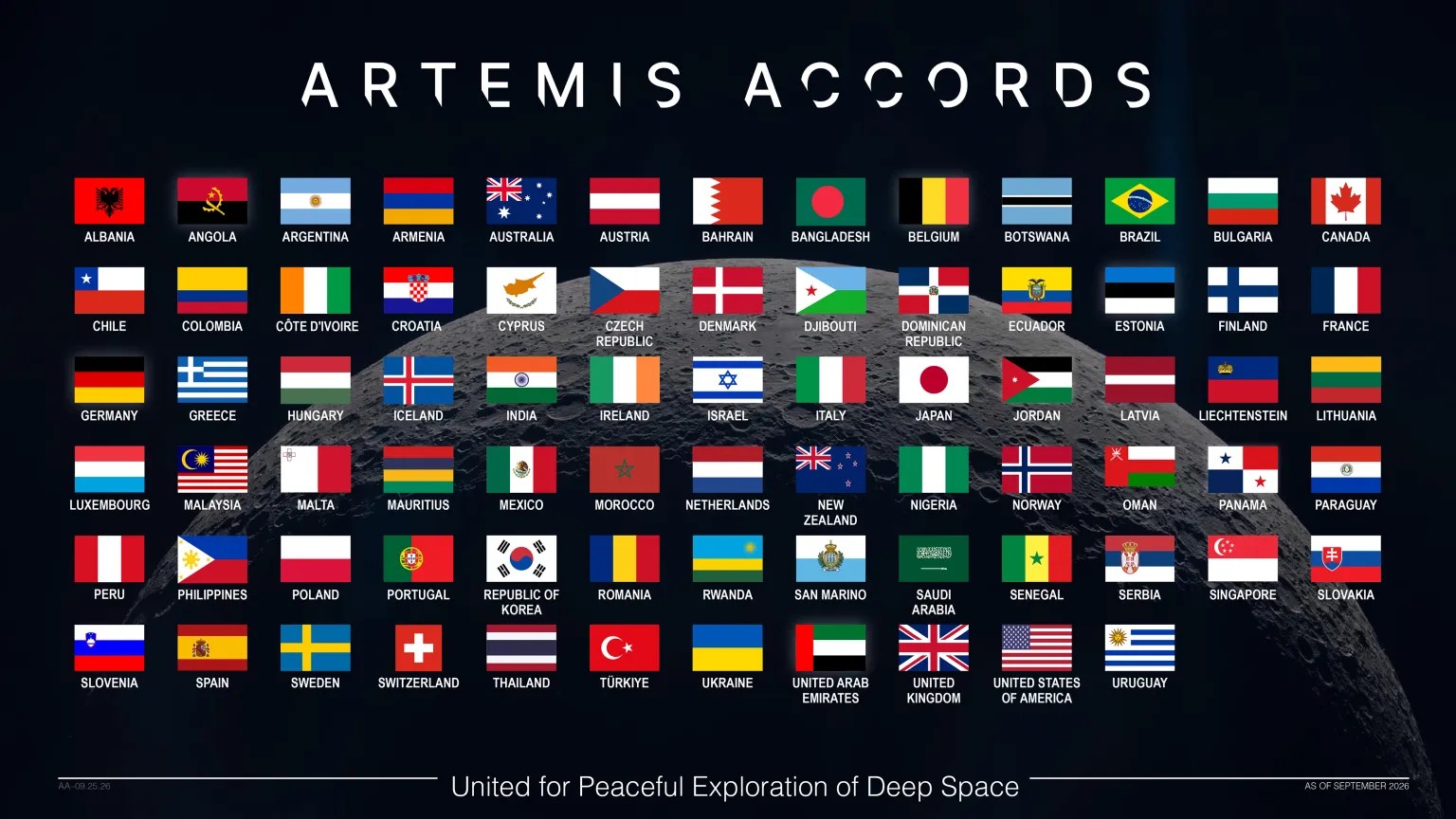
Graphic of 76 Flags from Artemis Accords Signatory Countries
Credit: NASA

Marking a significant expansion in the number of signatories to the Artemis Accords, NASA welcomed Albania, Croatia, Côte d’Ivoire, and San Marino, bringing total participation to 76 countries. 

“Our momentum reflects a growing commitment to peaceful, responsible exploration and a shared understanding that the future in space will be shaped by those willing to lead,” said NASA Administrator Jared Isaacman. “Nearly one-third of all signatories have joined since the start of President Trump’s second term. As the President directs NASA to return Americans to the lunar surface and lay the groundwork for Mars, we are strengthening a coalition of partners who share our values and are ready to help shape the future of exploration.”

The recent surge in growth reflects one of the most rapid expansions of international cooperation in civil space history. Nearly 40% of the world’s nations are now collaborating with NASA to build a transparent, peaceful, responsible, and safe approach to space exploration. Nearly two-thirds of countries that signed the foundational 1967 Outer Space Treaty also have signed the Artemis Accords.  

What began as an informal coalition of a small group of countries has developed into a large, structured community guided by the Signatories Group Method of Operations, adopted in 2024. Under this framework, the group meets twice annually, once at a technical workshop and once at a Principals’ Meeting during the International Astronautical Congress (IAC). Virtual sessions are added throughout the year to support implementation. 

As a result, participating countries have advanced agreed-upon recommendations on noninterference, interoperability, scientific data sharing, and registration practices. 

Two major workshops this year further strengthened technical alignment. Signatories reviewed their planned lunar landings and orbital missions and took part in hands‑on sessions focused on open science and practical tools for sharing lunar data. Experts from dozens of countries worked through real-world examples of how to make mission information easier to find, use, and share, from releasing lunar science data to adopting common standards that reduce interference between missions.  

This year’s Artemis Accords Principals’ Meeting at IAC in Antalya, Türkiye, beginning Monday, Oct. 5, will be co-chaired by NASA Deputy Administrator Matt Anderson and Major General Roberto Melgar Sheen, director of the Peruvian Space Agency (CONIDA). The meeting will examine ways to support emerging space nations and disseminate lunar debris‑mitigation recommendations. 

NASA continues to put the principles of the Artemis Accords into practice. With the creation of the Moon Base, NASA has invited every Artemis Accords signatory to participate in our return to the Moon through scientific payloads, technology demonstrations, CubeSats, and other capabilities. 

The United States, led by NASA and the U.S. Department of State, and seven other nations launched the Artemis Accords in 2020 to guide growing global interest in lunar activity. The accords established the first set of practical principles to enhance safety and coordination as nations explore the Moon, Mars, and beyond. Signatories commit to: 

  • Explore peaceably and transparently 
  • Render aid to those in need 
  • Enable access to scientific data 
  • Ensure activities do not interfere with others 
  • Preserve historically significant sites and artifacts by developing best practices 

More nations are expected to join the Artemis Accords in the months and years ahead as NASA continues working with partners worldwide to secure a safe, peaceful, and prosperous future in space. 

Learn more about the Artemis Accords at: 

https://www.nasa.gov/artemis-accords
-end-

Camille Gallo / Elizabeth Shaw  
Headquarters, Washington  
202-358-1600  
camille.m.gallo@nasa.gov / elizabeth.a.shaw@nasa.gov  

Share

Details

Last Updated
Sep 28, 2026
Editor
Jennifer M. Dooren

NASA Welcomes San Marino Signing the Artemis Accords  

25 September 2026 at 15:53
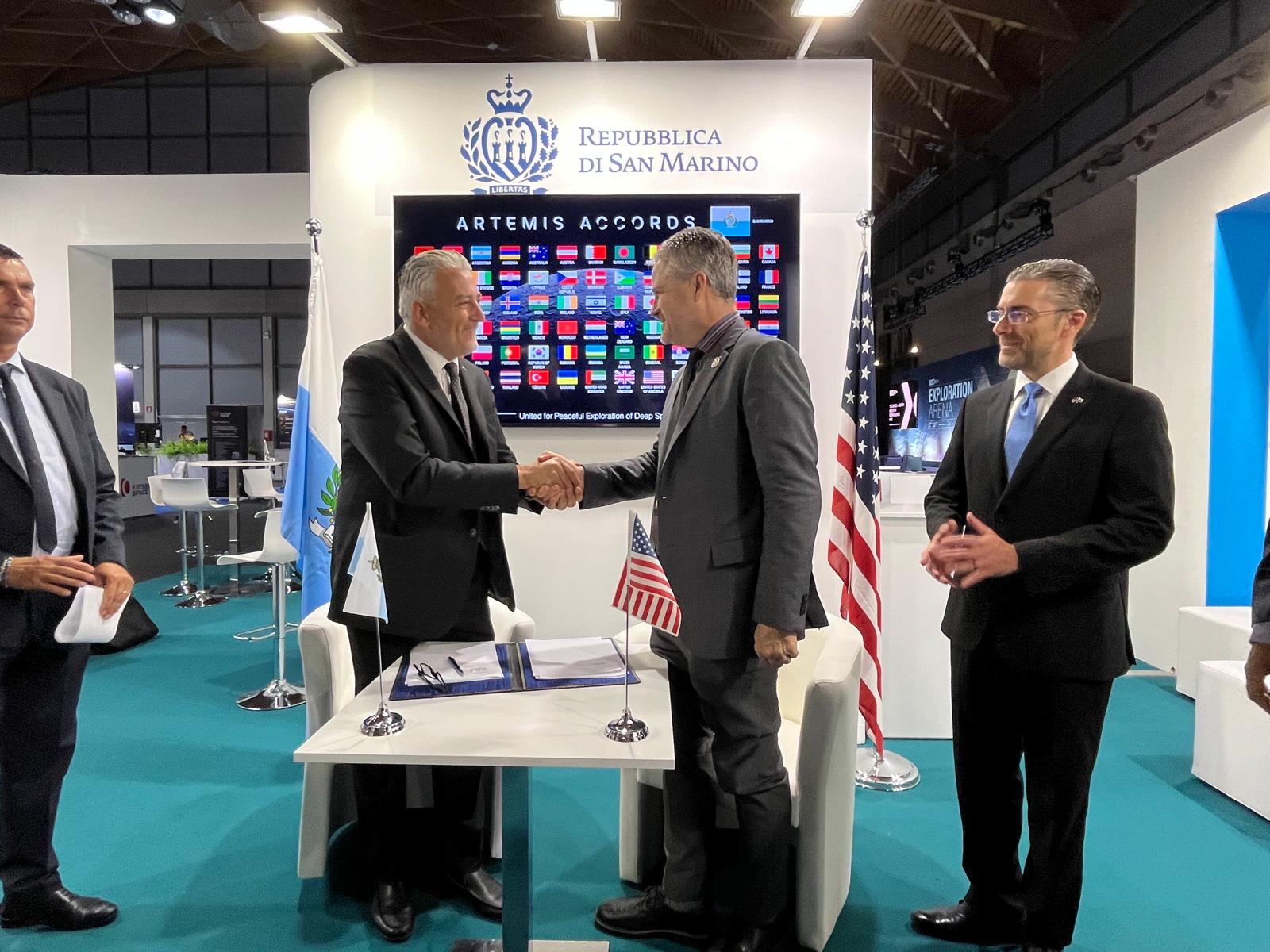
Minister of Industry and Technological Research Rossano Fabbri signed on behalf of San Marino. Gregory Mann, NASA Europe representative, and U.S. Consul General in Florence Joseph Tordella participated in the event on Friday, Sept. 25, 2026.
Credit: U.S. Department of State

The Republic of San Marino became the 76th signatory to the Artemis Accords during a ceremony in the city of Rimini on Friday with NASA and U.S. Department of State officials present.  

“San Marino joins a growing coalition of like-minded nations committed to the peaceful, transparent, and responsible exploration of space,” said NASA Deputy Administrator Matt Anderson. “President Trump has directed NASA to build a Moon Base and establish an enduring presence on the lunar surface. As we do, we are putting the principles of the Accords into practice. NASA has invited every Artemis Accords signatory to participate in our return to the Moon through scientific payloads, technology demonstrations, CubeSats, and other capabilities. San Marino is already looking toward that future.” 

Minister of Industry and Technological Research Rossano Fabbri signed on behalf of San Marino. Gregory Mann, NASA Europe representative, participated in the ceremony with the U.S. Consul General in Florence Joseph Tordella.   

“We are pleased and honored that the Republic of San Marino has been welcomed as the 76th signatory state of the Artemis Accords,” said Fabbri. “We fully share the principles and values expressed in the Artemis Accords, and we are convinced that the signatory states united under the Accords will make a tangible contribution to promoting international cooperation in space and ensuring the use of space for peaceful purposes.” 

In 2020, NASA and the State Department joined with seven other founding nations to establish the Artemis Accords, responding to the growing interest in lunar activities by both governments and private companies. They introduced the first set of practical principles aimed at enhancing the safety and coordination between nations as they explore the Moon, Mars, and beyond, committing nations to: 

  • Explore peaceably and transparently 
  • Render aid to those in need 
  • Enable access to scientific data 
  • Ensure activities do not interfere with those of others 
  • Preserve historically significant sites and artifacts by developing best practices 

By signing the Artemis Accords, nations open the door to opportunities for future lunar exploration with NASA, advancing humanity’s return to the Moon, and shaping the Golden Age of exploration and innovation. 

Learn more about the Artemis Accords at:

https://www.nasa.gov/artemis-accords

❌
❌