Normal view

There are new articles available, click to refresh the page.
Today — 13 September 2026Main stream

APOD: 2026 September 13 – Comet NEOWISE Rising over the Adriatic Sea

13 September 2026 at 00:05

APOD

Astronomy Picture of the Day

Discover the cosmos! Each day a different image or photograph of our fascinating universe is featured, along with a brief explanation written by a professional astronomer.

Comet NEOWISE Rising Over the Adriatic Sea

Explanation: This sight was worth getting out of bed early. Just over four years ago, Comet C/2020 F3 (NEOWISE) rose before dawn to the delight of northern sky enthusiasts awake that early. Up before sunrise on July 8th, the featured photographer was able to capture in dramatic fashion one of the few comets visible to the unaided eye this century, an inner-Solar System intruder that has become known as the Great Comet of 2020. The resulting video detailed Comet NEOWISE from Italy rising over the Adriatic Sea. The featured time-lapse video combines over 240 images taken over 30 minutes. The comet was seen rising through a foreground of bright and undulating noctilucent clouds, and before a background of distant stars. Comet NEOWISE remained unexpectedly bright for over a month, with its ion and dust tails found to emanate from a nucleus spanning about five kilometers across.

APOD’s main NASA site is moving: From apod.nasa.gov to science.nasa.gov/apod
Tomorrow’s picture: open space

Date September 13, 2026
Credit & Copyright Paolo Girotti
Authors & editors: Robert Nemiroff, Jerry Bonnell, Cecilia Chirenti, Keighley Rockcliffe
A service of: ASD at NASA / GSFC,
NASA Science Activation & Michigan Tech. U.
Before yesterdayMain stream

APOD: 2026 September 11 – M83: The Southern Pinwheel

11 September 2026 at 00:05

APOD

Astronomy Picture of the Day

Discover the cosmos! Each day a different image or photograph of our fascinating universe is featured, along with a brief explanation written by a professional astronomer.

A spiral galaxy is shown in front of a dark field of stars.

M83: The Southern Pinwheel

Explanation: Beautiful and bright spiral galaxy M83 lies some twelve million light-years away, near the southeastern tip of the very long constellation Hydra. Prominent spiral arms traced by dark dust lanes and blue star clusters lend this galaxy its popular name, the Southern Pinwheel. Still, reddish star forming regions that dot this cosmic pinwheel’s spiral arms have suggested another nickname, the Thousand-Ruby Galaxy. A mere 40,000 light-years across, smaller than the Milky Way, M83 is a member of a group of galaxies that includes active galaxy Centaurus A. In fact, the core of M83 itself is bright at x-ray energies, showing a high concentration of neutron stars and black holes left from an intense burst of star formation. This sharp, groundbased telescopic view also features foreground Milky Way stars and distant background galaxies.

APOD’s main NASA site is moving: From apod.nasa.gov to science.nasa.gov/apod
Tomorrow’s picture: lunar sun catcher

Date September 11, 2026
Credit & Copyright Aldo Zanetti
Authors & editors: Jerry Bonnell, Robert Nemiroff, Cecilia Chirenti, Keighley Rockcliffe
A service of: ASD at NASA / GSFC,
NASA Science Activation & Michigan Tech. U.

APOD: 2026 September 10 – LDN 1295: The Giraffe Nebula

10 September 2026 at 00:05

APOD

Astronomy Picture of the Day

Discover the cosmos! Each day a different image or photograph of our fascinating universe is featured, along with a brief explanation written by a professional astronomer.

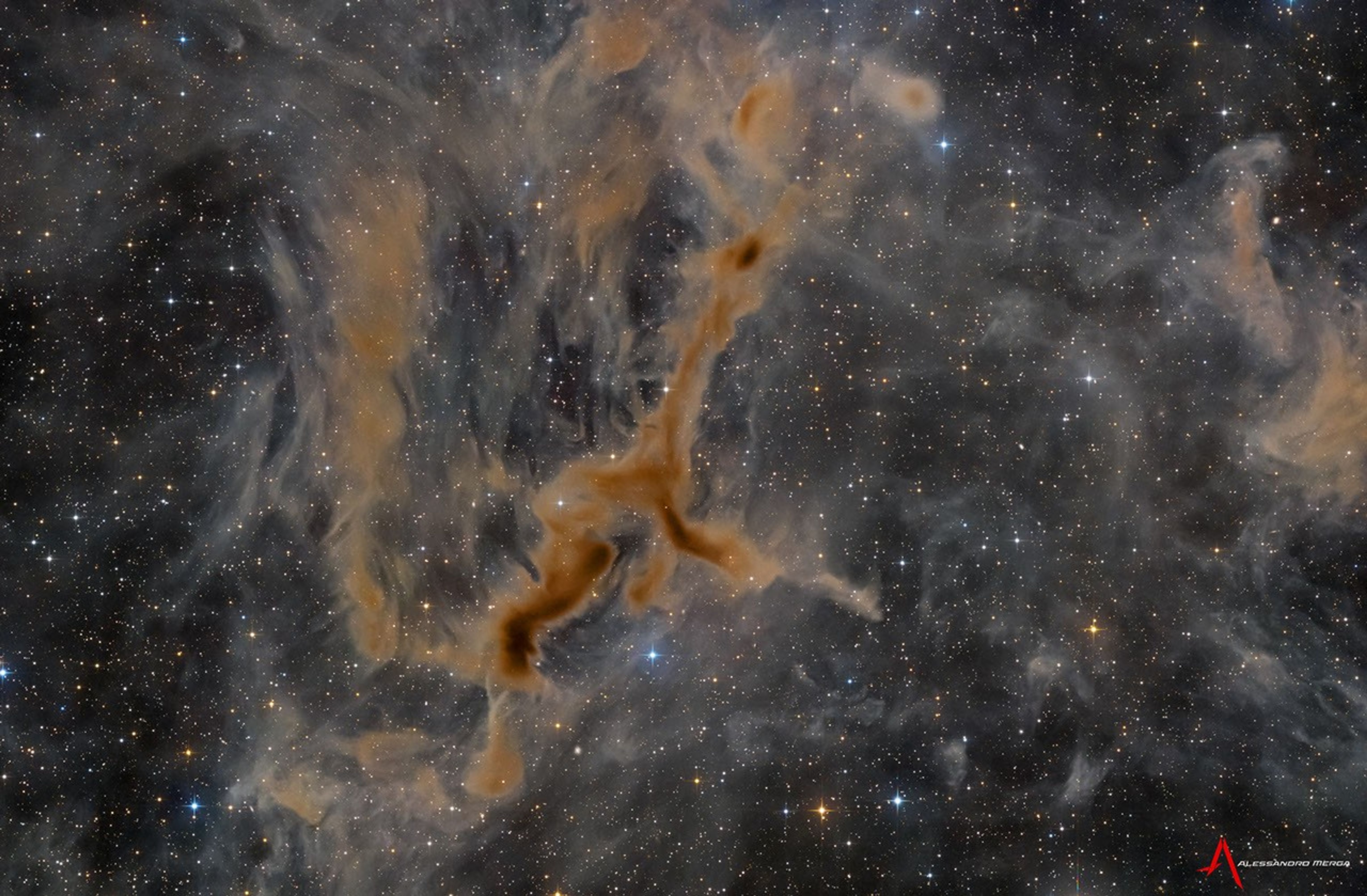
LDN 1295: The Giraffe Nebula

Explanation: What does this image look like to you? Many see a giraffe facing right, with neck stretched high and long legs mid-stride (but some may see a squirrel instead). The featured image shows LDN 1295, also called the Giraffe Nebula, in the constellation of the mythical queen of Aethiopia (Cassiopeia). It is an object in the Lynds Catalogue of Dark Nebulas, compiled in 1962 by American astronomer Beverly Lynds, a pioneer for women in astronomy and astrophysics. Dark nebulas are interstellar clouds of dust and gas that block the visible light of the stars behind them. These nebulas are often faint and challenging targets for astrophotographers. Why do we see animal shapes and faces in nebulas, clouds, and pretty much everywhere? It is due to pareidolia, our tendency to look for familiar patterns. Pareidolia may provide animals with an evolutionary advantage, for example in identifying (and avoiding) predators.

APOD’s main NASA site is moving : From apod.nasa.gov to science.nasa.gov/apod
Tomorrow’s picture: freewheeling

Date September 10, 2026
Credit & Copyright Alessandro Merga
Authors & editors: Cecilia Chirenti, Robert Nemiroff, Jerry Bonnell, Keighley Rockcliffe
A service of: ASD at NASA / GSFC,
NASA Science Activation & Michigan Tech. U.

APOD: 2026 September 8 – Hubble: Decagon Around Saturn’s South Pole

8 September 2026 at 00:05

APOD

Astronomy Picture of the Day

Discover the cosmos! Each day a different image or photograph of our fascinating universe is featured, along with a brief explanation written by a professional astronomer.

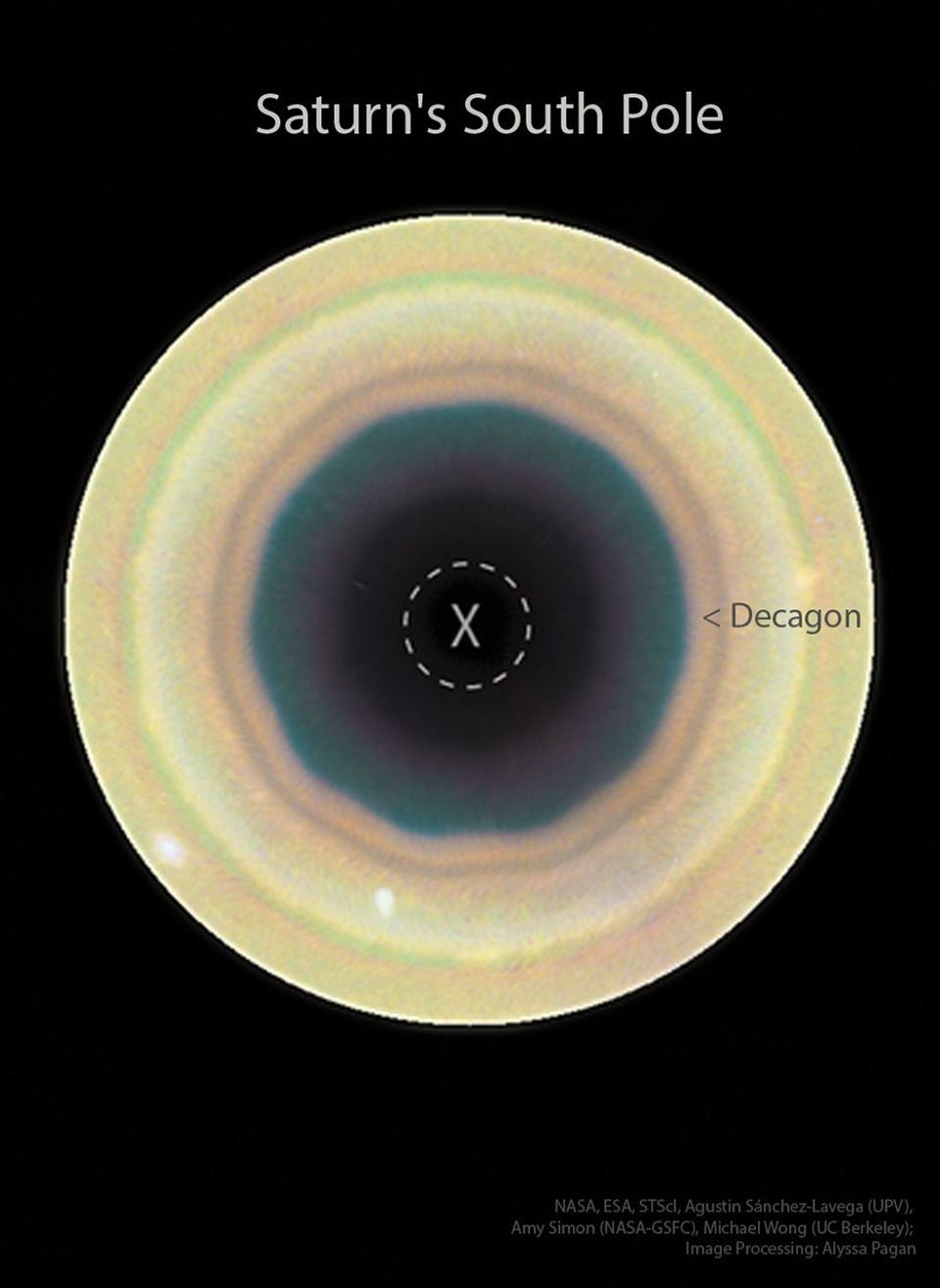
A dark field has a bright circular disk near the center. Around the center of this disk are bands. One of the bands  appear particularly geometric and appears to have 10 sides. Please see the explanation for more detailed information.

Hubble: Decagon Around Saturn’s South Pole

Explanation: Why are Saturn’s poles geometric? Saturn’s North Pole has been known to be surrounded by a hexagonal (6 sides) cloud since discovery in 1987 in data taken by NASA’s Voyager spacecrafts, which quickly flew past the ringed world in the early 1980s. Now, recent observations of Saturn by the Hubble Space Telescope reveal a slightly different geometric cloud pattern around the South Pole: a decagon (10 sides). The geometric boundaries are possibly caused by waves when the fast-moving gas away from the poles interacts with slower-moving gas closer to the poles. In the featured image composite by the Hubble taken last year, the South Pole of Saturn is marked by an X and surrounded by bands of circulating clouds. The decagon appears most prominent in the dark inner regions. The northern hexagon has proven stable for over 40 years, while the stability of the southern decagon will surely remain a topic of research.

APOD’s main NASA site is moving: From apod.nasa.gov to science.nasa.gov/apod
Tomorrow’s picture: open space

Date September 8, 2026
Credit NASAESASTScIHSTA. Sánchez-Lavega (UPV), A. Simon (NASA-GSFC), M. Wong (UC Berkeley); Processing: A. Pagan (STScI)
Authors & editors: Robert Nemiroff, Jerry Bonnell, Cecilia Chirenti, Keighley Rockcliffe
A service of: ASD at NASA / GSFC,
NASA Science Activation & Michigan Tech. U.

APOD: 2026 September 7 – The Pelican Nebula in Gas, Dust, and Stars

7 September 2026 at 00:05

APOD

Astronomy Picture of the Day

Discover the cosmos! Each day a different image or photograph of our fascinating universe is featured, along with a brief explanation written by a professional astronomer.

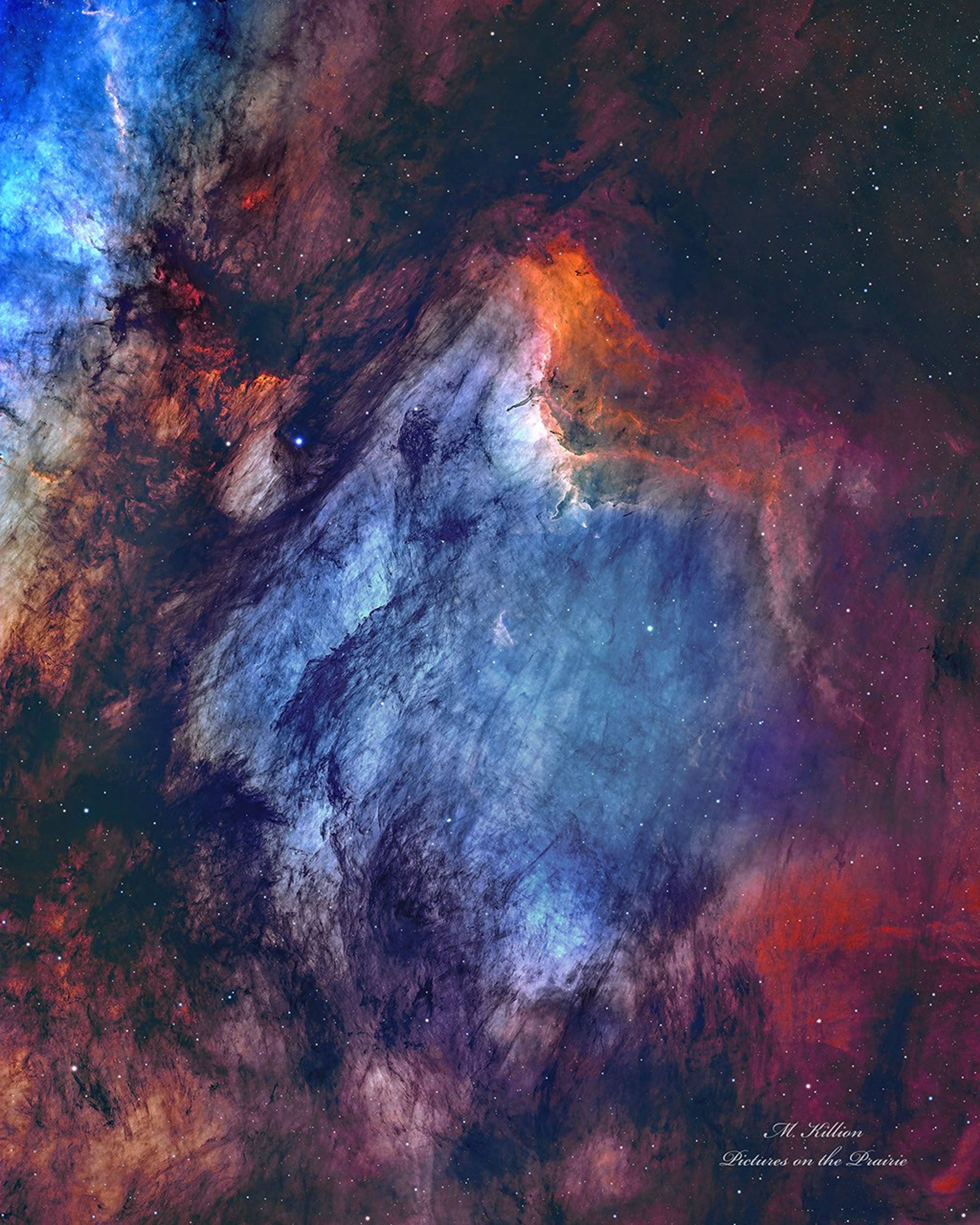
A busy starfield is dominated by red and blue glowing gas and dark filamentary dust. The nebula appears to some to have the shape of a pelican.

The Pelican Nebula in Gas, Dust, and Stars

Explanation: The Pelican Nebula is slowly being transformed. IC 5070 (an official designation) is divided from the larger North America Nebula by a molecular cloud filled with dark dust. The deep featured picture from UtahUSA incorporates 25 hours of exposure and brings out great details of this filamentary dust. The Pelican Nebula receives much study because it is a particularly active mix of star formation and evolving gas clouds. The light from young energetic stars is slowly transforming the cold gas to hot gas, with the advancing boundary between the two, known as an ionization front, visible in bright orange on the upper right. Particularly dense tentacles of cold gas remain. Millions of years from now, the Pelican Nebula, bounded by dark nebula LDN 935, might no longer be known as the Pelican, as the balance and placement of stars and gas will surely leave something that appears completely different.

APOD’s main site is moving: From apod.nasa.gov to science.nasa.gov/apod
Tomorrow’s picture: geometric Saturn

Date: September 7, 2026
Credit & Copyright: Mark Killion
Authors & editors: Robert Nemiroff, Jerry Bonnell, Cecilia Chirenti, Keighley Rockcliffe
A service of: ASD at NASA / GSFC,
NASA Science Activation & Michigan Tech. U.

APOD: 2026 September 5 – Chasing the Moon’s Shadow

5 September 2026 at 00:05

APOD

Astronomy Picture of the Day

Discover the cosmos! Each day a different image or photograph of our fascinating universe is featured, along with a brief explanation written by a professional astronomer.

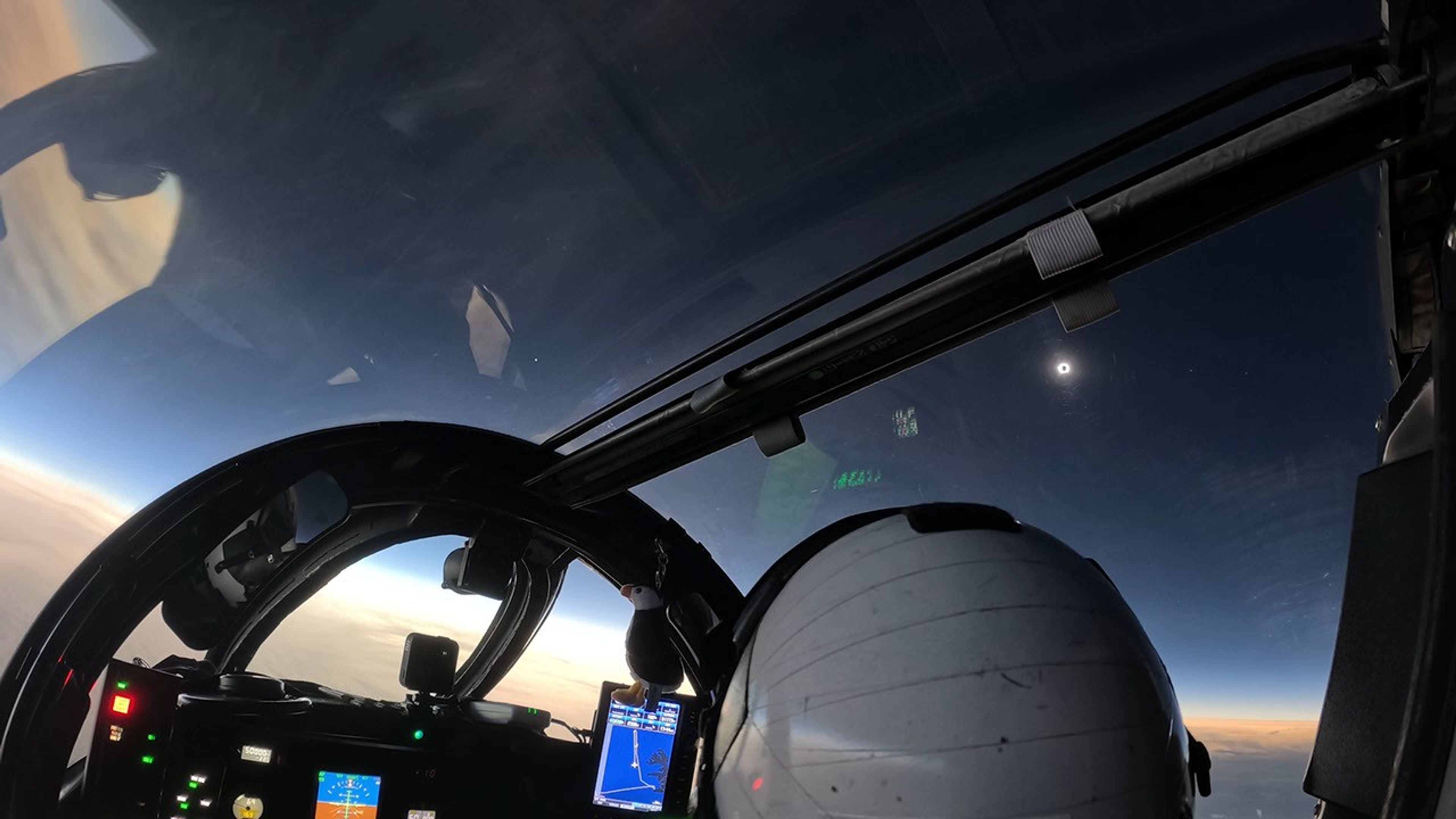
A solar eclipse as viewed by a pilot from an aircraft cockpit.

Chasing the Moon’s Shadow

Explanation: Chasing the shadow of a New Moon, NASA’s WB-57F high altitude research aircraft took to the skies off the coast of Iceland on August 12 to observe a total solar eclipse. At 50,000 feet the aircraft was piloted along the precisely determined path of totality to maximize its time in the Moon’s shadow. A suite of high-resolution cameras on board was able to record eclipse data from above the clouds, dust, and atmospheric water vapor that interfere with observations made closer to the ground. This view from the cockpit, taken from an inflight video, captures the solar corona emerging at the beginning of totality. The sky appears dark in the shadow of the Moon. Venus is shining left of center in the video frame, while Jupiter and Mercury are just visible to the right of the eclipsed Sun. But the sky is bright along the distant horizon below, beyond the reach of the Moon’s shadow.

APOD’s main NASA site is moving: From apod.nasa.gov to science.nasa.gov/apod
Tomorrow’s picture: enhancing Pluto

Date September 5, 2026
Credit: NASA
Authors & editors: Jerry Bonnell, Cecilia Chirenti, Robert Nemiroff, Keighley Rockcliffe
A service of: ASD at NASA / GSFC,
NASA Science Activation & Michigan Tech. U.

APOD: 2026 September 4 – Na Uhane Mahoe Huki Pu i ke Ola

4 September 2026 at 00:05

APOD

Astronomy Picture of the Day

Discover the cosmos! Each day a different image or photograph of our fascinating universe is featured, along with a brief explanation written by a professional astronomer.

Two spiral galaxies colliding.

Nā ʻUhane Māhoe Huki Pū i ke Ola

Explanation: Nā ʻUhane Māhoe Huki Pū i ke Ola, is the Hawaiian name given to this image of a pair of spiral galaxies locked in a mutual gravitational embrace. Some 200 million light-years distant toward the high flying constellation Pegasus their spectacular, galactic scale merger is captured in sharp detail in the image from the 8.1 meter Gemini North telescope on Maunakea, Hawai‘i. The galaxy pair, known as NGC 7253 and Arp 278, was chosen as a target, researched, and given a Hawaiian name by high school students in the joint Gemini Observatory and University of Hawaiʻi Project Hōkūlani internship program. The name translates to “The Twin Spirits Pulling Together Creating Life”. That’s both culturally and astronomically appropriate for galaxy collisions that trigger a cosmic maelstrom of star formation from galactic reservoirs of elemental building blocks of life. These merging galaxies are found within a region of Pegasus identified as the Hawaiian navigational constellation Ka Lupe o Kawelo.

APOD’s main NASA site is moving: From apod.nasa.gov to science.nasa.gov/apod
Tomorrow’s picture: chasing shadows

Date September 4, 2026
Credit: Image Credit: International Gemini Observatory / NOIRLab/NSF/AURA
Image Processing: J. Miller & M. Rodriguez (International Gemini Observatory/NSF NOIRLab),
T.A. Rector (University of Alaska Anchorage/NSF NOIRLab), D. de Martin & M. Zamani (NSF NOIRLab)
Authors & editors: Jerry Bonnell, Cecilia Chirenti, Robert Nemiroff, Keighley Rockcliffe
A service of: ASD at NASA / GSFC,
NASA Science Activation & Michigan Tech. U.

APOD: 2026 September 3 – The Eclipse and the Stork

3 September 2026 at 00:05

APOD

Astronomy Picture of the Day

Discover the cosmos! Each day a different image or photograph of our fascinating universe is featured, along with a brief explanation written by a professional astronomer.

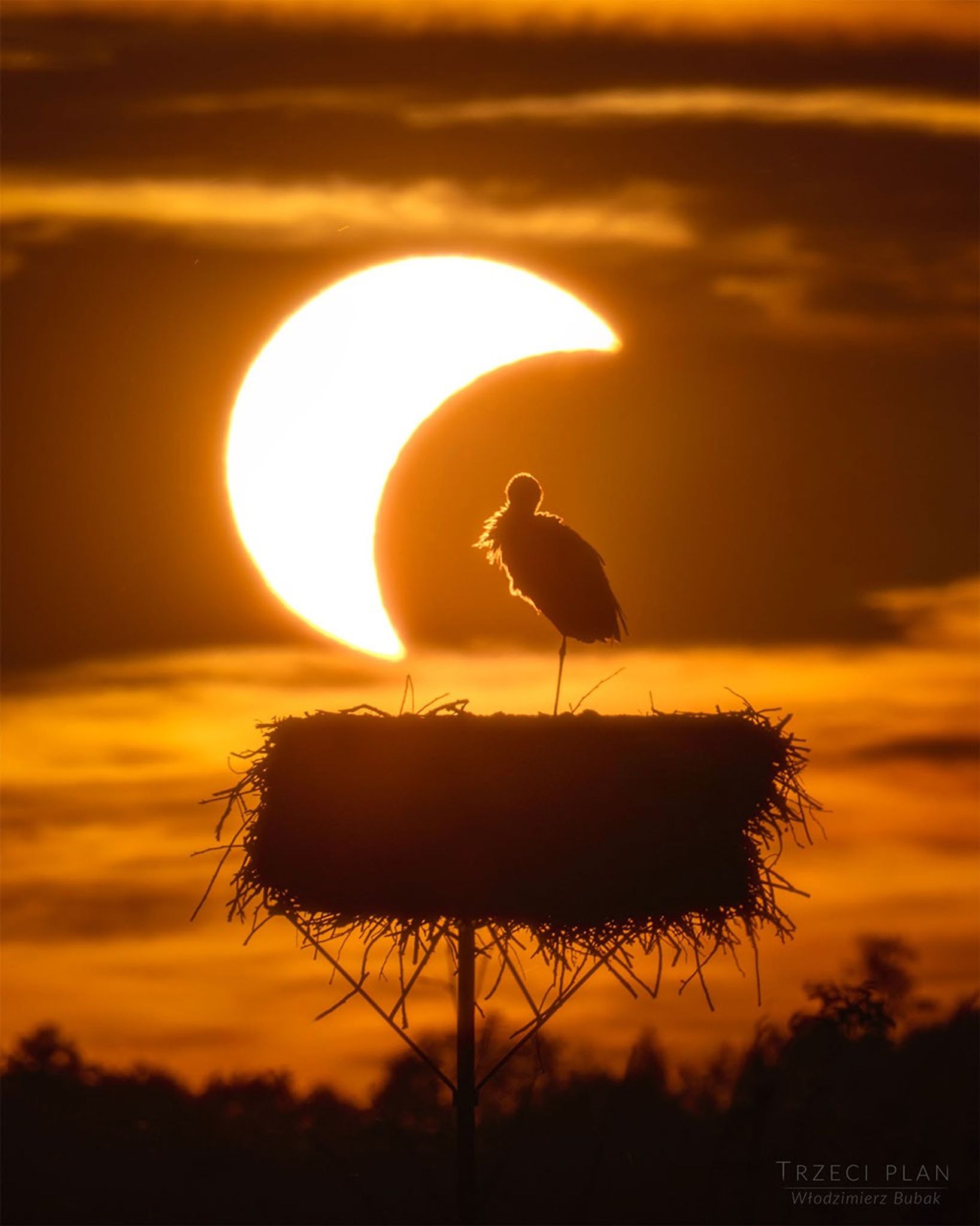
A sunset view of the solar eclipse, 	  framed behind a stork standing on one leg in her nest.Włodzimierz Bubak

The Eclipse and the Stork

Explanation: How do animals react to a total solar eclipse? The featured image shows a stork roosting on her nest in Poland at a partial phase of the recent total solar eclipse. If you are lucky enough to experience a total eclipse somewhere quiet and close to nature, you may be able to notice unusual daytime animal behaviors. During totality, you may hear nighttime sounds like crickets and frogs and see fireflies. In the dark, most birds are quiet. Thinking that it is time to go to bed, ducks and other waterfowl prepare to sleep on one leg, with their heads turned around and their beaks tucked into their back feathers (they don’t really sleep with their heads tucked under one wing). When sunlight returns at the end of totality, songbirds greet the new “morning” with their dawn songs. The crickets and frogs go quiet again. Animals and people resume their lives, only briefly disturbed by the chance alignment of our Sun and Moon.

APOD’s main NASA site is moving : From apod.nasa.gov to science.nasa.gov/apod
Tomorrow’s picture: aloha

Date September 3, 2026
Credit & Copyright Włodzimierz Bubak
Authors & editors: Cecilia Chirenti, Robert Nemiroff, Jerry Bonnell, Keighley Rockcliffe
A service of: ASD at NASA / GSFC,
NASA Science Activation & Michigan Tech. U.

APOD: 2026 September 2 – Solar Eclipses and Culture

2 September 2026 at 00:05

APOD

Astronomy Picture of the Day

Discover the cosmos! Each day a different image or photograph of our fascinating universe is featured, along with a brief explanation written by a professional astronomer.

Solar Eclipses and Culture

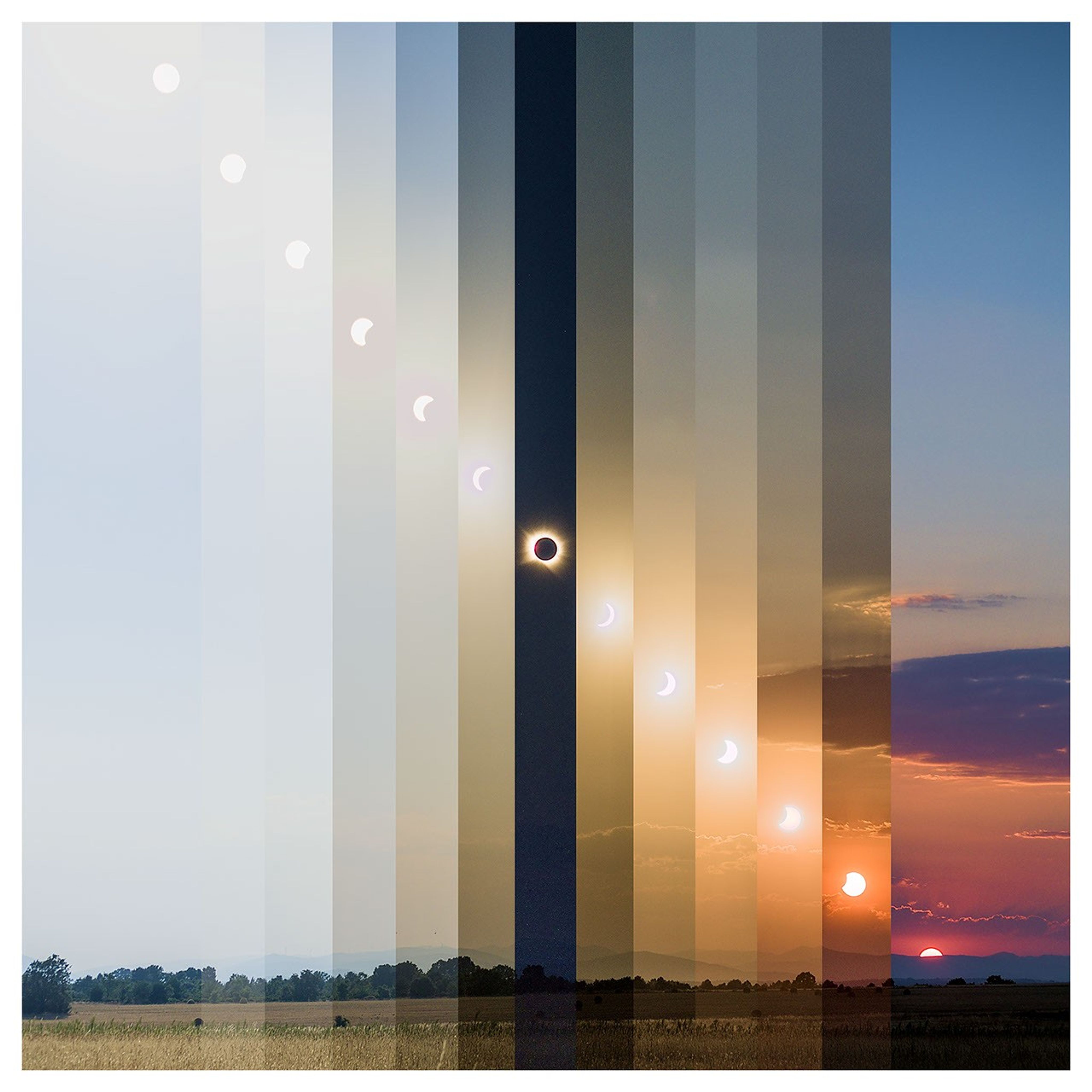
Explanation: Pretend you have never heard of a solar eclipse. The Sun’s behavior has been predictable your whole life. One day, you witness the sky transform as it does in today’s spliced image spanning two hours of the August 12, 2026 solar eclipse. The Sun disappears, leaving behind a bright, empty ring. What would you think had happened? Humans have interpreted eclipses in countless ways throughout history, embedding beliefs about connection, rebirth, or danger into culture. “Eclipse” comes from the Greek word “ékleipsis” meaning “abandonment”. In ancient Greece, the solar eclipse marked the anger of the gods and the Sun abandoning humanity. To the Diné people, this celestial alignment is a time of renewal. Out of respect and to avoid the danger of sunlight, the Diné stay inside until the Sun and Moon separate. The Batammariba people of Benin and Togo believe that the Sun and Moon fight during an eclipse, so the community encourages peace among themselves. Eclipses are an example of the longstanding connection between astronomy and society.

Gallery: Solar Eclipse of 2026 August 12
Tomorrow’s picture: a bird’s eye view

Date: September 2, 2026
Credit & Copyright: Javier Castro
Authors & editors: Keighley Rockcliffe, Robert Nemiroff, Jerry Bonnell, Cecilia Chirenti
A service of: ASD at NASA / GSFC,
NASA Science Activation & Michigan Tech. U.

APOD: 2026 September 1 – A Plane Lunar Eclipse

1 September 2026 at 00:05

APOD

Astronomy Picture of the Day

Discover the cosmos! Each day a different image or photograph of our fascinating universe is featured, along with a brief explanation written by a professional astronomer.

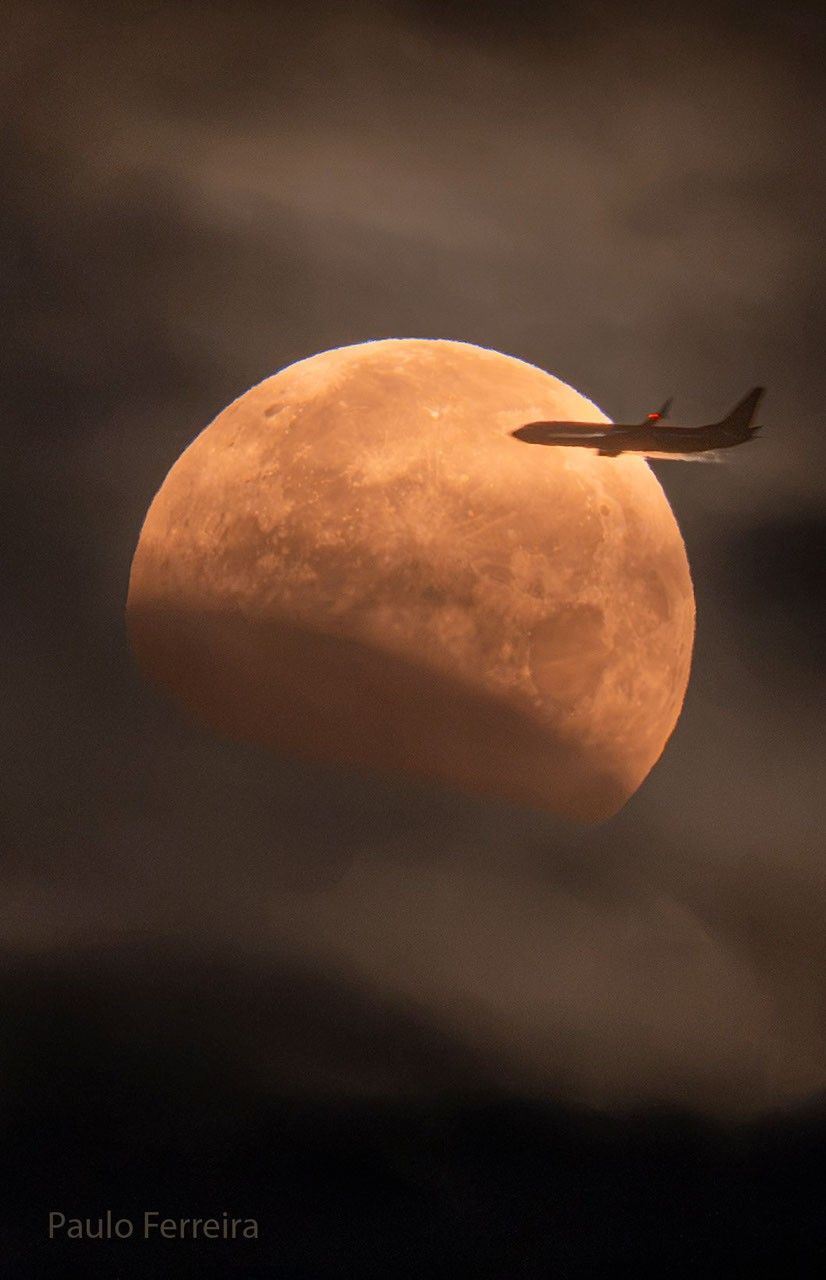
The Moon is seen in front of clouds but with part of its lower left being unusually dark. On the upper  right, a foreground airplane appears flying into the disk of the Moon.

A Plane Lunar Eclipse

Explanation: Did you need to be on the right side of this airplane to see this eclipse? No. Lunar eclipses are routinely seen from the half of the Earth facing the Moon when the eclipse occurs, making them some of the most commonly witnessed astronomical events. You don’t even need any special equipment to see one — just your unaided eyes. Lunar eclipses are also some of the most photographed astronomical events because, unlike with a solar eclipse, your eyes and camera do not have to look toward the bright Sun. However, considering the featured image taken last week from Portugal, if you were on the left side of that airplane during takeoff, you might have trouble seeing it — at first. But even then, after takeoff, since lunar eclipses typically last for hours, you might soon be able to safely cross the aisle(s) to see it.

Gallery: Lunar Eclipse of 2026 August
APOD’s main NASA site is moving: From apod.nasa.gov to science.nasa.gov/apod
Tomorrow’s picture: cultural eclipses

Date September 1, 2026
Credit Paulo Ferreira
Authors & editors: Robert Nemiroff, Jerry Bonnell, Cecilia Chirenti, Keighley Rockcliffe
A service of: ASD at NASA / GSFC,
NASA Science Activation & Michigan Tech. U.

APOD: 2026 August 31 – Launch of the Roman Space Telescope

31 August 2026 at 00:05

APOD

Astronomy Picture of the Day

Discover the cosmos! Each day a different image or photograph of our fascinating universe is featured, along with a brief explanation written by a professional astronomer.

Launch of the Roman Space Telescope

Explanation: A new telescope has been launched into space to study the universe. The Nancy Grace Roman Space Telescope (RST) has the same size main mirror as the Hubble Space Telescope (HST) but sees 100 times more sky during each snapshot. This is possible because when compared to HST, RST’s main mirror is more curved, its secondary mirror is closer, and its main camera is larger. The result is that RST can inspect more of the sky more quickly, likely allowing, among other capabilities, the discovery of many more supernovas which tell us more about the expansion rate and composition of our universe, and many more planets orbiting other stars that tell us more about the possibilities for life elsewhere in the universe. RST will orbit the Sun, not the Earth, like the James Webb Space Telescope. The featured video shows Roman being launched yesterday from Kennedy Space Center, Florida, USA aboard a SpaceX Falcon Heavy rocket.

APOD’s main NASA site is moving: From apod.nasa.gov to science.nasa.gov/apod
Tomorrow’s picture: eclipse flight

Date August 31, 2026
Credit: NASA
Authors & editors: Robert Nemiroff, Jerry Bonnell, Cecilia Chirenti, Keighley Rockcliffe
A service of: ASD at NASA / GSFC,
NASA Science Activation & Michigan Tech. U.

APOD: 2026 August 28 – The Sky Turns Above Paranal

28 August 2026 at 00:05

APOD

Astronomy Picture of the Day

Discover the cosmos! Each day a different image or photograph of our fascinating universe is featured, along with a brief explanation written by a professional astronomer.

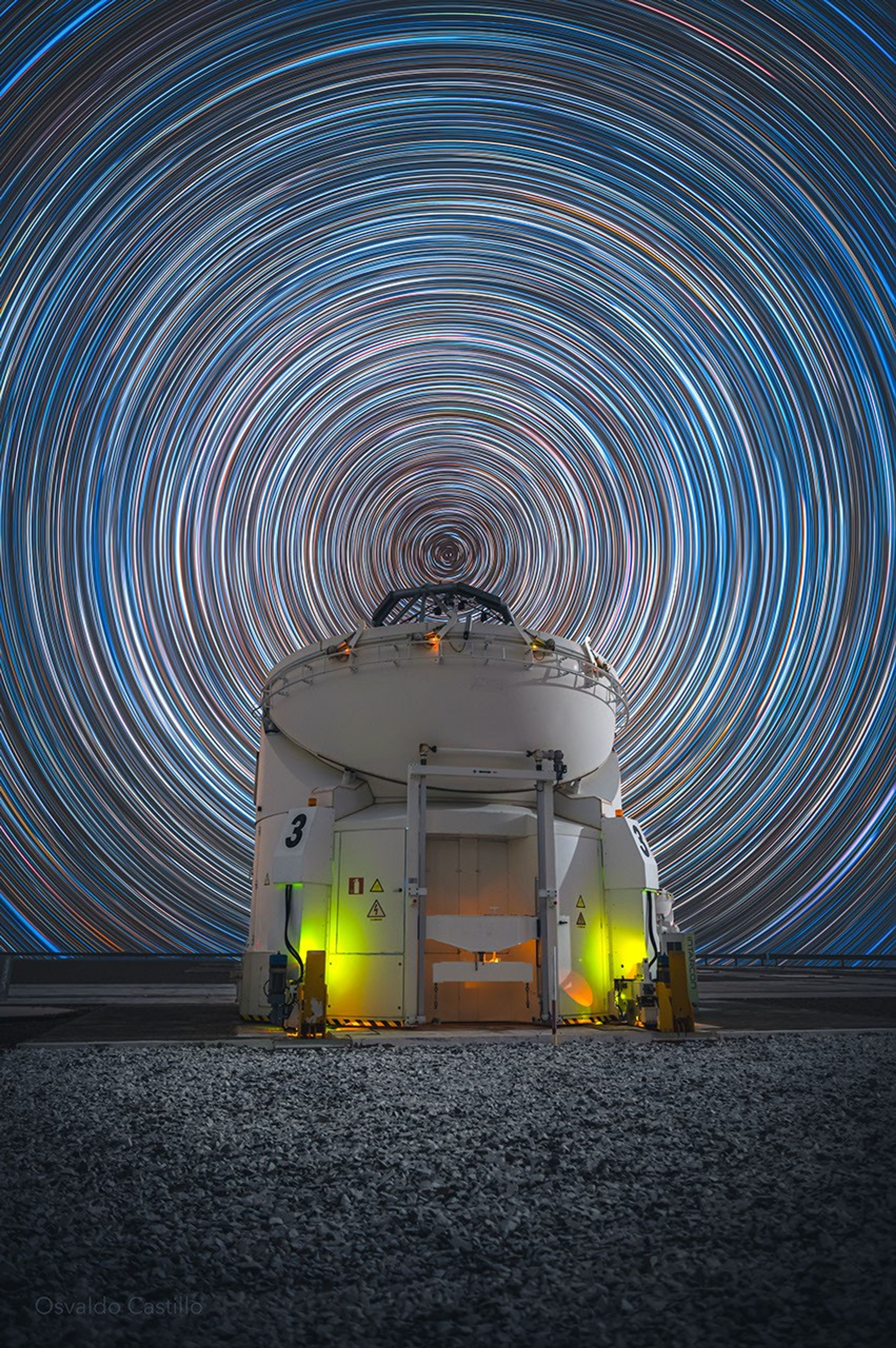
A picture of star trails in the night sky above a telescope.

The Sky Turns Above Paranal

Explanation: At the latitude of ESO’s Paranal Observatory in Chile, about 25 degrees south, Earth’s rotation moves the planet’s surface eastward at over 1,500 kilometers per hour. And while that’s faster than the speed of sound at sea level, the motion is imperceptible. Still, that motion can be revealed in the apparent rotation of the night sky by photographing star trails. This star trail image was composed from a digital stack of 300 consecutive 25-second exposures made with a camera fixed to a tripod to trace the star trail arcs. The graceful arcs are concentric and centered at the south celestial pole, the southern hemisphere extension of Earth’s axis of rotation into space. One of the observatory’s operating 1.8 meter auxiliary telescopes, AT 3, appears beneath the south celestial pole, faintly illuminated in the foreground of this well-planned scene from a rotating planet.

APOD’s main NASA site is moving: From apod.nasa.gov to science.nasa.gov/apod

Tomorrow’s picture: pixels in space

Date August 28, 2026
Credit & Copyright: Osvaldo Castillo
Authors & editors: Jerry Bonnell, Cecilia Chirenti, Robert Nemiroff, Keighley Rockcliffe
A service of: ASD at NASA / GSFC,
NASA Science Activation & Michigan Tech. U.

APOD: 2026 August 27 – Colorful Aurora over an Icelandic Waterfall

27 August 2026 at 00:05

APOD

Astronomy Picture of the Day

Discover the cosmos! Each day a different image or photograph of our fascinating universe is featured, along with a brief explanation written by a professional astronomer.

Aurora with green, pink and yellow shades over a waterfall will stars in the background.

Colorful Aurora over Icelandic Waterfall

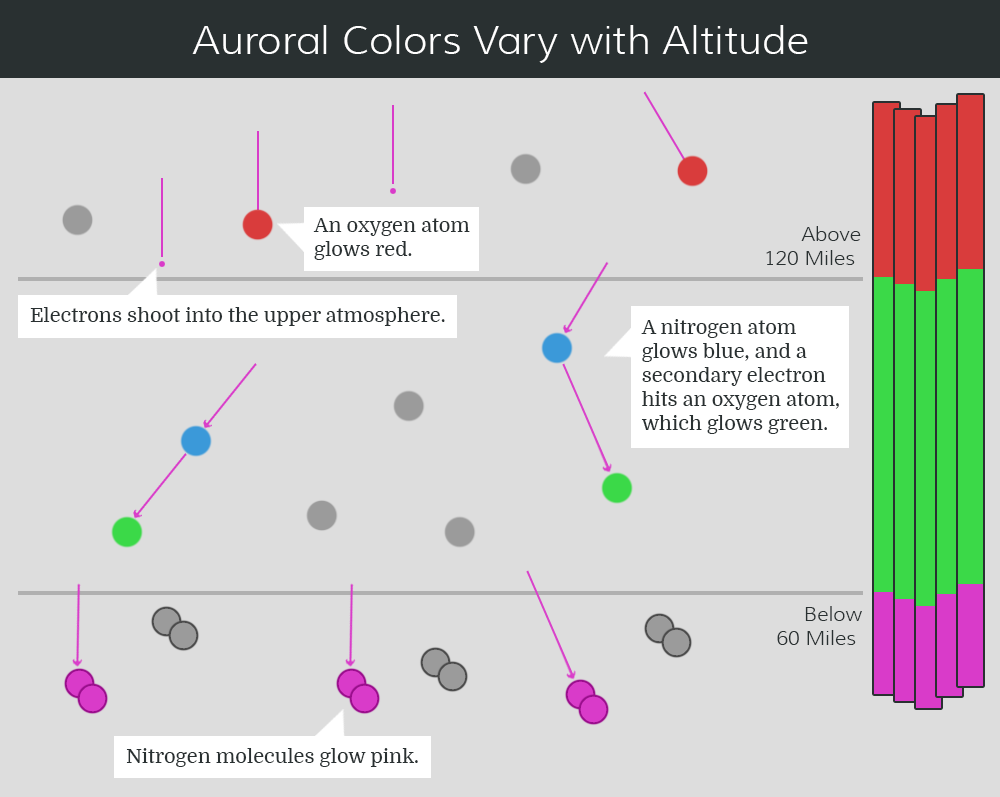
Explanation: What a sight to behold, when a night sky became filled with colors that appeared to rain over the Skógafoss waterfall in Iceland. This image was taken in a single 5 second exposure by the photographer in April 2025. Seeing an aurora is on many people’s bucket lists. But it is not easy. It requires high solar activity, dark and clear skies, and usually a viewing location at high latitude. That makes the northern lights more easily seen than the corresponding southern lights, simply because there is less landmass in the Southern Hemisphere, especially around the Antarctic Circle. Auroras are caused by charged particles from the solar wind that are captured by the Earth’s magnetosphere and guided by the magnetic field to a region close to one of the poles, where they collide with gas particles in the atmosphere. Different colors indicate interactions with different gases at different altitudes, like oxygen (red and green) and nitrogen (blue and pink).

APOD’s main NASA site is moving : From apod.nasa.gov to science.nasa.gov/apod
Tomorrow’s picture: What’s next?

Date August 27, 2026
Credit & Copyright Victor Lima
Authors & editors: Cecilia Chirenti, Robert Nemiroff, Jerry Bonnell, Keighley Rockcliffe
A service of: ASD at NASA / GSFC,
NASA Science Activation & Michigan Tech. U.

APOD: 2026 August 26 – JWST Images The Lion’s Head Nebula

26 August 2026 at 00:05

APOD

Astronomy Picture of the Day

Discover the cosmos! Each day a different image or photograph of our fascinating universe is featured, along with a brief explanation written by a professional astronomer.

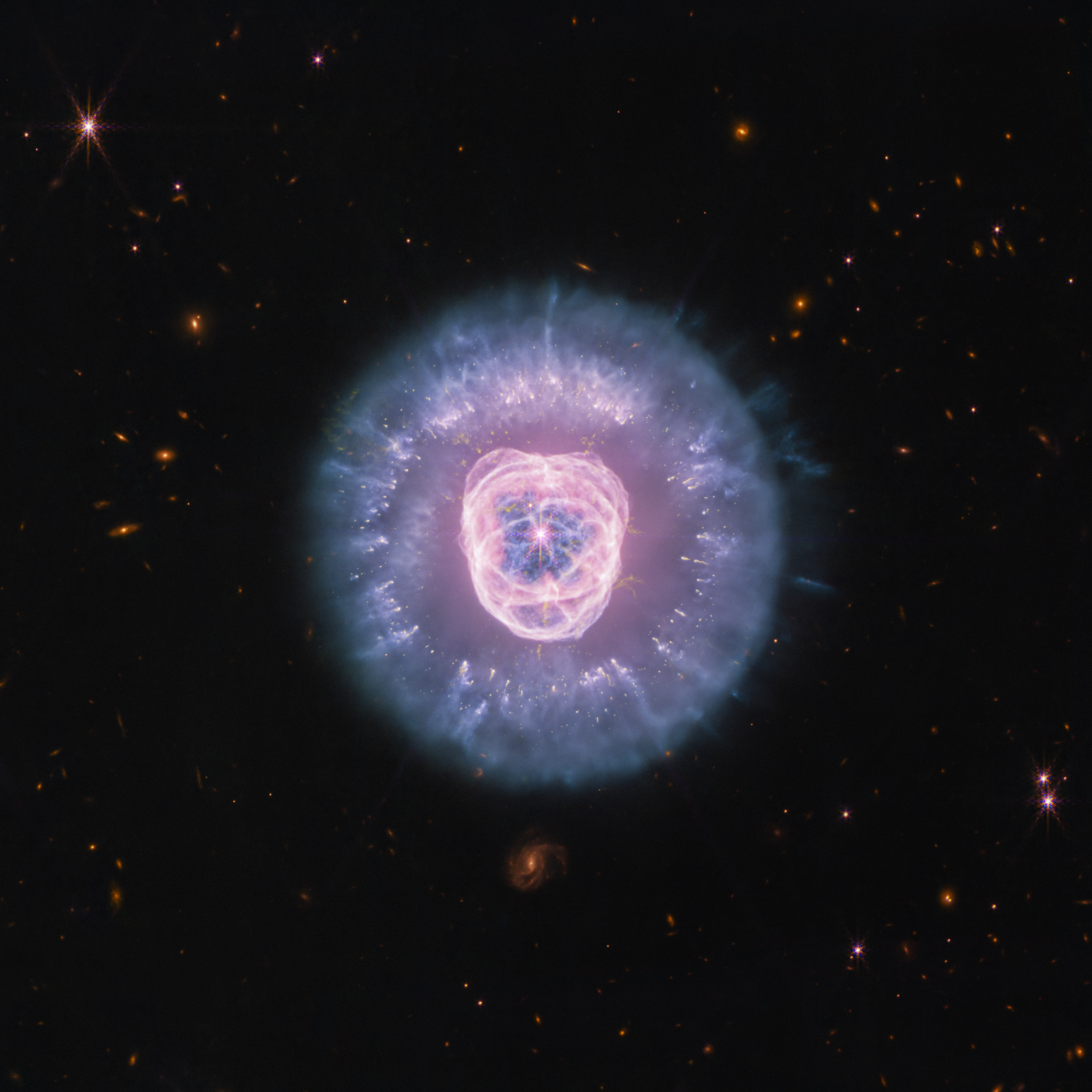
JWST’s Near Infrared Camera and Mid Infrared Instrument combined image of planetary nebula NGC 2392, the Lion Nebula, against the black background of space. The nebula is at center, circular in shape, and looks like a male lion’s head. In the center is a small, pinkish-white circle with eight-point diffraction spikes, a white dwarf star. Surrounding the star are purple-pink cavernous bubbles and shell-like rings. The bubbles and shells collectively form an oval with two small, wide arcs near the top, reminiscent of a lion’s face and its ears. What appears to be extended outward from the lion’s face is a thick ring of purple-blue material. The width of the ring is consistent throughout and resembles a mane. The area closest to the lion’s face looks cloudy, while the edges of the mane look like there are clumps of dust with comet-like tails. In the background are distant galaxies and stars. Some galaxies are yellow and orange points of light and others have spiral structures. Some stars have diffraction spikes.

JWST Images The Lion’s Head Nebula

Explanation: Are we looking at the future of our Sun? The James Webb Space Telescope captured today’s composite image of the Lion’s Head Nebula (NGC 2392) with its NIRCam and MIRI instruments. The Lion’s Head Nebula is the remnant of a Sun-like star. This star was unable to sustain the nuclear fusion in its core needed to remain stable. It began to shed layers of gas and dust into space, forming this planetary nebula. A hot stellar core, called a white dwarf, is left behind within the lion’s nose. Do not boop this nose! Intense radiation from the white dwarf is ionizing the gas as it expands, creating the irregular bubble that makes up the lion’s face. Dust clumps that have survived the white dwarf’s radiation and a cloud of ionized gas make up the lion’s mane. This new and more detailed view of the nebula will help humanity learn more about how the gas and dust interact with each other and the white dwarf radiation.

Tomorrow’s picture: a waterfall of light

Date: August 26, 2026
Credit: Image: NASA, ESA, CSA, STScI; Image Processing: Alyssa Pagan (STScI)
Authors & editors: Keighley Rockcliffe, Robert Nemiroff, Jerry Bonnell, Cecilia Chirenti
A service of: ASD at NASA / GSFC,
NASA Science Activation & Michigan Tech. U.

APOD: 2026 August 24 – Comet 220P in Outburst

24 August 2026 at 00:05

APOD

Astronomy Picture of the Day

Discover the cosmos! Each day a different image or photograph of our fascinating universe is featured, along with a brief explanation written by a professional astronomer.

Comet 220P with green coma and white dust tail.

Comet 220P in Outburst

Explanation: Comet 220P is unexpectedly bright. Normally, periodic Comet 220P/McNaught is so dim that to see it requires a telescope. Two surprising outbursts this year, however, have made it about 20,000 times brighter than usual, so that it is now visible with binoculars and long-duration camera exposures. As expected, Comet 220P continues to orbit the Sun between Mars and Jupiter with a period of over 5 years. The featured long duration exposure, taken 10 days ago from South Africa, shows the comet‘s bright green head and short dust tail. Reasons for Comet 220P’s impressive outbursts are unknown but could be caused by the release of built-up subsurface gas or comet quakes. Comet 220P will pass about one Earth-Sun distance from the Earth in October, after which it is expected to fade quickly as it begins its return to the far part of its orbit.

Tomorrow’s picture: Moon dark

Date August 24, 2026
Credit & Copyright: Spilios Asimakopoulos
Authors & editors: Robert Nemiroff, Jerry Bonnell, Cecilia Chirenti, Keighley Rockcliffe
A service of: ASD at NASA / GSFC,
NASA Science Activation & Michigan Tech. U.

APOD: 2026 August 22 – Mostly Perseids

22 August 2026 at 00:05

APOD

Astronomy Picture of the Day

Discover the cosmos! Each day a different image or photograph of our fascinating universe is featured, along with a brief explanation written by a professional astronomer.

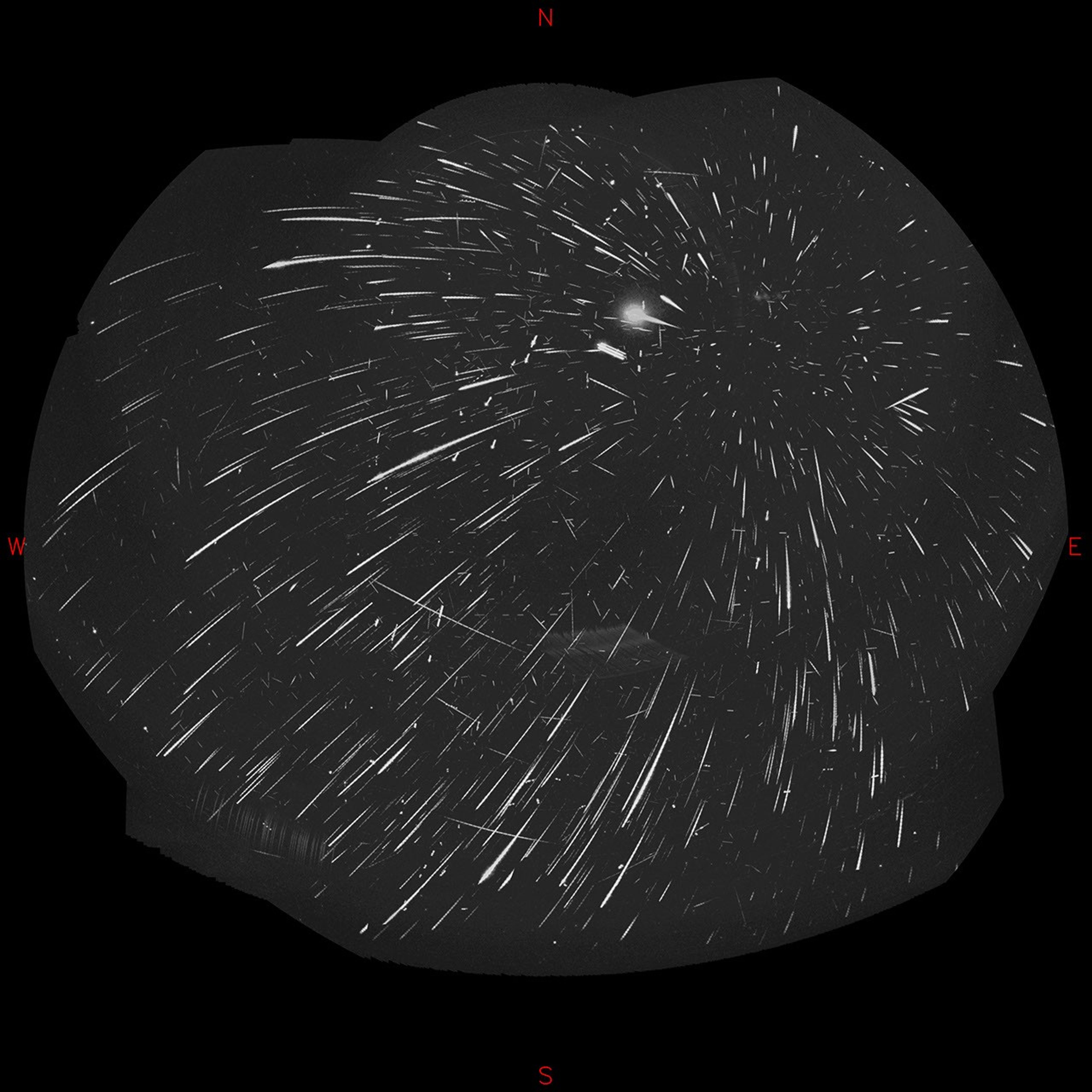
An allsky camera view of the Perseid meteor shower.

Mostly Perseids

Explanation: Recorded the night of August 12-13, images from four dedicated meteor-monitoring cameras at an astronomical observatory in Czechia were aligned and combined to create this all-night, all-sky view. On that night, the total count came to 1,706 meteors. And since that coincided with the peak activity of the 2026 Perseid Meteor Shower, most are perseids. Their overwhelming numbers make them easy to spot. Quite convincingly, perseid trails all trace back to a single radiant on the sky at the upper right, a region in the annual shower’s eponymous constellation Perseus. But meteors belonging to other much less active showers can be revealed by finding their radiants too. For example, seen crossing the perseid trails are meteors from a shower whose radiant lies in Cygnus, known as Kappa Cygnids. The antihelion complex, a general region near Aquarius and opposite the Sun in the sky, is also identifiable as a weak source for meteors.

Tomorrow’s picture: interplanetary road trip

Date August 22, 2026
Credit & Copyright: Jakub Koukal (Valašské Meziříčí Observatory)
Authors & editors: Jerry Bonnell, Cecilia Chirenti, Robert Nemiroff, Keighley Rockcliffe
A service of: ASD at NASA / GSFC,
NASA Science Activation & Michigan Tech. U.

APOD: 2026 August 20 – The Elephant’s Trunk in Cepheus

20 August 2026 at 00:05

APOD

Astronomy Picture of the Day

Discover the cosmos! Each day a different image or photograph of our fascinating universe is featured, along with a brief explanation written by a professional astronomer.

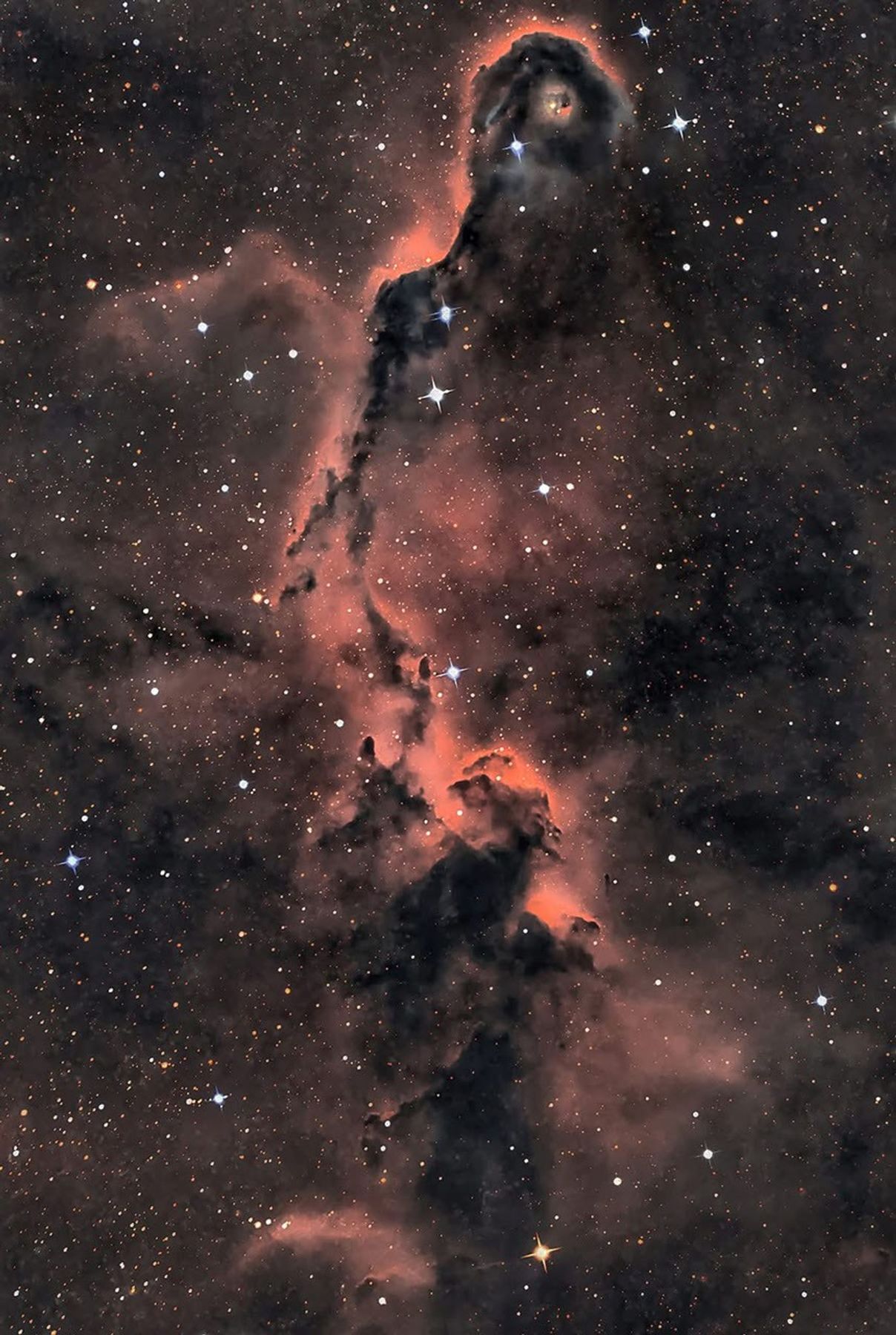
An image of a long, trunk-like interstellar cloud.

The Elephant’s Trunk in Cepheus

Explanation: Like an illustration in a galactic Just So Story, the Elephant’s Trunk Nebula winds through the emission region and young star cluster complex IC 1396, in the high and far off constellation of Cepheus. Also known as vdB 142, this cosmic elephant’s trunk is over 20 light-years long. The detailed telescopic view features the bright swept-back ridges and pockets of cool interstellar dust and gas that abound in the region. But the dark, tendril-shaped clouds contain the raw material for star formation and hide protostars within. Nearly 3,000 light-years distant, the relatively faint IC 1396 complex covers a large region on the sky, spanning over 5 degrees. Top to bottom this proboscidean-like rendition reaches across an almost 1 degree wide field of view, though. That’s a little less than the angular size of 2 full moons.

Tomorrow’s picture: pixels in spacetime

Date August 20, 2026
Credit and Copyright: Eddie Sgarbossa
Authors & editors: Jerry Bonnell, Cecilia Chirenti, Robert Nemiroff, Keighley Rockcliffe
A service of: ASD at NASA / GSFC,
NASA Science Activation & Michigan Tech. U.

APOD: 2026 August 19 – The Case of the Mysterious Maybe Meteor

19 August 2026 at 00:05

APOD

Astronomy Picture of the Day

Discover the cosmos! Each day a different image or photograph of our fascinating universe is featured, along with a brief explanation written by a professional astronomer.

Juan Pablo Castañeda

The Case of the Mysterious Maybe Meteor

Explanation: Whatdunit? What disappeared while crossing a partially eclipsed Sun? Let’s present the evidence. The 24 frames-per-second video was taken in Spain (40°34’30.3″N 1°12’28.8″W) at 20:28 local time on August 12, 2026. The Perseids meteor shower was at its peak during this time. Is this a meteor? Meteor showers trace back to a region of the sky called a radiant point that corresponds to where the Earth is crossing a comet’s path. The object’s path might trace back to the Perseids’ radiant point in the Perseus constellation. The object trails a smaller angle on the sky than the 0.5 degree Sun and Moon, which is smaller than expected for a meteor. Its brightness does not extend much past the Sun, but a meteor burning up in the sky would not need sunlight to be seen. Perhaps the sunlight is reflecting off of the object? After cross-referencing the location, time, and point in the sky with a flight database, the culprit is found to be an airplane contrail!

Tomorrow’s picture: another mystery

Date: August 19, 2026
Credit & Copyright: Juan Pablo Castañeda
Authors & editors: Keighley Rockcliffe, Robert Nemiroff, Jerry Bonnell, Cecilia Chirenti
Hat tip: William Cooke, David Lee, Peter Brown, Denis Vida, Peter Jenniskens
A service of: ASD at NASA / GSFC,
NASA Science Activation & Michigan Tech. U.

APOD: 2026 August 18 – Perseids from Perseus

18 August 2026 at 00:05

APOD

Astronomy Picture of the Day

Discover the cosmos! Each day a different image or photograph of our fascinating universe is featured, along with a brief explanation written by a professional astronomer.

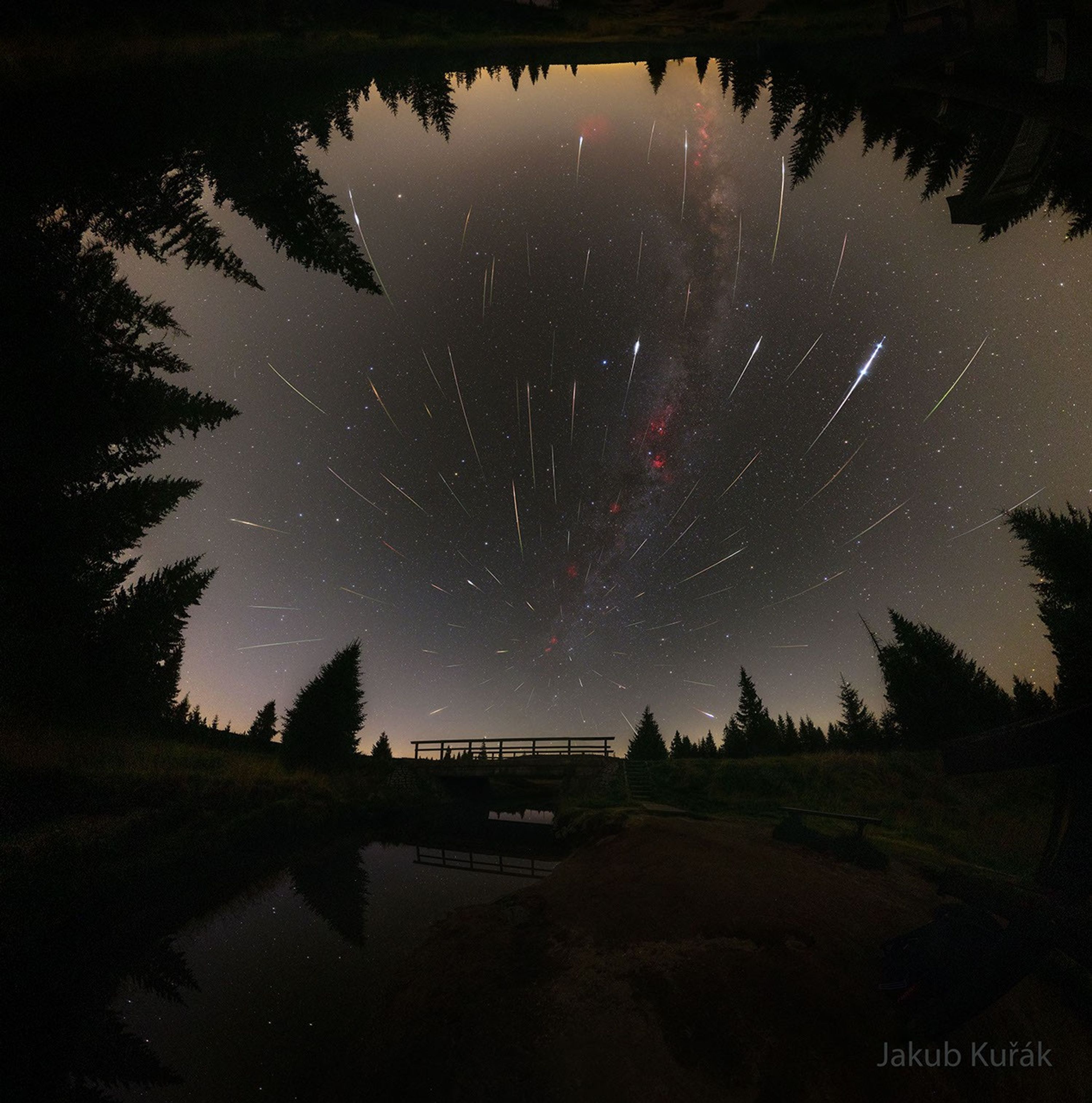
A starfield is bounded by trees on three sides and a pond on the bottom. Amongst the stars are many streaks of light appearing to emanate from a place on the sky just above a foreground bridge.

Perseids from Perseus

Explanation: This was a good year for the Perseids meteor shower. A key reason was the Moon was absent from lighting up Earth’s night sky so that more meteors were visible than usual. Where was the Moon? It was busy visiting the Sun. Near the Perseids peak, the Moon moved directly in front of the Sun and created a total solar eclipse visible from Greenland and Spain. The Perseids occur when the Earth collides with a stream of Sun-orbiting debris cast off by Comet Swift-Tuttle. Perseid meteors, although typically only the size of a sand grain, tend to be fast and bright because Swift-Tuttle’s debris orbits the Sun in a direction partly opposite Earth’s orbital motion. In the featured image compilation, accumulated over several nights from Jizerka in the Czech Republic, the Perseids meteor streaks can be traced back to a single location on the sky — its radiant in Perseus.

Gallery: 
Perseids Meteor Shower of 2026
Tomorrow’s picture: open space

Date August 18, 2026
Credit Jakub Kuřák
Authors & editors: Robert Nemiroff, Jerry Bonnell, Cecilia Chirenti, Keighley Rockcliffe
A service of: ASD at NASA / GSFC,
NASA Science Activation & Michigan Tech. U.

APOD: 2026 August 17 – A Golden Corona Eclipse

17 August 2026 at 00:05

APOD

Astronomy Picture of the Day

Discover the cosmos! Each day a different image or photograph of our fascinating universe is featured, along with a brief explanation written by a professional astronomer.

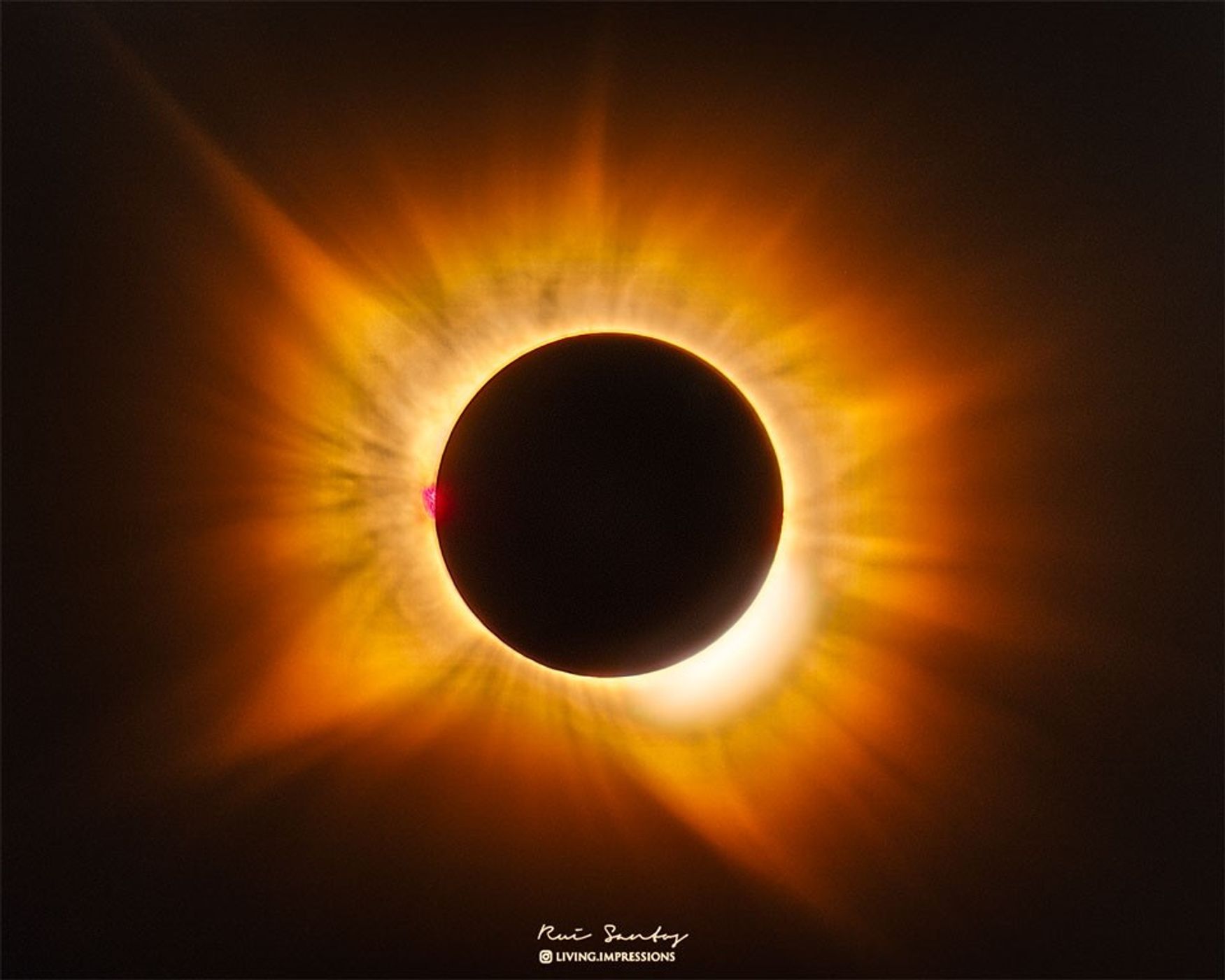
A total eclipse Sun is featured in the image center. Around the Sun is a filamentary gold-hued corona flowing out in all directions.  Please see the explanation for more detailed information.

A Golden Corona Eclipse

Explanation: This total solar eclipse appeared not only poetically beautiful but scientifically interesting. Usually the solar corona appears white, and to some observers the corona of last week’s total solar eclipse did appear this pearly color. But this time, totality observers in Spain saw a corona that appeared unusually golden. For one reason, from Spain, the totality occurred when the setting Sun was near the horizon. That low, sunlight travels through a large amount of air which scatters out blue light. An unusual amount of smoke in the air from nearby forest fires acted as a second filter, further scattering the remaining blue tones and deepening the already gold-dominated light. The HDR-processed, multiple-exposure featured image was captured from Benavente, Spain last week. One thing that did not appear golden was a hydrogen-glowing prominence that hovered over the Sun‘s left edge — its original bright pink color survived.

Gallery: Solar Eclipse of 2026 August 12
Tomorrow’s picture: fast meteors

Date: August 17, 2026
Credit & Copyright: Rui Santos (Living Impressions)
Authors & editors: Robert Nemiroff, Jerry Bonnell, Cecilia Chirenti, Keighley Rockcliffe
A service of: ASD at NASA / GSFC,
NASA Science Activation & Michigan Tech. U.
❌
❌