NASA Johnson Pilots Chase Moon’s Shadow for Eclipse Science
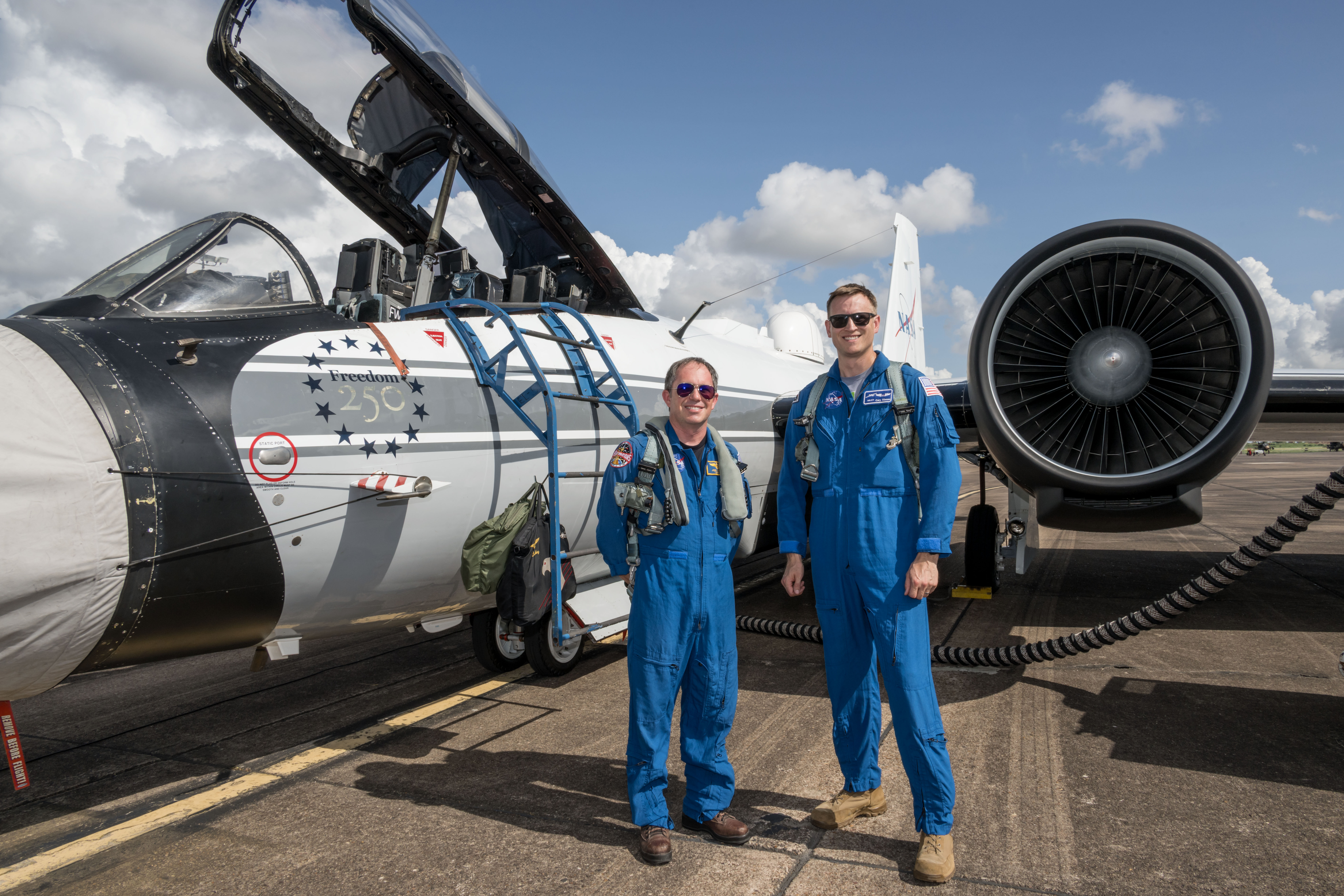
NASA’s WB-57F aircraft prepares for takeoff from Ellington Field in Houston ahead of its mission to observe the Aug. 12, 2026, total solar eclipse from Iceland. From left are John Gustine, NASA WB-57F pilot, and Cary Klemm, sensor equipment operator for NASA’s WB-57F.
NASA/Robert Markowitz
During the Aug. 12 total solar eclipse over Europe, scientists aimed to study a long-standing mystery: why the Sun’s outer atmosphere, the corona, is far hotter than its visible surface. Capturing the data they needed meant being in exactly the right place at the right time.
Pilots from NASA’s Johnson Space Center flew the WB-57F high altitude research aircraft from Ellington Field in Houston to Iceland, their base for flying through the path of totality to give scientists a clearer view of the Sun’s corona.
A total solar eclipse provides a unique opportunity to examine the corona because the Moon temporarily blocks the Sun’s bright surface, revealing its fainter outer atmosphere. Observations collected during this brief window can help scientists better understand how energy and material move through the corona and away from the Sun, improving our understanding of space weather.
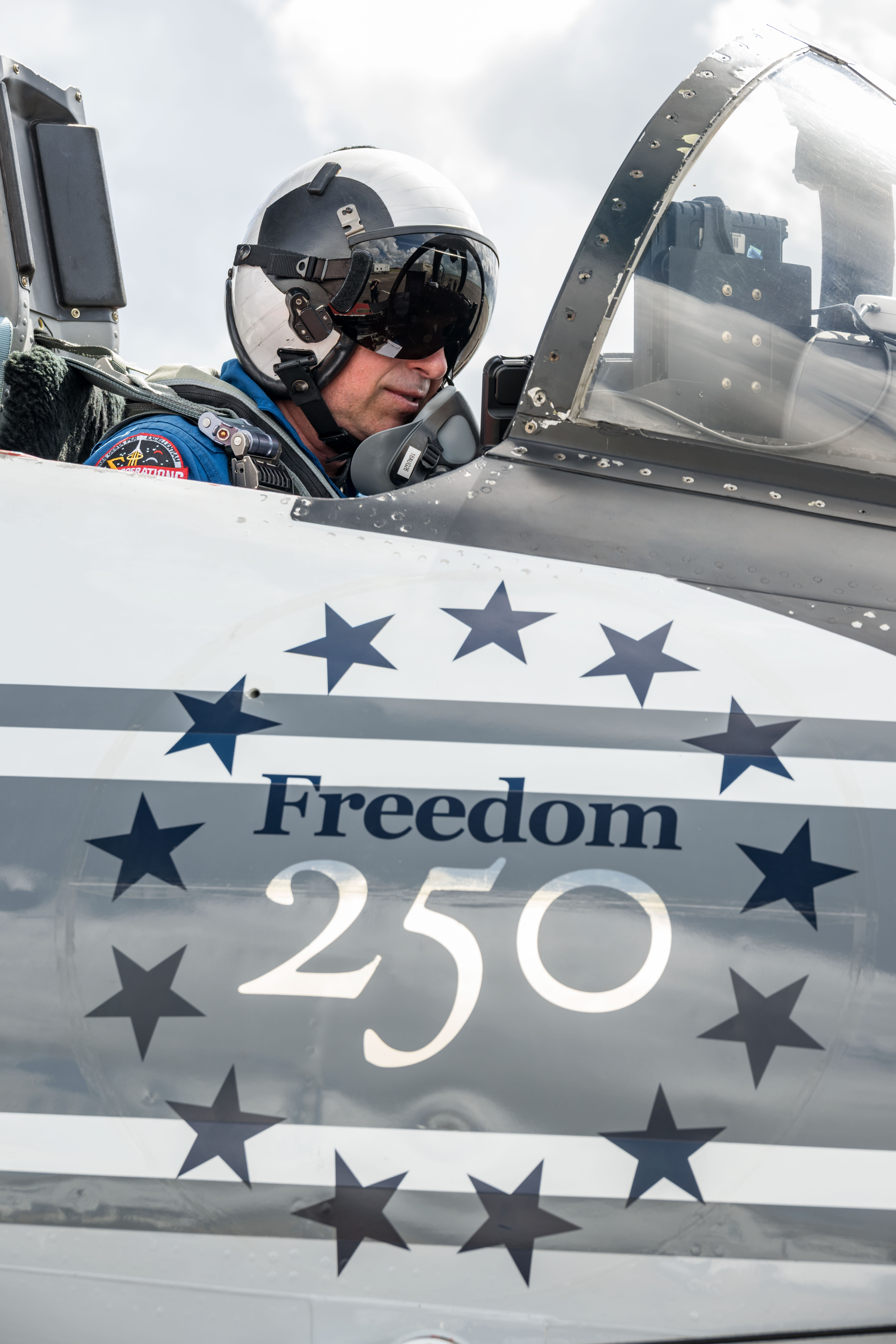
John Gustine, NASA WB-57F pilot, prepares for flight at Ellington Field in Houston ahead of the aircraft’s departure for Iceland to support the Aug. 12 total solar eclipse.
NASA/Robert Markowitz
At about 50,000 feet, the WB-57F flew above most clouds, dust, and water vapor that can interfere with observations from the ground. The altitude reduced atmospheric interference while also allowing the science instruments to observe infrared wavelengths that are largely absorbed lower in Earth’s atmosphere.
Capturing those observations required careful coordination between scientists and the flight crew. Before the mission, teams calculated where the aircraft needed to be as the Moon’s shadow moved across the North Atlantic.
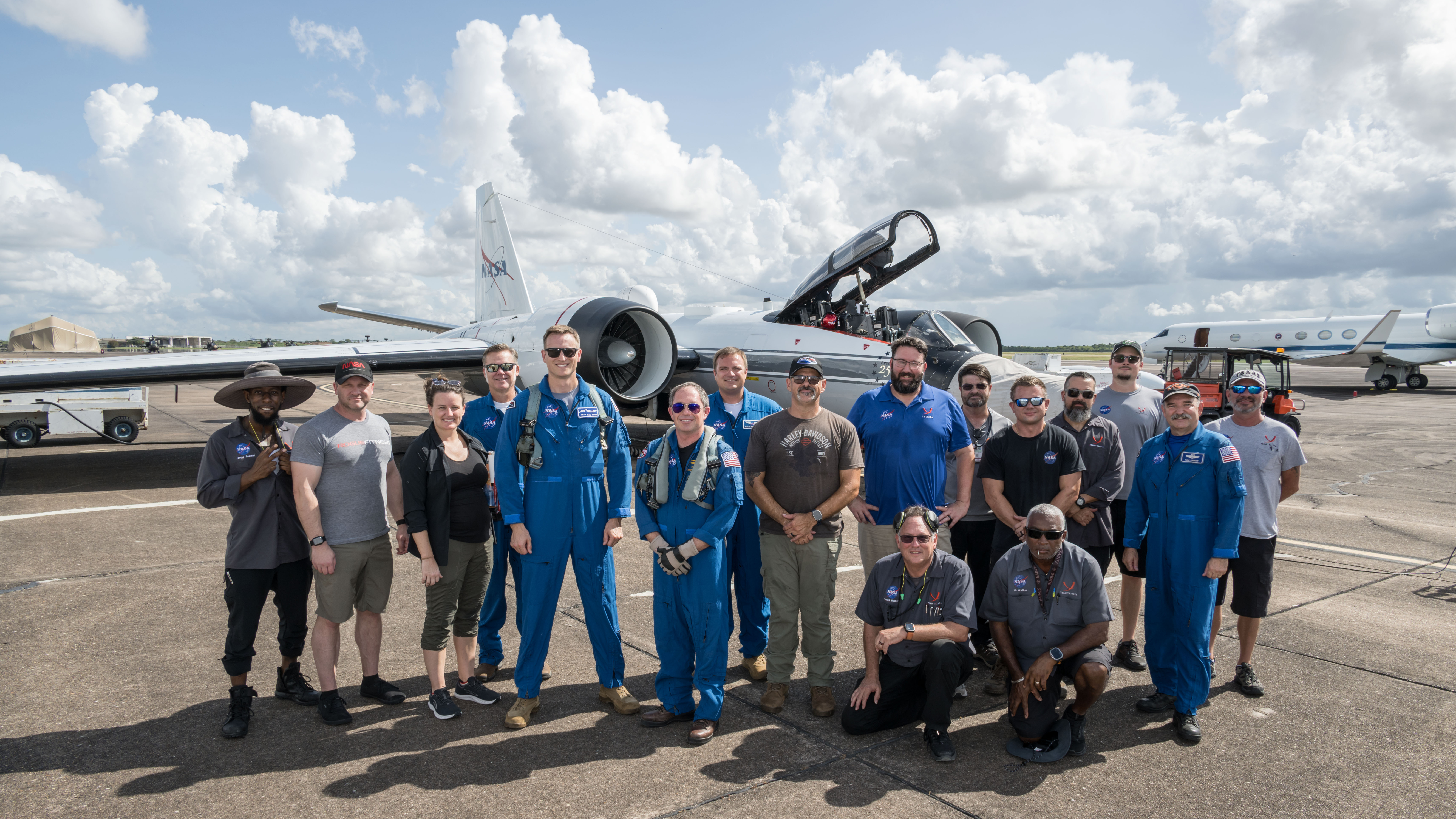
“Going into a mission like this takes a huge team. It starts with the science team establishing the requirements, and then we work closely with them for months leading up to the mission,” said Tom Parent, NASA WB-57F pilot. “We rely heavily on our maintenance team to get the instruments serviced, prepared, loaded onto the aircraft, and flight tested. It’s a huge team effort to get an aircraft like this up there to image and achieve these objectives.”
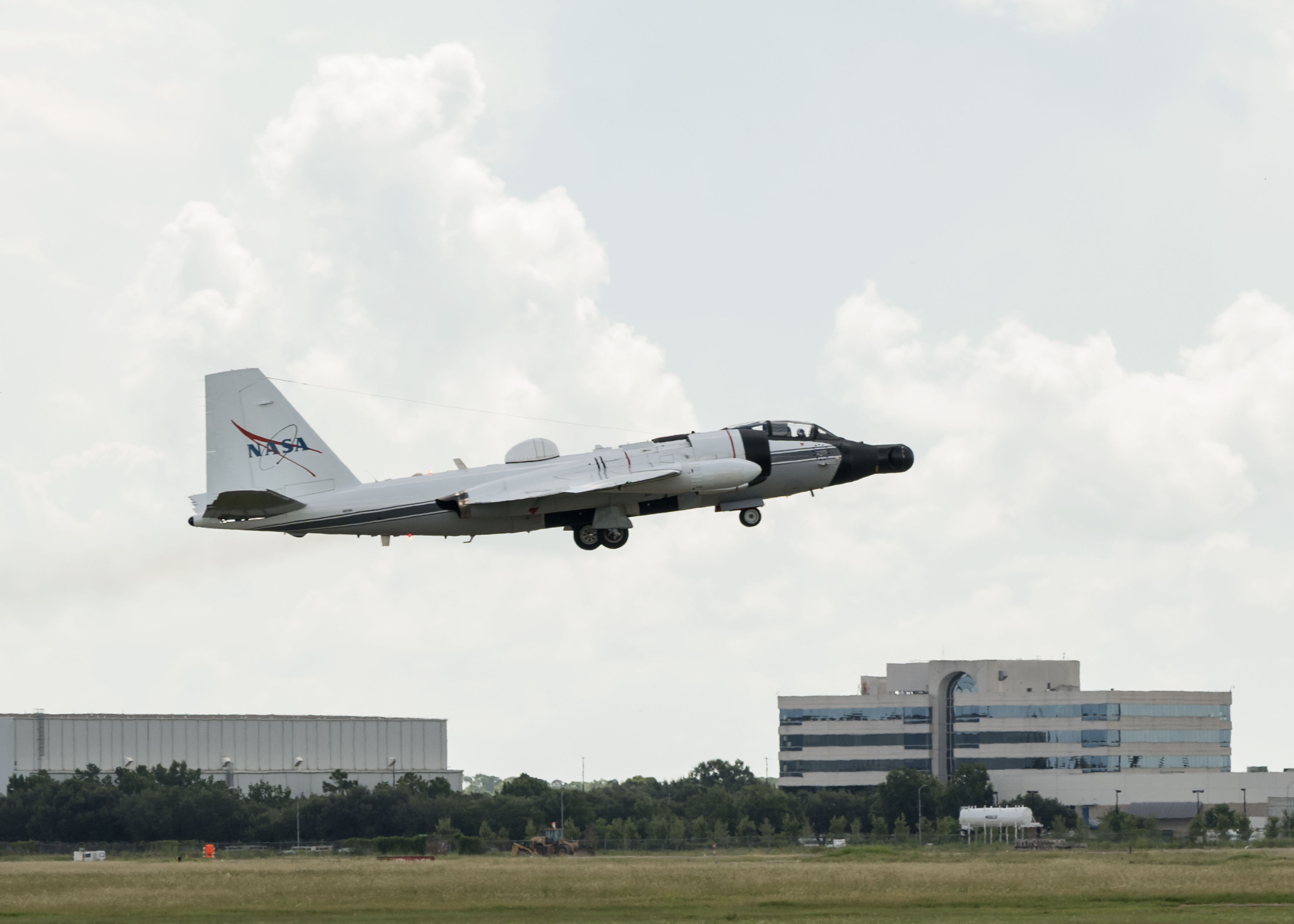
NASA’s WB-57F aircraft takes off from Ellington Field in Houston ahead of its mission supporting the Aug. 12 total solar eclipse from Iceland.
NASA/Robert Markowitz
During totality, NASA WB-57F pilot John Gustine positioned the aircraft along the eclipse path to maximize time in the Moon’s shadow and give scientists as much opportunity as possible to collect data.
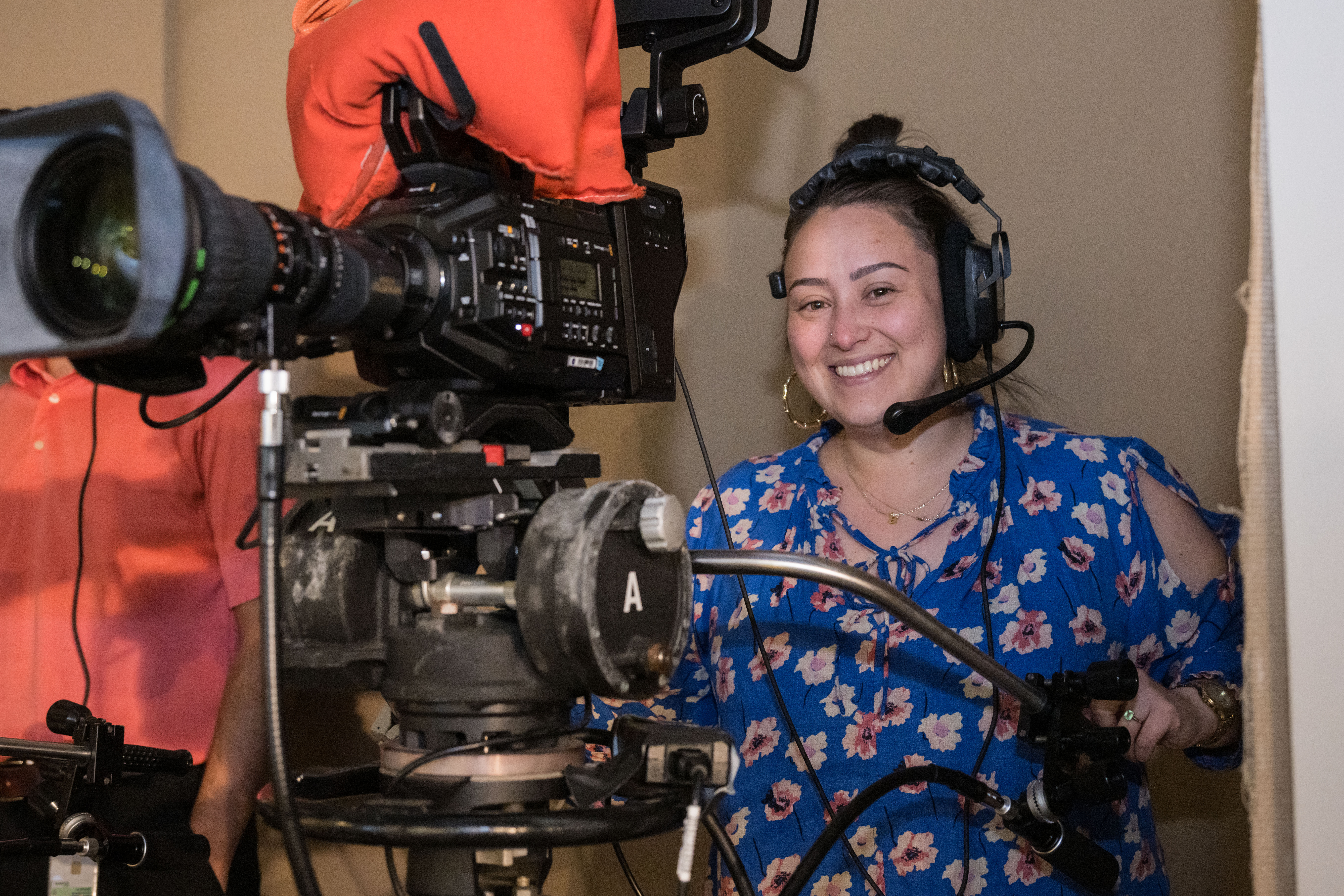
From the back seat, Cary Klemm, sensor equipment operator for NASA’s WB-57F, controlled the camera systems, adjusting focus and exposure times while tracking features of interest throughout totality.
With the cameras capturing observations throughout the brief window, every second mattered.
“Every image is another piece of data that could reveal something new about the Sun,” Klemm said.
What scientists can learn from those observations reaches far beyond the eclipse itself. The Sun’s corona is made of plasma shaped by magnetic fields, and many of the same physical processes occur elsewhere in the universe.
“The NASA WB-57F’s unique capabilities of high-altitude flight were truly crucial in providing access to these valuable wavelengths during an eclipse whose path crossed mostly over the ocean in an area where clouds are common,” said Amir Caspi, principal investigator for the study at Southwest Research Institute in Boulder, Colorado. “We could not have achieved this success without this platform, and all of the efforts of the many intrepid ground, air, and science crew members.”
Members of NASA’s WB-57F eclipse mission team gather at Ellington Field in Houston ahead of the aircraft’s departure for Iceland.
NASA/Robert Markowitz
The data gathered during the flight will give scientists another opportunity to investigate the Sun and the processes that influence the space environment around Earth.
Behind the Lens: Meet NASA Johnson’s Photographers
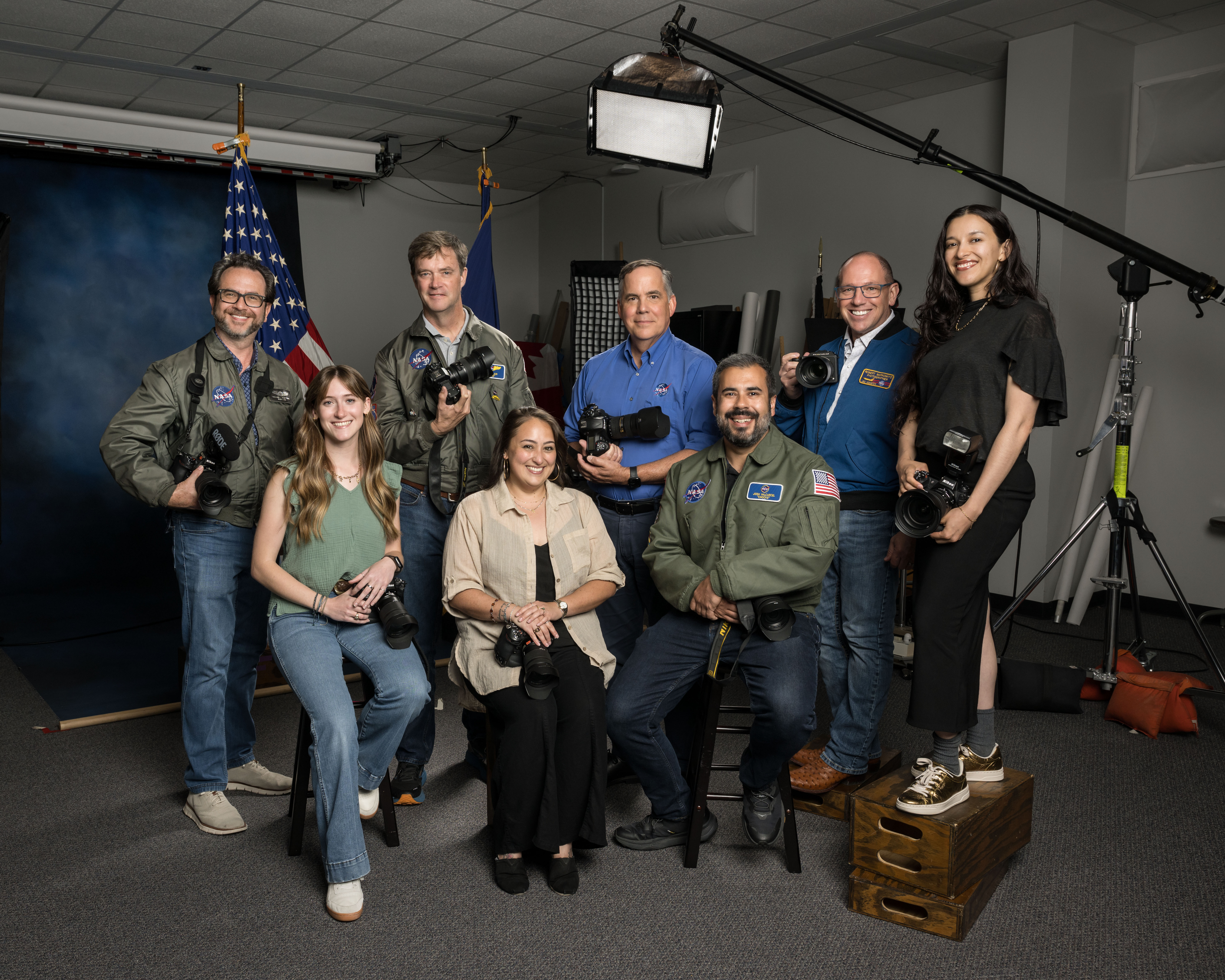
NASA Johnson Space Center’s Imagery Acquisition Group poses for a group photo on Aug. 10, 2026.
Credits: NASA/Robert Markowitz
The Imagery Acquisition Group at NASA’s Johnson Space Center poses for a group photo in Houston, Texas on Aug. 10, 2026. Back row, from left, are NASA photographers Bill Stafford, James Blair, supervisor Mark Sowa, and NASA photographers Robert Markowitz and Luna Posadas Nava. Front row, from left, are NASA photographers Morgan Gridley, Helen Arase Vargas, and former NASA photographer Josh Valcarcel.
NASA/Robert Markowitz
Photographers at NASA’s Johnson Space Center in Houston have documented some of the most defining moments in human spaceflight.
From astronaut training and engineering tests to mission control operations and milestone celebrations, their images preserve the history of exploration while capturing the people and teams behind the missions shaping the next era.
Meet the photographers behind the lens and explore the stories behind the images that have helped tell NASA’s story.
Robert Markowitz
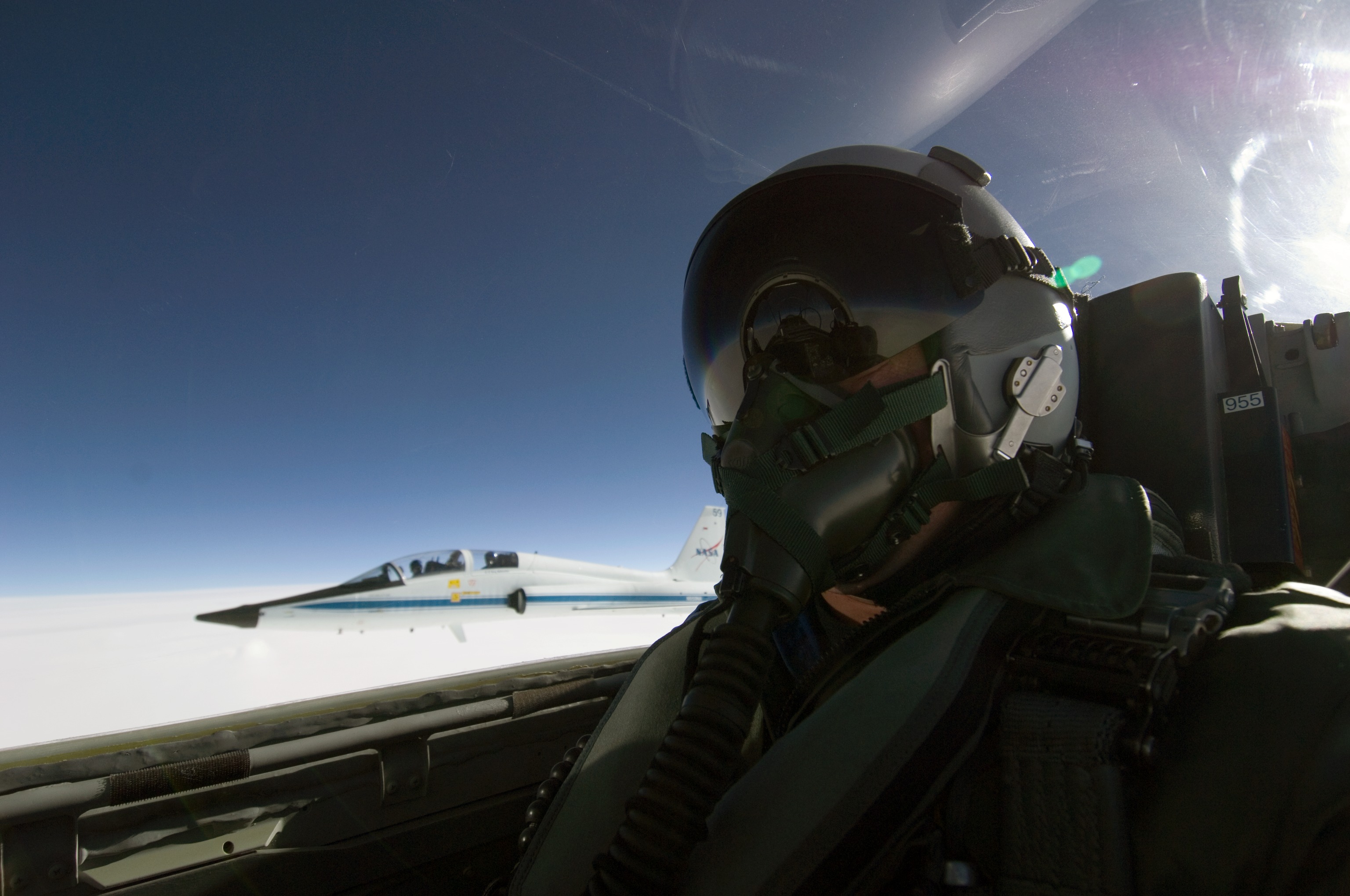
NASA photographer Robert Markowitz flies aboard a T-38 aircraft during flight operations.
NASA/Robert Markowitz
Being able to help tell the human spaceflight story, frame by frame, has been an incredible adventure.
“My favorite part of this job has always come down to the range of assignments we take on and the people I get to work with every day,” Markowitz said.
One of Markowitz’s early career highlights came during the filming of “Apollo 13,” when he served as the behind-the-scenes still photographer for nearly every KC-135 zero-gravity flight. “Looking back as a 25-year-old photographer at Johnson, I don’t think I fully appreciated how unique an opportunity it was to be there documenting those moments,” he said.
Markowitz says the job has challenged him to grow as both a photographer and a communicator. Whether photographing dozens of individual portraits in a day or coordinating a 300-person group photo, each assignment has strengthened his ability to adapt, collaborate, and connect with people.
“This work has shaped not just my career, but my life,” he said. “Being part of a team that captures and preserves the story of human spaceflight continues to be one of the great honors of my time at Johnson.”
NASA’s Artemis II flight control team works on console in the White Flight Control Room in the Mission Control Center in Houston during the mission’s lunar flyby on April 6, 2026.
NASA/Robert Markowitz
Former Expedition 1 crewmembers Yuri Gidzenko, Bill Shepherd, and Sergei Krikalev celebrate the International Space Station’s 25th anniversary of continuous human habitation at Space Center Houston on Jan. 19, 2026.
NASA/Robert Markowitz
The Counterweight-Offload Astronaut Suited Test and Evaluation Rig is displayed in Johnson’s Space Vehicle Mockup Facility.
NASA/Robert Markowitz
NASA’s Artemis II training team gathers in front of the Orion spacecraft mockup at the Space Vehicle Mockup Facility at Johnson Space Center on May 6, 2026.
NASA/Robert Markowitz
Country music artist Garth Brooks performs from mission control during a live event with the Expedition 52 crew aboard the International Space Station. From left are Dina Contella, deputy manager for the International Space Station in NASA’s Low Earth Orbit Program; NASA astronaut Stephanie Wilson; Garth Brooks; and Norm Knight, Flight Operations Director.
NASA/Robert Markowitz
Members of the Apollo 13 movie cast and crew take part in a zero-gravity flight aboard a KC-135 aircraft, owned by NASA at the time. Floating from left are actor Tom Hanks, who portrayed astronaut Jim Lovell; director Ron Howard; actor Bill Paxton, who portrayed astronaut Fred Haise; actor Kevin Bacon, who portrayed astronaut Jack Swigert; actor Gary Sinise, who portrayed astronaut Thomas Mattingly; and executive producer Todd Hallowell.
NASA/Robert Markowitz
Bill Stafford
NASA photographer Bill Stafford photographs an event in the Teague Auditorium at NASA’s Johnson Space Center in Houston.
NASA/David DeHoyos
I love figuring out how to frame a single image so it captures not just a moment, but the significance behind it.
Bill Stafford
NASA Photographer
NASA photographer Bill Stafford’s path to Johnson began during his senior year of college, when a friend who was completing a photography internship at the center told him about an opening on the photography team. With a longtime interest in science and technology, Stafford saw the opportunity to combine those interests with photography in an extraordinary environment.
Stafford approaches each assignment as a technical challenge and a storytelling opportunity. Whether working around constraints in lighting, timing, or access, he uses composition, visual psychology, and an understanding of how a viewer’s eye moves through an image to shape the final photograph.
“My favorite part of the job is the problem-solving that comes with it,” Stafford said.
Working at Johnson has sharpened those instincts as he photographs spacecraft, hardware, astronauts, and the people behind NASA’s human spaceflight missions.
“So many of the subjects I photograph carry weight and history that I want the image to reflect,” he said.
NASA astronauts Reid Wiseman (right) and Victor Glover (left) participate in an Artemis II entry simulation at NASA’s Johnson Space Center in Houston.
NASA/Bill Stafford
NASA’s Joint Extravehicular Activity and Human Surface Mobility Program test team conducts a mock spacewalk to prepare for lunar surface operations and technology development for future Artemis missions.
NASA/Bill Stafford
NASA astronaut and Expedition 75 Flight Engineer Anil Menon participates in photography training at NASA’s Johnson Space Center in Houston.
NASA/Bill Stafford
NASA’s Exploration Extravehicular Mobility Unit is photographed inside a thermal vacuum chamber at NASA’s Johnson Space Center in Houston.
NASA/Bill Stafford
Participants test technology during NASA Spacesuit User Interface Technologies for Students (SUITS) test week at NASA’s Johnson Space Center in Houston.
NASA/Bill Stafford
James Blair
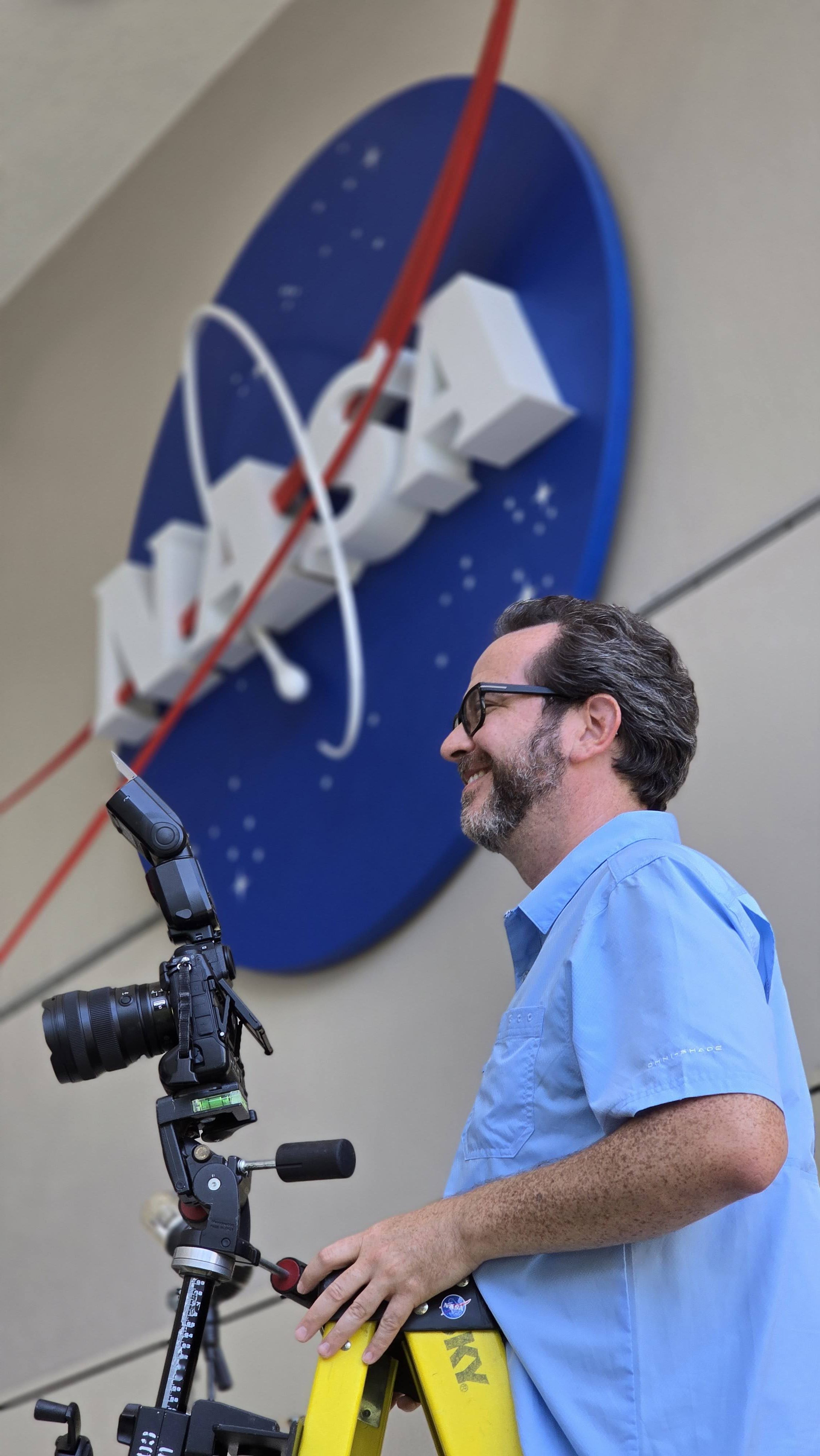
NASA photographer James Blair prepares to capture imagery during a flight operations assignment.
NASA
I truly enjoy capturing candid photos of people during decisive moments.
James Blair
NASA Photographer
From newspapers across the country to working as a photographer and photo editor for a publication in Ecuador, NASA photographer James Blair began his career in photojournalism. Photography has taken him around the world, a path that has continued at Johnson with assignments ranging from astronaut training to geology field training in Iceland.
“Since I was very young, I have always been fascinated by spaceflight and the technology it takes to reach beyond Earth’s atmosphere,” Blair said.
At Johnson, Blair combines that fascination with his photojournalism background to document the people and technology shaping NASA’s next era of exploration.
“I enjoy documenting the new hardware that is being developed to return us to the Moon,” he said. “From spacesuits to rovers and potential lunar habitats, I get to show the world what NASA has in store for the future of human spaceflight.”
U.S. Navy divers and Artemis II astronauts aboard an inflatable raft are approached by helicopters and lifted away to the recovery ship after egressing NASA’s Orion spacecraft.
NASA/James Blair
Artemis II crew members Christina Koch (middle) and Victor Glover (right) participate in an Artemis lunar imaging training using an Orion crew configuration at NASA’s Johnson Space Center.
NASA/James Blair
From left, JAXA (Japan Aerospace Exploration Agency) astronaut Aki Hoshide and NASA astronaut candidates Yuri Kubo and Cameron Jones participate in an Artemis geology field training expedition in Iceland.
From left, EVA task officer Bridget Scheib, chief training officer John Ray, NASA astronaut candidate Cameron Jones, geology instructor and Artemis science officer Kelsey Young, associate research scientist Patrick Whelley, geology instructor and Artemis curation lead Juliane Gross, and JAXA (Japan Aerospace Exploration Agency) astronaut Aki Hoshide participate in an Artemis geology field training expedition in Iceland.
NASA/James Blair
From left, Artemis IV chief training officer Bryce Prescott, geology instructor Jacob Richardson, and NASA astronaut Zena Cardman participate in an Artemis geology field training expedition in Iceland.
NASA/James Blair
Helen Arase Vargas
NASA photographer Helen Arase Vargas captures a news conference on lunar terrain vehicles for Artemis missions at NASA’s Johnson Space Center in Houston on April 3, 2024.
NASA/Robert Markowitz
I’ve always liked the idea of my work serving the public interest.
Helen Arase Vargas
NASA Photographer
NASA photographer Helen Arase Vargas began her career in photojournalism and reporting in Southern California before joining Boeing’s scientific photography team in El Segundo. Her experience photographing aerospace sparked an unexpected interest that eventually led her to Johnson.
“The best part of the job is my coworkers; cheesy, but there is so much to learn from everyone,” Arase Vargas said. “Our core team has so much knowledge. They are all quick to offer help and are great humans.”
Arase Vargas says much of the work at Johnson reflects the journalism ethics she learned early in her career and fulfills her desire to serve the public interest.
The range and volume of assignments also helped her become more comfortable working in different environments while continuing to develop her craft.
For Arase Vargas, documenting the Artemis II crew’s return to Ellington Field in Houston came with a heightened sense of responsibility.
“The world is watching, and all that imagery must be rushed out by the lab,” she said. “Your photo could be the one that ends up on every news site, and you don’t want to miss capturing the joy and celebration the moment deserves.”
NASA’s Artemis II crew returns to Ellington Field in Houston following the mission on April 11, 2026.
NASA/Helen Arase Vargas
The Artemis III crew poses for an official portrait in Houston, Texas. In the back row, from left, are NASA astronauts Andre Douglas and Frank Rubio. In the front row, from left, are ESA (European Space Agency) astronaut Luca Parmitano and NASA astronaut Randy Bresnik.
NASA/Helen Arase Vargas
ESA (European Space Agency) astronaut Sophie Adenot poses in an Extravehicular Mobility Unit during a portrait session at NASA’s Johnson Space Center.
NASA/Helen Arase Vargas
NASA’s 2025 Astronaut Candidate Class participates in geology training at Rio Grande del Norte National Monument in New Mexico on May 20, 2026.
NASA/Helen Arase Vargas
The 2025 Astronaut Candidate Class poses for a holiday photo during wilderness survival training at Fort Rucker in Alabama.
NASA/Helen Arase Vargas
NASA teams conduct nighttime operations training with a Lunar Terrain Vehicle Ground Test Unit at Johnson Space Center’s Rock Yard.
NASA/Helen Arase Vargas
Luna Posadas Nava
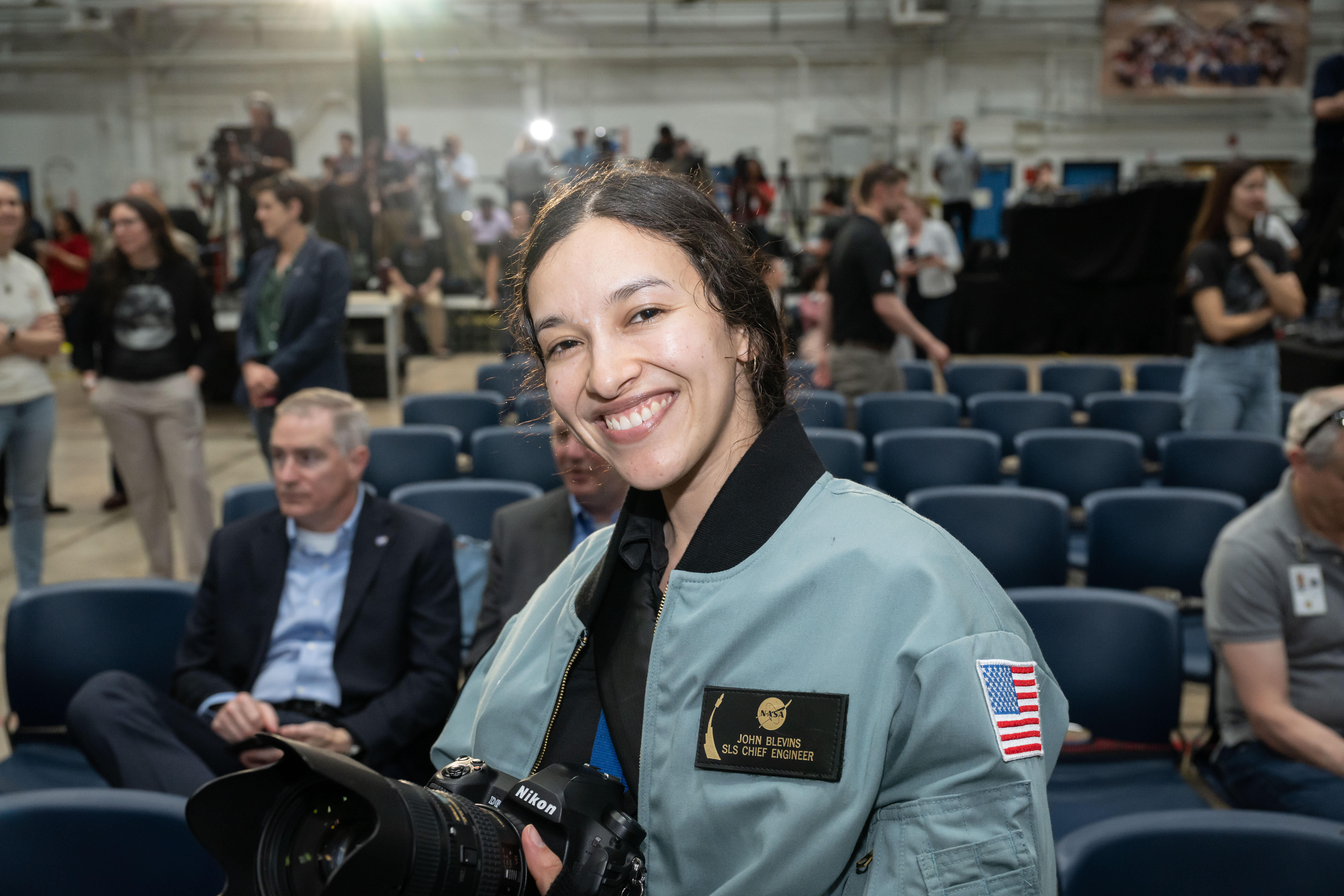
NASA photographer Luna Posadas Nava documents the Artemis II crew return at Ellington Field in Houston.
NASA/Luna Posadas Nava
I have used the camera as a bridge between curiosity and understanding.
Luna Posadas Nava
NASA Photographer
NASA photographer Luna Posadas Nava’s path to Johnson spans emerging technology, optics and imaging systems, and photographing artists across the East Coast. Her work grew from a desire to visualize and expand the boundaries of what is possible.
Joining Johnson shortly before the launch of NASA’s Artemis II mission, one of Posadas Nava’s first experiences was helping bring Moon Joy to the world. She documented the Science Evaluation Room, where scientists worked together to conduct real-time lunar science observations during the mission’s lunar flyby.
Posadas Nava said it was inspiring to witness the team at work and especially meaningful to see so many women contributing to the mission’s science.
Seeing the response from women in her own life and online reinforced for Posadas Nava the power of representation through photography.
“When we see ourselves in stories, we imagine new futures,” she said. “I hope my work helps more people see themselves in the story of exploration, because what we see shapes what we believe is possible.”
The Artemis II lunar science team celebrates in the Science Evaluation Room following the mission’s successful lunar flyby. Artemis II Deputy Lunar Science Lead Marie Henderson stands at left. From the right foreground are lunar science team members Ariel Deutsch; Maria Banks, behind her; Ryan Watkins, to her right; and Sara Schmidt.
NASA/Luna Posadas Nava
Artemis II deputy lunar science lead Jacob Richardson, left, and Artemis II lunar science team member Kiarre Dumes react to the astronauts’ verbal observations of the Moon during the mission’s lunar flyby on April 6, 2026.
NASA/Luna Posadas Nava
Artemis II science officer Angela Garcia, left, and lunar science team member Kiarre Dumes discuss science operations in the Science Evaluation Room at NASA’s Johnson Space Center.
NASA/Luna Posadas Nava
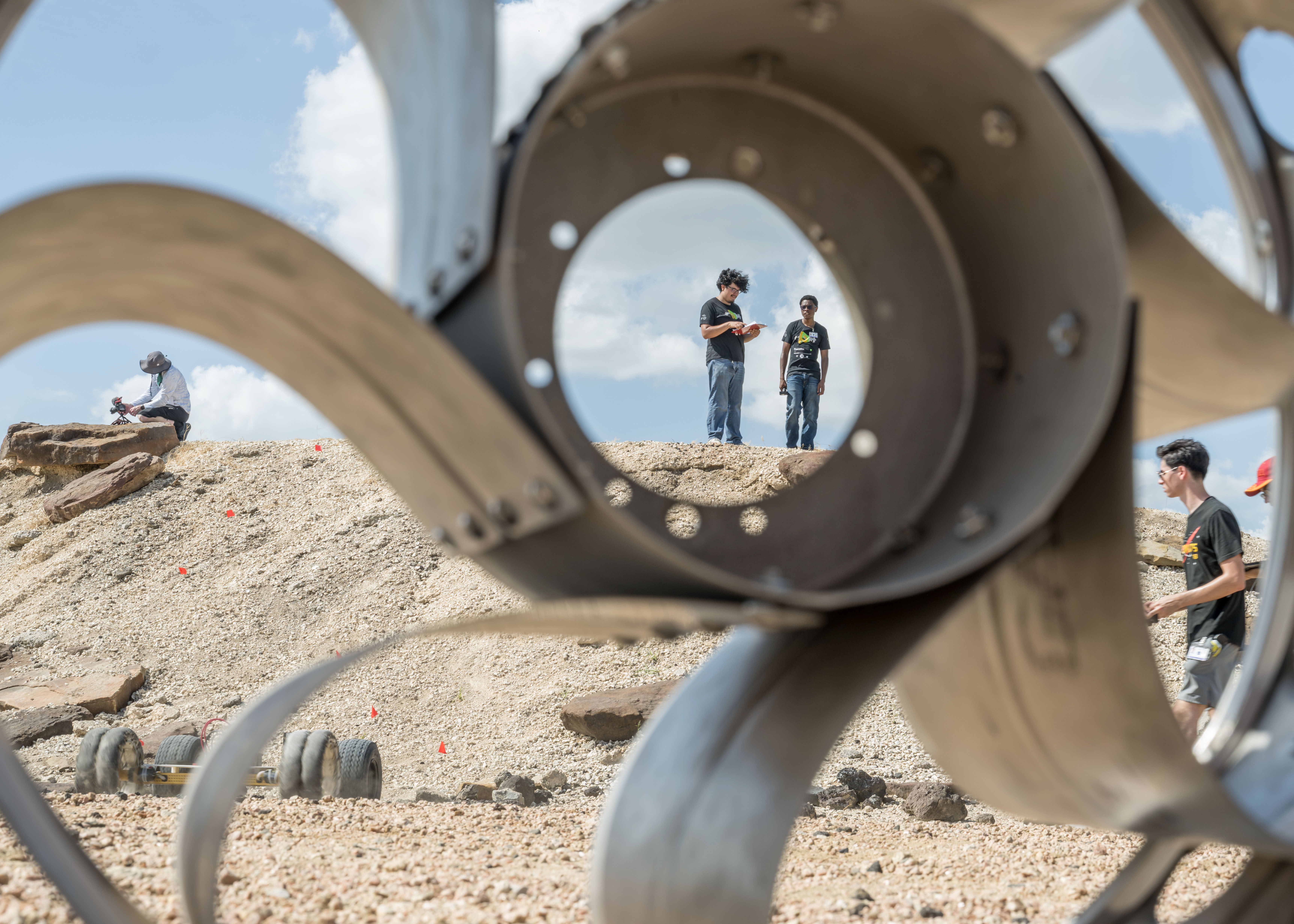
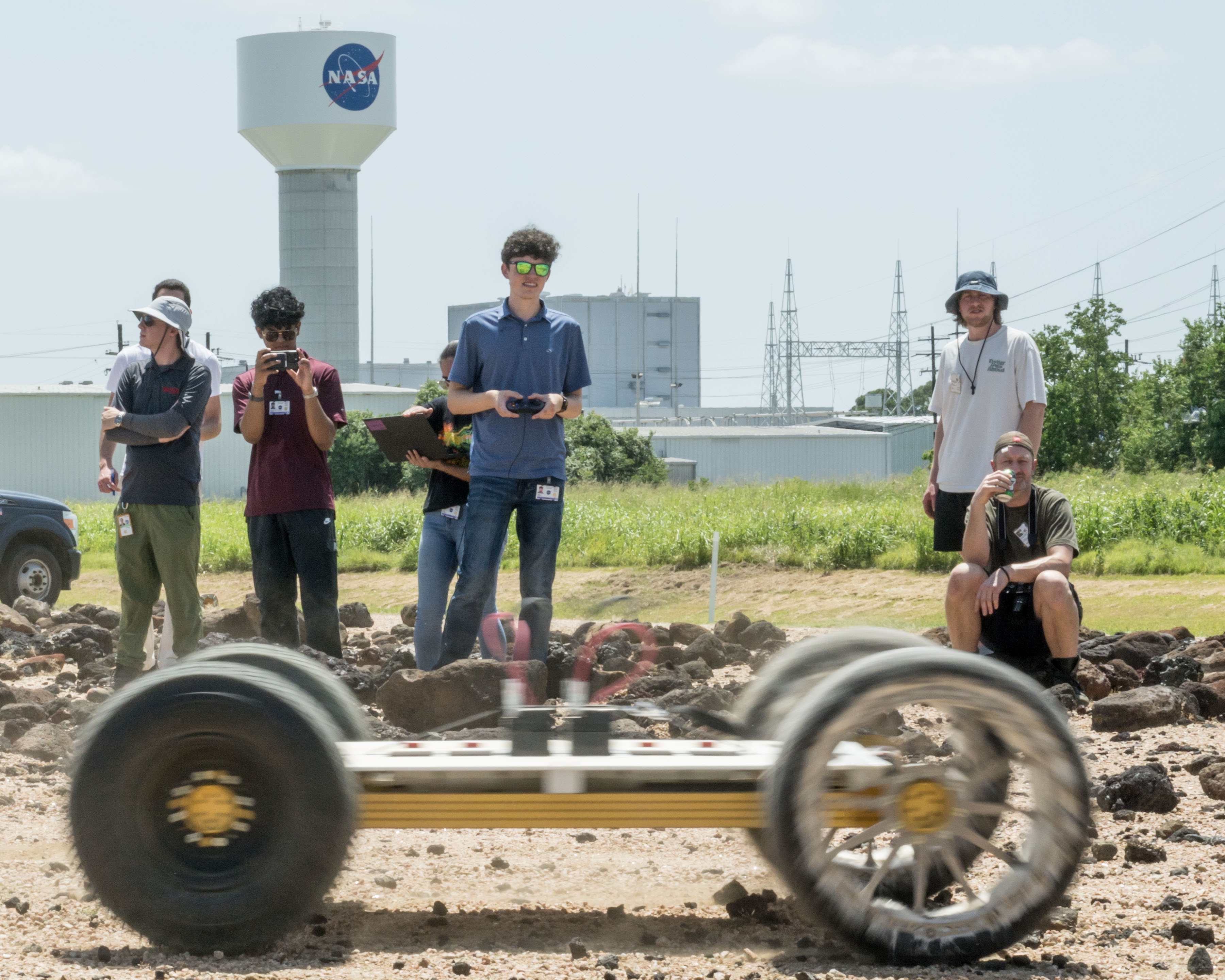
NASA engineers and teams from the Rock and Roll with NASA Challenge test rover prototypes at NASA’s Johnson Space Center Rock Yard in Houston on July 31, 2026.
NASA/Luna Posadas Nava
NASA’s Artemis III crew participates in a video shoot for the crew announcement at NASA’s Johnson Space Center on June 3, 2026.
NASA/Luna Posadas Nava
The Expedition 73 crew attends a debrief and awards ceremony at Space Center Houston on June 16, 2026.
NASA/Luna Posadas Nava
David DeHoyos
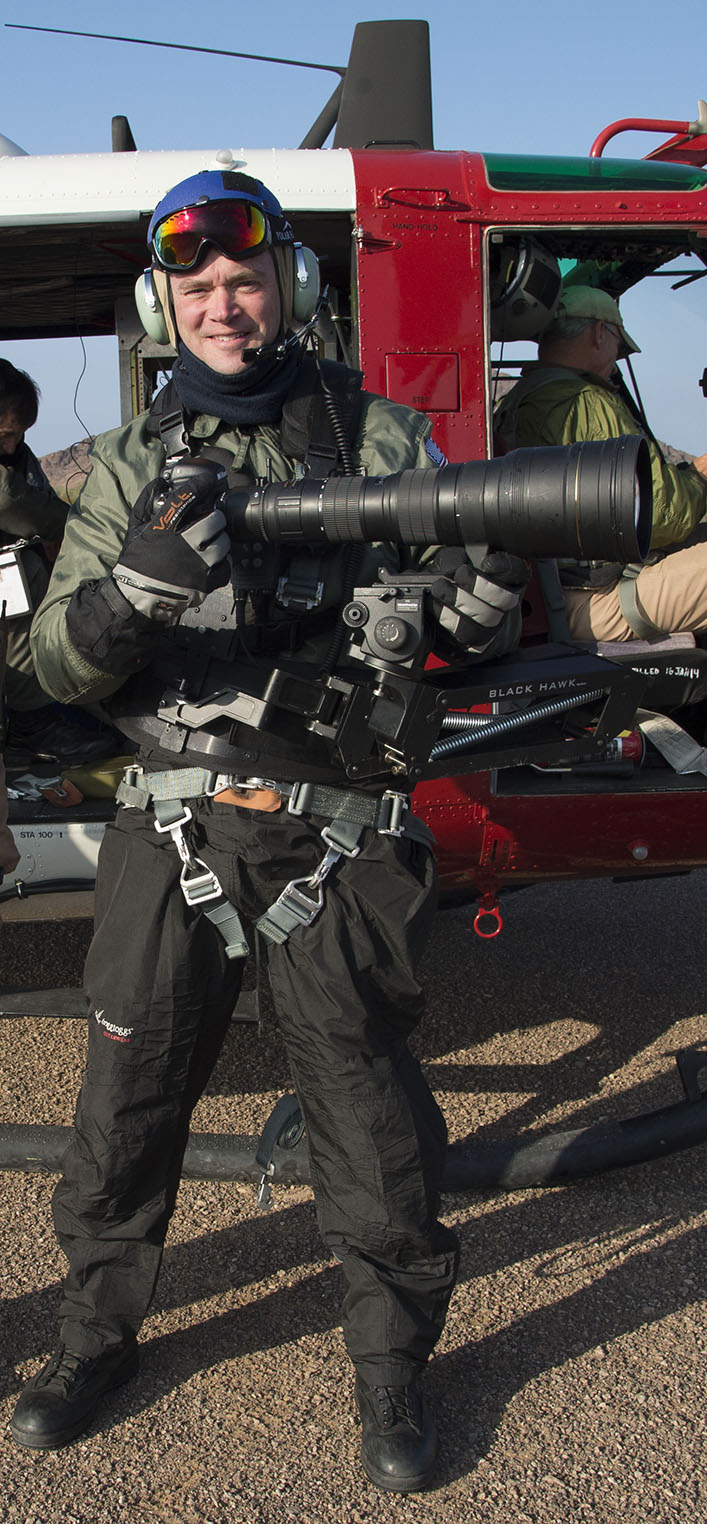
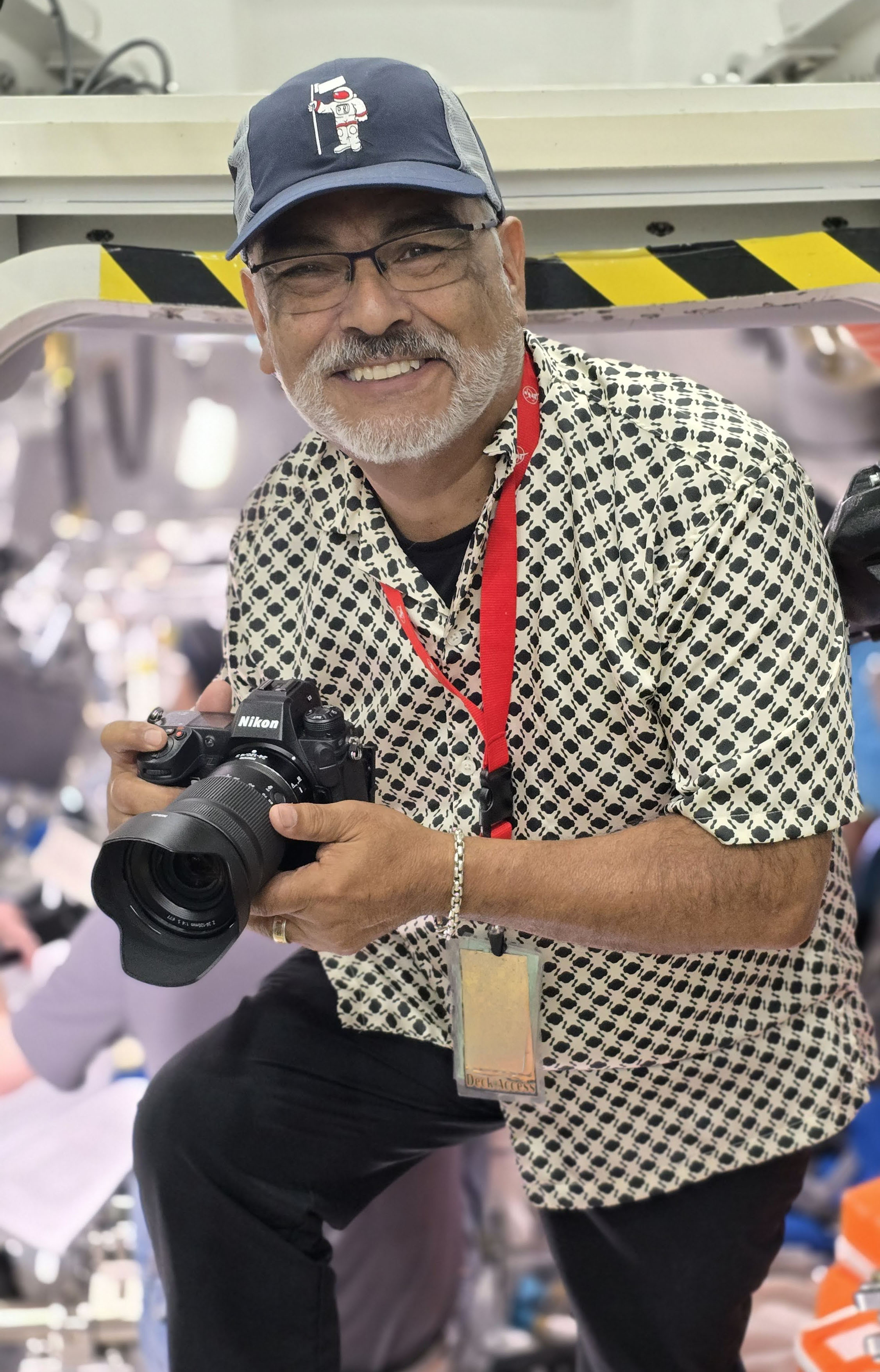
NASA photographer David DeHoyos is photographed during an assignment in the Space Vehicle Mockup Facility at NASA’s Johnson Space Center in Houston.
NASA
I am very aware of the importance of preserving history and what it means to others when our images are shared with the world.
David DeHoyos
NASA Photographer
Growing up in Houston during the Apollo era, NASA photographer David DeHoyos knew from an early age that he wanted to be part of the space industry. His interest in photography began with his mother’s Kodak Instamatic camera and continued through school and a decade working in photo labs. In 1991, that path brought him to Johnson’s photo lab and eventually behind the camera as a NASA photographer.
After more than three decades at Johnson, DeHoyos says connecting with people remains one of his favorite parts of the job. He enjoys learning about the people he photographs, sharing what he has learned about Johnson with visitors and new employees, and encouraging the next generation.
“I keep an assortment of NASA goodies in my camera bag, and the ultimate joy I get is giving a pin or sticker to a child and seeing their little faces just light up,” DeHoyos said. “It just warms my heart to encourage a youngster to work hard and pursue their dreams because that’s how I got here.”
For DeHoyos, photography is also about preserving moments that can take on greater meaning over time.
“I love the process of figuring out technical details to create an image that will make someone say, ‘Wow, cool shot, how did you do that?’” he said.
NASA’s Artemis II commander Reid Wiseman participates in emergency cabin leak training for the Orion spacecraft at NASA’s Johnson Space Center in Houston.
NASA/DavidDeHoyos
Artemis II Pilot Victor Glover returns to Ellington Field in Houston following the crew’s nearly 10-day mission around the Moon on April 11, 2026.
NASA/David DeHoyos
NASA astronaut Zena Cardman participates in emergency consultation training at NASA’s Johnson Space Center in Houston.
NASA/David DeHoyos
Members of NASA Johnson’s Extravehicular Activity, Robotics, and Crew Operations Division gather for a group photo in the Neutral Buoyancy Laboratory high bay.
NASA/David DeHoyos
NASA astronaut Anil Menon participates in a hardware review run at NASA’s Neutral Buoyancy Laboratory in Houston on April 23, 2025.
NASA/David DeHoyos
The Honeybee Robotics prototype undergoes lunar VSAT (Vertical Solar Array Technology) testing inside Chamber A at NASA’s Johnson Space Center in Houston.
NASA Challenge Tests Wheel Designs for Moon Base Mobility
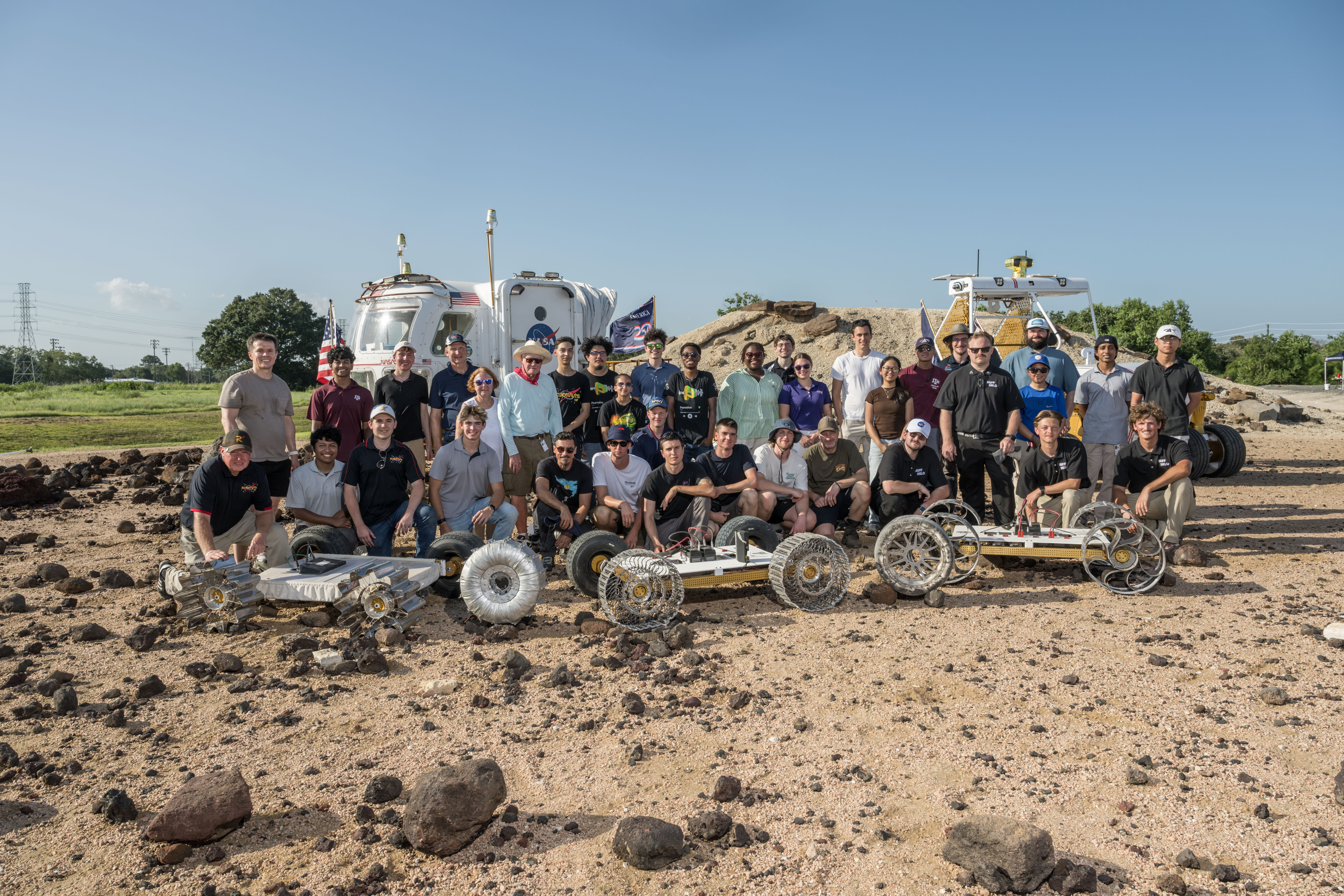
NASA engineers, NASA Robotics Academy students, and teams from the Rock and Roll with NASA Challenge pose with the wheel prototypes at NASA’s Johnson Space Center Rock Yard in Houston on July 31, 2026.
Credits: NASA/Luna Posadas Nava
NASA engineers, NASA Robotics Academy students, and teams from the Rock and Roll with NASA Challenge pose with the wheel prototypes at NASA’s Johnson Space Center Rock Yard in Houston on July 31, 2026.
NASA/Luna Posadas Nava
As NASA prepares to establish the Moon Base, advancing surface mobility will be key to helping crews and robotic systems travel farther across the lunar surface.
To help advance that capability, the Rock and Roll with NASA Challenge invited public innovators to design and build next-generation lunar rover wheels.
Five teams from 128 submissions and 49 countries advanced to the final phase of the competition, where they tested their prototypes on July 31 at NASA’s Johnson Space Center in Houston.
The Huff Helo lunar wheel prototype is tested at Johnson Space Center’s Rock Yard.
NASA/Luna Posadas Nava
The challenge sought lightweight, durable, and scalable wheels that could support longer-duration lunar surface operations. The designs also needed to be compliant enough to absorb impacts, maintain traction at higher speeds, and withstand the harsh lunar environment.
“Every additional kilometer a rover can reliably travel will expand how far we can explore, what science we can achieve, and what infrastructure we can build,” said Ed Herrera, robotics engineer at Johnson and co-leader of the challenge project.
NASA Johnson uses ground prototypes to test mobility technologies, while lunar terrain vehicles will be delivered to the lunar surface through the Commercial Lunar Payload Services initiative. For the challenge, the wheels were fitted to MicroChariot, a 45-kilogram test rover, and put through a series of courses at Johnson’s Rock Yard to evaluate their performance across different types of terrain.
NASA Robotics Academy students navigate the lunar wheel prototype Scotch Pad Tyres fitted on the MicroChariot rover at Johnson’s Rock Yard.
NASA/Luna Posadas Nava
“Crowdsourcing gives us an opportunity to look beyond traditional approaches for lunar wheel design,” Herrera said. “The more wheel technologies we can develop and understand, the more options we have to meet the needs of different vehicles, terrains, and missions on the Moon and Mars.”
Those ideas were reflected in five distinctly different designs.
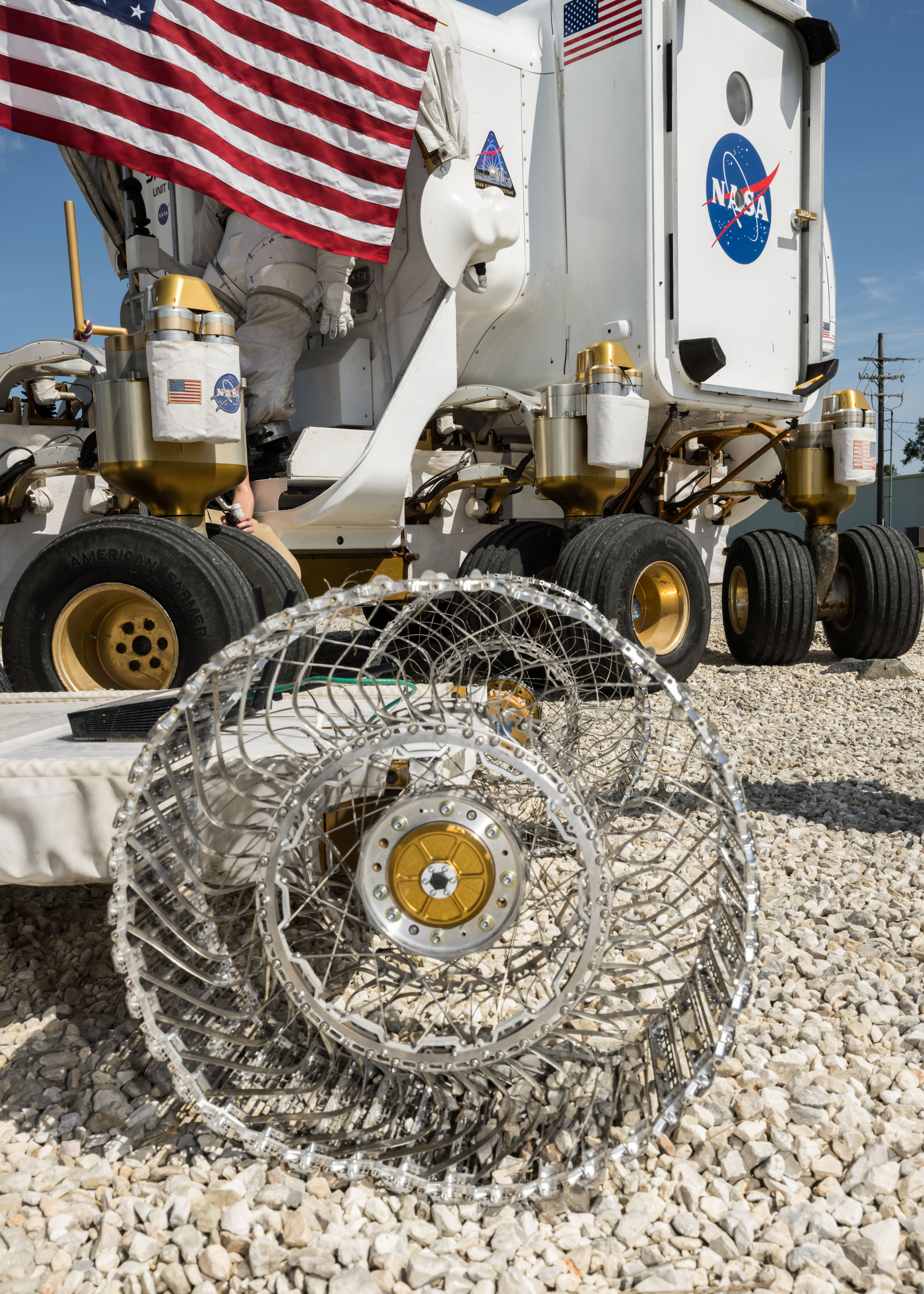
The HTR Variable Flex Lunar Wheel created by Hellenic Technology of Robotics SA uses an internal system designed to vary the wheel’s stiffness depending on terrain and vehicle needs. The team adapted technology it had been developing for terrestrial wheels for about a decade.
The Hiper Wheel created by Hyperbola uses tensioned cables and a corigated structure that provides spring-like behavior, allowing the wheel to flex without relying on traditional radial spokes.
The Huff Helo Flexible Titanium Wheel created by Huff Helo Inc. uses formed titanium sheet metal as both structure and spring. During testing, the team found that the strength of the design also made the wheel more rigid, causing it to bounce over some obstacles rather than conform to the terrain.
The Payne Aviation Wheel created by Deborah and Craige Payne took inspiration from aviation and history. Its designer, an aircraft mechanic, combined a pneumatic approach with ideas from early automobile tire designs.
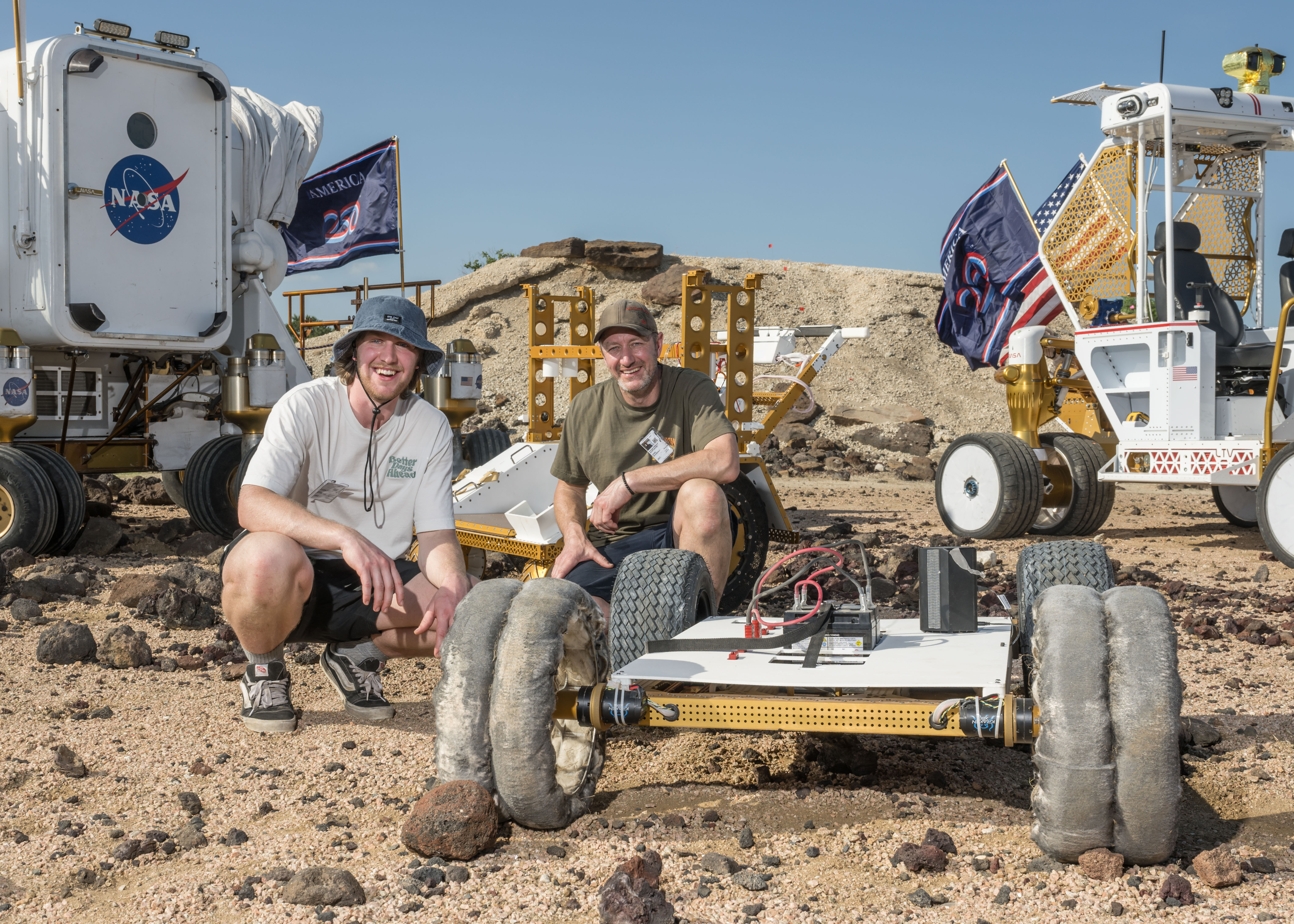
The winning Scotch Pad Tyres team poses with their prototype and MicroChariot at Johnson’s Rock Yard.
NASA/Luna Posadas Nava
The winning Scotch Pad Tyres concept came from an Australian mechanical engineer Daniel Bloomfield and his son Isaac Bloomfield. Their prototype uses a Nomex-based tire structure supported around an aluminum hub. The soft material allows the tire to deform around terrain, while internal support helps it maintain its shape. A treated outer surface of epoxy and corundum grit was integrated to improve traction.
The Rock Yard testing also demonstrated why different terrains may require different approaches. Loose material can affect traction, while rocks and slopes place different demands on wheels such as vehicle stability.
The HTR Variable Flex Lunar Wheel prototype sits alongside NASA’s Space Exploration Vehicle at Johnson’s Rock Yard.
NASA/Luna Posadas Nava
As lunar exploration expands, different vehicles will require different combinations of speed, load capacity, durability, and terrain performance.
Seeking that variety was part of the challenge design. The design options gave engineers different technologies to consider and potentially advance.
“This challenge brought in new ideas from outside traditional industries and helped us identify wheel technologies that may be suitable for longer-duration surface operations,” said Lucien Junkin, robotics engineer at Johnson and co-leader of the challenge project.
The next phase could evaluate how the wheels respond to lunar-like dust, vacuum, and extreme temperatures in Johnson’s thermal vacuum chambers. Engineers could also assess the designs over longer distances and at different sizes and loads.
“Mobility is key to everything we want to do on the Moon,” Junkin said. “The farther we want to explore, the more we need to advance the wheel technologies that can get us there.”
The Common Robotics Project of the Robotic Systems Technology Branch within Johnson’s Engineering Directorate conducted the Rock and Roll with NASA Challenge. NASA’s Center of Excellence for Collaborative Innovation, part of the Prizes, Challenges, and Crowdsourcing Program within the Research and Technology Mission Directorate, managed the challenge contract. Students in NASA’s Robotics Academy helped prepare hardware and support the competition, while engineers from NASA’s Glenn Research Center in Cleveland supported reviews of concepts and proposals. HeroX administered the challenge on behalf of NASA.
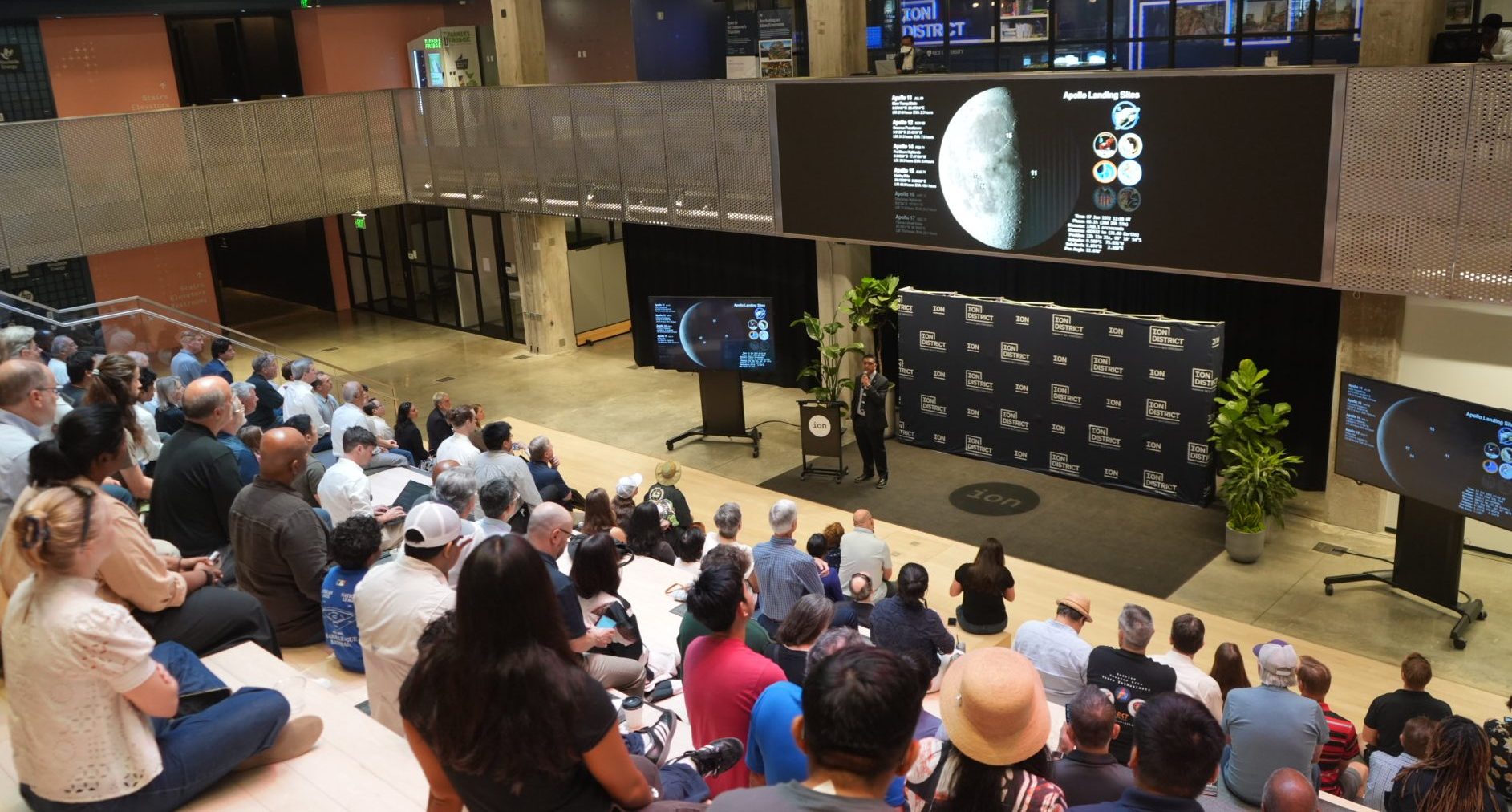
Shatel Bhakta, principal systems engineer for NASA’s Moon Base Program, gives a presentation during NASA Stories at the Ion in Houston on July 30, 2026.
Credits: NASA/Sumer Loggins
Shatel Bhakta, principal systems engineer for NASA’s Moon Base Program, gives a presentation during NASA Stories at the Ion in Houston on July 30, 2026.
NASA/Sumer Loggins
As NASA prepares to return astronauts to the lunar surface for longer stays and increasingly complex operations, building the Moon Base will require new ideas, advanced technologies, and expertise across many fields.
During NASA Stories at the Ion on July 30, Shatel Bhakta, principal systems engineer for NASA’s Moon Base Program, presented “Building the Moon Base: Challenges and Opportunities at the Lunar South Pole.” He discussed the work required to establish a sustained human presence at the Moon.
Through its growing partnership with Rice University and the Ion, NASA’s Johnson Space Center in Houston hosts recurring talks connecting agency experts with entrepreneurs, researchers, students, and industry leaders. The series gives Houston’s innovation community a closer look at the people and ideas shaping the future of exploration.
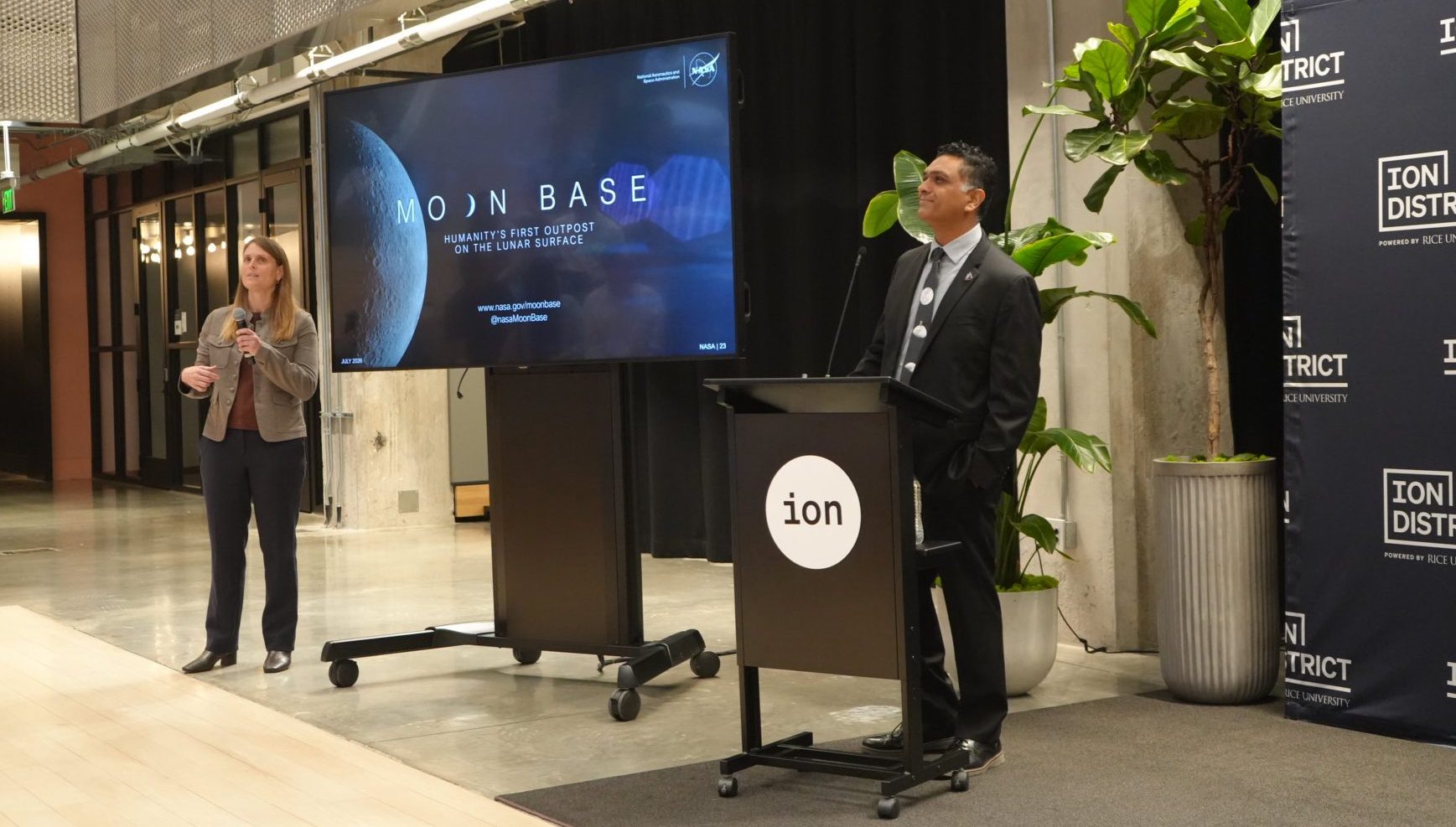
Shatel Bhakta, principal systems engineer for NASA’s Moon Base Program, presents during NASA Stories at the Ion. At left is Laura Neder, head of platform for the Rice Alliance for Technology and Entrepreneurship and the Ion District.
NASA/Sumer Loggins
Laura Neder, head of platform for the Rice Alliance for Technology and Entrepreneurship and the Ion District, welcomed attendees and introduced Monte Goforth, acting director of Business Development and Technology Integration at Johnson. Goforth delivered opening remarks on the value of sharing NASA’s work beyond the agency and bringing people together to support future exploration before introducing Bhakta.
Bhakta outlined how NASA is working toward long-duration human exploration of the lunar South Pole through the agency’s Moon Base Program.
As part of that effort, NASA is taking a step-by-step approach to Moon Base development. Early robotic missions and technology demonstrations will help NASA gather data about the lunar environment, test systems, and reduce risks before expanding infrastructure and human operations.
“This is probably going to be the most challenging endeavor NASA has ever undertaken,” Bhakta said.
Meeting that challenge will require collaboration between NASA and its commercial and international partners to develop solutions for operating in extreme environmental conditions.
Unlike the Apollo landing sites, areas near the lunar South Pole contain steep slopes, deep craters, and lighting conditions that change throughout the year. The Sun remains low on the horizon, creating shifting shadows that can complicate navigation and leave solar panels without sunlight for extended periods, increasing the need for energy storage and other power sources.
Because of the region’s rugged terrain, crews, rovers, and other surface systems may not always have a clear line of sight to Earth. NASA will need communications infrastructure to relay signals across the lunar South Pole.
Bhakta explained that Moon Base may not be a single cluster of connected structures. Terrain, lighting, power, and landing constraints could require habitats and other systems to be distributed across the lunar surface.
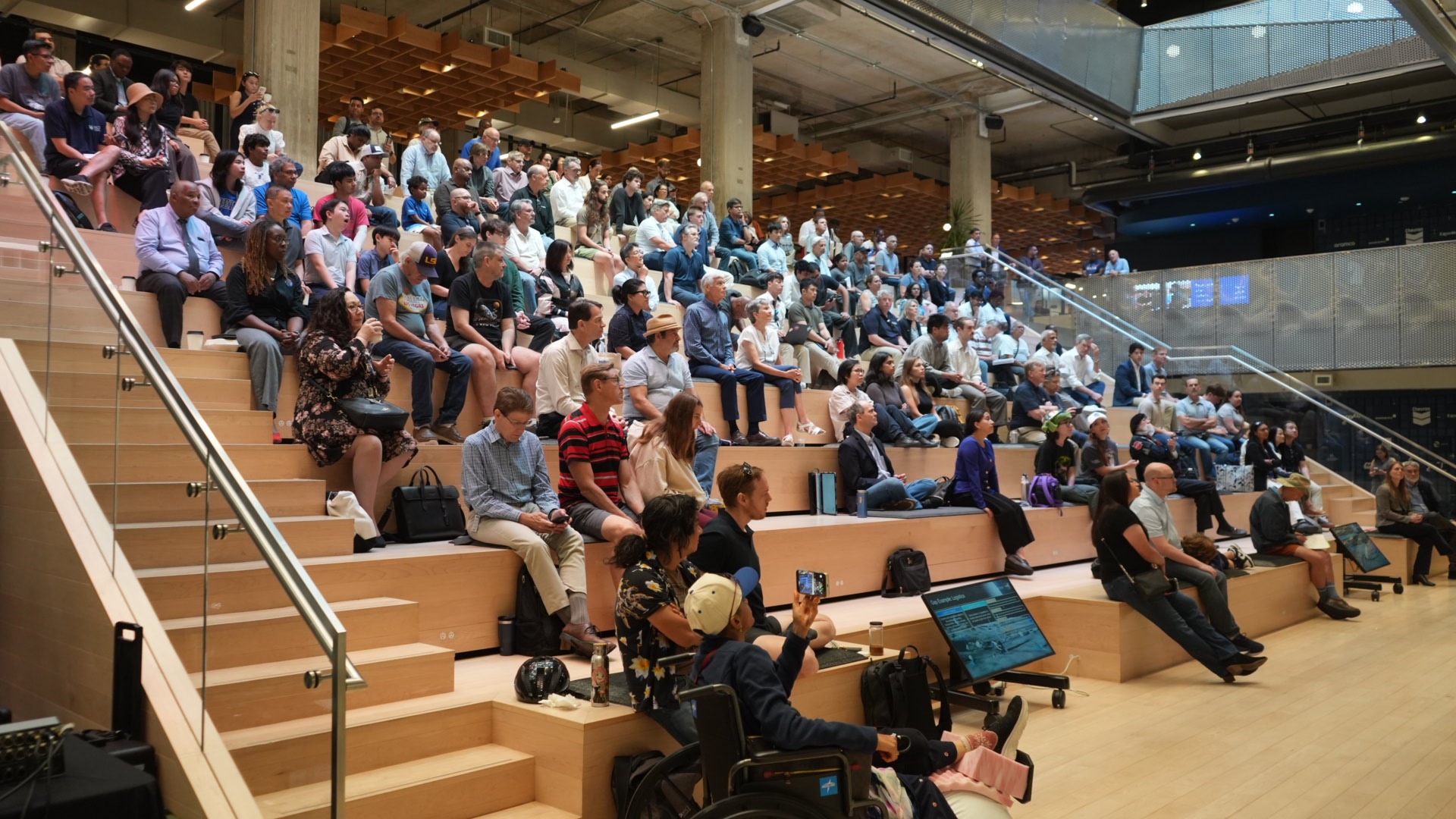
Attendees listen as Shatel Bhakta, principal systems engineer for NASA’s Moon Base Program, discusses the challenges of establishing a sustained human presence at the Moon.
NASA/Sumer Loggins
Lunar regolith, or Moon dust, remains one of the greatest challenges. Without mitigation, the sharp and clingy substance could damage equipment and spacesuits while posing health risks to astronauts. Its electrostatic properties can also change depending on lighting and environmental conditions.
Understanding how lunar regolith behaves will be essential to ensuring crews can safely live and work on the lunar surface.
Some permanently shadowed regions near the lunar South Pole may not have received direct sunlight for billions of years and may contain water ice and other volatile materials. These resources could support future exploration, but using them will require new mobility, power, and processing systems.
The Moon will also serve as a proving ground for missions farther into the solar system. Operating on the lunar surface will help NASA learn how crews, equipment, and infrastructure perform away from Earth before future human missions to Mars.
As NASA develops these capabilities, Bhakta explained that keeping the Moon Base architecture adaptable will require understanding how individual systems connect and work together.
“Don’t deal with the technology directly,” Bhakta said. “Deal with the interfaces.”
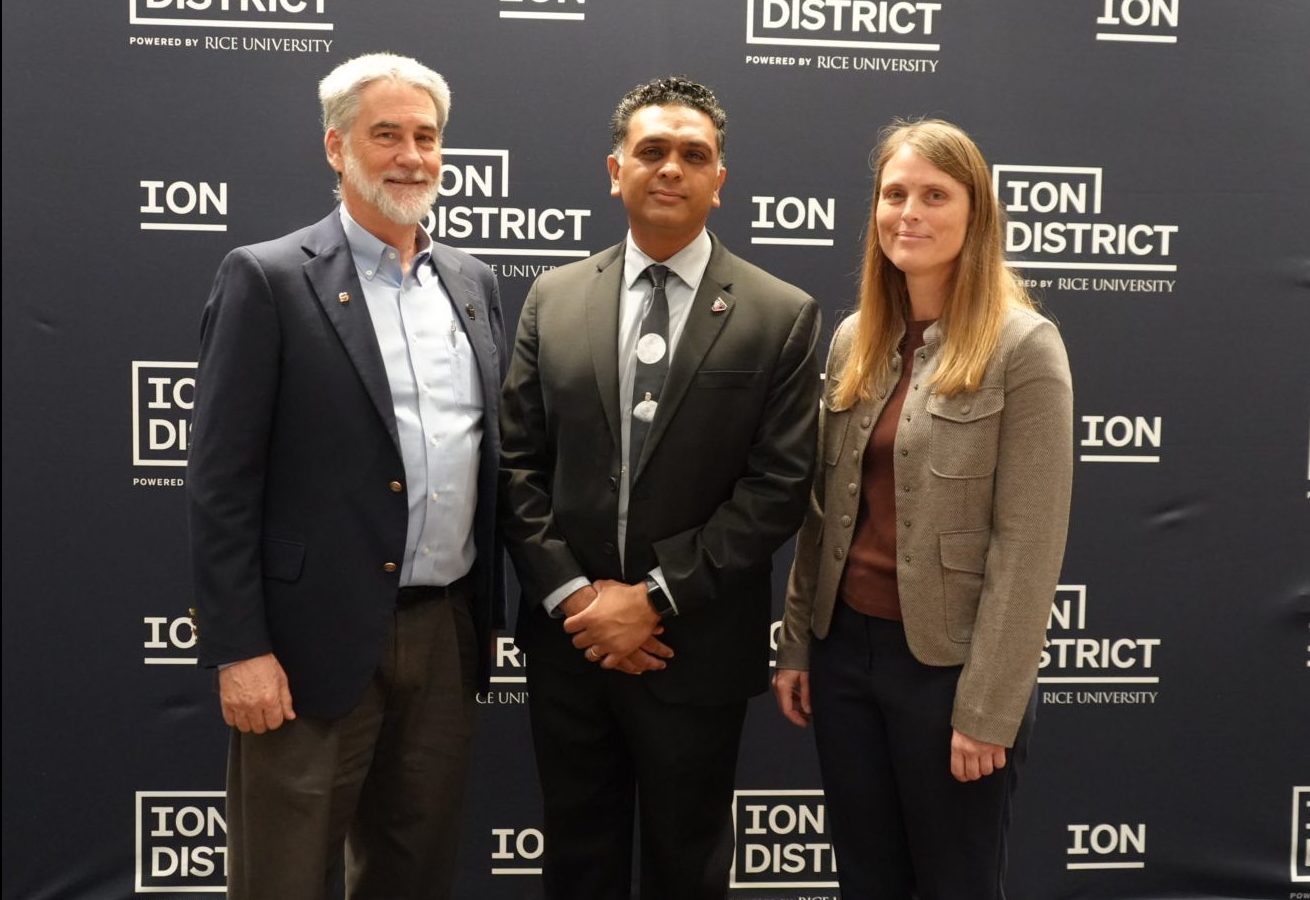
From left, Monte Goforth, acting director of Business Development and Technology Integration at NASA’s Johnson Space Center; Shatel Bhakta, principal systems engineer for NASA’s Moon Base Program; and Laura Neder, head of platform for the Rice Alliance for Technology and Entrepreneurship and the Ion District, pose during NASA Stories at the Ion.
NASA/Sumer Loggins
Building the Moon Base will take more than engineers and scientists. NASA will need communicators, business professionals, researchers, and people from many other fields to help solve problems and share the agency’s work.
“There are many ways to contribute,” Bhakta said. “Don’t be afraid that your skill set does not fit in.”
Moon Base build-up will offer multiple entry points for industry and international collaborators to participate, innovate, and contribute. From early demonstrations to long-term surface operations, there are multiple solicitations currently open.
NASA’s Lunar Development and Test Facility Prepares Artemis Hardware for Moon
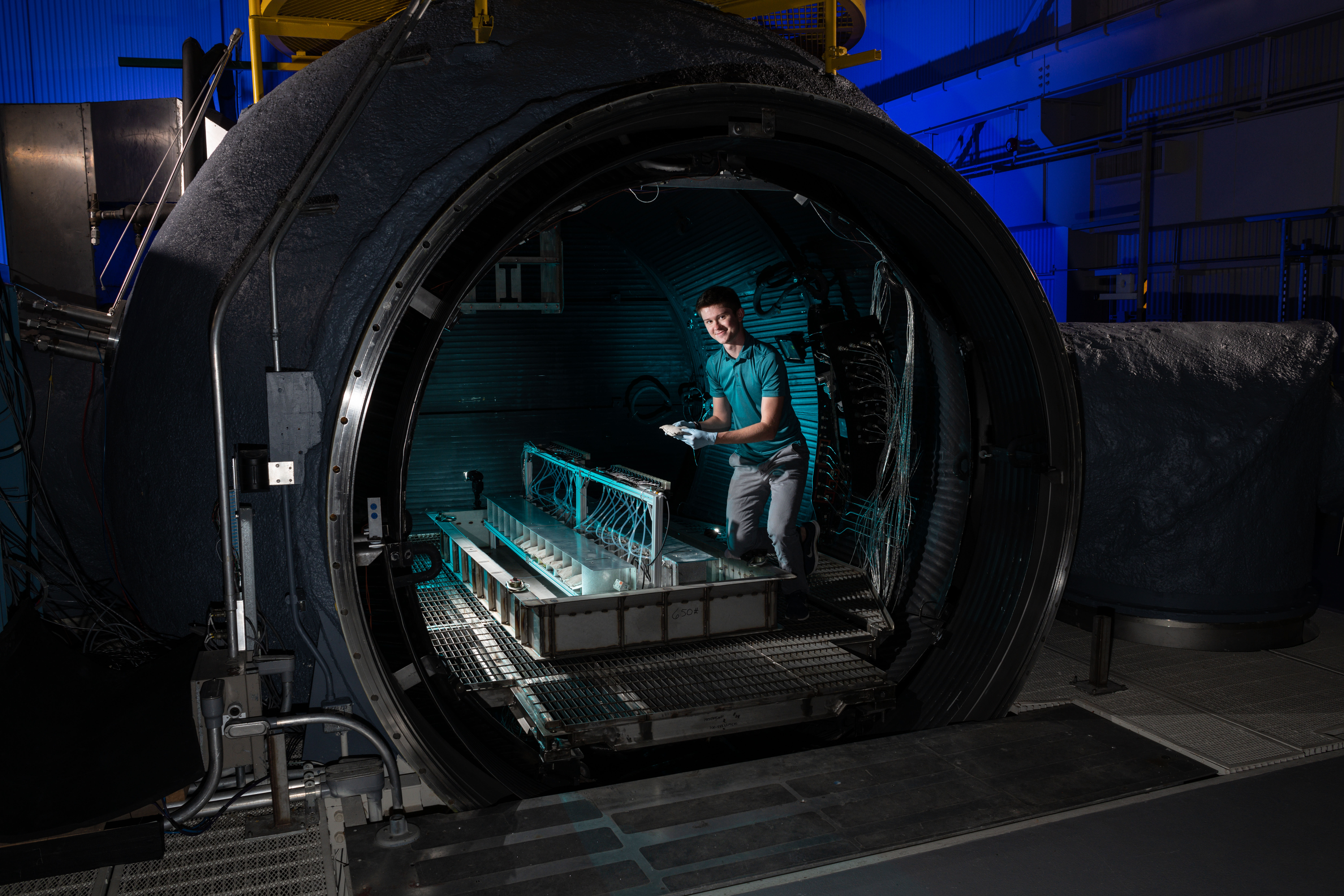
The Handheld Lunar Electrostatic Dust Mitigation tool is tested inside the Lunar Development and Test Facility at NASA’s Johnson Space Center in Houston.
Credits: NASA/Josh Valcarcel
Before astronauts return to the Moon’s surface through NASA’s Artemis program, the hardware they depend on must first prove it can survive the unforgiving lunar environment. At NASA’s Johnson Space Center in Houston, engineers at the Lunar Development and Test Facility are tackling one of exploration’s biggest challenges: Moon dust.
Unlike sand on Earth, lunar dust is sharp, abrasive, and clings to nearly everything. Without mitigation, lunar dust could damage equipment and spacesuits while posing health risks to astronauts. Understanding and mitigating the effects of lunar dust is essential as astronauts prepare to live and work on the surface of the Moon.
The Handheld Lunar Electrostatic Dust Mitigation tool is tested inside the Lunar Development and Test Facility at NASA’s Johnson Space Center in Houston.
NASA/Josh Valcarcel
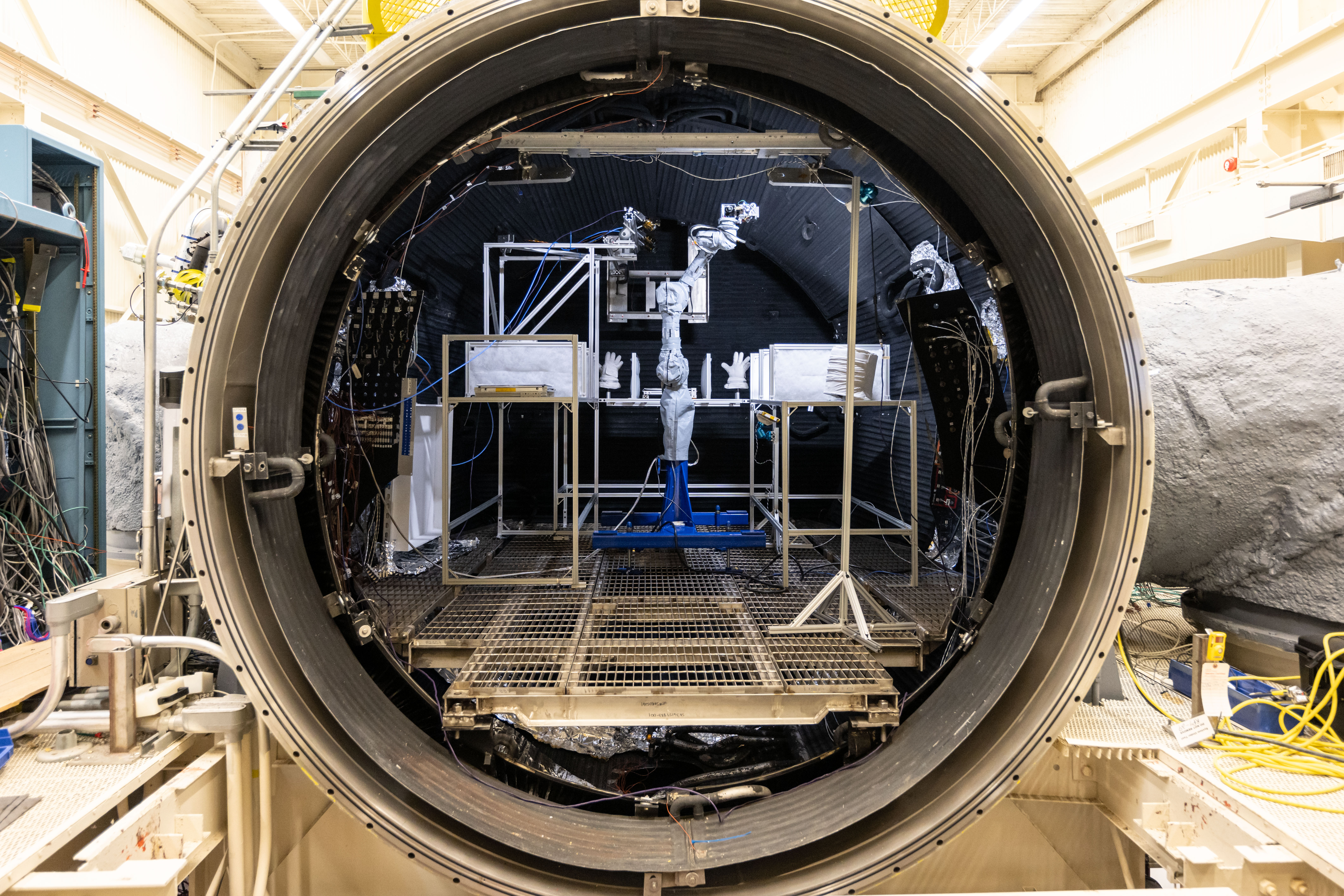
Located within the Energy Systems Test Area and managed by NASA engineers, the Lunar Development and Test Facility supports the development and testing of hardware in simulated lunar conditions. Engineers evaluate systems and subsystems inside vacuum chambers using lunar regolith simulant to better understand how spacesuits, spacecraft components, and mechanisms with moving parts and joints will perform during future Artemis missions.
Lunar spacewalking tools undergo a dust mitigation test inside Johnson’s thermal vacuum chamber.
NASA/Bill Stafford
NASA Johnson’s Propulsion and Power Division developed specialized systems that make the facility’s lunar simulations possible. The facility includes a dust containment and preparation laboratory for ambient testing, a 3-foot cube vacuum chamber, and a 15-foot thermal vacuum chamber.
Inside the chamber, engineers test hardware under realistic lunar conditions using lunar regolith simulant. The chamber uses a closed-loop nitrogen system to recreate the harsh lunar environment.
“The facility helps develop and test technologies needed for long-duration lunar exploration,” said Mike Salinas, Propulsion and Power Division branch deputy chief. “Engineers are advancing techniques to extract resources from lunar regolith, which can be turned into oxygen for astronauts and liquid oxygen for rocket propellant.”
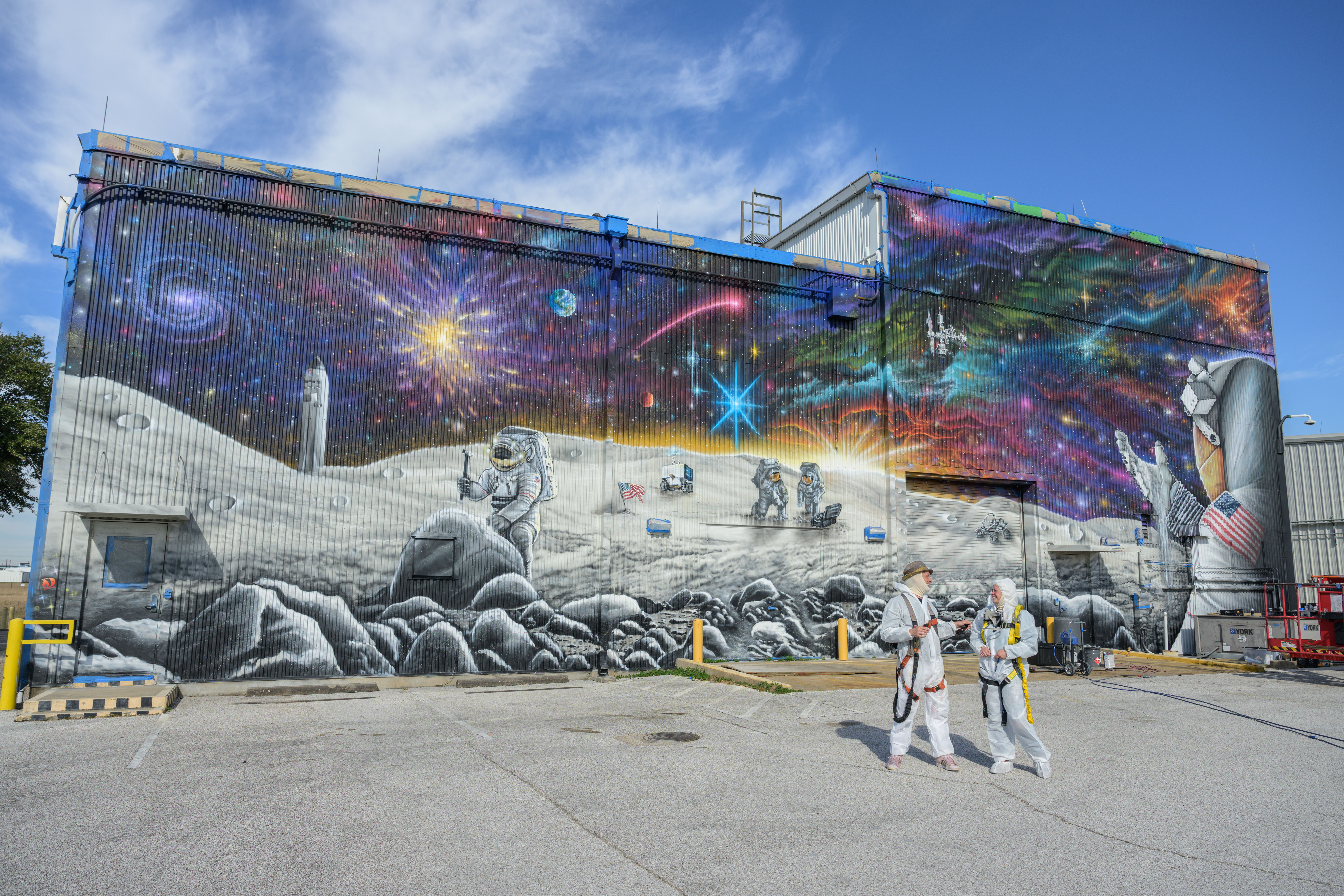
The spirit of exploration extends beyond the facility’s walls. Its exterior features a large-scale mural depicting astronauts exploring the lunar surface beneath a view of the cosmos. Completed in 2024 by artist Sebastian Boileau, the artwork celebrates the innovation, ingenuity, and discovery happening inside the building every day.
Artist Sebastien Boileau, left, and Margaret Braun pose in front of Johnson’s Lunar Development and Test Facility after the mural’s completion on Feb. 7, 2024.
NASA/Josh Valcarcel
Now, anyone can step inside the facility from anywhere. Explore NASA’s new 3D virtual tour of the Lunar Development and Test Facility to see where engineers are helping prepare the technologies that support this Golden Age of exploration and innovation.

 Login
Login