The 2026 Hackaday Superconference is just around the corner in November. It’s hard to believe that we’ve been having an annual gathering for so long, but this is number ten. Every year, it’s a great time to refresh your pool of new ideas, hang out with fellow hackers, put your soldering skills to the test, eat some phenomenal tacos, and catch some of the two tracks of talks.
What’s got me stoked right now is that we just finished up talk selection, and this year is going to be a banger! We had more talks submitted than ever, and all of high quality. Frankly, if this keeps up for next year, we might have to figure out a third stage.
This year also marks the move to a bigger venue, with more space for hacking in the courtyard, more space for talks in two halls, and more room for you to all settle down and share your work, or create something new. Even the badge is going to be bigger this year – but that’s all we can say at this time.
If you don’t have your tickets yet, go ahead and get them. Flights are still relatively cheap, and hotels not booked up yet. See you all soon!
This article is part of the Hackaday.com newsletter, delivered every seven days for each of the last 200+ weeks. It also includes our favorite articles from the last seven days that you can see on the web version of the newsletter.
Want this type of article to hit your inbox every Friday morning? You should sign up!
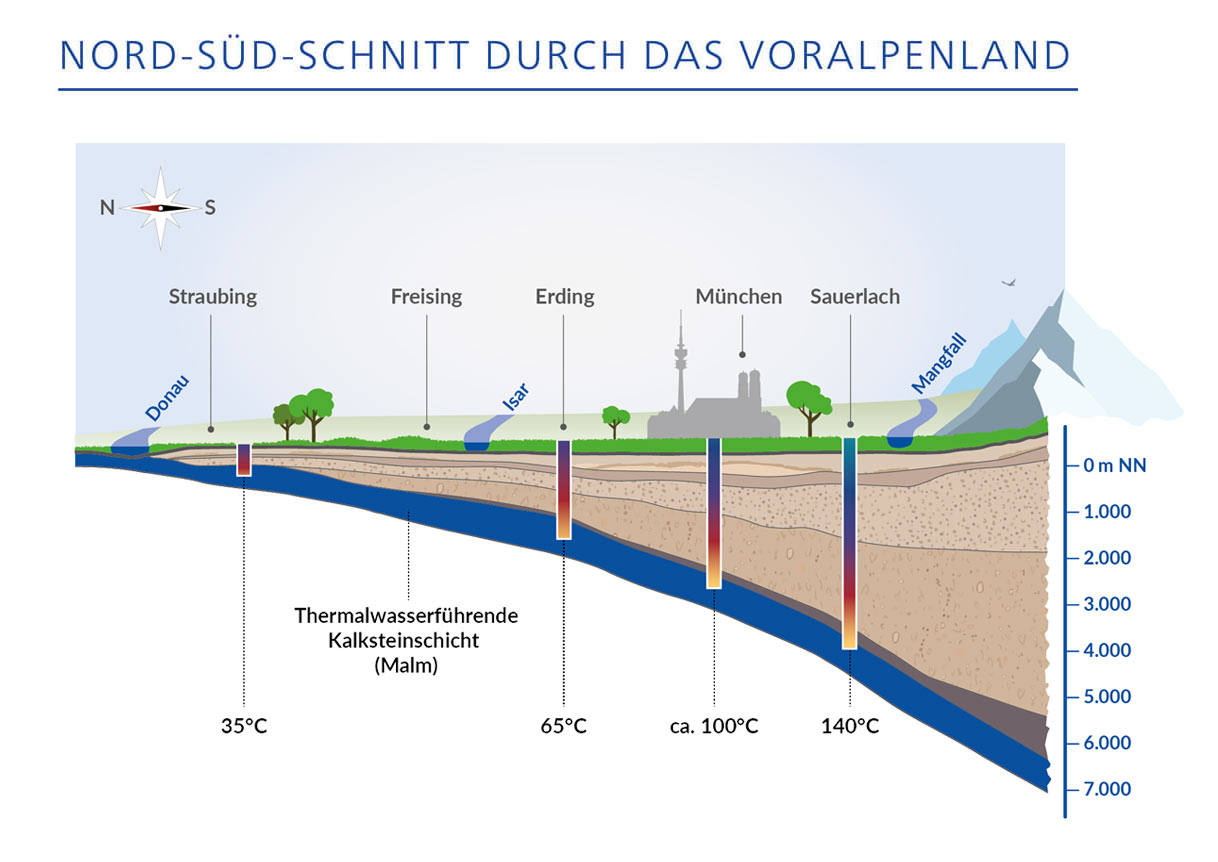
A few weeks ago, my wife was out walking the dog, and she sent me four or five photos of small orange boxes planted all around our neighborhood. (OK, I’ll bite!) They had little cards on them explaining that they were geophones, and a QR code on them that lead to a website with all the details. Munich was getting a large-scale seismic survey to map out our underground water, with the aim of using it for geothermal heat and power in the near future.
How do you map up to five kilometers under the earth? You pound the ground, sending shockwaves downward, and then listen for their reflections. At the boundaries between different layers, the change in the speed of sound in the different media cause reflections. Calculating the time it took for a given reflection to reach you lets you figure out how deep the layer boundary is.
The seismic survey procedure goes like this: geophones are set out at roughly 20 m intervals in lines spaced around 300 m apart that run roughly north-south, while “vibrotrucks” drive a roughly east-west course, creating mini-earthquakes every 20 meters along the way. Covering a surface of 1,000 km^2 with over 120,000 sample locations and exciting them 86,000 times is going to take a while. Lucky for me, they started in my part of town.
Hot Water
Because the earth is essentially a ball of hot molten metal with a thin and crispy outer crust, and because there is radioactive decay going on even within the crusty bit, temperatures rise as you dig down: roughly 30 °C per kilometer. And Munich has this fantastic source of water that’s folded under the earth in a layer that dates back to the Jurassic, which makes it both low in dissolved minerals and sitting just around 3 km down: at 100 °C. This turns out to be the sweet spot in terms of difficulty of drilling and heat gained from doing so.
Blessed with hot water underground, the question is how to best use it. The plan at the moment is to situate a number of geothermal plants around the city, drill relatively large bore holes at each site that reach down 1 km to 2 km, and then drill diagonally down after that to spider out into a larger source of water. This “extended reach drilling” pulls from a larger heat source, prevents cool spots, and has only recently become technologically feasible.
Which brings us to the GIGA-M study. A 3D map of the underground will help plan out where to put the geothermal plants, in which directions the runners will need to be drilled, and generally how to best coordinate the resource. There were a number of individual smaller surveys done over the last 20 years, and Munich and the surroundings already have a number of geothermal plants, but this survey aims to fill in all of the gaps.
The Hunter and His Prey
It was a Thursday morning when my wife thought she heard some pounding and humming outside. She was wrong, but it got us to look at the online map, and while they weren’t in our neighborhood just yet, they were probably within easy driving distance. I threw my camera and tripod in the car and headed out.
The Big Vibrotrucks
Out in the country, just outside of Grossdingharting (you can’t make these names up!) I spotted a plume of dust rising up from a field. Was it just a farmer tilling? Or was it a vibrotruck? I drove through the woods on a logging road, and when I came out, I was nearly face-to-face with the beasts.
They were loud, and I felt the rumble when I stepped out of the car, so I ran up and asked if I could film it. They said “sure”, and I set up the tripod. The first video I shot, apparently I hadn’t screwed the camera down hard enough in the tripod, and it vibrated loose. So I ran another 20 m further and tightened everything down.
I’m not going to lie: it was exceedingly loud and very exciting. I drove back home and couldn’t wait to review the footage.
The next morning, I heard the same sound outside my own house. They were driving vibrotrucks around in the field about a block up the street. I grabbed the camera and ran out barefoot to get footage. And then Saturday morning, while cooking blueberry pancakes for the family, they drove up my street. Am I stalking the vibrotrucks, or are they stalking me?
An engineer asked if they could stand in our front yard, so I took my chance to bombard him with questions. He seemed stoked to talk about it.
Geophones and Vibrotrucks
When you stand next to one of these things, first it shakes, and then you can hear a bassy tone, and then it rises and stops. They’re obviously doing a frequency sweep, much like you would use a sonar chirp to help disentangle the multiple reflections from one another.
The sweep means that even if they receive two reflections at once, they will hear two different pitches because one signal traveled further than the other, and comes from the earlier, lower-pitch part of the impulse. It also makes for a very easy to find signature. Correlating these times of flight across the entire array of geophones gives a 3D map of the underground layer discontinuities.
You can see from a cleaned up version of the audio that they’re sweeping from something like 6 Hz up to maybe 96 Hz. The lower end sounds like distinct hammering, and the top end a humming. Here is another video, with filtered audio. Because you feel the vibrations through your feet and in your chest, the live experience is a little bit like this with more noise. Play on good headphones or with a subwoofer for maximum effect.
Of course, the time of flight matters. I asked if each geohpone had a GPS timebase, and the friendly engineer told me that they individual geophones don’t – too expensive – but that when they install one, they connect it to a laptop with GPS that records the location and sets the geophone’s clock. When they harvest them, they record the location again, dump the time to verify that the clocks haven’t drifted too much, and then pull down all of the recorded timestamped data.
Why do they drive around in pairs? It’s simply because they make twice the vibration. The two trucks are actually synced together in phase, so they emit as one. The trucks have a GPS-disciplined clock inside, so they know exactly when they start each cycle and can derive the time-of-flight to all of the receiving geophones. The rest is math.
He also mentioned that it was too bad that I only got to experience the smaller “urban” vibrotrucks like the one outside my house. I kept my mouth shut – nobody needs to know that I’m a vibrotruck stalker.
Erin Kennedy has been building robots for over a decade now, with a focus on smaller bots that interact with, or maybe even clean up, the outdoor environment. Still other bots are made to interact with people, and when the people are outside in the park, that’s where your robot needs to go.
Whatever the reason, Erin’s talk at Hackaday Europe 2026 is an invitation to take your projects out into the outdoors. But the great wide world outside of your lab is not necessarily the most friendly place for a little bot, and the other half of this talk is about practical design tips and lessons learned to help it survive.
Environments
She structures the talk around different environments, which gives her an opportunity to focus on her bot cleaning up plastic trash on the beach, but also to point out the absolute horrors that sand can work on robot motors. She goes through a number of strategies for dealing with this, including going slow, keeping the motors as high up as you can, and designing the body of the robot to be full of holes and shed sand.
Taking to the water, she demos Otter Force One, which aims to capture invasive sea urchins. But underwater means under pressure, and she gives us some good tips on how to get the cables out while keeping the water in – double-o-ring cable glands potted with marine epoxy. I especially love the Nalgene-bottle-on-a-string with a radio that can be deployed to help retrieval. Her lessons-learned section is as deep as it is understated, including underwater hazards from low visibility to accumulated silt messing up your presumed center of gravity. Over the long term, rubber leaks and barnacles accumulate. Double seals, durable hooks, tether ropes, and bright colors are your friends. Underwater bots have it hard.
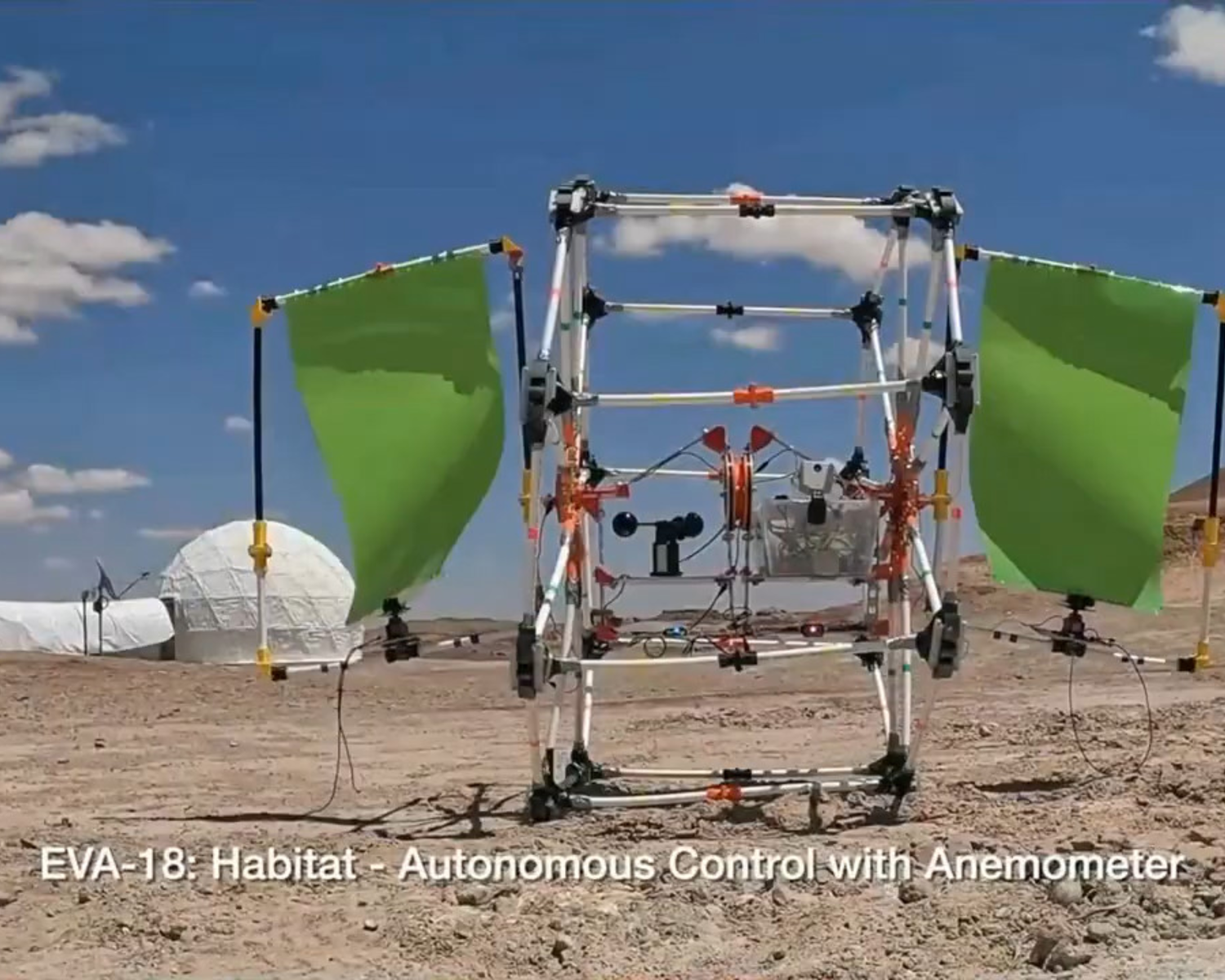
Erin’s air-inspired bots are the wildest. Some are just whimsical, like the flappy square bird, or beautiful like the butterfly bots. But her Atmosphinder bot uses the wind for actual propulsion. It’s a rolling wheel with sails that aims to explore long distances on Mars. Whether it’s going to get there or not, it’s got a bunch of great design elements for anything you have that’s going to have to roll. “Magic toboggans” make great plastic sails. But beware, while you can turn off a motor, you can’t turn off the wind. Be prepared to stake your bot down before or after its mission.
Experiences
Whatever the environmental challenges of taking your bot outside, it’s the non-laboratory environment that’s the most challenging, and rewarding. Erin tells the story of when a bird settled down in the shade cast by Bowie, or when the wind blew all of the Aruco markers away. But people and animals are just as delightful and unpredictable as the weather, and that’s an extra level of adventure. If you’re going far, bring hydration for the humans and spare batteries for the bots. Rolling with the changes seems to be the key to having a good time outside with your bots.
And of course, bringing your robot outside is a great opportunity to share what you’ve been working on with the offline world. We absolutely love the mission: normalizing robot hacks among the general public by hanging out with your bot in the park is right up our alley. She has had tremendous success with random encounters – folks just coming up and asking about what it’s doing. Making your bot seem friendly and/or beautiful seems to go a long way here. Don’t neglect the aesthetics.
Take Your Bot Outside
We left Erin’s talk absolutely inspired to build something that can make it through the rough environment that lies just outside our basement. It reminded us of our old days experimenting around with BEAM robotics, another bio-inspired practice aimed at the outdoors. With 3D printable parts and cheap geared motors, you don’t even have to break the bank to build your own Mars neighborhood rover. Watch this talk and get inspired!
… at least document what failed and give the failure analysis a good effort. And then later on, you can “try, try again” or let someone else carry on with the work; they’ll have a good basis to start from.
We were talking about a project to use 10 W blue lasers to post-smooth 3D prints when I came up with this not-very-catchy catchphrase. The project itself is very much “in progress”, which is a nice way of saying that it hasn’t yet fully met its goals. But nonetheless I was entirely happy to watch not one, but two, videos where [I changed a thing] discussed the intricacies of laser-smoothing 3D prints, precisely because it sounds easy but absolutely isn’t, and because the problems were laid out so well.
I definitely take for granted how easy the slice-it-into-layers nature of FDM 3D printers makes path planning. After all, you can print interlocking knots, hinges, and even entire sections of chain mail as long as you only have to go one layer at a time. When you print this way, you never have to worry about the print head crashing into something that you’ve printed before, or being unable to reach into a small valley. To smooth two or more layers of a 3D print into each other, you are suddenly out of the comfy flatland. You have to worry about collisions, obstructions, and all the rest of actual 3D.
But those issues and more were carefully documented as [I changed a thing] went through his attempts at writing the software to drive the laser-augmented machine, and honestly that attention to the problems that were confounding him was worth a dozen “success” videos. In that sense, it worked on me a little like nerd sniping.
Those were my takeaways from the video series, then. One, it’s hard to do laser smoothing uniformly. But two, documenting the difficulties, considerations, and failures for your future self, or for others, is not just good practice, but can also encourage other people to help you with your project, or to take it on themselves. The more thought you put into how and why your project failed, the more bait you’re laying out for the next nerd. And that’s at least one part of what makes the open-source ethos work.
This article is part of the Hackaday.com newsletter, delivered every seven days for each of the last 200+ weeks. It also includes our favorite articles from the last seven days that you can see on the web version of the newsletter.
Want this type of article to hit your inbox every Friday morning? You should sign up!
Whether you like it or not, the use of LLMs to write code is kind of a big deal at the moment. We’ve been asking ourselves what, if anything, this means for us here at Hackaday. Should we try to figure out what percentage of a project was done by an actual human and how much was done by a machine? Does it really matter? What is our AI policy anyway?
Clearly, Hackaday is pro-human. We’re in it for the hackers as much as for the hacks. Our community is, like Soylent Green, made of people. It’s your inspirations and innovations that keep us reading and writing every day. And we produce 100% of our content the old-fashioned way, with projects selected through the taste and judgement of our writers, and their own words telling the story.
What about the hacks? We’ve seen a lot of projects recently that were coded with the help of an LLM. Does that diminish the work? In the end, what rings truest to us is what has always been Hackaday’s editorial guiding star: Is there something special in the hack that makes it worth talking about? Then we write about it. Was it written using vim or emacs? Did the author consult friends or a chatbot while working on the project? That’s not really relevant.
But in the past few years, the BS-generation machines have found our hobby, and we’re finding a lot more projects that don’t have any spark to them. We’re seeing circuits that make no sense, and claims that defy physics. Of course, we always have. The LLM-nonsense project is today’s version of the perpetual motion machines of old. Just like we never trust a hardware project that is all renders, seeing only AI-generated images is a huge red flag. It’s our job to separate out the wheat from the chaff for you all, but it’s something that you must be doing everyday as well.
We’ve seen amazing hacks over Hackaday’s 22-year history. Hackaday is older than YouTube and older than Stack Overflow. We’ve seen technology come and go. We’ve seen C-beams glitter in the dark near the Tannhäuser gate. (OK, maybe not.) And in the end, our AI policy is our same-old policy: we write up hacks that inspire us in the hope that they inspire you.
So if you’re using Claude to help you with the UI bits, or if you’re hand-writing it all in assembly, or wiring up the logic in diodes, we just want to see your cool hacks. And we hope that our collective signal will be so loud that we drown out the noise, at least in our own little corner of the hacker universe.
This article is part of the Hackaday.com newsletter, delivered every seven days for each of the last 200+ weeks. It also includes our favorite articles from the last seven days that you can see on the web version of the newsletter.
Want this type of article to hit your inbox every Friday morning? You should sign up!
On Hackaday last week, and on the podcast, we were talking about one of the educational toys of yesteryear that launched a thousand careers, at least if the comment section is to be believed: the Radio Shack 200-in-1 electronics kit. The “toy” itself was basically a bunch of components with spring terminals, but the secret sauce was in in the instruction book, and maybe the marketing.
Tom had one of these when he was a kid, and told a great story about wanting it desperately based on the ads he had seen with kids Morse coding to each other. When he got the kit, and found out that “it was just a bunch of wires” he was fully pissed off. But he worked through the examples, learned some basic electronics, and the rest is history.
What I really love about this story is the siren’s call of a good project. Tom was pulled in, and maybe even fooled, by the advertising, but it probably changed his life. It’s funny how many of our folks can remember the first project that got them hooked as well. With me it was some simple audio effects pedals and then maybe later some simple BEAM robots, and for younger hackers maybe it was a 3D printer or Arduino project.
Digital or analog, the common ground here is that we all thought that some project was cool enough to warrant the sweat of learning enough to do it. Good instructions are helpful of course, and having the parts on hand never hurts. But it’s the promise of making something that you really want that I think underlies all good first projects. (And heck, every subsequent project as well.)
So while Tom, and a bunch of our readers, were looking back with nostalgia at the 200-in-1, I’m thinking about how many more than 200 projects I’ve seen made by our community, and even featured here on Hackaday, that are out there to provide the motivation to get someone started. Keep on hacking!
This article is part of the Hackaday.com newsletter, delivered every seven days for each of the last 200+ weeks. It also includes our favorite articles from the last seven days that you can see on the web version of the newsletter.
Want this type of article to hit your inbox every Friday morning? You should sign up!
What is it about retrocomputing? For some people, it’s nostalgia. For others, it’s the appeal of simplicity. For still others, it’s the chance to save old machines from the graveyard. Whatever your motivation, there’s no denying that we’ve seen a metric ton of retrocomputer projects here at Hackaday. And we’d like to see more!
Now’s the chance to put your retrocomputer project up for all to see. Open up a Hackaday.io project that features your retrocomputer project, and we’ll pick our three favorites for a $150 gift certificate courtesy of this contest’s sponsor, DigiKey. You have until Tuesday, October 27th. So get hacking!
Honorable Mention Categories
Old Iron: Are you saving an old C64 from the scrapyard? Restringing the core memory of a PDP-8? Or working on even more esoteric ancient devices? If you’re restoring or running the old hardware itself, it’s an “Old Iron” project.
Modern Retro: Computing power is plentiful, but the nice interfaces of past computer made them a joy, or a terror, to use. This honorable mention category is for emulations, work-alikes, and all the other retrocomputers that are TRS-80 on the outside, but modern electronics on the inside.
Retro-Modern: You love your classic machine, but you also love reading Hackaday on the Internet Of The Future, so you built a web-modem to bring the old beast into the modern era. This category is for keeping old hardware relevant.
Coding Like It’s 1999: Retrocomputers don’t run without software, and it’s a continual source of amazement to us how programmers today can get more out of old machines than we could back in the day. Think of the demoscene, for instance. But it doesn’t have to be showy either. If you’re writing new code for old boxes, it fits in here.

 Login
Login