
❌

Normal view

There are new articles available, click to refresh the page.
Today β€” 13 September 2026Main stream

Hackaday Links: September 13, 2026

By: Tom Nardi
13 September 2026 at 19:00
Hackaday Links Column Banner

We try to steer clear of politics and societal issues here at Hackaday, so a protest is not usually the sort of thing we’d cover. But we figure it’s safe enough to bend the rules a bit when the ones doing the protesting happen to be robots.

About 30 bots gathered β€” or at least were commanded to gather by the event organizers β€” in Warsaw to spur discussion about the impact AI and robots will have on the labor market. Beyond getting public and media attention, the demonstration was also designed to raise awareness of what modern humanoid robots can do. While we appreciate the idea of showing robots taking the β€œjobs” of the protesters, it does seem somewhat ironic that marching around and chanting for hours is exactly the sort of repetitive work that most people would be happy to see taken over by machines.

Although we hope these protests remain peaceful, there’s always a chance things can turn violent when tensions are high. Should things go south, take comfort in the knowledge that a company in Japan has introduced a robot ambulance service. It’s probably more accurate to compare it with roadside assistance, as the goal is to repair the robot on-site. That said, if the fault is more serious, they can bring the damaged bot back to HQ. Of course, the major difference between this program and a traditional ambulance service is that they’ll be able to bring along a spare robot that can take over the patient’s job while repairs are being made. Should anyone start doing that for humans, expect a few more protests.
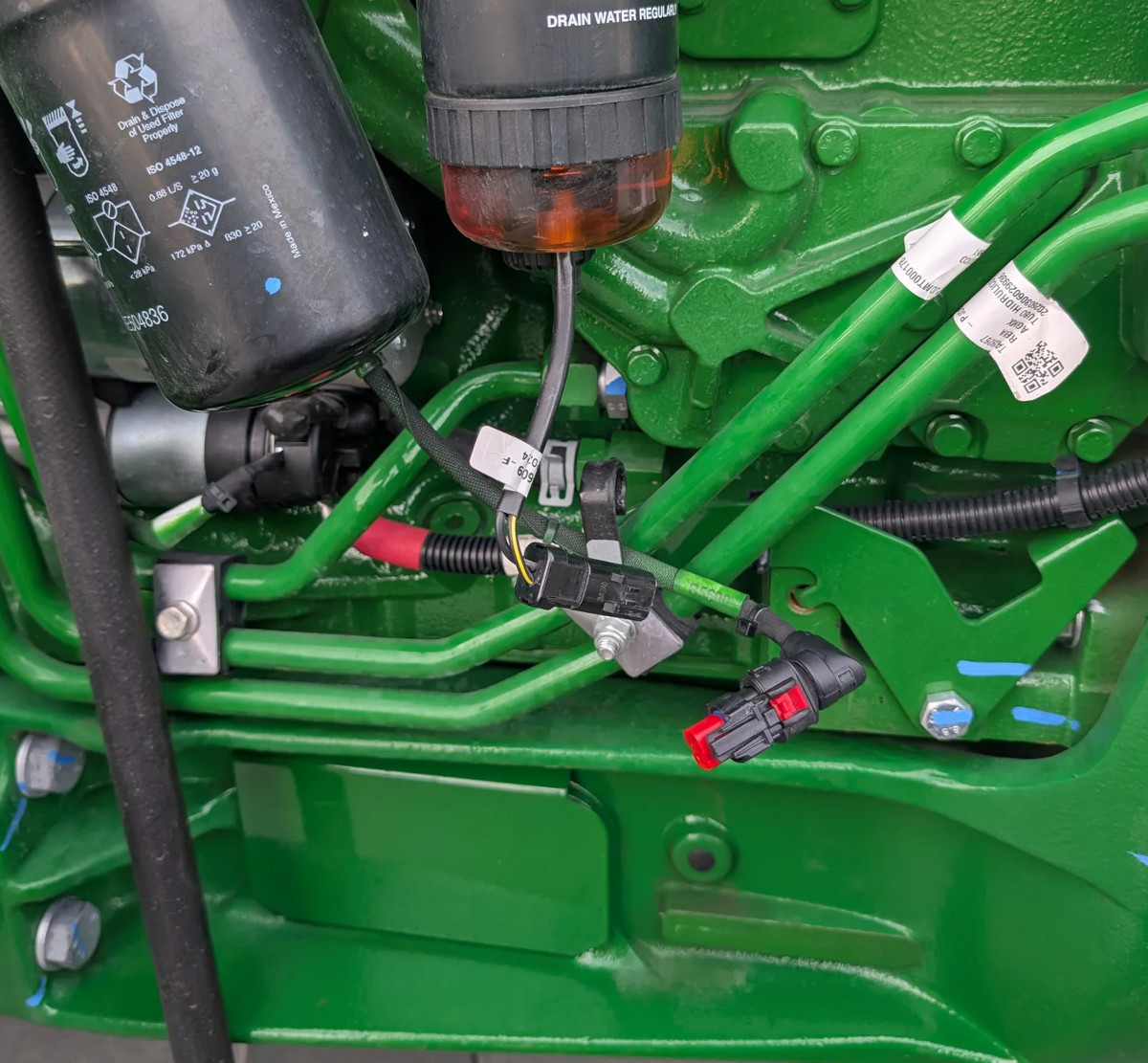
Would you need a subscription to fix this?

Speaking of repairs, [Boone Ashworth] at WIRED recently wrote up an interesting hands-on experience he had with John Deere’s AI-driven DIY repair service at the company’s corporate headquarters. Armed with a laptop and tasked with fixing the error message showing on a ~$120,000 USD tractor, he was able to follow the instructions provided by the software to identify a sensor that had been unplugged. Reconnecting the sensor fixed the error message and elicited applause from the Deere reps who presumably had carefully unplugged the sensor in the first place for the purposes of the demonstration.

If that doesn’t strike you as a particularly impressive display for a subscription service which starts at $195 a year for each individual machine, you aren’t alone. When Boone reported his experience to critics of Deere’s repairability track record, it was met with literal laughter. You don’t have to have worked in the fields to know that a sensor becoming unplugged ranks pretty low on the list of potential problems you might face in the middle of a harvest.

We can certainly understand why Deere wouldn’t ask journalists to fix a blown clutch or a leaky hydraulic cylinder for the purposes of a media demo. Even so, they could surely have come up with something a bit more challenging if their goal was to convince customers to log into their repair service β€” something the company claims only about a thousand users do each day.

Finally, this one leans more heavily into the β€œarts and crafts” than we’d usually cover here on Hackaday, but [Terence Eden]’s Collection of Imaginary Software is too cool not to get a mention.

The idea is simple enough: make up fake disk labels for a bunch of fictional pieces of software (think the games David Lightman was trying to get his hands on in WarGames), stick them on some of the old 3.5 floppies we know you have hiding in a box somewhere, and put them in a frame.

As we’ve talked about in the past, many of us in the hacker and maker community were inspired by nerds in the media. This project strikes us as a fantastic way to show off just which examples you resonated with personally, and if any readers come up with something similar to adorn the walls of their basement, we’d love to see it.


See something interesting that you think would be a good fit for our weekly Links column? Drop us a line; we’d love to hear about it.

Yesterday β€” 12 September 2026Main stream

I spent $4,000 on a robot dog from China

12 September 2026 at 07:00

On a sunny morning in June, I walked to work with a quadruped robot beside me. I’ve never gotten more attention from strangers.

A bunch of people snapped pictures of my robot dog. Several people asked me questions. Was it mine? (Yes.) Did I build it? (No.) Was it being used for surveillance? (No.)

Biological dogs kept a safe distance from my mechanical companion. Some growled or barked at it.

Read full article

Comments

Β© Nat Purser

Before yesterdayMain stream

Inside Meta’s push to put robots to work in data centers

30 August 2026 at 07:03

Meta is testing robots that can plug in cables, reset servers, and handle other tasks inside its data centers, according to several current and former workers familiar with the projects. The ongoing effort, which has not been previously reported, may eventually allow Meta to operate its rapidly expanding data center footprint with fewer humans, keeping labor costs in check as its spending on AI infrastructure soars.

Meta is using robots and related hardware from several different vendors, including Watney Robotics, Kinova, and ABB, according to the same workers, who asked to remain anonymous because they weren’t authorized to speak to the media. Kinova and ABB declined to comment. Watney didn’t respond to requests for comment.

In one experiment, Meta is evaluating whether a Kinova Gen3 robotic arm could be used for power cycling or cutting off electricity to servers. The company is also testing a different robot to swap networking cables. One Meta data center worker estimates that if it’s successful, the bot could replace up to 80 percent of some people’s workloads. β€œWe thought those of us performing the physical tasks were safe for a while, but not anymore,” says the worker. β€œIt’s coming for us all, unfortunately.”

Read full article

Comments

Β© Getty Images

Anthropic's new hardware standard lets AI agents control the physical world

27 August 2026 at 18:15

For all the interest in and uptake of agentic AI systems over the past year or so, the world of automated AI has thus far been primarily limited to text, images, code, and other data and actions that take place inside a computer. Anthropic is now aiming to change that somewhat with what it's calling the Model Hardware Standard (MHS), a set of standardized drivers designed to let AI agents easily interface with and control arbitrary devices.

For now, the "research preview" of the MHS effort is being sold mainly as a way to help scientists streamline the arduous process of creating the custom software integrations that are often needed to get disparate components of an experiment working in concert. MHS can provide a common interface and common format for data sharing between these devices, Anthropic says, allowing them to talk to each other across a network "without needing a bespoke 'translator' program in between." The standardized system could reduce weeks or months of exacting experimental setup down to "hours or minutes," Anthropic writes.

An Anthropic graphic illustrating how MHS serves as a "translation" layer between AI agents and multiple types of devices. Credit: Anthropic

In a video posted alongside the announcement, Anthropic Technical Staffer Alek Kemeny says the MHS effort was inspired by observing neuroscientist Arco Bast work through an experiment on memory formation in the brain at the HHMI Janelia Research Campus in Ashburn, Virginia. Kemeny said Bast had worked out an interface to get the rotating laser beams, microscopes, cameras, and myriad other components of the experiment to coordinate through a common interface. "This idea could be used to have AI run any science experiment in the world," Kemeny recalls thinking at the time.

Read full article

Comments

Β© Anthropic

World humanoid robot games show runners breaking records, bursting into flames

25 August 2026 at 16:59

Viral videos of the World Humanoid Robot Games show sprinting robots beating the human 100-meter record held by Usain Boltβ€”but also feature running robots crashing into barriers and falling down because they cannot readily stop running. A few fallen robots even break at the waist in a shower of sparks or catch on fire.

That demonstration of both robotic prowess and limitations came from the second edition of the World Humanoid Robot Games hosted in Beijing from August 22–26. Like the inaugural event held in 2025, this year’s event challenged humanoid robots to run fast, perform kung fu or dance moves, fight one another in kickboxing, and play soccer or table tennis.

This year’s games also tested robots in more humdrum practical scenarios like washing and hanging laundry, where they appeared to lag behind typical human working speeds. That suggests the event organizers, including Chinese state media and the Beijing city government, are keen to showcase the commercial potential of humanoid robots at a time when China’s robotics industry is rapidly developing and testing such robots.

Read full article

Comments

Β© evin Frayer/Getty Images

❌
❌