
❌

Normal view

There are new articles available, click to refresh the page.
Before yesterdayMain stream

20 FPS on E-Paper Display Without Help

21 July 2026 at 04:00

If electronic paper displays have one downside, it’s generally refresh rate. Earlier versions of the tech might only have been able to do single-digit frames per second, while modern, mid-range devices can sometimes manage 10-20 FPS β€” and that’s not including the frames needed to blank the display. Getting up past that double-digit barrier typically requires higher-end displays, more powerful processors or FPGAs, and more money. On the other hand, [Tony] was recently able to get 20 FPS out of an ESP32-based device without using any extra processing power.

The key to improving e-paper performance is understanding how the display actually works. The β€œink” consists of microscopic charged pigment particles that physically move in response to electric fields, making the display much slower than LCD or OLED panels. Rather than fully erasing and redrawing every frame, the software takes advantage of the particles’ existing state by generating optimized driving waveforms that only move the particles needed to produce the next image. On the software side, an MPEG-like encoding is used so only changes between frames are transmitted and converted into these waveforms, reducing unnecessary data transfers and allowing much higher frame rates.

Tony’s method is able to drive 960Γ—540 panels, like those found in the Lilygo or M5PaperS3, to 20 FPS, and these platforms are based on nothing more than the capable but limited ESP32 chip. It’s an impressive push, and worth checking out the video in the linked project page. We assume you’d need a little more to drive something like the massive e-paper display found in this home automation setup, though.
Make a DIY E-ink Faceplate For Valve’s Steam Machine

5 July 2026 at 01:00

Valve has always designed hacker-friendly hardware, and in that spirit, [NaKyle Wright] released Inkterface, a design for an E-ink faceplate to fit the recently released Steam Machine. As far as projects go, this one is meticulously documented, so give it a peek.

The system uses a selection of components that include a 5.83β€³ E-ink panel and driver board, a small lithium-polymer battery, and an ESP32-based controller board. [NaKyle] used a Feather V2 and display from Adafruit, so you might be in for some GPIO changes if you go with a different board.Β  A cleverly-designed 3D printed frame and bezel hold everything just so, creating a snug assembly with minimal wiring hassles.

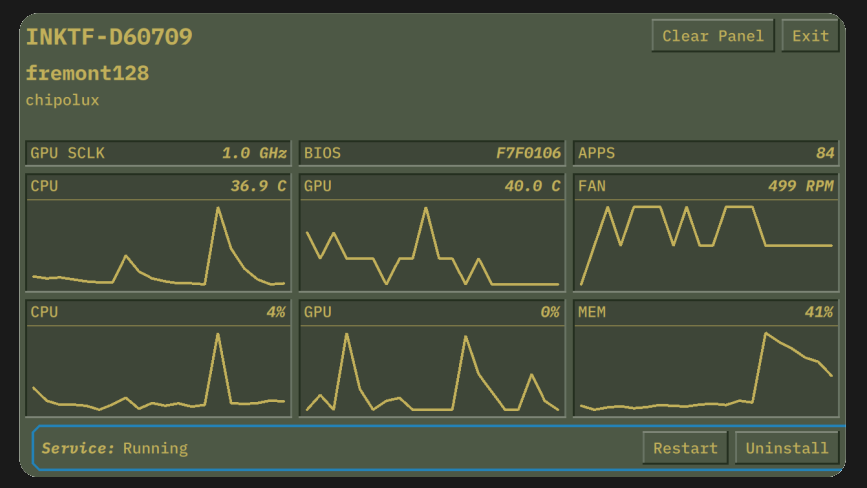
A small service can be easily configured to control how the display updates.

The faceplate is wireless and self-contained, attaching with the help of four magnets. On the software side, the host machine communicates over Bluetooth, and a service takes care of pushing updates. An app for configuring and talking to the display will be available on Steam eventually, but in the meantime one can install that part manually.

[NaKyle]’s bill of materials calls for specific components, but the underlying design is very modular. Should one wish to make hardware or component changes, alterations to the 3D printed parts might be needed as well. Fortunately, [NaKyle] includes the .step files alongside the .stl models. We love to see that, because it makes tweaking or customizing so much more accessible. A homebrewed version of this E-ink panel might be just the thing to complement a homebrewed Steam machine.

Be sure to also check out the repository of Steam hardware, which contains drawings and 3D models of the Steam Deck and Steam Controller, useful for designing holders or custom brackets or whatever else one may need.

Modern E-Ink Dashboards, Kindle and Otherwise

3 July 2026 at 04:00

People have been attempting to turn Kindles into more than e-readers since the first devices came out nearly two decades ago. The e-ink displays are low-power and great for displaying information that doesn’t refresh too often, and with Amazon continuing their trend of bricking their older devices there will be more of these devices available. [Hemant] built a weather dashboard with one of his, but since then had requests for other types of e-reader dashboards and has a guide for making more general-purpose use of an old Kindle.

The first approaches outlined here involve the installation of a dashboard client on the Kindle and pointing it at a server that hosts a PNG image of whatever information needs to be displayed. The client simply displays that image and refreshes it at predetermined intervals. There are a number of options for creating that server as well, including using Home Assistant for those who already have a home automation system deployed. The benefit of using Home Assistant is that it’s much more straightforward to gather data for the dashboards from sensors and other peripherals that are already installed.

Installing a client like this might seem straightforward, and it can be, provided that the Kindle involved is jailbroken or capable of being jailbroken. An Amazon update recently broke many modern devices’ ability to execute the jailbreak, so not every Kindle can do this anymore. But [Hemant] goes into detail about this and also outlines some methods for using generic e-ink displays instead, and also dives into the hardware and software behind building a server to host the dashboard images for those without Home Assistant already running. It’s a great overview for those who have always wanted something like this but never knew where to start.

An eInk, ESP32-based Game Boy

2 July 2026 at 14:30

This is one of those projects that was both inspired and made possible by the absolute embarrassment of dev boards available to the modern hacker. In this case, the dev board was the M5Stack PaperS3, which as the name implies combines an ESP32-S3 with an e-ink panel. [Wenting Zhang] picked one up and was immediately inspired to try and make an e-ink Game Boy.

The M5Stack PaperS3 made this project possible by exposing the display with row/column control β€” parallel, some would call it, as opposed to the usual serial interface of SPI. That allowed [Wenting] to work some of the same e-ink magic he perfected on his Modos monitors to allow partial refresh at up to 60 Hz. That the ESP32-S3 is capable of emulating a Game Boy while driving the screen should surprise no one, since it can emulate an MSX while outputting VGA or even Windows 95 on a 386. In this case, he’s basing the actual Game Boy emulation on Crank Boy.

Of course the e-ink screen on the M5Stack is far larger and has a much higher resolution than what the Game Boy shipped with, which lets him implement touch controls and scale the image up 3X so he can fake a couple of shades of grayscale while actually outputting black and white. Even better, if he was actually playing this thing on the regular, once the high-refresh portion of the screen starts to wear out, he can flip the orientation and keep gaming on the virtually-unrefreshed control portion of the screen β€” doubling the lifetime of the system, something many of you raised as a concern when we last looked at a his e-ink monitor project.

The only real shortcoming of this hack is the sound. With one-bit beeps coming out of the M5Stack buzzer, it’s got nothing on Nintendo’s hardware. Of course, that’s partially down to using the hardware as-is. With the addition of an I2S sound chip like the one used in the MOD player project we featured recently, you’d just need to squeeze out enough processor cycles to make this sound as good as it looks.

❌
❌