Coinbase has opened SUI staking with a one-token minimum and estimated annual rewards of 1.4% to 3.3% as Sui tests resistance near $0.78. Coinbase announced the rollout on July 22, giving eligible customers a way to stake SUI and collect…
SUI Hits 4.5B Transactions As Wallet Activity Climbs
Sui has crossed 4.5 billion cumulative transactions, according to SuiScan data, marking another on-chain milestone for the Move-based layer-1 network.
The network’s active wallet count has also risen, with the validated figures pointing to 1.2 million daily active addresses. That gives Sui a stronger activity story at a time when layer-1 networks are competing for developers, users, liquidity, and attention.
Still, transaction milestones need careful interpretation.
High transaction counts can reflect real usage, but they can also include automated micro-transactions, arbitrage bots, gaming loops, testing activity, and other programmatic demand. The number is impressive, but the quality of activity matters just as much as the quantity.
TL;DR
Sui has crossed 4.5 billion cumulative completed transactions.
SuiScan data shows daily active wallets reaching roughly 1.2 million addresses.
The milestone is positive, but activity quality matters because automated transactions can inflate totals.
Why Transaction Counts Matter
Transaction count is one of the simplest ways to measure blockchain activity.
If a network is processing more transactions, it suggests people, apps, bots, or protocols are using it. That can be a positive signal, especially for a newer layer-1 trying to prove demand beyond speculation.
For Sui, the 4.5 billion figure supports the idea that the network is becoming an active execution environment.
Sui’s architecture is built around the Move language and an object-centric model. Its supporters argue that this design can support high-throughput applications, consumer use cases, games, DeFi, and other transaction-heavy systems.
A large transaction count helps support that narrative.
But transaction totals alone do not tell the whole story.
A chain can have high activity and still limited economic value if much of that activity comes from low-value automated transactions. That is why traders and analysts need to look at fees, active users, app distribution, DeFi liquidity, stablecoin growth, and developer adoption alongside raw transaction numbers.
Active Wallets Add A Useful Layer
The active wallet spike is important because it adds another dimension.
If transactions rise but active wallets do not, activity may be concentrated among a small number of automated actors. If both transactions and active addresses grow, the network’s usage story becomes stronger.
The validated data points to 1.2 million daily active addresses, which is a meaningful figure for a layer-1 ecosystem.
That suggests activity is not limited to one tiny set of accounts. But here again, the market needs context. Active wallet metrics can also include bots, one-off accounts, and app-generated wallets.
The best signal would be sustained activity across multiple applications.
If Sui can show strong wallet growth alongside DEX activity, gaming usage, stablecoin transfers, and developer traction, the market will take the milestone more seriously.
Sui’s Competitive Layer-1 Position
Sui sits in one of crypto’s most competitive sectors.
Ethereum remains the dominant smart contract ecosystem. Solana has strong retail activity and low-cost execution. BNB Chain has exchange-linked distribution. Aptos, Avalanche, Sei, Injective, and others all compete for similar attention.
For Sui, differentiation is essential.
The network’s performance, Move-based design, and consumer-app focus give it a clear technical story. But technical narratives need user proof. Transaction milestones and wallet activity help provide that proof, as long as the activity is durable.
This is why the latest numbers matter.
They give Sui supporters something concrete to point to. The network is not only pitching future scalability. It is already processing billions of transactions.
The Next Test Is Economic Activity
The next question is whether transaction growth translates into economic activity.
A healthy blockchain ecosystem needs more than high throughput. It needs applications people use, liquidity that stays, developers who keep building, and revenue or fee activity that supports the network’s security and long-term relevance.
For Sui, the 4.5 billion transaction milestone is a positive marker. But investors will want to see whether it lines up with TVL growth, stablecoin usage, NFT or gaming traction, and real application demand.
That is the difference between activity and adoption.
The milestone shows Sui has activity. The next step is proving that activity has value.
If wallet growth stays strong and transaction demand continues across multiple sectors, Sui’s layer-1 case becomes more convincing. If activity fades or remains concentrated in automated flows, the market may discount the headline number.
For now, Sui has added another major data point to its adoption story.
This article is based on SuiScan and Sui materials.
This article was written by the News Desk and edited by Samuel Rae.
This report is based on information released in official primary source disclosures at primary source documentation.
The internal logic to support sequential inputs and multiple operators in a way that feels intuitive is a complex thing.
Resolving something like 1 + 2 = is pretty straightforward but complexity compounds rapidly after that, with numerous special cases. Let’s imagine one decides to program a simple calculator UI as a weekend project. The development process might look a little like this:
User types in 1 + 2 = and the calculator displays 3. What happens if the user immediately presses -?
No problem, just consider the result of the previous operation as an already-there input. So we’ll have 3 - for this next operation, and wait for more.
Unless we should have treated that - as a negative sign for whatever number is coming next, making it a negative number? No, ignore that. Just treat whatever results from pressing equals as a pre-typed input.
Unless the user hits a number. Because if they hit 2 (for example) then we’ll have a 32 and not a 2 which they probably, definitely don’t expect. So that’s a special case and we should insert a clear if that happens.
Oh, better clear if the user enters a decimal, too.
I’m going to need a coffee…
And that’s just the tip of the iceberg. Imagine trying to figure all this out for the very first time, without the benefits of habit and history to fall back on.
The fact is that supporting the apparently trivial behavior of a simple calculator requires an underlying complex state machine that deals with all kinds of special cases in order to make the UI feel intuitive. And that’s just for a basic four-function calculator; we haven’t even touched on how special keys like % should behave.
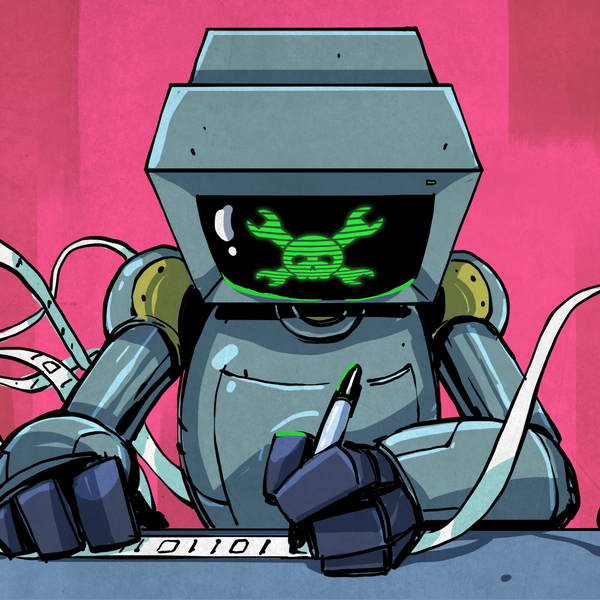
We know [lcamtuf] speaks from experience, not just because of their deep knowledge of calculator history but because they rolled their own calculator that uses voltmeters as digit displays and there’s nothing like actually implementing something to make one appreciate it.
SUI is drawing fresh attention from technical traders after chart analysis pointed to a bullish flag pattern forming on the daily chart.
The setup, shared by crypto analyst Gopal, shows SUI consolidating inside a downward-sloping channel after a stronger upward move. In technical-analysis terms, that kind of structure can become a continuation pattern if price breaks above the upper channel with enough volume.
The key word is “if.”
Chart patterns do not guarantee direction, and a bullish flag can fail if buyers do not follow through. But the setup gives traders a clear level to watch at a time when altcoin momentum is becoming more selective.
For SUI, the question is whether consolidation is cooling the market before another leg higher, or whether the earlier impulse is losing strength.
A bullish flag usually appears after a sharp upward move.
The market rallies, then price begins to consolidate in a controlled downward or sideways channel. Instead of collapsing, the asset holds most of the previous gains while traders take profit and new buyers wait for confirmation.
If price breaks above the channel, traders often interpret it as a sign that the previous trend is resuming.
That is the optimistic reading for SUI.
The danger is that traders see the pattern too early. A channel can look like a flag until it breaks down. Volume can fade. Buyers can fail to show up. A broader market pullback can invalidate the setup before it confirms.
That is why confirmation matters.
For SUI, the bullish case depends on price clearing the upper boundary of the channel with stronger trading activity. Without that breakout, the pattern remains potential, not proof.
Why SUI Is On Traders’ Screens
SUI has become one of the more closely watched altcoins because it sits in the high-performance layer-1 category.
The network competes on speed, developer experience, object-based architecture, and consumer-facing applications. That gives SUI a narrative that can attract traders when capital rotates into newer layer-1 ecosystems.
Technical setups become more powerful when they align with a broader story.
If traders already believe SUI is one of the stronger altcoin candidates in a risk-on move, a bullish flag can give them a clean entry signal. If the wider market is weak, the same pattern may struggle to play out.
That is the current tension.
Altcoin traders are looking for assets that can outperform, but they are also more cautious after a choppy market. SUI needs both chart confirmation and broader risk appetite to turn the setup into a stronger move.
Volume Is The Deciding Factor
The most important part of this setup is volume.
A breakout without volume can be unreliable. It may trap late buyers before price slips back into the channel. A breakout with strong volume suggests new demand is entering and that traders are willing to chase the move.
That is especially important for altcoins, where liquidity can be thinner and false moves more common.
TradingView price action can help validate whether the pattern is still intact, but traders will also watch broader market conditions. If Bitcoin stabilises and altcoins begin moving again, SUI has a better environment for a technical breakout. If majors weaken, even a good-looking pattern can fail.
That does not make the chart useless. It just means the chart needs context.
The Setup Is Clean, But Not Confirmed
The best way to frame SUI here is as a technical setup waiting for confirmation.
The bullish flag structure gives traders a clear invalidation point and a clear breakout zone. That is useful. It creates a tradeable map. But the market has not confirmed the move until price exits the channel with conviction.
For readers, that distinction matters.
Technical-analysis stories can become too promotional when they treat patterns as outcomes. A better approach is to explain what traders are watching, what would confirm the setup, and what would weaken it.
In SUI’s case, the bullish argument is straightforward: consolidation after strength can reset the market before continuation. The bearish or cautious argument is just as simple: without volume, the flag may fade into a normal pullback.
The next move will decide which reading is right.
For now, SUI is on the watchlist because the structure is clear. Traders just need the breakout to make it real.
This article is based on the referenced X chart post and TradingView market data.
This article was written by the News Desk and edited by Samuel Rae.
This report is based on publicly available market and on-chain data. at X
Sui has launched gas-free stablecoin transfers, a move that goes directly at one of the most annoying pieces of crypto payments: needing the network’s native token just to move dollars.
For experienced crypto users, gas is normal. For everyone else, it is friction. A user may have USDC or another stablecoin in a wallet, but if they do not also hold the chain’s native token, they can get stuck. They cannot send funds, make a payment, or move assets without first acquiring gas.
That is a terrible experience for payments.
Sui’s new stablecoin transfer feature is designed to remove that issue by allowing users to send supported stablecoins without holding SUI for transaction fees. The available source material points to implementation through Sui’s Move API, with gas set at zero and the fee burden handled away from the end user.
That sounds technical, but the user-facing idea is simple: stablecoins should move more like money and less like a puzzle.
Sui has launched gas-free transfers for supported stablecoins.
Users can move assets such as USDC without first holding SUI for fees.
The change could make Sui more competitive in stablecoin payments and consumer crypto apps.
Why Gas Still Breaks Crypto UX
Stablecoins are one of crypto’s clearest product-market fits.
They are used for trading, settlement, payments, remittances, DeFi collateral, and dollar access in markets where banking rails are slow or unreliable. But even stablecoins can feel awkward when the user has to understand gas.
The problem is especially obvious for new users. Someone may receive stablecoins and assume they can send them immediately. Then the wallet tells them they need the native asset to pay fees. Now they have to find SUI, ETH, SOL, TRX, or another gas token before they can do anything.
That is not how normal payments work.
Nobody expects to hold a separate “fee token” to send pounds from a banking app or dollars from a payment wallet. Crypto users have learned to tolerate that because they understand blockchains. Mainstream users have not, and probably should not have to.
Gas-free stablecoin transfers are an attempt to hide that complexity.
If Sui can make stablecoin movement feel more like a normal payment action, the network becomes easier to use for wallets, apps, merchants, and everyday transfers.
Stablecoin Competition Is About Convenience Now
Sui is not the first network to chase stablecoin payments, and it will not be the last.
Ethereum has the deepest liquidity and most established DeFi ecosystem. TRON has become a major stablecoin transfer network because of its low fees and wide USDT usage. Solana has pushed hard into fast, low-cost consumer payments. Base is trying to combine Ethereum alignment with cheaper transactions and app distribution.
That means Sui needs a real reason for users and developers to care.
Gas-free stablecoin movement is a practical answer. It does not rely on abstract network claims. It solves a visible user problem.
The supported stablecoin list is important as well. According to the cleaned pack, supported assets include USDC, USDsui, suiUSDe, AUSD, FDUSD, USDB, and USDY. That gives the feature a wider stablecoin base than a single-asset implementation.
For developers, the more interesting part may be the infrastructure model. If apps can build payment flows where the user never has to think about gas, Sui becomes easier to integrate into consumer-facing products.
That could matter for wallets, games, DeFi front ends, subscription tools, and cross-border payments.
The Real Test Is Usage
The launch is promising, but the market will judge it by adoption.
Gas-free transfers sound useful, but the feature needs real volume. Users have to adopt it. Wallets and apps have to integrate it cleanly. Stablecoin liquidity has to remain deep enough that the experience feels reliable.
The competitive bar is high. Users already move stablecoins across other networks, and many do not care which chain wins as long as the transfer is cheap, fast, and easy. Sui has to prove that removing gas friction is enough to pull activity into its ecosystem.
There is also a sustainability question. If end users are not paying gas directly, someone else is absorbing or sponsoring those costs. That can work well, but the economics need to make sense over time, especially if volume scales.
Still, the direction is right.
Crypto payments will not become mainstream if every transaction requires users to understand the mechanics underneath. The winning experience probably looks boring: open app, send dollars, done.
Sui’s gas-free stablecoin feature moves in that direction. It is not a guarantee that Sui becomes a dominant payments chain, but it gives the network a cleaner user-experience argument at a time when stablecoin competition is becoming more serious.
This article is based on information from Sui Network.
This article was written by the News Desk and edited by Samuel Rae.
This report is based on information released by Sui. at Sui
"While KDE and GNOME dominate the landscape, a relative newcomer is starting to make waves with features other desktops still don't fully support," argues XDA Developers:
Linux 7.0 was the first release of the kernel to officially support Rust, but COSMIC has been all-in on Rust since the very beginning, and COSMIC 1.1 finally stripped all the leftovers of C language from the desktop. It no longer has any traces of Nautilus (the GNOME file manager), and then there's now a COSMIC-native system monitor to replace the GNOME System Monitor, so you have even fewer chances of being afflicted by C-related problems. [The article calls COSMIC's system monitor "much better at showing detailed information about everything from processes to network and disk usage compared to the GNOME and KDE alternatives."]
Stacking Windows
As someone who used to love following Windows news, one of the most disheartening announcements was when Microsoft gave up on Sets, a feature that essentially turned every app window into a tab you could combine with other apps in the same window. I never thought I'd see that feature again, until COSMIC came along. Simply called "stacking", COSMIC has a feature that is exactly what Sets was supposed to be, though this time, you have more control. By default, apps still open in their proper, typical windows, with a title bar as you'd expect. But if you do want to combine multiple apps into one, you can right-click the title bar (or press Super + S) to enable stacking for that window. Then, simply drag another window over that one to start stacking them as tabs. This essentially gives you a whole new way to create "workspaces", as you can have a single window with all the tools you need, so you don't need to jump between different windows all the time, and you can keep a given window focused on a specific workload, but have multiple apps within it. It's a great reminder of what Microsoft took from us, too.
Tiling, But On Demand
Tiling windows is one of those features some power users simply love, and yes, there are ways to make it happen on KDE and GNOME with third-party apps or extensions, but those aren't ideal. It's an extra step to set them up, and very often they don't play nice with all the features those desktops offer, especially as new updates come out and those tools may have a hard time keeping up with the development of the desktops themselves. COSMIC is fantastic because not only does it have built-in window tiling, it's entirely controllable by the user. You can set any workspace to use tiling or floating windows depending on your preference, all completely independent of each other, and you can also choose the new default behavior for new workspaces so things are always tuned to your preferences. You can turn tiling on or off for a given workspace easily, and of course, even while tiling is on, you can allow certain apps to ignore it and still float above others. Not all these capabilities are exclusive to COSMIC, but to have this kind of feature built in with this level of control is still leagues better than anything KDE or GNOME offer in this regard.
The article argues COSMIC also makes customization extremely simple without stifling your options (like tweaking color options for your desktop). "This desktop environment just keeps getting better, and it's quickly establishing itself as a major competitor to long-standing alternatives."

 Login
Login