[Bob the Science Guy] remembers how to use a slide rule. Even after all these years, it is pretty easy to remember how to multiply and divide. If you can’t remember, you can usually work it out, as long as you understand how slide rules work. But what about sine, cosine, and quadratics? [Bob’s] been making videos about topics like this, and if you’ve wanted to put your slide rule collection to practical use, you’ll enjoy these videos. You can see one below.
The trick to the slide rule is that it is deceptively simple. You are in effect adding logarithms and then taking an antilog. The issue is that you still have to have some intuition about the scale of the answer since 2×3 works out the same as 2×3000 or 200×300.
But it is even trickier than that. Adding and subtracting is not easy on the slide rule. [Bob] shows how to use your math skills to convert problems that might have been addition problems into trig problems. So while it might seem more complicated to use trig, it may help work the problem on the slide rule.
If you already know what a nonius is, you can probably skip this post. But, if like us, you would have to look it up, we’ll tell you what we found out. It turns out, a translation mistake taught us a new word and some history we weren’t aware of.
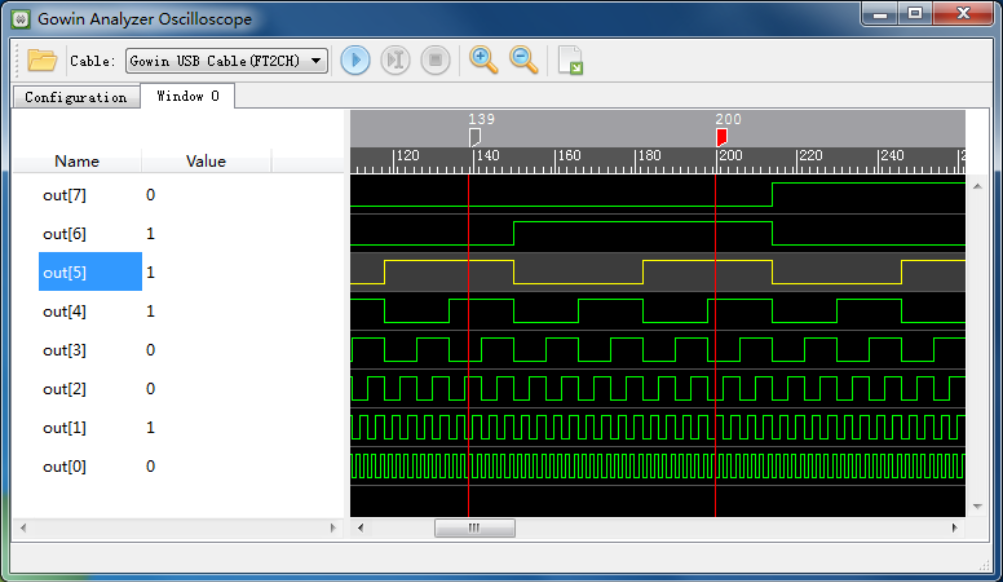
In the manual, this is captioned: Figure 4-7 Nonius Display (Standard Mode)
Have a look at the adjacent graphic from a waveform display. What would you call the vertical red lines at positions 139 and 200?
We’d probably call them markers. Or maybe cursors. The manual, however, calls each one a “nonius”. It refers to them that way multiple times.
Oddly, the manual also has sentences like “Select one nonius and right-click, and then select ‘Remove Marker’ in the next window to delete the nonius.”
So, clearly, a nonius is the vertical line marker or cursor. But that, of course, begs a question…
What is a Nonius?
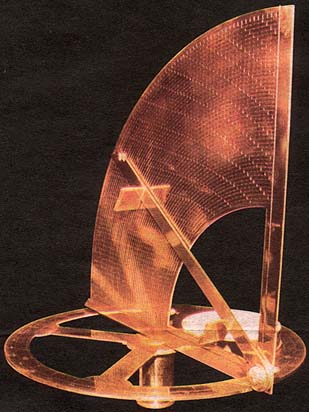
“Nonio originale” by [Henrique Leitão]Have you ever heard of the vernier scale? If you’ve done navigation, used a traditional caliper, or tuned an old shortwave receiver, you probably have. [Pierre Vernier] developed it in 1631 as a way to better interpolate values on a scale.
However, there was an earlier version used to improve measurements on astrolabes. A Portuguese navigator named [Pedro Nunes] created this type of astrolabe in 1542. The Latinized version of his name is [Petrus Nonius]. What are the odds of him inventing… oh wait, they named it after him. That does make more sense.
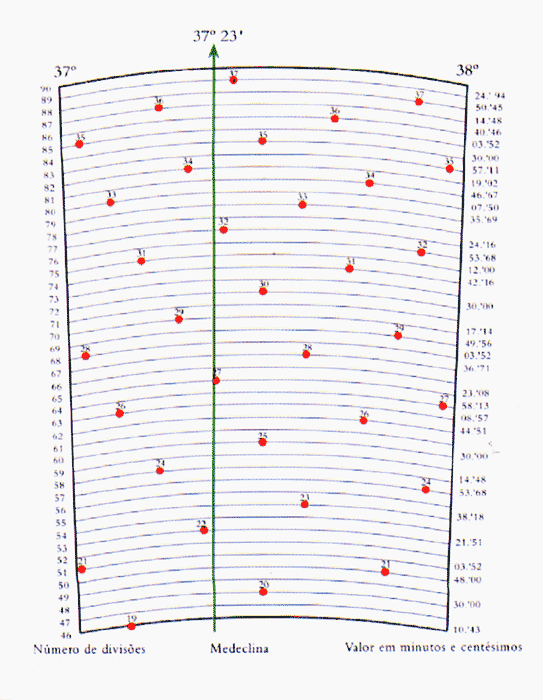
The nonius is a series of concentric circles traced on the instrument. Working towards the center, each circle has fewer divisions than the previous one. In fact, if the outer ring had 90 marks for 90 degrees, the next ring would have 89, and the following one would have 88.
The astrolabe’s line, the “alidade”, would cross all these circles but would be closest to one mark on one circle. Given that mark and that circle, you could look up the correct answer.
One degree of a nonius showing 37º 23′.
For example, the image shows such a system from [Nunes] himself. It shows the circle from 37 degrees to 38 degrees. You can see the 89th circle has only one mark for 37. The other marks are in other sectors of the outer ring. The 88th, for example, has two marks for 36 and 37.
On ring 65, the line runs right over the 27, which is hard to read because the line covers it up. With a table lookup, you’d find the correct value was 37º 23′ within 0.08′. Not bad. [Nunes] was considered one of the greatest mathematicians of his time.
But we had never heard of him, which goes to show that being a mathematician is not a good way to get lasting fame. [Charles V], [Nostradamus], and [John Calvin] were all born around the same time and, while not household names, are more likely to be known today than [Nunes].
And while this is interesting, it raises another question: Why did the GOWIN software instruction manual call the vertical marker line on a scope trace a nonius?
Why Nonius?
Lost in translation
Our guess is that this is a translation mix-up: Chinese 游标 can mean either a computing cursor or a vernier. Or a nonius. Someone apparently selected the wrong English equivalent.
Of course, we figured it out. Plus, we learned a new word and a little history. So we aren’t complaining.
Astrolabes are pretty amazing. Navigation was so important that it drove many technological advancements. Of course, measuring things in general was also of keen interest to our forefathers.

 Login