
 Login

A new pal for Pluto? Rubin Observatory finds its first dwarf planet candidate
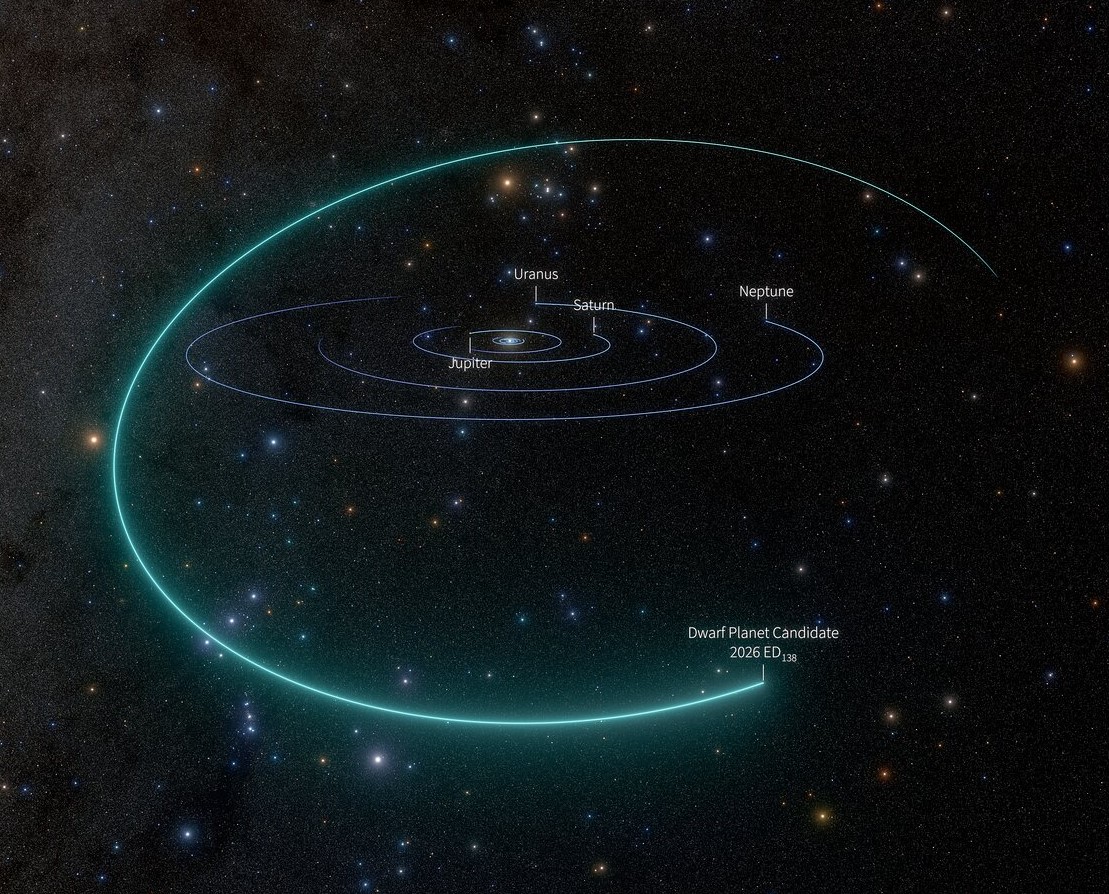
Astronomers sorting through data from the Vera C. Rubin Observatory in Chile have found an icy world that has a good chance of joining Pluto in the solar system’s retinue of dwarf planets.
University of Washington astronomer Mario Jurić joined the astronomer who made the discovery, Matthew Holman of the Harvard & Smithsonian Center for Astrophysics, to announce the findings today at a meeting of the American Astronomical Society’s Division for Planetary Sciences in Spokane, Wash.
Jurić, the Rubin team’s solar system lead scientist, said the observatory’s capabilities made it possible to detect and characterize the new dwarf planet candidate, known as 2026 ED138.
“Rubin is giving us an unprecedented capacity to explore the sky through a combination of speed, depth, and precision,” Jurić said in a news release. “And the discovery is just the beginning: Once we identify a new object, we can search back months, and sometimes even decades, finding it in images where nobody knew to look. This ability to both discover and ‘precover’ objects is transforming how quickly and accurately we can determine their orbits and understand the distant solar system.”
2026 ED138 traces a tilted orbital path that takes it well beyond Pluto, the solar system’s best-known dwarf planet. It’s currently at a distance of 46 astronomical units, where 1 AU equals the average distance between Earth and the sun. Pluto, by comparison, is currently about 40 AU from the sun.
Astronomers suspect ED138 formed billions of years ago closer to the sun before being flung into a wider orbit by gravitational interactions with Neptune.
Based on an analysis of its distance, brightness and assumed composition, ED138 is thought to be somewhere between 600 and 1,500 kilometers (373 to 932 miles) in diameter. At that size, an icy object should possess enough gravity to pull itself into a round shape — satisfying the primary physical criterion for a dwarf planet.
ED138 may be Rubin’s first dwarf planet candidate, but it almost certainly won’t be the last. Thanks to the observatory’s Simonyi Survey Telescope — named after the family of Seattle software billionaire Charles Simonyi — the Rubin team detected more than 11,000 new asteroids even before June’s official start of a 10-year survey of the southern sky.
Rubin’s researchers analyze the data from those scans to find objects of interest — ranging from asteroids to gamma-ray bursts — and track them over time. On Oct. 13, Holman was running data through a search code that he developed with Kevin Napier, a colleague at the Center for Astrophysics. ED138 stood out due to its exceptional size and brightness.
“My first reaction was one of excited disbelief,” Holman said. “Objects like this are very rare, so I immediately started checking whether I or the code had done something wrong.”
To confirm the discovery, Holman, Jurić and their colleagues found 30 archived observations of ED138 dating back to March 4. The Asteroid Institute’s ADAM Precovery service found still more images of the object, going back to 2016, in the archives of a different astronomical survey.
The precovery data confirmed that ED138 was a special case.
“Finding an object this big, roughly 1,000 kilometers across, is something that happens maybe once in a generation,” Jurić said. “It’s the largest trans-Neptunian object found in about 20 years, and Rubin turned it up while we were still commissioning the telescope.”
In 2006, the International Astronomical Union defined dwarf planets as planetary objects that are big enough to crush themselves into a roundish shape — technically speaking, into a state of hydrostatic equilibrium — but not big enough to clear their orbital neighborhood.
So far, the IAU has classified five solar system objects as dwarf planets — including Ceres in the main asteroid belt, plus Pluto, Eris, Haumea and Makemake in the region beyond Neptune. 2026 ED138 joins a host of other celestial objects that are thought to be dwarf planets but haven’t yet been added to the IAU’s official list.
“The official list hasn’t moved since 2008,” Jurić told GeekWire in an email. “I’m not sure if there’s an active process that reviews candidates, and what are the timelines.”
Jurić and his colleagues hope additional observations will boost ED138’s chances of attaining true dwarf planethood.
“The next step in building the case would be to prove it’s round (in hydrostatic equilibrium),” he wrote. “The means to do that would be directly through occultations (and there’s a good chance of that, given it’s in a dense stellar field), and then thermal measurements plus modeling and light curves (or the absence of variability).”
