❌

Normal view

There are new articles available, click to refresh the page.
Today β€” 30 October 2026Hackaday

Snake On a Seven-Segment Display is Gloriously Bad

By: Tom Nardi
30 October 2026 at 04:00

You’ve no doubt heard the saying, β€œIf something is worth doing, it’s worth doing well.” But there’s actually a counter-perspective to this particular philosophy that says it’s also worth doing things badly, with the general idea being that even a semi-successful attempt at something is better than no attempt at all.

We’re not sure if that’s the principle [JosΓ© Luis Monteiro] and his father had in mind while working on a way to play the classic Snake on a seven-segment LED display salvaged from an old DVD player, but surely the end result is the same. It’s not so much that the display isn’t a good fit for the eponymous snake, in fact, it actually makes a strange amount of sense. Each of the segments can stand in for a piece of the ever-growing serpent, and they’re already arranged in a roughly rectangular grid that makes moving around straightforward enough.
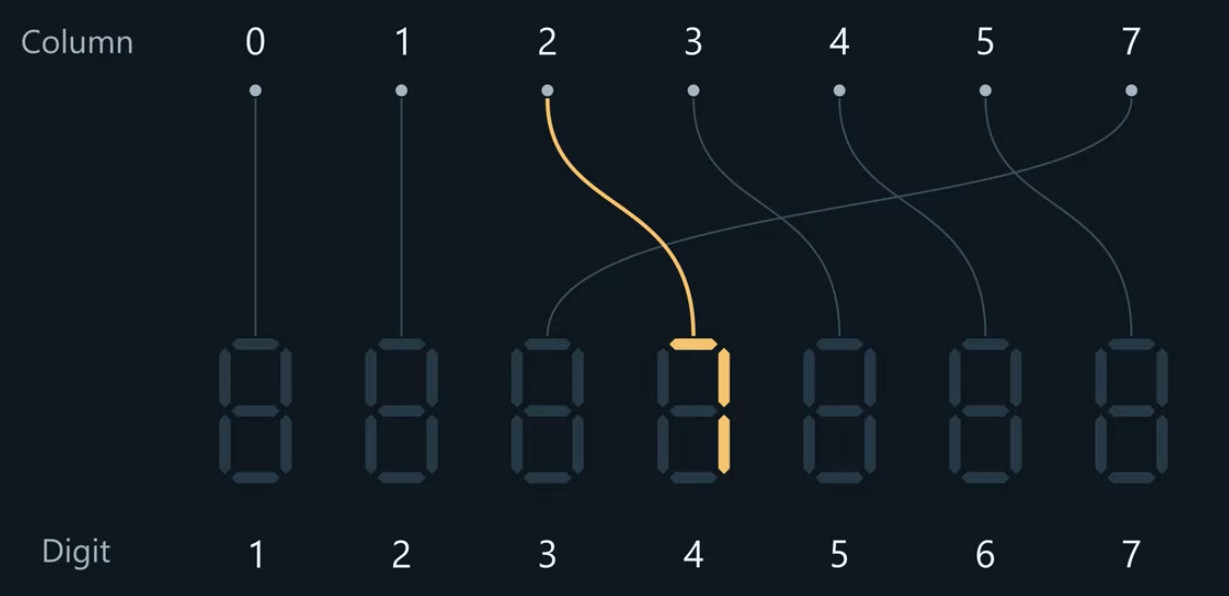
The issue is that the resolution β€” such as it is β€” of the display it pretty unforgiving for anything else. Namely, the β€œfood” that your sake is after is naturally identical to one of its own segments, so it doesn’t take long before it’s all rather confusing visually. But in those brief opening moments, it actually works pretty well.

Even if you’re not interested inΒ Snake, between the documentation, source code, and the video below, this project is a great primer on reverse engineering these types of displays. With a microcontroller, a datasheet, and a bit of patience, you could put together an unattractive and frustrating gameplay experience of your very own! If that’s not the dream, what is?

Before yesterdayHackaday

Floating-Point Addition and Subtraction on Intel’s 8087

22 October 2026 at 07:00

Although you can do basic floating point format operations like addition and subtraction just fine on any CPU, having specialized hardware for it can provide a significant speed boost. Here Intel’s 8087 was the first mainstream floating-point coprocessor to provide this option to a wide audience, with [Ken Shirriff] recently reverse-engineering using an 8087 die how these basic operations were implemented.

The real-world speed-up of even simple operations like adding two floating point numbers compared to the 8086 CPU was on the order of a hundred times, which is very relevant the moment you start doing interesting things with spreadsheets, not to mention rendering 3D scenes in CAD software or even games.

As always, the devil is in the details, with sneaky infinities and edge cases also providing the biggest potential for speed-ups in dedicated silicon, along with the large circuitry spent on the shifter. With floating point values being very much about aligning values with shifting by a number of bits, this circuitry along with the detecting of over- and underflows is the key element why the 8087 and its successors were so crucial in making floating-point operations at all feasible in PC applications.

How this shifting works in theory is detailed in the article by [Ken], along with how the 8087 implements this in its circuits. Naturally, a large part of this is implemented in microcode, the listing for which is also provided. From this it’s quite clear how what seems like a simple set of operations is actually quite complex, making even the now much maligned x87 ISA an improvement over doing it all in integer-based software.

Pager Converted to Meshtastic Node

15 October 2026 at 01:00

Text messaging has been around on cellular networks en masse for around three decades now. It’s so common that it’s difficult to remember a time without it. Its two-way quick messaging is incredibly useful, but for even simpler communications there’s a one-way system that predates it. Pagers are able to receive simple messages, but outside of hospitals are rarely used nowadays. Eventually some added in two-way communications like this Motorola T900, but they’re still mostly obsolete. That’s why [zindustries87] converted it to operate on the Meshtastic network instead.

To get this pager working, a lot of reverse engineering was needed. There is essentially no documentation on the chips in these devices, so the screen and keyboard both were reverse-engineered to work with other hardware. In this case, [zindustries87] found space for a Heltec V4 with an ESP32-S3, a popular Meshtastic node with a small form factor. Some programming was needed to get everything communicating together, but from the looks of things it seems to have basic functionality.

[zindustries87] points out that this is a prototype, and didn’t know going in if the keyboard and screen could be brought back to life, or if the other hardware would fit in the case. But with it working on this level, they plan to add a number of other features in and possibly build a drop-in PCB replacement for these devices. They were once fairly popular so there are plenty around, and they’re a good form factor for a dedicated Meshtastic device that doesn’t need a smartphone to work. The only other ways of bringing pagers back to life involve bootstrapping an entire pager network, and Meshtastic is a bit more useful than that now.

❌
❌