Normal view

There are new articles available, click to refresh the page.
Before yesterdayHacking and InfoSec

Artificial Intelligence (AI) in Cybersecurity, Part 25: Upgrading Your Model with Specific Skillset

8 September 2026 at 09:24

Welcome back, aspiring cyberwarriors!

Sometimes you might run the same model twice and get different results. That often happens when you’ve upgraded it with skills. Skills are detailed text documents that lay out the tools the model should use, the approach it should take and how it should analyze the results. Good skills are practical, pulled from actual reports on HackerOne and other bug bounty platforms. A model can still lean on its own knowledge, but that’s just less efficient.

There are plenty of skills out there you might come across, but not everything can be trusted. Some skills can simply be dangerous and infect your system. To make sure they are safe, you can check them with SkillSpector by NVIDIA, so you don’t end up with anything malicious on your system.

Bug Bounty Skills

Both of these repositories do bug bounty hunting end to end, but they go about it in almost opposite ways.

The first is called Bountyforge. It’s actually just one single skill file, but it’s smart enough to split itself into eight different mini agents that all work at the same time. One looks at websites and apps, another at crypto and blockchain, others go after different angles hackers can exploit. It also checks each finding with four different tests to make sure it’s not a false alarm. Then you get a report in whatever format the bug bounty program wants.

bountyforge

You don’t even need Claude Code or any other coding tool for this, you can just run it right inside the regular Claude website in your browser.

The second bug bounty repository is Claude-BugHunter. It takes the opposite approach. The repo has 83 skills and almost half of those were built by studying 681 real bug reports that people actually got paid for on HackerOne. These skills aren’t locked to Claude Code either, you can use OpenCode, Codex or Hermes Agents with them.

Here are a few examples of the results we got with these skills.

API endpoints are often vulnerable and this is worth trying your luck on to see how it goes.

api abuse found

Another approach can be APK reverse engineering. Here we found a hardcoded RSA-2048 signing private key baked into the published APK. With that key, hackers can push a new app to the app store and infect every employee phone, getting access not just to the WiFi network at the workplace but to their personal life too. Quite dangerous.

supply chain attack found

We found an API endpoint vulnerable to an SQL injection and managed to pull the entire database.

sqli injection found

Having skills built on real attacks keeps the model from wandering off into its own weird approaches and missing a lot of good findings. 

Active Directory Skills

Claude-AD was made by ADScanPro for testing a company’s internal network. It gives your model a playbook with skills and agents built for an Active Directory assessment. The developers are upfront that it’s not an auto pwn tool. It’s meant to guide you through the assessment. Every finding can get mapped to a compliance control (DORA, NIS2 and ENS).

Claude-AD is very careful about getting caught too. It explains what a security team would actually see on their end if that technique got used. And any time it’s about to do something that would actually change things on the company’s network, it stops and asks for confirmation first.

General Cybersecurity Skills

Antropic-Cybersecurity-Skills is basically a giant reference book. It has 817 skills covering 29 areas of security work, cloud security, malware analysis, all the way down to hardware and firmware. Each skill is its own small file, so your agent will quickly pull out the two or three it actually needs for its task.

antropic cybersecurity skills

Every skill ties back to real security frameworks that companies and auditors already use (NIST CSF, MITRE ATT&CK and so on). So if your model finds a problem using one of these skills, it can also tell you exactly which official standard it violates. You can use it to justify findings to a compliance team.

SCADA Skills

On an industrial network, a clumsy scan can shut down a production line or damage physical equipment, since a lot of this gear is old and wasn’t built to handle unexpected traffic. That’s why the ICS skill by Masriyan is built to never actively touch a live industrial network. Instead, it works off network captures someone already took. It reads the file, recognizes industrial protocols by the ports they normally run on (Modbus, DNP3, Siemens S7, EtherNet/IP, OPC-UA, and more) and counts which devices are talking to each other. It then shows you write commands, these are the ones that change a value on an industrial device. That’s the traffic you want to see first.

scada ai skills

The second mode skips network captures and instead searches for exposed industrial equipment using Shodan and Censys. The skill can also help your model reason about how an industrial network is laid out and check findings against MITRE’s ICS specific attack framework and the IEC 62443 security standard.

Science Skills

Although science isn’t really what we want to focus on here, in one of our SCADA articles we mentioned that to carry out a successful attack requires hackers to understand the technical process of the plant. That means understanding how the chemicals are produced and which units are used along the way. We also showed how vinyl acetate is produced and talked about paracetamol production.

1 kg of paracetamol at 100% purity was reported to cost €8,205, while 1 kg at 99% purity cost just €5. So even a single day of sabotage could cause serious financial damage to an enterprise.

paracetamol price and purity

Finding a scientist among hackers is quite a challenge, which is why Stuxnet needed a group of people from different backgrounds working toward one objective. But now hackers can just import different skills to make their attacks more devastating. K-Dense published 140 skills with access to different scientific databases and Python tools.

The real concern here isn’t ICS exploits inside the repository, there aren’t any. It’s the access to sensitive scientific data paired with an AI agent that can actually understand that data and change it.

ai science skills

Summary

AI skills can be a gamechanger, especially when they’re based on actual reports hackers got paid for. These skills show your model how to approach things and what tools to use during the test, so it doesn’t wander off hallucinating and inventing its own ways of testing things. That can wreck your bug bounty flow, since you’ll end up overlooking plenty of potential targets.

Simply relying on the AI to find things isn’t enough, hunters that do it keep getting a lot of dupes. You need to test things manually too. For this reason we created our Bug Bounty training to show you how to find bugs and work with the AI more efficiently.

The post Artificial Intelligence (AI) in Cybersecurity, Part 25: Upgrading Your Model with Specific Skillset first appeared on Hackers Arise.

Post-Quantum Network Readiness

By: OTW
31 August 2026 at 12:33

The Quantum computing industry is making leaps and bounds towards developing quantum computers that can–among other things–break the encryption that keeps our data safe and confidential. Some say it will take place in as little as two years, but even the most conservative estimates are for four years or 2030. In either case, it is time to begin to prepare your network for the coming post-quantum world.

To learn more about this risk, see my interview with David Bombal on Quantum Computing here.

When that day arrives, all of our encryption– and therefore all our data– will be exposed to anybody who has a quantum computer. Initially, this will be only nation state actors such as the US, China, Israel, and Russia.

No need to fret or stress as people have been preparing for this day for many years and have developed post-quantum cryptography (PQC). This field is in constant flux and recently one of the post-quantum cryptographic algorithms (HAWK) was found to be breakable by quantum computers. The point here is that this field is changing rapidly, not unlike artificial intelligence.

Some people have compared this to the Y2K crisis that took place some 26 years ago. At that time, nearly everybody was looking for a crisis that would break systems once we transitioned from a two-digit year to a four-digit year.The fact that no crises took place in 2000 can be attributed to years of preparedness for that potential crisis. Companies and institutions spent at least two or three years preparing for it and as a result nothing adverse really took place. It all went very smoothly.

For your organization, you need to start preparing now. To help you to prepare, Hackers Arise has developed a course on preparing your network for the post-quantum world. The training will be offered over 3 days October 13-15.

Post-Quantum Network Readiness

Outline

1.What are Quantum Computers are What Makes them Different

2. The Quantum Countdown: Harvest-Now-Decrypt-Later & Why Your Network Is Already Exposed

3. Know Your Attack Surface: Automated Cryptographic Discovery & CBOM

4. The New Arsenal in Action: NIST PQC Standards (ML-KEM, ML-DSA, SLH-DSA) with OpenSSL 3.5 & liboqs

5. Hardening the Wire: Hybrid TLS 1.3 & Quantum-Safe Tunnels

6. Post-Quantum PKI at Scale: Certificates, Signature Bloat & Real Network Performance Impact

7. From Vulnerable to Quantum-Ready: A Phased Migration Roadmap, Crypto-Agility & End-to-End 

The post Post-Quantum Network Readiness first appeared on Hackers Arise.
Quantum Resistance: Scanning Company Assets for PQC Readiness

28 August 2026 at 10:18

Welcome back, cyberwarriors! 

Almost a year ago, OTW spoke about quantum computers and the risk of our encryption getting broken within three years. In March, Google shared its concern on the same issue, moving up its own post-quantum migration deadline to 2029. Some companies are migrating to mitigate that risk, but not many are taking it seriously. Eventually, a huge number of companies are going to get left behind with weak and breakable encryption. Hackers will only benefit from that negligence.

To help you minimize the risk and get an actionable plan with recommendations tailored to your company, we want to show you how AC-Scanner works.

AC-Scanner

AC-Scanner is basically a script for post-quantum cryptography exposure assessment. It maps your full cryptographic attack surface across TLS endpoints and SSH services, assesses every asset against NIST post-quantum standards and generates a structured Cryptographic Bill of Materials (CBOM).

Before we continue with the scan, you might want to watch a video by OTW and David Bombal on the risk of quantum computing being able to decrypt things at mass scale and expose session keys.

Setting Up

Docker is the easiest way to get started. We’ll start with the CLI version first, then show you how to get the web version up and running. They both work the same way, so you can choose any.

First install Docker on your system:

ubuntu > sudo apt update
ubuntu > sudo apt install docker.io

Then switch to root and pull it:

root > docker pull qubitac/acscanner:latest
docker pull

Now it’s ready, so let’s see the help menu. 

root > docker run --rm -it qubitac/acscanner:latest bash -c 'rm -f /.dockerenv && cd /app/scripts && ./scan.sh -h'
ac scan help menu

We’re only interested in the presets here. As you can see, you can test basically any of your assets.

Scanning Assets – CLI

Let’s choose some random Russian company for this scan. We don’t intend them to benefit from the results, we will just use it for demonstration to show how prevalent the issue is.

For our scan we used –all to scan everything: 

root > mkdir -p ~/ac-scans/example.com && docker run --rm -it -v ~/ac-scans/example.com:/app/scripts/example.com qubitac/acscanner:latest bash -c 'rm -f /.dockerenv && cd /app/scripts && ./scan.sh --noinstall example.com --all'
scanning the assets

If you’re testing a big company, it will take time. 

results

Results will be stored in ~/ac-scans

files

Here we only need crypto-bom.json that’s hiding in cbom.

Results

Upload crypto-bom.json to the dashboard by clicking Load CBOM. You will see the overview. 

dashboard

You can already see the infrastructure is not PQC ready and has several critical issues. 

The next step is HTTPS. Although 9 of their endpoints are using HTTPS, it’s vulnerable and the risks are high.

https

The scanner tried to fingerprint the SSH endpoints too, but they weren’t open.

ssh

Let’s look at the issues that the company has. It will show all the affected hosts with severity assigned to each. 

issues

Quantum risks may help tracking the progress of your migration. The results below are from a different company, but you can see they have only 3 PQC ready hosts out of 308. 

Recommendations will help you address issues by giving you prioritized actions. 

The recommendations were intentionally redacted by us to make them unusable. However, you can still clearly see how the page is structured.

Finally, your main goal is migration. Here it lists all the migration phases and gives you deadlines by which they need to be completed. 

pqc migration

As you can see, legacy TLS should be abandoned by 2027 and hybrid PQC key exchange should be introduced no later than 2028. That applies to everyone, not just this organization in particular. The report gives clarity and orients your client so there’s no confusion.

Scanning Assets – Web

If you don’t want to work in the terminal, you can use the web version. 

root > docker pull qubitac/acscanner
root > docker run -d --name acscanner -p 8080:80 qubitac/acscanner:latest 
docker web version

It’s available in the browser on http://localhost:8080/.

ac scanner web

Summary

AC-Scanner is easy to work with if you use Docker, otherwise you’ll run into some incompatibility issues. The dashboard has all the valuable information and most importantly it’s actionable and orienting. You don’t just see the vulnerabilities, you get a guide with recommendations on how to fix them too. Your client will definitely appreciate that.

Want to learn how to prepare your network for the post-quantum world? Join our Preparing Your Network for the Post-Quantum World training, taking place October 13-15 at 3 PM UTC. Available exclusively to Subscriber PRO students.

The post Quantum Resistance: Scanning Company Assets for PQC Readiness first appeared on Hackers Arise.

How legitimate cloud platforms enable phishers to bypass MFA

4 August 2026 at 08:00

Threat actors are increasingly exploiting legitimate cloud services to evade detection and streamline the deployment of their scam infrastructure. Cloud hosting services and decentralized networks have become primary platforms for hosting phishing pages and sites. Throughout 2025 and 2026, we have observed phishing operators steadily migrate toward platforms like Cloudflare Workers, Vercel, Netlify, GitHub Pages, and IPFS. This post analyzes the mechanics of a real-life adversary-in-the-middle (AitM) attack in a cloud environment and presents detailed statistics on the platforms and domains phishers abuse most frequently.

The cloud as a safe haven for phishers

Threat actors select platform-as-a-service (PaaS) offerings and distributed cloud environments to host phishing sites for much the same reasons legitimate software developers do:

  • Inherent trust and reputation. Phishing pages hosted on reputable platforms appear trustworthy, reducing suspicion among potential victims.
  • Most platforms offer generous free-tier developer plans. The onboarding process takes minutes and rarely requires Know Your Customer (KYC) identity verification. This enables a single operator to create hundreds of malicious accounts.
  • Evasion and anonymity. Attackers leverage native security features to obscure their true origin server IP address behind a CDN, which complicates detection for security vendors.

Additionally, these platforms allocate shared subdomains hosting millions of legitimate projects and websites. Security teams cannot simply block the parent domain or its subdomains without inflicting collateral damage on bona fide users – a limitation that malicious actors take advantage of. To counter this tactic, security vendors must advance content-based analysis methodologies.

Multi-stage AitM attack

Consider a modern AitM phishing campaign that leverages Cloudflare Workers, a widely adopted cloud platform. The attackers execute the operation through multiple HTML pages distributed across a compromised website and the cloud platform. Each page serves a specific function: harvesting target email addresses, initializing the reverse-proxy infrastructure, or spoofing the login form to capture multi-factor authentication (MFA) sessions.

Stage 1. Contact harvesting and network monitoring evasion

The attack typically begins with a phishing email that uses a plausible pretext – such as a request from a coworker to review documents – to entice the target into clicking a malicious link.

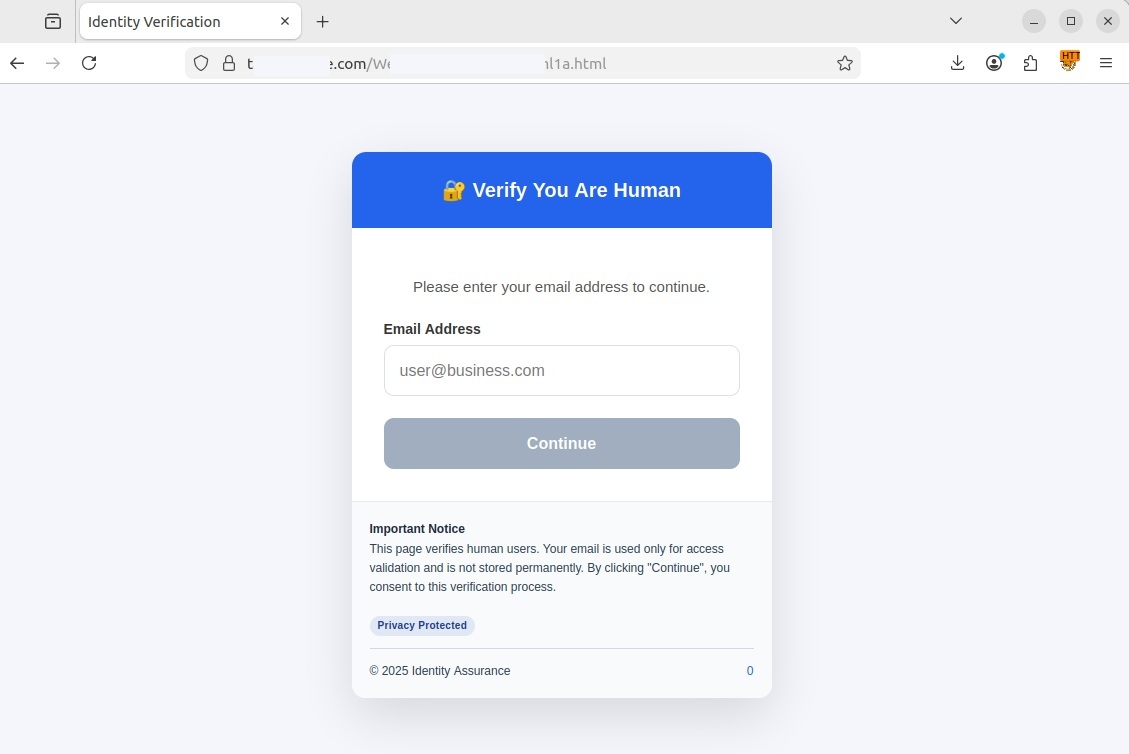
Upon clicking the link, the user is redirected to a fake CAPTCHA landing page hosted on a compromised legitimate website. This specific campaign used the https://t[REDACTED]e.com website, but any other variations are possible. In this scenario, the compromised page served as a disposable relay — vendor detection mechanisms typically block phishing links delivered directly via email much faster — to prevent the early discovery of the core phishing content hosted on Cloudflare.

If the user entered their email address and clicked Continue, the pseudo-CAPTCHA marked them as a human user and initiated a redirect. The primary objective of this stage is to harvest target email addresses, filter out bots, and route legitimate users to a subdomain of workers.dev. Such subdomains are generated automatically and free of charge by Cloudflare Workers. The victim’s email address was embedded in the URL hash (the part of the URL following the # character), allowing the page at [REDACTED].workers.dev to extract the email without issuing a request to the attacker’s server, thereby avoiding detection.

Stage 2. Initializing a transparent proxy

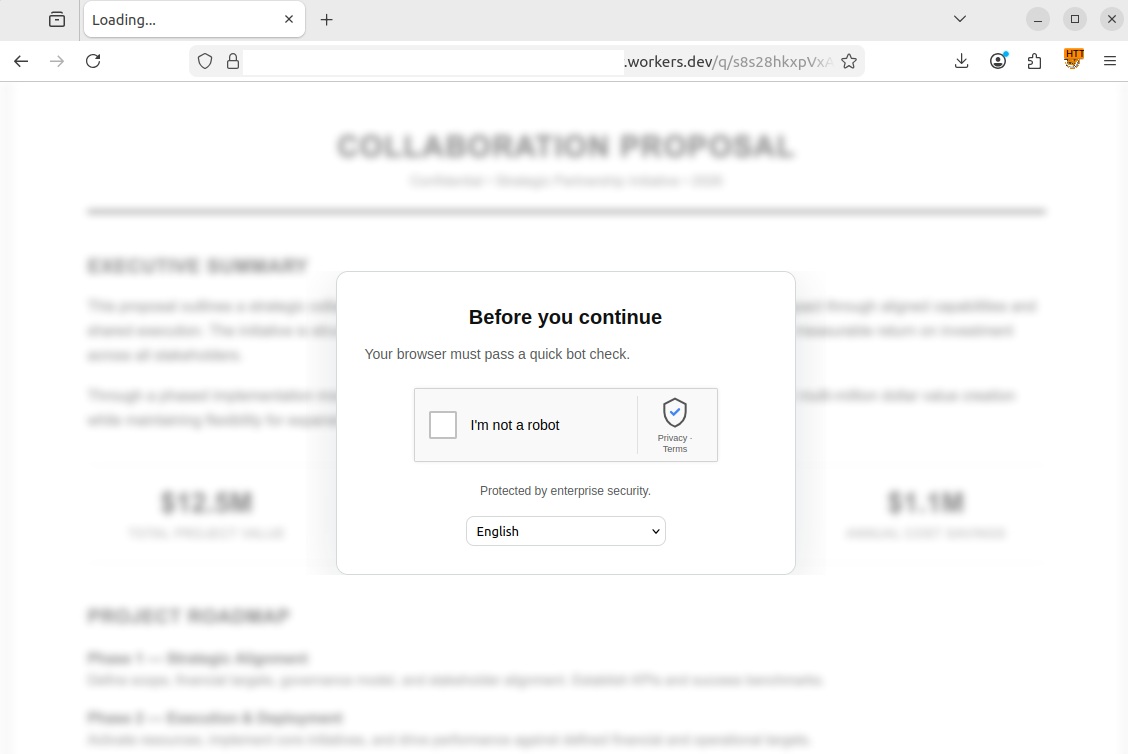
The user’s browser then loaded a [REDACTED].workers.dev page with #user@business.com at the end of the URL. At this point, the page presented the victim with a genuine CAPTCHA challenge. This step ensured that an actual user was interacting with the page rather than a security sandbox.

Another CAPTCHA, this time a legitimate one

Another CAPTCHA, this time a legitimate one

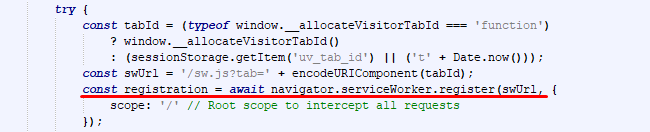
Once the user successfully completed the challenge, a service worker was registered in their browser. This is a special JavaScript file capable of running in the background and intercepting all network requests generated by the current tab. As this type of script was designed as a core component of progressive web apps (PWAs) to optimize load times and support offline functionality, browsers treat service workers as standard site feature and execute them without prompting for user consent as long as the website uses an HTTPS connection.

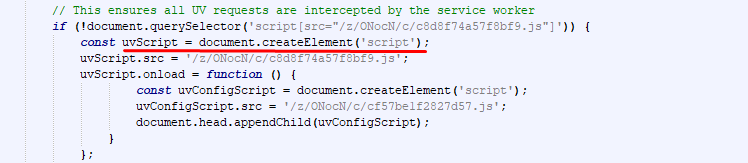
The attackers leveraged the service worker to deploy Ultraviolet, a legitimate open-source web proxy library, to dynamically rewrite all links and forms on the page. This forced every outgoing request – including those for Microsoft login credentials – to route through the attackers’ server rather than directly to the legitimate services.

Immediately upon loading, the page extracted the victim’s email address from the URL hash and stored it in the browser’s sessionStorage property so it would not be overwritten when the CAPTCHA loaded. This step also allowed the script to pre-fill the username field in the form automatically. A pre-populated login field enhanced the page’s credibility and bolstered user trust. Once the CAPTCHA was passed, the malicious script constructed a redirect URL for the third stage, appending the email retrieved from sessionStorage back to the hash. By passing the email via the URL hash across three consecutive stages, the attackers successfully kept it hidden from network attack detection systems.

Registering a service worker to intercept traffic

Registering a service worker to intercept traffic

Establishing a transparent proxy via an external library

Establishing a transparent proxy via an external library

Stage 3. Session hijacking and browser window spoofing

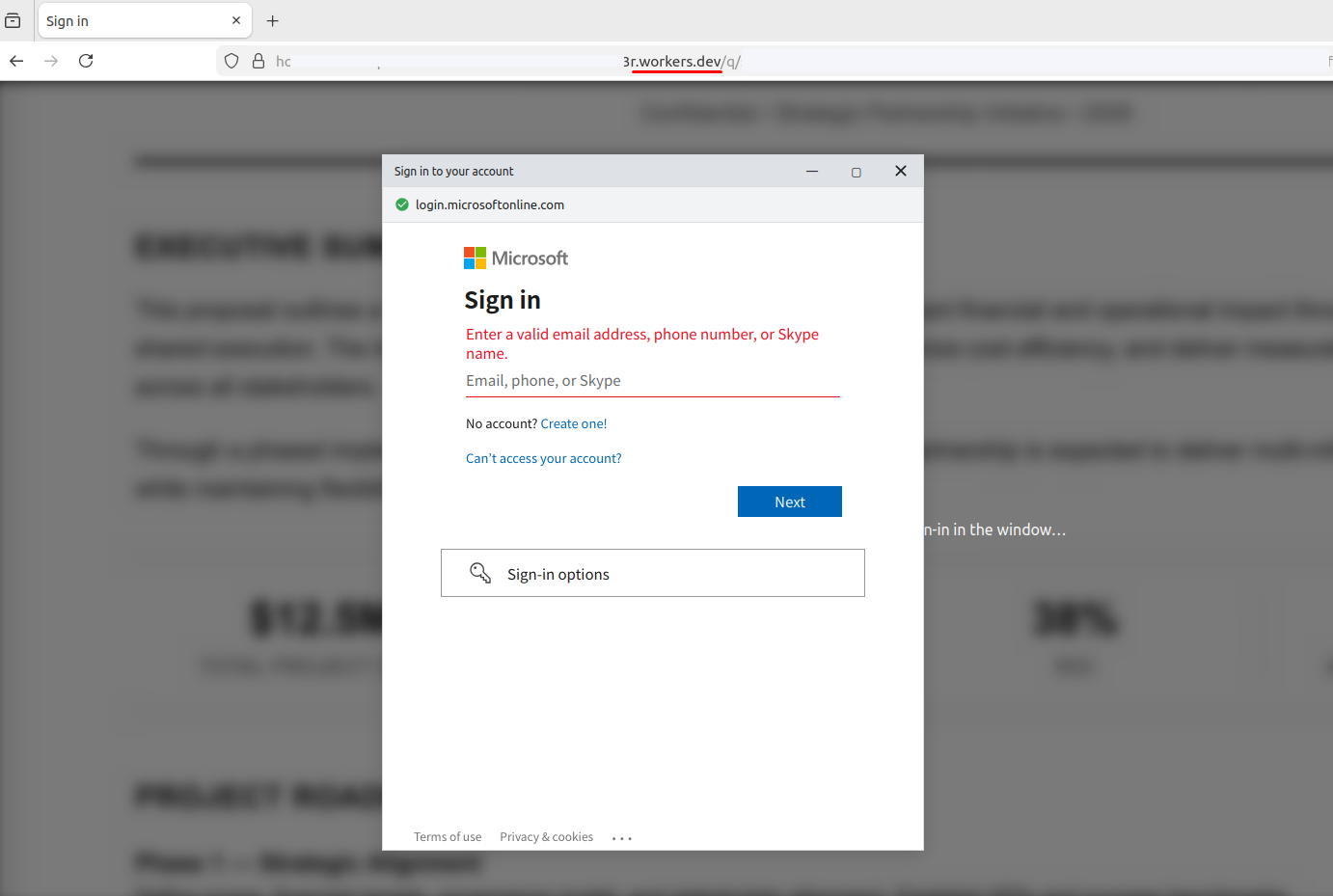
The final stage unfolded on a third page, combining adversary-in-the-middle (AitM) traffic interception with a browser-in-the-browser (BitB) UI spoofing technique. BitB attacks operate by rendering a block inside a legitimate webpage that visually mimics a native browser pop-up window.

In this case, the script hosted on the attacker’s page generated a pop-up visually identical to a native browser window, complete with window controls and a spoofed address bar showing a trusted Microsoft URL. Within this simulated window, an iframe loaded the authentic login interface, routed dynamically through the service worker reverse proxy created in Stage 2. When the victim entered their credentials and MFA code into the BitB window, the proxy script intercepted both the credentials and the session tokens. Combining BitB with AitM significantly increases the threat: BitB provides a convincing, trusted visual wrapper (displaying a legitimate URL and branding), while the hidden AitM proxy quietly handles traffic interception and session hijacking behind the scenes.

Upon successful login, the proxy instructs the interface to close the pop-up and redirect the victim to a generic system error page, such as SessionExpired. This minimizes suspicion: the victim assumes a technical glitch occurred and attempts to log in again, unaware that the attacker already has full access to the session.

Cloud platform phishing attack statistics

We analyzed phishing URLs hosted across popular cloud platforms – including Cloudflare, Netlify, and GitHub Pages – over a 12-month period spanning August 2025 to July 2026. The data below outlines trends in unique third-level domains exploited to deliver phishing content. In total, our security solutions blocked 224,984 unique third-level domains on cloud and decentralized services used in phishing attacks within that timeframe.

Number of unique third-level domains
(download)

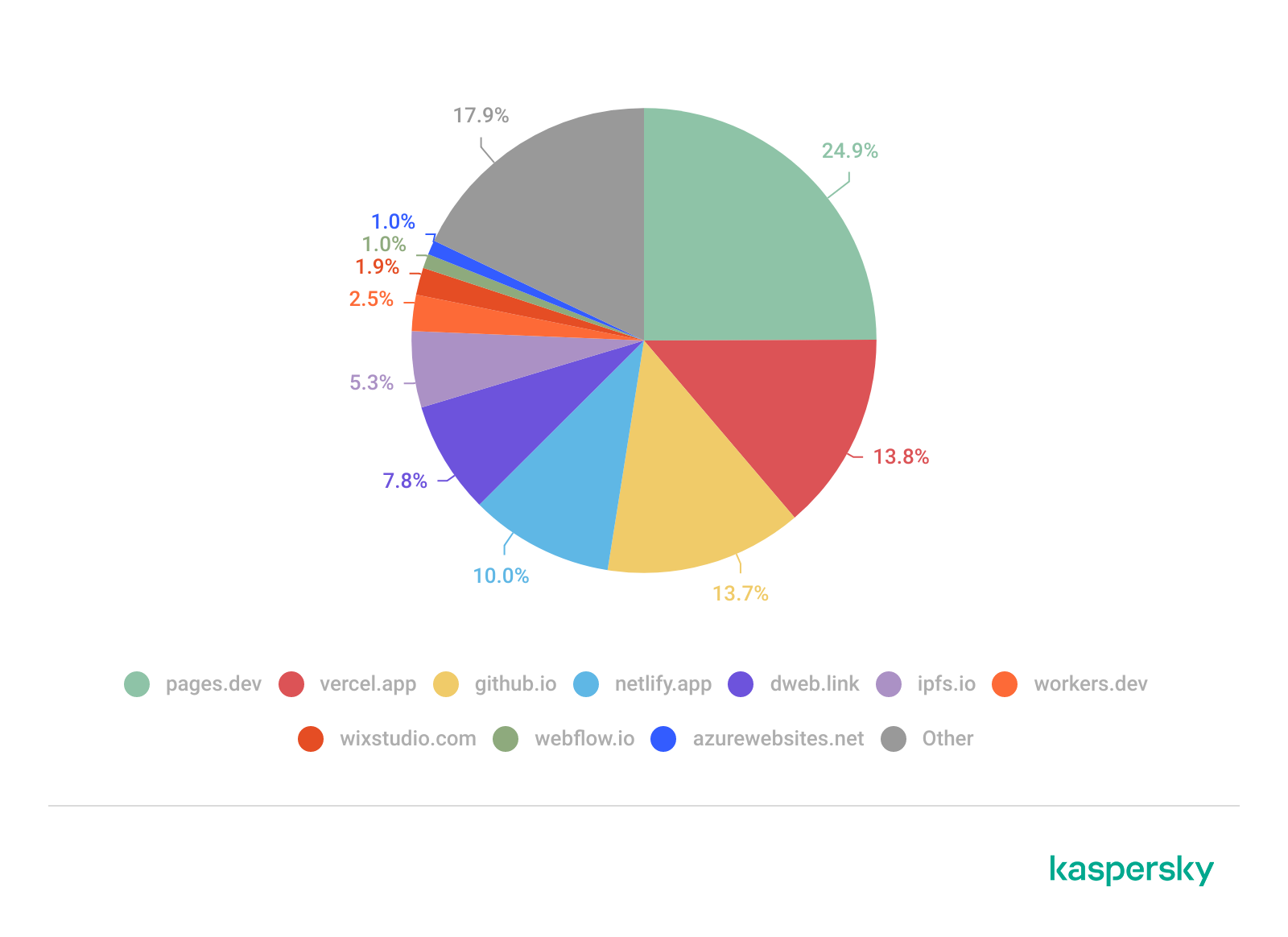
Based on this telemetry, we compiled a list of the TOP 10 cloud domains most frequently abused in phishing campaigns over the specified period.

Number of phishing links

Unsurprisingly, Cloudflare and Vercel emerged as the undisputed leaders: both offer free tiers, automated SSL certificate issuance, and global CDNs. GitHub Pages ranked third. The widespread legitimate use of the github.io domain complicates bulk blocking efforts, as security teams risk limiting access to non-malicious projects.

Decentralized networks also warrant close attention – we posted on this subject in 2023. The ipfs.io and dweb.link domains function as IPFS gateways. The principal risk associated with these platforms is content persistence: even if a specific gateway gets blocked, the phishing page remains accessible via alternative nodes across the network.

The visual website builders Wix and Webflow also ranked among the TOP 10 (eighth and ninth, respectively). These platforms allow low-skilled individuals to build phishing pages rapidly without advanced coding expertise, which significantly lowers the barrier to entry for less capable malicious actors.


Domain Number of phishing links Platform
1 pages.dev 24.9% Cloudflare Pages
2 vercel.app 13.8% Vercel
3 github.io 13.7% GitHub Pages
4 netlify.app 10.0% Netlify
5 dweb.link 7.8% IPFS gateway
6 ipfs.io 5.3% IPFS (InterPlanetary File System)
7 workers.dev 2.5% Cloudflare Workers
8 wixstudio.com 1.9% Wix Studio
9 webflow.io 1.0% Webflow
10 azurewebsites.net 1.0% Microsoft Azure
Other 17.9%

In total, we identified and neutralized over 390,000 phishing pages hosted across legitimate cloud platforms and decentralized networks (IPFS) over the past 12 months. This data confirms that threat actors actively exploit the implicit trust associated with legitimate PaaS providers (such as Cloudflare Workers, Vercel, Netlify, and GitHub Pages) and IPFS gateways. High domain reputation, generous free tiers, and built-in evasion capabilities enable phishers to deploy multi-stage AitM attacks designed to hijack MFA sessions.

Recommendations

Traditional security controls, such as relying on HTTPS lock icons or reputation-based domain denylists, are inadequate against these attacks. The cloud provider’s apex domain maintains a positive reputation score, while attackers generate malicious subdomains programmatically and at scale.

Effective defense against these threats calls for a layered security posture:

  • Exercise caution with unexpected requests, even if they are served from reputable domains or secured with valid SSL/TLS certificates.
  • Treat any CAPTCHA interface requiring personal data input as a possible scam. Legitimate CAPTCHA challenges rarely request personally identifiable information, such as email addresses.
  • Inspect the URL in the address bar at the very top of the browser window. In BitB attacks, threat actors can render a fake browser pop-up displaying any target URL, even a legitimate one. However, the true address bar – located at the top of the main browser window alongside native navigation controls (Back, Forward, Refresh) – will continue to display the actual attacker-controlled domain.
  • Avoid entering credentials in pop-ups you did not expect to see. If a login or MFA form appears without your explicit action, close the tab immediately. Navigate to the intended service manually by entering its address directly into the browser.
  • Additional protection can be provided by Kaspersky Secure Mail Gateway for enterprise environments and Kaspersky Premium for personal correspondence. These robust email security solutions neutralize phishing links at the delivery stage before they reach the inbox.

❌
❌