Donald Glover will star in Netflix's live-action PUBG series and help write and direct it. Stephen Glover joins him behind the camera, but the adaptation doesn't have a release date or revealed storyline yet.
Instagram is testing a new longform, horizontal video format called "Features" as it pushes further into YouTube territory and expands its presence on TVs. The Verge reports: Instagram boss Adam Mosseri has been against doing longform video on the platform "for a long time," he says in a six-and-a-half-minute video (here's the widescreen version) with VP of product Tessa Lyons, saying that "one of my concerns has been, how do we make sure that we keep Instagram not just about entertainment, but about connecting with friends." If you watch a longform video, "it's a lot of Reels, photos, and carousels that you might not have sent to a friend," meaning less likes and shares. Now, though, the team is working on making shortform and longform video "symbiotic," according to Mosseri, like podcasts or comedy specials that can be both long videos and broken up into shorter ones.
The announcement of this widescreen video push also follows the launch of Instagram's TV app late last year. That app launched first as a Reels-focused experience and as a pilot for Amazon Fire TV devices in the US, but it's since expanded to Google TVs, Samsung TVs and Apple TV, and Instagram launched new features like the ability to watch Stories earlier this year.
Longtime Slashdot reader schwit1 shares a report from CBS News: Walter Koenig, the actor who played Pavel Chekov in the original "Star Trek" series and several movies, has died, his rep confirmed to CBS News. He was 90. Koenig died Sunday night at his home in the North Hollywood neighborhood of Los Angeles, talent rep Zachery McGinnis said in a statement. He died surrounded by his daughter and niece, McGinnis said.
In 'Star Trek,' Ensign Chekov was the sole member of the spaceship Enterprise bridge staff from what was the Communist bloc. His friendly, supportive presence showed how the rival nations (in the far-off future in which the show was set) were capable of working together. Speaking heavily Russian-accented English, Chekov embodied stereotypical Russian personality traits, including fierce pride, love of poetry and blind loyalty. "Through countless convention appearances and interactions with fans, he shared his kindness, wit, and appreciation with everyone fortunate enough to meet him. He understood what Star Trek meant to people and embraced the community that grew around it," McGinnis said. "Thank you, Walter, for the memories, the inspiration, and for boldly going where few have gone before."
Watch some of the Chekov's best moments on YouTube.
Some disappointing, but perhaps not entirely unsurprising news this week out of Denmark — after announcing last year that they would transition away from Microsoft’s proprietary software, the realities of making it work seem to have caught the government off guard. The word is that a trial program immediately ran into problems when government employees that had been given Collabora tried to collaborate with their peers running Office, and has since been quietly abandoned.
Although there’s probably a joke to be made about different parts of the government not knowing what the other ones are talking about, the reality is that if one group of staffers can’t reliably access the data being produced by another, that’s a pretty big problem. Of course, had they simply asked us nerds, we could have advised them that these sort of issues are inevitable if you don’t fully commit to the effort.
Had the entire government moved to the Open Document Format (ODF) at once they would have avoided the issue, at least when it came to newly created documents, but obviously that’s a considerably larger undertaking than installing Collabora or OpenOffice on a few dozen machines and calling it a day. There’s no word yet on how this stumble will impact Denmark’s larger effort to free themselves of proprietary software, but we’d hazard a guess it’s not a great sign. Hopefully things go better for the Dutch.
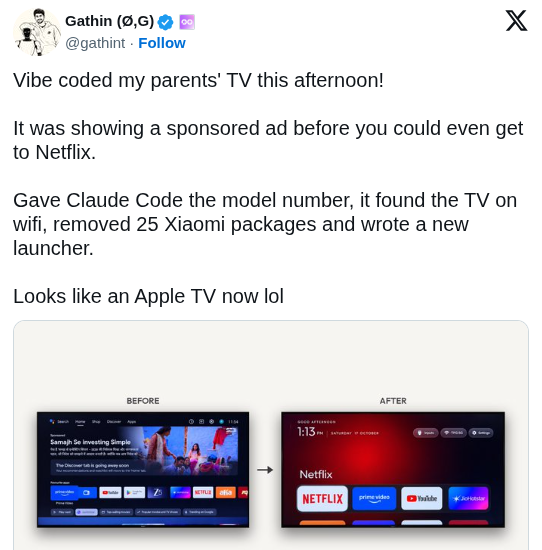
Speaking of users trying to improve their personal software situation, The Verge has an interesting article on a recent trend of frustrated users pointing AI tools like Claude at their smart TVs, with a few success stories posted to social media showing off interfaces that have been stripped of ads or replaced with something else entirely. It’s compelling stuff for anyone who’s unhappy with their current smart TV experience, but the whole thing isn’t quite as technically impressive as it might seem on the surface.
As the TV’s in question are running Android, all the AI tools need to do is connect to them over Android Debug Bridge (ADB) and uninstall any offending packages that might be providing ads, and similarly creating a customized launcher interface is a matter of spinning up an Android app and installing it over the network. The results may look like arcane magic to the uninitiated, so we appreciate The Verge pointing out that it’s all pretty basic stuff for anyone familiar with Android development.
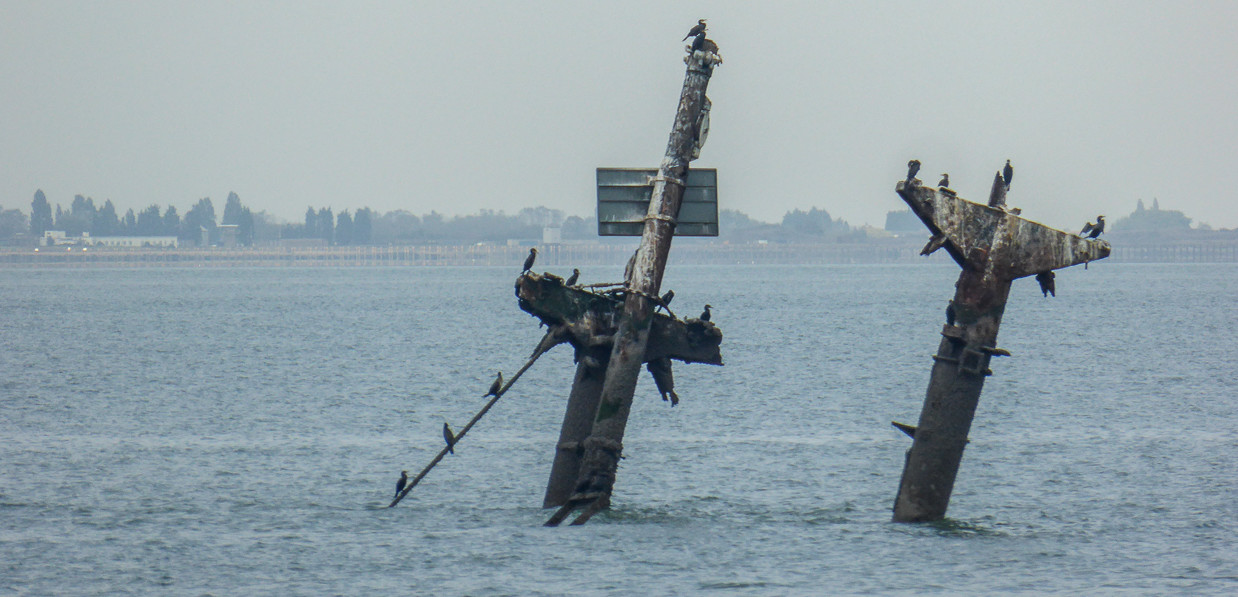
On the subject of extracting unwanted components, a delicate operation to remove the masts of the sunken WWII cargo ship SS Richard Montgomery was completed successfully earlier this week off the coast of Sheerness, England. To those unfamiliar with this particular vessel that might not sound like a big deal, but when you’re dealing with a wreck holding an estimated 1,400 metric tons of explosives that have been deteriorating since 1944, even approaching the area needs careful planning and coordination.
Masts of the SS Richard Montgomery in 2014. Image Credit: Christine Matthews
There was a concern that the masts and their supporting structures were on the verge of collapsing into the hull of the wreck, which experts warned could potentially trigger an explosion large enough to endanger life and property. Actually removing the explosives from the ship itself will be a far larger undertaking, but at least for the time being, removing the masts has helped stabilize the situation.
Finally, if you’re looking to learn about something a little more local than a potentially explosive situation in Sheerness (apologies to anyone in Sheerness), check out Local Wikipedia. Created by [Ed Jefferson], the site lets you filter Wikipedia pages by their distance from your location or whatever other landmark you wish. By default it shows results that are within 1.5 miles, but if you don’t have anything too exciting within range it will start opening up the radius to pull in more results.
See something interesting that you think would be a good fit for our weekly Links column? Drop us a line, we’d love to hear about it.
If you’re a collector of older TVs, you’re probably facing the problem in some form of having no transmissions to tune in to. With many sets you can use a SCART or other A/V input, but nothing beats using the thing as it was intended. [BorisDigital] had exactly this problem, and since he worked in a TV transmitter control room in the 1990s, he’s made a small TV station that looks and operates like the real thing.
It’s a 10 inch rack stuffed with goodies, each of which replicates the function of a piece of broadcast gear which would have cost a small fortune back in the day. At the top is a transmitter, a relatively inexpensive board from China. Below it a clock and audio monitor powered by a Pi Pico, then a vectorscope, waveform monitor, and monitor powered by a set of Pi 5s with USB video digitisers, a pair of SD card video record/play units — yet more Raspberry Pi — and at the bottom, an automatic scheduler powered by another fruity board from Cambridge. If you’re not into TV the construction may be worth a second look. Those neat looking rack front panels are 3D printed with different filaments for the lettering, and are both robust and stylish. We can already see how this could be used in our work.
We miss analogue TV, partly because it was a wonderfully intricate technology that, beautifully, just worked. it’s a few years now since we reported on the last gasp of analogue TV in the USA, about a decade after it was turned off where this is being written.
Frustrated by intrusive ads, sluggish interfaces, and data tracking, smart TV owners are using AI coding tools and open-source projects to strip unwanted software from their televisions and build customized home screens. The Verge reports: Several vibe-coded TV-debloating projects exploded in popularity over the weekend. Cleanyourtv (known as tv-vibehack until the 19th), tv-detox, and dumbtv all claim to accomplish similar things -- remove sponsored ads, debloat the TV so it runs faster, and block unwanted data collection that tracks what you're watching -- without hacking, or rooting, the TV. By default, they all also replace the TV's built-in app launcher with simpler ones. Many users are going a step further and vibe-coding their own replacement launchers, like the Pokemon one below.
Most of the projects we've seen so far focus on TVs that run on Android and Google TV operating systems (such as TCL, Hisense, Sony, and older Amazon Fire products), using existing developer modes and the Android Debug Bridge (ADB) to tweak settings and apply (and remove) packages. According to the GitHub pages, they can also work with some Fire TV products that use a custom fork of Android (although likely not on the new Vega-based Fire TV Sticks). Because they use built-in developer tools, they don't require root access or firmware hacking, and they're reversible. Even projects that totally change the look of the interface just use Android's ability to install custom launchers -- in many cases with an assist from Claude Code or a similar tool to create the new launcher, too.
We’ve seen plenty of game console projects here, many of them that seek to produce a miniature game console. But this one from [RayTriangle] may break a new barrier entirely — it fits an entire TV game console that plays DOOM, including the battery, into a TV antenna plug.
There’s a type of antenna plug with screw terminals, originally intended for matching 300 ohm balanced feeder to 75 ohm co-ax. It provides a tiny project box if you look at it that way, and it’s in here that the console sits. It’s an ESP32-S3 that talks to a controller via Bluetooth, and he’s gone into some detail on how the RF for the TV is made. Some clever tricks such as a look-up table for the phase shifted chroma waveforms for each color allow the creation of a good quality composite signal through a resistor-ladder DAC, and this is modulated in a surprisingly old-fashioned way onto a carrier provided by the ESP’s clock generator.
The result as can be seen in the video below is a bit noisy, but we think that might be fixable with a little filter magic. It’s designed for PAL TVs with a VHF tuner, but we’re guessing some ingenuity could be brought into play to make it happen for UHF or NTSC. The hardware meanwhile is put on two boards either side of the battery, with a flexible PCB joining the two.
It’s true that gaming though an analogue RF input to a TV is probably less common in 2026, but we applaud the ingenuity in getting this into such a small space. For some reason it reminds us of the world’s smallest MIDI synthesizer.

 Login