Dimensional advertised $20-an-hour robot dog walkers who might need to carry the machines home. Its software and Anthropic's research show how much human help useful AI-powered robots can still require.
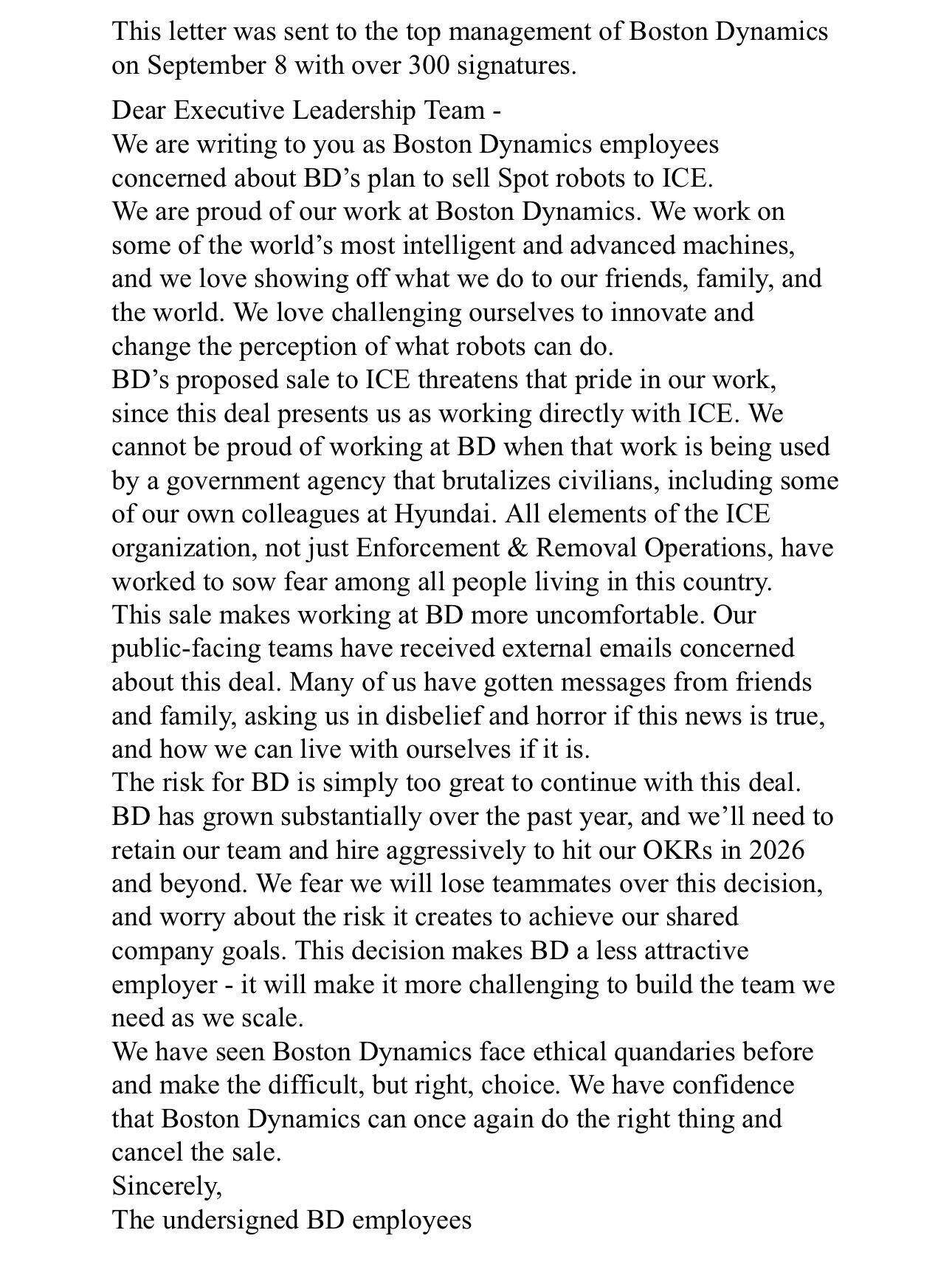
Hundreds of employees at the US robotics firm Boston Dynamics signed a petition calling for executives to halt a sale of the company’s robot dogs to US Immigration and Customs Enforcement—but executives stood by the deal, while saying the robots would not be weaponized.
On September 25, the Department of Homeland Security contract awarded $1.3 million to a Connecticut company called Radeco to provide ICE with modified versions of Boston Dynamics’ quadruped robots. But Boston Dynamics workers sent the petition letter with more than 300 signatures—half of them anonymous—to the company’s executives in early September and shared copies with The Boston Globe and WBUR public radio station.
“Many of us have gotten messages from friends and family, asking us in disbelief and horror if this news is true, and how we can live with ourselves if it is,” according to the petition. “The risk for Boston Dynamics is simply too great to continue with this deal.”
Bedrock Robotics, which is now valued at $4.1 billion, is particularly focused on autonomous excavators, in part because of a growing shortage of skilled operators.
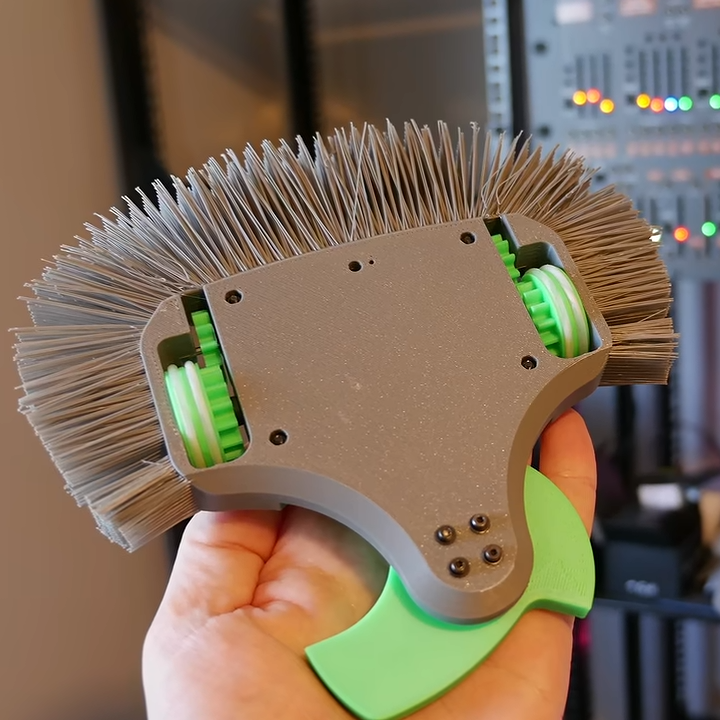
Just to set the stage, [Angus]’s new robot competes in the plastic antweight (or “plant”) division, in which robots are limited to 150 grams with both chassis and weapons made of plastic. In such circumstances, one can see how a mane of thick, rigid “hairs” might actually punch above its weight, so to speak.
The green shape at the bottom is a spinning weapon. The bristles cover the sides and rear.
Nothing settles a question like a good experiment, so [Angus] sat down and redesigned his latest robot to replace its outer shell with a thick wad of bristles, in the style of a 3D printed lion’s mane. Filament is bridged between the model and an outer support structure, which is cut away afterwards to expose the “hairs”.
How well did it perform? Well enough to merit further study! Where past robots got their outer shells broken up, the hairy robot seems to have come through quite intact. It seems the idea might not be as silly as it first seemed, at least in the plastic antweight division.
3D printers have been fantastic in the field of combat robotics. First they were great because they made custom parts easier and more accessible to hobbyists, but things have evolved more since then. Now folks compete by putting motors and electronics inside almost entirely 3D printed robots. There’s never been a better time to get into combat robotics, and experiment with unorthodox designs.
US chip champion Intel was so confused by the US government ban on foreign-made robots that it requested and received a waiver “out of an abundance of caution.” The tech company wanted to make sure that it could continue using certain robotic vehicles in its US chip fabs.
The uncertainty surrounding the Federal Communications Commission ban on certain foreign-made robots was revealed in the agency’s decision to grant Intel’s waiver request. On October 22, the FCC published its order allowing Intel to continue using the foreign-made robots in US semiconductor manufacturing facilities for a period of one year.
The robots in question are automated guided vehicles operating on “tracks or predefined paths” while often requiring operator oversight, according to Intel’s website. They help to move materials and items around within warehouses and factory floors.
Nvidia and Agile Robots unveiled Agile ONE SN, a compact humanoid with Jetson Thor computing and Isaac GR00T training tools. Here's what it can do, its specifications, and when it launches.
Nvidia and Hugging Face show how a $399 duck-shaped robot learns to walk using AI simulation. Here's how Microduck works, what it costs, and when buyers may get one.
China's Unitree unveils the H2-X humanoid robot with kung fu moves and rescue demonstrations, but questions remain about its autonomy, safety and endurance.
Reliable’s automated Cessna 208B Grand Cavan conducts autonomous operations in Mojave, Calif. (Reliable Robotics Photo)
Aviation startup Reliable Robotics is opening a new engineering hub in the Seattle area, establishing a radar research and development center in Bothell.
The Mountain View, Calif.-based company also announced Tuesday that it has raised $115 million, pushing its valuation above $1 billion. The funding will help expand its aircraft fleet, production facilities and engineering team as it works toward federal certification of its autonomous flight technology.
Reliable’s new office in the Bothell Highlands north of Seattle will open with about 25 employees and serve as its Radar Center of Excellence, a facility for developing and testing systems designed to help aircraft detect and avoid other aircraft. The company plans to grow the team and is heavily recruiting in the region, including roles across radar, embedded software, flight controls, guidance and navigation, simulation and systems engineering.
The expansion adds another player to the Seattle area’s growing mix of aerospace, robotics and autonomous systems companies.
Last month, GeekWire reported that San Diego-based Shield AI selected Des Moines, Wash., as the production and engineering hub for its X-BAT, an AI-piloted aircraft designed to take off and land vertically. The heavily-funded company is planning a 420,000-square-foot manufacturing and engineering facility and says it expects to employ about 4,000 people in the region by the early 2030s.
Reliable is developing systems that can automate aircraft operations, including engine startup, taxiing, takeoff and landing. Its longer-term ambitions include enabling aircraft to fly without a pilot aboard, with remote operators overseeing flights from the ground. The company is working toward certification from the Federal Aviation Administration.
Founded by former SpaceX engineers in 2017, Reliable has spent nearly a decade developing technology designed to work with existing aircraft rather than requiring entirely new planes. Its initial system is intended to keep a pilot in the cockpit while automating key flight operations, with more advanced levels of autonomy planned over time.
The 250-person company’s latest financing, including $90 million led by Nimble Partners and a $25 million term loan from Silicon Valley Bank, brings total funding to $380 million.
The company’s new Bothell lab will bring together engineers to design, build and test radar systems, including its active electronically scanned array air-to-air radar.
The technology is intended to support detect-and-avoid capabilities that would help autonomous aircraft safely operate in the national airspace alongside conventional planes.
“Seattle represents the past, present and future of aviation. For decades, engineers here have developed aircraft and systems that change how the world connects,” Chris Schulenberg, Reliable’s vice president of programs, said in the company’s announcement. “By expanding into the Pacific Northwest, Reliable is uniting the tech talent in Silicon Valley with the aviation expertise of Seattle.”
The Bothell office — located at 21222 30th Drive SE — will be led by Schulenberg and Marc Pos, a senior technical fellow focused on radar who previously spent more than two decades at Honeywell.
“Radar development is a hands-on process,” Pos said in a statement. “By bringing a team together in a centralized lab and engineering environment, with all of the resources we need at our fingertips, we can move from design through development and testing with the rigor, speed and precision unique to Reliable.”
Reliable also plans to expand its engineering operations in San Diego, where it will focus on aviation autonomy for military applications.
The two offices bring the company’s footprint to five locations, joining its headquarters and aircraft hangars in California and the operating hub of its subsidiary airline, Reliable Airlines, in Albuquerque, N.M.
Eka Robotics may be the first robotic arm that is actually good at picking up a wide range of objects, and it is so smooth and human-like, it is wowing the industry.
The LaserWeeder G2 from Carbon Robotics is pulled behind a tractor to detect and zap weeds on a farm. (Carbon Robotics Photo)
Carbon Robotics, the Seattle-based agricultural technology startup known for its AI-powered, laser-weeding farm implements, has trimmed its workforce.
The company did not disclose the total number of layoffs, but confirmed to GeekWire on Monday that the cuts affected employees across multiple departments both in the U.S. and internationally.
Carbon Robotics currently employs 275 people worldwide, according to Brett Goodwin, vice president of marketing, who attributed the decision to a need to “realign costs due to broader economic conditions.”
The cuts come after a period of rapid momentum for the startup. The company raised $20 million last year to support the development of an undisclosed AI-powered farm robot. Carbon also unveiled an autonomous tractor kit in 2025.
The company’s signature product is its LaserWeeder, a machine which can be pulled behind a tractor and uses AI to detect and map plants in fields and then target and eliminate weeds with lasers. The most recent iteration is the LaserWeeder G2.
Founded in 2018 and led by CEO Paul Mikesell, Carbon Robotics has raised about $177 million to date from investors including BOND, NVentures, and Anthos Capital.
In a recent interview with AgFunder, Mikesell noted that the startup crossed the $100 million revenue threshold, stating, “We intend to keep scaling from there — it’s our intention to get to the point that we’re an independently publicly traded company, so that would involve going through an IPO.”
Robert F. Kennedy Jr., the U.S. secretary of health and human services, earlier this year touted Carbon Robotics’ machines on an episode of “The Joe Rogan Experience” as a possible solution in cutting pesticide use.
Carbon Robotics was named Next Tech Titan at the 2026 GeekWire Awards earlier this year. The company is currently ranked No. 8 on the GeekWire 200 index of the Pacific Northwest’s top startups.
Faraday Future unveiled a $2,490 humanoid robot and $299 mini model for developers and students, with robotics training, AI tools and phased availability.

 Login