Login
Login
5 Biggest Fintech Stories of 2025 and 5 Bold Predictions That Could Shape 2026
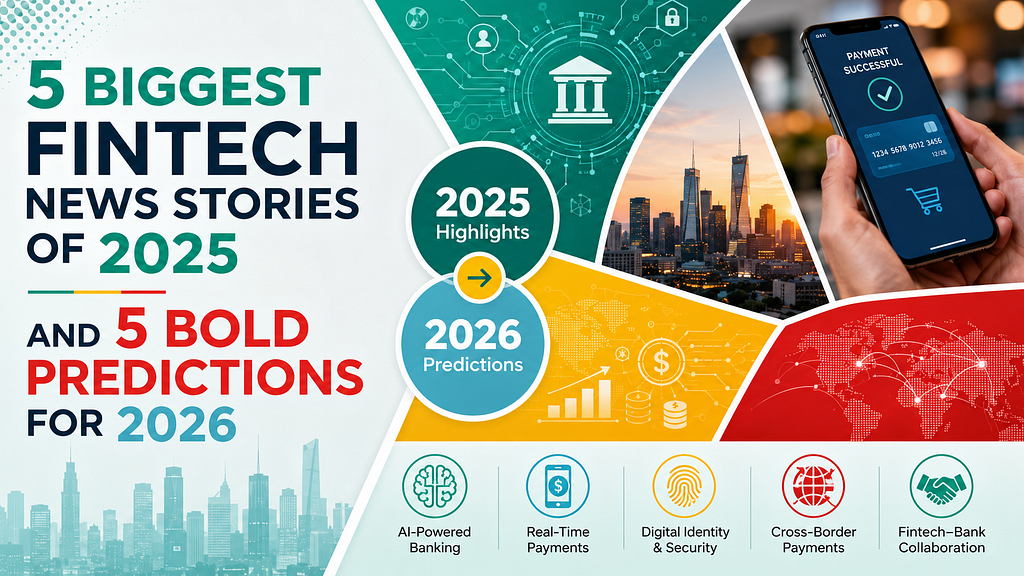
Fintech didn’t slow down in 2025, it grew up. From AI-powered banking to cross-border payments and digital identity, this was the year financial technology moved from disruption to essential infrastructure.
Every year people say that this will be the year that fintech really takes off.
2025 Was different from other years.
The fintech industry did not just talk about the buzzwords.
It actually worked on solving problems that people face.
Banks became more comfortable using intelligence.
Digital payments became more common and easy to use.
The people in charge of making rules moved faster than expected.
Consumers just expected everything to work quickly and easily.
When we look back at 2025 it is clear that there was not one big change.
The whole year was defined by the fact that things kept moving
Here are five stories that shaped the fintech industry and five things that could happen next.
1. Artificial Intelligence Became Very Important in Banking
If there was one thing that stood out in fintech this year it was intelligence.
Banks stopped asking if artificial intelligence was useful and started asking how they could use it in a way.
Artificial intelligence was used for things including:
- Finding fraud
- Helping customers
- Deciding who gets a loan
- Making sure banks follow the rules
- Managing wealth
- Predicting what will happen with money
The biggest change was not in the technology.
It was in the way people thought about intelligence.
Banks started using intelligence as a normal part of their work not just as an experiment.
This change in thinking might be more important than any product that was launched.
2. Payments Became Faster and More Common
People do not usually think about how payments work.
They only notice when something goes wrong.
In 2025 the systems that make payments faster kept getting better and were used in places.
This made people expect businesses and banks to be faster.
Waiting a time for a payment to go through is starting to seem old-fashioned.
Whether you are sending money to family paying a supplier or paying a bill speed is becoming the standard.
The future of payments is not about using digital systems.
It is about making payments happen away.
3. Digital Identity Became More Important
As financial services become more digital it is just as important to prove who you are as it is to move money.
Banks and fintech companies invested a lot in:
- Using biometrics to verify identity
- Verifying identity
- Using intelligence to find fraud
- Making it easier for people to sign up online
- Continuously verifying identity
Customers want things to be easy and convenient.
The people in charge of making rules want things to be secure.
The companies that are doing well are finding ways to give people both convenience and security.
4. Cross-Border Payments Started to Get Better
payments have been a big problem in finance for a long time.
There are fees, slow payments and complicated banking details.
In 2025 the industry made some progress.
New payment systems, coordination between banks and the use of standards like ISO 20022 made things more efficient for businesses that operate globally.
There is still work to be done. Cross-border payments are becoming faster more transparent and more customer-friendly.
5. Fintech and Traditional Banks Stopped Competing and Started Working Together
A years ago people thought that fintech would replace banks.
Things did not turn out that way.
In 2025 fintech and banks started working more often than competing.
Banks got access to technology.
Fintech companies benefited from the expertise and experience of banks well as the trust that people have in banks.
The future is starting to look like it will be about partnerships, not one industry replacing another.
Sometimes the biggest innovation is not about replacing an industry. About making it better together.
So What’s Next? Five Things That Could Happen in 2026
It is always hard to predict what will happen next. There are some trends that suggest where fintech might be headed.
The first thing that could happen is that artificial intelligence will become invisible.
Customers will not choose an app just because it uses artificial intelligence.
They will choose it because it makes things easier.
Artificial intelligence will quietly make recommendations help with decisions protect against fraud and give people personalized experiences often without them even realizing it.
The second thing that could happen is that financial services will be built into things.
You will be able to book travel manage your health run your business and buy equipment all with services built in.
Payments, loans, insurance and banking products will become part of the background not separate things.
The third thing that could happen is that cross-border payments will become almost instant.
Businesses that operate globally will expect the speed as domestic payments.
There will be investment in real-time settlement blockchain-based payment systems, artificial intelligence-powered routing and better coordination between financial networks.
The phrase “ transfer delay” might start to disappear.
The fourth thing that could happen is that following the rules will become an advantage.
The fintech companies that do well will not just be the ones that move the fastest.
They will be the ones that combine innovation with trust.
They will use intelligence in a responsible way protect peoples data keep things secure and be transparent.
These things will not just be required by law they will be what sets companies apart.
The fifth thing that could happen is that financial experiences will become very personalized.
Imagine opening your banking app and getting advice that’s just right for you.
Not just general. Random offers.
Real insights based on your goals, spending habits, investments and financial behavior.
That is where artificial intelligence, open banking and advanced analytics are headed.
The future of banking might feel like managing money and more like having a financial coach in your pocket.
The Bigger Picture
The biggest lesson from 2025 is that fintech is no longer a small part of the financial industry.
It has become part of life.
Whether you are paying with your phone getting paid from another country investing through an app applying for a loan online or using intelligence-powered financial tools chances are you are already using fintech every day.
The technology has become so common that many people do not even notice it anymore.
Ironically that is often the sign of innovation.
Final Thoughts
If 2024 was about trying things and 2025 was about making them work then 2026 might be the year that fintech really becomes mature.
Artificial intelligence will become smarter.
Payments will become faster.
Identity will become more secure.
Banking will become more personalized.
Fintech and banks will likely work together even more.
The biggest question is not whether fintech will keep changing.
It probably will.
Let’s Keep
The real question is which companies will build things that people really trust and will keep using after the excitement, about new technology fades away.
Looking back, which fintech story do you think had the biggest impact in 2025?
And if you had to make one prediction for 2026, what would it be?
Share your thoughts below. Some of the most interesting ideas about the future of finance often begin with conversations like this.
5 Biggest Fintech Stories of 2025 and 5 Bold Predictions That Could Shape 2026 was originally published in Coinmonks on Medium, where people are continuing the conversation by highlighting and responding to this story.