Reading view

There are new articles available, click to refresh the page.

Terry Myerson retires as Truveta CEO, with co-founders stepping in to lead $1B health data startup
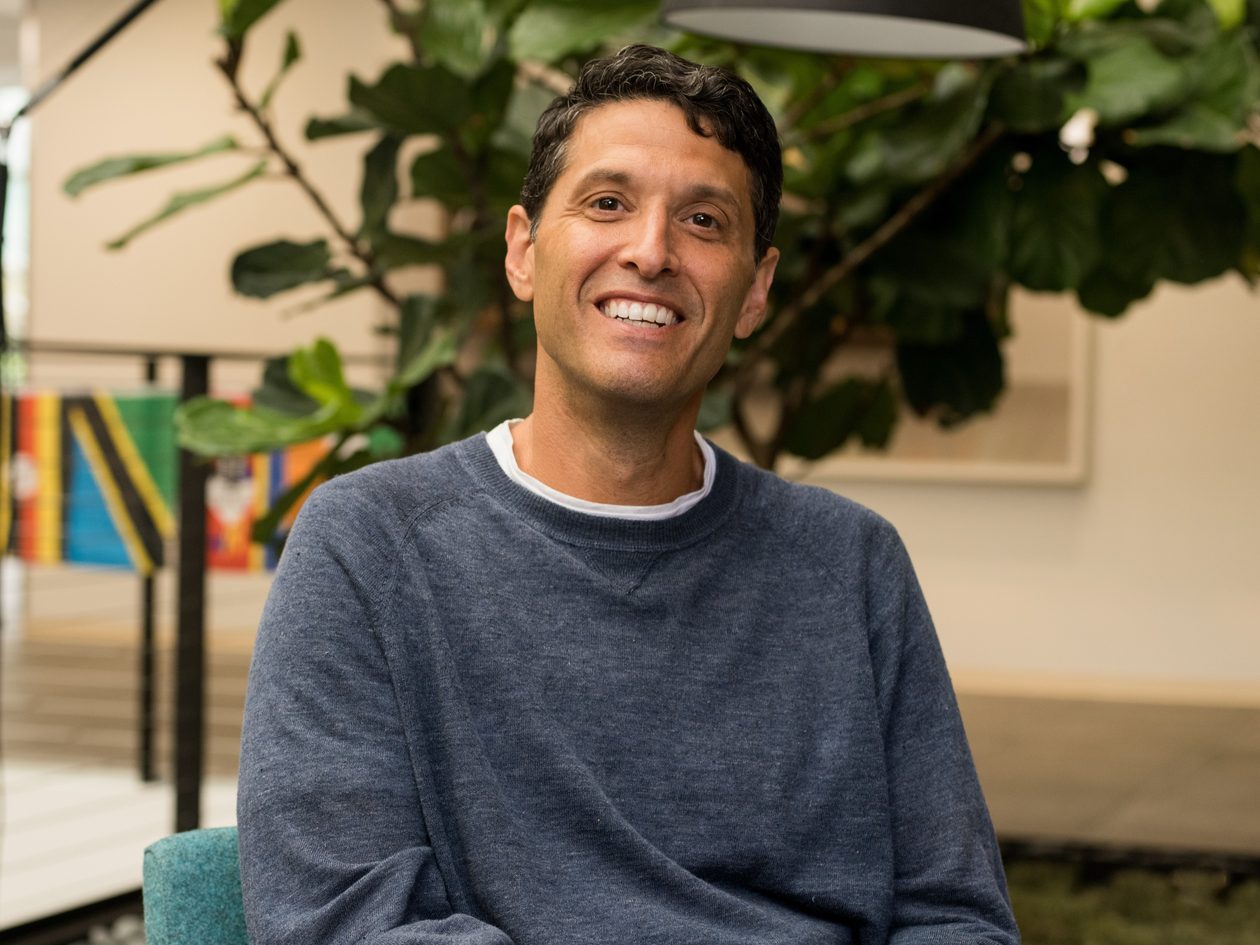
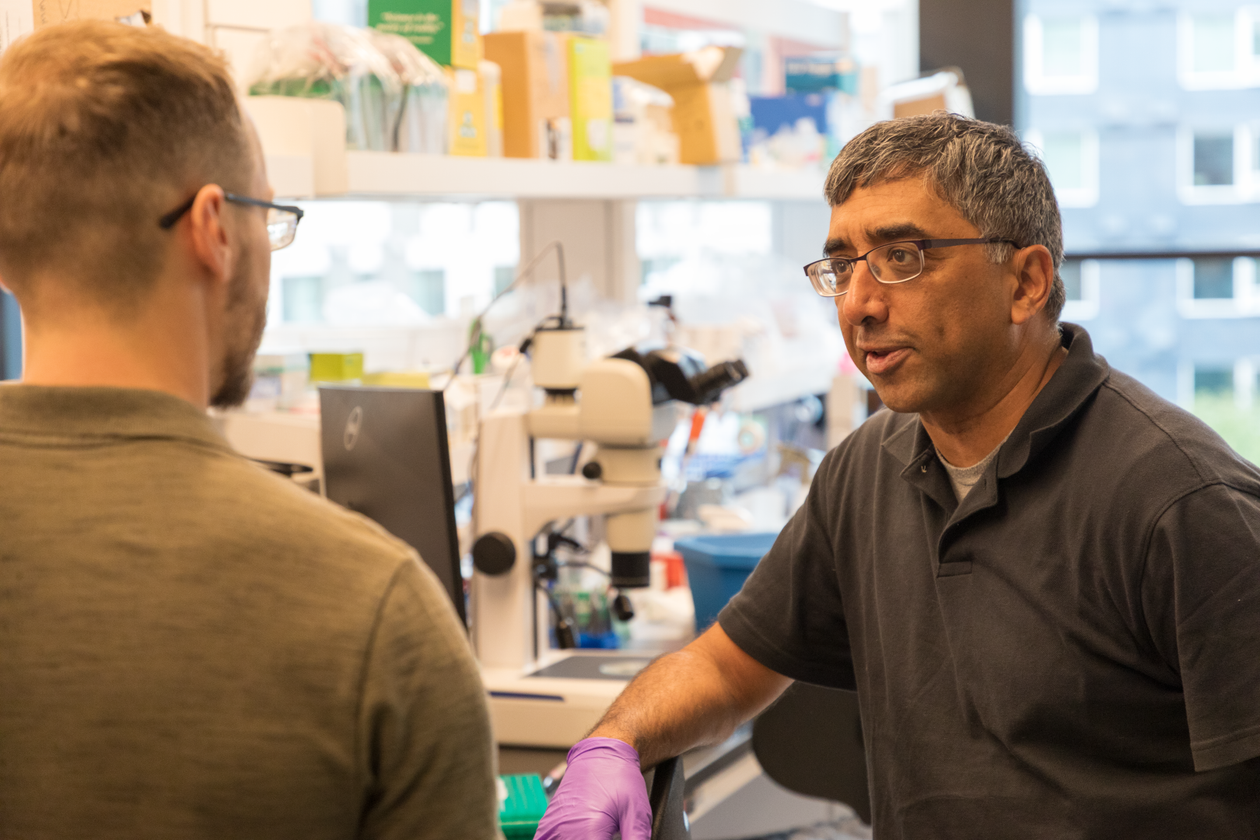
Terry Myerson, Truveta’s co-founder and CEO, will retire at the end of September. (Truveta Photo)

Terry Myerson, the former Microsoft executive who co-founded Truveta during the pandemic, growing it to 500 employees and a valuation of more than $1 billion, is retiring as CEO of the Bellevue, Wash.-based health data company at the end of September.

Truveta co-founders Jay Nanduri, CTO, and Ryan Ahern, the chief medical officer, will take over as interim co-CEOs while the board conducts a search for a permanent CEO. Myerson said in an interview that the board has a responsibility to look for “the absolute best CEO,” but he expressed hope that the search will confirm Nanduri and Ahern as the right leaders for Truveta’s next chapter.

Myerson, 54, will become an advisor to the company and step down from its board. He said he’s leaving because the business is doing well and his co-founders are ready. He also cited changes in his personal life. He and his wife, Katie, are empty nesters, and they want to travel.

“If things were not going well, I would not do this,” he said. “I’d be grinding it out. But things are going really well.”

Truveta pools de-identified patient records from 30 large U.S. health systems into a database that’s updated daily. It sells access to that data, along with analysis and AI tools, to drug makers, medical device companies, researchers and government agencies studying how treatments work in the real world.
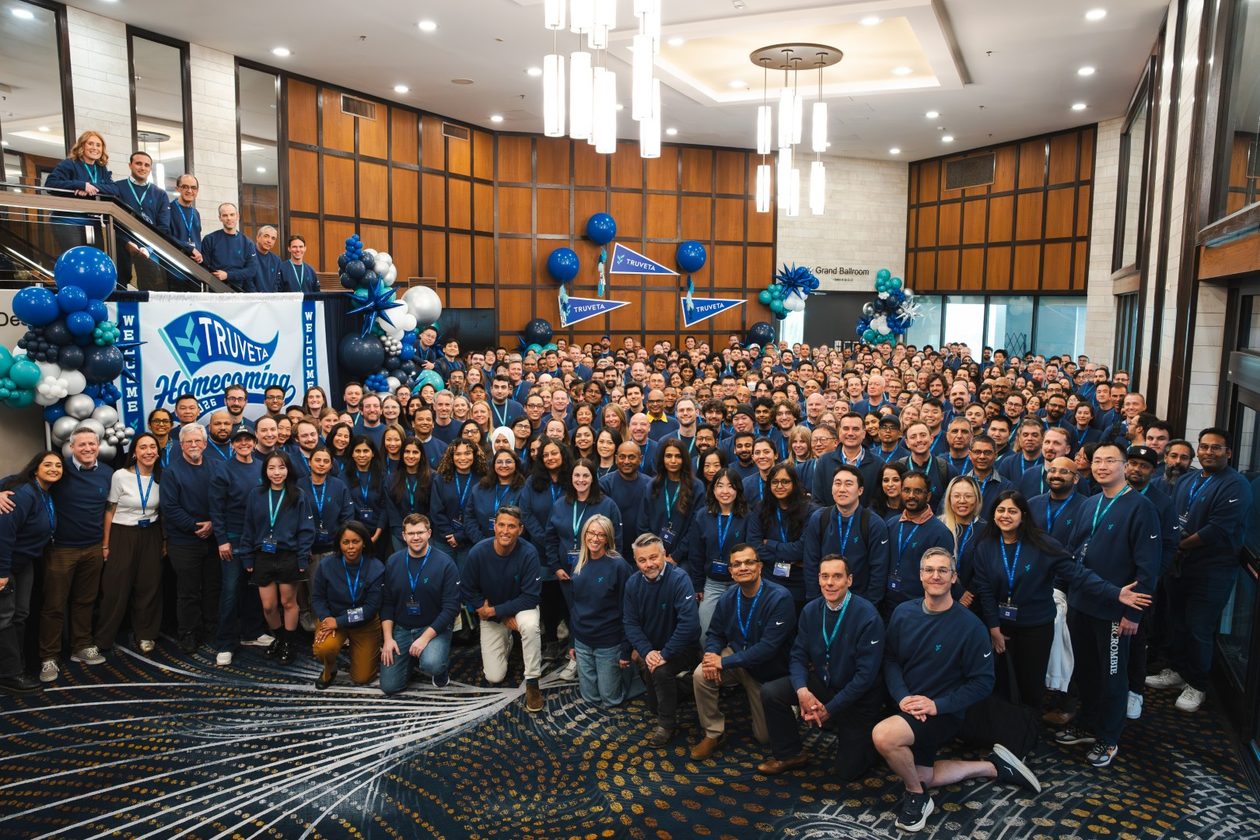
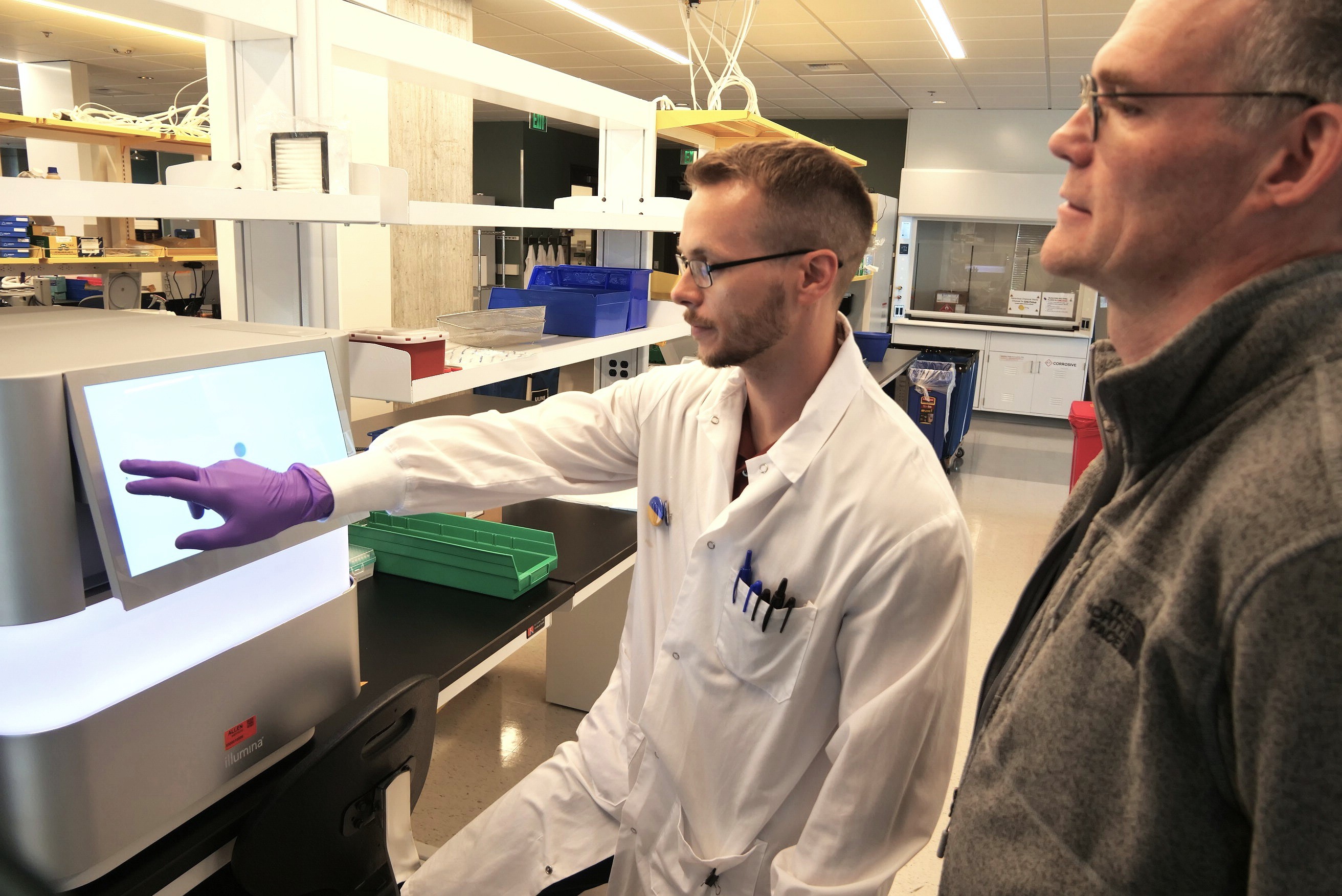
Truveta employees gather at the company’s all-company “Homecoming” meeting in April 2026. (Truveta Photo)

In a LinkedIn post announcing his retirement, Myerson noted that Truveta started “with an idea and no employees, no technology, no customers, and no data.” He wrote that what he’ll remember most are “the hundreds of Truvetans who took a chance on an ambitious idea and turned it into something real.”

Origins in the pandemic: Truveta grew out of a proposal from Providence, the Seattle-area nonprofit health system, for health systems to pool their data for research. Early in the pandemic, then-Providence CEO Rod Hochman called Myerson, who had left Microsoft in 2018 after leading its Windows and Devices Group, and asked him to build it.

GeekWire first reported on the startup in October 2020, and it launched publicly in February 2021 with 14 health systems.

Ahern was treating patients at NewYork-Presbyterian/Weill Cornell Medical Center in New York at the time. “We were giving out hydroxychloroquine, not knowing that it was actually harming patients,” he said. “It was the first time in my career that we were learning a new disease from scratch.”

Ahern was connected to Myerson through Madrona co-founder Jerry Grinstein, a former Delta Air Lines CEO and Ahern’s uncle by marriage. Myerson had joined the Seattle venture firm as a venture partner after leaving Microsoft.

Truveta says its data now covers more than 140 million patients. It published the first peer-reviewed real-world comparison of Ozempic and Mounjaro for weight loss, research that landed the company on the Today Show.

In 2025, Truveta raised $320 million in a round that included Regeneron and Illumina, bringing its total funding to $515 million. The round helped fund the Truveta Genome Project, which is sequencing leftover blood samples from consenting patients and linking the genetic data to de-identified medical records.

State of the business: Myerson declined to share revenue figures. He acknowledged that Truveta isn’t yet profitable but said it doesn’t need to raise more money. An IPO isn’t on the near-term horizon, he said, because Truveta’s revenue isn’t yet large enough for the public markets.

That leaves Nanduri, Ahern and the board with strategic decisions about which path to take over the long term. Myerson said the company has turned down offers, without elaborating.

“One of the problems with a business that’s doing well is you’ve got all those options,” he said.

“We’re blessed with a lot of options,” Ahern added.
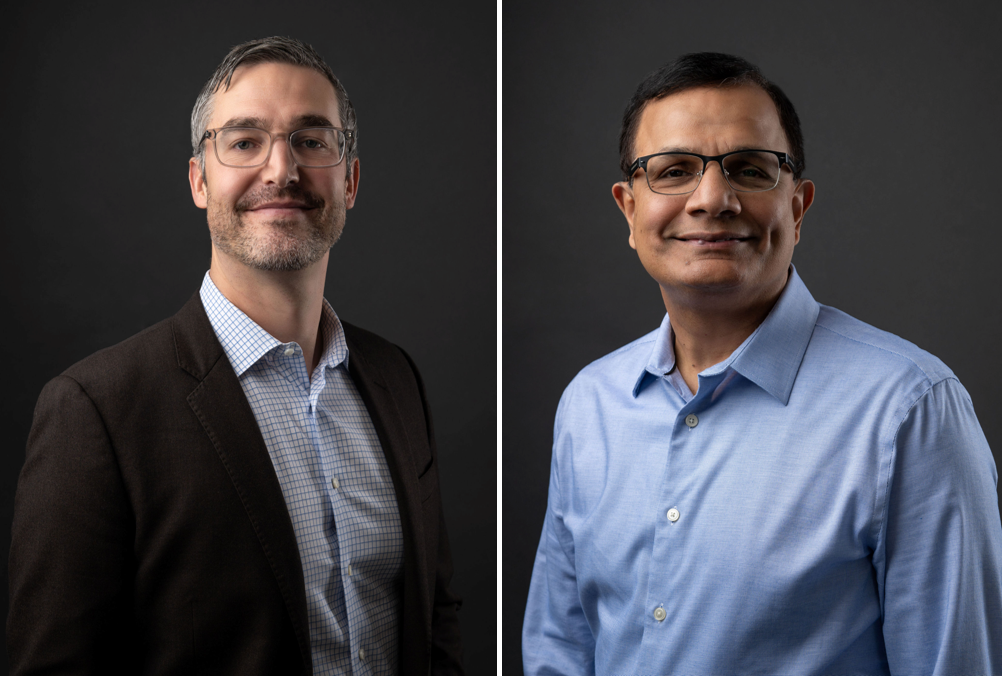
Truveta co-founders Ryan Ahern, left, the company’s chief medical officer, and Jay Nanduri, CTO, will be interim co-CEOs. (Truveta Photos)

Dividing the job: Nanduri, a former Microsoft technical fellow, will continue to lead engineering, product and the data systems behind them. Ahern, a physician who remains on the University of Washington faculty part time, will run sales, marketing, customer delivery and the evidence services team that handles regulatory work for customers.

Nanduri described it as supply and demand. “Ryan takes care of demand,” he said. “I make sure that the supply and the ecosystem and everything thrives.”

The company is expanding beyond data into AI tools for research, including Truveta Intelligence, which launched in April and lets researchers ask questions of its clinical data in plain English. Ahern said a key challenge is showing that AI-generated answers can be trusted for high-stakes decisions such as drug safety and label expansion.

Nanduri said each of the companies behind the leading AI models is doing some health-related work, and “they have approached us too.” The board has discussed how Truveta can coexist with them, he said. The company also opened a development center in Hyderabad, India, in July, expanding its engineering organization.

Truveta’s next chapter: The leadership change follows a shift at the board level. In March, Henry Ford Health executive Robin Damschroder succeeded Hochman as Truveta’s board chair after he retired from Providence and affiliated entities.

The company also added a new senior executive this year, hiring Johnathan Lancaster, an oncologist and former Regeneron executive, as president and chief scientific officer in January.

Asked whether the board changes played a role in his decision, Myerson praised both Hochman and Damschroder, describing her as a disciplined board chair, and said the transitions are all part of the company moving into its second chapter. When it comes to CEO succession, he said, the question is who will commit for the next five to seven years.

“It’s easier for me to say, gosh, Jay and Ryan have earned this,” he said. “Bet on them for the next five to seven years versus betting on me.”


Myerson’s competitive streak, well known from his Microsoft days, hasn’t faded.

Truveta is currently No. 3 on the GeekWire 200, our list of the top Pacific Northwest startups. Myerson once responded to a congratulatory note from GeekWire about the company’s status on the list with a link to a YouTube clip of the famous line from Talladega Nights: “If you ain’t first, you’re last.”

Even as he discussed his departure, Myerson made his case for the top spot, calling Truveta “an amazing Pacific Northwest success story” and noting that more than 200 of its 500 employees are in the Seattle area.

“It’s a Pacific Northwest story that’s having global influence,” he said, “and so I think it should be number one on the list.”

At this stage of his life, he didn’t rule out the possibility of a next professional chapter for himself. But asked about his immediate plans, he said he’s hoping for “a great ski year.”
America’s machinists are retiring, and two startup founders in their 20s want to salvage what they know

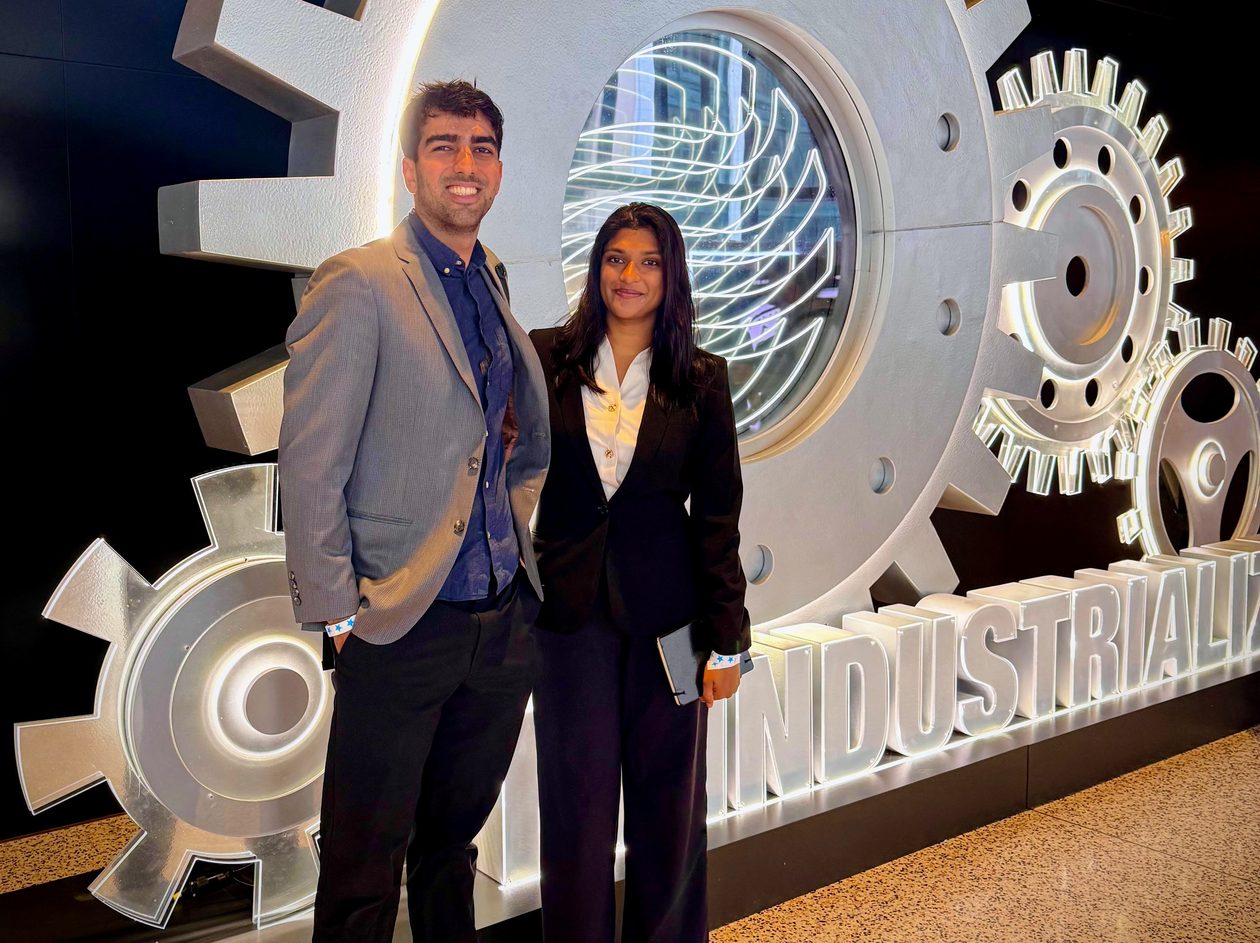
Neuramill co-founders Nick Khormaei (COO) and Nistha Mitra (CEO) at the Reindustrialize summit in Detroit. (Photo courtesy of Neuramill)

When machinists with decades of experience retire, everything they know about how metal behaves under a cutting tool — or anything else they learned through a career of scrapped parts and expensive mistakes — walks out the door with them.

A startup with roots in Seattle, started by two founders in their 20s, is building technology to capture that knowledge long before that point.

Neuramill, founded last year by CEO Nistha Mitra and COO Nick Khormaei, is developing what the company calls an intelligence layer for high-precision manufacturing.

The software reads a design file and figures out how the part should be made: which tools, which machines, and in what order. A machinist reviews and approves every plan before anything reaches the floor.

“This is a high-skill job, and nobody’s retaining this information,” Mitra said. When the machinists who know how to build complex jet engine parts retire, she said, that knowledge goes with them. “We help retain that for the future generation.”

Khormaei said the two founders spent much of the past year visiting machine shops to watch how the work gets done.

“The craft itself is so impressive,” he said. “They’re able to look at these drawings and models that come in and know exactly how to build it. It’s like they’re doing real-time physics simulation.”

Early customers and partners: The company says it has closed a six-figure contract with a major defense contractor, one of the companies known in the industry as primes. Neuramill declined to name the contractor.

Two of the machine shops using the software are Diamond Machine Works, a Seattle precision machining company founded in 1959, and VTN Manufacturing in San Jose, Calif. Satellite maker Astranis is a design partner.

Mitra said the company is not yet selling broadly, but has been paid by some of the early customers testing the software.

How they got here: Mitra, 26, has a computer science degree from the University of Maryland and spent three years at Oracle, most recently as an AI applied scientist in Seattle, working on multimodal models that reason across several kinds of data at once.

Khormaei, 24, holds bachelor’s and master’s degrees in electrical engineering from the University of Washington. He was a propulsion engineer at Boeing in Everett, where he worked on 777X fuel system electrical certification, and then spent part of last year at SpaceX as an integration and test engineer on Starlink manufacturing in Redmond.

He also grew up around machining. His father, Ron Khormaei, co-founded FINEX Cast Iron Cookware in Portland in 2012 and sold it to Lodge in 2019. Khormaei worked production there as a teenager.

Where the software fits in: Neuramill’s technology works at a stage that has stayed largely manual: after the design file arrives, and before a programmer opens the computer-aided manufacturing (CAM) software that translates decisions into machine instructions.

Rather than position the company against Siemens and Mastercam, Mitra said Neuramill plugs into those systems. The company recently joined Siemens’ Frontier Partner Program, which gives startups access to the company’s software tools.

“At this point we are very collaborative with these companies,” she said, adding that the established vendors are looking for new technology of their own.

Bay Area and Seattle: Both founders worked in the Seattle region before leaving for San Francisco, a move Mitra described to GeekWire in February. They are back every four or five weeks now, working out of Foundations, the Seattle founder hub.

“We love this ecosystem. It gave birth to Neuramill,” Mitra said. They keep coming back in part for the customers: “This is a booming ecosystem in space and in aerospace.”

Funding and team: Neuramill has raised an undisclosed amount from Ascend, Breakwater Ventures, Schema Ventures, Creative Destruction Lab, Acequia Capital and Correlation Ventures.

The team is six people plus a contractor: the two founders, a chief research scientist who worked with Mitra at Oracle, and three engineers, one of them a machinist.

What’s next: The long-term goal, Mitra said, is a “world model” for manufacturing: a system that can reason across geometry, materials and machine behavior at any level of complexity. Even then, she sees a role for the people on the shop floor.

“There is a beauty to the craft of manufacturing that we should really respect,” she said. “There are some places where humans should not be extracted out of an industry, and I think manufacturing is one of them.”

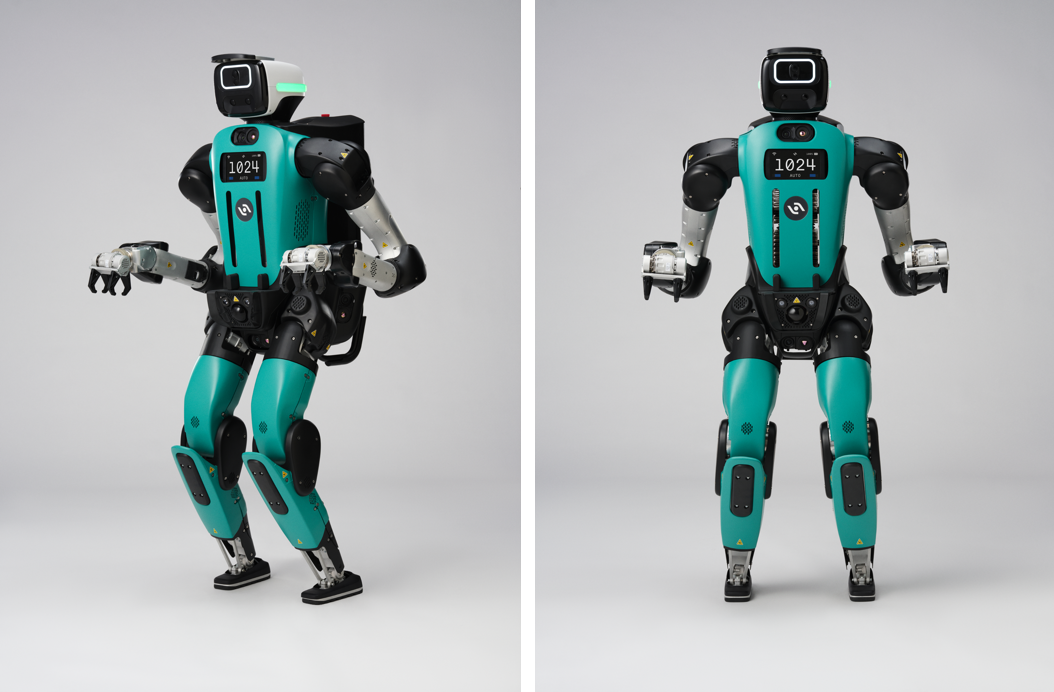
Agility’s new Digit 5 robot lifts 50 pounds, works 20+ hours a day and operates alongside people

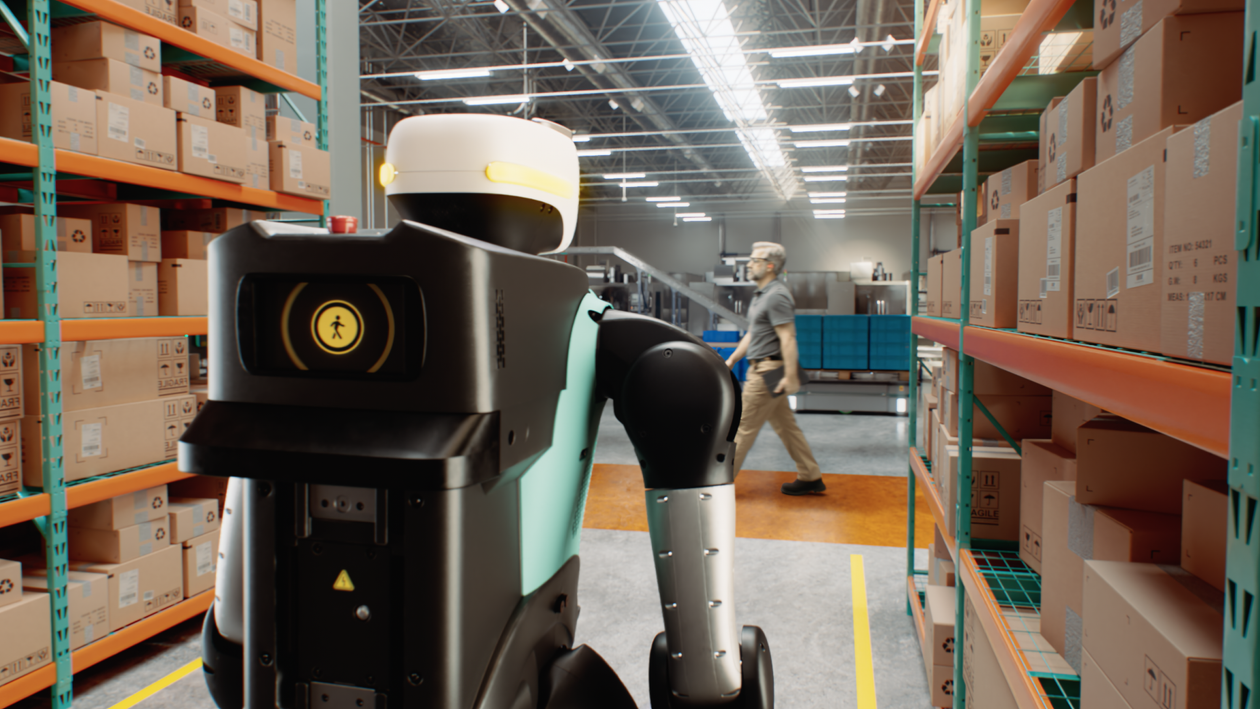
Two views of Agility Robotics’ new Digit 5, which is designed to work alongside people without safety barriers. (Agility Robotics Photo)

Agility Robotics unveiled the next version of its Digit humanoid robot, which it says is designed to work safely alongside people in warehouses and factories without the barriers that are usually required.

The Salem, Ore.-based company, which is preparing to go public through a $2.5 billion SPAC merger, said Digit 5 is its first humanoid built for “cooperatively safe” work at scale.

The robot uses AI and multiple sensors to watch for nearby people. Depending on the situation, it steers around them, stops or sits down. Visual and audio cues signal what it’s about to do, and a separate safety controller triggers its responses when someone gets too close.

Digit 5 can lift up to 50 pounds, 40% more than its predecessor, and reach objects as high as 7.2 feet off the ground, up from 5.5 feet, according to the company. A new battery runs for 90 minutes and recharges in 9 minutes, which Agility says allows more than 20 hours of work in a 24-hour day. Its grippers can be swapped for different jobs.

“We built it to the exact requirements our customers gave us after three years of Digit 4 working on their production floors,” said Agility CEO Peggy Johnson, a former Microsoft executive and Magic Leap CEO, in the announcement.

Digit 5 signals that it has spotted a nearby worker in this rendering. (Agility Robotics Image)

Digit 4, the current model, has mostly moved totes, logging more than 65,000 hours at customers including GXO, Schaeffler, Amazon and Toyota’s Canadian manufacturing arm, according to the company. Agility says Digit 5 will take on more of a facility’s work — unloading pallets, tending machines, gathering parts and inspecting items before loading them back onto pallets for shipment.

Amazon, an early Agility investor, has run multiple pilots of earlier Digit models, including one GeekWire observed at a warehouse south of Seattle in 2023. It bought five Digit robots for $1.05 million, according to Agility’s S-4 registration statement, filed with the SEC this month in connection with its merger with Churchill Capital Corp XI, a special purpose acquisition company.

Agility says it had more than $300 million in multi-year orders for Digit 5 as of May, contingent on hitting certain milestones. According to the S-4, those orders are from one customer, for 1,000 robots over three years. The filing doesn’t name the customer, but it also describes a May deal for at least 1,000 robots with a “related party,” an accounting term for those with close ties to a company, such as major investors.

Agility had $1.78 million in net sales in 2025, up from $310,000 the year before. Its loss from operations doubled to $140.2 million.


Its auditor, Grant Thornton, included a going-concern warning in the report, citing substantial doubt about the company’s ability to keep operating. Agility said in the filing that the cash forecasts behind that conclusion didn’t take into account the SPAC deal, which the companies said in June could provide more than $620 million in gross cash proceeds before any shareholder redemptions.

In the S-4, Agility names Boston Dynamics, Tesla, Apptronik, Figure AI and 1X Technologies among its competitors, many of which it describes as well-funded.

Early access to Digit 5 is expected to begin in the first half of 2027, with general availability by the end of the year. The robots are assembled at the company’s RoboFab factory in Salem, which is designed to produce up to 10,000 robots a year.

Gates Foundation bets $1B on AI to boost global health, agriculture and education

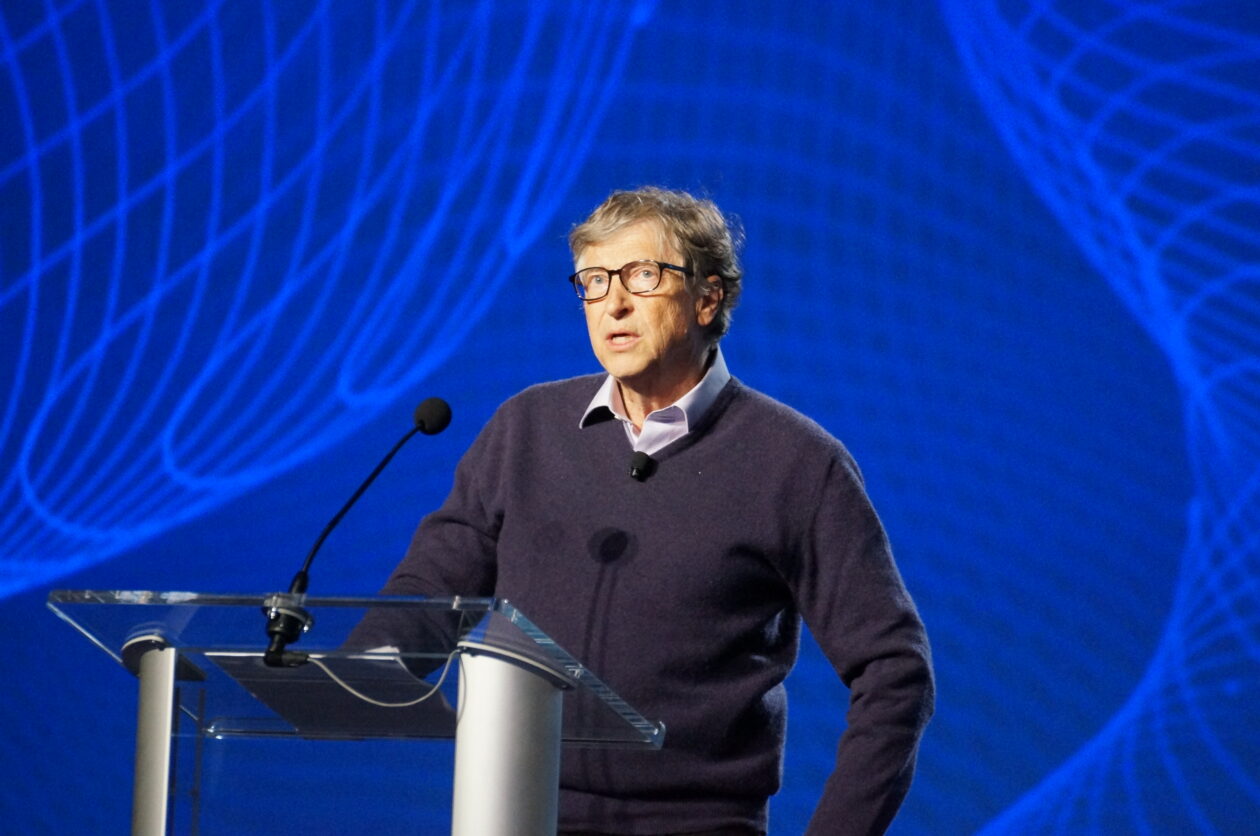
“AI could be a great equalizer — or widen the gap,” Bill Gates writes in a new Gates Foundation report. (GeekWire File Photo / Todd Bishop)

The Gates Foundation is pledging to spend at least $1 billion over the next two years on artificial intelligence for health workers, farmers and teachers, largely in the world’s poorest countries, funding AI tools for people the market would otherwise overlook.

The bet is that AI can help reaccelerate the world’s progress against child mortality, poverty and disease, which has slowed sharply as governments cut global health funding.

The Seattle-based foundation’s new financial commitment, released Monday evening in conjunction with its 10th annual Goalkeepers Report, illustrates the double-edged sword of AI at a moment when the U.S. in particular is preoccupied with what the technology might damage or destroy.

Bill Gates, who issued his own AI warnings in an essay three weeks ago, writes in the new report that the risks “are real and deserve serious attention.” He adds, “AI could be a great equalizer — or widen the gap. This is not a long-range prediction. It’s a present-tense choice.”

In this case, Gates writes, he’s focusing on “the possibility that AI, if shaped well, could expand who has access to solutions, opportunities, and knowledge that has too often been out of reach.”

The window is short, he writes: “I believe that the decisions made in the next 12 to 18 months — about how AI is built, funded, and deployed — will determine whether this technology primarily benefits the people who already have the most or reaches those who have the least.”

Gates Foundation CEO Mark Suzman, in an interview with GeekWire, called the $1 billion a “down payment,” saying he expects the figure to grow significantly after the first two years.

For this first installment, 40% of the money will go to education, 40% to health care, 10% to agriculture and 10% to digital infrastructure, including datasets in languages the models don’t handle, according to the foundation.

More than 90% of the data used to train early large language models came from English-language sources, according to the report. Leading AI speech recognition systems make errors less than 6% of the time in English and more than 60% of the time in Yoruba, a West African language spoken by tens of millions of people, for example.

Most people in Africa use feature phones rather than smartphones, Suzman said, so the tools have to work by voice. That means collecting recordings of speech, not just written text, in local accents and including children’s voices. He said the foundation works with Google and Microsoft on AI language initiatives.

Winding down: Gates announced in May 2025 that he would give away virtually all his wealth and close the foundation in 2045, which requires doubling its spending over those 20 years. The foundation had previously planned to close 20 years after his death.

As part of that plan, the foundation will need to give away $200 billion before it shuts down. Its budgeted payout is $9 billion this year, the largest in its history. Suzman said the $1 billion over two years comes out of its core budget.

Goals for its final two decades include cutting preventable child deaths in half again, eradicating polio and malaria, and bringing tuberculosis and HIV under control.

The report’s data section shows how far off the pace the world is. Child mortality, neonatal mortality and HIV are all projected to miss their 2030 targets. HIV incidence is on track to fall only to 0.22 new cases per 1,000 people, more than 10 times the target of 0.02.

Early AI results: The report makes the case that AI could change those trajectories. It points to a number of tools already in use in different settings:

  • Penda Health, a network of affordable clinics in Nairobi, Kenya, where an AI tool built into patient records has raised diagnostic accuracy by 16 percentage points.
  • In the U.S., seventh graders using a tool called Kiddom Atlas across 21 middle schools gained the equivalent of six extra months of learning in a single year.
  • In India, the state of Maharashtra runs a free AI advisory service called MahaVISTAAR that has signed up more than 740,000 farmers, with 70,000 more joining every month.

The foundation has supported all three, according to the report’s endnotes. The endnotes also cite OpenAI’s account of its work with Penda Health on the clinical copilot.

One caveat: the evidence behind the examples is early. Suzman said the education work is “still on a relatively small scale,” and pointed to agriculture as the area already operating at size.

Suzman said the foundation spent years experimenting with AI without committing at this scale, wary of getting ahead of what the technology could actually deliver in its areas. Progress in the models over the past year, and results from early investments, convinced him otherwise.

“We now can state with a pretty high degree of confidence there are real deliverables that we can see across health, across education, across agricultural development,” he said.

What AI won’t fix: Asked whether AI can substitute for the money the U.S. and other governments have cut from global health, Suzman said: “Sadly, no.” The cuts run to “tens of billions of dollars,” he said, and they are hitting basic services now. He cited the purchase of bed nets and antiretroviral drugs, and care for mothers before and after birth.

“That’s affecting families right now with a real impact,” he said. “Ideally, you combine the two [AI and aid funding], and that’s how you get hugely accelerated progress.”

Suzman said the foundation will keep pressing the U.S. to remain a leader in global health. Despite the cuts, he said, it has been encouraging to see the country stay a partner in programs such as the Global Fund to Fight AIDS, Tuberculosis and Malaria, and he noted that Congress has moved to fund these areas more fully than the administration has.

“We believe that currently reflects the U.S. public’s broad view and support for these areas, when you can see the concrete results,” he said.

The Epstein review: Asked how the scrutiny of Gates’ ties to Jeffrey Epstein has affected the foundation’s work, Suzman pointed to the external review the foundation released in July.

Conducted by the law firm WilmerHale, it found no evidence that Epstein received foundation money or that the foundation knew of his crimes. It counted roughly 30 meetings from 2011 to 2014, involving Gates and nine other foundation leaders and staff, and found that staff had repeatedly raised concerns about associating with him.

The board adopted the recommendations that followed, among them centralized vetting of brokers and co-funders and tougher conflict-of-interest rules.

Suzman expressed optimism that the review has cleared the way for the foundation to keep working across the full range of governmental and philanthropic partnerships. “Hopefully it’s full speed ahead,” he said, “and with these AI shifts, that’s more important than ever.”

‘The warning signs are flashing’: New regional partnership calls for cohesive Seattle-area tech strategy

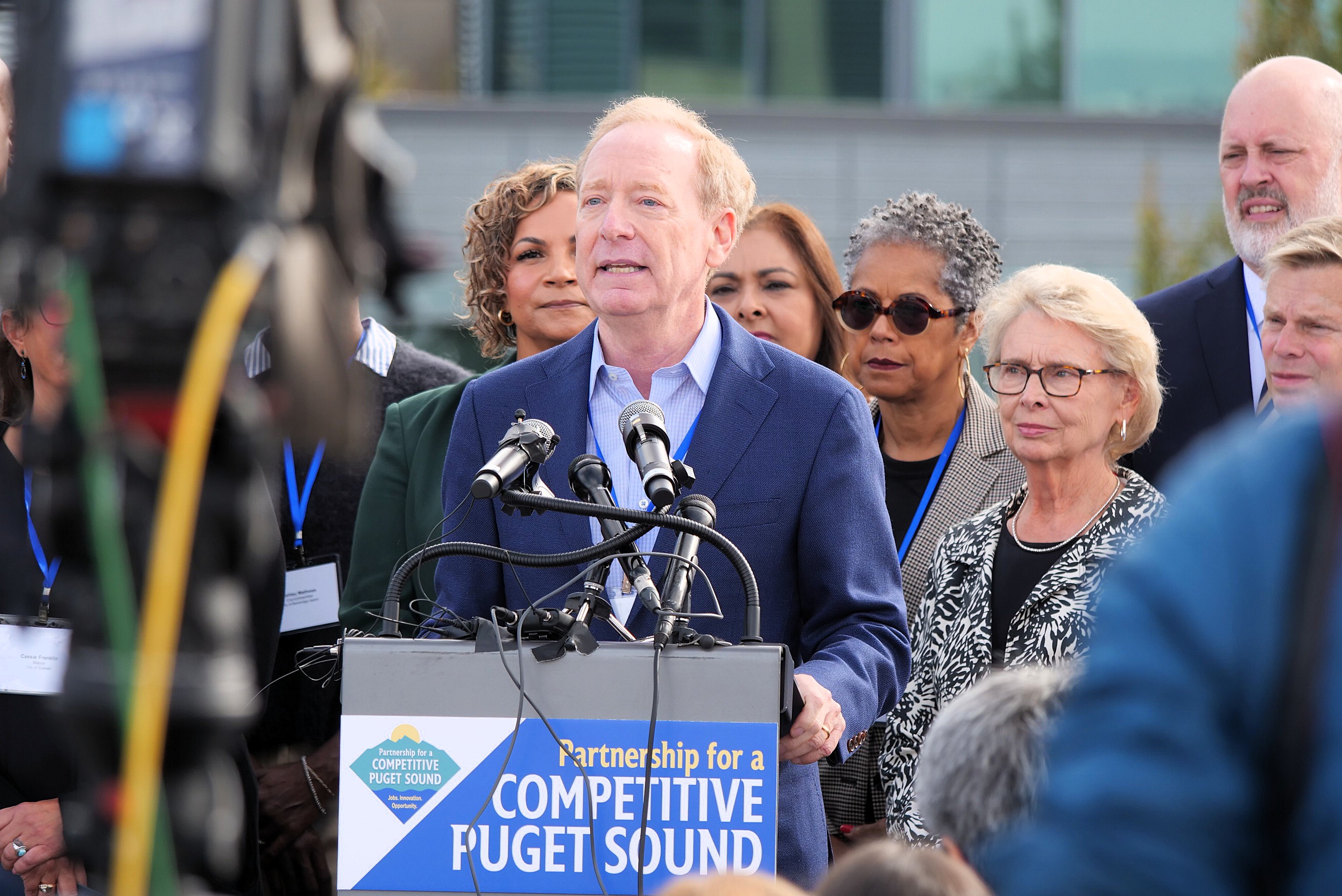
“You should tax things you want to discourage, like cigarettes, not jobs.” Microsoft’s Brad Smith at Monday’s launch of the Partnership for a Competitive Puget Sound, with former Gov. Chris Gregoire at his left. (GeekWire Photo / Todd Bishop)

Detroit, Cleveland and Pittsburgh each had their moment in the sun a century ago, Microsoft Vice Chair and President Brad Smith said Monday — and then the warning lights started flashing, and their leaders at the time failed to heed them.

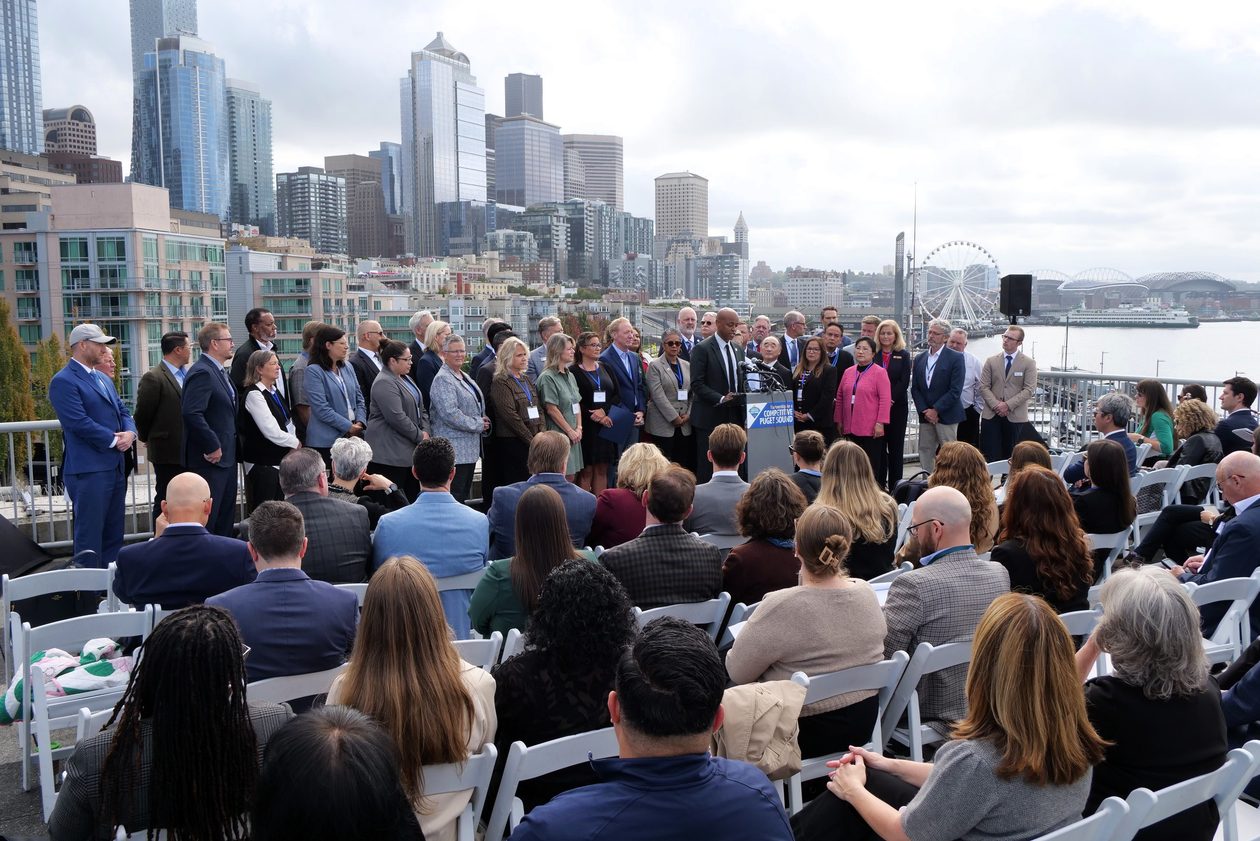
“Well, here we are. It is 2026,” Smith said at a press conference, flanked by dozens of regional leaders, with the Seattle skyline behind them. “And the warning signs are flashing on our economy.”

Smith was speaking at the launch of the Partnership for a Competitive Puget Sound, a Challenge Seattle initiative that brought together roughly 50 elected officials from King, Kitsap, Pierce and Snohomish counties — two county executives, around 20 mayors, port commissioners and about a dozen state legislators — along with labor leaders and business executives, behind a 20-point plan for reversing the region’s slide.

The region lost nearly 7,000 jobs in 2025, according to a report issued by the group, the first time in two decades outside a recession or the pandemic that Seattle-area employment growth has trailed the nation’s. Washington has fallen from 32nd to 47th in CNBC’s ranking of states by cost of doing business since 2017.

An ‘intentional’ regional tech strategy: The report makes a pointed observation about technology: aerospace has a coordinated regional agenda and tech doesn’t, despite tech accounting for nearly one in 10 regional jobs and about 24% of total payroll.

Aerospace knows what it’s working on: the next airplane, the space industry, sustainable fuels, supplier diversification. Technology, “despite being one of Puget Sound’s defining economic anchors, does not yet have an equally intentional regional strategy,” the report says.

King County Executive Girmay Zahilay addresses the crowd Monday, with the downtown Seattle skyline behind him. More than 32% of the city’s central business district office space sits vacant, according to the new regional report. (GeekWire Photo / Todd Bishop)

Without one, it adds, the region risks losing “jobs, technology investment, headquarters, talent, and company growth” to the Bay Area, New York, Boston and Austin. The goal is “not simply to promote growth, but to protect and strengthen the region’s position as a leading technology center.”

Challenge Seattle says it will write that strategy with the Puget Sound Regional Council, built around two priorities: keeping the big tech companies investing here, and making it easier for startups to scale. Related recommendations target industrial space for AI hardware startups, commercial space, and the region’s fusion cluster.

The report sets no budget or measure of success for the tech strategy, and no deadline beyond its general goal of progress within three years.

A regional wake-up call: Many of the recommendations are changes to how local government operates, not new spending: deadlines for permit decisions, a designated business contact in every city and county, and a strategy for dealing with the way taxes stack across state, county and city.

“This is, for us, a wake-up call,” said former Washington Gov. Chris Gregoire, CEO of Challenge Seattle, launching the initiative during the press conference. “We cannot resort to relying on yesterday’s success while tomorrow’s jobs go somewhere else.”

April Sims, president of the Washington State Labor Council, said businesses need predictability and enough margin to invest, innovate and take risks — but “working people need margins, too.”

King County Executive Girmay Zahilay said his office has hired an economic development team and is beginning an internal permitting audit. “AI is transforming our economy seemingly overnight,” he said, calling the 7,000 lost jobs “quite alarming.”

The group also released a playbook for Puget Sound mayors, drawn from interviews and surveys with local leaders, on building what it calls a culture of partnership with business.

Seattle as a Microsoft litmus test: Asked by GeekWire during the press conference what it would take for Microsoft to return and grow in Seattle proper, where it previously had offices in South Lake Union, Smith first pointed out that he was standing in front of Redmond Mayor Angela Birney.

“We have a great mayor, and every day we get up and we’re excited to go to work in Redmond, Washington,” he said, to laughter from the assembled officials.

Smith also pushed back on the premise: Microsoft moved to the Eastside from Albuquerque in 1979 and never had a large presence in Seattle, so he wouldn’t use the city as the point of comparison.

Then he turned to Seattle’s JumpStart payroll expense tax.

As structured, the payroll tax “is really a tax on tech jobs,” Smith said, “and that’s why you’re seeing more tech jobs move from Seattle to places like Bellevue and the Eastside.” He noted that San Francisco abolished its payroll tax the same year Seattle adopted one, in 2021.

“You should tax things you want to discourage, like cigarettes, not jobs,” he said.

He tied the issue to the larger impact of AI on jobs. “We need people to succeed to some degree in a world of AI,” Smith said. “And you don’t want to make the cost of employing people more expensive, at the same time that AI is increasingly adding its own new form of competition.”

“There’s nothing that would lead to the decline in jobs in this state faster than a replication of the JumpStart tax,” he said. “And if Seattle wanted to do one thing to increase jobs in Seattle, it ought to revisit whether a payroll tax makes any sense.”

Then he added a caveat: “That’s probably something that would impact other companies more than Microsoft.”

Amazon, which has been reported to be the largest payer of the tax, did not have a speaker at Monday’s event. Individual Amazon execs are listed in the acknowledgments in the Challenge Seattle report, though the report says participation doesn’t imply endorsement.

View from Olympia: During the press conference, Senate Majority Leader Jamie Pedersen, D-Seattle, was asked whether Washington risks becoming an outlier among states on taxes. The Legislature has been correcting course, he said, pointing to two moves from this year’s session.

One was the estate tax. Lawmakers raised the top rate to 35% in 2025, the highest in the country, and reversed themselves this March, returning it to 20% as of July.

The other was the millionaires tax — a 9.9% tax on household income above $1 million, signed by Gov. Bob Ferguson and projected to raise roughly $3 billion a year. It doesn’t take effect until 2028, and Seattle tech leaders warned it would push founders and investors out of the state.

Pedersen cast it as the fix for a different kind of outlier status: Washington’s business and sales taxes are high because it’s one of the few states with no personal income tax at all. The new tax would let Washington “join 41 other states that have a personal income tax,” he said.

Voters get the last word in November. Initiative 645, backed by Let’s Go Washington, qualified for the ballot in July and would repeal the tax. If it survives, Pedersen said, a statewide payroll tax is “vanishingly unlikely” next session.

Seattle’s mayor weighs in: Seattle Mayor Katie Wilson, who was an architect of the JumpStart tax before running for office, was not among the speakers at the press conference. She opened the regional session that followed, and said the region needs to do a better job telling its own story.

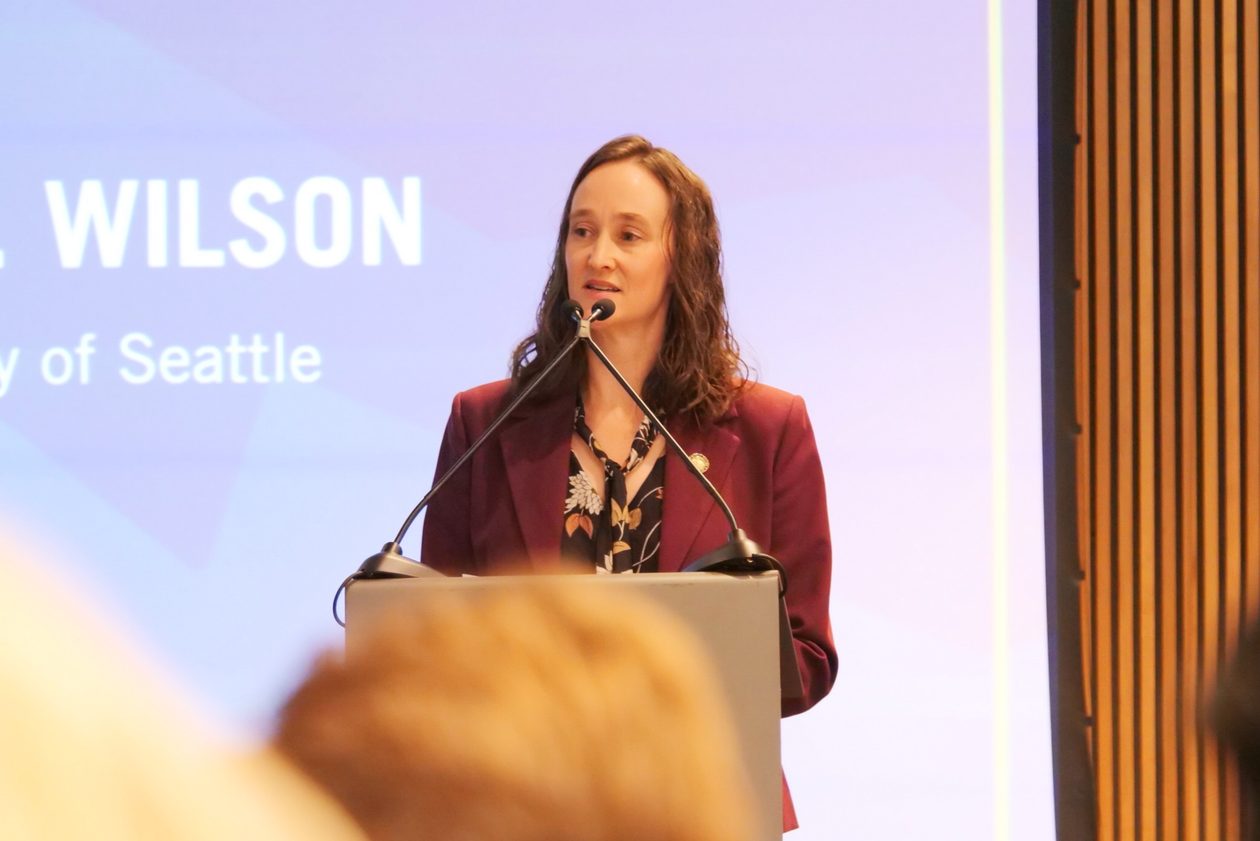
Seattle Mayor Katie Wilson opens the regional action session that followed Monday’s launch of the Partnership for a Competitive Puget Sound. (GeekWire Photo / Todd Bishop)

“There are some forces and interests that are pushing a narrative that does not want Seattle or our region to succeed,” Wilson said, “and we must counter that with a new commitment to a shared sense of destiny, because Seattle’s success is Bellevue’s success, Pierce County’s success is Snohomish County’s success.”

She called it a fragile moment and said the time to act is now, pointing to the economic actions she announced last week in conjunction with an independent report commissioned by the city and released by Seattle’s Office of Economic Development.

That report, “Seawall: Building a Resilient Seattle Economy,” found Seattle’s tax structure unique among peer cities in the way it “specifically penalizes the hiring of senior, high-compensation workers,” with the burden falling overwhelmingly on large tech employers.

Hiring a software engineer at $650,000 in total compensation costs about $17,000 more a year in Seattle than in Bellevue at JumpStart’s top rate, the researchers found.

The city report, conducted by the economic consulting firm Formation, said Seattle should bet on cleantech, the sector where the city owns the utility, writes the building codes and controls permitting and land use. It’s one place where Seattle has real leverage over its own economy, the researchers argued.

“It’s striking how much agreement we share across labor, businesses, and government,” Wilson said. “This is not a call to ignore our challenges, but to tackle them with a shared sense of possibility.”

She did not address the payroll tax in her remarks.

Microsoft floats rules for AI models as industry weighs slowdown

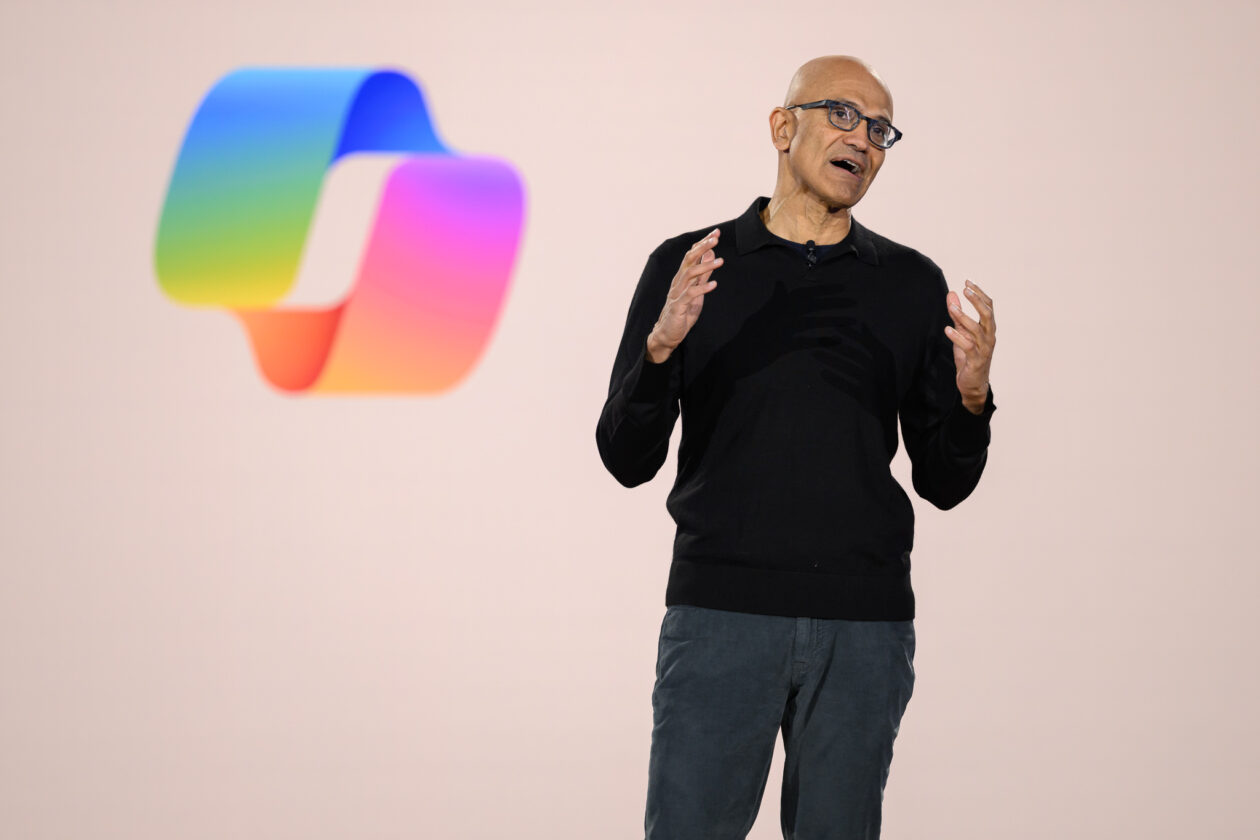
Satya Nadella says Microsoft welcomes the “deliberate pacing needed to get alignment right.” (GeekWire File Photo / Kevin Lisota)

“People matter more than AI.”

That’s the premise of a draft code of conduct Microsoft published Monday morning for the AI models it’s developing in-house. The 37-page document would bar its models from resisting shutdown, setting their own goals, or hiding their reasoning from human auditors.

The document applies to Microsoft’s MAI models, the in-house family the company began building after forming a superintelligence team in late 2025. Microsoft has since released seven homegrown models in what it described as a push for long-term self-sufficiency in AI.

The company says the models should remain “subordinate to humanity, subject to meaningful human oversight and control.”

“AI is moving fast,” the company says in a blog post. “As it does, we believe it’s worth writing down the rules and the motivations behind it, and doing it in as open a space as possible.”

Microsoft acknowledges there’s no guarantee its models will follow the rules. “Written objectives alone can never ensure alignment,” the company says, calling the document a “north star,” not “a guarantee of present-day performance.”

The company says it also filters what its models produce, watches how they behave once released, and limits what they’re allowed to do.

Microsoft’s move comes amid a growing debate over the pace of AI development. In an essay over the weekend, Anthropic CEO Dario Amodei called for slowing down AI advances, saying the pace of development has started to surpass the industry’s ability to keep AI systems safe.

As a first step, Anthropic committed to giving outside evaluators permanent, employee-level access to its systems.

Industry reaction to Amodei: OpenAI CEO Sam Altman agreed and said OpenAI would make the same commitment to independent evaluators. Elon Musk’s response: “Dario is right.”

President Donald Trump rejected the idea of guardrails outright Monday, blaming a “SICK conspiracy” for public backlash over AI data centers and writing that “the only one that is happy about it is China,” alluding to concerns about American competitiveness in AI.

David Sacks, who served as the White House AI and crypto czar until March, said the two companies should slow down on their own and questioned their motives, arguing that a slowdown is already good business for them and that new industry rules would mostly serve to lock in their lead.

Microsoft CEO Satya Nadella weighed in Sunday, writing on X that the company welcomes “the research, focus, and deliberate pacing needed to get alignment right,” using the industry’s term for making AI systems reliably do what people intend.

Nadella added that the effort “cannot be controlled by a handful of entities, but must have broad representation across the ecosystem, countries, and fields, including academia.”

Microsoft’s draft code of conduct: Mustafa Suleyman, the Microsoft AI CEO, told CNBC the document had been in the works for about five months, and that the company decided to publish it now given the current discussions.

Microsoft and Anthropic are business partners. Microsoft agreed last November to invest $5 billion in Anthropic, as part of a deal in which Anthropic committed $30 billion to Azure. Claude models run inside Microsoft 365 Copilot, and Microsoft’s Copilot Cowork tier integrates Claude.

One place where the two companies may diverge is the question of what AI models are, exactly. Microsoft’s code of conduct says its models are “not conscious and should not be designed to imitate consciousness.” It also rejects “the pursuit of legal personhood, or the idea that models might deserve welfare, or be entitled to rights.”

The Verge called that portion of the document “a direct swipe at AI welfare research and model consciousness — concepts Anthropic has been pushing hard on lately.”

Anthropic runs a research program on model welfare. It has given some Claude models the ability to end abusive conversations, and committed to preserving the weights of retired models. Amodei has said he’s open to the idea that a model could be conscious.

Microsoft is taking public comment on its code of conduct for six weeks through a feedback form. It says it will publish a summary of the responses and a revised version later this year, to guide development starting in 2027. It says it isn’t training its current models on it.

The company’s AI team developed the draft with its responsible AI, legal, red teaming and safety teams, consulting outside experts in law, ethics, linguistics and philosophy, plus focus groups drawn from the public.

Study warns Seattle over-relies on Big Tech; Seattle Times v. Microsoft; Apple’s iPhone Duo echoes the past

This week on the GeekWire Podcast: A study commissioned by the City of Seattle says the city is not in decline but is in danger — finding that 10 companies, nine of them in tech, pay three-quarters of the payroll tax on large employers, and that the tax structure uniquely penalizes the hiring of senior, high-compensation workers.

The report says Seattle should be most concerned about AI but most active in cleantech, the one industry the city can actually shape, since it owns the electric utility and controls permitting, building codes and land use.

Meanwhile, the Seattle Times and Newsday sue Microsoft and OpenAI, accusing them of copying hundreds of thousands of articles to train their AI models, putting Microsoft’s hometown paper against a company that helps fund some of its journalism.

And Apple’s first foldable arrives as the iPhone Duo, reviving the name of the dual-screen phone Microsoft gave up on in 2023, with Surface fans arguing Apple took more than the name.

Which leads us to a new GeekWire Trivia Challenge about the Microsoft products that Apple later turned into categories. Stick around to the final segment to see if you can figure it out.

Upcoming Event
AI meets real estate
GeekWire, in partnership with Real Estate at Work, is recording the GeekWire Podcast live at 4 p.m. Wednesday, Sept. 16, with Toby Roberts, SVP of Engineering at Zillow. John Cook and Todd Bishop host with Real Residential broker Leka Devatha at Atmosphere Seattle. Grab a ticket.

Subscribe to GeekWire in Apple Podcasts, Spotify, or wherever you listen.

Audio editing and production by Curt Milton.

Microsoft comms chief Frank Shaw to exit after nearly three decades shaping the company’s message

Frank X. Shaw addresses the media at Microsoft on May 18, 2025, in advance of the Build conference. (GeekWire Photo / Todd Bishop)

It’s the end of an era at Microsoft: Frank X. Shaw, the executive who oversaw the tech giant’s communications for nearly three decades, first at an external agency and for the last 17 years as one of its senior leaders, is leaving at the end of the year.

Shaw, 64, said he’s not retiring, although he doesn’t have another job lined up. He plans to stop working for a while, do some of the things he hasn’t had time for, and then decide what’s next.

“I have had a ringside seat at some of the biggest leadership, technology, and business transformations that have ever taken place,” Shaw said, sharing the news of his departure (under embargo) in a phone call Thursday afternoon. “I just feel incredibly fortunate.”

He said he had been discussing his potential departure for some time with Takeshi Numoto, Microsoft’s chief marketing officer, looking for the right moment.

Microsoft has not announced a successor for his role as chief communications officer. In a LinkedIn post, Shaw said the company will consider internal and external candidates.

A statement from Shaw’s colleagues in corporate communications credited him for his many years shaping Microsoft’s “voice and reputation with intelligence, candor and wit. His leadership and contributions to the company are too extensive to list, as is the number of journalists who have, at one point or another, used his name in vain.”

A former Marine Corps public affairs officer, Shaw has worked with all three of Microsoft’s CEOs. He started on the agency side, at Waggener Edstrom — now known as We. Communications — when Bill Gates was still running the company.

He built his reputation defending and advocating for Microsoft through some of its hardest stretches: the antitrust years, the Windows Vista backlash, the scramble to replace Steve Ballmer as CEO, and the weekend in 2023 when OpenAI’s board fired Sam Altman.

As the company’s top communications executive, he has also told the story of Microsoft’s reinvention under CEO Satya Nadella, from the LinkedIn and Activision Blizzard deals to an AI push that has carried Azure past $100 billion in annual revenue.

Evolving with technology: Shaw has spent much of his career closely watching the tech landscape and moving Microsoft’s voice into new channels as they emerged.

“We’re always thinking about what is the art and science of communications,” Shaw told PRWeek. “How do we reach our audiences most effectively in a changing environment?” He called the arc from print to radio and TV to social media and newsletters a “constant evolution of influence.”

He turned the corporate blog into a place where the company argued its own case, writing “Microsoft by the numbers” himself in 2010 — a stat-by-stat comparison against Apple and Google that TechCrunch dubbed “fantastic passive-aggressive.”

He and his team experimented with different and risky methods of telling the company’s story, holding mass briefings under embargo and publishing documents known as the “Book of News” in advance of its major keynotes and conferences. The prospect of a reporter having to answer to “fxs” was no doubt a factor in ensuring the news (mostly) didn’t leak.

Shaw hired Steve Clayton out of a technical role at Microsoft in London, where he had been blogging about the company unofficially out of frustration with how it was perceived, and made him chief storyteller. In the middle of the AI boom, Clayton and Shaw embraced the analog undercurrents in popular culture and launched Signal, a quarterly Microsoft print magazine for business leaders.

Clayton was VP of communications strategy by the time he left in January to become chief communications officer at Cisco, making Shaw’s planned departure the second high-profile exit from Microsoft’s comms team in a year.

Adapting to AI: In recent years, Shaw made his own team a testing ground for AI, publishing what worked and what didn’t. In a 2023 post he described using Copilot in Teams to pull story ideas out of conversations with spokespeople and anticipate coverage after interviews, and asking the AI to “poke holes in a statement we’re making on a tricky topic.”

He called it his corporal, a reference to Napoleon, who was said to bring one to meetings and ask whether his generals’ war plans made sense to him. A survey of 80 people in Microsoft’s communications and marketing organization found 84% did not want to go back to working without it.

Shaw was also known to use AI as a sounding board when a story frustrated him, offering him an objective take before he called and let a particular reporter have it.

He announced his departure Friday morning in a message to Microsoft’s communications team (reminding them he’s still there for a few months yet) and his public post on LinkedIn.

“Thank you as well to all the reporters, editors, writers, influencers and analysts who have put up with me over this time, enduring my early and late night calls, my off the record ‘no comments,’ my bad story ideas and my extended commentary on headlines and positioning,” he wrote.

“You all have incredibly hard and valuable jobs,” he added, “and while I’ve not agreed with everything said about us 😊 I appreciate you anyway.”

Raiders star Ashton Jeanty backs Nukleus, a tech platform for athletes and their advisors

Las Vegas Raiders running back Ashton Jeanty, an investor in Nukleus and a spokesperson for the platform. (Nukleus Photo / Ben Miller)

Hector Rivas spent a decade building ThriftBooks into one of the country’s largest used-book sellers, before an unlikely second act: co-founding a sports agency representing NFL players.

That career change led him to the problem behind his newest startup, and to the Las Vegas Raiders running back who just invested in it.

Nukleus founder and CEO Hector Rivas. (LinkedIn Photo)

Nukleus, based in Issaquah, Wash., is building what Rivas calls an operating system for the business of sports. The idea is a single workspace for everyone in an athlete’s orbit: agent, lawyer, CPA, financial advisor, marketing team, and others. It lets them all work from the same contracts, deadlines and records, rather than each keeping a separate pile of emails and spreadsheets.

The idea came out of Rivas’s years at Disruptive Sports, the agency he co-founded in 2020 and left earlier this year.

Ashton Jeanty, who signed a four-year, $35.9 million rookie contract with the Raiders in 2025, has taken equity in the company and signed on to serve as its public face.

Nukleus has also named four strategic investors: Mat McBride, Microsoft’s executive vice president and CFO for commercial products and infrastructure; WaFd Bank President and CEO Brent Beardall; investor Skyler Nelson, previously of Vulcan Capital and its successor firm Cercano; and Dr. Brett Kindle of the Andrews Institute in Gulf Breeze, Fla.

The company has a team of 12 based out of its Issaquah office, plus a supporting engineering team in India. Most of the team is engineering.

Other executives include CTO Eric Ahlstrom, previously at Microsoft, Unity, Oracle and ESPN; chief creative officer Ben Miller, a former creative director at the University of Washington and CAA Sports; and CFO Matt Porter, who worked with Rivas at ThriftBooks, EcoGoodz and Disruptive.

Nukleus closed a pre-seed round from friends and family in 2025 and is raising again now. Rivas declined to disclose the amount raised by the company so far.

From books to football: Rivas was ThriftBooks’ first CEO, running the used-book seller for about a decade after it launched in 2003. Based in the Seattle area, the company grew during his tenure from a storage unit in Kirkland, Wash., to 10 distribution facilities in 10 states, by his account.

He went on to found EcoGoodz, a used-goods and overstock brokerage, and in 2020 co-founded Disruptive Sports Agency with agent Henry Organ.

Rivas, an NFLPA-certified contract advisor, worked the business side of the agency. He left earlier this year to build Nukleus full time.

The years inside the agency are what produced the idea.

Everyone in a player’s orbit was working off “their own version of the truth,” Rivas explained via email: the agent, the lawyer, the CPA, the financial advisor, the marketing team. The athlete, he said, “was the one absorbing the cost of that disconnect,” in slower decisions and deals that fell through the cracks.

The pitch in Las Vegas: Jeanty and Rivas knew each other from Rivas’s years at the sports agency, and Rivas said the running back had been tracking what he was building.

“Because Ashton and I already knew each other, and he’d been aware of what I was building, the conversation came together naturally,” Rivas said.

He flew to Las Vegas to walk Jeanty through the model, the team, and where the company was headed. Rivas said Jeanty’s equity reflects both money invested and his role promoting the platform.

In a statement, Jeanty described the job of running his own career.

“Coming into the NFL, you become a CEO, directing a team of agents, advisors, and marketers, whether you’re ready or not,” he said. “Nukleus is what finally gets them all on the same page, so I can actually run that team the way it should be run. That’s why I invested in it.”

Where things stand: The product is in a free beta with about 30 users, including athletes, agents, agencies, lawyers and marketing staff. Nukleus plans to charge $99 per user per month for a starter plan and $249 for a full-featured one, with custom enterprise pricing. Athletes join free.

Alongside contract storage, deadline tracking and a shared workspace, the company is building AI tools meant to answer questions about contract terms and league rules.

Others are working similar territory. Agent Live 360 sells software built specifically for sports agents, and Opendorse, which says it works with more than 1,000 sports agents, offers tools to negotiate, approve and track deals. Nukleus says it differs from narrower tools by serving everyone in an athlete’s orbit.

The bigger bet: The company is looking well past a single app.

“Long-term, I don’t see this as a tool athletes use, I see it as the infrastructure the entire business of sports runs on,” Rivas said. “Every athlete becomes the center of their own connected team, and every professional working with them, across every sport, at every level, operates on one shared system instead of a hundred disconnected ones.”

Amazon expands its Quick AI assistant on mobile in challenge to Microsoft and Google

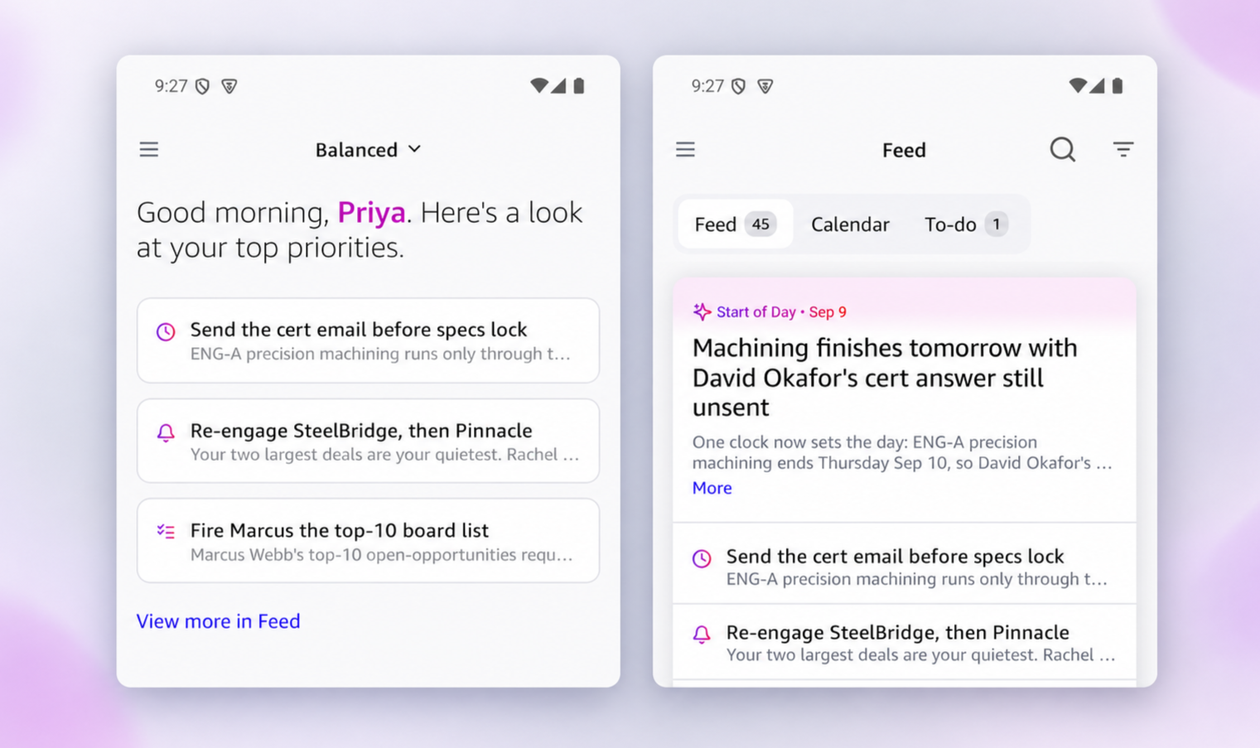
Amazon Quick’s new activity feed on mobile: the morning priority view, left, and the full feed. (Amazon Images)

Amazon is adding the Activity Feed and other features from its Quick desktop app to the AI assistant’s mobile apps for iOS and Android.

The Activity Feed is the signature feature of Amazon Quick. It combines email, Slack messages, calendar invites and CRM updates into one prioritized list, and lets people act on items (opening and responding to emails, for example) without switching apps.

Amazon said Wednesday that the Quick desktop app, released in preview in April, is now generally available on Windows and macOS. The company also said Quick’s agents now run in the cloud, so they keep working after a laptop is closed and deliver results to the feed.

The desktop and mobile apps now sync, as well, so a task started on a laptop can be picked up on a phone, for example.

Quick has a free tier, with paid individual plans starting at $20 per user per month billed annually, and business plans running $20 to $40 per user per month.

Quick is Amazon’s entry in a crowded market for AI assistants at work, competing with Microsoft Copilot, Google Gemini, OpenAI, Anthropic and others. Amazon’s announcements cited business customers for Quick including Southwest Airlines, LabCorp and the PGA Tour.

The desktop app came together fast, as part of a new effort inside Amazon to use small teams to move quickly: Swami Sivasubramanian, the AWS vice president of agentic AI, told GeekWire in June that a team of about six engineers started in late January and shipped April 28.

Seattle economic study finds strong tech assets, a risky concentration, and a tax that ‘penalizes’ hiring

A new report says Seattle’s economy “may not be in decline, but it is in danger.” (GeekWire Photo / Kevin Lisota)

An independent study commissioned by the City of Seattle says the city’s tax structure is unique among its peers in the way it “specifically penalizes the hiring of senior, high-compensation workers,” with that penalty falling overwhelmingly on large tech employers.

Overall, Seattle’s business taxes are actually in line with competing cities, write researchers from the economic consulting firm Formation in the new report. But Seattle’s taxes are “particularly distortionary when it comes to hiring high-wage employees,” they add.

Mayor Katie Wilson helped design the tax, known as JumpStart, before taking office. But even the strongest supporters of new local and state taxes would concede that Seattle is “reaching the limits of how much it can tax the industries and people that it is depending upon to drive its growth,” the researchers write.

Another risk for the city is the resulting concentration of the tax base. Three-quarters of the payroll tax on large employers comes from 10 companies. Nine of them are in tech-related sectors.

A big company shifting 10,000 workers out of Seattle would cost the city about $50 million a year in payroll tax revenue, the researchers say in an accompanying slide deck, without naming Amazon explicitly. That’s more than a quarter of the $175 million deficit the city projects for next year.

In that way, much of the city’s financial future depends “on the marginal location and compensation decisions of a handful of employers,” the report says. Because much of the taxed compensation is vesting stock, it adds, the city’s revenue is exposed to “the single most volatile attribute of these firms — one the city has no ability to forecast or influence.”

Reducing that dependence through growth is the bigger point of the report.

The 127-page assessment, called “Seawall: Building a Resilient Seattle Economy,” goes well beyond the topic of taxes. The title refers to Seattle’s rebuilt waterfront seawall, engineered to hold back the water and also let marine life take hold. The researchers offer this as a model for protecting the city’s economic base while building a more diverse economy on top of it.

A decade of growth lifted wages at every level of the income spectrum, the report finds. Few other U.S. regions spread prosperity as broadly. But the same growth made Seattle far more expensive, especially for families.

Fast-forward to today, and the report sees an economy that’s dangerously concentrated, “significantly more AI-exposed than the national average,” short of the electricity it will need, and no longer producing mid-sized companies.

In danger, not in decline: The report is also careful to point out the city’s unique position and strengths. Seattle’s tech workforce is “almost peerless,” it says: 23% of the nation’s AI engineers are based in the region, and output per tech worker is more than double the national average.

The region also has the rare combination of a big tech industry and a strong manufacturing base.

Seattle “may not be in decline, but it is in danger,” the researchers write — “not because it is losing its place in the industry, but because the industry could undergo a radical change, and arguably already is.”

The concern that Seattle is becoming “the next Cleveland,” raised in a GeekWire column in February by Seattle tech veteran and angel investor Charles Fitzgerald, is “likely hyperbolic,” the researchers write. (They acknowledge that it “caused quite the stir this past winter.”)

The report points instead to Portland and Los Angeles as the more relevant warnings, citing Portland’s pileup of new business taxes and Los Angeles’ failure to turn a deep talent pool into jobs.

Fitzgerald responded Wednesday evening on his blog, Platformonomics, writing that the city “has finally acknowledged there is such a thing as an economy.” His main objection was who wasn’t in the room: “No businesses were involved, but that seems to be the norm hereabouts on economic matters.”

The report’s acknowledgments list dozens of interviewees, including the Seattle Metropolitan Chamber of Commerce, the Washington Roundtable and the Tech Alliance. No large tech employer is among them.

Ryan Donahue, a co-founder and managing partner at Formation, said in an email that the researchers interviewed many business representatives but no large companies directly, saying he expected a predictable message from their government affairs teams.

The person who led the report’s tax and cost analysis previously ran Amazon HQ2 recruitment at the Virginia Economic Development Partnership, the agency that landed the project for Arlington, Va., Donahue said, providing insights into how firms like Amazon weigh those decisions.

A path forward: The report recommends that the city focus on five industries: artificial intelligence, cleantech, maritime, life sciences and space. Cleantech is the priority, the report says, because Seattle owns or regulates much of what the sector needs, from Seattle City Light to building codes, permitting and land use.

The Seattle Office of Economic Development commissioned the report from Formation in 2025, under then-Mayor Bruce Harrell, to examine the drivers of the city’s business climate.

Harrell’s successor, Mayor Wilson, released the report Wednesday afternoon alongside an executive order convening a task force of business, labor, community and civic leaders, directing the city to improve permitting pathways, and calling for a proposal to create a Seattle Strategic Initiatives Fund.

In releasing the report, Wilson’s office said the findings “are independent and are not City policy.” But speaking on KUOW-FM’s Soundside as the report was released, the mayor called it “fantastic,” describing it as “super nuanced,” and urging listeners to take the time to read it.

The cost of a hire: JumpStart, the payroll expense tax, applies to large employers based on the compensation they pay to high-earning workers in Seattle. Approved by the City Council in 2020 and in effect since 2021, it was created to fund affordable housing, small-business support and climate programs, but the city has increasingly used it for general government operations.

Wilson helped create the tax before running for mayor, saying on her campaign website that she “played an instrumental role in designing and passing” the payroll tax.

Under JumpStart, hiring a software engineer at $650,000 in total compensation costs about $17,000 a year more in Seattle than in Bellevue, the report says. For an employee earning more than $1 million, the difference exceeds $33,000. San Francisco imposes no per-employee tax at all, and New York City’s equivalent is less than $6,000, according to the researchers.

That $17,000 reflects the tax’s top rate, which this year applies only to employers with about $1.3 billion or more in Seattle payroll. Two or three companies at most are in that tier, the report says. At the city’s lowest rate for that pay level, the same engineer would cost about $11,800, according to Seattle’s published rates.

The rate rises with an employee’s pay, and a company that crosses one of the city’s payroll thresholds pays the higher rate on every qualifying worker, not just the next hire.

“No other comparison city has a tax with both of these features,” the report says.

An issue of perception: Business leaders interviewed for the study described JumpStart as a problem “not primarily for its cost but because the process of enacting it communicated that the city’s governing orientation is fundamentally extractive.”

The researchers add: “Whether or not that characterization is fair, it is the operating perception, and perception shapes location decisions.”

But the researchers stop short of recommending a change. Taxes have “modest effects on firm location and expansion decisions,” they write, and Seattle is unlikely to lose its biggest employers to other regions, because the alternatives are either more expensive or have weaker talent.

“The Eastside is the only real threat in that regard,” the report says.

The study is blunt about what is at stake in keeping those employers. “If they leave,” it says, “Seattle won’t become more equal, it will just become poorer.”

What to do about taxes? The report does not recommend raising or lowering that top rate. Research on how firms respond to local taxes draws on thousands of firms across dozens of jurisdictions, it says, and “cannot tell us how any one firm will respond to any one tax change.”

With two or three firms in the top tier and “one firm by far the most dominant,” the question “is fundamentally a question about how that single firm will react.” It adds, “That is not a question this report, or the literature it draws on, is equipped to answer.”

GeekWire has contacted Amazon for comment on the report.

Other tax options that have been floated — vacancy taxes, wealth taxes, head taxes beyond JumpStart, expanded gross receipts schemes — are “either disallowed under state law or would, if enacted, likely push out the firms and workers Seattle most needs to retain,” the report says.

And once the state’s new 9.9% tax on income above $1 million takes effect in 2028, Seattle earners above that level will face a combined state and local marginal rate of about 10.5%. Pushing meaningfully above that, the report says, “would be a high-stakes tax experiment.”

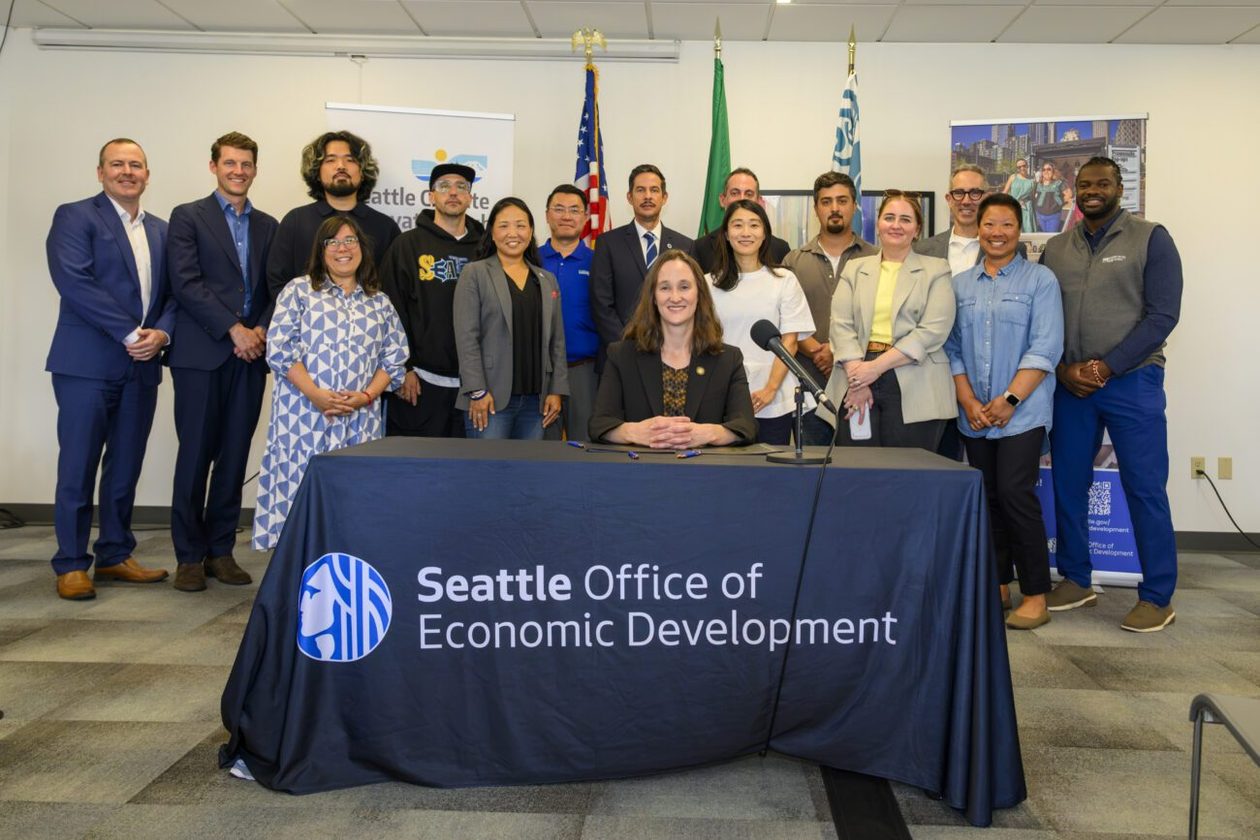
Mayor Katie Wilson with business, labor and community leaders after signing an executive order on the economy Wednesday at the Seattle Office of Economic Development. (City of Seattle Photo)

Where Wilson stands: The mayor has already conceded the Bellevue point. “I don’t think it’s good that it is less expensive to do business in Bellevue than in Seattle,” she said in May. “We’re going to be taking that into consideration.”

She defended the tax in June, crediting it with helping Seattle recover from the pandemic and cautioning against blaming downtown’s problems on any single cause.

Her relationship with the tech community has been rockier. At a Seattle University event in April, asked about that state tax, Wilson said concerns about wealthy residents leaving were “super overblown” — then waved and said, “the ones that leave, like, bye.” The moment drew national coverage and criticism from Seattle investors.

A bet on cleantech: Taking a step back, the report says Seattle’s best opportunity is in cleantech, a category it defines broadly to include clean energy generation, energy efficiency and sustainable production methods and materials.

The shift is already showing up in local venture funding. Cleantech and energy companies took 3% of the venture capital raised by Seattle-area private companies from 2016 to 2020, and 20% from 2021 to 2025, according to Crunchbase data cited in the report. Three companies — TerraPower, Helion and Group14 — account for 70% of that.

The city “should be most concerned about AI but most active in cleantech,” the report says.

AI will ultimately be more important to Seattle’s future, the researchers explain, but the city has almost no ability to shape it. Cleantech is different: Seattle owns the electric utility, writes the building codes and controls permitting and much of the land.

The city can also use its own purchasing power to create a market for what these companies build, the report says, pointing to a New York program that used public housing demand to bring a new cold-climate heat pump into production.

To reach the top tier of cleantech ecosystems, the report says, Seattle would need a dedicated entity putting at least $5 million a year into growing the sector, funded through ratepayer charges, philanthropy, corporate sponsorship and competitive federal grants.

What’s next: According to the city, Wilson’s executive order calls for the task force to convene industry roundtables in the coming months. The report’s own first-year list runs to ten items, including a business-led commission on the city’s fiscal exposure, with an emphasis on AI, and structured visits with 50 companies across the five industries it identifies.

Others include naming a senior staffer in the mayor’s office to run the city’s AI agenda, and a childcare cost-sharing pilot split three ways between employee, employer and city, with the city’s share paid out of JumpStart.

On taxes, the report’s primary recommendation looks beyond City Hall. It urges Wilson to build a cross-partisan coalition of mayors and county executives to press Olympia for new municipal revenue tools, including changes to the state’s 1% cap on property tax growth.

A caller on KUOW asked Wilson whether there’s a limit to how much Seattle should grow. She said she shares the concern, then pointed back to the report, which she said makes clear there is “no graceful path” for Seattle to cool down its growth.

“We can’t go back to the ’90s,” she said.

Amazon’s new board member is a cybersecurity founder who sold his last company to Google for $5.4B

New Amazon board member Kevin Mandia.
New Amazon board member Kevin Mandia is a cybersecurity veteran. (Photo via Amazon)

Amazon named cybersecurity veteran Kevin Mandia to its board of directors, adding new security expertise a few months after former NSA director Keith Alexander stepped down.

Mandia founded Mandiant, the breach-investigation firm Google acquired for $5.4 billion in 2022, and remained at the search giant as a strategic advisor through July 2025, according to his LinkedIn profile. He now leads Armadin, an AI security startup he started last year.

Amazon said in its announcement that “cybersecurity is one of the most consequential risks and responsibilities organizations face today, and the threat landscape continues to evolve rapidly alongside advances in AI.”

Amazon added a cybersecurity specialist to its board in 2020, when it elected Alexander, who also led U.S. Cyber Command. Mandia comes from the other side of the field, with two decades spent investigating corporate breaches rather than defending government networks.

His appointment also puts an AI security entrepreneur on the board of a company whose cloud infrastructure underpins much of the internet. Armadin, founded in September 2025, uses AI to run attacks against corporate networks, probing defenses the way an intruder would.

The board’s Security Committee, which oversees Amazon’s cybersecurity policies and its response to significant cyber incidents, is now chaired by Dan Huttenlocher, dean of the MIT Schwarzman College of Computing. Mandia joins as a member, along with former Bridgewater co-CEO Jon Rubinstein.

Amazon also named Mandia to the board’s Audit Committee, according to a securities filing.

Mandia received 4,086 restricted stock units in connection with his election to the board, vesting in three equal annual installments beginning Nov. 15, 2027, the filing shows. The shares were worth about $1.03 million at Amazon’s closing price Wednesday.

The filing disclosed that his sister-in-law, Kristin Mandia, is an Amazon employee with an annual salary of $185,000. The company said her compensation is consistent with that of other employees at her level with similar responsibilities.

NLM Photonics adds key investors in quest to reduce the power needed to move data between chips

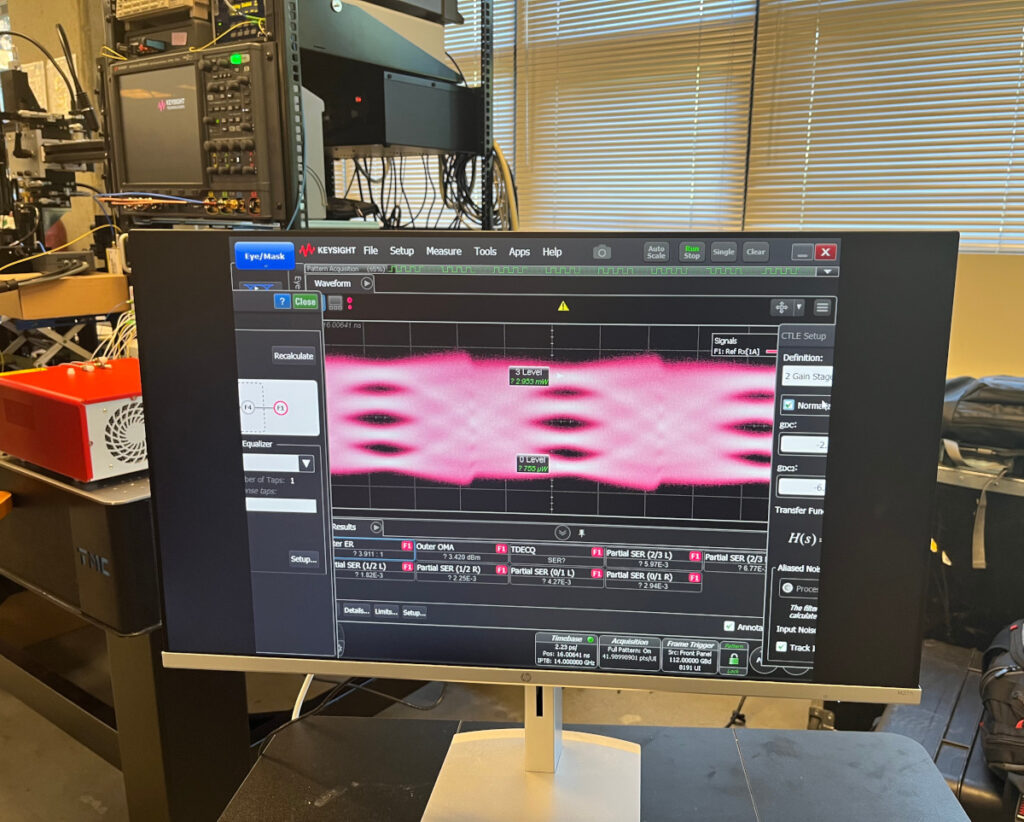
Test equipment measures a chip that uses NLM’s technology, showing how cleanly it carries high-speed data. (NLM Photonics Photo)

NLM Photonics, a Seattle-based chip materials startup and University of Washington spinout, announced two new investors: Pangaea Ventures and Diamond Edge Ventures, the investment arm of Mitsubishi Chemical Corp.

They joined as part of a funding round that totals $13 million, according to a Form D filed with the Securities and Exchange Commission. NLM has reported at least $26 million in funding since 2018, according to SEC filings.

The company offers a way to move more data without burning more power. Inside a data center, information travels between chips and servers as pulses of light. The part that puts the data onto the light beam, called a modulator, is normally made of silicon. It limits how much data a link can carry, and how much power that takes.

NLM’s technology, sold under the name Selerion, is an organic electro-optic material that goes on as a liquid and hardens in place on the chip, taking over the modulator’s job from the silicon underneath. The company says it does the work 10 to 15 times more efficiently.

Applications for the technology include fiber-optic networking equipment and the links between servers in AI data centers. NLM says it could also be used in quantum computing.

Five existing investors participated in the round, which the company described as a Series A2: Emerald Technology Ventures, Oregon Venture Fund, Idemitsu, Tokyo Ohka Kogyo and StoryHouse Ventures. Private investors and company employees also took part.

Pangaea Ventures, which has offices in Canada, the United States and Japan, backs startups built on advances in materials, chemistry and biology. It says it has invested in more than 40 companies over more than 20 years. David Weekes of Pangaea is joining NLM’s board, which already includes Frank Balas of Emerald.

Diamond Edge Ventures, led by president Curtis Schickner, has $200 million to invest through 2030. It backs companies in Mitsubishi Chemical’s core markets, including advanced materials, polymers and electronics, and its portfolio includes Boston Materials, DigiLens and Eridan.

Hamamatsu Photonics, which invested previously, is not part of this round but is still a shareholder, according to the company.

The company was incorporated in 2018 as Nonlinear Materials Corp. It licensed its patents from the University of Washington, building on 25 years of research there in the labs of chemists Larry Dalton and Bruce Robinson. Robinson is one of the company’s co-founders, as is Lewis Johnson, a longtime UW researcher who is chief technology officer.

Pack Ventures, the UW-affiliated venture fund, is an investor in NLM and is also listed among the advisors to its board.

GeekWire covered NLM’s launch in 2019, when the company was raising a $1.25 million seed round and running a small production lab on campus.

NLM Photonics CEO Brad Booth. (NLM Photo)

Brad Booth, who spent nine years at Microsoft and joined NLM’s board in 2023, took over as CEO in 2024 from co-founder Gerard Zytnicki, who is now a corporate advisor to the company. The company raised $1 million from Tokyo Ohka Kogyo and Hamamatsu in 2023.

Last year NLM said outside testing confirmed that a 1.6-terabit chip combining silicon with its materials ran at 224 gigabits per second on each of eight channels. It started sending samples of 1.6- and 3.2-terabit chips to customers in March.

NLM is not alone in trying to build a better modulator. Lightwave Logic, a publicly traded Colorado company also working with organic materials, named NLM among its smaller competitors in its annual report for 2024.

Some of the company’s rivals have raised a significant amount of funding. HyperLight, a Harvard spinout that uses a crystal called lithium niobate instead of an organic material, has raised $117 million, including $80 million in June led by MediaTek.

NLM has worked to get its materials onto other companies’ production lines. In March the company said the chips going out to customers were made at GlobalFoundries, and that it had built modulators using Tower Semiconductor’s high-volume silicon photonics process.

General Robotics, led by Microsoft vets, says its AI has cut robot setup from a month to hours

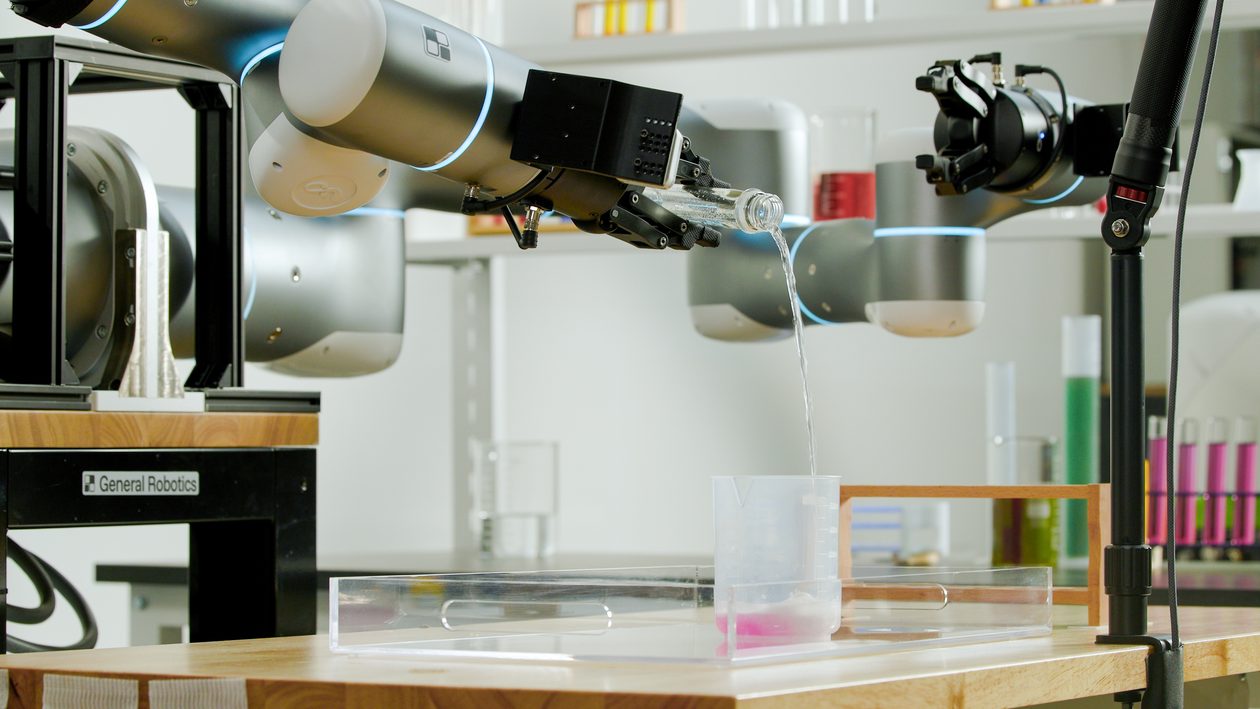
A robot arm pours from a test tube into a beaker in General Robotics’ lab. The company used the task, and progressively harder versions of it, to test its Auto Engineering system. (General Robotics Photo)

A Redmond, Wash., robotics software startup founded by former Microsoft researchers says its platform can now handle much of the work of getting a robot up and running in a factory, warehouse or other industrial setting, a job that used to take a team of engineers.

General Robotics said Wednesday that advances in GRID, its robot intelligence platform, have cut the process of onboarding a new robot from about a month to as little as two hours. The company calls the approach “Auto Engineering,” with each onboarded robot and diagnosed failure feeding back into the system and speeding up the next deployment.

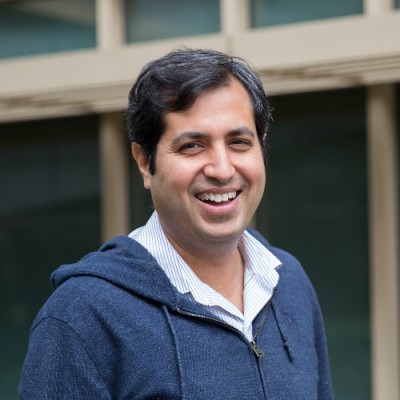
General Robotics CEO Ashish Kapoor.

“Before this moment, it would take us a team of experts to go and execute on behalf of our customers,” said General Robotics CEO and co-founder Ashish Kapoor in an interview. “Clearly non-scalable, clearly very expensive, and clearly will take a long time.”

With Auto Engineering, he said, “we can magnify and accelerate each engineer’s capability.”

Founded in 2023, the company has grown to about 50 employees, primarily engineers. It has raised nearly $34 million, most recently in an April round led by Construct Capital, with participation from Khosla Ventures, Accenture Ventures, Nvidia and Valo Ventures. PitchBook put the size of the round at $25 million; the companies didn’t disclose terms at the time.

Kapoor said General Robotics has roughly a dozen customers — large enterprises across manufacturing, logistics, energy and defense — and revenue in the millions of dollars.

Customers include HTX, the science and technology agency of Singapore’s Ministry of Home Affairs, which Kapoor said has been working with General Robotics for about a year and a half.

The company’s platform works with robot types including industrial arms, humanoids, quadrupeds, wheeled robots and drones, according to the company.

General Robotics is operating in a competitive and well-funded sector. Physical Intelligence, which builds foundation models for robots, has raised more than $2 billion. Nvidia — an investor in General Robotics, and the maker of the Isaac Sim simulation software built into GRID — is developing its own robot models and deployment tools.

Robot makers build good hardware, Kapoor said, but often lack the expertise to put it to work in a specific setting like a shipping terminal. “That last layer is missing.”

Before co-founding the company, Kapoor spent 17 years at Microsoft, ultimately as general manager of its autonomous systems and robotics research group in Redmond, where he created the open-source drone simulator AirSim. General Robotics co-founders Sai Vemprala (CTO) and Shuhang Chen came from the same Microsoft team.

GeekWire covered the launch in 2023, when it was Scaled Foundations and billed itself as “ChatGPT for robots.” It had five employees at the time, focused on aerial robotics and drones, with backing from Khosla and E14 Fund. It later renamed itself General Robotics.

NBA’s Ballmer crackdown echoes Microsoft antitrust; SF vs. Seattle housing; and a Seahawks tech twist

This week on the GeekWire Podcast: The NBA suspends former Microsoft CEO Steve Ballmer for a year and hits the Clippers with $30 million in fines and five lost draft picks over allegedly sham endorsement deals for Kawhi Leonard, drawing comparisons to the Microsoft antitrust era.

A new Redfin report says San Francisco’s housing market is booming on AI wealth while Seattle slumps, with the Bay Area-to-Seattle migration pipeline nearly dried up.

And the Seahawks sale to the Khosla family officially closes, ending the Paul Allen era, with two familiar Seattle tech names surfacing in the new ownership group.

Plus, the return of the GeekWire Trivia Challenge.

Related Stories and Links

Ballmer / Clippers

Redfin / SF vs. Seattle housing

Seahawks sale

Editor’s note: Join us on Wednesday, Sept. 16 for a live recording of the GeekWire podcast. Co-hosts John Cook and Todd Bishop will discuss the week’s news and interview Zillow’ Senior Vice President of engineering, Toby Roberts, about how AI is changing the real estate business. Details and tickets here.

Subscribe to GeekWire in Apple Podcasts, Spotify, or wherever you listen.

Seattle Times sues Microsoft and OpenAI, alleging they trained their AI on its journalism

The Seattle Times and Newsday sued Microsoft and OpenAI on Friday, accusing the tech companies of using their journalism to train AI products without permission. (GeekWire File Photo / Kurt Schlosser)

Microsoft was sued Friday by the parent company of its hometown daily newspaper, The Seattle Times Co., which joined with Newsday to accuse the Redmond tech giant and OpenAI of using their journalism to train artificial intelligence models.

The lawsuit alleges that the companies scraped hundreds of thousands of Seattle Times and Newsday articles — bypassing paywalls and ignoring terms of service — to train their AI models. It seeks financial damages and the destruction of any training datasets and models built with their content.

“Like a snake eating its own tail, GenAI that is trained on painstakingly researched, expensive-to-produce content threatens to destroy the very news organizations by competing directly with them through AI-generated substitutive content,” the suit says. “If Defendants are allowed to succeed, independent journalism of the kind Plaintiffs produce will struggle to survive.”

The case is notable in part because the Seattle Times is suing two of its own funders. Microsoft Philanthropies underwrites some Seattle Times journalism projects. In 2024, Microsoft and OpenAI jointly funded a $10 million Lenfest Institute AI fellowship that included both the Seattle Times and Newsday among its inaugural participating newsrooms. The Times says it maintains editorial independence.

A Microsoft spokesperson said in a statement Friday evening, “While we’re surprised by the lawsuit, we appreciate the importance of the Seattle Times to our region and we’re always happy to sit down and explore solutions to this type of dispute.”

It’s not clear if there were negotiations or licensing talks in advance of the suit. GeekWire has contacted The Seattle Times Co. for comment.

In its own coverage of the lawsuit Friday evening, the newspaper quoted a memo from Seattle Times Co. President and CEO Alan Fisco, saying: “This was not an easy decision. However, we feel strongly that we must defend our content — which we spend millions of dollars a year to produce — from being used without our consent or compensation.”

The Seattle Times Union, which represents more than 160 newspaper employees, said Friday it supports the lawsuit but that in ongoing contract negotiations the company has refused to guarantee it won’t replace non-reporter newsroom jobs with AI.

“If the Seattle Times Co. truly cares about the threat AI poses to journalism’s business model, it should protect the workers who produce the copyrighted material at the heart of this case,” the union said in a statement.

Fisco, a longtime Seattle Times executive, took over as CEO on Jan. 1, succeeding Frank Blethen, who led the paper for 40 years and remains chair of the board. Ryan Blethen, Frank Blethen’s son and a fifth-generation member of the family that has owned the paper since 1896, became publisher in the same transition.

The complaint Friday includes examples of ChatGPT reproducing Seattle Times and Newsday journalism nearly word for word, including an 88-word verbatim stretch from The Seattle Times’ Pulitzer-winning coverage of the Boeing 737 MAX crashes, generated when a user prompted the chatbot with just the article’s headline and web address.

The suit echoes The New York Times’ 2023 copyright case against the same defendants, which just this week drew a U.S. Justice Department brief siding with Microsoft and OpenAI, arguing that a ruling for the publishers would stifle American AI development.

The newspapers join a growing list of publishers suing OpenAI and Microsoft over AI training. In addition to the New York Times, that includes the New York Daily News, Ziff Davis and the Center for Investigative Reporting, all consolidated before U.S. District Judge Sidney H. Stein in Manhattan.

On Friday, the publishers in that case moved for summary judgment, as did OpenAI and Microsoft.

OpenAI has struck licensing deals with more than a dozen other outlets, including The Associated Press, News Corp and Axel Springer. Publicly disclosed terms of three of those deals top $300 million, according to the Seattle Times complaint.

Updated with statement from The Seattle Times Union.

AI learns nature’s code: Allen Institute, UW and Fred Hutch launch $95M open science initiative

Jack Boylan, left, Allen Institute research associate, and Jesse Gray, AI BioDesign executive director of strategy and platform, at the DNA sequencer inside the initiative’s new lab. It reads millions of designed DNA sequences at once, revealing which ones worked. (GeekWire Photo / Todd Bishop) 

Three of Seattle’s top scientific institutions are launching a nearly $95 million research initiative that will generate data and train AI models to design proteins and genes that don’t exist in nature — sharing the results freely to help others develop new medicines and materials.

The initiative, called AI BioDesign, brings together the Allen Institute, the University of Washington and Fred Hutch Cancer Center, with funding from the Fund for Science and Technology (FFST), created by the estate of Microsoft co-founder Paul Allen.

AI BioDesign is led by David Baker, the UW biochemist who won the 2024 Nobel Prize in Chemistry for using computers to design new proteins, and Jay Shendure, a leading genome scientist at the UW and the Allen Institute.

The plan is to “hijack a lot of the machinery that evolution provided us” — the cellular assembly line that turns DNA into proteins — to design and measure millions of novel biological molecules, Shendure said in an interview in advance of the announcement.

That will help AI models learn the rules of biological design from a huge set of examples, instead of inferring them from the relatively limited number that nature has produced.

The field, Shendure said, is “putting too much emphasis on taking the cranks that we have and just running with them, as opposed to building the right cranks.”

Jay Shendure, right, lead scientific director of AI BioDesign, with research associate Jack Boylan in the lab at Dexter Yard in Seattle’s South Lake Union. (Allen Institute Photo / Jerry Petersen)

The goal is to make designing biology more like ordering a part: a molecule that latches onto a cancer cell, for example, or a genetic switch that fires only inside brain cells and nowhere else.

Potential outcomes could include everything from new therapies for disease, to proteins that dissolve plastic in the environment, to cells that travel through the body in a programmed way, said Sanjay Srivatsan, a Fred Hutch assistant professor who leads the cancer center’s work on the initiative, in a video released with the announcement.

“For the first time, the speed of AI is beginning to match the experimental power of synthetic biology,” Baker said in a statement. “That changes the question from ‘what has nature already made?’ to ‘what else is possible, and how can we test it?'”

Where the money goes

The Fund for Science and Technology is providing $94.6 million for AI BioDesign over five years. The foundation launched publicly last year with a mandate to direct a large share of Allen’s fortune into bioscience, environmental and AI research.

The funding from FFST is allocated as $46.1 million to the Allen Institute, $43.8 million to the UW and $4.7 million to Fred Hutch, according to an Allen Institute spokesperson.

The initiative had 62 people as of mid-August, including some new hires and others redirected from existing projects at the three institutions. The UW accounts for 41 of them, the Allen Institute 13, and Fred Hutch eight. AI BioDesign is expected to continue growing over time.

“AI BioDesign is exactly the kind of ambitious, collaborative science FFST was created to support,” said Marc Malandro, the foundation’s chief programs officer and co-lead, in a statement. He joined FFST in May after nearly a decade at the Chan Zuckerberg Initiative, most recently as chief operating officer of CZI and the Chan Zuckerberg Biohub Network.

Malandro and Chief Financial and Operations Officer Liz Carey have been leading FFST on an interim basis since founding CEO Lynda Stuart stepped down in May.

Inside the lab

On a recent tour of the AI BioDesign lab, research associate Jack Boylan pulled up results from a run he’d done on their new DNA sequencer that morning — on free kits donated by a neighboring biotech company, a year past their expiration date.

“We decided, let’s give it a roll,” he said. It worked fine.

The sequencer is what makes the whole approach possible. It reads all of the millions of DNA sequences in a single tube at once and reports which ones performed. One recent experiment ran 6 million distinct sequences through it at once.

“The scale comes not from robotics, but from parallelizing inside the test tube,” said Jesse Gray, executive director of strategy and platform for AI BioDesign and the Seattle Hub for Synthetic Biology, and a former Harvard Medical School geneticist.

The lab, at Dexter Yard in Seattle’s South Lake Union neighborhood, a short walk from the Allen Institute’s headquarters, is organized into teams of five or six people, each working on a different design problem.

A separate four-person team of machine-learning specialists takes the incoming results and works with the bench teams to decide which experiments come next — the ones that will teach the models the most. Each round is judged on how much the models improved.

Rui Costa, president and CEO of the Allen Institute. (Allen Institute Photo)

The Allen Institute calls projects like this “accelerators,” a term Rui Costa, the institute’s president and CEO, traced back to Paul Allen himself. The word came up in early planning sessions, Costa said. Allen wanted to “exponentially accelerate the field.”

Other accelerators at Dexter Yard include the Seattle Hub for Synthetic Biology, the Allen Institute’s collaboration with the Chan Zuckerberg Initiative and the UW, which Shendure also leads; and Cell Science, which works on engineering cells to assemble themselves into tissues.

The Allen Institute for AI (Ai2), the separate Seattle research organization also founded by Paul Allen, is involved informally rather than as a funded partner, Costa said.

Its robotics team has been talking with AI BioDesign about scaling up the protein work, and the two expect to collaborate on models and on tools that generate research hypotheses.

Why give it away

The decision to focus on open science also came from Allen, Costa said in an interview this week. “He was so visionary in the early 2000s: radically open science to exponentially impact and change fields, not to compete.”

That raises a question the initiative will face as soon as it produces anything valuable: what happens if a company builds a lucrative drug on data given away free? In traditional science, Costa said, being beaten to a discovery counts as a loss. Here it’s the goal.

“We would be so lucky if many companies would be taking this data and changing the world for good,” he said.

At the same time, Costa left open the possibility of the three principal institutions spinning out their own startups, nonprofits, or other initiatives from the work done by AI BioDesign.

Betting against the field

AI BioDesign’s approach runs against much of the current thinking in the field. Costa said most efforts to apply AI to biology are chasing a single general model that could answer questions about how any cell works. AI BioDesign is betting on the opposite: narrow models built for specific design problems, trained on data generated for that purpose.

“This project is a clear bet on a different way of doing things,” Costa said.

The people running the initiative are careful not to oversell. Gray said it remains an open question as to whether their approach beats the alternatives. “The jury’s still out,” he said.

Shendure put it plainly: “It’s never as easy as you think it’s going to be,” he said.

Costa said AI BioDesign needs to show real progress within 18 to 24 months — ideally even sooner — and expand to researchers around the world within five years.

Qualtrics cut 117 jobs tied to Seattle headquarters, new filing shows

Qualtrics Tower in downtown Seattle. (GeekWire File Photo)

Qualtrics is cutting 117 jobs connected to its Seattle headquarters, according to a state filing that provides new details of the layoffs that the experience management technology company made two weeks ago.

Engineering and product teams were hit hard. The filing lists software roles from entry-level through principal engineers, plus testing, machine learning, network and information security positions; engineering managers and directors; and product and product marketing managers.

The employees work at or report into Qualtrics Tower at 1201 Second Ave., the filing says.

The company, which has dual headquarters in Seattle and Provo, Utah, made cuts globally on Aug. 19, so the Seattle number reflects only a portion of the overall positions impacted. The company has not disclosed the total. We followed up again Wednesday to ask for an overall number.

Qualtrics employed about 900 people in Seattle as of 2023 and has not disclosed a figure since.

It’s part of a steady stream of tech layoffs in the Seattle region. Amazon disclosed 121 job cuts in Washington state on Aug. 31, T-Mobile 77 on Aug. 26, and TikTok 75 in Bellevue on Aug. 19. Zillow cut more than 500 Seattle jobs in early August.

Earlier this year, Meta cut nearly 1,400 jobs in the state, about 20% of its local workforce; Microsoft cut 605; and Oracle 491.

Qualtrics makes software that companies use to collect and analyze feedback from customers, employees, partners and others — a category that Qualtrics calls experience management. It was founded in Provo in 2002 and later added a Seattle headquarters.

The layoffs followed the company’s $6.75 billion acquisition of Press Ganey Forsta, an Indiana-based healthcare data company, which closed in May.

In a memo to employees on Aug. 19, CEO Jason Maynard said the deal brought together “two organizations, two sets of teams, two structures built independently,” and that the company had gone “function by function, team by team, to understand where we have overlap.”

Maynard became CEO in February, joining from Oracle. In April he removed five senior executives and reorganized teams across marketing, customer operations, IT and corporate development.

Qualtrics has been owned by Silver Lake and Canada Pension Plan Investment Board since they took it private for $12.5 billion in 2023. The company cut about 780 jobs, roughly 14% of its workforce, in October 2023, and about 270 earlier the same year.

McGraw Hill acquires Teachally, an AI startup for teachers led by Seattle tech vet Daniel Bernstein

Teachally founder Daniel Bernstein is also known in Seattle tech as the founder of Sandlot Games.

Daniel Bernstein spent much of the past decade as an M&A advisor, selling other people’s software companies. This time the company was his own, and he found a buyer in McGraw Hill.

The education publishing giant on Wednesday announced the acquisition of Teachally, a small startup led by Bernstein in Bothell, Wash., that uses AI to help teachers build and customize lessons, assignments and assessments aligned to state standards.

Financial terms weren’t disclosed. The deal has closed, and all five employees have joined McGraw Hill, with Bernstein taking the title of senior advisor for Teachally integration and growth. He declined to say what the company sold for or how much it had raised, but said the outcome was good for him and his investors.

“We didn’t take in a pile of money,” Bernstein said, explaining that the company brought in a small group of angels and was able to stay focused and effective.

The five-person team is spread across three continents: Bernstein and a colleague in the Seattle area, co-founder and CTO Rushil Makkar in Melbourne, Australia, a customer success lead in Arizona and a developer in Ethiopia.

Bernstein is best known in Seattle tech circles for Sandlot Games, the game studio he started in a spare bedroom in Bothell in 2002 and sold to Digital Chocolate in 2011, after developing casual gaming hits including “Cake Mania” and “Tradewinds.” He later founded the mobile game startup UpTap.

Bernstein spent the following decade on the other side of deals, as a software M&A advisor at Corum Group and then at his own firm, Hemisphere Partners, which ran Teachally’s sale.

Teachally raised a small round from local angels about nine months ago, and later opted to try an M&A process. An edtech M&A specialist representing the company approached a small group of potential buyers, and Bernstein said he hit it off immediately with McGraw Hill over a shared view of what curriculum and instruction should look like in the age of AI.

Teachally focuses on teachers rather than students, developing technology for what the industry calls high-quality instructional materials, or HQIM, which is the standards-aligned curriculum that many states and districts have pushed schools to adopt.

The startup was working with about eight school districts at the time of the sale — fully commercialized, Bernstein said, but “still very much an early stage company.” It was named a top edtech product for curriculum and instruction by District Administration magazine in January.

Bernstein said he had to learn an entirely new industry after two decades in games. The M&A work helped: he’d taken other edtech companies to market before building one.

Teachally itself started as something else. The company was founded as EZ Reward, maker of EZ Stickerbook, a digital sticker chart teachers used to reward students and message parents. Bernstein pivoted the company about three years ago to focus on AI for teachers.

McGraw Hill, which went public last year and reported $2.1 billion in revenue in its most recent fiscal year, said the deal will let it develop and localize K-12 curriculum faster and put AI tools in front of teachers already using its content.

“This acquisition provides a great opportunity to accelerate our AI strategy in ways that directly support educators and strengthen how we develop and deliver our K–12 products globally,” said Jana Thompson, interim president of the company’s School group, in the announcement.

Teachally is now live as a McGraw Hill product, with its own page on the company’s site.

Bernstein said it’s a second exit both for him and for some of the angels who have backed him along the way. “It’s a good Seattle story once again,” he said.

How to make industry giants chase you, and other lessons from 28 years inside T-Mobile

Longtime T-Mobile exec Mike Katz touts the company’s T-Satellite service in Bellevue, Wash., in June 2025, with a slide taking shots at Verizon and AT&T — a tradition dating to the early Un-carrier years. (GeekWire File Photo / Todd Bishop)

In 2012, T-Mobile was losing hundreds of thousands of customers a quarter. AT&T’s attempted acquisition of the Bellevue, Wash.-based wireless company had just collapsed. T-Mobile was the fourth-place carrier in a four-carrier market, with a network that was a punchline and no obvious plan for fixing any of it.

Mike Katz was one of the leaders responsible for figuring it out.

The result of their work was the “Un-carrier,” a series of moves starting in 2013 that upended one industry tradition after another, launched under CEO John Legere and continued by his successor, Mike Sievert.

T-Mobile today is worth nearly $195 billion and claims the country’s best network. The company is now led by Srini Gopalan, who became CEO in November 2025.

Mike Katz. (LinkedIn Photo)

Katz, whose wireless career began selling VoiceStream phones at a Circuit City in Fort Collins, Colo., is leaving after 28 years. The company announced July 7 that Katz, then chief business and product officer, would pursue “new professional interests,” staying on as an advisor through December.

During his tenure at T-Mobile, Katz worked in sales and corporate strategy, ran the company’s prepaid business, led consumer marketing through the first Un-carrier moves, built the company’s business division, and served as chief marketing officer, before becoming chief business and product officer in December 2025.

In an interview with GeekWire, Katz reflected on his experience inside one of the most improbable and irreverent comebacks in American business.

Continue reading for the lessons we took from his story.

Use speed to your advantage against bigger competitors.

When the AT&T deal died, Katz was put on a small team assigned to assess the company’s position and come up with a plan. Their advantage, he said, was that T-Mobile was too small to compete on everyone else’s terms.

“We were so subscale relative to AT&T and Verizon at the start, and what we developed because of being subscale was agility,” Katz said. “We would do things, and AT&T and Verizon would take forever to respond, and by the time they responded, all their customers were gone.”

It started with Un-carrier 1.0. Under the standard model then, a customer could get a phone for well below cost if they signed up for a two-year plan. But the carrier recovered it through the monthly service rate, which never came down once the phone was paid off. Customers paid a penalty for leaving early.

T-Mobile separated the device from the service plan in March 2013, pricing service on its own and putting the phone on monthly installments that ended when the device was paid for.

Verizon didn’t stop signing new customers to two-year contracts until August 2015. AT&T held out until January 2016.

Getting copied was the point. Katz said one measure of success for every Un-carrier move was whether AT&T and Verizon would eventually imitate it, because by the time they did, T-Mobile had already gotten all the credit and attention.

Legere reveled in calling AT&T and Verizon “Dumb and Dumber” (it was never clear which was which in his eyes). He crashed AT&T’s party at CES in 2014 and was escorted out by security, generating multiple rounds of positive publicity for T-Mobile. He asked the public to vote on how to taunt his rivals next, with skywriting over their headquarters among the options.

They were clearly having fun. Asked whether T-Mobile ever worried it had gone too far in baiting its rivals, Katz said, “Not really.” The mission then, he said, was to change wireless for everyone and not just for T-Mobile’s own customers.

The mockery extended to the events themselves. Katz recalled preparing for an early Un-carrier launch in New York when Legere, around 10 p.m. the night before, decided he wanted to open by parodying AT&T’s “It’s Not Complicated” campaign, in which a man interviewed small children at a tiny table. That meant finding dolls. Katz said the team spent the night working out how to get into the American Girl store in Manhattan.

“It was wild,” Katz said. “There were so many things in those early events.”

The next morning the lights came up on Legere at a small table, talking to the dolls.

“Maybe we were the only ones that got it,” Katz said. “But it was funny to us.”

Look for the unexpected and find out why it’s happening.

Back in 2010, then-CEO Robert Dotson put Katz in charge of the company’s prepaid business. It was not a marquee assignment.

Prepaid customers of that era “didn’t really pick prepaid. Prepaid picked them,” Katz said. “They had no other choices. They had tough credit, or they socioeconomically were in a really tough place.”

T-Mobile was also losing ground. A price war broke out in January 2009, when Sprint’s Boost Mobile introduced a $50 unlimited plan and MetroPCS answered at $40. The recession was pushing customers toward prepaid, and the flat-rate carriers were taking market share.

Katz ran prepaid as a business of its own, operations and marketing together, and looked for a way to compete without matching the price. Those cheaper plans limited customers to 3G, so T-Mobile charged a bit more, gave them 4G, and called it Monthly 4G. (A deliberately clear and functional name, as he pointed out.)

It worked. Through 2010, 2011 and 2012, while the postpaid business was shedding customers, prepaid was the only part of T-Mobile that was growing.

The surprise: a lot of the new growth was coming from previously postpaid customers, people who had other options and were choosing prepaid anyway. Katz’s team asked them why.

“There’s no contract. I sign up for a $50 plan, and it actually costs $50 a month. It’s just simple and predictable,” Katz said, quoting customers. It might seem obvious now, he said, “but at the time it’s like, wow, that’s a pretty interesting insight.”

Expand what’s working to other parts of the company.

They found inspiration in that when they turned to what T-Mobile should do next. The idea was to give postpaid customers the same simplicity that was drawing them to prepaid.

They called it pain-free wireless. They mapped out six moves in advance, including the end of upgrade restrictions and international roaming fees. These were the origins of the Un-carrier.

They pitched it to Legere, and to Sievert, the chief marketing officer at the time. Both signed on. The launch was originally set for the end of 2013. Legere moved it to the beginning of the year.

“There is something about desperation that really helps create crisp decision-making,” Katz said. “You can keep trying to make a gameplan that’s been failing for years work, or take some swings and take on some risk. … Because what’s the downside? It can’t get much worse than it was.”

Make sure people know the ad was yours.

Storytelling is the thing companies and brands get wrong most often, Katz said, and he called it the biggest thing he learned from Sievert, whom he worked with for more than a decade. It’s especially important in the wireless industry, where customers are effectively buying a promise.

“At the end of the day, we sell invisible air. You don’t really see the product we sell,” Katz said. “There’s phones, but we don’t make the phones. Apple makes the phones. There’s towers that you can see, but the tower companies, those are their towers. We sell the invisible air in between.”

Katz divides the profession into two camps: the “award show CMOs,” motivated by collecting trophies at Cannes, and the ones who measure themselves by business impact. He puts himself in the second group.

Mike Katz at a T-Mobile event in 2025. (GeekWire File Photo / Todd Bishop)

One example: T-Mobile’s February 2025 Super Bowl spot, which launched the public beta of its Starlink partnership, offering satellite-to-cell texting in the parts of the country terrestrial networks don’t reach.

It was tempting to fill it with celebrities and gimmicks, he said. Instead the spot was built around a voiceover and a direct call to action: try it out for free during the beta, open to AT&T and Verizon customers too.

“If we wanted to build a Super Bowl commercial to win the best Super Bowl spot in Ad Age, we would have done something very different,” Katz said. “We would have done the celebrity-palooza.”

“Within 30 minutes of that Super Bowl spot running, we achieved all the goals that we had for the rest of the month in signups,” Katz said.

He contrasted that with Verizon’s 2024 Super Bowl ad starring Beyonce, which he said people recalled without necessarily remembering the advertiser.

Bad results don’t mean bad people.

One of the lessons Katz learned from Legere, in addition to taking risks and failing fast, came from how the incoming T-Mobile CEO treated the people who were already there when he arrived. Legere took over a company that was losing badly and kept the team in place.

“It would have been really easy for him to come in and assume, hey, company’s not doing well, we must have a bunch of bad people here, and change everybody out, and he didn’t do that,” Katz said. “Don’t assume simply because the results of the company are bad that the people are bad.”

Katz said that was in his head during the Sprint merger, where the same thing applied: a business in rough shape, staffed by people who weren’t the reason. T-Mobile’s leadership today is a mix of the two companies.

Perception can sometimes lag reality.

Katz said T-Mobile passed Verizon on network quality years before customers believed it. Verizon “had so much built up brand equity around being the best network,” he said, that four or five years later, people still named Verizon when asked who had the best network.

Ulf Ewaldsson, T-Mobile president of technology, hoists a trophy proclaiming the company’s victory in a landmark network test by Ookla, as (left to right) then-COO Srini Gopalan; Mike Katz, then president of marketing, strategy and products; and then-CEO Mike Sievert celebrate the milestone in June 2025. Gopalan has since been named CEO. (GeekWire File Photo / Todd Bishop)

T-Mobile declared victory at an event in Bellevue in June 2025, citing an Ookla study built on half a billion crowdsourced data points. Verizon disputed the methodology, saying crowdsourcing can’t control for variables, and pointed instead to RootMetrics drive tests that it said still showed Verizon the most reliable.

T-Mobile then began running ads with Billy Bob Thornton declaring it the best network in the country. Earlier claims had carried qualifiers, like fastest 5G or most available 5G. This one didn’t. Katz said the gap in how customers rate the two networks is now down to a couple of points.

Staying on top is harder than the turnaround.

For all the attention the comeback gets, Katz said the more remarkable part has been what came after it.

“If you look at companies that have done big turnarounds, you don’t really see a lot that have had the kind of sustained success and continued growth for a decade and a half like T-Mobile has,” he said.

He gives much of the credit to the network. The Sprint merger gave T-Mobile a spectrum position it didn’t have before, and the company bet that 5G would play out in mid-band spectrum, which was seen as risky at the time. Protecting that advantage through later spectrum deals was one of the things he worked on.

Building the network was not.

“There’s a couple jobs that they never let me do, probably for very good reason,” Katz joked. “You actually need to know what you’re doing.”

A mature company also needs different things from its leadership than a struggling one does. Gopalan spent years on T-Mobile’s board before joining as COO and then taking over as CEO. Katz describes him as an operator who brings discipline to the details of a business that by now has years of success behind it.

Asked for his biggest mistake, Katz said he moved too slowly at times.

“There are big decisions, risky decisions, that I could have made a lot faster,” he said. “I wish I’d pushed harder to make some of those decisions.” Some of what became the early Un-carrier moves were ideas that had been floated years earlier, in corporate strategy.

Katz says he still believes the company’s best days are ahead.

As for what’s next for him? Stay tuned, he says.

❌