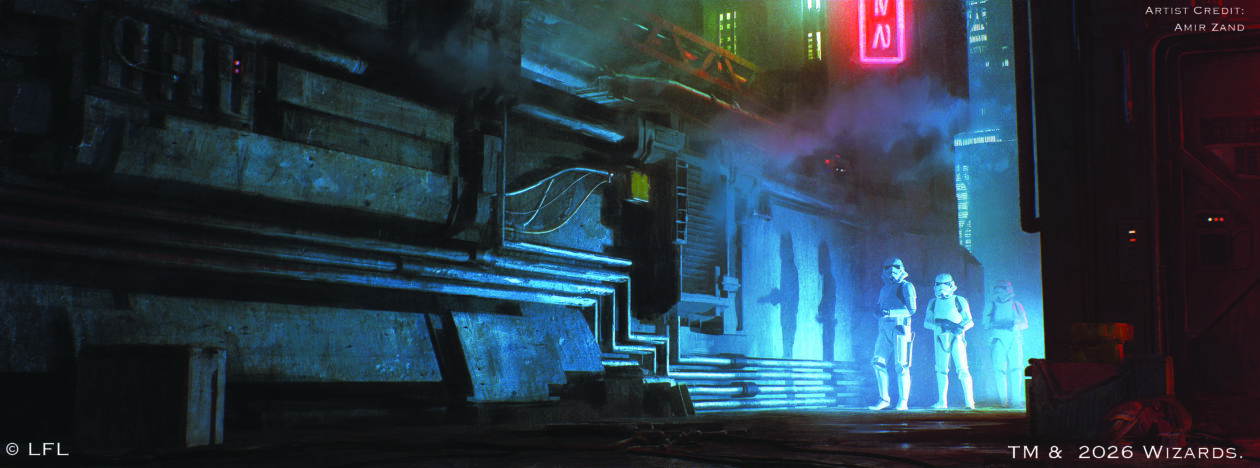
Wizards of the Coast plans to revisit the Star Wars universe as its next big cross-company collaboration for Dungeons & Dragons.
On the first day of New York Comic Con 2026, one of the reveals at its big Disney/Lucasfilm panel was the upcoming debut of two new sourcebooks for D&D based on the Star Wars universe, a crossover Wizards first teased at Gen Con in July, as part of D&D’s previously announced Universes Beyond imprint.
The first book, Star Wars Core Rules, is designed to let players of fifth-edition D&D run games set in the established Star Wars universe. The second, Tyro Squadron: Adventures, contains a full campaign for D&D set during the original Star Wars trilogy, which places players in the role of a secret crew within the Rebellion.
(Source: Kieran Yanner, for Wizards of the Coast)
Wizards and Lucasfilm offered no further details, save that more about the new Star Wars D&D books may be revealed at the Star Wars Celebration festival in April 2027.
Star Wars has a long and surprisingly complex history in the tabletop RPG space, beginning with West End Games’ Star Wars: The Roleplaying Game in 1987.
Renton, Wash.-based Wizards of the Coast, a Hasbro subsidiary, took over the Star Wars license in 2000 and released a new game, which used the same d20 system that powered 3rd edition D&D. That version of Star Wars lasted until 2010, when Wizards declined to renew its license.
The most recent Star Wars TTRPG was published by Fantasy Flight Games in 2012 and uses the Narrative Dice System pioneered by the third edition of the Warhammer Fantasy Roleplay game. Fantasy Flight exited the TTRPG business in 2020, but its parent company Asmodee moved the Star Wars license to Edge Studio (Arkham Horror, Genesys).
Edge Studio has kept Fantasy Flight’s Star Wars in print, but hasn’t released any new content for it in six years. It reportedly retains the Star Wars license despite the new Universes Beyond books from Wizards.
Bungie, the Bellevue, Wash.-based video game studio behind Destiny and Marathon, began its week with an apology from its new studio head, as it tries to win back its audience after several recent missteps.
On Monday morning, in a blog post and video entitled “The Next Chapter for Bungie,” new studio head Poria Torkan and Josh Deane, Bungie’s head of product, directly addressed Bungie’s community regarding its extraction shooter Marathon and the future of the Destiny franchise.
“For more than 30 years, Bungie has built these amazing worlds, and communities have been formed around them,” Torkan said in the video. “Over the last few years, we lost sight of that. The consequences have been real. We lost trust. We lost incredible colleagues. And our ambitions as a studio stalled.”
Almost three years ago, Bungie’s star was on a meteoric rise. Sony had acquired the studio in a deal valued at $3.6 billion, completed in July 2022. Destiny 2 was one of the most popular games-as-a-service on the modern market, which led to talks of expansion.
June also marked the departure of studio head Justin Truman, who’d replaced outgoing head Pete Parsons in 2025, and what was reported to be the end of development on Destiny 2.
If you’d asked an industry analyst what would happen to Bungie in July, the most likely answer was that it would be either turned into a support studio for other developers in the PlayStation network or shut down entirely. Instead, Torkan and Deane, as Bungie’s new leadership team, appear to be on an apology tour.
“We’re not asking for your trust,” Torkan said. “We know we have to earn it, and to do that, we need our games to deliver in ways that exceed your expectations of what you’ve come to love about the games that we make.”
The first step along that road is, according to Torkan, raiding Destiny 2’s infamous “content vault.”
Starting in 2020, three years into Destiny 2’s run, Bungie would routinely remove older parts of the game from the live service, such as its launch campaign and several early raids.
In theory, this was to make the client easier for Bungie to update, since it only had to focus on the newest parts of Destiny 2. In practice, this was like deleting the first episodes of a TV show to “make room” whenever a new one came out. If a player hadn’t been keeping up with D2 from the beginning, it was difficult to figure out what was actually going on in-game without a wiki dive or lore video.
Further, if a player wanted to go back and re-play those earlier parts of Destiny 2, they couldn’t. The first third or so of D2, despite being part of a live-service game, was effectively lost media. According to Torkan and Deane, Bungie is now working to bring back that “vaulted” content to the modern version of Destiny 2.
In addition, while neither Torkan nor Deane actually used the phrase “Destiny 3,” Torkan did say that Bungie is “absolutely not done with Destiny.” Their first priority, however, is remaking and restoring the lost levels in Destiny 2.
“That restoration will hopefully lay the foundation for how we reforge new Destiny stories and games that you all deserve and that we want to create,” Deane said.
While Bungie had already announced plans for the future of Marathon, Deane, the game’s general manager, said today that Marathon will continue to evolve into a “deeper survival experience,” with more agency for players in both PvE and PvP modes.
A consistent thread throughout both the video and post, however, was a focus on Bungie’s audience and fan community.
“How we build this new Bungie… has to be through the spirit of putting players above everything else,” Deane said. “We have to find a way back to making games that we want to play, but with you at the center. We have to meet you where you are, build what you want, and reforge our creative soul to prove that Bungie is still capable of building worlds that are part of your life, your time, your stories, and most importantly, your communities.”
“We need to restore Destiny to a place you can call home again,” Deane continued. “Evolve Marathon for more of you to enjoy and to create a new inspiring future for Bungie no matter what.”
“We’ve made commitments like these before,” Torkan said. “We understand the skepticism. We spent too much time trying to do too much, and that came at a real cost.”
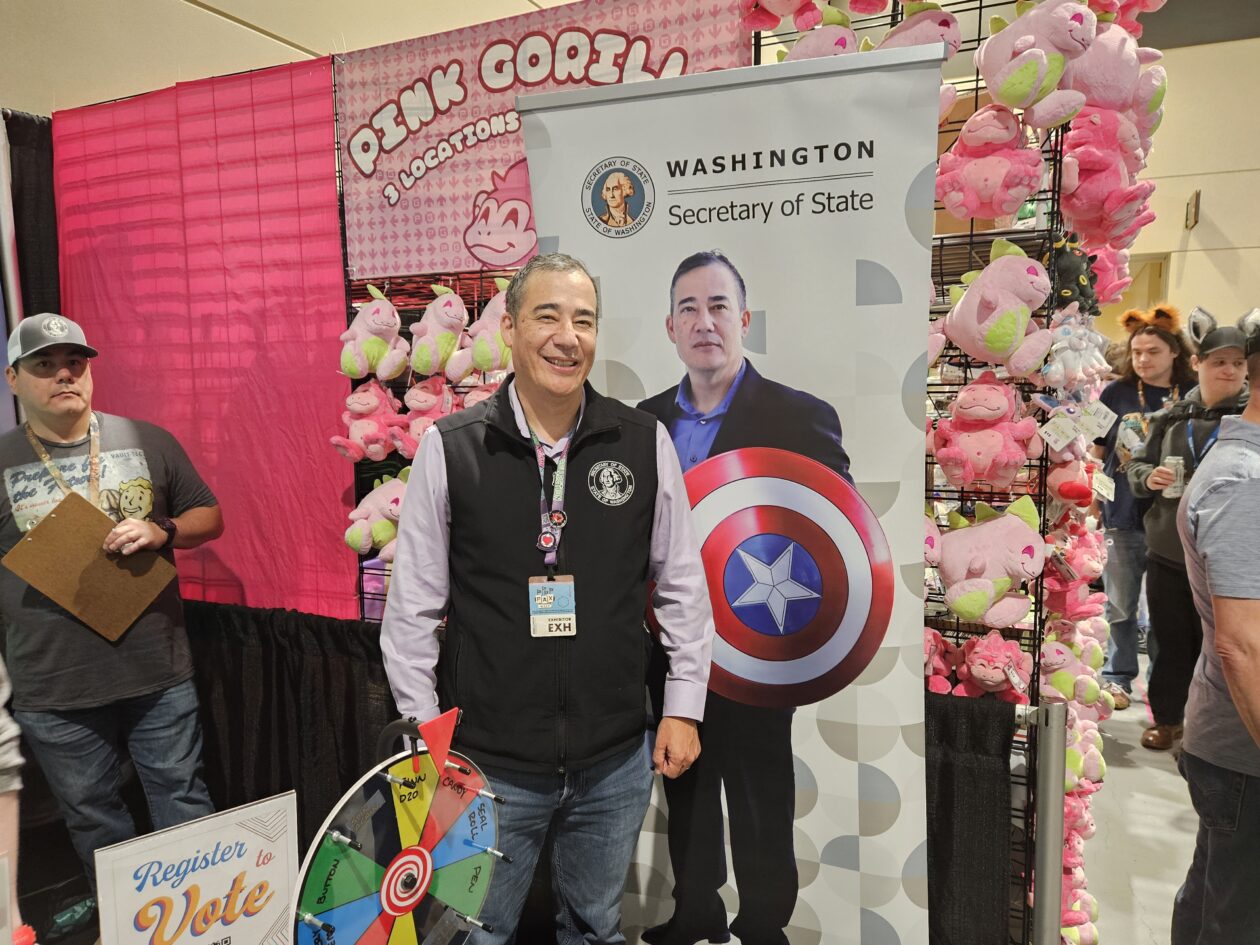
Steve Hobbs, secretary of state for Washington, poses at his booth during the 2026 Penny Arcade Expo in Seattle. (GeekWire Photo/Thomas Wilde)
If you explore the main expo hall during the Penny Arcade Expo, you can often find some interesting booths around the edges of the room. These can offer rare games, designer clothing, blind boxes of themed merch, and occasionally/inexplicably, unfiltered access to local Washington politicians.
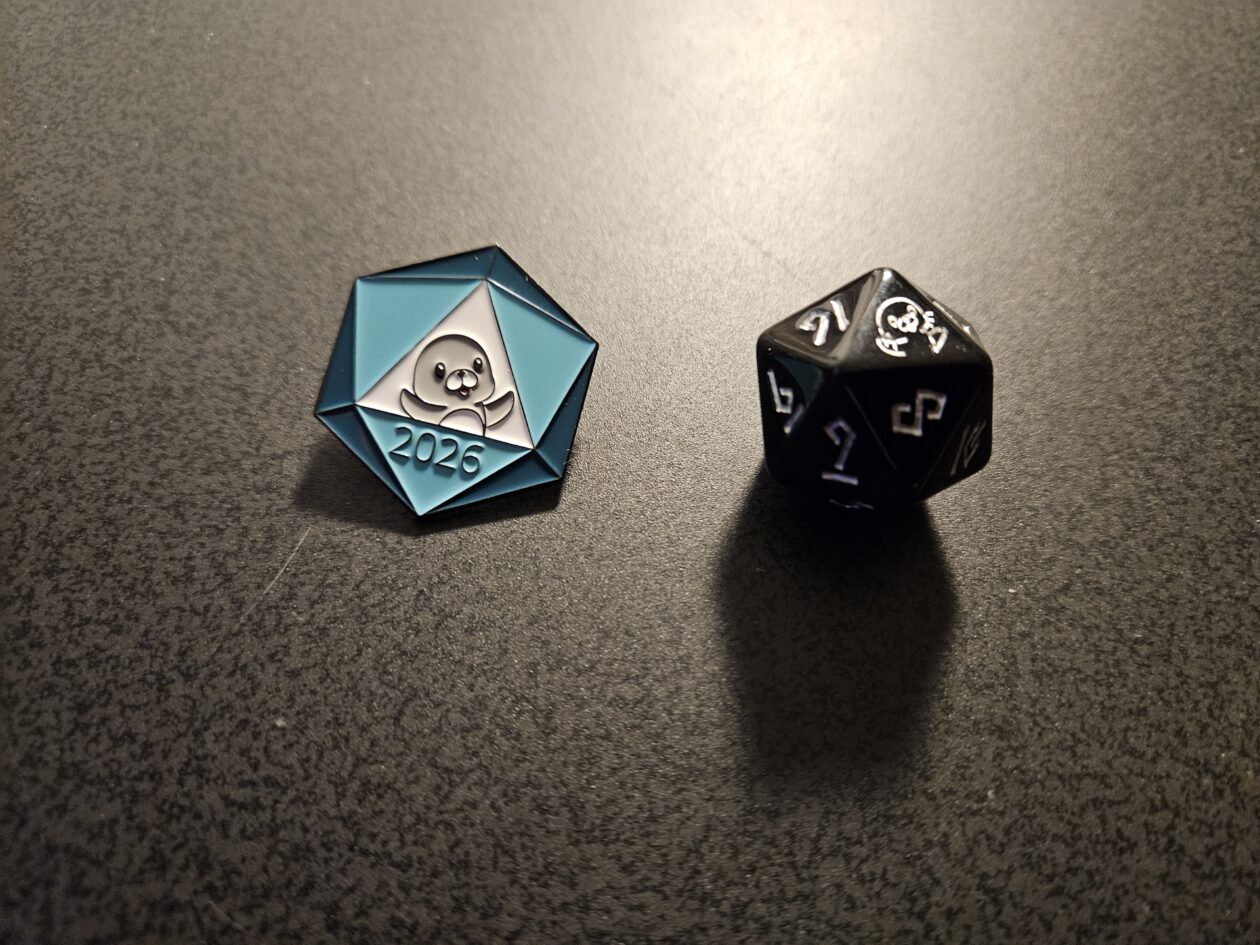
Steve Hobbs has held the secretary of state position for Washington since 2021. Visitors to his booth during PAX, held over Labor Day weekend at the Seattle Convention Center, could meet Hobbs and spin a prize wheel, with rewards that included buttons, collectible pins featuring the office’s official mascot Finn, custom 20-sided dice with Finn on the 20 face, and free snacks.
This wasn’t Hobbs’ first time at PAX, but it was the first time I’d heard about a closed-doors event he’d hosted on the night before PAX. One of the local exhibitors mentioned that Hobbs’ office had held a networking event in Seattle on Thursday, Sept. 3, between local tabletop companies and an assortment of international game publishers.
That got me curious enough to schedule a short conversation with Hobbs on the third day of PAX. Once we sat down, however, I had to ask him the question that I’d heard from a lot of other attendees: what was he doing at PAX in the first place?
“It’s twofold,” Hobbs told me. “One, this is a great opportunity for me to reach out to the gaming companies here in the state of Washington and look for opportunities for them to go overseas, linking up some of these indie game developers with major publishers.”
He continued, “The rest of it is civic engagement. Just reminding people, hey, don’t forget to vote. Don’t forget to check your registration.”
Washington mails a ballot to every registered voter, who can return it by mail or at an official drop box. Hobbs was urging people to use the drop boxes, citing what he called “a low-key fight with the USPS.”
Washington and 24 other states sued in August to block a U.S. Postal Service rule requiring new barcodes on ballot envelopes, and the Supreme Court kept it from taking effect on Sept. 14, after this interview.
“Look, PAX is where all the young people are at, right?” Hobbs said. “This is a very diverse, young community, and this is where we need to engage people.”
Visitors to the secretary of state’s booth during PAX could win collectible pins or 20-sided dice featuring the office’s mascot Finn. (GeekWire Photo/Thomas Wilde)
That brings us back to the games.
The Thursday-night event was intended to help connect Washington’s homegrown board games industry with interested publishers and players in Japan, Poland and elsewhere. This could allow Washington-based designers to sell their products overseas, as well as potentially letting foreign partners export their own games to North America.
Washington doesn’t make quite as big a deal about it as one might expect, but it’s one of the biggest states in the U.S. for tabletop and board game design, if not the biggest. Local Washington studios range in size from Renton-based Wizards of the Coast to one-person indie creators who make card games as a hobby. Hobbs’ office estimated early last year that tabletop gaming in Washington is a $2 billion industry.
The Secretary of State’s Office is best known for its core duties of running elections and registering businesses, but state law also directs the secretary of state to develop a citizens’ exchange program promoting ties that “may result in increased tourism, business relationships, and trade.”
“So what we do is help these indie game developers get access to foreign markets by putting on these trade missions,” Hobbs said. “What we’ll do is provide the booth [at international gaming conferences, such as Game Market in Tokyo], which is the most expensive thing. We will also help them navigate through the federal grant process in order to mitigate some of the costs over there.”
His office then works its connections with the U.S. State Department and the host nation’s commerce department to set up meetings for the developers.
“We have really strong ties with the German and Japanese governments, and we actually get these people to do their pitches with the major publishers in Europe and Japan,” Hobbs said.
As an example of the initiative’s success, Hobbs pointed to Lethal Shadows, a Snohomish County business that specializes in premium tabletop miniatures. According to Hobbs, he’d helped Lethal Shadows partner up with a Lithuanian company. As a result, Lethal Shadows has moved from a garage to a warehouse and is hiring more employees.
That did raise the question of why Hobbs’ office wasn’t making equivalent inroads toward Washington’s significantly larger video game industry.
“It’s more of a lack of bandwidth,” Hobbs said. “We want to take baby steps. We didn’t want to take a big step into it. And frankly, I didn’t realize that it was important to go to these conventions. In Japan, Germany, and Poland, we’re seeing if there might be an opportunity to do the same thing on the digital side.”
Hobbs continued, “I believe trade must go two ways. We need to support each other.”

 Login