
Reading view

There are new articles available, click to refresh the page.

As U.S.-China biotech race heats up, Seattle makes its case to D.C.
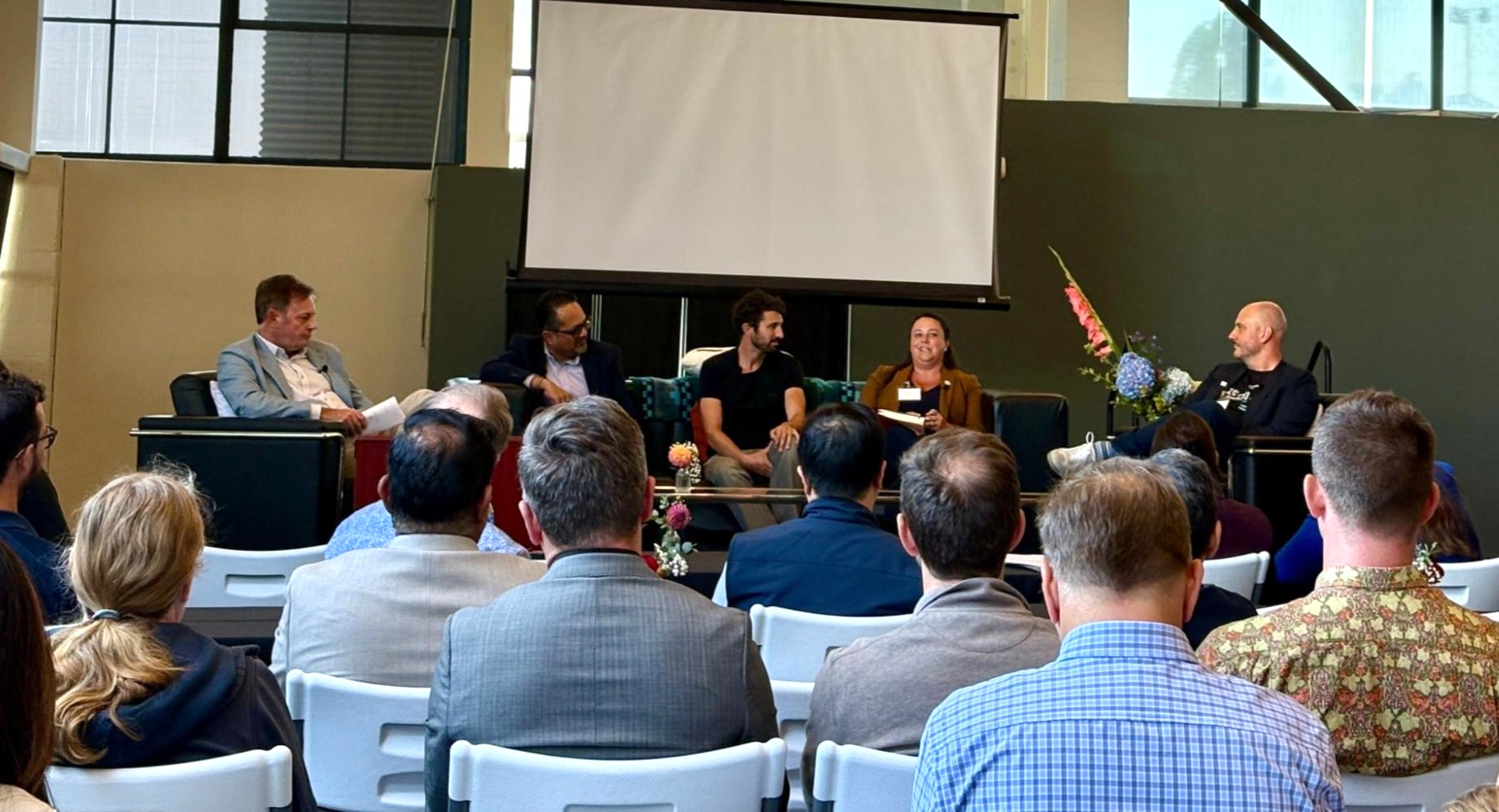
From left, Marc Cummings, Life Science Washington; Snehal Patel, Sana Biotechnology; Joe Horsman, Madrona Venture Group; Rebecca Bryant, Fred Hutch Cancer Center; and Alex Zanghellini, Arzeda, at a Seattle forum hosted by the National Security Commission on Emerging Biotechnology on Tuesday. (GeekWire Photo / Sydney Jackson)

Arzeda designs enzymes for products ranging from laundry detergent to stevia. But when it comes time to manufacture at commercial scale, the Seattle-based startup often has to look overseas.

That’s why, when a federal biotechnology commission visited Seattle on Tuesday, the industry came forward with a problem: They have the science, but lack the infrastructure and workforce pipeline to keep innovation on U.S. soil.

Arzeda’s designs reach an estimated 1.8 billion consumers worldwide, and the company has spent the better part of two decades building its technology. The company’s enzymes, sometimes designed in days rather than weeks thanks to AI, are largely manufactured in Western Europe and India — with one U.S. contract manufacturing partner in Wisconsin. 

Finding domestic manufacturers with the expertise and capacity to make these specialized proteins has been difficult, CEO Alexandre Zanghellini said. And for a company trying to commercialize new biotechnology, he added, manufacturing delays can be “catastrophic.” 

The federal group visiting Seattle — the National Security Commission on Emerging Biotechnology — was created by Congress to address these kinds of problems. Since 2022, the team of 11 bipartisan experts have examined how biotech intersects with national security, and what the U.S. needs to do to remain competitive with China. 

Last year, the commission drafted a report to Congress with 49 recommendations spanning at least $15 billion in federal investment over five years, with policies to get more private capital into biotechnology, build domestic manufacturing capacity, strengthen the workforce and reduce vulnerabilities in the supply chain. 

Now, with the commission sunsetting in December, its members are taking their case around the country. 

The science is here, the infrastructure isn’t

In Seattle, the urgent matter is finding a way to keep biotechnology breakthroughs in the United States. Alexander Titus, a commission member who has headed AI-focused biotech initiatives in Seattle and nationwide, said Washington stands out for its early innovation and research. 
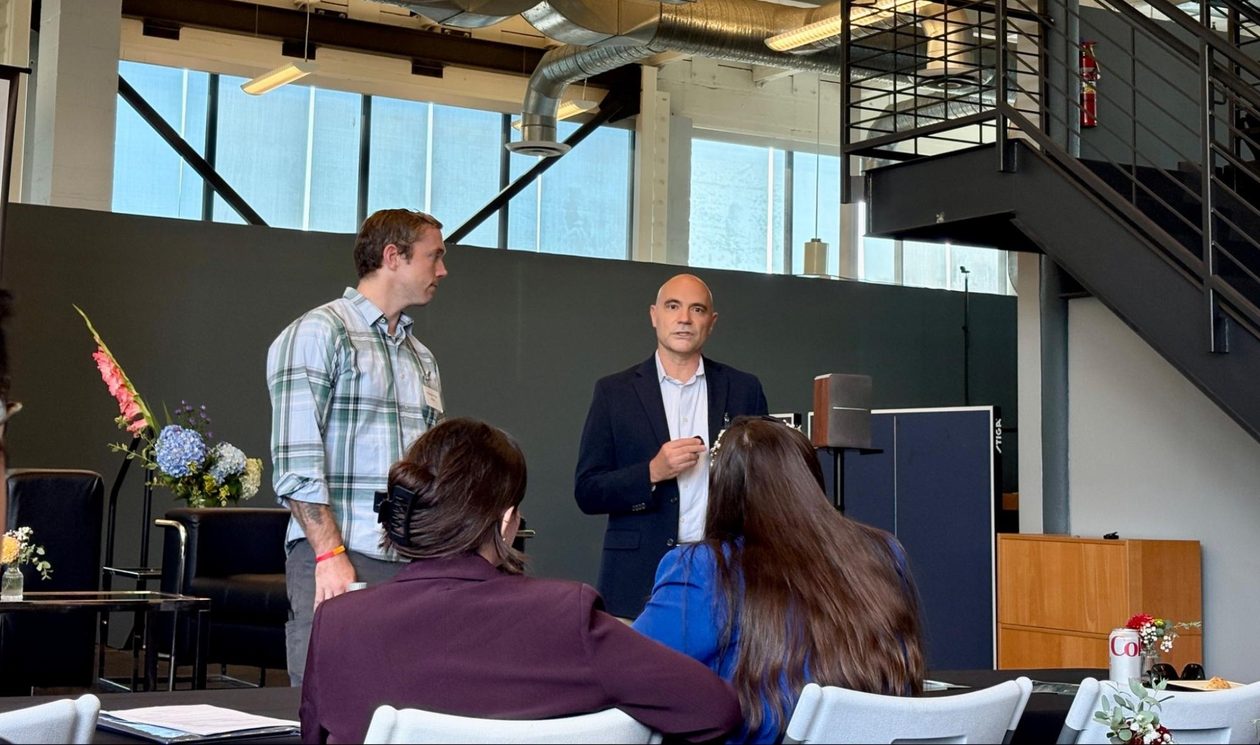
National Security Commission on Emerging Biotechnology commissioners Alexander Titus, left, and Paul Arcangeli speak with attendees at a Seattle biotech forum on Tuesday. (GeekWire Photo / Sydney Jackson)

“Companies like Arzeda are having pretty serious leadership roles in the AI and bio space,” he told GeekWire. “A lot of the work we have done in the commission has revolved around helping the U.S. meet the moment when it comes to this nexus.” 

Institutions like the University of Washington, Fred Hutchinson Cancer Center and the Allen Institute have helped build a deep life-sciences ecosystem in Washington. UW’s Institute for Protein Design, led by 2024 Nobel Prize winner David Baker, has spun out more than 20 companies.

One is Arzeda, which has an increasingly fast agentic workflow that can fine-tune a model, suggest the next experiment, and allow researchers to test thousands of sequences in a single round. The company’s first AI-designed commercial product was a stevia ingredient launched in 2024; it’s now negotiating a $44 million contract with the federal Defense Threat Reduction Agency related to biothreat response. 

While technology is moving quickly, the infrastructure needed to commercialize it is not — creating what Seattle biotech leaders called a “valley of death” between research and manufacturing.

The U.S. has federal funding for basic research, as well as a venture-capital system that can finance early-stage discoveries. But once a company needs to build or access physical infrastructure for commercial-scale manufacturing, the financing becomes much harder. Venture capital investors don’t see the returns attractive enough, Zanghellini said. Banks aren’t eager to finance them, either. 

The pull of overseas manufacturing

Meanwhile, China has spent two decades making biotechnology a strategic priority, and its 2026 Five-Year Plan doubles down on areas including biomedicine, biomanufacturing, pharmaceuticals and brain-computer interfaces. For U.S. companies in the race, that can create an uncomfortable incentive: If the infrastructure is cheaper and faster somewhere else, that’s where the work often goes. 

Last year, Seattle-based Sana Biotechnology canceled plans for a manufacturing plant that was supposed to employ hundreds of workers in Bothell, Wash., instead opting for a contract manufacturer elsewhere to cut costs. Snehal Patel, the company’s executive vice president and chief technical officer, said on Tuesday he’s optimistic the Seattle area could compete on speed and cost with China’s fully integrated supply chain — with the right resources.

Ideally, manufacturing facilities in the U.S. would offer flexibility and knowledge in different products and processes, while ensuring trade secret protection.

The commissioners recognize this need; among their recommendations for Congress is a nationwide manufacturing network for precommercial, bioindustrial product scale-up. That could address the problem Seattle companies face: a startup shouldn’t have to choose between sending manufacturing overseas or trying to build an entire facility itself.

The commission has also recommended requiring companies to disclose points of supply-chain vulnerability in foreign countries of concern. If a geopolitical conflict disrupts the supply of medicines or other biological products, Titus said, the consequences can reach Americans far from any battlefield.

“Being able to keep and maintain our leadership in certain industries allows us to have the edge in any given situation,” he said. “We want our industries to be able to produce here…it’s truly national security in the broadest sense at this point.”

Building the workforce pipeline

To accomplish this, companies need a stronger industrial biomanufacturing workforce.

Rebecca Bryant, Fred Hutch’s director of government relations and a former staffer for Rep. Adam Smith, said while Washington trains well for research, there’s no equivalent pipeline into entry-level biomanufacturing jobs. Titus sees the issue as part of a broader problem of “bioliteracy” — that biology should be a basic problem-solving tool in the same way that engineering, chemistry and computing are, rather than a specialized field understood by few. 

In Washington, the Hutch Advance partnership with Shoreline Community College trains and places lab technicians, while Sana Biotechnology has worked on a model for moving workers into biomanufacturing. Seattle industry leaders suggested a state or federally-supported workforce consortium to bolster the effort. Meanwhile, the commission has urged Congress for more biomanufacturing training support. 

According to the commission, the next three years will determine whether the U.S. remains the global leader in biotechnology or cedes the future to China. Of the commission’s 49 recommendations, Titus said, 26 have been written into law in some capacity. The next step is in the hands of Congress, federal agencies, states and the industry itself. 

Former Microsoft product manager launches bid to end clock change in Washington state, Congress or not

Scott Thurlow is founder of Last Fall Back Washington. (Photo courtesy of Scott Thurlow)

Scott Thurlow isn’t a morning person. So much so, he wants to change state law.

In 2019, Washington lawmakers voted to put the state on permanent daylight saving time if Congress ever allows it. Thurlow has a different idea: Stop changing the clocks now, even if that means staying on Pacific Standard Time for a while.

Thurlow spent 32 years at Microsoft in product management for franchises including the original Outlook, Teams and, most recently, Copilot. A constant stressor was working across time zones. 

“We always dreaded the time zone changes on either end because it was meeting chaos,” he said. “Talking with India, which is like 12 hours off, went from really bad to worse.”

In July, Thurlow took part in Microsoft’s voluntary retirement program, and was featured in a GeekWire story along with several others. Last week, he launched Last Fall Back Washington, a nonprofit campaign built around what he’s calling the Last Fall Back Act. The idea is straightforward: Washington should move to permanent Pacific Standard Time immediately. 

Thurlow’s campaign is timely: British Columbia is dropping its seasonal clock changes and moving to permanent daylight time, meaning Washington will fall an hour behind its northern neighbor from November until March. Thurlow argues the difference could complicate everything from cross-border travel to transportation schedules and business meetings.

His own proposal would make that gap year-round at first, since Washington would sit on the winter clock while B.C. stays on the summer one. He accepts the tradeoff: stop the switching now, and get back in sync later if Congress makes daylight time permanent nationwide.

He also points to research linking the spring clock change with short-term increases in heart attacks, workplace injuries and fatal crashes — in 2020, one study published in Current Biology reported that fatal crashes increase by about 6% in the week after the spring time change.

Under the federal Uniform Time Act, states can opt out of daylight saving time changes, but only by staying on standard time. Permanent daylight time requires an act of Congress. Permanent standard time does not, which is how Arizona and Hawaii do it. That’s the path Thurlow’s proposal would take.

“If and when Congress ever really does act,” Thurlow said, “we would snap into daylight time.”

Done waiting for Congress

In July, the House passed the federal Sunshine Protection Act by a 308-117 vote, sending the bill to the Senate. The legislation would make daylight saving time permanent nationwide, but the Senate has not taken it up. Thurlow isn’t counting on that changing — although President Trump is pushing for it.

“It’s going to end up withering on the vine and stalling,” Thurlow said.

Washington’s Legislature has also considered permanent-time legislation, but bills introduced since 2022 have stalled without reaching a floor vote.

Washington has two types of citizen initiatives: an initiative to the people, which goes directly to the ballot, and an initiative to the Legislature, which gives lawmakers the opportunity to pass the measure themselves or send it to voters.

Thurlow plans to spend the coming months building support for the latter approach and pushing legislators to introduce and pass the Last Fall Back Act when the 2027 session begins.

“The single most effective thing we can do is have lots of people contacting their legislators,” he said.

If lawmakers again decline to act, he expects to file an initiative to the Legislature around March 2027. The campaign would then need to collect about 386,000 signatures, providing a cushion above the 309,000 valid signatures required. If lawmakers still don’t pass the measure, it could go before voters in November 2028. 

Experts are divided 

Experts seem to agree Washington should stop changing its clocks — but disagree on how to go about it. 

University of Washington law professor Steve Calandrillo has long advocated permanent daylight time, and has testified against Washington legislation that would put the state on standard time. He told GeekWire he appreciates Thurlow’s efforts to pressure Congress, but doesn’t want Washington to spend years on standard time while waiting for federal action.

“I don’t want to see us go in the wrong direction,” he wrote in an email.

Under Washington’s current system, daylight saving time effectively functions as the state’s default for about two-thirds of the year. Permanent standard time would move sunset an hour earlier throughout that period, Calandrillo argues, creating safety risks and other costs.

Evening darkness is more dangerous than morning darkness, he argues, because more people are traveling and spending time outside in the evening — and there’s a greater chance of crime.

Other UW researchers have split on the question. Biology professor and circadian researcher Horacio de la Iglesia has testified in favor of permanent standard time. 

Environmental and forest sciences professor Laura Prugh testified against the 2024 bill alongside Calandrillo, citing research she co-authored that modeled about an 8% increase in deer-vehicle collisions in Washington under year-round standard time. She also worked on a study across 23 states that showed collisions with deer jump by 16% in the week following the autumn clock change. 

National groups are similarly divided. Save Standard Time has supported Washington legislation favoring permanent standard time, while Lock the Clock has pushed Congress to give states more flexibility rather than taking a position on which permanent time is best.

Temporary costs for long-term gains

Thurlow’s campaign acknowledges the tradeoffs: permanent standard time would put Washington out of sync with Oregon and California for much of the year, shorten summer evenings and potentially increase deer collisions.

But those costs would be temporary, he argues. The twice-yearly clock changes, by contrast, would continue indefinitely unless someone breaks the stalemate.

Thurlow also expects opposition over winter darkness, particularly concerns about children walking to school before sunrise. His response is that many Washington students already do so under the current system, and that changing school start times can address the problem. Seattle and other districts have already adjusted schedules for other reasons.

“There’s sort of a set of gut reactions and instant responses that people have, which may not be grounded in truth,” he said. 

Thurlow is betting that enough Washingtonians are tired of changing their clocks that the campaign can turn a decades-old annoyance into a political issue — and give the state a way out before Congress decides on the issue. His campaign is in early stages, with a handful of signups through his website.

❌