
Reading view

There are new articles available, click to refresh the page.

The Account Size That Changes How You Trade
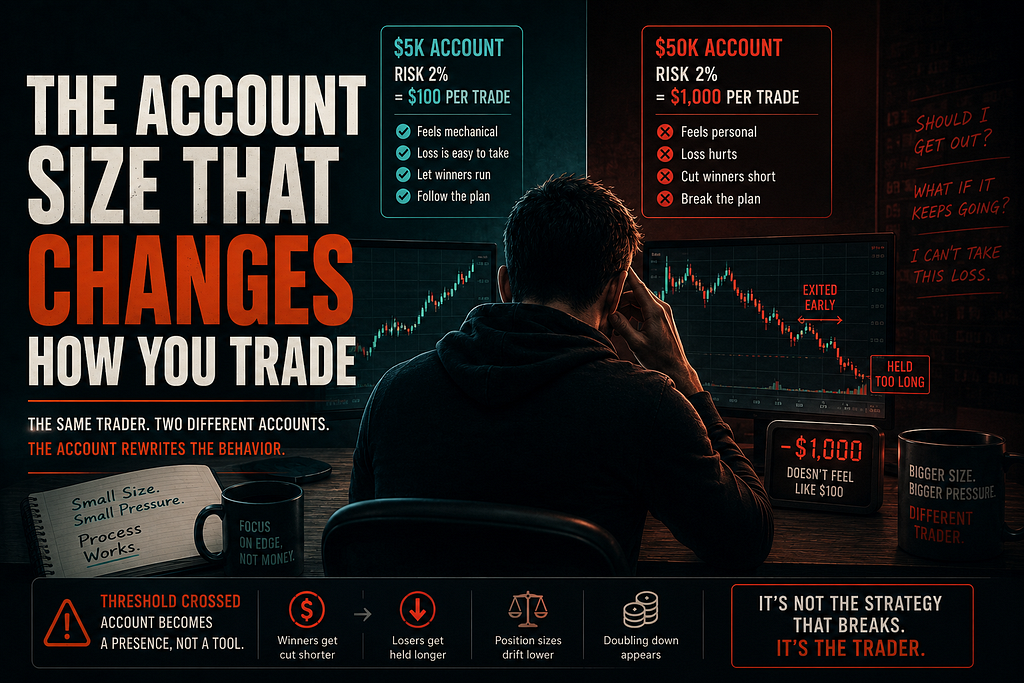
The same trader at $5k and $50k is not the same trader. The account itself rewrites the behavior.

There’s a quiet assumption underneath most trading education: that process scales linearly. That the rules a trader follows at one account size will produce the same outcomes, proportionally, at a larger one. The math supports this assumption. The math is not what trades the account.

What the Numbers Look Like on Paper

At $5k, a 2% risk per trade is $100. The trader sees the number, accepts it, executes. The position size is small enough to feel hypothetical. If the stop hits, $100 is gone. A bad week takes a few percent of the account. A bad month is recoverable in a couple of normal weeks. The account behaves like a sandbox.

At $50k, a 2% risk per trade is $1,000. The math is identical. The percentage is identical. The position relative to capital is identical. The trader, however, is not identical. The trader is a person looking at a number that represents real money in the world outside the screen. A thousand dollars buys things. A thousand dollars is rent in some cities. The number stops being abstract.

This is where the linear-scaling assumption breaks. The risk percentage stays the same. The risk experience does not.

The Threshold That Changes Everything

Every trader has a threshold. It’s not the same number for everyone. It might be $500 per trade. It might be $5,000. It might be higher. Below the threshold, position sizes feel mechanical. Above it, position sizes feel personal.

The threshold isn’t determined by the trader’s net worth or their income. It’s determined by the size at which the position starts occupying mental space outside of trading hours. When the trader thinks about the position while making dinner. When they check the chart from bed. When the unrealized number affects their mood for the day.

That threshold is the line where the account stops being a tool and starts being a presence. Crossing it changes what the trader does, even when they don’t notice the change. It’s part of why traders break their own rules — the rule that worked perfectly at one size simply stops being followable at another, not because the rule is wrong, but because the trader following it is no longer in the same emotional state.

The same setup, with the same edge, executed at a size that crosses the threshold, becomes a different trade. The trader who could hold a $100 loser through normal volatility now flinches at a $1,000 drawdown. The hand that placed the stop at $5k tightens that stop at $50k. The exit that was planned at a level becomes an exit at the first sign of discomfort.

How the Behaviors Shift

The shifts are predictable, even though they vary in intensity.

Winners get cut shorter. At the smaller account, a $200 profit is a nice trade. The trader lets it run because there’s no urgency to lock it in. At the larger account, a $2,000 profit is significant. The urgency to secure it overrides the plan. The trader closes early, not because the setup invalidated, but because the dollar amount feels like enough.

Losers get held longer. At the smaller account, taking a $100 loss is administrative. The trader hits the button and moves on. At the larger account, taking a $1,000 loss requires admitting that real money is gone. The trader hesitates. The hesitation creates room for the loss to grow. The stop that was supposed to be mechanical becomes a discretionary decision, and the discretion is shaped by the discomfort of the dollar amount, not by the structure of the chart.

Position sizes drift. The trader who risked 2% at $5k starts risking 1% at $50k, sometimes without realizing it. The official rule says 2%. The trader’s hand says 1%. The discrepancy isn’t laziness or fear in the usual sense. It’s the body adjusting to a size that exceeds the trader’s actual comfort zone, regardless of what the spreadsheet says.

Doubling down appears for the first time. At small account sizes, averaging into losing positions feels reckless because the recovery isn’t meaningful. At larger sizes, the desire to “fix” the position becomes overwhelming. The trader who never averaged down at $5k starts adding to losers at $50k because the loss is large enough that they need it to come back, rather than accept it.

None of these behaviors show up in a backtest. They show up in the live account, and only at the size where the threshold is crossed.

Why the Process Looked Like It Worked

The trader who built their edge at smaller sizes will often arrive at the scaling moment confident. The process has been tested. The win rate is documented. The risk management has been followed for months. By every measurable standard, the trader is ready.

What the testing didn’t expose is the relationship between the trader and the dollar amount of each individual trade. The process worked because the dollar amounts were below the threshold. The discipline held because the discipline was never under real pressure. The mechanical execution was mechanical because nothing was at stake emotionally.

When the size scales up, the test conditions change. It’s not the strategy being tested anymore. It’s the trader’s psychology under conditions that were never present in the historical data. The win rate from the past was generated by a different version of the trader — one operating below their threshold. The new version of the trader, operating above the threshold, is unknown.

This is why scaling so often produces results that look nothing like the smaller-account performance. The strategy didn’t break. The trader who runs the strategy did.

The Specific Weakness That Gets Exposed

Each trader has a specific weakness that smaller accounts never tested. For some, it’s the inability to take losses cleanly. For others, it’s the inability to hold winners. For others, it’s an unconscious tendency to size down when they shouldn’t, or up when they shouldn’t.

These weaknesses are invisible at smaller sizes because the consequences are too small to surface them. A trader who can’t take losses cleanly at $5k just absorbs a few extra losses without noticing. The drag on performance is real but invisible against the noise of normal variance.

At larger sizes, the weakness becomes the dominant feature of the performance. The trader who couldn’t take losses cleanly at $5k now refuses to take them at all at $50k. The small leak becomes the main source of drawdown. The strategy that produced consistent profits at smaller scale produces inconsistent results at larger scale, and the inconsistency comes from the trader, not the market.

The painful version of this is that the trader doesn’t see it as a scaling problem. They see it as a strategy problem. They start adjusting the strategy that wasn’t broken instead of recognizing the weakness in themselves that the new size exposed. The adjustments make things worse, because they’re solving the wrong problem.

The Step Most Traders Skip

The step most traders skip is admitting that the account size has changed them. There’s a kind of pride in believing that one’s process is robust enough to scale without psychological consequence. That belief is wrong, and the wrongness of it is part of why humility is the actual edge in trading at larger sizes.

The trader who admits the size has changed them can do something about it. They can size down to a level just below their threshold, build experience and emotional capacity at that size, and then incrementally scale up. They can recognize when their behavior is being driven by the dollar amount instead of the structure, and they can pause until the recognition becomes integrated.

The trader who refuses to admit it will keep executing at the size that exceeds their capacity, attribute the resulting losses to bad luck or strategy decay, and either blow up the account or shrink it back down to where they’re comfortable again. The cycle repeats every time they try to scale.

What Scaling Actually Requires

Scaling an account isn’t a math problem. It’s a capacity problem. The trader has to grow into the size, not just allocate into it.

The growth is invisible from the outside. It looks like the same trader executing the same strategy at a larger size. Internally, it requires desensitization to the dollar amounts. The $1,000 risk has to feel as routine as the $100 risk did. That desensitization takes repetition at the size, over a long enough period for the emotional response to flatten out.

There’s no shortcut. The trader can read every book on trading psychology, can intellectually understand every concept, can rehearse every scenario in their head. None of it substitutes for the lived experience of taking the trades at the size, watching the dollar amounts move, and accumulating enough repetitions for the body to stop reacting.

Most traders don’t give themselves the time to do this. They scale up, get punished, scale back down, and conclude that they should stay small forever. The real conclusion is different. They should have scaled more slowly, accepted the friction as part of the process, and let the threshold gradually move.

What This Looks Like in Practice

The trader who handles scaling well looks unimpressive in any given week. They size up in small increments. They sit with each new size for longer than feels necessary. They give themselves permission to size back down if they notice their behavior changing.

They don’t talk about their account size. They don’t try to reach a specific number by a specific date. They treat the account as a slow accumulation, not a target. The discipline that protects them isn’t about the trades. It’s about resisting the pressure to scale faster than their psychology can absorb.

The same trader at $5k and $50k is not the same trader. The trader who succeeds at both sizes is the one who knows it.

Every day I track one thing: where market structure and crowd sentiment disagree — and which one leads. Today’s read:

swaphunt.dev/today

Daily on swaphunt.dev. Same on @SwapHunt. Not financial advice.


The Account Size That Changes How You Trade was originally published in Coinmonks on Medium, where people are continuing the conversation by highlighting and responding to this story.
How Information Loses Its Edge in Markets

Every piece of information has a half-life. By the time it reaches you, the edge it once carried has usually decayed past usable.

This is not a complaint about being late. It is a description of how information moves through markets. The same headline that feels urgent at 9:00 was already known at 8:45, traded at 8:30, and structurally positioned for at some point earlier in the week. The version you receive is the final, most-public iteration of a story that has been circulating, in different forms, through different participants, for a long time.

The trader who acts on widely-known information is not acting on information. They are acting on a residue of it.

The Layers Information Passes Through

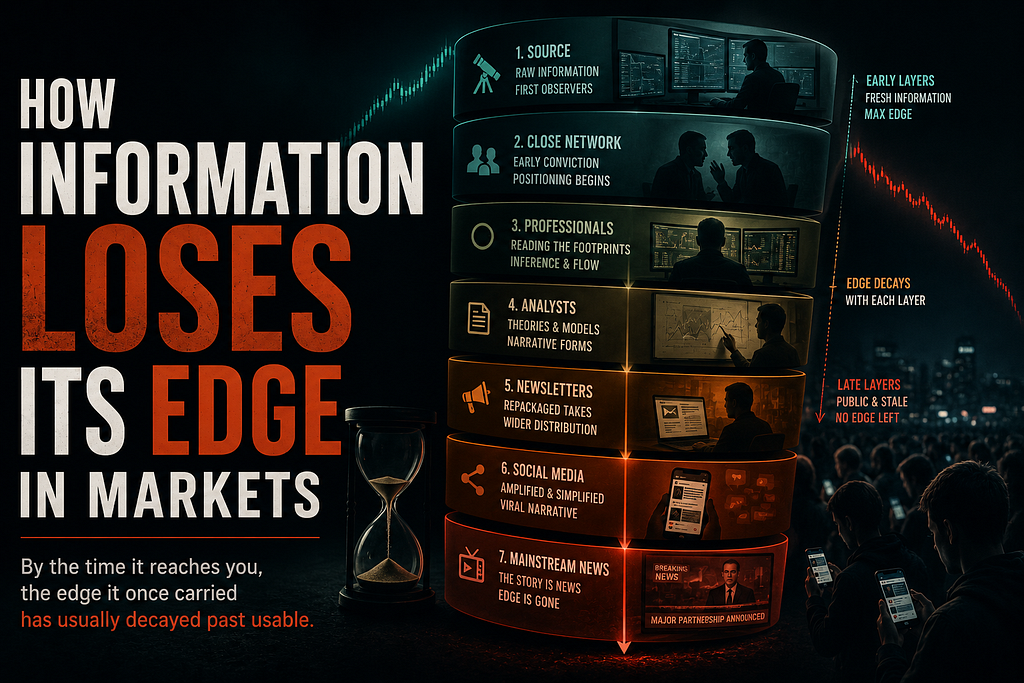
Markets are not flat. Information does not arrive simultaneously to all participants. It moves through layers, and at each layer, the pricing power of that information decays.

At the earliest layer, there is the source. A protocol team aware of a vulnerability. A market maker watching unusual order flow on a counterparty’s books. A custody desk seeing redemptions from a fund. These participants are not predicting anything. They are observing the raw inputs that will, eventually, become a story for everyone else.

The next layer is the close network. People one or two relationships away from the source. They do not have the same certainty, but they have enough conviction to act. Their positioning starts shifting the price in small, often unattributable ways.

After that come professional traders who read the order book carefully. They cannot see the source, but they can see the footprints. Unusual buys at calm hours. Aggressive bids on low liquidity. A widening spread that does not match the surface narrative. These traders act on inference, not knowledge.

Then come analysts, who construct theories from price action and on-chain data. Then retail-focused newsletters, which repackage those theories. Then social media, which amplifies the conclusion without the reasoning. Then mainstream coverage, which announces it as news.

By the time the story is news, the price has moved through every prior layer of positioning. The information has been priced six times before it reaches the seventh layer.

Why the Late Layer Is the Loudest

There is a paradox in how information feels. The earliest layers operate quietly. A few orders. A few conversations. No headlines. The latest layers operate loudly. Trending posts. Push notifications. Television segments.

The volume of attention is inversely correlated with the freshness of the information. By the time something is loud, it is also stale.

This creates a structural illusion. Loudness feels like signal. The trader watching social media sees activity, conversation, urgency, and reads it as evidence that something is happening. Something is happening, but it is the discussion of an event, not the event itself. The event already occurred when the first layer began positioning.

The decay is not always visible in the chart, but it is usually visible in price before the headline. The market does not wait for confirmation. It responds to the early layers, drifts during the middle layers, and often reverses by the time the last layer arrives. This is the entire structure behind why markets move before news. The price is not predicting. It is reflecting positioning that the public layer has not yet seen.

What Decayed Alpha Looks Like

When a trader acts on information that has already passed through most of the layers, they are not buying edge. They are buying the appearance of edge. The signal is real. The reasoning is sound. But the position has already been taken by others, and those others now need someone to sell to.

The late entrant is the exit liquidity for the early layer.

This dynamic is most visible during news-driven moves. A protocol announces a partnership. Price spikes on the headline. The trader who entered on the headline often watches price fade for the rest of the session. The move that looked like the beginning was actually the end. The earlier participants who positioned during the rumor phase used the headline-driven enthusiasm to distribute.

Nothing about this is conspiratorial. It is the natural consequence of how information propagates. If you can see the headline, the headline has already been processed by the market.

The Internal Dynamics of Each Layer

It would be wrong to suggest each layer is a homogeneous group acting in coordination. They are not. Within each layer, participants disagree about magnitude, timing, and interpretation. Some early actors take small positions. Some take large. Some hedge. Some scale.

But what is consistent across layers is the type of information available. The early layers have access to raw inputs. The middle layers have access to inferred patterns. The late layers have access to confirmed narratives. Each type of information is less actionable than the one before it, because the price has already absorbed the earlier interpretations.

By the time the narrative is confirmed, the actionable phase is over. What remains is positioning around the resolution, not around the discovery.

The Trap of Feeling Informed

The most expensive feeling in markets is the feeling of being informed.

A trader reads three articles, watches two interviews, and follows a thread that summarizes a complex situation. They feel they understand. They feel prepared. They take a position based on what they now know.

The problem is that the act of being able to read those three articles means the information is already public. The thread exists because someone wrote it, which means someone else read it first, which means the conclusion the trader is now reaching was reached by others days or weeks earlier.

Feeling informed is a sign that the information has fully decayed. The market did not wait for the trader to read the thread. It moved during the period when only the source knew. By the time the trader arrives at a confident interpretation, the price reflects a different stage of the cycle, often the stage where early positioning is being unwound.

A good study in this is the exploit was expected — a clean example of how informed participants act on information before the public layer ever sees it, and how the headline arrives at the moment the early layer is exiting.

Why Decay Cannot Be Outrun

A common response to this problem is to try to move faster. Refresh feeds more frequently. Subscribe to more sources. Watch more screens. The reasoning is that if late information is decayed, then earlier information must be better, and the way to access earlier information is to consume more of it.

This logic fails because the constraint is not consumption speed. It is layer position. A trader on social media can refresh every second and still be in the seventh layer. The earlier layers are not faster versions of the same channel. They are different channels entirely.

The professional desk does not learn about the order flow from Twitter. They see the order flow directly. The custody team does not learn about redemptions from a newsletter. They process the redemptions. No amount of faster consumption moves a participant from a downstream layer to an upstream one.

Speed within a layer is not the same as access to a higher layer.

What Remains When Information Decays

If information decays past usable by the time most traders see it, what is actually tradable? The honest answer is: structure, behavior, and price itself.

Structure does not decay. The architecture of how markets move, how liquidity gathers and disperses, how participants behave at certain types of levels, remains valid across cycles. It is not faster information. It is a different kind of information entirely.

Behavior does not decay either. The way crowds react to losses, to rallies, to news cycles, is consistent over time. A trader who studies behavior is not racing against the information layer. They are operating on a different axis.

Price itself is the most honest layer. Price reflects all the positioning that has already happened, including from the earliest layers. A trader who reads price carefully is not trying to predict what comes next. They are trying to see what has already been decided.

These are slower, less exciting forms of analysis. They do not produce the urgency that headline trading produces. But they do not depend on being early to information, because they do not depend on information in the conventional sense.

The Discipline of Knowing You Are Late

Most traders are in the late layer most of the time. This is not a personal failure. It is a structural fact of how information distributes.

The useful response is not to pretend otherwise. It is to assume lateness as the default, and to design behavior around it. If you are late, the headline is not a buy signal. It is, more often, a sign that the move you are reading about is in its distribution phase. The trader who acts on the headline is providing liquidity to the participants who acted weeks earlier.

This does not mean acting on news is always wrong. It means acting on news as if it were fresh information is always wrong. The information is not fresh. The price has already absorbed it through six earlier layers.

The trader who understands this stops chasing the feeling of being informed. They stop refreshing feeds for an edge that the feed cannot provide. They start watching structure, behavior, and price, because these are the few layers that do not decay between the source and the screen.

The half-life of information is short. The half-life of structure is long. Most traders spend their effort optimizing for the wrong one.

Every day I track one thing: where market structure and crowd sentiment disagree — and which one leads. Today’s read:

swaphunt.dev/today

Daily on swaphunt.dev. Same on @SwapHunt. Not financial advice.


How Information Loses Its Edge in Markets was originally published in Coinmonks on Medium, where people are continuing the conversation by highlighting and responding to this story.

The Trades You Remember Are Lying to You

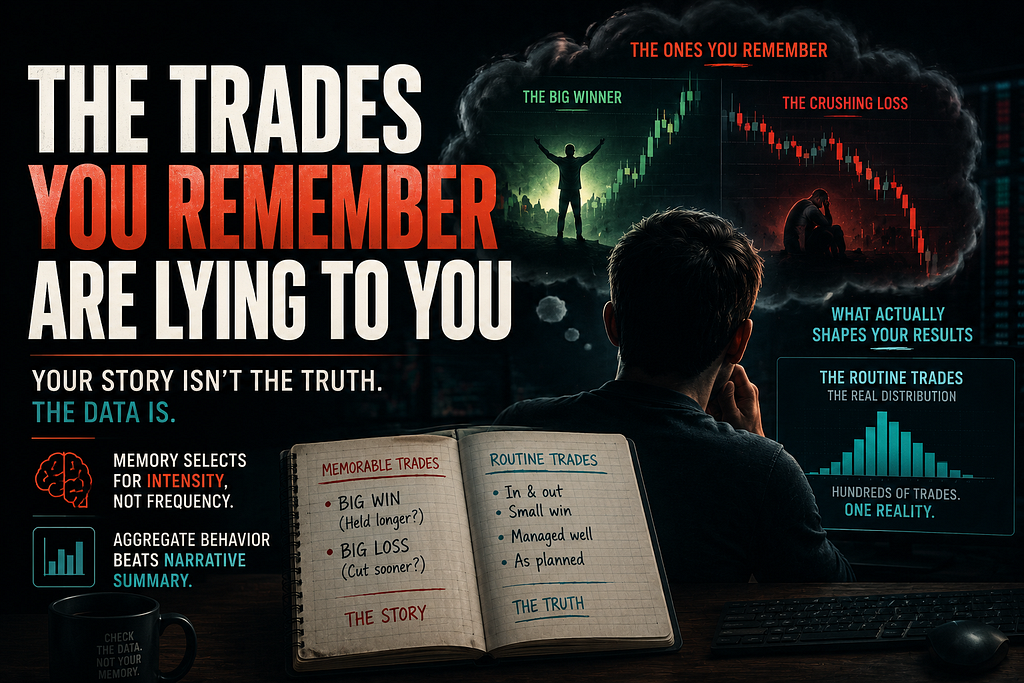
The trades you remember most clearly are not the ones that shaped your account. They are the ones that shaped your story.

This distinction matters, because the story you tell yourself about your trading is the foundation on which every future decision is built. If the story is shaped by the trades that left the deepest emotional imprint, rather than the trades that produced the most representative outcomes, the foundation is distorted before any new decision is made.

Most traders never examine this distortion. They assume their memory is a reasonable summary of their experience. It is not. Memory is a curation process, and the criteria for curation have almost nothing to do with statistical relevance.

What Memory Selects For

Memory selects for intensity, not frequency. The trade that made the most emotional impression — the one that moved fastest, hurt most, or vindicated a thesis most clearly — is the one that gets encoded with the greatest fidelity. The trade that produced a routine outcome, neither dramatic nor catastrophic, is forgotten almost immediately.

This means the trades available to you when you think about your trading are a biased sample. They are not a cross-section of your actual behavior. They are a highlight reel of your most emotionally charged moments, curated by a process that has no interest in accuracy.

If you ask yourself how you have been trading lately, the answer that comes to mind is shaped by this curation. The trades that come up first are the ones that hurt or thrilled. The trades that simply happened — entered, managed, exited within plan — are absent from the recollection.

The absence is the problem. The forgotten trades are the trades that actually define your performance. They are the bulk of the distribution. The memorable trades are the tails.

The Lesson That Is Not the Lesson

Every memorable trade comes with a lesson attached. The big winner teaches you that you should have held longer, or sized larger, or trusted the conviction. The big loser teaches you that you should have cut sooner, or sized smaller, or respected the warning signs.

These lessons feel earned. They came from real experience. They emerged from real pain or real reward. The trader who extracts them is doing what every trading book recommends: learning from each trade.

But the lesson is drawn from a single observation. And the single observation is the most extreme observation, not the most representative one. The trader is generalizing from the tail of the distribution to inform decisions that will be applied across the entire distribution.

This is where the distortion enters. The lesson from the memorable trade tells you to do something different next time. The unremembered trades — the ninety routine outcomes that came before — would have told you that what you were already doing was working fine. But those trades do not speak. They have been forgotten.

So the trader updates their process based on the loudest trade rather than the most informative one. The update is not improvement. It is overcorrection in response to a sample of one.

Why Aggregate Behavior Beats Narrative Summary

This is precisely why humility is the actual edge. The trader who trusts their memory of their trading is trusting a story. The trader who trusts the data is trusting a count.

Stories compress. They simplify. They highlight the moments that fit the narrative and discard the moments that do not. A story about trading sounds coherent because it has been edited for coherence. The trades that contradicted the narrative were left out, not because they were inconvenient, but because they were not memorable enough to make the cut.

Data does not edit. The trade log contains every position, regardless of how it felt at the time. The routine trade that produced a modest gain is recorded with the same weight as the dramatic trade that produced a large loss. The aggregate of those records is a representation of behavior that no memory could produce.

When the trader sits down with the aggregate, the picture often contradicts the story. The trader who remembers themselves as a poor exit decision-maker discovers that their exits are statistically reasonable, and the perception was driven by two or three highly memorable bad exits. The trader who remembers themselves as patient discovers that their average holding period is shorter than they thought, because the patient trades stood out in memory while the impatient ones blended into the background.

The story is not the trader. The aggregate is the trader. And the gap between them is where most behavioral errors originate.

The Journal Distortion

Trading journals are often offered as a corrective to memory bias. The idea is sound: by writing down each trade, the trader creates a record that does not depend on recall.

But journals get distorted too, in a different way. The trades that get written about in depth are the memorable ones. The routine trades get a one-line entry, if they are recorded at all. The journal ends up reflecting the same curation bias as memory — it is just slightly more durable.

A trader who reviews their journal months later does not read the entries with equal attention. They linger on the long entries about the dramatic trades. They skim past the brief entries about the routine ones. The journal becomes another highlight reel, just one with timestamps.

To use a journal as a corrective rather than an amplifier, the trader has to read it against the grain. They have to spend the most time on the entries that received the least attention at the time of writing. They have to deliberately weight the routine trade as more informative than the dramatic one, because the dramatic trade is already overweighted by every other cognitive process at work.

This is uncomfortable. Reading routine trade entries feels boring. The trader’s attention drifts. The lesson is not in the boredom, but the boredom is the price of accessing the lesson.

The Exit That Distorts Future Exits

The clearest example of memory bias in action is exit behavior. A trader exits a winning position. The position continues higher. The trader watches the additional move with frustration, and the experience is encoded with significant emotional weight.

The next time the trader is in a winner, the memory of the early exit shapes the decision. They hold longer than the system would call for. They override the exit signal. They give the position more room because the previous exit hurt.

If the next trade also runs further than the original exit point, the lesson is reinforced. If the next trade reverses and gives back the gains, the lesson is overridden by the new dramatic memory, and the trader swings back toward earlier exits.

This is why traders exit winners too early, and also why they exit them too late. The exit decision is not being made from the system. It is being made from the most recent memorable exit experience. The memory of the last dramatic exit overwrites the statistical reality of how the system performs in aggregate.

The trader is not exiting based on the trade in front of them. They are exiting based on a ghost of a previous trade that left a stronger emotional imprint than the system’s actual edge.

The Trade That Did Not Happen

Memory also distorts in the opposite direction: by remembering trades that did not happen.

The trader who almost took a trade, decided not to, and then watched the move occur without them, remembers the missed trade with vivid clarity. The position size, the entry, the exit, the profit — all of it gets reconstructed in detail, and the absence of the position is felt as a loss.

But the trade did not happen. There was no profit. There was also no risk. The aggregate equity curve is unchanged by the trade that was not taken. The only thing that changed is the trader’s perception of their own decision-making.

Over time, the accumulation of remembered missed trades distorts the trader’s risk appetite. They begin to enter trades they would have otherwise passed on, not because the setups improved, but because the pain of missing has been encoded more vividly than the relief of avoiding. The remembered miss is louder than the unremembered avoidance.

The trade that was correctly avoided — the one where the setup deteriorated and never moved — leaves no memory. The trader does not congratulate themselves for not taking it. The avoidance is invisible, and because it is invisible, it does not contribute to the story.

The Loudest Trade Is Not the Most Informative

The general principle is this: the trade that screams for your attention is almost never the trade that contains the most useful information.

The most informative trades are the routine ones. They reveal what the system actually does, on average, when nothing dramatic is happening. They show the base rate. They define the distribution. They are the source of the edge, if there is one.

The dramatic trades are the tails of the distribution. They are real. They happen. But they do not reveal what the system does in general. They reveal what the system does in extreme conditions, which is a different question.

Conflating the two is the most common analytical error in trading. The trader who studies their dramatic trades to improve their system is studying the wrong sample. The trader who studies their routine trades is studying the sample that actually generates the equity curve.

What This Asks of You

To work against memory bias requires a shift in attention. Instead of asking what you remember about your trading, ask what the record shows. Instead of extracting lessons from the loudest trades, extract them from the average ones. Instead of trusting the story, trust the count.

This is harder than it sounds. The brain resists. The dramatic trade keeps coming back, demanding attention, asking to be the source of the lesson. The routine trade slips away, refusing to be remembered, refusing to contribute to the narrative.

The discipline is to refuse the dramatic trade’s demand. To set it aside, not because it is unimportant, but because it is already overweighted. To deliberately seek the routine trade, not because it is exciting, but because it is the only honest sample.

The trader who can do this develops a different relationship with their own performance. They stop overcorrecting in response to recent drama. They stop drifting from system to system in pursuit of the next dramatic lesson. They settle into the aggregate, which moves more slowly and more truthfully than memory ever will.

The trades you remember are lying to you. Not on purpose. Not maliciously. Just structurally, because memory was never designed to summarize a distribution. It was designed to flag what was intense. And in trading, what is intense is rarely what is true.

The trader who learns to mistrust their own memory, and to trust the unremembered majority of their trades instead, is the trader whose story finally aligns with their account.

Every day I track one thing: where market structure and crowd sentiment disagree — and which one leads. Today’s read:

swaphunt.dev/today

Daily on swaphunt.dev. Same on @SwapHunt. Not financial advice.


The Trades You Remember Are Lying to You was originally published in Coinmonks on Medium, where people are continuing the conversation by highlighting and responding to this story.

❌