Reading view

There are new articles available, click to refresh the page.

Crypto Market Q2 2026: Bitcoin Correction, Institutional Pressure, and Signs of Accumulation

ETF outflows, Fed pressure, and treasury stress collided with record BTC long-term holder accumulation.

Bitcoin investors just experienced one of the most confusing quarters of 2026.

BTC fell nearly 14%, ETFs recorded billions in outflows, and macro liquidity remained tight.

Yet beneath the surface, something unusual happened: long-term holders accumulated aggressively while speculative activity collapsed.

1. Executive Summary

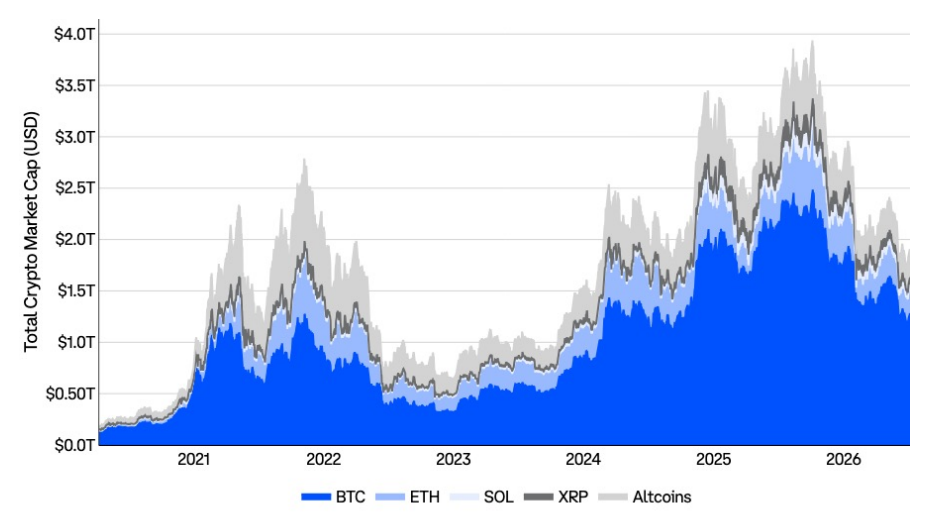
The second quarter of 2026 proved to be a challenging period for the digital asset market. Total crypto market capitalization (excluding stablecoins) contracted by approximately 12%, while the price of Bitcoin (BTC) declined by ~14%, closing June at $58,544.
Despite the price correction, underlying on-chain metrics point to an accumulation phase and seller exhaustion:

  1. The share of Bitcoin supply in a loss position surpassed the share in profit for the first time in the current cycle.
  2. Supply held by Long-Term Holders (LTHs) hit a new all-time high.
  3. The market faces pressure from tight Federal Reserve monetary policy and ETF outflows; however, macroeconomic fundamentals (productivity gains and strong CapEx) provide a constructive long-term backdrop.

2. Bitcoin (BTC): Technicals and On-Chain Metrics

Price Dynamics and Key Support Levels

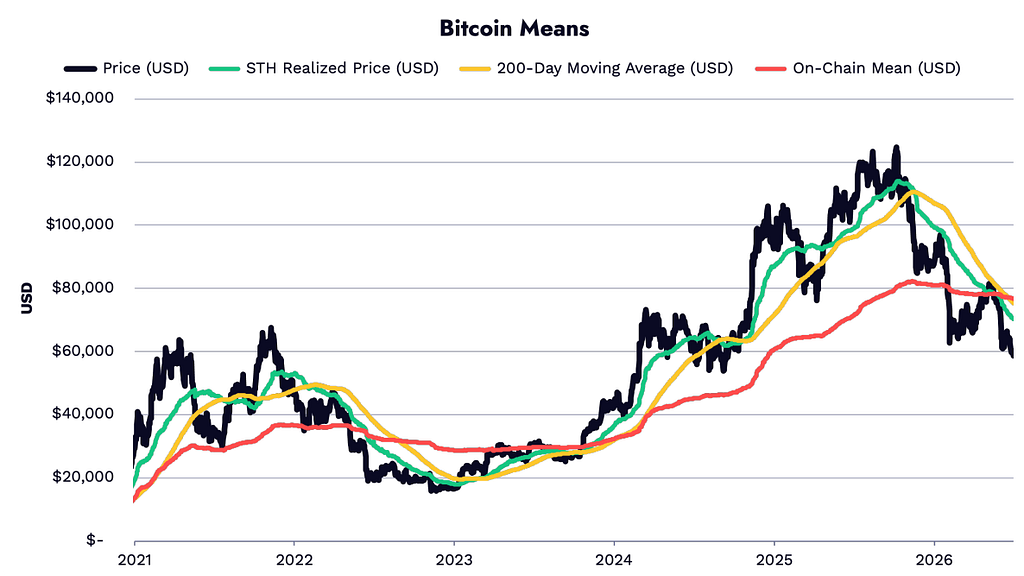
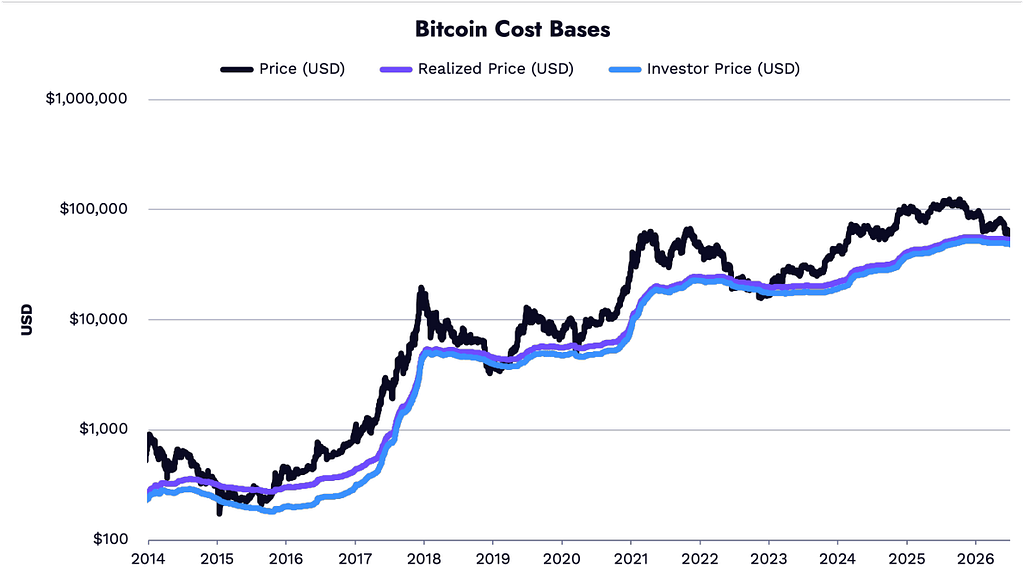
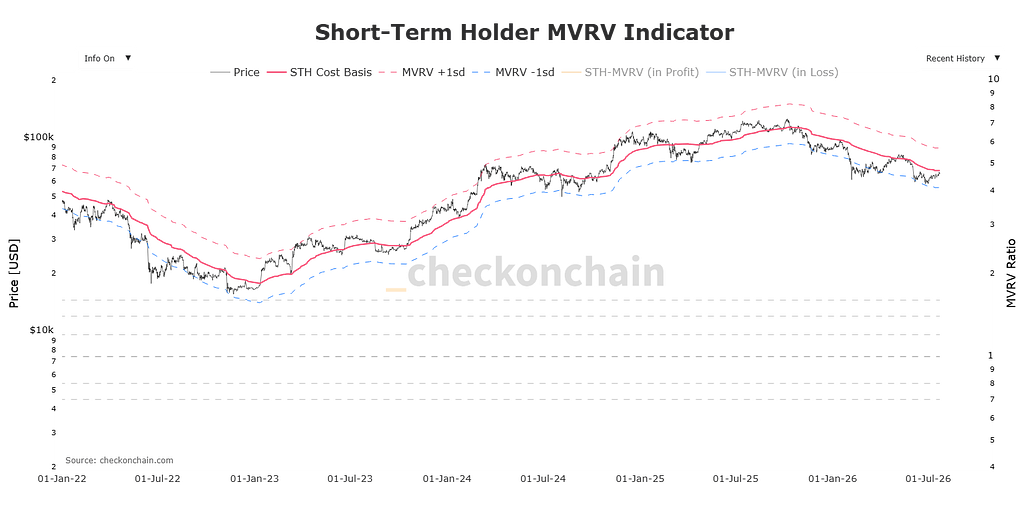
Throughout Q2 2026, Bitcoin was attempting an exit from its corrective phase. Despite a local push toward $82,186 early in the quarter, BTC closed June below all three of its primary moving cost-bases:

  • Short-Term Holder (STH) Realized Price: ~$70,327
  • 200-day Moving Average (200-day MA): ~$75,371
  • On-Chain Mean: ~$76,660

The shift of these levels from support to resistance confirms short-term bearish sentiment. However, the fundamental “floor” for this cycle sits in the $49,000 — $53,000 range (between the Realized Price of $53,135 and the Investor Price of $48,581).
Holder Behavior and Exhaustion Indicators

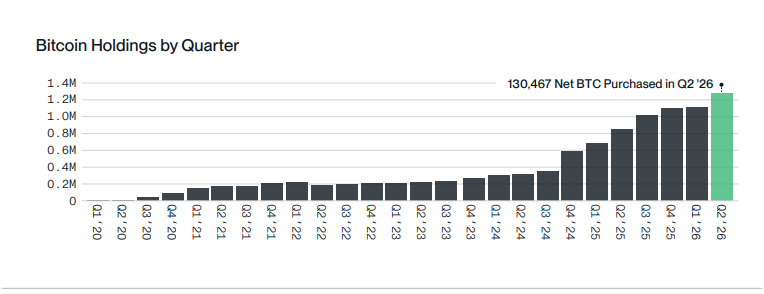
  • Long-Term Holder (LTH) Record: Total BTC held by LTHs reached a record ~14.85 million BTC (+313k BTC during the quarter). Long-term investors actively absorbed circulating supply.
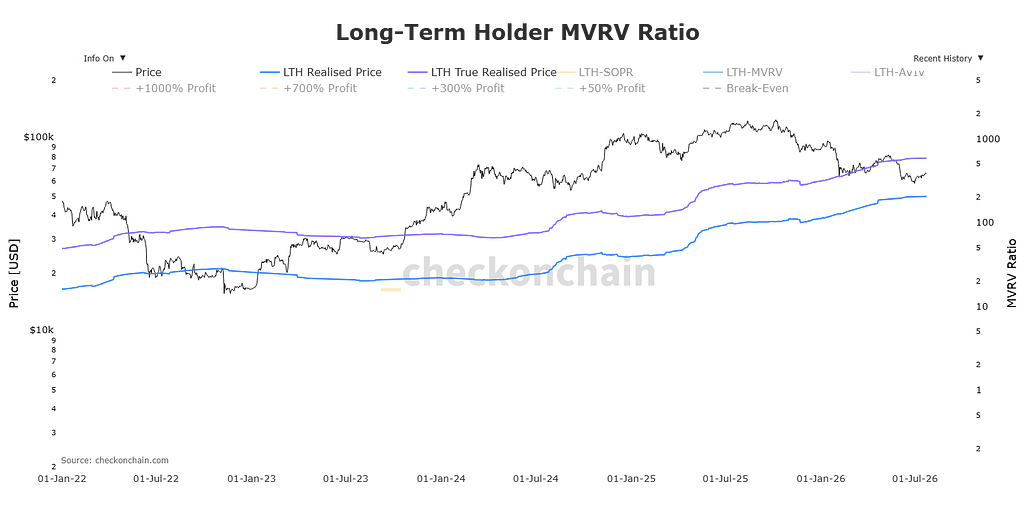
  • Dormancy and Illiquidity: Supply last moved over 1 year ago continued to rise, whereas short-term speculative activity (coins moved within months) refreshed multi-year lows.
  • Entity-Adjusted NUPL: Net Unrelized Profit/Loss shifted out of the “Optimism/Anxiety” zone down toward “Hope/Fear,” approaching the “Capitulation” threshold.
3. Ethereum (ETH) and Stablecoins Performance
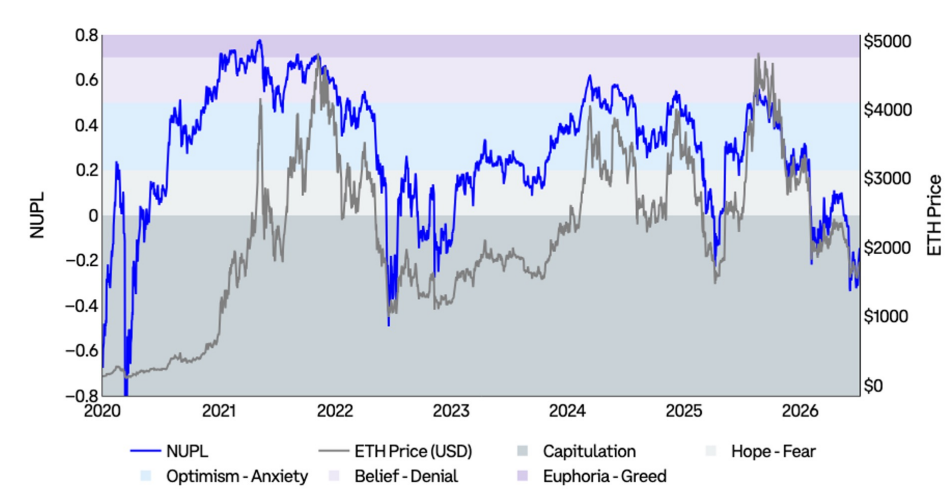
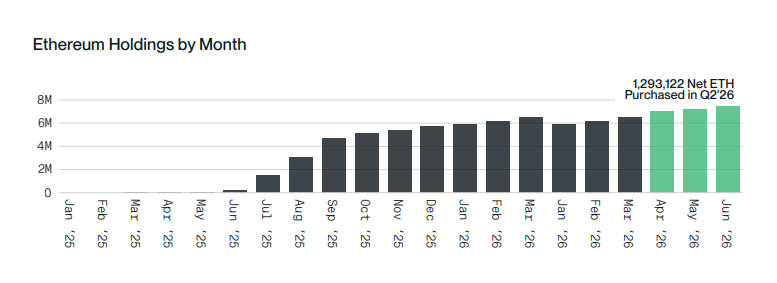
  • Ether noticeably underperformed the broader market. Its NUPL dipped into the “Capitulation” zone, placing the average ETH holder in a net unrealized loss position.
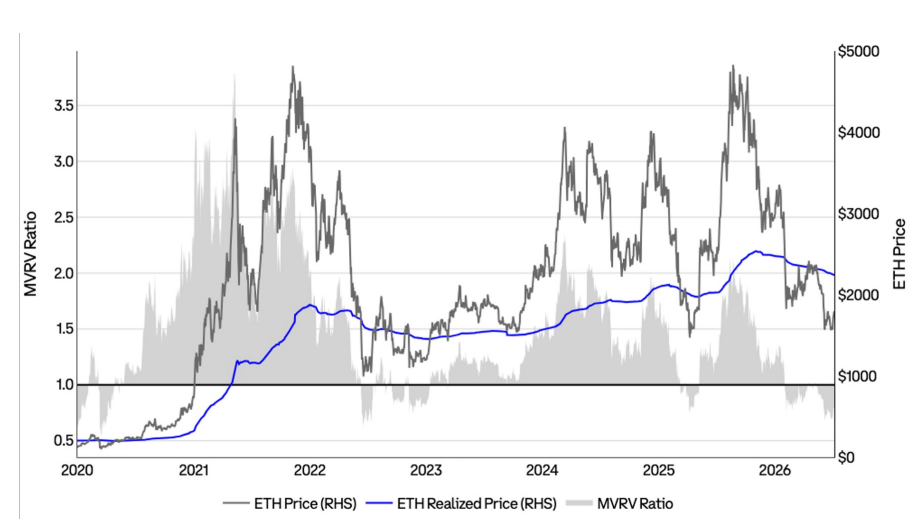
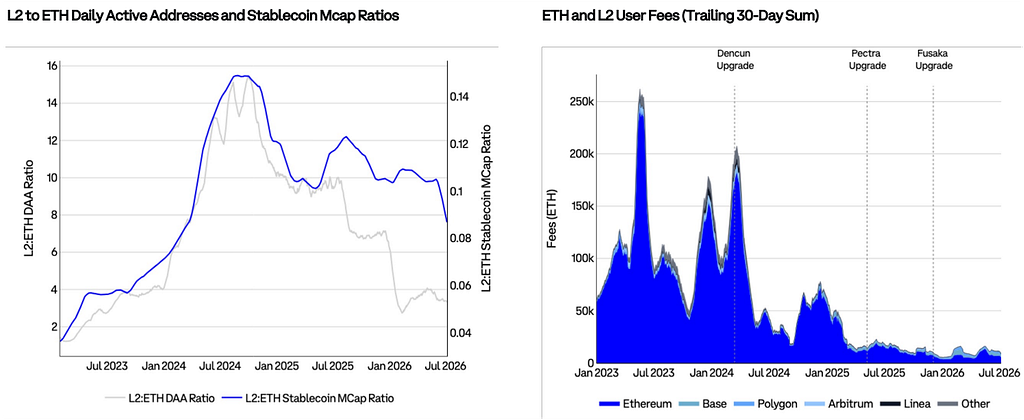
  • On-chain data indicates a re-concentration of capital on the base layer (L1). Activity and stablecoin volume ratios on L2s relative to mainnet softened, though total Real-World Assets (RWA) and stablecoin balances on Ethereum proper remain near peak levels.
4. Institutional Flows, Derivatives

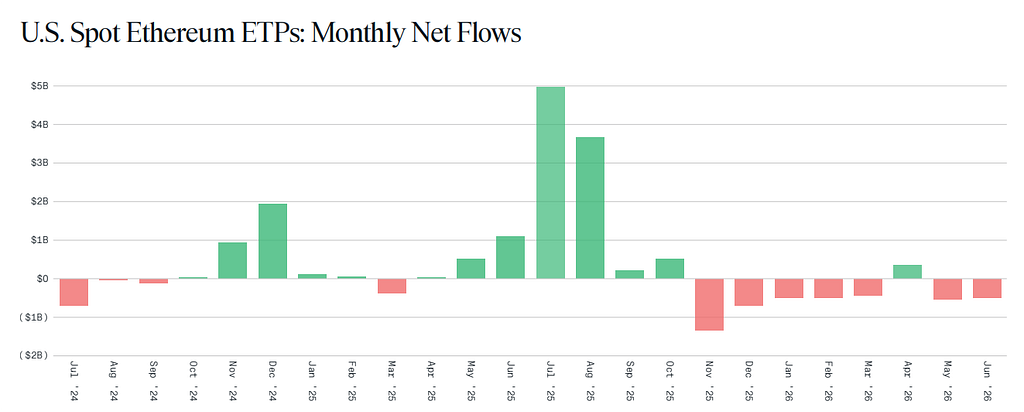
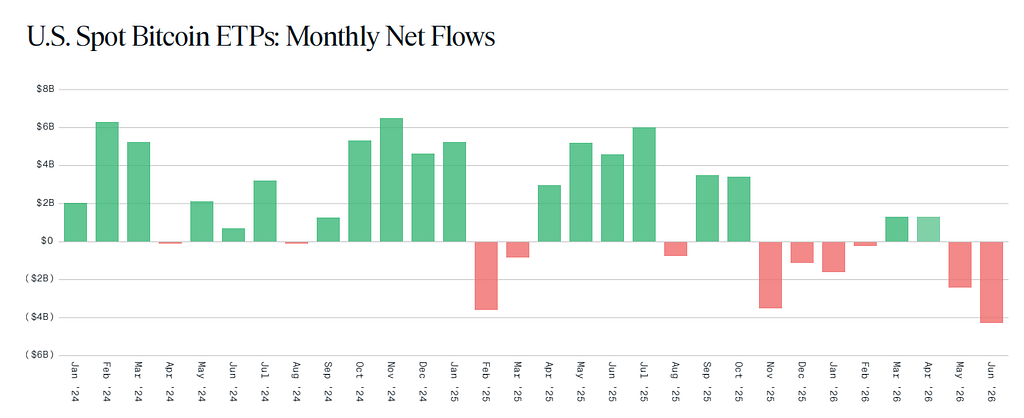
  • US Spot BTC ETFs: Q2 saw 7 consecutive weeks of net outflows from US spot ETFs (~71,000 BTC total). June marked the worst single month on record, with around $4.5B leaving the funds. However, outflow velocity began to exhaust toward the end of the quarter.
  • Pressure on Corporate Treasuries (DATs): Preferred stock yields and prices for treasury-heavy entities like Strategy (STRC) pulled back from the $100 par value down to $74.57. This indicates stress in corporate bitcoin reserve financing models and a rising cost of capital for leveraged treasury strategies.
  • Derivatives Market: Open Interest (OI) in BTC futures stayed moderate, and the 3-month annualized futures basis hovered around 2.3%–2.7%. The absence of excessive leverage keeps market structure healthy, mitigating the risk of cascade liquidations.

Summary & Outlook for Q2 2026

The market’s mid-term outlook is currently rated as Neutral. While headwinds from tight macroeconomic liquidity and spot price pressure persist, key on-chain indicators signal the early stages of a bottoming process.

  • Bullish Catalysts: Dovish shifts in Fed messaging, a return to net positive spot ETF inflows, and a decisive recovery of BTC above $70,000 — $75,000.
  • Bearish Risks: Renewed heavy ETF redemptions, forced liquidations among corporate treasury strategies (DATs), and a retest of the lower fundamental cost-base between $49,000 and $53,000.

We are currently in the “purge” stage. The market is washing out weak players. Prices are low, but the fundamental news has never been better. History teaches us: when the news is great, but the numbers on the monitor are grim — that is the best time for those who look 3–5 years ahead.

Stay calm. The palace is being built right now.

More detail to: https://medium.com/@orlaresearcher/4d6c68fed6ee?source=friends_link&sk=f8292678c4a6a0185b58b9d72f62380e


Crypto Market Q2 2026: Bitcoin Correction, Institutional Pressure, and Signs of Accumulation was originally published in Coinmonks on Medium, where people are continuing the conversation by highlighting and responding to this story.
Centrifuge: Wall Street Is Moving On-Chain

How tokenized U.S. Treasuries, BlackRock, Ethereum, and institutional capital are turning Real-World Assets (RWAs) into the fastest-growing segment of digital finance.

The Real-World Assets (RWA) market has become the fastest-growing sector of digital finance. While much of the cryptocurrency market struggled through 2025 and early 2026, tokenized U.S. Treasuries, credit markets, commodities, and equities continued attracting billions of dollars from institutional investors. The question is no longer whether tokenization will reshape global finance — but how quickly it will happen.

Disclaimer: This content is for educational and informational purposes only and does not constitute financial, investment, or professional advice. We do not recommend any buying, selling, or holding of digital assets.
All views are the author’s own. Digital assets involve high risk and volatility, and readers should conduct their own research before making any decisions.
This report is not sponsored by any mentioned companies.

Business Model Analysis

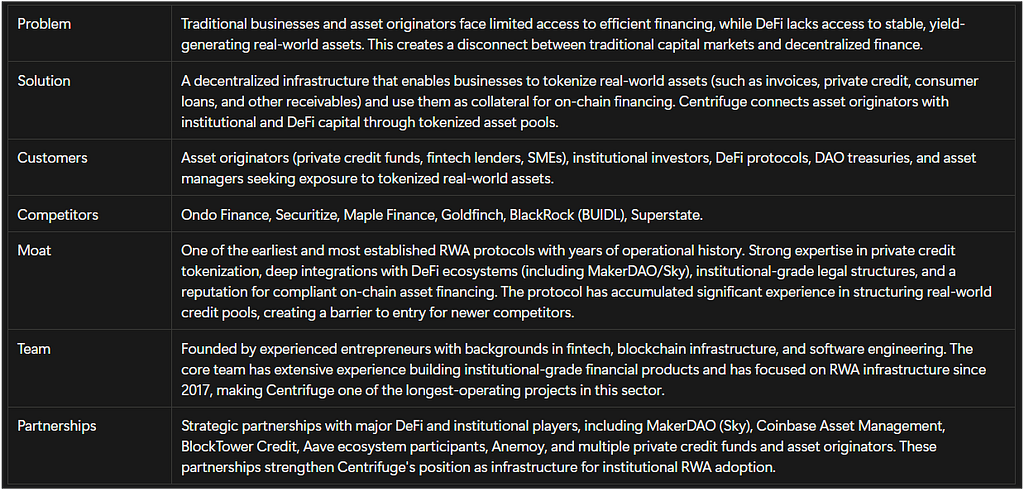
The project operates in the RWA (Real World Assets) sector, focusing on the tokenization of real-world assets and the infrastructure for private credit and on-chain financing of real-world assets.

  • Value proposition: Centrifuge provides infrastructure that enables companies, credit funds, and institutions to tokenize real-world assets and raise capital through blockchain-based lending markets.
  • Moat (competitive advantage): The key strength lies in its infrastructure-first positioning in private credit tokenization, long-standing presence in DeFi, and deep integration with institutional partners and lending protocols. This creates high barriers to entry and makes Centrifuge less dependent on retail demand cycles.

Business rating: 8.8/10.

Financial Metrics

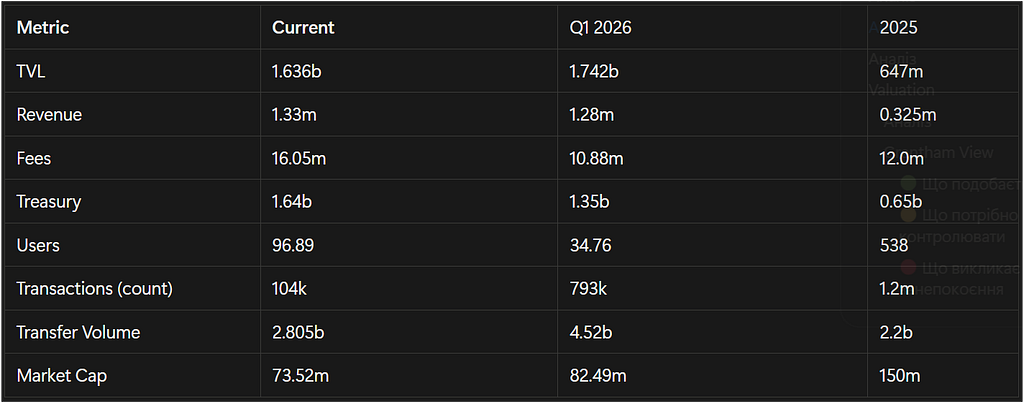
The project’s financial condition demonstrates strong scaling in core metrics:

  • TVL growth: Increased by more than 2.5x year-over-year, indicating expanding adoption of tokenized credit assets.
  • Revenue growth: Increased nearly 4x, which is a key indicator of real economic activity and protocol sustainability.
  • Treasury: $1.64 billion — reflects strong ecosystem expansion and financial resilience.
  • User and transaction activity: Declined, but this is not critical due to the B2B infrastructure nature of the protocol, where value is driven by capital volume rather than user count.

Financial rating: 8.6/10

Tokenomics

This is the most controversial aspect of the project.

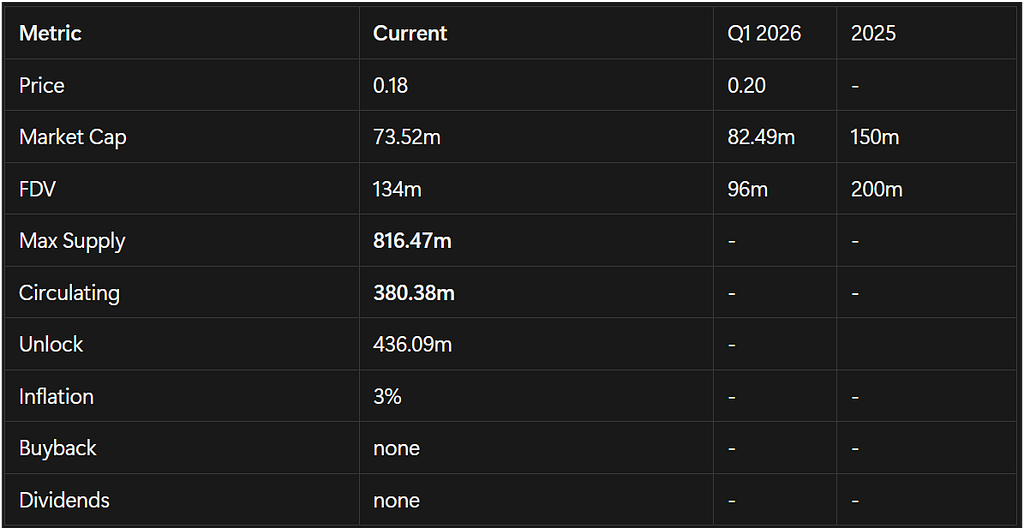
  • Issue: The CFG token has weak connection to the protocol’s economic performance. There is no buyback or revenue-sharing mechanism, meaning protocol revenue does not directly translate into token value.
  • Distribution: Approximately 50% of the total supply is still not in circulation, creating ongoing unlock pressure. Inflation is relatively low (~3%), which partially offsets dilution risk.

Tokenomics rating: 6.4/10

Valuation

The current market valuation of Centrifuge appears moderate relative to the scale of its business and the assets flowing through its ecosystem. Market capitalization is significantly lower than TVL, which may indicate a relatively conservative market pricing compared to other competitors in the RWA sector.

However, the key question is not whether the token looks cheap today, but whether it is capable of capturing future economic growth of the underlying business. Due to the lack of a clear value capture mechanism, estimating the intrinsic value of CFG remains difficult. As a result, even a potentially undervalued asset can stay undervalued for a prolonged period without a strong fundamental catalyst.

If the protocol continues to grow revenues and the token gains a stronger economic role within the ecosystem, the current valuation could become attractive. For now, however, the market is appropriately applying a discount due to uncertainty in tokenomics.

Valuation Score: 7.8/10

Final Review

What is positive (✅):

  • Real business with a proven operating model.
  • One of the pioneers in private credit and RWA tokenization.
  • Strong growth in TVL, treasury, and revenue.
  • Strong institutional partnerships.
  • Large long-term potential of the asset tokenization market.

Main concerns (🔴):

  • Absence of revenue-sharing or buyback mechanisms.
  • Weak link between business success and token value.
  • Difficulty in determining CFG intrinsic value.
  • Increasing competition in the RWA sector.
  • Dependence on broader adoption of real-world asset tokenization.

Answers to key questions:

Would I own the business outright?

Yes. The business solves a real problem, operates in a large market, and has a proven infrastructure model with high entry barriers.

Would I buy the token under current economics?

Rather no. The token is not sufficiently involved in capturing the business’s economic value, so the investment case is more expectation-driven than fundamentally anchored.

What would need to change for an A+ rating?

Implementation of value-capture mechanisms (such as buybacks or revenue sharing), continued sustainable revenue growth, increased share of institutional clients, and completion of major token unlock phases.

THE RESEARCHER


Centrifuge: Wall Street Is Moving On-Chain was originally published in Coinmonks on Medium, where people are continuing the conversation by highlighting and responding to this story.
The $30 Billion RWA Revolution: Why Wall Street Is Moving On-Chain

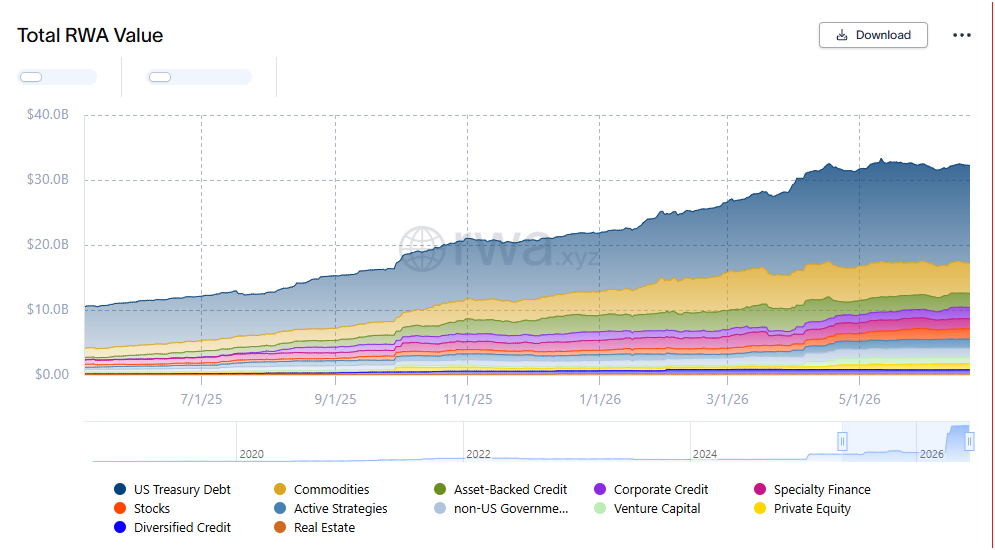
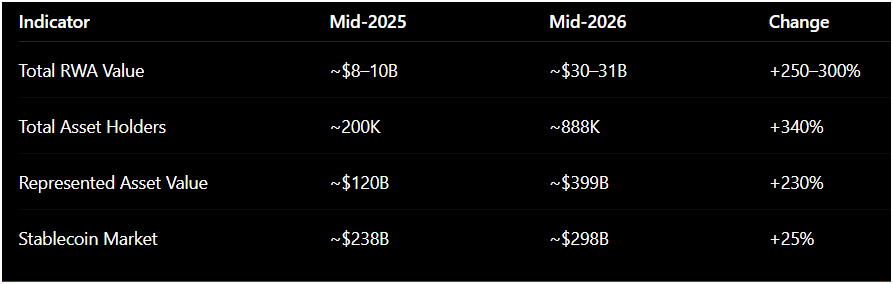
While much of the cryptocurrency market struggled with volatility throughout 2025 and 2026, one sector continued attracting institutional capital at an extraordinary pace: Real-World Assets (RWAs). Tokenized Treasuries, credit markets, commodities, and equities have transformed blockchain from a speculative ecosystem into a rapidly growing financial infrastructure layer. With the RWA market surpassing $30 billion and representing nearly $400 billion in underlying asset value, tokenization is becoming one of the most important trends in global finance.
Disclaimer: This content is for educational and informational purposes only and does not constitute financial, investment, or professional advice. We do not recommend any buying, selling, or holding of digital assets.
All views are the author’s own. Digital assets involve high risk and volatility, and readers should conduct their own research before making any decisions.
This report is not sponsored by any mentioned companies.

Market Size and Growth Dynamics

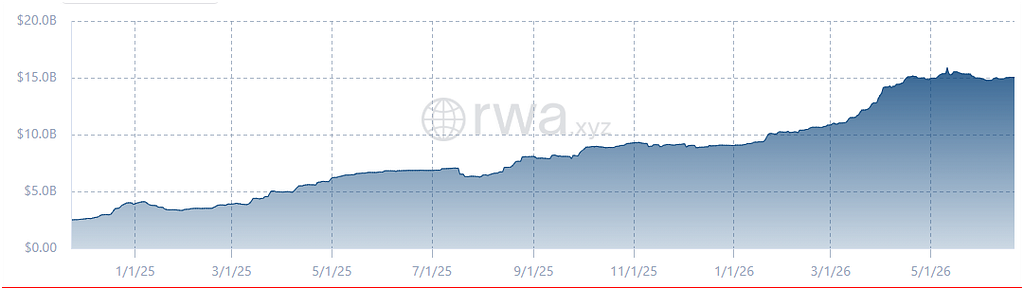
The RWA market continued to expand throughout 2025 and 2026 despite broader market volatility.

INSIGHT: The data suggests that tokenization is moving beyond experimentation and becoming a viable infrastructure layer for traditional financial markets.

Structure of the RWA Market

One of the most important developments in 2026 is the diversification of tokenized assets.

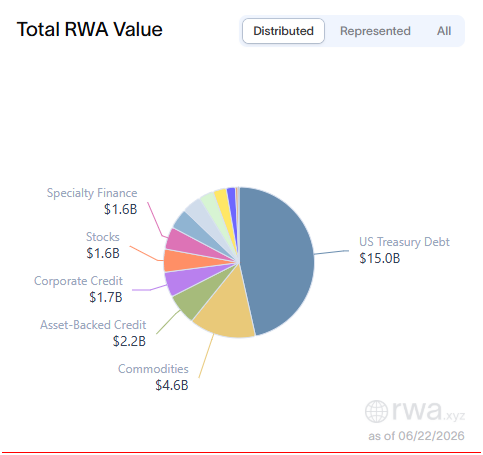
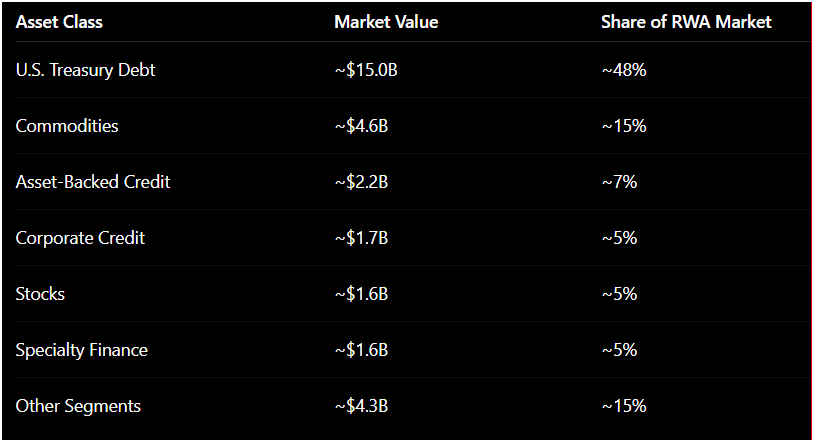
Based on current RWA.xyz market data and the charts provided, the market structure is approximately as follows:

INSIGHT: The market remains heavily concentrated around fixed-income products, particularly tokenized government debt, which accounts for nearly half of all on-chain real-world assets.

Tokenized U.S. Treasuries: The Dominant Growth Driver

The most significant trend in the entire RWA sector is the explosive growth of tokenized U.S. Treasury products.

The segment expanded from approximately $7–8 billion in mid-2025 to roughly $15 billion in 2026, effectively doubling in size within a year.

Key drivers:

  • Attractive risk-adjusted yields (3–5%)
  • Institutional demand for on-chain cash management
  • Integration with DeFi collateral systems
  • Regulatory clarity around tokenized securities
  • Growing participation from traditional asset managers

Major issuers such as BlackRock, Franklin Templeton, Ondo, Circle, and Securitize now collectively manage the majority of tokenized Treasury exposure.

INSIGHT: The importance of this segment extends beyond its size. Treasury products are increasingly functioning as the “base collateral layer” for decentralized finance, serving a role similar to cash and government bonds in traditional financial markets.

Commodities Become the Second-Largest RWA Category

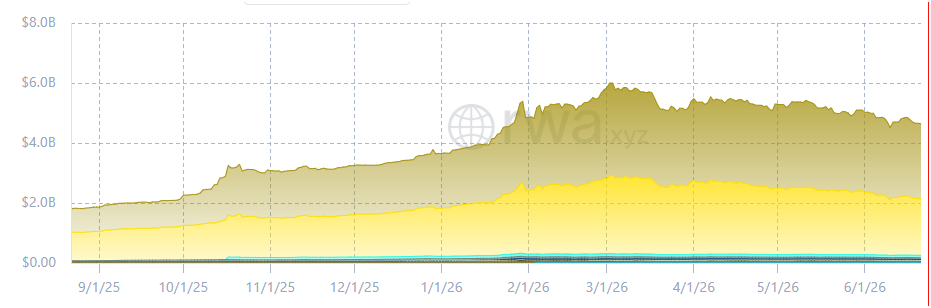
Commodities have emerged as the second-largest tokenized asset class.

The sector now represents approximately $4.6 billion in value, driven primarily by tokenized gold products.

Unlike Treasury products, which are predominantly used for yield generation, tokenized commodities serve as:

  • Inflation hedges
  • Portfolio diversification tools
  • Cross-border stores of value
  • Collateral assets within DeFi
INSIGHT: The rapid expansion of tokenized gold reflects growing investor demand for defensive assets during periods of macroeconomic uncertainty.

The Rise of Credit Markets

Credit-related products collectively represent one of the fastest-growing categories in the RWA ecosystem.

Combined segments include:

  • Asset-Backed Credit
  • Corporate Credit
  • Private Credit
  • Specialty Finance

Together they account for more than $7 billion in tokenized value.

This trend is particularly important because credit products generate recurring cash flows and provide a direct bridge between DeFi liquidity and real-world economic activity.

INSIGHT: Private credit funds, trade finance instruments, and structured lending products are increasingly using blockchain rails for issuance, servicing, and distribution.

Tokenized Equities: Small Today, Potentially Massive Tomorrow

Although tokenized stocks currently represent only around $1.6 billion of the market, they have become one of the fastest-growing RWA categories in 2026.

The emergence of tokenized versions of public equities, ETFs, and index products signals the beginning of a broader convergence between traditional capital markets and blockchain infrastructure.

Several major providers have launched tokenized exposure to:

  • U.S. equities
  • Global ETFs
  • Technology stocks
  • Sector-specific funds

While still relatively small compared to Treasury products, tokenized equities are widely viewed as one of the most important long-term growth opportunities within the RWA sector.

Key Trends Defining the RWA Market in 2026

1. From Crypto-Native to Institutional Capital

The primary source of growth is no longer retail speculation. Asset managers, banks, issuers, and corporate treasury departments are becoming the dominant participants.

2. Fixed Income Leads Adoption

Treasuries, money-market funds, and credit products account for the majority of tokenized value.

3. Tokenized Stocks Enter Growth Phase

While still small, equities are among the fastest-growing categories and represent the next major expansion opportunity.

4. Integration with DeFi Accelerates

Tokenized assets are increasingly used as collateral within lending markets, liquidity protocols, and structured yield strategies.

5. Market Maturity Increases

The industry is moving beyond simple token issuance toward comprehensive financial infrastructure including compliance, custody, settlement, and secondary-market liquidity.

Overall Assessment of the RWA Market

The RWA sector has become one of the strongest-performing segments of the broader digital asset ecosystem. While many areas of crypto remain sensitive to speculative cycles, tokenized real-world assets are increasingly tied to underlying economic activity and institutional demand.

The market’s evolution over the past year suggests that tokenization is no longer merely a technological experiment. Instead, it is becoming a new distribution layer for traditional financial products.

The dominance of tokenized U.S. Treasuries demonstrates that institutions are first adopting blockchain technology through familiar low-risk assets. Meanwhile, rapid growth in credit markets, commodities, and tokenized equities indicates that the scope of tokenization is expanding steadily across the entire capital markets landscape.

If current growth rates persist, the RWA market is likely to remain one of the fastest-growing sectors in digital finance through the remainder of 2026 and beyond, serving as the primary bridge between traditional finance (TradFi) and decentralized financial infrastructure.

THE RESEARCHER

More detail: https://medium.com/@orlaresearcher/4d6c68fed6ee?source=friends_link&sk=f8292678c4a6a0185b58b9d72f62380e


The $30 Billion RWA Revolution: Why Wall Street Is Moving On-Chain was originally published in Coinmonks on Medium, where people are continuing the conversation by highlighting and responding to this story.
❌