
Reading view

There are new articles available, click to refresh the page.

Web3 Marketing vs. Traditional Marketing: What’s Really Different?

Not the channels. The channels are the easy part. It’s who owns distribution, what counts as proof, and what happens to your funnel when the “customer” can see your treasury wallet.
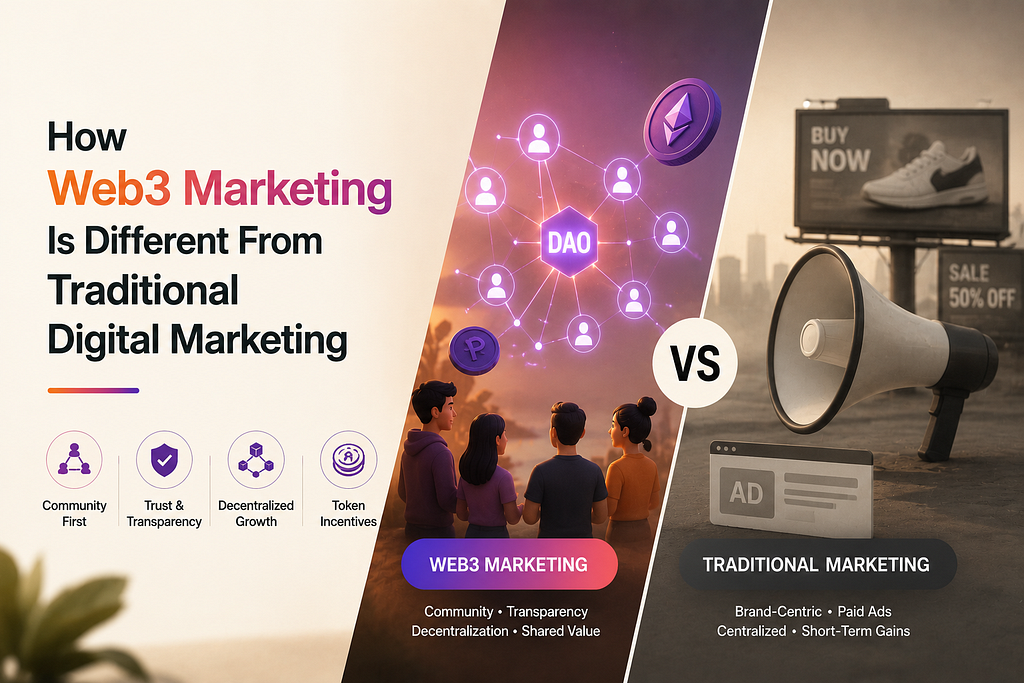
Web3 Marketing

A few months back I sat in on a call between a growth marketer and a founder who’d just brought her on to run acquisition for a token launch. She’d spent six years running paid search for SaaS companies and could recite CAC math in her sleep. About twenty minutes in, she stopped mid-sentence and asked, “wait, you don’t have a landing page with a signup form?” The founder laughed.

His entire acquisition plan ran through a Discord server, forty KOLs on X, and a Telegram group that had grown to 30,000 people without a single dollar of paid media.

Neither of them was doing it wrong. They were describing two different sports that happen to use the same ball. That’s the honest answer to “what’s really different” between Web3 marketing and traditional marketing it isn’t the tools, it’s the physics underneath them. Once you see where the physics actually diverges, the channel questions (should we be on Discord, should we still run Meta ads) answer themselves.

A few months back I sat in on a call between a growth marketer and a founder who’d just brought her on to run acquisition for a token launch. She’d spent six years running paid search for SaaS companies and could recite CAC math in her sleep. About twenty minutes in, she stopped mid-sentence and asked, “wait, you don’t have a landing page with a signup form?” The founder laughed. His entire acquisition plan ran through a Discord server, forty KOLs on X, and a Telegram group that had grown to 30,000 people without a single dollar of paid media.

Neither of them was doing it wrong. They were describing two different sports that happen to use the same ball. That’s the honest answer to “what’s really different” between Web3 marketing and traditional marketing it isn’t the tools, it’s the physics underneath them. Once you see where the physics actually diverges, the channel questions (should we be on Discord, should we still run Meta ads) answer themselves.
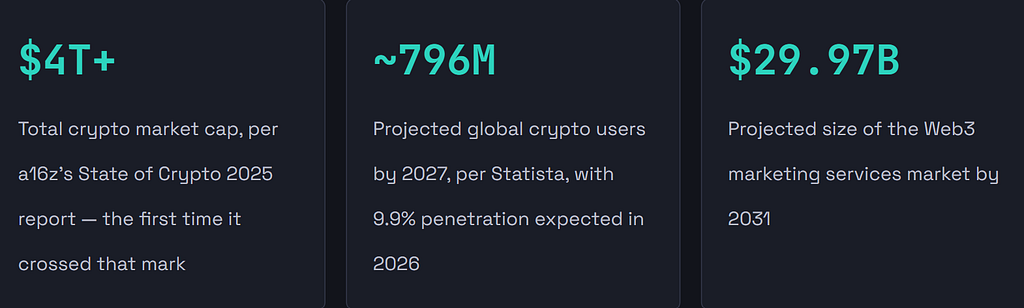
The four places the playbooks actually split

Not “which app do you post on” the underlying mechanics

Traditional marketing assumes a few things that quietly stop being true in Web3. It assumes the brand owns its distribution (an email list, a follower count, an ad account). It assumes the product mostly works and the job is persuasion, not proof. It assumes conversion happens on a page you control. And it assumes measurement lives inside a walled garden a pixel, a CRM, a dashboard only you can see.

Traditional marketing runs on

  • Owned channels: email list, ad account, CRM
  • Persuasion-first messaging the product mostly speaks for itself once trust is built
  • A single conversion event on a page you control
  • Closed-garden analytics: pixels, UTM tags, CRM attribution

Web3 marketing runs on

  • Borrowed / community-owned channels: Discord, X, Telegram — the community is the distribution layer
  • Proof-first messaging -audits, treasury data, and on-chain traction have to come before persuasion
  • Conversion is a wallet action: a swap, a mint, a stake, a claim
  • Public, verifiable on-chain attribution anyone can check the ledger, including your competitors

That last point is easy to underestimate. In traditional marketing, your funnel data is private. In Web3, a decent chunk of it is sitting on a public blockchain that anyone with a Dune Analytics dashboard or a Nansen wallet-labeling subscription can inspect. That changes what “trust me” means. You’re not asking someone to believe your case study you’re inviting them to go check the transaction themselves.

The old playbook pushed announcements, influencer posts, and airdrops. The new one has to link every campaign back to something a stranger can independently verify.

Funnel vs. flywheel

The shape of the customer journey isn’t the same shape

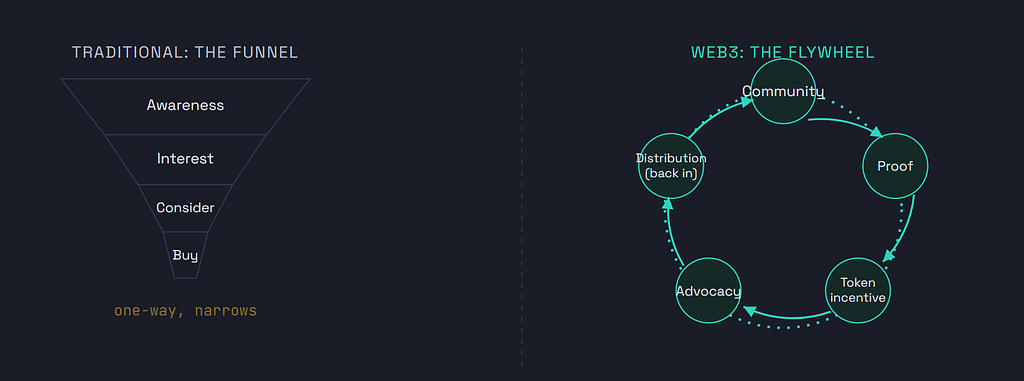
Traditional marketing thinks in funnels wide at the top, narrow at the bottom, and every stage designed to filter people out until only paying customers remain. Web3 growth behaves more like a loop. A community member becomes a holder, a holder becomes a contributor, a contributor becomes the next campaign’s distribution channel, and the loop feeds itself again. Paid media can kick-start a loop, but it can’t replace the incentive structure that keeps it spinning that’s usually token design, governance rights, or plain social status inside the community.
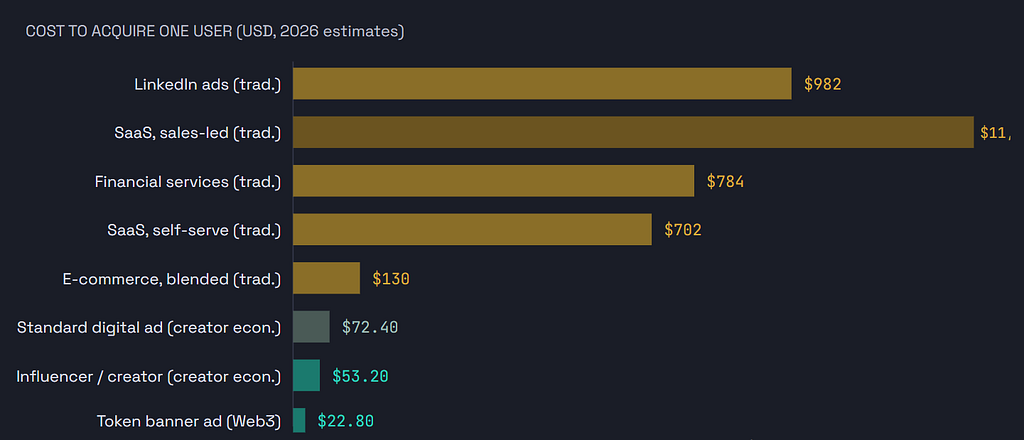
What it actually costs to acquire someone

This is where the difference stops being theoretical. Digital customer acquisition cost in traditional industries has been climbing hard up 40–60% between 2023 and 2025 by most estimates, and one widely cited analysis puts the eight-year increase at 222%.

Financial services brands are paying close to $784 per customer through paid digital channels; B2B SaaS with a sales-led motion averages around $11,400 a customer, against roughly $702 for self-serve. Even a straightforward LinkedIn ad campaign is averaging near $982 per acquisition, compared with about $150 for a referral.

Web3 acquisition, when it’s routed through community and creator channels instead of paid impressions, tends to land somewhere else entirely. One 2026 study of token promotion campaigns found Instagram Reels-style creator content converting at roughly $6.14 per acquisition against $22.80 for a comparable banner ad.

That tracks with the broader creator-economy pattern: traditional digital ads are averaging about $72.40 per acquisition industry-wide, versus roughly $53.20 through influencer and creator partnerships, with micro-influencer campaigns coming in around 6.7 times cheaper than celebrity-led ones.
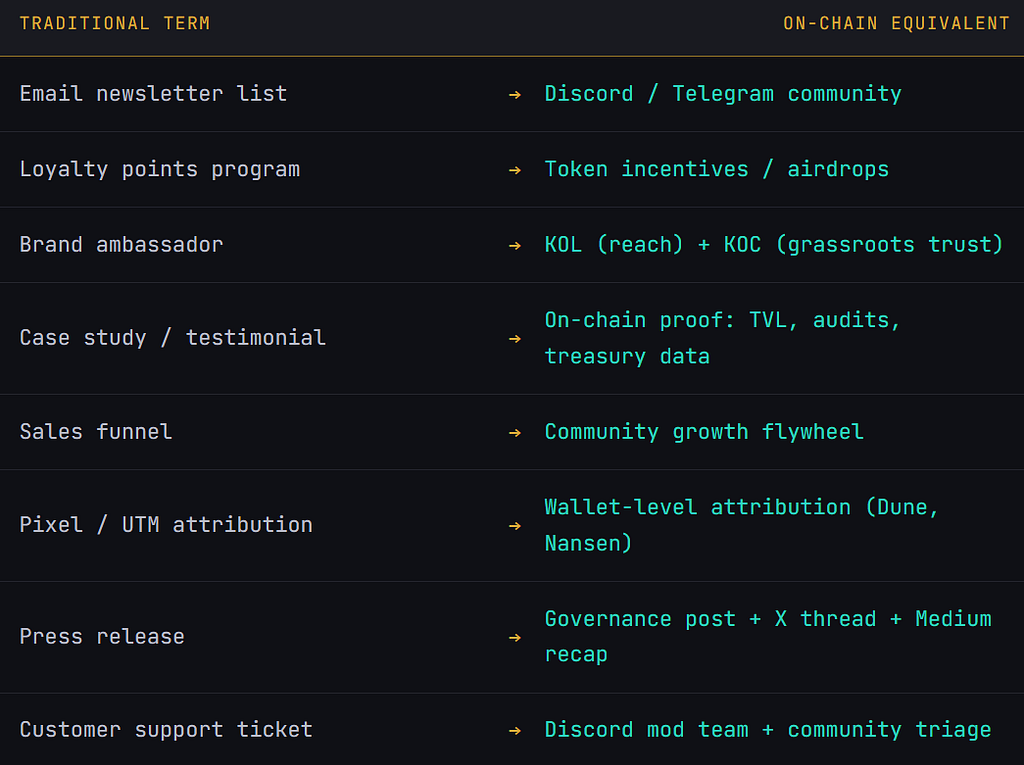
The translation ledger

Same marketing job, different name on each side of the chain

Most of what looks foreign about Web3 marketing is actually a familiar concept wearing a new name. It helps to just line the two up.
Where they’re actually the same

Don’t throw out everything you learned in traditional marketing

It’s tempting to treat Web3 as a different discipline requiring a whole new skill set. Mostly it doesn’t. Good segmentation is still good segmentation. Search and answer-engine optimization still decide whether anyone finds you before a competitor does. Clear positioning saying exactly who this is for and why it’s better than the obvious alternative still separates projects that scale from ones that stall. What changes is the proof standard and the speed: Web3 audiences expect the receipts in public, and they expect them fast, because the whole point of the ledger is that nobody has to take your word for it.

The teams doing this well in 2026 aren’t abandoning fundamentals, they’re front-loading them. Utility-first messaging — leading with real use cases and verifiable on-chain results instead of speculation is becoming the baseline expectation rather than a differentiator, as the on-chain real-world-asset market alone grew from roughly $5.5 billion to $18.6 billion over the course of 2025.

Final Thoughts

Most brands aren’t choosing one world or the other they’re translating a traditional growth strategy into something that works inside a Discord server, a KOL network, and an on-chain audience at the same time. That’s the specific overlap Inoru’s KOL marketing team works in daily, pairing structured content and SEO/GEO strategy with the community and creator relationships that actually move Web3 audiences.


Web3 Marketing vs. Traditional Marketing: What’s Really Different? was originally published in Coinmonks on Medium, where people are continuing the conversation by highlighting and responding to this story.

Every Crypto Trader Needs a Better Information Strategy

Discover why a strong information strategy is becoming essential for crypto traders and how AI-powered market intelligence helps turn overwhelming data into smarter, faster trading decisions.

Crypto Trading

The cryptocurrency market has never offered traders more data than it does today. Every second brings new price updates, on-chain transactions, social media discussions, macroeconomic news, exchange announcements, and technical indicators.

Ironically, having access to more information hasn’t necessarily made trading easier.

Many traders spend hours jumping between X, Telegram, Discord, TradingView, CoinMarketCap, and countless news platforms, hoping they won’t miss the next big move. Yet despite consuming more content than ever, they often make decisions with less confidence.

The problem isn’t a lack of information.

It’s the absence of a clear information strategy.

In an increasingly competitive market, traders who organize and prioritize information are gaining an advantage over those trying to process everything at once.

Information Overload Is Becoming a Trading Risk

One of the biggest misconceptions in crypto trading is believing that more information automatically leads to better decisions.

In reality, too much information often creates:

  • Analysis paralysis
  • Conflicting opinions
  • Emotional decision-making
  • Missed opportunities
  • Delayed execution

One influencer predicts a breakout.

Another expects a crash.

Technical indicators point upward while macroeconomic headlines suggest caution.

Without a structured way to filter information, traders can easily become overwhelmed before placing a single trade.

Every Piece of Data Doesn’t Deserve Equal Attention

Successful traders don’t attempt to monitor everything.

Instead, they identify which information consistently influences the market.

High-value data often includes:

Market Structure

Understanding trends, support levels, resistance zones, and liquidity helps traders interpret price action rather than simply reacting to it.

On-Chain Activity

Large wallet movements, exchange inflows, token accumulation, and network activity frequently provide early clues about changing market conditions.

Market Sentiment

Crypto is one of the few financial markets where public sentiment can influence prices almost instantly.

Monitoring discussions across social platforms often provides valuable context before major price movements occur.

Breaking Events

Exchange listings, partnerships, regulatory announcements, security incidents, and economic news can reshape market direction within minutes.

An effective information strategy focuses on the signals that matter most while filtering out unnecessary noise.

Why Speed Alone Isn’t Enough

Many traders believe receiving alerts first guarantees success.

It doesn’t.

Receiving information quickly only creates an advantage if that information is meaningful.

For example, hundreds of price alerts may arrive throughout the day.

Only a handful actually indicate meaningful changes in market conditions.

The goal isn’t simply faster notifications.

It’s receiving relevant insights supported by data and context.

Build a Repeatable Information System

Professional traders rarely depend on random news feeds or viral posts.

Instead, they develop systems that consistently answer key questions:

  • What is happening?
  • Why is it happening?
  • Does it affect my trading plan?
  • What level of risk does it introduce?
  • Should I act now or wait?

Following the same decision-making process every day reduces emotional trading and improves long-term consistency.

Artificial Intelligence Is Changing Information Management

The amount of market data generated every day has grown beyond what most individuals can process manually.

Artificial intelligence helps solve this challenge by identifying patterns across multiple sources simultaneously.

Modern AI systems can evaluate:

  • Technical indicators
  • Market momentum
  • On-chain activity
  • Sentiment changes
  • News developments
  • Liquidity shifts
  • Cross-market relationships

Rather than forcing traders to monitor dozens of platforms, AI can surface the information that deserves immediate attention.

The result is not less information but better organized intelligence.

Better Decisions Start With Better Context

Imagine receiving the following notification:

“Ethereum price increased by 4%.”

Useful?

Somewhat.

Now compare it with this:

“Ethereum is up 4%, trading volume has doubled, exchange outflows are increasing, and market sentiment has shifted positive following institutional accumulation.”

The second message provides context.

Context allows traders to understand whether a move may have momentum behind it or whether it’s simply short-term volatility.

This is why context has become just as valuable as speed.

The Future Belongs to Intelligence, Not Information

The next generation of crypto trading platforms won’t compete by offering more charts or more indicators.

Instead, they’ll compete by helping traders make sense of increasingly complex markets.

We’re already seeing a shift toward platforms that combine AI, blockchain analytics, market sentiment, and live market monitoring into a unified experience.

The objective isn’t to replace trader judgment.

It’s to help traders spend less time searching for information and more time making informed decisions.

From Information Streams to Intelligent Workflows

As the crypto ecosystem becomes more complex, traders need tools that simplify decision-making instead of adding to the noise. That philosophy has shaped the development of i5.xyz throughout its testnet journey.

Rather than functioning as another dashboard filled with endless metrics, i5 has been built to organize market information into clear, actionable insights. By bringing together AI-powered analysis, real-time market activity, and evolving trading narratives, the platform aims to help users understand what matters now instead of forcing them to sift through countless sources.

With the live platform launch approaching in the next week, i5.xyz is entering a new stage focused on delivering faster, smarter, and more practical market intelligence for everyday crypto traders. The goal isn’t simply to provide data it’s to create a workflow where meaningful insights reach traders when they can still make a difference.

Final Thoughts

Every crypto trader develops a trading strategy, but far fewer develop an information strategy.

In today’s markets, the ability to filter, prioritize, and understand information is becoming just as important as technical analysis itself.

As artificial intelligence continues transforming financial markets, traders who rely on organized, contextual, and real-time intelligence will be better positioned to adapt to changing conditions and identify opportunities before they become obvious.

The future of successful trading won’t belong to those with the most information. It will belong to those who know which information truly matters.


Every Crypto Trader Needs a Better Information Strategy was originally published in Coinmonks on Medium, where people are continuing the conversation by highlighting and responding to this story.

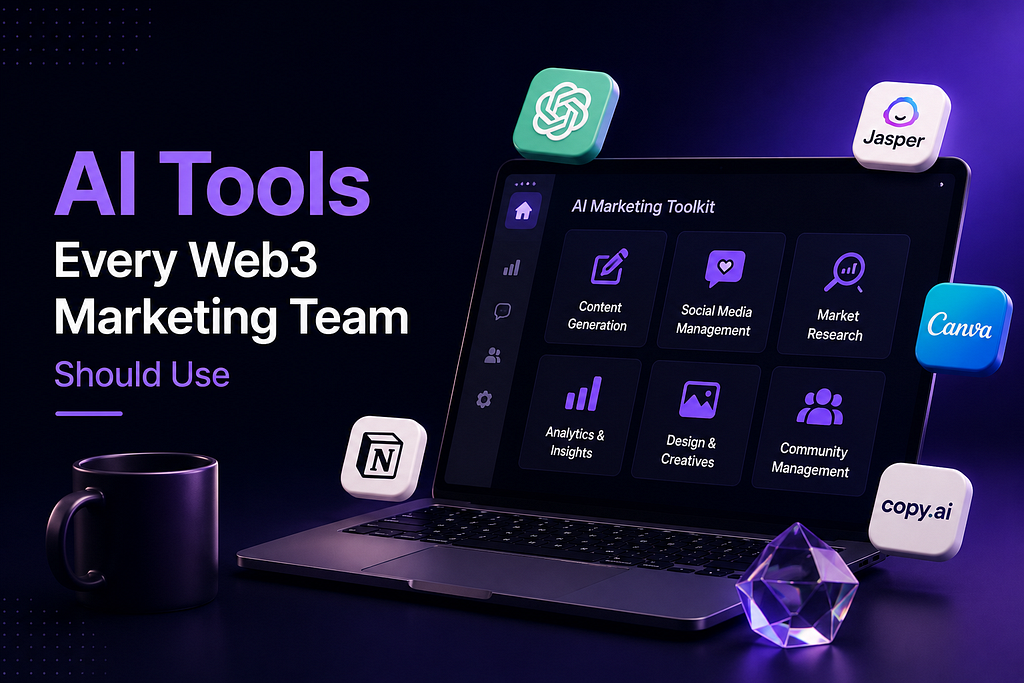
The AI Tools Every Web3 Marketing Team Wishes They Started Using Sooner.

Discover the best AI tools every Web3 marketing team should use to streamline content creation, community management, SEO, analytics, design, and campaign optimization for blockchain and crypto projects.

Web3 Marketing Team

Artificial intelligence has become an essential part of modern marketing, and the Web3 industry is no exception. As blockchain projects compete for attention in an increasingly crowded market, marketing teams are expected to create high-quality content, manage active communities, analyze campaign performance, optimize SEO, and engage audiences across multiple platforms. Doing all of this manually can be time-consuming and resource-intensive.

AI tools help Web3 marketing teams work faster, make smarter decisions, and improve campaign performance without sacrificing quality. Whether you’re promoting a blockchain startup, NFT marketplace, DeFi platform, crypto exchange, or GameFi project, the right AI tools can simplify repetitive tasks and allow your team to focus on strategy and growth.

In this guide, we’ll explore the most valuable AI tools for Web3 marketing, explain how they support different marketing activities, and share best practices for integrating them into your workflow.

Why AI Is Becoming Essential for Web3 Marketing

The blockchain ecosystem evolves rapidly. Marketing teams must keep up with changing trends, frequent product updates, and active online communities.

AI enables teams to:

  • Create content more efficiently
  • Analyze large volumes of marketing data
  • Improve customer engagement
  • Optimize search engine rankings
  • Personalize communication
  • Automate repetitive workflows
  • Generate creative ideas
  • Monitor campaign performance in real time

When combined with human creativity and strategic planning, AI becomes a valuable asset rather than a replacement for marketers.

AI Tools for Content Creation

Content marketing remains one of the strongest pillars of a successful Web3 marketing strategy. AI writing assistants can help generate ideas, improve writing quality, and accelerate content production.

AI Writing Assistants

These tools assist with:

  • Blog writing
  • Website copy
  • Email campaigns
  • Social media posts
  • Product descriptions
  • Whitepaper drafting
  • Content optimization

Popular AI writing tools include:

  • ChatGPT
  • Claude
  • Google Gemini
  • Jasper AI

While AI can produce high-quality drafts, every piece of content should be reviewed to ensure technical accuracy and align with your brand voice.

AI Tools for SEO Optimization

Search visibility plays an important role in attracting long-term organic traffic.

AI-powered SEO platforms help marketers identify opportunities to improve rankings.

Keyword Research and Content Optimization

These tools help you:

  • Discover keyword opportunities
  • Analyze competitors
  • Optimize headings
  • Improve readability
  • Identify content gaps
  • Track ranking performance

Popular SEO platforms include:

  • Surfer SEO
  • Clearscope
  • Semrush
  • Ahrefs

Combining AI-generated insights with SEO best practices can significantly improve the visibility of Web3 marketing campaigns.

AI Tools for Graphic Design

Visual content is essential for attracting attention on social media and educating blockchain audiences.

Design Faster With AI

AI design tools help create:

  • Social media graphics
  • Infographics
  • Presentation slides
  • Marketing banners
  • Promotional visuals
  • Blog illustrations

Popular options include:

  • Canva AI
  • Adobe Firefly
  • Microsoft Designer

These tools allow marketing teams to produce professional-quality visuals without requiring advanced design skills.

AI Tools for Video Creation

Video content has become increasingly important for explaining blockchain concepts and promoting new products.

Simplify Video Production

AI-powered video platforms can assist with:

  • Promotional videos
  • Product demonstrations
  • Tutorials
  • Educational explainers
  • Social media clips
  • Voiceovers

Popular tools include:

  • Synthesia
  • Pictory
  • Runway
  • VEED

Short, engaging videos can improve audience engagement across X, LinkedIn, YouTube, and other social platforms.

AI Tools for Community Management

Building active communities is a critical part of Web3 marketing.

Managing Discord and Telegram communities manually can become challenging as membership grows.

Automate Community Support

AI can help:

  • Answer common questions
  • Moderate discussions
  • Detect spam
  • Organize community resources
  • Provide multilingual support
  • Respond instantly to users

Automation improves response times while allowing moderators to focus on meaningful conversations.

AI Tools for Social Media Management

Maintaining a consistent presence across multiple platforms requires careful planning.

Schedule and Optimize Content

AI-powered platforms help marketers:

  • Generate captions
  • Schedule posts
  • Analyze engagement
  • Recommend posting times
  • Track audience behavior
  • Monitor campaign performance

Popular platforms include:

  • Buffer
  • Hootsuite
  • Metricool
  • SocialBee

Consistency remains one of the most important factors in successful social media marketing.

AI Tools for Data Analytics

Marketing decisions should always be backed by data rather than assumptions.

Understand Campaign Performance

Analytics tools help measure:

  • Website traffic
  • Conversion rates
  • Community growth
  • User engagement
  • Referral sources
  • Campaign ROI

Platforms such as Google Analytics and Looker Studio provide valuable insights that help refine future marketing strategies.

AI Tools for Email Marketing

Email remains one of the most effective channels for nurturing communities and keeping investors informed.

Personalize Email Campaigns

AI can help:

  • Generate subject lines
  • Personalize content
  • Optimize send times
  • Segment audiences
  • Improve open rates
  • Analyze performance

Popular email platforms include:

  • Mailchimp
  • Brevo
  • HubSpot

Personalized communication often leads to higher engagement than generic email campaigns.

AI Tools for Customer Support

As Web3 platforms grow, user support becomes increasingly important.

Deliver Faster Responses

AI-powered chatbots can answer questions related to:

  • Wallet setup
  • Token purchases
  • Platform navigation
  • Frequently asked questions
  • Product features

This reduces response times while improving user satisfaction.

Best Practices for Using AI in Web3 Marketing

AI delivers the best results when it complements human expertise.

Combine AI With Human Creativity

AI can generate ideas and drafts, but your team should refine the content to ensure accuracy and authenticity.

Verify Blockchain Information

Because blockchain projects often involve technical concepts, always fact-check AI-generated content before publishing.

Maintain Your Brand Voice

Use AI to improve efficiency without losing the personality and tone that make your brand unique.

Focus on Value Rather Than Volume

Publishing fewer high-quality articles is more effective than producing large amounts of repetitive AI-generated content.

Continue Monitoring Performance

Review campaign metrics regularly to identify opportunities for improvement and refine your marketing strategy.

Common Mistakes to Avoid

Many teams rely too heavily on AI and overlook the importance of human oversight.

Avoid these common mistakes:

  • Publishing AI-generated content without editing
  • Ignoring SEO best practices
  • Producing repetitive content
  • Overautomating community interactions
  • Neglecting originality
  • Failing to verify technical information
  • Relying solely on AI for strategic decisions

AI should enhance your marketing efforts rather than replace thoughtful planning.

Why AI and Human Expertise Work Best Together

Artificial intelligence excels at automating repetitive tasks, analyzing data, and generating ideas. Human marketers bring creativity, strategic thinking, emotional intelligence, and industry expertise.

The most successful Web3 marketing agencies combine both to create campaigns that are efficient, engaging, and results-driven.

By integrating AI into daily workflows while maintaining strong editorial and strategic oversight, teams can improve productivity without compromising quality.

Final Thoughts

AI is transforming how blockchain and crypto companies approach marketing. From content creation and SEO to design, analytics, social media, and community management, AI tools help marketing teams work smarter and respond more quickly to an ever-changing industry.

However, successful Web3 marketing still depends on strategy, creativity, and authentic engagement. AI can accelerate execution, but lasting growth comes from understanding your audience, building trust, and delivering consistent value.

For businesses looking to scale their marketing efforts, experienced partners like INORU combine AI-powered workflows with expert-led Web3 marketing services, including SEO, content marketing, KOL marketing, Discord marketing, community management, and growth strategies tailored for blockchain, crypto, NFT, and DeFi projects.

PS: This is just a personal Opinion DYOR and get on the track and I hope you will do the best and better start your startups it’s never late.


The AI Tools Every Web3 Marketing Team Wishes They Started Using Sooner. was originally published in Coinmonks on Medium, where people are continuing the conversation by highlighting and responding to this story.
Before Spending on Ads, Every Web3 Startup Should Read This

The wallet-targeted CPA looks great in the deck. The problem is what happens after the click and most Web3 teams find out too late that no one was ready to catch it.

Web3 Marketing

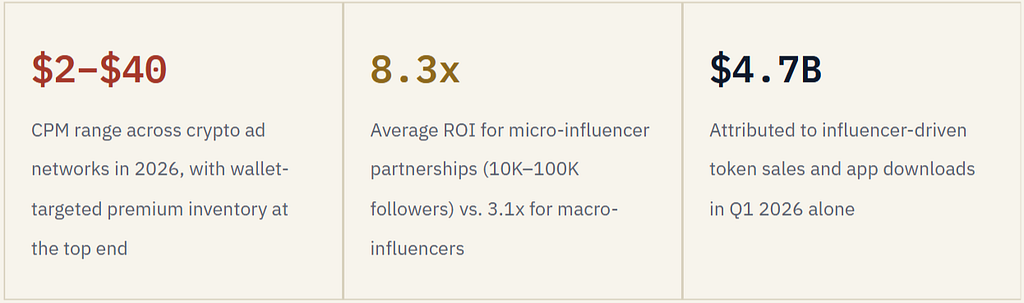
It’s an easy trap to fall into. There’s a treasury line item marked “marketing,” a media buyer on the other end of a call, and a launch date circled in red. So the instinct is to open a dashboard and start spending. But in 2026, a Web3 ad dollar is judged by a colder metric than impressions: did it produce a wallet that actually stuck around. Industry benchmarks put crypto CPM between $2 and $15 on most networks, climbing to $20–$40 for wallet-targeted premium inventory, with CPA for an actual token purchase landing anywhere from $20 to $200 or more depending on the value of the conversion. Those numbers aren’t the risk. The risk is spending them on a project that hasn’t done the unglamorous work first. Before an ad account gets funded, seven things need to already be true.

What Skipping the Audit Actually Costs

The gap between a prepared campaign and an unprepared one shows up immediately in cost per acquisition. A 2026 study tracking 1,200 crypto campaigns across 14 countries found that short-form video promotion delivered an average CPA of $6.14, compared to $22.80 for the same budget spent on static banner ads nearly a 4x difference driven almost entirely by whether the creative, landing page, and community were ready to receive that traffic. Compare that to bidding directly on branded crypto search terms, where keywords like “crypto exchange” can exceed $15–$25 per click on Google Ads before a single wallet has connected. Paid media doesn’t fail because the network is bad. It fails because the budget arrives before the foundation does.

The 5 -Point Pre-Ad Ledger

Think of this as the audit a serious treasury lead runs before releasing budget not a wishlist, a gate. Each line item is something that should already be true before a single ad set goes live.

01/ Utility survives a one-sentence test

If your team can’t explain what the product does not what the token might be worth in a single plain sentence, an ad won’t fix that. 2026’s most credible projects lead with demonstrated function: fractional real estate liquidity, cheaper cross-border settlement, verifiable on-chain yield. Utility-first messaging now consistently outperforms speculation-led messaging, and it’s free to fix before you pay to amplify it.

02/ A community that exists without the ad budget community

Token-gated Discord servers, governance forums, and members-only channels are where 2026’s most durable Web3 brands are built — and they need to show signs of life before paid traffic arrives. An ad that lands a new wallet in a silent server converts once and churns. An ad that lands them in an active one converts and compounds.

03/ Organic content and search groundwork are already live SEO / AEO

Docs-led SEO, protocol comparisons, and founder-driven technical commentary are outperforming generic blog content in 2026, and they’re also what AI answer engines pull from when someone asks “is [project] legitimate” before clicking your ad. If that groundwork isn’t published yet, paid traffic is arriving to check a reputation that doesn’t exist online.

04/ KOL and KOC relationships that predate the campaign

The most effective 2026 approach pairs KOLs for reach with KOCs smaller, highly engaged creators for grassroots trust. These relationships take weeks to build properly and cannot be assembled the same week a campaign launches. Agencies running KOL marketing at scale exist specifically to have this bench ready before budget needs to move.

05/ Wallet-level attribution is wired up before dollar one on-chain data

Tools like Spindl, Formo, and Addressable, alongside Dune and Nansen for on-chain verification, can trace a click all the way to a wallet’s subsequent behavior. Without this in place, “it drove impressions” is the only story an ad campaign will ever be able to tell and impressions don’t justify treasury spend to a DAO or an investor.

What the 2026 Spending Data Actually Shows

Look at where the money is already proving out, and the order writes itself. Instagram and Facebook jointly account for 58% of ROI-focused crypto campaigns, while TikTok has overtaken YouTube in total crypto-related video views for the first time 38.4 billion versus 29.7 billion in a single quarter. None of that reach converts on its own. It converts when it lands on a community, a landing page, and an attribution stack that were built before the campaign, not during it.

The best-performing Web3 campaigns in 2026 aren’t the ones with the biggest ad budgets they’re the ones where the ad budget was the last thing turned on, not the first.

Frequently Asked Questions

Should a Web3 startup run paid ads before building a community?

No. Paid traffic that lands in an inactive Discord or a silent X account converts once and disappears. Community activity should exist before ad spend begins, not launch alongside it.

What’s a realistic CPA for a crypto ad campaign in 2026?

Expect roughly $5–$50 for a wallet connection and $20–$200+ for an actual token purchase, depending on the network and how qualified the traffic is. Short-form video creative currently runs far cheaper per acquisition than static banner ads.

Why do micro-influencers outperform macro-influencers in Web3 marketing?

Micro-influencers with 10K–100K followers are currently delivering roughly 8.3x ROI compared to 3.1x for macro-influencers, largely because their audiences trust their recommendations as genuine rather than sponsored reach.

What is wallet-level attribution and why does it matter before spending on ads?

It’s the ability to trace a user from an ad click all the way to the wallet address and on-chain actions that follow. Without it, a campaign can only report impressions and clicks not whether it produced real holders or usage, which is what most treasuries and investors now expect to see.


Before Spending on Ads, Every Web3 Startup Should Read This was originally published in Coinmonks on Medium, where people are continuing the conversation by highlighting and responding to this story.

❌