Replify, a Seattle startup that uses agentic AI to help fitness operators automate member and prospect communications, is being acquired by Dallas-based ABC Fitness, the companies announced Monday.
Replify’s software handles phone calls, emails, chats, and texts for health and wellness businesses, including inbound customer messages as well as proactive outbound marketing.
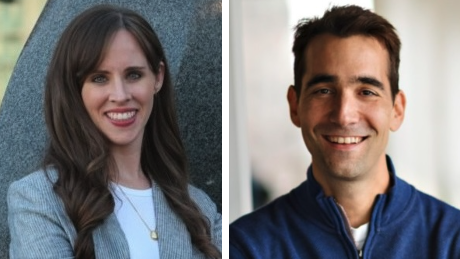
Replify co-founders Anna Rodriguez, left, and Tony Small. (LinkedIn Photos)
The idea is to help gyms, recreational facilities, tanning salons, and other businesses improve customer service and free up staff to focus on other tasks.
ABC Fitness is a technology provider for fitness businesses with a global customer base of more than 30,000 businesses and 40 million members. It already shares customers with Replify, including Gold’s Gym, UFC Gym, and Club 24.
Replify’s platform supports approximately 35 languages across voice, and more than 100 across text and chat. ABC Fitness’ software is used in more than 100 countries.
Replify was founded in 2023 as heyLibby by CEO Tony Small and CTO Anna Rodriguez. Zillow co-founder and former CEO Spencer Rascoff, who worked with Small and Rodriguez at the Seattle real estate company, joined as co-founder, investor and advisor. He incubated the startup out of his Los Angeles-based firm 75 & Sunny Labs.
Replify raised $4.5 million in an April 2025 seed round led by French firm Aglae Ventures and Silicon Valley-based Vertical Venture Partners. The company raised $6.7 million total in three years.
“Replify was built to help fitness operators be present at every moment a prospect or member is ready to engage,” Small said in a statement. “By joining ABC Fitness, we can bring our AI agents to a larger global ecosystem and help more operators capture demand, support their teams and grow with less manual work.”
Small and Rodriguez and the 12-member Replify team are joining ABC Fitness, which employs nearly 2,000 people, according to its website. Small will be senior VP of AI strategy and Rodriguez will be VP of engineering, with both reporting to ABC Fitness President Khal Rai.
The goal for the Replify team is to lead the advancement of the agentic layer of ABC’s Intelligent Operating System and continue innovation in agentic AI capabilities, Rodriguez told GeekWire.
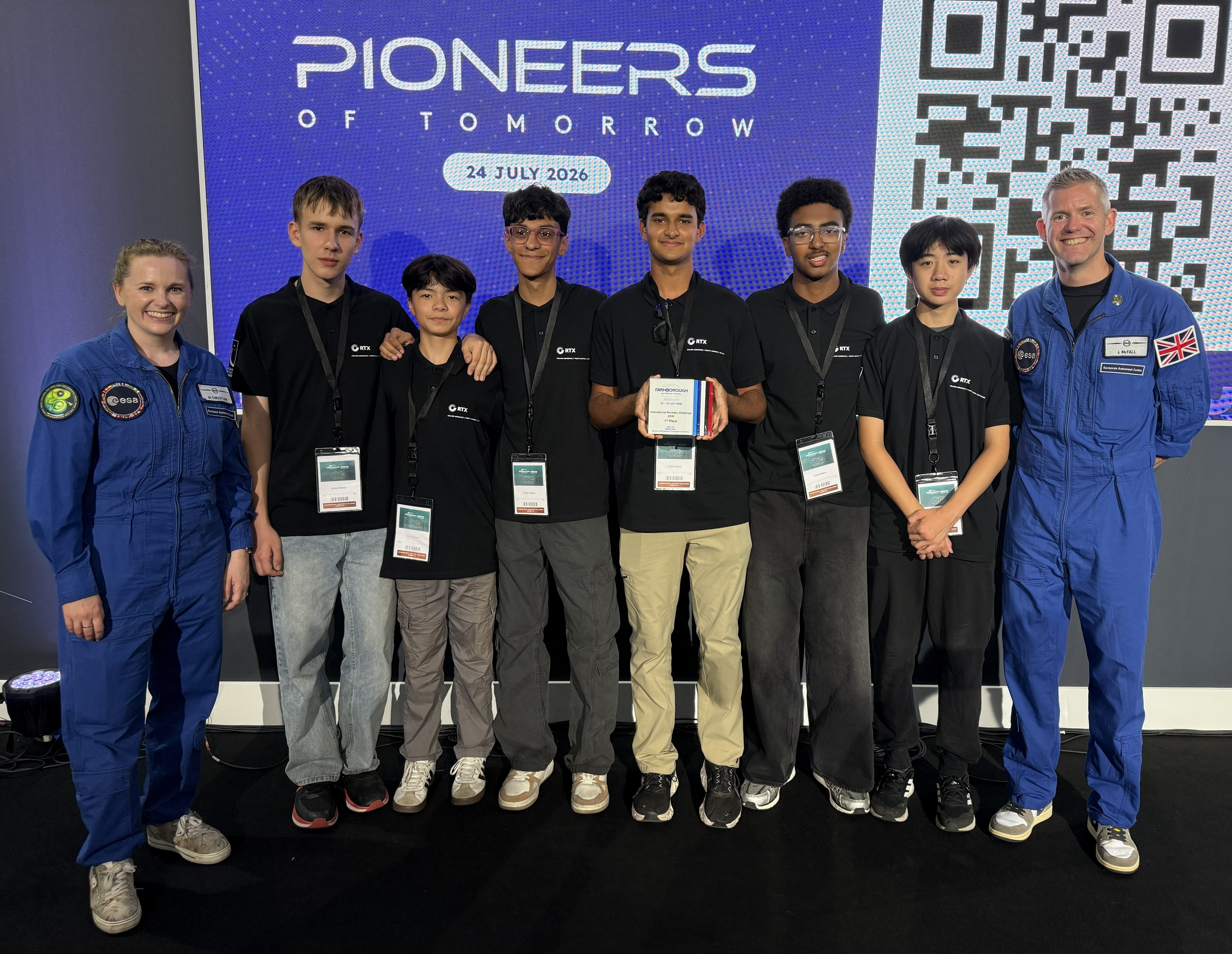
Washington Youth Aerospace, the winners of the International Rocketry Challenge, from left in black shirts, Mikhail Antipin, Antoine Vigneron, Anay Mediwala, Nikhil Sirivara, Daniel Tadesse and Bao-ky Tran, pose with European Space Agency astronauts Meganne Christian, left, and John McFall at the Farnborough International Airshow south of London. (Photo courtesy of Sudheer Sirivara)
A team of Bellevue, Wash., high schoolers soared above teams from France, Japan, the UK, and Ukraine to win the International Rocketry Challenge in England over the weekend.
Washington Youth Aerospace, a team made up of six ninth graders from Bellevue’s Interlake High School, represented the United States in the competition at the Farnborough International Airshow. Team members include Daniel Tadesse, Bao-Ky Tran, Mikhail Antipin, Antoine Vigneron, Nikhil Sirivara, and Anay Mediwala.
With a target altitude of 750 feet, the team launched its rocket, carrying a raw egg payload, to an altitude of 765 feet with a flight time of 38.16 seconds.
The rocket launch counts for 60% of a team’s score and a presentation for judges counts for 40%. The team ranked first in both categories.
“Our success in the competition is extremely special given the work we have been putting in from middle school,” team member Nikhil Sirivara told GeekWire. “We could not have done this without the mentors and friends who helped us along the way and this win has inspired us to aim even higher going forward.”
Washington Youth Aerospace finished second in May at the 2026 National Finals of the American Rocketry Challenge, overcoming a last-minute scramble to replace a rocket motor that was lost in the mail. The team stepped in to represent the U.S. in the international event when the national finals winner from California had a scheduling conflict.
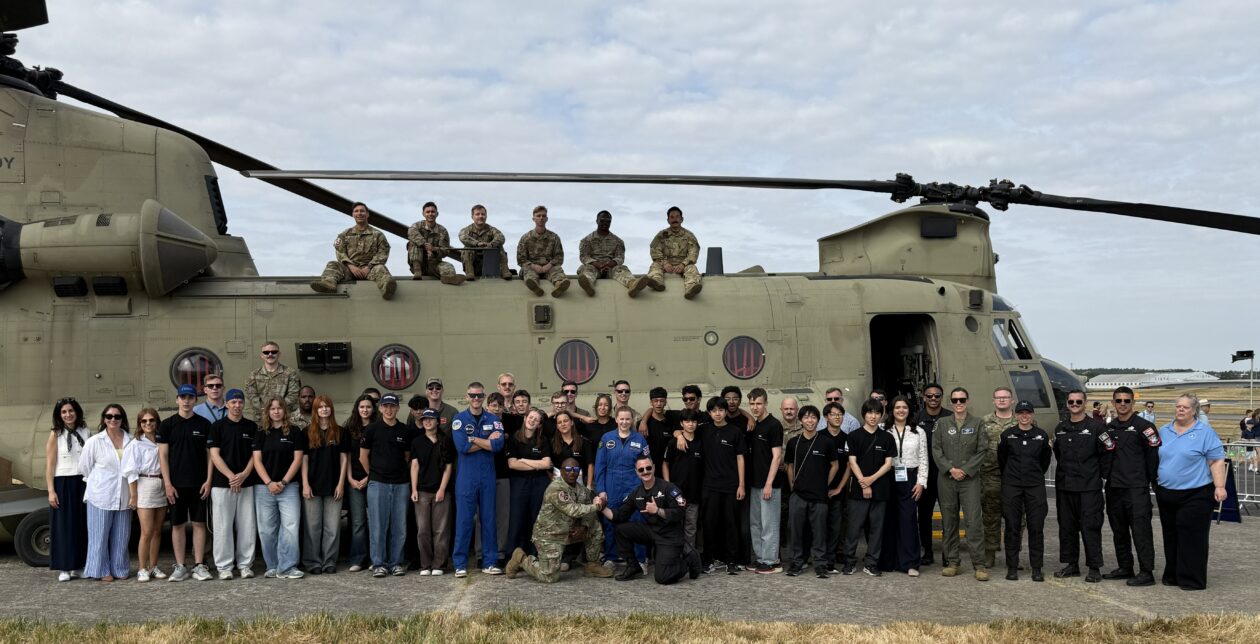
Students participating in the International Rocketry Challenge at the Farnborough Airshow in England pose with crew members and others in front of a Chinook helicopter. (Photo courtesy of Sudheer Sirivara)
Sudheer Sirivara, a parent advisor and chaperone, said the students got a chance to interact with the teams from other countries and also had a cultural exchange program where each group presented something unique about their hometown.
They also explored interesting aircraft, including Black Hawk and Chinook helicopters, and C-130 and F-35 airplanes. The team had a chance to see London before returning to the Pacific Northwest on Sunday.
“This remarkable achievement reflects months of dedication, innovation, teamwork, and perseverance,” the American Rocketry Challenge said in a LinkedIn post. “From designing and testing their rocket to competing on the global stage, these students demonstrated the technical skill and determination that define the next generation of aerospace leaders.”
The American Rocketry Challenge is the flagship STEM initiative from the Aerospace Industries Association (AIA) trade group, and is supported by industry partners as a way of strengthening the workforce pipeline of engineers and scientists.
Washington Youth Aerospace is looking forward to participating in the NASA Student Launch Initiative (SLI) next, as well as next year’s rocket challenge.
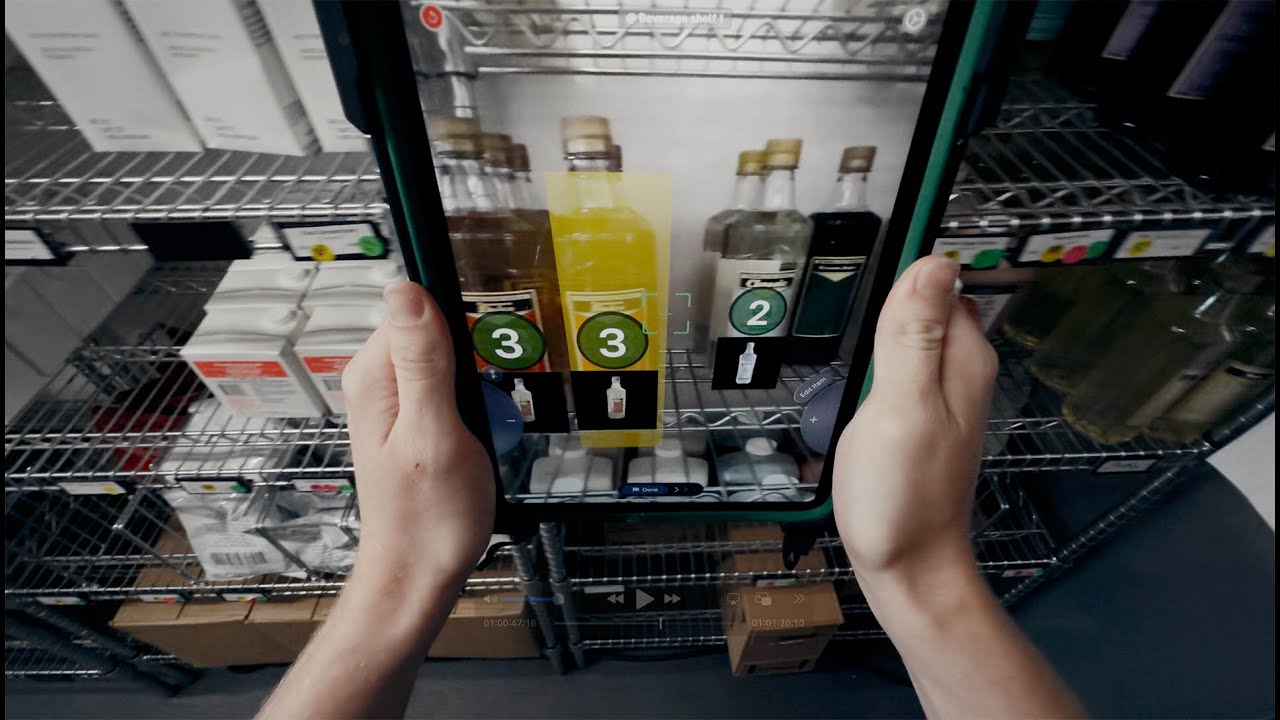
Starbucks was using technology from Redmond-based NomadGo to automate how workers counted inventory items. (Starbucks Photo)
When Starbucks scrapped an AI-powered inventory counting tool back in May, just nine months after revealing the new system, it landed as a surprise to those tracking the coffee giant’s high-tech ambitions. A new report from Fast Company tells the inside story of how the national rollout disintegrated — and why the Redmond, Wash.-based startup behind it was left “blindsided.”
Known as “Automated Counting,” the tool was built in partnership with NomadGo to scan backroom storage shelves using iPad Pros equipped with computer vision, spatial computing, and augmented reality. It was designed to automatically tally coffee bags, milk, syrups, and other key supplies.
The idea was to turn an hour-long manual chore into a 10-to-12-minute job so baristas could focus on making drinks and connecting with customers.
The technology was deployed rapidly across all 11,300 company-operated Starbucks locations in North America. But almost immediately, real-world store environments triggered rampant glitches, according to Fast Company.
Baristas reported camera errors — such as shiny refrigerator reflections doubling milk counts or the app misidentifying syrups and trash cans — while stores with spotty Wi-Fi frequently had their counting progress wiped out entirely mid-scan.
According to Fast Company, the technical breakdowns stemmed from both software limitations and outdated infrastructure. While NomadGo’s computer vision achieved 99% accuracy in controlled tests, CEO David Greschler noted that computer vision inherently struggles when inventory changes — requiring up to six weeks of retraining for seasonal holiday cups or limited-time packaging that NomadGo developers sometimes only learned about once items hit store shelves.
Compounding the problem, people involved in building the tool pointed to Starbucks’ backend network, which relies on a legacy IBM AS/400 system dating back to the 1990s, making it difficult for cutting-edge AI to process real-time store data reliably.
When Starbucks notified NomadGo on April 3 that it was pulling the plug, the startup was reportedly blindsided. Greschler called the decision “a complete surprise,” telling Fast Company that “there’s nothing you can do when leadership and strategy change.”
Within days of losing its centerpiece enterprise client, NomadGo was forced to lay off a large chunk of its 30-person workforce, according to the report, including the technical team that managed the Starbucks integration. Six weeks later, on May 18, Starbucks formally notified baristas that Automated Counting was retired, instructing them to rip the QR tracking codes off backroom shelves and return to manual tallies.
A Starbucks spokesperson provided GeekWire with this statement on Monday:
“Human connection is at the core of our business, which is why we have invested $500 million to put more partners (employees) in our coffeehouses. We use technology to support human connection, not to replace it. This tool was designed to simplify a routine task and give partners more time with their customers. When it fell short, we listened to feedback and changed course. That is what innovation looks like at Starbucks: listening, learning, and adapting.”
GeekWire also contacted NomadGo, and we’ll update this story when we hear back.
Despite retiring Automated Counting, Starbucks has pushed forward with other AI initiatives across its business. The coffee giant is building an AI-powered ordering companion inside its mobile app to translate cravings into custom recipes, while testing a ChatGPT integration that suggests drinks based on a customer’s mood or outfit.
For store staff, the company continues to rely on Green Dot Assist, a generative AI virtual assistant built to help baristas quickly look up recipes, standards, and store operating procedures.
The biggest movie of the summer will create a big headache for film geeks in Seattle who want to see “The Odyssey” precisely as director Christopher Nolan intended.
For a population that has gotten comfortable watching anything and everything streamed on TVs and smartphones, the difference might not be that big of a deal. But the epic picture starring Matt Damon was shot on 70mm IMAX to capture the highest quality image and sound, and seeing it like that in a theater should be considered a treat.
But only 25 theaters in the U.S. can project “The Odyssey” in IMAX 70mm. Axios mapped the theater locations, as well as ones in Canada, showing how far apart they’re spread — unless you live in California, where there are eight.
The true IMAX format is an option in Seattle at what was previously called the Boeing IMAX Theater, located at Pacific Science Center. But earlier this year, The Space Needle purchased the theater as part of a sale of a chunk of the Science Center’s campus.
IMAX at the Center, with the biggest such screen in Washington state at six stories tall and 80 feet wide, switched to showing documentaries, according to Axios, which said the Space Needle has “no immediate plans” to show feature films.
For the record, the theater used to do IMAX 70mm film projection, but switched to an IMAX digital projection system that employs dual 4K projectors. It’s still the only nearby screen capable of showing films shot in IMAX in full frame, such as Nolan’s “Oppenheimer.”
The PACCAR IMAX Theater at the Science Center is showing “The Odyssey,” but the smaller screen is said to crop films that were natively shot for the taller 1.43:1 true IMAX aspect ratio.
So, if you’re willing to drive north to Vancouver or Richmond, B.C., two theaters across the border are showing the big IMAX version. Consider Odysseus’s 10-year journey before complaining about a 2.5-hour trip. Furthermore, if this has you really into distances and measurements, IMAX says “The Odyssey” was shot on 2.1 million feet of film — longer than the distance from Toronto to New York.
If you do decide to stick closer to home, what are you actually missing? The short answer: a lot of screen space. The long answer requires unspooling the technical jargon behind “70mm,” “IMAX,” and the digital formats filling up local multiplex listings:
IMAX 70mm Film (15/70, 1.43:1): The native, uncompressed “gold standard” shot by Nolan. Runs physical film horizontally for massive 18K-equivalent resolution and a towering 1.43:1 screen shape that fills giant 6-to-8-story screens.
IMAX Dual Laser GT (1.43:1): Dual 4K digital laser projection. You lose the analog film grain, but it is the only digital format that preserves 100% of the expanded vertical picture without cropping.
Standard 70mm (5-Perf, 2.20:1): Physical analog film running vertically. You keep the rich color, grain, and contrast of celluloid, but it is cropped to a wide 2.20:1 letterbox shape (available in the Seattle area at SIFF Cinema Downtown, AMC Pacific Place, and AMC Bellevue).
Commercial IMAX Digital (1.90:1): Single-laser or dual-xenon digital systems found in standard multiplexes. Crops about 26% to 40% of the native top and bottom image down to a 1.90:1 aspect ratio.
This YouTube video gives a quick idea of what the full frame and cropping looks like on various formats:
“IMAX is the best film format that was ever invented,” Nolan says on the IMAX website. “It’s the gold standard and what any other technology has to match up to, but none have.”
Nolan spoke to “60 Minutes” earlier this year about the technical aspects of shooting the first-ever feature entirely on IMAX film.
Two non-IMAX versions will be showing at Seattle’s most tech-heavy theater, the SIFF Cinema Downtown — formerly the Cinerama. The theater has 70mm screenings from July 16-26, and July 31-Aug. 2. Digital screenings run July 27-30 and Aug. 3-13.
A spokesperson for SIFF told GeekWire that 70mm provides finer detail and higher resolution in comparison to digital, and that movies shot and projected on film generally have a more natural, organic image than digital pixels.
Alternating between the two formats comes down to operational realities.
“We are currently working with a contract projectionist for these screenings, so we are limited by their availability,” SIFF said. “This is also the first time that SIFF has screened in 70mm on these projectors that we inherited from the Cinerama era. We also have digital screenings scheduled to give both the projectors and our projectionist a break.”
In another Cinerama-related story this week, The New York Times reported on the planned revival of the Los Angeles version of the famed Cinerama Dome. It’s an interesting development that explains in part why people even care about the arrival of “The Odyssey” in theaters.
The key point is that going to the movies in a theater is on the rebound after a retreat during the COVID pandemic nearly killed off the pastime. Domestic ticket sales totaled roughly $5.4 billion for the year to date, up 10% from the same period last year and the highest total since 2019, the NYT reported, citing film data service Rentrak.
“I am constantly having conversations with studio heads, and you can sense an optimism that they haven’t felt in a long time,” actor Seth Rogen told Variety in another story that cited Gen Z’s enthusiasm for going to the movies.
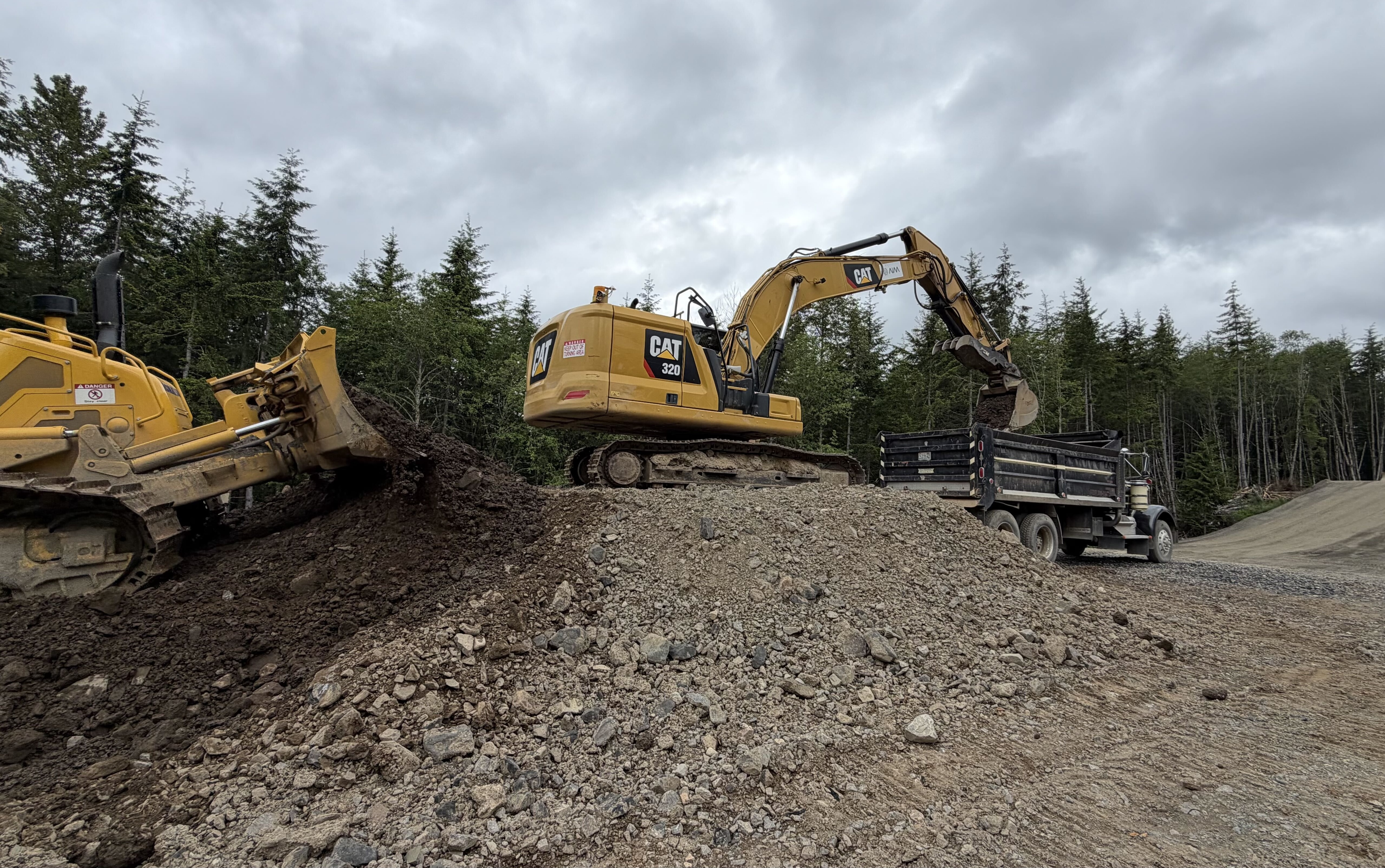
An excavator and bulldozer operating autonomously using AIM Intelligent Machines’ AI platform work at the company’s proving grounds near Monroe, Wash. (AIM Photo)
In a headquarters and lab space formerly occupied by SpaceX in Redmond, Wash., AIM Intelligent Machines (AIM) is focused on solving big problems on Earth. But the startup’s CEO envisions a day when autonomous bulldozers and excavators will dig, haul, and grade on the moon or Mars, and take AIM’s “terraforming mission” off planet.
For now, AIM’s 25,000-square-foot facility in a nondescript business park is a long way from Mars. Inside the sprawling space, there are glimpses of what the rapidly growing company is working on, including the apparatuses that attach to existing machines to make them self-driving.
Around the office, desk cubicles are decorated with tiny yellow excavator buckets, mirroring photos on the walls of heavy equipment operating on job sites worldwide.
AIM founder and CEO Adam Sadilek. (AIM Photo)
The toy excavators are a nod to a massive global market that AIM founder and CEO Adam Sadilek wants to continue to disrupt with modern technology.
Autonomous passenger vehicles have captured the public’s attention for decades, but construction, mining and hauling equipment attracts little fanfare, even as legacy companies including Komatsu and Caterpillar embrace new technology.
AIM’s goal is not to build new machinery, but retrofit existing earthmoving fleets with a physical AI platform — using advanced sensors and edge compute to let heavy iron operate entirely on its own.
Founded in 2021, the startup grew out of Sadilek’s background at Google where he spent nine years working on projects involving AI and autonomous vehicle systems.
Whether building anti-flood structures or wildfire breaks, managing nuclear waste, mining critical materials or clearing land for agriculture or the military, Sadilek views AIM’s work as immediate terraforming on Earth that is necessary to drive down costs for housing and commodities. But the long-term vision remains interplanetary.
“When humanity goes to Mars, the real question is not so much around what the rocket looks like as a vehicle to get us there, but what is going to happen after the rocket lands,” Sadilek said. “You cannot have human operators run there. That’s why this is a very long mission that we are on.”
Building autonomy for heavy equipment presents a paradox self-driving cars never have to face: the ground itself is constantly changing. While a Tesla or Waymo relies on pre-mapped roads and predictable lanes, a bulldozer or excavator’s entire job is to reshape its environment. AIM’s physical AI platform has to continuously build real-time 3D maps using onboard 360-degree LiDAR and edge compute, making split-second decisions without relying on persistent GPS or cloud connectivity on remote job sites.
Furthermore, taking human operators out of cab seats addresses one of the most perilous aspects of heavy industry. By creating “zero-entry” sites where machines operate autonomously, AIM’s platform effectively removes workers from harm’s way — transitioning traditional equipment operators into remote site supervisors who oversee entire fleets from a safe distance.
Beyond early deployments in mining and site preparation for data centers, AIM landed a $4.9 million U.S. Air Force contract earlier this year to deploy autonomous machines for airfield repair and base construction in remote or high-risk zones. The military work builds on the company’s growing momentum following a $50 million funding round backed by Khosla Ventures, General Catalyst, and Human Capital.
AIM has risen to No. 110 on the GeekWire 200 ranking on top Pacific Northwest startups.
To support its growth, AIM has rapidly expanded its headcount, doubling in size to about 80 employees in the last few months. Sadilek is attracted to the Seattle area’s intersection of hardware expertise from companies like Boeing and Amazon alongside top-tier software and AI talent.
But while AIM has managed to hire a couple former SpaceX engineers to build out its team, it isn’t the only startup mining that rocket-engineering pedigree. TerraFirma, an Austin-based company founded by two more SpaceX engineers, raised $115 million earlier this month in the burgeoning race to semi-automate physical construction.
For Sadilek, anchoring his team in Redmond rather than Silicon Valley was a deliberate decision to stay rooted in physical engineering. Having spent years in the Bay Area during his time at Google, Sadilek wanted to avoid the tech industry’s “echo chamber.”
“I wanted to be somewhat shielded from the Kool-Aid in Silicon Valley,” he said. “We wanted to build something that’s real and gets in the black really quickly… To do that, you need to do it in an environment that is more anchored in reality.”
That philosophy extends directly into their field testing. AIM’s regional proving grounds in the mountains near Monroe, Wash., expose the autonomous equipment to heavy snow and inclement weather early in development so the physical AI is built for harsh, real-world conditions from day one.
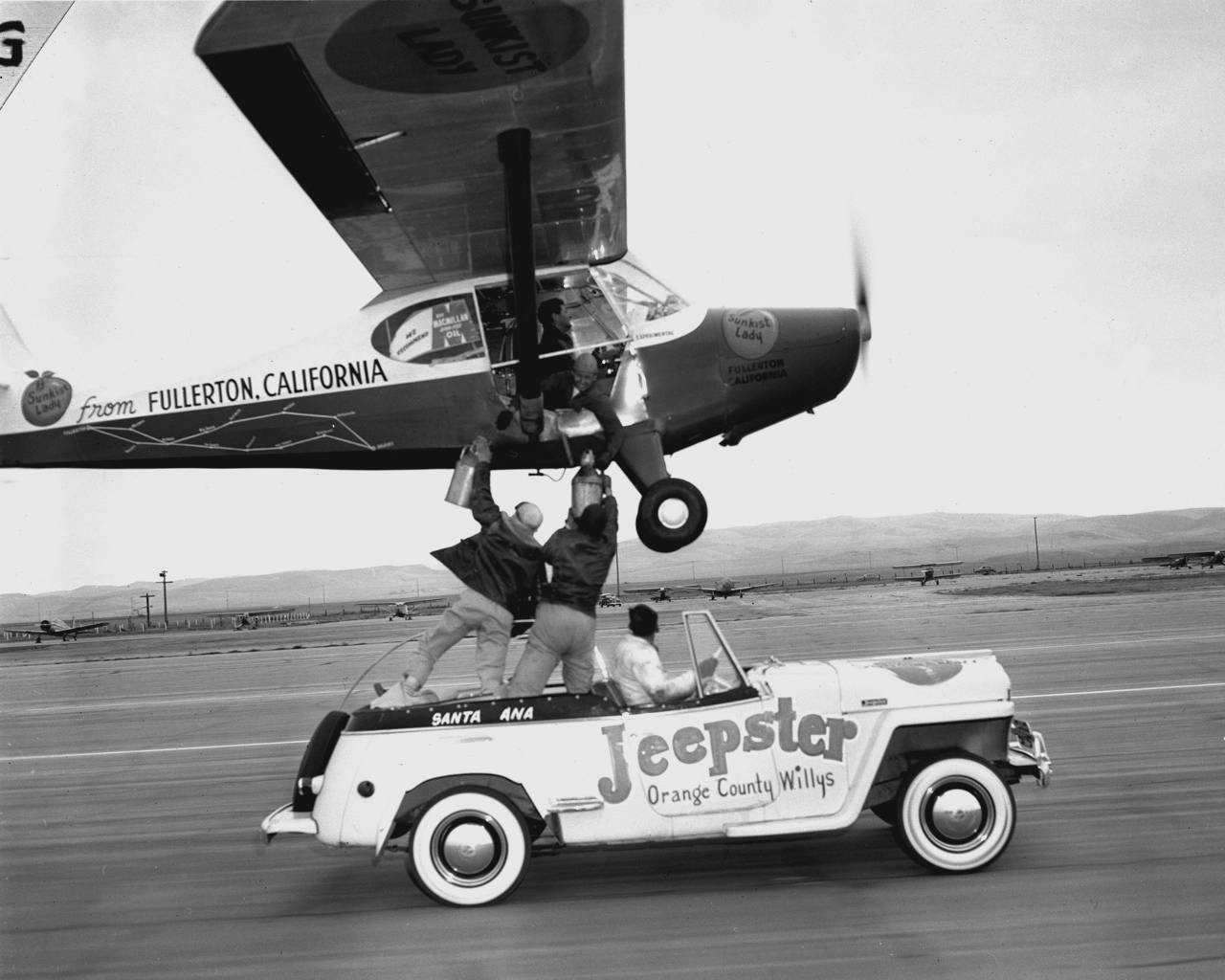
The poster that hangs in AIM’s lunchroom: “Building the plane while flying it” is a popular startup cliche, but it was close to real life during an April 1949 endurance flight in which the Sunkist Lady took on supplies while in the air. (Image via Orange County Public Libraries)
Amid the hard hats, safety vests and construction-related decor in AIM’s headquarters space, one piece of art offers a fun take on where AIM has been and where it’s headed.
The 1949 photograph, titled “Refueling the Sunkist Lady,” shows a Jeep driving beneath a low-flying plane and transferring supplies to aid the crew during an endurance flight.
Sadilek likes it as a reminder of getting started, and what it feels like to build a company from scratch, literally working on the airplane while it’s already rolling down the runway.
“The first years of AIM were exactly like that,” he said. “I think every tech startup is like that in the early days. The problem is that some of them never finish building it before the runway ends.”
Microsoft is putting $60 million behind the U.S. Department of Energy’s Genesis Mission, a push to use artificial intelligence to speed up scientific research across the government’s 17 national labs.
The company’s investment is split into two pieces: $40 million in Azure cloud computing and AI credits over three years, and $20 million for engineering and deployment help to get DOE researchers actually using the tools, Microsoft said in a blog post Wednesday.
Microsoft is also launching a new internal group called SPARK — Scientific Partnership Advancing Research & Knowledge — to serve as the single point of contact between the company and DOE on Genesis Mission work. It’s meant to combine Microsoft’s program management, engineering, security and research teams into one coordinated effort, instead of leaving individual labs to navigate Microsoft on their own.
President Trump created the Genesis Mission through an executive order in November 2025, directing DOE to build a unified computing and data platform — since named the American Science and Security Platform — that connects the national labs’ supercomputers, AI tools and scientific datasets.
The order likened the effort’s urgency and ambition to the Manhattan Project, and the White House said it’s expanded into a whole-of-government initiative involving more than 15 federal agencies, backed by more than $5 billion in commitments.
Microsoft named four initial projects taking shape under the partnership, including work with Pacific Northwest National Laboratory in Richland, Wash., to speed up the discovery of new energy storage materials — cutting analysis that used to take years down to weeks — and autonomous lab work with Lawrence Livermore National Laboratory aimed at detecting biological threats earlier.
“We move faster together,” Chris Barry, president of Microsoft’s U.S. Public Sector business, wrote in the blog post announcing the commitment, framing the investment as both a “national security imperative” and economic opportunity for the U.S.
Microsoft isn’t the only Seattle-area cloud giant courting the Genesis Mission. Amazon Web Services was recognized by DOE as a Genesis Mission supporter in December, highlighting its work with Idaho National Laboratory on AI tools for nuclear reactor design, and the company launched its own Genesis Accelerator Initiative in February, offering up to $50 million in cloud credits for DOE-related research over three years.
Google also announced Wednesday that it was committing $40 million of AI tokens and cloud credits for researchers in support of the Genesis Mission.
A painting of Jimothy, the viral raccoon, by Seattle artist Ryan Henry Ward. (@henry_beyond_museums via Instagram)
Jimothy isn’t just a viral internet sensation — he’s a cause for good.
A painting of the beloved raccoon by Seattle artist Ryan Henry Ward attracted a winning bid of $6,543.21 in an informal Instagram auction this weekend, with all proceeds directed to the Ballard Food Bank.
The winning bidder for the 24-by-24-inch painting was identified by Ward as Angela Galdabini, who posted a picture of the painting hanging on her wall.
Now the auction gift is going viral in its own way, attracting a matching donation from Amazon, which encouraged other Seattle-area companies to follow suit. According to the tech giant on Monday, T-Mobile, Alaska Air and Brooks have all gotten on board.
“When we saw a local artist giving back to the Ballard Food Bank, inspired by a little raccoon that’s brought so much joy, we wanted to help,” Kara Hurst, Amazon’s chief sustainability officer, said in a statement. “Amazon is proud to match the winning bid, and we’re calling on other Seattle-based companies to join us.”
Update: On Tuesday, Microsoft let us know that they, too, had committed funds to the food bank.
Update: According to Amazon on Thursday, the Seattle Mariners, the Seattle Kraken, Starbucks, and Stanley 1913 have also joined in with matching gifts, bringing the total additional donation to $58,888.89.
Jimothy seemed destined to be captured by Ward, a prolific muralist whose colorful, whimsical work is seen across the Seattle region on buildings, fences, garage doors and elsewhere. His art frequently features a variety of animals and other characters, including Sasquatch.
Ward called Jimothy “the hero we needed” in his Instagram post on Saturday, and said he was giving to Ballard Food Bank because the organization helped him through some of his hardest times.
The viral Jimothy sensation took off last week when the raccoon was spotted in Ballard and a video attracted millions of views on Instagram. The craze spread around the world and other videos have emerged online, sparking immense curiosity and adoration, and a flood of memes, artwork, food, crafts, poetry, songs and more.
The “Jimothy” video game features Seattle’s beloved raccoon making his way through assorted challenges. (Image via Chris Pirillo)
Jimothy, the short-spined Seattle raccoon, has become a global sensation whose likeness has been immortalized in artwork, clothing, songs and tattoos — and now a video game created in the creature’s hometown.
Tech enthusiast and entrepreneur Chris Pirillo launched an 8-bit NES-style video game called “Jimothy” this weekend in which players can control the movements of the critter as he raids trash cans, crosses streets to the park, sneaks past the paparazzi, and climbs to the safety of a big tree.
Pirillo says the missions are pulled straight from Jimothy’s real life. No doubt the animal is busy these days trying to dodge curious onlookers who are hoping to capture the next photo or video that feeds the masses on social media.
The viral Jimothy sensation took off last week when Kiana Hall spotted the raccoon in Seattle’s Ballard neighborhood and posted a video on Instagram — viewed by millions since — asking the question heard around the world: “What am I looking at?”
An earlier video of Jimothy, captured by a home security camera and posted on Reddit, ignited further curiosity and adoration, and now Reddit is flooded with sightings, memes, artwork, food, crafts, poetry and more. The Mariners put a Jimothy mascot in the Salmon Run. There’s even a Lego Jimothy.
Pirillo told GeekWire the game idea came to him on Saturday afternoon after seeing so many creatives flood his feeds with their own Jimothy fan art. He started to build a not-so-live tracker and realized it was a not-so-great idea. He hopes internet creativity is enough of a fix for the Jimothy-curious.
“This game is as close as any of us should ever get to him,” the game site states. “If you find yourself in his neighborhood: don’t go looking for him, don’t feed him, don’t try to touch him, and don’t crowd him for a photo.”
The game is easy enough to play, with challenges that are reminiscent of classic 1980s games “Frogger” and “Donkey Kong.”
Pirillo’s “Vibe Arcade” is loaded with other games he’s created. Earlier this year he vibe-coded a Resume Analyzer app and a pre-rejection letter generator called Dear Applicant to channel his frustrations with searching for a job.
Pirillo credits AI with changing the speed and ease with which a moment can go viral and be captured in new and creative ways.
“I remember when every big moment had a video game. But by the time a studio could create a video game around a meme pre-AI, the meme’s energy would have dissipated,” he said. “We are now at a day and age (certainly with AI as a tool) where almost literally anybody of any age or tech experience level can bring full-fledged experiences to life in just a few hours. We can simply talk our solutions into existence. It’s astounding.”
Pirillo built the game as a single HTML page, pitting OpenAI GPT 5.6 against Anthropic’s Claude Fable 5. One of the bigger challenges was getting the look of Jimothy right, as multiple AI models kept returning regular-looking raccoons.
Tyler Rivers, founder and CEO of Seattle-area electronics recycler Living Green Technology, examines some of the artifacts he rescued this week, including vintage hybrid microcircuits, left, which showcase the delicate gold-bonded wiring and silicon architectures hidden inside. (Photos courtesy of Tyler Rivers)
A technological time capsule of artifacts from the Seattle region’s aerospace history was saved from the waste bin by an electronics recycler this week. Now he’s trying to solve the mystery: Who owned them, where did they come from, and what exactly are they, anyway?
Computer and electronic parts dating back nearly 50 years were among a donation of items dropped off at the Bellevue, Wash., location of Living Green Technology. Instead of the usual assortment of obsolete laptops, gaming consoles and tangled cords, the lot was like a pristine engineering archive consisting of gold-plated prototype chips, raw silicon architectures exposed under glass, and experimental fiber-optic cables used to pioneer early flight control systems.
Tyler Rivers, founder and CEO of the 13-year-old company, personally inspects weekly collections from his company’s public drop-off sites, and he instantly realized the pieces were far too rare to be shredded for their precious metals.
“I’m kind of the nerd for all this stuff,” Rivers told GeekWire on Wednesday. “I go down many, many rabbit holes with different things.”
Rivers was looking into whether the donor could be tracked down to help piece together the high-tech puzzle. He did his own digging and GeekWire also leaned on Google’s Gemini AI to help identify items in photographs Rivers shared. We’re hoping readers might also email us with their own insights.
For now, we’ve determined that the collection paints a picture of a highly specialized, Cold War-era engineering workspace focused on the physical dawn of modern aviation, spacecraft engineering, and early fiber-optic data networks. It includes:
Texas Instruments SBP9900X microprocessor: A rare, military-grade 16-bit processor from 1977 marked “Experimental.” Built using a specialized architecture resistant to extreme temperatures and ionizing cosmic radiation, this line of chips was famously utilized by NASA and military defense contractors for deep-space and missile guidance systems. (Check out this report on testing radiation-hardened microprocessors.)
A collection of vintage military, and aerospace-grade microelectronic components and hybrid microcircuits dating from the 1970s through the early 2000s. The Texas Instruments SBP 9900X is the long, gold and white ceramic DIP chip, a rare, military-grade 16-bit microprocessor built using Integrated Injection Logic technology. (Photo courtesy of Tyler Rivers)
Canstar 8×8 optical star coupler: A beautifully preserved, heavy-duty glass-and-metal fiber-optic coupler stamped “8X8 100/120/140.” This component physically fused fiber-optic strands together to split and route light signals — a critical building block for prototyping early, interference-proof “Fly-by-Light” flight control systems.
A rare, intact Canstar 8×8 Optical Star Coupler from the late 1970s or 1980s. (Photo courtesy of Tyler Rivers)
DDC Total-AceXtreme avionics module: A mechanical engineering sample marked by Data Device Corporation (DDC), a pioneer of 1970s and ’80s military flight systems. The component is designed for MIL-STD-1553, the standard data bus protocol that allows cockpit flight computers, sensors, and avionics to communicate with one another on military aircraft and spacecraft.
An assortment of hybrid microelectronics and multi-chip modules. Rather than sealing a single silicon die in plastic, hybrids integrate bare silicon dies, tiny resistors, capacitors, and hand-wound magnetic inductors directly onto a ceramic or metal substrate, connected by ultra-fine gold wire bonds. The DDC mechanical sample is at center top. (Photo courtesy of Tyler Rivers)
Un-lidded hybrid microcircuits: Custom-engineered ceramic and metal cavities housing bare silicon architectures connected by microscopic, gold-bonded wire arrays. These high-reliability hybrids were custom-crafted by hand for military and aerospace programs to pack dense electronic circuitry into compact, hermetically sealed packages.
Rivers has no formal aerospace, computer science or electronics background — he’s a 2012 University of Washington graduate in economics. He started his company as a college student while working at a UPS Store, setting up a drop-off bin on the counter to collect, repair, and resell old cell phones and iPods.
Today, in addition to public e-recycling, Living Green Technology assists businesses, government agencies and others in secure data destruction, asset recovery and more.
Rivers’ hands-on curiosity regularly follows him home. When unique or puzzling items show up at his public drop-off sites, he often takes them home to dissect them in his garage. Among his previous saves is a NASA laptop, complete with receipts and tagging showing it was modified for spaceflight.
“I pretty much deep dive and gather as much information as I can,” Rivers said. “Usually, sadly after that, I stick it on a shelf in my workshop and just leave it there until I figure out what I want to do next with it.”
This particular assortment of salvaged history offers a physical look at engineering hurdles solved decades ago, representing a transition period when computers were first being ruggedized to survive the extreme environments of military aviation and space flight.
The physical “pipes” and “plugs” of an early Fly-by-Light flight control system: A fiber-optic cable assembly labeled “1st Gen Array,” left, and a military-standard M38999 Series 3 metal shell connector featuring prototype optical seals. (Photos courtesy of Tyler Rivers)
For further insight, GeekWire reached out to Andrew “bunnie” Huang, a renowned hardware hacker, author, and MIT-trained electrical engineering Ph.D. widely known for his pioneering work in reverse engineering and open-source hardware. His blog is a hardware geek’s must-read.
After reviewing photos of the Bellevue haul, Huang pointed out that the collection may not actually be a single, unified archive from a lone aerospace project. Instead, he suspects it is the ultimate “collage” of high-tech souvenirs.
“The random tray of components on the black ESD foam… I almost would be inclined to think this was more of a collage of components kept by a technician from various projects,” Huang said. “There’s some pretty nice optical sensors in there with enormous active areas, a random segmented LED display, and an old 2K EEPROM.”
Given the Seattle region’s history around aviation, aerospace and technology, there are surely countless boxes stuck in garages, attics and storage spaces holding the artifacts of innovation.
Lāth Carlson is the former executive director of Living Computers: Museum + Labs, the now-closed Seattle institution founded by Microsoft co-founder Paul Allen as a home for vintage computing equipment. Carlson was accustomed to random boxes showing up on his doorstep.
“Many people don’t realize that most museums would not exist without collectors — people that say, ‘well, that seems like it’s worth keeping’ and put it in a box,” said Carlson, who now leads Seattle’s National Nordic Museum. “Sometimes we get really lucky and they end up being more right than they realize.”
Without speaking for local e-recycling outfits, Carlson recommended getting in touch before just leaving things at a museum, because most are bound by policy to dispose of such items.
For now, Rivers’ latest rescue is safe from the shredder, perhaps waiting for its full story to be uncovered.
“Roxy” the AI time-traveling vlogger in front of the famed Crocodile Cafe music venue in what’s supposed to be 1992 Seattle. (@roxyintime via Instagram)
The best thing about Seattle’s grunge era is that it existed before the internet could completely spoil it — although the mainstream media, MTV and fashion designers eventually did their best.
None of them would be any match today for artificial intelligence.
In a new video we spotted on Instagram, a time-traveling vlogger under the handle Roxy In Time goes back to 1992 Seattle to explore the city’s music scene during its heyday. The result is grunge meets 2026 AI slop.
It’s an interesting study in how technology that’s very much being built and hyped in modern Seattle can be used to illustrate what the city sort of looked like more than three decades ago. In the video, it’s two years before the start of Amazon and another 15ish before cloud computing and a massive tech boom truly reshaped the region.
AI is being both celebrated and derided for its ability to help create content like Roxy’s time-traveling exploits. Where some see an innocent, weirdly educational history lesson, others can’t look past the replacement of human creativity, the excess of such material polluting social media channels, and the tech’s ability to deceive viewers in more dangerous ways.
Roxy is an AI-generated influencer — not a real person — with a penchant for visiting historically significant places, both real and imagined. She recently checked out L.A.’s Sunset Strip in 1987 and a New York speakeasy during Prohibition in 1929. In other videos she runs across fantastical figures including Paul Bunyan and Humpty Dumpty, and she visits cavemen in 30,000 B.C.
In the Seattle video, Roxy is dressed for the era’s part in a flannel, Nirvana T-shirt, ripped jeans and combat boots. She starts her tour by saying she’s in town to see the band Mudhoney play at Belltown’s Crocodile Cafe. But first she heads to Easy Street Records in West Seattle to browse records, tapes and CDs.
The video is populated with images of random musicians carrying guitars down the street, and people drinking coffee and reading actual print publications instead of staring at laptops. At The Central Saloon and OK Hotel in Pioneer Square, everyone has long hair, or a beanie, or both. Sweaty music fans in mosh pits seem to fit the timeline.
AI’s vision of 1992 Seattle: No laptops at the cafe! Garbled words on flyers! The grunge pit! (Screenshots via @roxyintime)
AI’s artistic limitations do come into focus in a few spots, especially when written words are displayed. The names of bands and clubs on music flyers — such as Comet Tavern — are a jumbled mess. Same goes for some of the names on record dividers at Easy Street, where the store’s neon wording also breaks apart.
Back at the Crocodile, Roxy is in line to see Mudhoney, and she’s confused by an opening act named Pen Cap Chew. Inside, as the show starts, she realizes that Pen Cap Chew is actually Nirvana, playing under the secret moniker because by that time the band was a worldwide sensation riding the success of the album “Nevermind.”
In perhaps the most realistic demonstration of being in 1992 — in a club where no one knows what a smartphone is yet — Roxy ends the video by saying she needs to stop recording.
“I’m putting this thing away, I’ve gotta watch this,” she says.
The lifelike avatar of President Theodore Roosevelt, which relies on artificial intelligence to answer visitors’ questions, at the Theodore Roosevelt Presidential Library in Medora, N.D. (Theodore Roosevelt Presidential Library Photo via Microsoft)
“Speak softly and carry a big prompt.”
That’s not exactly how Theodore Roosevelt put it, but presidential historian Doris Kearns Goodwin found herself face to face with an AI-powered version of the 26th president at the newly opened Theodore Roosevelt Presidential Library in Medora, N.D. — and she had questions.
Goodwin is among the high-profile visitors to interact with the lifelike, immersive version of Roosevelt that is able to discuss his life, leadership and legacy.
A week after a visit from President Trump, Goodwin joined Microsoft President Brad Smith at the library to learn how the tech giant’s AI is being used to help the institution — and the Roosevelt avatar — speak directly to future generations.
“Who better to put our avatar to the test than American historian Doris Kearns Goodwin,” Smith wrote on LinkedIn on Sunday, where he shared a video of a clearly giddy Goodwin meeting the digital Roosevelt.
“I’ve been wanting to meet you for such a long time,” Goodwin said. “I feel like I’ve lived with you for 10 years of my life when I wrote a first book about you.”
Goodwin asked Roosevelt questions about his relationship with JP Morgan, the changing will of the country, and how it was presumed that when he neared death, Roosevelt would still be fighting and still be in the arena.
“I never cared how’d I’d be remembered by the historians,” the avatar said. “Still swinging, still loud, still on your feet. If folks say I managed that, well, I’m glad of it.”
A Pulitzer Prize-winning biographer who has written extensively about presidents and American history, Goodwin was moved by the interaction.
“Wow,” she said. “It’s amazing.”
The AI works as part of Box 1, the knowledge base backbone of the museum, powered by technology Microsoft helped create. According to a July 1 Microsoft blog post, the system is loaded with hundreds of thousands of archival documents, and AI is used to “organize, enrich and reconstruct fragmented materials into searchable, contextualized historical records.”
Box 1 and AI also power The Campfire Reading Room, a digital research tool that anyone anywhere in the world can use to search through Roosevelt’s writings, letters, images and historical materials.
Microsoft donated much of its work with the library through its AI for Good Lab. The company said it plans to release a paper documenting exactly how the technology works and to open source the software used in the project.
As technology evolves, the library will evolve with it, Microsoft said. When more documents are added to Box 1 or as generative AI improves, the Roosevelt avatar will automatically update with the additional context.
“That’s why we call it a living library,” said Laura Hoffman, senior director of the AI for Good Lab. “One of the most challenging things for cultural institutions is to continue to keep their experiences feeling relevant and fresh. This is what’s great about AI technology: It will continue to get better and better.”
Augmodo, the Seattle startup that straps AI-powered cameras onto retail workers to track store shelves, has raised $21 million as it pushes its technology beyond grocery aisles and into warehouses, factories, and other physical workplaces.
The new funding, led by existing investor TQ Ventures, values Augmodo at $350 million.
CEO Ross Finman, who told GeekWire he wasn’t even looking to raise fresh capital, said he was motivated by interest in the startup’s technology from customers beyond retail, including automotive settings and hospitals.
Augmodo CEO Ross Finman. (Augmodo Photo)
“Fundamentally, someone grabbing a wrench at an automotive factory isn’t that different from someone grabbing a Cheerios box,” Finman said. “Turns out the algorithms work pretty well across all of those.”
Founded in 2023, Augmodo builds AI-powered “Smartbadges” — lightweight wearable devices with dual cameras — that store employees wear passively as they move through aisles. The badges use computer vision, 3D mapping, and spatial computing to track shelf inventory in real time, building what the company calls a digital “Realogram” of each store.
Augmodo raised $37.5 million a year ago in a round that came after Australian pharmacy chain Chemist Warehouse — the startup’s first big customer — moved from a pilot to a full contract and validated the technology at scale. Now others want in on the action.
“Our whole mission statement is AI systems for the physical workforce,” Finman said. “Everyone’s focused on the 20% of the workforce that’s knowledge work, and we’re focused on the 80% of the workforce that’s physical work.”
That demand has pulled Augmodo into warehouses, facility maintenance, delivery operations, and even employee training — verticals the company didn’t originally set out to serve. Existing retail customers, Finman said, kept expanding their contracts to cover new parts of their operations, from auditing warehouse pallets to logging maintenance work like HVAC repairs.
The Smartbadge itself has evolved, too. Finman said it’s now lighter than an iPhone Air and has grown into what he calls an “everything device,” adding walkie-talkie capabilities, an opt-in panic button, and a digital ID display, on top of its original inventory-tracking function.
“That’s actually become a really big selling point,” Finman said. “You don’t need to buy five or six different devices, you buy one at cost, and then here’s all the different features that you can get out of it.”
The company says it has grown 10x in revenue over the past year and now maps more than 186 million square feet of retail space monthly — a figure it expects to cross 1 billion square feet per month by year’s end. Augmodo is adding 50 to 100 new store locations a month.
The company’s headcount has grown 5x over the past year to more than 50 employees, including new CTO Bradford Snow, who joined in January after previous stints at Axon, Meta, Amazon and Microsoft.
Augmodo is ranked No. 145 on the GeekWire 200 list of top Pacific Northwest startups and was a finalist in the Hardware, Robotics, and Physical AI of the Year category at the 2026 GeekWire Awards.
Beyond TQ Ventures, backers include Lerer Hippeau, Jefferson River Capital, Arena Holdings, Chemist Warehouse, New Fare, Interlace, and Webb Investment Network.
Andrew Marks, co-founding partner at TQ, called Finman an “exceptional” leader and said every board meeting reinforced that demand for Augmodo’s tech was outpacing the team’s ability to serve it.
“When you pair a truly special founder with customers lining up around the door and pulling you into new markets, it was obvious we should propose putting more fuel on the fire,” Marks said.
Augmodo said it plans to use the new capital to expand its global enterprise footprint, invest further in its core AI models, and grow its engineering team — with a particular focus on hiring for computer vision and machine learning roles as the company scales its data processing beyond retail.
Vinod Khosla speaks at a fireside chat at AI House in Seattle in March 2025. (GeekWire File Photo)
Vinod Khosla has spent four decades building and funding companies around a single idea: hire the right people and get out of their way. He’s one of the most respected and influential investors in Silicon Valley, with a track record of big bets and a habit of not backing down.
On Saturday, a group led by the billionaire venture capitalist and his family agreed to buy the Seattle Seahawks from the estate of the late Microsoft co-founder Paul Allen for a reported $9.6 billion, which would be the highest price ever paid for an NFL team.
Khosla, 71, was born in Pune, India. He earned degrees from the Indian Institute of Technology in New Delhi and Carnegie Mellon before getting his MBA at Stanford, where he landed in Silicon Valley for good. After co-founding Sun in 1982, he spent nearly two decades as a partner at the legendary venture firm Kleiner Perkins before launching Khosla Ventures in 2004.
His firm now manages roughly $15 billion and has backed companies including DoorDash, Affirm, and Opendoor. Khosla was the first VC to invest in OpenAI, putting in $50 million in 2019. Forbes ranked him No. 1 on its Midas List of top tech investors this year and estimates his net worth at $15.6 billion.
But the Seahawks deal isn’t just about Vinod. The Allen estate’s public statement confirming the formal sale agreement described the buyer as “an ownership group led by the Khosla family,” and Vinod’s own quote in the statement was delivered “on behalf of the Khosla family.”
An NFL memo sent to all 32 teams Saturday, reported by ESPN’s Adam Schefter and others, identified his wife, Neeru Khosla, as the controlling owner, and said their son, Neal Khosla, “would be expected to have a significant leadership role in the ownership group.”
Neal may be the one to watch. He has described himself on his personal website as “an obsessive sports fan” who likes “bringing a quantitative and analytical lens to understanding the game within the game,” the Seattle Times reports.
He and his father have been San Francisco 49ers season ticket holders for 30 years, and Neal has consulted for both the 49ers and the Miami Heat. The Khosla family last year bought a 3.1% stake in the 49ers — the Seahawks’ NFC West division rivals — which they’ll now have to sell.
But Vinod Khosla’s track record is the clearest window into how the family will approach its Seahawks ownership. Here’s what we know about him based on his long career in tech.
He focuses on people and talent above all else. “A company becomes the people it hires, not the plan it makes,” Khosla said in a 2016 Startup Grind interview.
“Experience doesn’t matter. The rate of learning matters,” he told Sam Altman in a Y Combinator interview the same year, using a football analogy (fittingly as it now turns out): “Pick for the best athlete, not the person who’s the most established wide receiver who knows how to run one pattern.”
At Sun, Khosla spent an inordinate amount of his time on recruiting. He personally reconstructed the org chart of competitor DEC to identify talent that the company could poach.
Speaking at Seattle’s AI House in March 2025, Khosla’s main advice for startup founders was that their success will be driven by the people they hire and the questions they ask.
“The single most important decision by far you will make is the team you build,” he said at the time. “The more questions that get asked around your conference table, the better it will go, the faster you will learn, and the faster you will accumulate advantages.”
Vinod Khosla speaks at the Bloomberg Green conference in Seattle in July 2025. (GeekWire Photo / Lisa Stiffler)
“Talent drives everything,” he said at another event in Seattle last summer, the Bloomberg Green Seattle conference on climate change.
For the record, the Seahawks’ current leadership is ostensibly locked in: general manager John Schneider is under contract through 2031, and head coach Mike Macdonald, who led the team to its Super Bowl win in February, is signed through 2029, according to The Seattle Times.
Whether the trademark Khosla obsession with talent will translate into getting involved with draft picks and player personnel will be an interesting question to watch.
He’s a Bay Area guy, not a Seattle guy. Khosla has lived and worked in Silicon Valley since earning his MBA at Stanford in 1980. Khosla Ventures is based in Menlo Park. The family’s 49ers ties underscore that this is not a homegrown owner.
Khosla has made a handful of appearances in the Seattle area over the years. His firm led a $11 million round for Seattle-based AI legal startup Lexion in 2021, and a $15 million round in Viome, the wellness startup co-founded by Seattle-area entrepreneur Naveen Jain, in 2017.
But he has no deep roots in the Pacific Northwest, which is a major difference from Seattle native Paul Allen and his family. How quickly the Khosla family builds a connection to the city and Seahawks fans may matter as much as anything they do on the football side.
He supports the people he picks, but tells it like it is. In more than 30 years on startup boards, Khosla says he has never once voted against a management team, even when he strongly disagrees.
“I’ll argue with them, I’ll debate with them, I’ll push them, but I will not vote against them,” he said in the Startup Grind interview. The Khosla Ventures website puts it more plainly: “Once we pick a management team, we back it and don’t second-guess it.”
For a Seahawks fan base that watched Paul Allen’s sister Jody Allen take a largely hands-off approach as chair of the Allen estate, the philosophy may sound familiar, although Khosla’s version would also come with a willingness to challenge leaders behind closed doors.
For example, Khosla has said he deliberately takes positions he doesn’t believe in when coaching founders — not to mislead them, but to force them to think through risks they haven’t considered.
The Khosla Ventures approach, as explained on its site, is “brutal honesty over hypocritical politeness.”
He’s not without controversy. In 2008, Khosla bought a 53-acre property south of Half Moon Bay, Calif., that included the only access road to Martins Beach, a stretch of coastline that surfers and families had used for decades. He locked the gate and blocked public access, setting off a legal battle that has lasted more than a decade and drawn widespread criticism.
The case has gone to the California Supreme Court and back.
“Every Generation Gets the Beach Villain It Deserves,” the New York Times headlined a 2018 story about the dispute. Khosla has argued it’s a private property rights issue. Critics see it as a billionaire putting his own interests above the public.
The takeaway: he doesn’t back down, even when public opinion is against him.
He’s persistent in business, as well. That habit of not backing down has been consistent throughout his tech and investing career.
When Sun was told it had lost a critical early deal to a rival, Khosla flew from San Francisco to Boston and camped out in the prospective customer’s office until the CEO agreed to see him. By the end of the day, the company had signed with Sun, according to The Generalist.
When defective Philips monitors nearly bankrupted Sun, Khosla went home at 3 a.m. and was back by 7 a.m. for months until the crisis passed, he said in the Y Combinator interview.
During a 2011 appearance in Seattle, Khosla offered this take on betting big: “I don’t mind the low probability of success, but I better be impactful if we do succeed.” He was talking about startups, but the same idea no doubt applies to chasing another Lombardi Trophy.
Seattle Seahawks head coach and self-professed football nerd Mike Macdonald just doesn’t understand why any coach or team would ignore the chance to lean into data and analytics.
“Why wouldn’t we use the best information out there?” he said during an interview this week on the Dan Patrick Show. “Why would you be scared about things that are going to possibly help you?”
Macdonald called himself a “psycho data guy” who needs “numbers and tendencies.” He has a new Super Bowl ring to show for his coaching style, but he’s also clear that while advanced technology and metrics may help support the team’s planning and in-game decisions, they don’t drive those decisions completely.
“You don’t have to do what the numbers say,” Macdonald said, adding that variables such as how a game is going, the feel for your own team, and gut instinct can all cancel out data suggestions.
That data-be-damned mentality came into play at the start of last season when the Seahawks, facing a 4th-and-1 from the San Francisco 49ers’ 19-yard line, ignored the analytical model that said to go for it. Macdonald opted to kick a field goal for a three-point lead and ended up losing when the 49ers came back and scored a touchdown.
Seattle started 0-1 and six months later won its second NFL title.
This year, Seattle opens against the New England Patriots, the team they beat 29-13 in Super Bowl LX.
Macdonald hasn’t learned much yet from that game, because he said he’s only watched it once, via tape and not the standard TV broadcast.
“Are you worried there’s a different ending?” Patrick laughed.
Echodyne CEO Eben Frankenberg, left, gives a tour of the company’s new manufacturing facility in Woodinville, Wash., to U.S. Rep. Suzan DelBene, center, and Sen. Maria Cantwell on Wednesday. (Echodyne Photo)
Echodyne, the Seattle-area radar-platform company, cut the ribbon Wednesday on a new $40 million manufacturing facility designed to meet growing demand for its drone-detection and airspace-monitoring systems.
Headquartered in Kirkland, Wash., Echodyne is opening an 86,350-square-foot manufacturing and operations hub in nearby Woodinville, Wash., that it says will eventually be able to produce more than 2,500 radars each month — or roughly 30,000 radars annually.
Echodyne says the expansion is fueled by U.S. and global demand for safety and security radars that can detect and track drones, driven in part by their proliferation on the battlefield in the Russia-Ukraine War and the fast-growing “low altitude economy” of commercial drone operations that require airspace monitoring.
Echodyne currently employs 260 people, and the new facility will support more than 100 new jobs and up to 200 as the facility reaches full production capacity, according to the company.
“Our global customer base is demanding more radar to be delivered as fast as possible,” CEO Eben Frankenberg said in a news release, adding that the proliferation of drones requires reliable, at-scale production. “The only way to defend against mass is with mass.”
Echodyne plans to add 100 new jobs at its new manufacturing facility in Woodinville, Wash. (Echodyne Photo)
Echodyne was spun out of Bellevue-based Intellectual Ventures in 2014 and has drawn backing from Microsoft co-founder Bill Gates, along with NEA, Madrona Venture Group, Baillie Gifford and Northrop Grumman, among others. The company raised $135 million in a 2022 investment round and total funding is $200 million.
The company’s radar systems rely on patented “metamaterials” technology — a flat-panel antenna that can electronically steer its beam without any moving parts — which Echodyne says allows for smaller, cheaper radar than conventional designs.
Echodyne originally focused on using compact radar to help drones detect and avoid obstacles in flight, before pivoting toward counter-drone security as demand grew for systems that could track other drones — including cheap, mass-produced ones deployed on the battlefield in Ukraine.
Echodyne’s radar technology is integrated into systems from Anduril, Axon, Moog and Northrop Grumman, among other defense companies, the company said. Most recently, Echodyne was selected as the primary radar provider for Trust Automation’s drone-detection platform, which is being delivered to the U.S. Air Force under a $490 million contract.
Wednesday’s ribbon cutting was attended by Sen. Maria Cantwell, U.S. Rep. Suzan DelBene, Woodinville Mayor Sarah Arndt, and Michael Robbins, president and CEO of AUVSI, the trade association for the uncrewed systems, autonomy, and robotics industry.
The new hub allocates approximately 74,350 square feet to manufacturing space and 12,000 square feet to warehousing.
Cutting the ribbon on Echodyne’s new manufacturing facility, from left: Sen. Maria Cantwell, U.S. Rep. Suzan DelBene, Echodyne CEO Eben Frankenberg, and AUVSI President and CEO Michael Robbins. (Echodyne Photo)
Dane Renkert, co-founder and CEO of Barkie, an AI-powered app for golfers. (Barkie Photo)
Perhaps the only downside to building a golf-focused startup is that it leaves less time to actually play golf.
Dane Renkert will take that tradeoff, for now, as he works on something that he says will change the way people play and interact around the game.
Renkert is co-founder and CEO of Barkie, a Bellingham, Wash.-based startup building an app that aims to be a true AI caddie in every golfer’s pocket — one that tracks scores by voice alone, settles betting games automatically, and rarely requires a golfer to look down at a screen.
Renkert is no slouch as an athlete and golfer. A Washington State University graduate, he played professional baseball for the Milwaukee Brewers before moving into tech and sales leadership roles at Docugami, Komiko, and Ben Kinney Companies. As a competitive golfer, he placed 13th at the 2009 World Long Drive Championship and now boasts a scratch handicap.
The name of the company is a nod to golf terminology — a “barkie” is an honest, hard-fought par saved after a golfer’s drive ricochets off a tree.
The inspiration for the startup stems from Renkert’s own frustration with existing golf mobile apps, which he argues have essentially operated as digital spreadsheets for the last decade. Incumbents like 18 Birdies, The Grint, and Golf Genius require constant manual data entry throughout a round, Renkert said.
Noting that seven out of 10 golfers still use a paper scorecard and pencil because they like the tradition or want to avoid screen distraction, Renkert set out to build a platform centered on a simple philosophy: “keep your head up and not down.”
To translate that concept into software, Renkert initially teamed up in 2025 with co-founder Zubin Wadia, an MIT grad whom he worked alongside for five years at Docugami, the Bellevue, Wash.-based AI startup. Wadia remains a strategic advisor to Barkie.
To achieve the “heads up” experience, Barkie is differentiating itself by launching a full voice user interface that eliminates manual typing entirely. Using standard gear like an Apple Watch or AirPods, golfers can simply speak the outcome of a hole to dynamically update a digital scorecard in the background.
According to Renkert, Barkie is the first to market with an AI-native, voice-first caddie that allows for natural, fluent speech on the course rather than forcing players to toggle through menus and hit arrows to log data.
“The voice thing, in particular, I believe is a massive lift technically, but it’s a big lift from a user experience side as well,” Renkert said, adding that the platform is designed to seamlessly augment the traditions of the game rather than disrupt them.
Screenshots of the Barkie app on an iPhone and Apple Watch, showing golf course GPS and scoring capabilities. (Barkie Images)
Under the hood, Barkie relies on a patent-pending dual-layer system to prevent the application from making mistakes or hallucinating numbers. A guardrailed large language model handles the conversational front end — interpreting natural voice requests, answering rules questions, or trading friendly banter.
A separate, rules-based engineering backend handles all the scoring, strokes-gained calculations, and betting math. This split ensures that while golfers can talk to the app like a human caddie, the actual bookkeeping remains completely accurate.
When the betting function comes online, that same backend will settle real-money side games — Nassau, skins, wolf, hammer bets — instantly once a round ends, sparing golfers the aggravation of hashing out who owes what on the 18th green.
Barkie’s simplest use case doesn’t require voice at all. Through a feature called ScoreShot, golfers can snap a photo of a paper scorecard. The app digitizes it and pushes the data directly to GHIN, the USGA’s official handicap system, via a partnership Renkert says gives Barkie access to course-specific data like slope rating and tee-box selection. Golfers without a club membership or GHIN account can still generate a handicap through the app, calculated according to World Handicap System guidelines.
Either way, the result is hole-by-hole performance data that Renkert says no other golf app currently offers — letting players see which holes they’re strongest and weakest on, and, he added, which holes they should be pressing their buddies on.
Barkie is available for download on iOS (optimized for iPhone, iPad, and Apple Watch companion setups) and Android devices via the App Store and Google Play Store.
The app offers a free tier that includes GPS mapping features. The premium tier unlocks unlimited hands-free voice tracking, advanced Strokes Gained analytics, the Barkie Betting Engine, and full GHIN integration. Limited-time pricing is available at $4.99 monthly or $29.99 annually.
Barkie investor and advisor Rob Gough. (Barkie Photo)
Barkie has attracted seed funding from friends and family and notable investors, including Rob Gough, an entrepreneur and collector perhaps best known outside tech circles for his record-setting $5.2 million purchase of a 1952 Topps Mickey Mantle baseball card. According to his LinkedIn, Gough is also an investor in Jeff Bezos’ AI startup Prometheus, which raised $12 billion in Series B funding last month.
“I invested in Barkie.ai because I believe they’re building something that delivers real value to golfers, not just another AI demo,” Gough said in a statement. “Great companies have an unfair advantage, and Barkie has exactly that: a founder with deep domain expertise as a scratch golfer who genuinely understands the game, combined with a world-class AI team recruited from companies like Meta, Google, and NASA.”
Barkie’s cap table also includes former Seattle Seahawks linebacker Lofa Tatupu, who serves as an advisor to the company.
Armed with high-profile backing and a team recruited from tech giants, Renkert isn’t shy about his ambitions to disrupt the entrenched players in the space.
“I want the incumbents to know I have a lot of backing, and I’m coming for you,” Renkert said. “I’m not trying to compete with you, I’m trying to take it over.”
For now, taking over means grinding behind a desk instead of on a fairway. Renkert admits that building the startup cut heavily into his own time on the course this past year — even leading to a rough showing when he tried to qualify for the U.S. Amateur.
But the grind is the point.
“I’ve done a lot of cool things in my life, but this is the hardest I’ve ever worked for something,” Renkert said. “I believe, hopefully, this will be my mantle piece.”
A screengrab of the Cascade PBS streaming app as built by Local Public. (Local Public Image)
Seattle’s Cascade PBS has spun out its streaming app technology into a standalone company called Local Public, which is now building connected-TV and mobile apps for public media stations across the country.
The goal is to provide local PBS stations nationwide their own branded, station-curated streaming apps — plus tools for fundraising and audience data — as an alternative to a one-size-fits-all national app.
Local Public was originally created within Cascade PBS (KCTS-TV channel 9) to build apps for that station, which serves Western Washington and part of British Columbia. Supported by 10 Founding Sponsor partner stations, a Local Streaming Initiative (LSI) was launched to expand the platform to serve stations nationwide.
On July 1, Local Public launched as a public benefit corporation. Cascade PBS owns 100% of Local Public, but it’s expected to take on investment and be co-owned by a coalition of other PBS stations in the near-future.
In a blog post announcing the launch, Local Public CEO Kevin Colligan wrote that the company is aiming to build “a growing coalition of independent public media organizations working together while remaining deeply rooted in their own communities.”
Eighteen stations are currently using Local Public, according to Cascade PBS, including Arizona PBS (Phoenix), Houston Public Media, OPB (Oregon), Rocky Mountain PBS (Denver), Vegas PBS, WETA (Washington, D.C.), WHYY (Philadelphia), WQED (Pittsburgh), and others.
Colligan framed the launch against the backdrop of media consolidation, arguing that a shrinking number of corporations increasingly control what Americans watch and read, while local newsrooms have been gutted and replaced by centralized programming.
He also pointed to the rise of low-effort, AI-generated content as a further threat to authentic local journalism and storytelling — one he said makes trusted, community-rooted public media more valuable, not less.
“We bring a startup mentality to public media’s longstanding tradition of community service,” Colligan wrote. “We are building technology that allows stations to move faster, collaborate more effectively, and reach audiences wherever they are.”
Local Public apps currently run on 10 platforms, including Roku, Fire TV, Apple TV, Google TV, Android TV, LG and Samsung smart TVs, iPhone, Android and a web video portal. NPR, radio and podcast integration is in development and expected to launch in fiscal year 2027.
The apps run on a centralized content management system, letting stations publish their own programming, build featured-content carousels and pull real-time viewer analytics. Stations can also message members and prospective donors directly within the app. The platform fully supports PBS Passport, the streaming benefit for recurring donors, and PBS Media Manager, the system stations use to manage and distribute video.
TheDesk.net reported that Sacramento’s KVIE has already relaunched its streaming app through Local Public as KVIE Plus (stylized KVIE+), offering free access to the station’s full lineup of broadcast channels over streaming alongside local programming and acquired shows, movies and documentaries. Denver’s KRMA has relaunched its connected-TV app through the platform as well
Pricing for Local Public is tiered by station size, based on how many Passport-eligible members a station has at signup. Small stations (fewer than 15,000 members), for instance, pay an $8,000 onboarding fee and $60,000 annually.
Sniff founder Amish Patel and Chewie, his standard poodle. (Photo courtesy of Amish Patel)
Amish Patel knows his neighbors by their dogs’ names before he knows their own. It’s a pattern he noticed in his Seattle neighborhood — and one he’s now built an app around.
Patel’s newest pet project — born out of his Conduit Venture Labs startup studio, is Sniff, an iOS app that turns the everyday moment two dogs greet each other on a walk into a lasting connection between their humans.
The idea traces back to Patel’s own block in Seattle’s Madrona neighborhood, where he moved with his standard poodle, Chewie, right before the pandemic. With no kids and limited ways to meet people, the neighborhood park became the default hangout — and a group text thread became, in Patel’s words, a real sense of community. The catch: most of those contacts were saved under names like “Glory’s mom” or “Louie’s dad.”
“The five people in Madrona that I hang out with, more often I met through him,” Patel said of Chewie.
Beyond widening Patel’s own social circle, Sniff has a greater societal objective — taking on loneliness and isolation, an epidemic cited in the U.S. Surgeon General’s 2023 advisory on social connection.
“Younger people are having kids less, getting more isolated … we’re sitting on our phones, even though we’re all next to each other,” Patel said. “One out of four people don’t know their neighbors or talk to their neighbors.”
Dogs — and Sniff — could be an answer.
Sniff verifies that users are real people who actually live in the neighborhood they claim, using address and location data, and the app is geofenced so members can only discover dogs nearby. Inside the app, users see only dog profiles and photos — no human names or personal details — until a connection is made. Patel said artificial intelligence plays a role only on the trust-and-safety side — confirming identity and location — rather than in matching people up.
Once connected, neighbors can message through the app, arrange meetups, and lean on each other for help — dog walking, sitting, or just a hand when something comes up. Patel said the trust that builds from already knowing someone’s dog often translates directly into people who are willing to help.
Screenshots from the Sniff app show a profile, community boundary, events and more. (Sniff Images)
The pilot is open in Madrona, Leschi, Madison Park, the Central District and Capitol Hill, but pet parents anywhere in Seattle can sign up today. Each neighborhood stays geofenced until it reaches enough engaged sign-ups, at which point Sniff opens it up — Madrona, the first to launch, already has about 100 people on the platform.
To help build momentum in each neighborhood, Sniff is partnering with the Seattle Chamber of Connection — where Patel sits on the board — to recruit “Pack Leaders”: local dog owners who help organize meetups and informal introductions as their neighborhood’s user base grows.
Patel is a Microsoft vet who spent eight years on projects including Xbox Kinect and Microsoft Band, before moving into the startup world with stints at fitness wearable maker Katalyst and football helmet manufacturer Vicis. He landed an entrepreneur-in-residence role at Seattle startup studio Pioneer Square Labs in 2020, and two years later co-founded Conduit Venture Labs with Susan Paley, the former first CEO of Beats by Dre.
Conduit focuses on “hard-tech” ventures that blend hardware and software. Sniff is Conduit’s fourth in-house startup, following Fluffy — a computer vision platform for doggy daycares — and an audiobook AI venture in the loneliness space that Patel said is preparing for a public seed round this fall. A fourth project, in health tech, remains under wraps for now.
The Sniff app itself was built lean: a couple of developers, a product lead, and Patel splitting his time across the studio’s other projects. Patel said the team has since shifted to AI-assisted development to move faster, and is now searching for a CEO to take the project in-house full time as it raises capital and pursues some hardware-related features.
For all the talk of trust layers, geofencing and future hardware, Sniff’s entire premise still comes down to a dog doing what dogs do. The humans get the friendships, the favors, the group texts. The dogs, Patel said, get something simpler.
“They just get to be more social,” he said, “because we don’t keep them in our house with us while we’re doom scrolling through everything.”
Emer Dooley, site lead for Creative Destruction Lab in Seattle, moderates an accelerator program session alongside mentors and startup founders. (CDL Photo)
Startups innovating across advanced manufacturing and computational health made up the latest cohort of the Seattle accelerator run by Creative Destruction Lab (CDL).
The nine-month, nonprofit program based at the University of Washington’s Foster School of Business graduated 17 early stage companies. It’s the fifth cohort since CDL launched its Seattle hub in 2021.
CDL, which runs startup programs around the world, does not take equity from companies and relies on funding from founding members such as the UW and Microsoft. Founders in the cohort get access to mentors including startup founders, investors, and other leaders from across the Pacific Northwest.
Startups that have participated have collectively raised more than $330 million in follow-on venture capital funding since 2022, according to CDL.
The list below includes the companies that just graduated, with descriptions provided by CDL. See past graduates here.
Manufacturing
3D Spark — An AI-powered B2B platform that lets engineering, procurement, and sales teams rapidly evaluate and compare manufacturing methods for custom parts by analyzing manufacturability, cost, lead time, and CO₂ footprint.
Outrun Robotics — An industrial automation company that builds and deploys capable, flexible, intelligent robotic workstations to automate stationary, repetitive work in factories.
Xronos — Empowers developers to rapidly and confidently design, test, and deploy software to automate the physical world.
Loadsters — A lightweight, rechargeable, modular conveyor-belt system that makes it easier for ramp agents to load and unload cargo and luggage in narrowbody aircraft, for airlines and ground handlers.
Velodex Robotics — Building general-purpose robotic manipulation, initially targeting high-volume production in the food industry.
AILOS Robotics — Builds the gearboxes robots need at every joint, making modern robotics lighter, faster, safer, more sustainable, and more affordable.
R2 Labs — Redefining industrial automation with the R2 Autonomy Controller (RAC), bringing vision, AI, and real-time intelligence to existing PLC-based systems.
Neuramill — AI tools for high-precision manufacturing; the copilot for CNC, sitting between CAD and CAM.
Computational health
Navis Bio — Software and AI tools for highly-customized intelligence on biopharma assets.
Cubtale — The first parenting platform integrated with healthcare systems, delivering AI-powered, personalized care guidance and rich behavioral data analytics from birth to early childhood.
Vocxi — A breath-based diagnostic platform that enables rapid, noninvasive detection of multiple diseases.
EloraHQ — The operating system for frontline care: 90% less paperwork, 10x clients, and full revenue capture.
Vivo Surgery — A cloud platform that captures and organizes surgical video into AI-ready data, accelerating precision training, connected operating rooms, and the future of autonomous robotic surgery.
LIND AI — Helps health systems accelerate trial accrual by automating screening and surfacing the most eligible patients, with source-verified evidence at their fingertips.
Adentris — An AI-powered platform that integrates with EHR systems to continuously scan for quality-measure adherence and documentation issues before they lead to patient-safety risks or financial losses.
Exin Therapeutics — Develops gene therapies to repair circuit dysfunction, powered by an AI drug discovery platform.
Therassist.AI — Helps psychotherapists close the quality gap by automating notes and guiding expertise in evidence-based psychotherapy.
Applications are now open for the 2026-27 cohort, with a July 24 deadline to apply. The program is conducted virtually with three in-person session days in October, February, and April. Founders can apply here or reach out to CDL Seattle venture managers: cdl-seattle@creativedestructionlab.com.
Common Room’s co-founders, from left: Tom Kleinpeter; Viraj Mody; Francis Luu; and Linda Lian. (Common Room Photo)
Common Room, the fast-rising Seattle startup that built an AI-powered platform to help sales and marketing teams track buying signals across their customers, is being acquired by Zoom.
Terms of the deal were not revealed in a news release on Thursday.
“When we founded Common Room in 2020, we set out with a simple vision: to transform how organizations connect with people,” Common Room co-founder and CEO Linda Lian wrote in a LinkedIn post. “Over the past six years, we’ve had the privilege of building alongside our customers through one of the biggest shifts in enterprise software, the rise of AI.”
Zoom said the acquisition will extend its Zoom Revenue Accelerator platform “upstream,” pairing Common Room’s buyer intelligence with the conversation data Zoom already captures from sales calls — giving reps insight into which accounts are in-market and why to reach out before a call even happens.
“Revenue teams will now have a single, unified platform that will help them reach the right person at the right moment with the right message at every stage of a deal, cutting busywork,” Abhisht Arora, Zoom’s chief strategy officer, said in a blog post.
Viraj Mody, left, and Linda Lian, co-founders of Common Room, accept the Startup of the Year award at the 2022 GeekWire Awards in Seattle. (GeekWire File Photo / Kevin Lisota)
Common Room emerged from stealth in 2021 with $52 million in funding from investors including Index Ventures, Madrona Venture Group, Next Play Ventures, Greylock, 01 Advisors and a bevy of angel investors — Etsy CEO Josh Silverman; former Twitter CEO Dick Costolo; and former Axiom CEO Elena Donio.
Early customers included Notion and Pulumi, and the roster has grown to include enterprises large and small.
Lian, a former associate at Madrona Venture Group and senior product marketing manager at Amazon Web Services, co-founded the company alongside three other Seattle tech vets: CTO Viraj Mody, a former engineering director at Dropbox and technical advisor to the CEO at Convoy; chief architect Tom Kleinpeter, previously a principal engineer at Dropbox; and design chief Francis Luu, who spent 10 years at Facebook.
Common Room was the 2022 GeekWire Awards Startup of the Year and is No. 80 on the GeekWire 200, our ranked index of Pacific Northwest startups.
Zoom, the San Jose, Calif.-based company best known for its video conferencing platform, has expanded in recent years into AI-powered tools for sales, customer service and workplace collaboration. The publicly traded company reported nearly $4.9 billion in revenue over the past 12 months and has a market capitalization of roughly $25 billion.
“Joining Zoom connects our graph to the conversations sellers have every day where deals are actually won and to the AI that can act on it,” Lian said in a statement. “With Zoom’s scale, resources, and global reach, we’ll be able to accelerate our roadmap while continuing to serve and innovate for our customers.”
Arjun Bhatia, an equity analyst with William Blair, said in a report Thursday that the “transaction aligns with Zoom’s M&A strategy and priority of embedding AI more deeply into workflows and advancing its vision of becoming a broader system of action for enterprises.”

 Login
Login