Reading view

There are new articles available, click to refresh the page.

The BornHack 2026 Cyber Ægg Is A Badge With A Life Afterwards

A problem facing the designers of event badges is this: what happens to the badge after the event? It’s one that designers have tried to solve in many ways with varying levels of success, whether that be by making it a dev board, a games console, a mesh-networked communicator, or as in the case of Electromagnetic Field, a continuing badge for future events. Ar BornHack 2026 they have taken a novel approach, by making it a useful desktop appliance. The BornHack Cyber Ægg is a half-egg-shaped badge with a 3D-printed case, and aside from its on-camp applications it’s both a desktop clock/calendar, and a MeshCore node.

Produced with the assistance of the badge.team European badge makers, it’s an egg-shaped PCB with a Nordic nRF52840 at its heart, a Semtech LoRa module, and an e-paper display. On-site there’s a Tamagotchi-style virtual pet game, an event calender, and an RFID token game, but it’s the other two features that give it a life after the camp. The clock and Meshcore, coupled with its case being designed with a flat spot to sit on a desk, make this badge as much an appliance as it is a badge. This is where it will sit in the Hackaday office, and we’re pretty sure most BornHack attendees will use it thus too.

We like this approach to giving a badge a life after the event, and we look forward to seeing what influence it has on future badges. A badge should be a thing to enjoy, not a piece of e-waste.

The Seemingly Impossible Oscillator

Back in the days when an integrated circuit meant a simple but expensive device such as a 741 or a 555, most electronics enthusiasts made do with discrete transistor circuits. The common emitter amplifier and its variants are the most familiar, but the humble 3-legged device can do so much more. A particularly obtuse circuit is the subject of examination by [lcamtuf], the reverse avalanche oscillator. A 2N2222, a capacitor, an LED, and a resistor, the transistor is the wrong way round, and there’s nothing on its base. Yet the LED flashes, what on earth is up!

The answer lies in avalanche breakdown, the behavior of a reverse biased diode junction as the voltage across it increases. Eventually the electric field reaches the point at which an avalanche of electrons crosses the depletion layer, and the junction conducts. When connected across an RC circuit, the voltage in the capacitor slowly rises to the point at which avalanche breakdown occurs, and the capacitor abruptly discharges. As the voltage falls the avalanche conduction stops, and the cycle repeats itself. It’s a relaxation oscillator.

We’re treated to an explanation of why a transistor behaves this way and why a simple diode doesn’t, due to a “hump” in its I/V curve, and why the emitter-base junction has a lower breakdown voltage than the collector-base. It’s one of those circuits which looks as though it shouldn’t work, but never fails to oscillate.

Want to know more about transistors? Do we have the series for you!

Can’t Find That ISA Sound Card? No Worries!

Many older hackers will have at some point gotten rid of an old piece of hardware that they later ended up regretting. All those ISA cards were next to useless back in 2006, but now their relative rarity plus the popularity of retrocomputing makes them sought-after. But if it’s a sound card you’re after then never fear! [Schlae] has got you covered, with the Beavis Ultrasound. It may have a name reminiscent of a ’90s cartoon series, but it’s a clone of the Gravis Ultrasound from back in the day.

There is of course a snag, to build one you need an AMD AM78C201. Assuming you’ve found one in a surplus supplier though, the rest of the card is analogue, some glue logic, and a ROM for samples. There is also a GAL for driving the IDE CD-ROM interface, from the days when sound cards came with such things.

New ISA cards are cropping up here from time to time, such as this very handy storage and network card.

It’s A Spectrum, With An RP2350 ULA

There was a time in the early 1980s when it was common to see home made keyboards for 8-bit machines that came with membrane or rubber keyboards. Though we’ve seen any numbers of home made modern ‘boards, it’s been decades since we saw one for an 8-bit micro. Until today, that is, when we saw [Vlad]’s Sinclair Spectrum. It’s a Spectrum with all that Sinclair glue logic that was in the ULA replaced in software by an RP2050, and that keyboard with the Spectrum decals.

The machine is a charming mixture of new and old, with a traditional cassette port alongside VGA, gameport joystick, and Sinclair joystick. The aim is to also have HDMI, though it’s not yet implemented. Sadly there is no Spectrum edge connector for period peripherals though. He admits it’s not cycle accurate to the original, but given that it runs all the games he’s given it this seems not to matter. Meanwhile that keyboard which caught our eye is a true period piece, sitting as it does on a piece of phenolic stripboard, and those decals are the perfect finishing touch.

The Spectrum receives quite a bit of love today, and if this one takes too many modern liberties for your liking, you can still make one using proper logic.

The First New WW2 Jeep Since 1945

Online publications sometimes work with sponsors. Over at the Autopian, they landed a sponsorship deal with eBay, but due to an unguarded comment, fulfilling the sponsor’s requirements turned out to be something of a handful. Build a brand-new, completely WW2-spec Jeep using only parts sourced from the auction site, and drive it to Moab for an event. [David Tracy] set to work, and the resulting write-up is a build of epic proportions.

Of course, many Jeeps have been built since the war, not least by Willys and its successors, but also by enthusiasts. You can even buy a modern-day visible derivative of the original made in America by the Indian company Mahindra, which has been licensed to build Jeeps since the 1940s. So his claim of making the first new WW2-spec Jeep since the war may be difficult to substantiate, but it’s certain that his attention to period detail is exceptional. For example, most people would either use a more modern engine or find a second-hand original. Instead, he sources a brand new block from France and builds a new engine from scratch. And is that the infamously flawed early Jeep steering system we spy? The vehicle uses second-hand parts for other major drive train components, but the chassis and body are made in the Philippines.

An early Jeep is a simple vehicle, but following his build, you realise the power of the manufacturing industry, as so many individual parts and assemblies must come together to make the finished machine. Some of us have had old cars in our lives, so we appreciate this very well. The moment of completion comes with very little testing time to spare, and he’s off on the long drive from LA to Moab. That in itself could make an epic write-up, and yet again, we recognise the combination of willpower and worry. All of this has made us idly want one of these wildly impractical but seductive vehicles, but we know it will pass. If you aren’t interested in authenticity, you can always meld a Jeep with a Prius.

Hackaday Podcast Episode Ep 377: Parallel Pixels, Wiggly Consoles, and Seven Segments

This week’s podcast sees Elliot joined by Jenny List, as both suffer silently in the European summer heat because the sound of a desk fan would come over on the recording.

A stand-out hack of the week comes from [Bitluni], whose GPU made from thousands of cheap microcontrollers is on a scale we’ve never seen before. It’s an amazing project in itself, but the manufacturing and power consumption issues of so many processors running at the same time make for a discussion of their own.

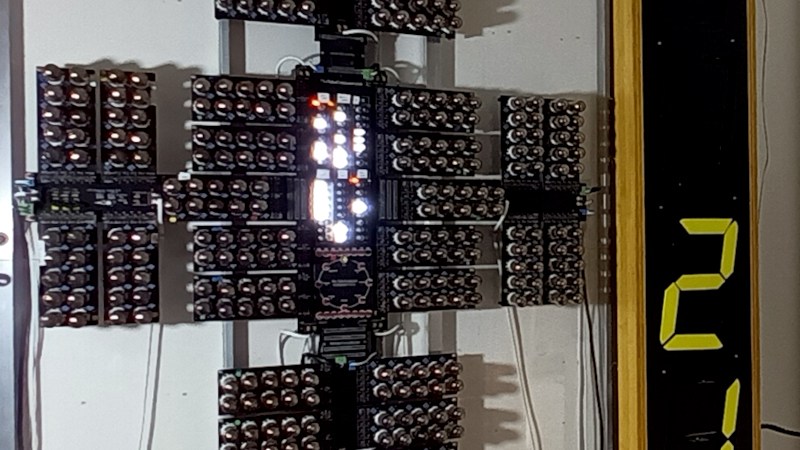
Otherwise, we have diecasting on the bench, an impressive achievement by any measure, a Raman spectrometer, and an open source take on something like a Kei truck. In quick hacks there’s a dicussion of soldering versus crimping for high current connectors, and neon tubes used as digital logic in an organ. The recording finishes with a discussion of 7-segment display history, and whether an engineering education teaches design for manufacture.

Or download it yourself, in glorious 192-bit MP3.

Where to Follow Hackaday Podcast

Episode 377 Show Notes:

Mailbag:

  • We were contacted by long-time listener [Alex], with a question about the deadline for What’s That Sound entries. The podcast is recorded on Thursday evening European time, most of the time, but Wednesday evening when Tom is onboard. If you get your entry in by Wednesday morning, wherever you are, you’re safe. Good luck!
  • Then we had a couple of responses to Zoe Skyforest’s pitot tube air speed sensor piece. Reese Johnson suggested that some version of this might be found in motorcycle fuel gauges, and Jeff told us about very similar differential pressure airflow sensors being used in the climate control systems of large buildings. So we’re closer than we think to these devices.

What’s that Sound:

Interesting Hacks of the Week:

Quick Hacks:

Can’t-Miss Articles:

A Super Cheap Desk Toy Becomes a Hackable Desktop Notifier

The GeekMagic SmallTV is as its name suggests, a tiny, vaguely TV-styled, device with a screen, that’s sold as a desktop notifier. Depending on the firmware running on the device it can display various pieces of information, ranging from the time and weather to the current price of Bitcoin. What makes it interesting is that it supports software updates over WiFi, so [Giovi321] has made a new firmware package for it.

A screenshot of AliExpress showing a range of the devices for sale.
These things are readily available from AliExpress.

It seems there are several versions of this device, something which appears to be reflected in the prices they sell for on AliExpress. The older version runs on the ESP8266, and there’s also a ESP32-C2 variant in the wild. The firmware supports both flavors, providing stock and crypto tickers, an ADS-B tracker, and a Claude AI token usage gauge.

What gives this potential is that the various functions are clearly split out in the code, and there’s nothing to stop you pointing it at a data source of your choosing. This makes it more than a bit of cheap e-waste novelty, and we hope that others will take up the baton and do interesting things with it.

The ESSP8266 is a chip we don’t see too much of these days, having been surpassed by its ESP32 siblings. Still, someone recently gave it a simple OS.

Fixing a Dodgy Cheap Audio DAC

One of the attractions of buying at the bottom end of the electronics market by mail order from China is that you never quite know what will come your way. Sometimes it’s a diamond in the rough, while with others it’s a mess. Occasionally along comes something which should work but doesn’t, and that’s the moment when you wonder if you could fix it. [Nyanpasu64] had just such a device, an HDMI to VGA converter with audio that didn’t work. What could be wrong?

The HDMI to VGA chip has an onboard audio digital-to-analog converter (DAC), and it’s a delta-sigma design. This type of DAC is frequently used in audio applications because it works by shifting its switching frequency many times higher than the input sample rate, thus reducing considerably the distortion. This one wasn’t performing as advertised though, and the problem turned out to be that switching frequency being all over the output. Clearly the filter wasn’t working, which led to the design of a new filter. The write-up is therefore an extensive dive into filter design, and in part also a discovery of the effect of impedance on them.

For a super-cheap module to cause so much work, one might ask why not simply spend a few more dollars and get a better one. But had they done that we wouldn’t have seen this write-up, so we’re sticking with team cheap.

We’ve looked at audio DACs, in the past.

An Analog Synth For The Modern World

We cover so many projects here at Hackaday that lead the author down a rabbit hole of technological investigation that distracts us from the task of bringing them to you. Such a project is polyUAnalog, a very modern take on an analogue synthesizer. If you are imagining a synth of old with modules and patch cables, think again. The modern way to do this is it seems to use an individual synthesizer chip for each voice, resulting in a very versatile instrument indeed.

The integrated circuit in question is the AS3397, which when coupled on a PCB with a Raspberry Pi Pico makes for a self-contained single-voice analog synth. It’s controlled via I2C from a conductor board for which frustratingly the README doesn’t give a processor, but we think may be powered by another Pi Pico. This board does the job of taking MIDI and other controls, and farming them out tot he individual voices. The prototype has ten, but it can support many more.

It’s the work of a pair of researchers from the University of Angers in France, and we’re told it’s a side project from their work in the field of spectroscopy. There’s a video about it which we’ve placed below the break, and they’ve also written a paper about it.

The Atari Jaguar Runs Linux

Among the many forgotten might-have-beens of the games console world, the Atari Jaguar occupies a special place. It was the final gasp of Atari Corporation, the Jack Tramiel-era incarnation of the famous pioneering game console brand that brought us the ST line of computers, and like Marlon Brando’s Terry Malloy character from On the Waterfront, it coulda been a contender. But the early ’90s games business wasn’t kind to the console from Sunnyvale, and it was squeezed from behind by the SNES and Genesis/MegaDrive, and in front from the PlayStation. Thirty years later then, can it run Linux? [Cakehonolulu] is here to show us how.

With only 2 megabytes of RAM and space for 8 megabytes of ROM, this is hardly a powerhouse. But its 16-bit 68000 processor is a supported Linux architecture, albeit with the -nommu flag on compilation. The “Jerry” DSP chip has the required serial port and timer to boot a first Linux kernel, and after a bit of hackery to make it jump to the ROM location, something boots. There’s no init process until the flat executable file for a -nommu kernel is navigated, but with that past a BusyBox userspace and a graphics driver for the “Tom” graphics chip gives it a chunky on-screen console. The code can be found in a GitHub repository, for the curious.

It seems to be the moment for 68k consoles to receive the Linux treatment, as it’s only a few weeks since we saw it on a MegaDrive. Other ’90s consoles aren’t far behind though, with the Nintendo 64 falling to the penguin a few years ago. Meanwhile, the Dreamcast had Linux running decades ago.


Jaguar image: Evan-Amos, Public domain.

When An Engineering Education Doesn’t Teach You How To Really Make Anything

In the sweltering temperatures of an unusually hot European heatwave, I found myself having a chat with  a friend of mine from my university days. After discussing the health of his cat who had solved the problem of a fur coat on a hot day by flattening himself out on the concrete floor in the coolest place in the house, we moved on to tech matters. We’ve known each other for not far short of four decades, so this is familiar territory for us. The problems that come with taking a prototype to manufacturing, a process which even the most seasoned of engineers can slip up on.

The Difference Between Making, And Making For Manufacture

If you’ve ever taken a project and replicated it, you will know the progression. If you’re making five or ten widgets, you can debug and rework as needed, tweak things, and get things going. If you’re making more then this, the process consumes a greater proportion of your time, until a point at which manufacture becomes impractical. Maybe that’s around fifty boards, sometimes more or less.

A picture of a printed circuit board covered with components, with a red ring drawn round a reworked part.
This rework on the SHA2017 badge was caused by counterfeit parts rather than bad design, but the work it created was very costly for the team.

The skill a professional engineer picks up here is designing for manufacture. It’s something I picked only progressively over the years, and learned with a bang when I became peripherally involved in the production of electronic conference badges. You learn to be much more exact in your PCB design to avoid those reworks and bodge wires, you pick your parts with much greater care, and pay far more attention to power supplies, decoupling, thermal issues, impedances, and ground isolation. Something that works has to become something that always works, first time. You go from having several spins of the prototype PCB to having maybe a couple, and you reach a point at which you can order 5000 boards and have less than 50 of them that need attention. My friend describes himself as more of a software expert than hardware, but he’s learned this process over the decades far more than I have.

One comment he made hit the mark so well that it prompted me to start writing this: that when hiring recent graduates they would design things that could not be volume manufactured, while the new hire apprentices’ designs could. This fit so well with our common experience when we came through an engineering education that it posed the question, were we failed by it? We both attended the University of Hull, on England’s north-east coast, but this isn’t specific to Hull or even our generation as the problem of inadequate preparation applies to so many other institutions. Last year I talked about a couple of young engineers wrestling with an analagous experience here in the 2020s, and they were a long way from the Humber.

Do Universities Secretly See Their Job As Training More Academics?

A brick-and-concrete university building, a lawn and paved path in the foreground.
Hull University Electronic Engineering Department, where I learned most of what I know about electronics (except how to make things for manufacture). Hullian111, CC BY-SA 4.0.

My overwhelming memory of my degree course was shared by my friend, that about half of it was composed of useful stuff, and the other half of it was either trying to teach you to be an electronic engineering academic like the people delivering the lectures, or a course that seemed only to be there because they had someone who could teach it.

My Achilies’ heel was the mathematics, something I was later told improved in later years when the engineering department wrested its students away from the maths department. We had a very small amount of practical work, including simple transistor circuits, digital logic using real 74-series chips, laying out a PCB using crêpe paper tape on acetate film, and oddly considering it was outdated even in the early 1990s, wire-wrapping.

It’s easy to sit here and say that a university course teaches too much theory and not enough practice, but the fact is that universities aren’t there to teach you to solder. Indeed, while it’s a super-useful thing to be able to do and I’d urge every electronic engineer to learn it, soldering your own projects is not what makes you an engineer. Instead there has to be an exploration of where the boundary lies between the theoretical and the practical, and education should straddle that line rather than stay only on one side of it. It’s in deciding where that straddling point stops that the key lies.

There are university courses that manage that boundary by splitting it entirely. They combine time in industry with time studying, and a student on one of those courses would in theory learn the skills of a real-world engineer in their work placements. There are also industry sponsorship schemes placing students into industrial environments, but they are so few and the competition for them so fierce, that they might as well not exist for most students. Even the world of hackerspaces which gives the students a rare chance to mix with professional engineers in their off-time, is actively discouraged by universities. For a student in a full-time, study-based course, the challenge comes in how to bridge that gap into real-world manufacturing despite all these challenges, and learn something useful without the luxury of a real-world environment.

Torturing The Students With Diabolical Designs

The temptation for most courses is to start yet another group project. A team of six students are tasked with getting something working together, and learn stuff. The trouble with group projects though is that they either completely don’t work like our early 1990s assignment to make a telephone exchange from a Transputer link adapter chip, or a few participants end up doing all the hard work like my two young friends mentioned earlier. Group projects are inexpensive for an institution, but they look better than they really are.

An excerpt from the datasheet for the NXP BAX23 dual switching diode, showing the three different pinout options for the same package.
Component pinouts like this one from the NXP BAV23 datasheet are a spectacularly evil trick to play on an unsuspecting student.

The hardware hacker world has been marked by a series of epochs, as new technologies bring with them a flowering of creativity. There’s one of those that I think has the potential to delover something impossible back in the 1990s when I was a student, and allow individual students to learn the art of manufacture without a group project in sight. I’m talking about inexpensive PCB manufacture, which allows multiple spins of a design to be completed with a bearable wait, and for not a lot of money.

So if I wanted to teach a bunch of students about designing for manufacture, I’d give them a ready made small project in software form, as EDA files, and as a BOM with a board assembly house. Of course, the project would be fatally flawed but fixable with probably two or maybe three spins, but I wouldn’t tell them that. Instead their first task would be to send the files off and receive a ready-made PCB, or if I was feeling charitable I could give them that first spin ready-made, and tell them to get on with it.

I would throw everything I could at this unfortunate design, a wrong-but-plausible footprint, badly thought out earthing, an accidental oscillator, and all the really annoying things which we’ve all in our time found. I am sure you could think of more diabolical but superficially plausible features. Their task would involve diagnosing the board and redesigning it before sending the files off to the assembly house. A week later they’d have that next spin, they’d have to hunt down any remaining bugs and repeat it all, and so on. I learned this process with my friends in the making of an event badge for 5,000 people, and I think it’s possible that you could learn it as a single trainee engineer with a much smaller board.

It may be unfair to throw all that is wrong with engineering education at the door of universities, even though it’s certain that there are some extremely low hanging fruit. But arriving in the workplace completely lacking an essential skill is perhaps the point at which something should be said. The question is, when it comes to designing for manufacture, is anyone listening?

Why the NES Put Out a Wobbly Picture

The NTSC television standard is a masterpiece of mid-century engineering, to pack a color image into the transmission bandwidth of a monochrome one, and to do so while maintaining backward compatibility with earlier monochrome TV sets. In terms of its timings and choice of sync and carrier frequencies it’s elegantly thought out for maximum quality on a 1950s round-CRT color TV set.

The trouble is, that while the standards are exacting, the receivers are quite forgiving, and will display adequately even with substantially off-spec video. [Nicole Express] is here with an in-depth examination of a time when that was pushed just a little bit too far, explaining why the Nintendo Entertainment System (NES) displayed wobbly color images.

We’re treated to a run-through of the NTSC standard itself, and a look at how some of the other consoles and home computers of that era either had similar problems, or managed to avoid them. The key lies in the exacting timing required to achieve perfect interlacing, and the NES’s use of a single crystal to provide all the clocks. The dot clock on adjacent frames was almost right, but not quite, leading to a side-to-side wobble that while barely perceptible, was exacerbated by some graphics. It’s a fascinating read.

We’ve looked at composite video in detail in the past.


NES image: JCD1981NL, CC BY 3.0.

The Coolest Hat At The Hacker Camp

People in hotter parts of the world may permit themselves a grin at this, but Europeans have recently been suffering under an unseasonal June heatwave. Most of us have been cowering inside with our air conditioners, but not [Making Stuff With Mike]. He’s adapting a safety helmet with a Noctua fan for only slightly uncool on-the-go cooling.

On the face of it, the hat is a straightforward hack. [Mike] mounted a 3D-printed chimney to the top of a hard hat and placed a fan in the top of it. But as always, there’s a little more to it than meets the eye, and in this case it’s because he’s modeled the hat/chimney interface by 3D scanning the hat and using the scan to create his CAD model. The two are attached with four small bolts, and a set of large holes are made in the hat for airflow. Taking it out for a spin, he finds it does the job, but has a few ideas for improvements.

So Mike’s ready for the upcoming BornHack hacker camp, which Hackaday has been to a few times. We’re not so lucky with headgear, but at least if there’s a heatwave, they have plenty of hammocks in the trees.

Old Midi Instruments Don’t Like Modern Midi. What’s To Be Done?

In theory, MIDI is an electrical and protocol standard that allows any such equipped instrument or computer to talk to any other. But as the wonderfully named [Knob Monster] will tell you, when the computer is new, and the instrument is old, it ain’t that simple.

They specialise in using the Web MIDI interface to allow browser control of an instrument. This might typically be done with a USB to MIDI interface, but in this lies a problem. The 8-bit microprocessor on a 1983 synth has problems keeping up with the rapid-fire data that spews relentlessly from the supercomputer-grade machine controlling it, and bad things happen as a result.

Expensive MIDI interfaces have a buffer built in, but a better solution lies in the Web MIDI code itself. They detail how to use the Web MIDI API’s built-in packet scheduler to slow things down a little and let your Yamaha DX7 chill a bit.

Meanwhile, if you need a USB to MIDI interface, we’ve covered one in the past.

The Persistent Display We Never Got

We all know the e-ink persistent displays, as they’re cheap and plentiful enough to have become ubiquitous in applications such as supermarket price labels. But we don’t often see some of the other technologies that almost did the same thing. The BBC Archive has a report from 1986 showing one of them, a prototype display from STC.

E-ink relies on flipping the arrangement of black and white particles in its pixels, while this one has a fluid in which the molecules are aligned to let light through, or dispersed randomly, at which point they block light. Frustratingly, we aren’t told what the liquid is, but we are given what might be the reason that we’ve never seen one. The activation voltage is rather high at 200 volts. It’s still a fascinating glimpse of something we might have had, with some tasty early-PC-era portables along the way.

The BBC archive has served up quite a bit of retro goodness over time, and we’ve certainly featured one or two of them over time. A recent one was this demonstration of email via a flight to Amsterdam, from the same year as today’s display.

Time Never Moves Slowly With This Clock

A clock is by its very nature a device for measuring time, and thus it moves forward at a constant rate. But how about in a theatrical setting, where time runs at the whim of the director? For the stage, a clock with more flexibility is required. To this endeavor [Playful Technology] has you covered, with a larger than life stage clock whose hands are independently controllable by DMX.

Behind the clock is a very unusual part, not the modified clock mechanism one might expect, but a dual stepper motor with a concentric shaft. This is driven by an Arduino with a stepper driver shield more familiar from the world of 3D printers, and an RS485 interface for DMX interfacing. The hands are built in OpenSCAD, and 3D printed to be an interference fit on the shafts. The DMX controller software has a handy rotating knob style interface, allowing easy hand manipulation.

You can see the results in the video below, complete with an exhaustive dissection of the Arduino code. Meanwhile DMX is itself a fascinating subject, and in the past we’ve taken a deep dive into RS485.

The Organ That Forgot To Use Transistors

When we think of 1960s synthesizers it’s usual to imagine instruments with vast arrays of controls and patch cables for configuring their many filters, oscillators, and other parameters. They created the templates for much of what we know today as electronic music.

In all the rush to look at full-blown synths though, it’s easy to forget their more mundane cousin, the electric organ. These instruments graced many a ’60s suburban home or church hall, and [Emma Repairs] has an interesting one. It’s a Philips Philicordia, and it’s sent us here at Hackaday down one of those rabbit holes when we should really be writing.

The instrument is a relatively straightforward single voice electric organ on the outside, but under the hood it’s a different matter. In an age when the transistor was revolutionizing electronic music, the folks in Eindhoven designed this one using tubes. There are a set of conventional enough tubes performing the role of amplifiers and oscillators, but the real party piece of this unit is the array of neon tube dividers. A neon bulb can be used as a switching element, and in those days when affordable digital logic chips were several years away, it made sense to use them in digital circuits.

The inside of the Philicordia is a feast of vintage Philips parts that will be instantly familiar to anyone who’s worked on Western European electronics of this era. The exterior design of the instrument screams understated early-1960s cool, and after she’s introduced it you can hear her playing it in the video below. Further down that rabbit hole we found that one of these instruments provided the distinctive organ sound on Chris Montez’s 1962 hit Let’s Dance, so they weren’t all uncool.

Jenny’s Daily Drivers: KolibriOS 0.7.7

It’s a fact of life when starting a computer, that booting into whatever operating system you use will take a while. Mine takes somewhere around 30 seconds, and yours probably does too. There has always been the promise of something faster just around the corner, but somehow the OS just keeps getting a little bigger. Perhaps the only computer with a disk based operating system I have ever owned which bucked this trend was a Commodore Amiga, and that machine’s booting speed was achieved by keeping most of its OS in a ROM. The subject of today’s Daily Drivers takes the idea of a long boot time and shreds it, leaving an experience more akin to that Amiga of old. It’s called KolibriOS, it’s small enough to run from a floppy disk if you want it to, it’s lightweight, and fast as lightning. It achieves this feat by being written entirely in assembly language, and it exists as a free fork of the earlier MenuetOS which moved to a proprietary licence in its 64 bit version. I downloaded the ISO file, and gave it a spin.

The KolibriOS GUI with the Netsurf browser showing the KolibriOS wiki.
You can surf the web with NetSurf, but not the encrypted web.

The minimum system requirements for KolibriOS are meagre, 1Mb of disk space, 8Mb of RAM, and a 586-class 32-bit processor. On a 2020s ThinkPad it boots in the proverbial blink of an eye, and drops immediately into a GUI desktop. It has the slightly pixelated look of a 1990s machine, there’s none of the anti-aliasing we’re used to today going on there. Installed software ranges from a set of games, emulators, graphics editors and viewers, internet software including the Webview and Netsurf web browsers, and assembly software development.

The immediate impression is of a mature and useful operating system, without any crashes or blue screens, and with applications that load on a dime. Unfortunately though, despite all the competence I can’t call it a Daily Driver by my definition of being able to write for Hackaday, because the web browser doesn’t support https. Immediately the majority of the modern Internet is off-limits, including this site. This changes the parameters of my review and I can no longer proceed as I normally would, but it doesn’t end it. Something this polished deserves a while to play around.

The KolibriOS desktop, with the DOSBox emulator running.
DOSBox gives this another dimension.

Diving into the command prompt gives a feeling somewhere between a UNIX style OS and DOS, as the commands are UNIX-style but their output feels more DOS-like. Navigating around the disk I’m immediately struck by how small the executables are due to their being written in assembly language. The only exceptions are those applications ported from outside such as Netsurf or DOSBox, which is hardly surprising.

Back in the 1990s there was a single-floppy demo of the QNX operating system that packed the OS, a GUI, and a reasonable web browser for the day. At the time it was mind-blowing to see so much in such a small space, and I am reminded of that QNX demo when I use KolibriOS. This is evidently a useful OS, and I am only sad that it doesn’t support the one thing that would make it useful for my purposes. If you have an older machine I can see it would make a great emulator platform though, and since one of the emulators gives you DOS it’s likely it could also run a lot of useful things from that OS. It will never offer the flexibility on a 32-bit laptop that a Linux distro such as SliTaz can, but on the other hand that low system requirement means it could make a much older 32-bit machine into something useful. If you’ve got some ancient hardware and fancy something new, give it a try!

Know Your Food: Organic Production

A few weeks ago we published the first in a new series of articles, Know Your Food. It was born out of the realisation that most people know surprisingly little about what they eat, and to apply a bit of Hackaday curiosity to received opinion on the subject. As we put it then: “To know both how common foodstuffs should be made, as well as how they are made industrially, should be an essential for everyone” We’ll continue in that vein, with a look at organic food.

If you buy your food in a supermarket it’s likely that in the vegetable aisle you’ll be presented with a choice. On one hand you will have the normal vegetable, and on the other and usually for a slightly higher price, the organic version of the same vegetable. What’s going on?

So What Is This Organic Stuff All About?

A watercolour picture of a bucolic scene with a farmhouse surrounded by trees, and some cows in the foreground.
It is unlikely that a typical organic farm in the 2020s will resemble this John Constable painting. John Constable, Public domain.

Organic production is a system of agriculture that emphasises natural fertilisers, pesticides, and farming methods over synthetic or intensive ones. It has its roots in the first half of the 20th century, and as the decades progressed it has become an important sector of agricultural industry. I grew up steeped in organic agriculture because my grandfather was an early adherent in the years following the war, so I’ve seen it from the sharpest end. There is a lot to commend organic production for and plenty of reasons to embrace it, but with that come some problematic aspects, and even dubious claims. Here I’ll try to unpick some of that.

It’s tempting to believe that all organic production is somehow a return to a 19th century rural idyl, complete with the obligatory chickens in the farmyard. Some organic producers do take a slice of this back-to-the-land approach to their craft, but the reality of organic farming is a very modern approach to managing the ecosystem. Organic farmers are not wary of progress, and neither are they reluctant to use pesticides or other chemicals. Instead they do so according to the principles of organic agriculture, so any techniques they use are designed to be beneficial to the ecosystem, and any chemicals have a natural origin.

The rear view of a tractor towing a manure spreader driving away from the viewer while spreading manure onto a grass field. It's a misty winter day, and leafless trees are visible in the distance.
If you spend time around organic agriculture, you become a manure expert. Ray Bird, CC BY-SA 2.0.

An important thing to understand is that the line between organic and non-organic agriculture is not sharply drawn. Crop rotation for example is long established farming practice, as are techniques such as contour ploughing in areas with soil erosion. As for fertiliser, there will be very few farming operations whose work does not include manure in some form, or who do not take advantage of nitrogen fixing crops. Pesticides such as the insecticide pyrethrum – originally derived from chrysanthemum root – or Bordeaux Mixture as a fungicide – a solution containing copper ions, so called because of its origin in French vineyards who applied lime solutions from copper containers – find uses where applicable in both organic and conventional agriculture. The important distinction lies in the organic farmers not going further than this, into synthetic amonium nitrate fertiliser for example, or glyphosate herbicide, which you might know as Roundup.

That’s the organic sales pitch, and it’s a compelling one. Now, we’ll go through the not so positive aspects, both of the movement and of the business.

Organic status is not simply conferred to produce by virtue of being organically grown. Instead it’s a legally protected designation, enforced through a system of certification performed by designated organisations. Where I grew up in the UK for example, organic certification is performed by the Soil Association. This is good because it preserves trust in organic status, but it suffers the flaw that it’s a profitable business for the certifier, and an expensive one for the producer. This in turn favours larger producers who can afford certification, and leaves the smaller producer unable to afford certification and thus unable to label their produce as organic. They can describe it as “Organically grown” of course, but they lose the cachet of the organic label. Since many small producers are by necessity organic, this affects a large number of producers if not a significant sector of the market.

Is Organic Food Really Better?

Then there is the produce itself. Is it better than the non-organic stuff? Here we enter complex territory, because the answer differs depending upon the circumstances.

In terms of what advertising people like to call “goodness”, by which I mean nutrients, vitamins and minerals, and the like, in many cases it’s difficult to make a case for the organic product being superior to the non organic one. There will be exceptions such as apples, where a typical non-organic commercial dessert apple is overwatered to the point of diluting the beneficial properties it might have in search of the elusive “crunch”. But in the more ordinary case, that organic zucchini is unlikely to have more nutritional value than its non organic equivalent. It’s important to note that the organic product will lack any pesticide residues which may be present on its non organic equivalent, however it must be remembered that pesticide residue levels in food are subject to their own stringent regulation.

A sign advertising Wynford Farm Shop, selling local Organic Aberdeen Angus beef.
If you’re looking for the best organic food, seek out places with signs like this. Stanley Howe, CC BY-SA 2.0.

In terms of flavour, yet again it’s a mixed bag. An organic product grown in as intensive a manner as can be got away with under the rules, is not likely to taste better than the equivalent. It’s difficult even to pin down what in the husbandry governs the flavour of the finished product in a scientific sense, however as someone who grew up around organic production I’d offer the view that the longer something took to produce, the better its flavour is likely to be.

The Slow Food movement champions products made in this way, usually traditionally produced foods, heritage varieties, and foods with a particular terroir. If you’re looking for better tasting food then you may not find it with a supermarket organic label, but it’s quite likely that one of those small organic producers will have what you are looking for, simply because their methods are less intensive.

Finally, if you’re looking at the benefit to the environment, it’s likely that in most cases the organic product will impose less stress on the ecosystem and the wider environment than its non organic equivalent. If that’s your concern you should also look further than the means of production and into food miles; how far did the food in front of you travel to your plate? Here in Europe the strawberry is in season from around May to September, so does it make sense to fly them from the other side of the world in January, however nice they taste?

So now I hope you have more of an idea about organic food than you did at the start of this piece. You’ll know something about its benefits and problems, and you’ll know when it’s better than its non-organic equivalent. I hope you’ll find the food you like, and if you do, I hope it’s from a small producer, they need your business. Bon appetit!

Header: MichelM10, CC0.

A Rare Drone Common Sense Outbreak, In Denmark

Last September, Denmark was gripped by a spate of drone sightings near airports. It’s familiar territory for Hackaday, as we reported on a similar drone panic saga at British airports back in the last decade. Back then the British police dragged their feet and hid behind secrecy laws for years to avoid admitting they overreacted, but it seems in Denmark they do things differently (Danish language, Google Translate link.).

The Danish police in Jutland have rolled back their report, and noted that a reported observation alone is not enough to confirm a drone was present. It’s not confirmed why they’ve taken this step, but we’ve been told that there’s been an effort within the drone community to identify possible aircraft flight paths which could have resulted in a false drone sighting at the times in question.

We welcome this correction, and hope that its important message travels widely. Of course it is the right thing to do for a police force to take drone reports seriously, but overreacting as the British police did is of little help. We commend the Danish police for taking this step, and we’re likely to trust any drone reports from them a little bit more in the future. If you’d like to read our plea for a sensible response at the time, it’s here.

Thanks [UAVHive] for the tip.

❌