
Reading view

There are new articles available, click to refresh the page.

Shadow IT Security and why visibility beats another approval process

A staging site is meant to last a week, but six months later, it still resolves on a company subdomain, runs an old framework, and has no clear owner. The asset never made it into the central inventory, which means that it also missed the normal cycle of testing, patching, and retirement.

That is how many Shadow IT Security problems develop. The original shortcut may have been reasonable, but the risk grows when temporary infrastructure becomes part of the permanent attack surface without anyone noticing.

Security teams often respond by tightening approval processes or reminding teams about policy, and those controls can reduce the use of unmanaged technology. They cannot, however, keep an inventory perfectly aligned with a business that changes every day, so Shadow IT Security has to account for the gap between what the organization believes it owns and what is actually exposed.

Shadow IT grows where teams hit friction

Most unmanaged technology has a practical origin rather than a dramatic one. A developer needs somewhere to run a short-lived job, a product team wants to test a SaaS service before procurement is finished, or an acquired company still has applications running under domains that never entered the parent company’s security tooling.

Naturally, governance still matters: procurement reviews, identity controls, cloud policies, and approved tooling reduce avoidable risk, but they cannot show everything running today. A useful Shadow IT Security program has to work with that reality rather than assume every asset will pass through the same process before it appears online.

The priority changes once unmanaged infrastructure becomes reachable from the internet, because an overlooked service can create the same exposure as any formally managed production system while receiving far less scrutiny.

Exposure is where the risk becomes real

An unused SaaS account and a forgotten public-facing test server do not deserve the same response, which is why exposure and business context matter. The weaknesses themselves are usually familiar: a test application has no authentication, a storage bucket exposes files, a database accepts public connections, or a legacy API still runs an old framework because nobody owns the upgrade.

Known systems can suffer from the same problems, but they are more likely to be monitored, scanned, patched, and assigned to an owner. Shadow assets often sit outside those routines, which means a relatively ordinary configuration mistake can remain in place for much longer.

For Shadow IT Security, the important window is the time between an asset becoming exposed and somebody taking responsibility for it. Shortening that window gives security a better chance of fixing routine mistakes during normal work instead of investigating them after an incident.

The inventory ages quickly

An inventory records what teams registered and what security knew during the last review, so it remains useful as a management tool, but it should not be treated as a complete picture of the external environment. Test environments stay online, domains survive migrations, partners launch infrastructure under company-owned subdomains, and acquisitions bring services that may never reach the central security team.

Point-in-time audits have the same limitation because they capture a moment while the attack surface continues to change. The findings may be accurate on the day of testing and incomplete a week later, which is why Shadow IT Security benefits from an outside-in view alongside internal records.

Better attack surface visibility helps security teams see domains, services, and infrastructure that never reached the central inventory, while effective shadow IT detection looks for public signals that connect those assets back to the organization. External attack surface monitoring can then surface domains, IP addresses, certificates, DNS records, open ports, services, and exposed technologies that internal records may miss.

That visibility only becomes useful when it changes what the team does next.

Move from discovery to ownership

A discovery feed can become another source of noise when every new asset lands in a backlog without context, so Shadow IT Security needs a process that connects discovery directly to a decision. In practice, that means moving through a small number of steps:

  1. Discover the asset: identify new or changed internet-facing infrastructure and determine whether the signal is worth investigating.
  2. Confirm ownership and context: establish whether the asset belongs to the organization, whether it is still active, and what role it plays.
  3. Assess the exposure: understand what is running, how reachable it is, and whether the asset needs deeper application or API testing.
  4. Assign and resolve: route verified issues to the team that can act, then patch, restrict, monitor, or retire the asset and confirm the change.

This gives Shadow IT Security a route from discovery to ownership and remediation instead of simply producing a larger asset list, while also making it easier to distinguish a forgotten but harmless domain from an exposed application that needs immediate attention.

Detectify supports this part of the process by helping teams discover and monitor internet-facing assets, while deeper application and API testing can provide more evidence when surface-level checks are not enough. Within a Shadow IT Security program, that can help connect an unexpected asset with the next security action rather than leaving it as another unexplained item in an inventory.

External monitoring still has limits because it will not uncover every unsanctioned SaaS account, unmanaged endpoint, or isolated cloud resource. Shadow IT Security therefore works best alongside identity data, endpoint controls, cloud governance, procurement records, and cooperation from engineering teams, each of which covers a different part of the problem.

Measure how long the gap stays open

Raw asset counts can be misleading because finding more assets may reflect a growing attack surface, better discovery, or both. Shadow IT Security metrics should instead show how quickly the team turns uncertainty into ownership and action.

Time to discovery, time to confirmed ownership, and time to remediation are more useful than the total number of assets in a dashboard, while exposed systems with no owner and assets that return after retirement can reveal where the underlying process is failing.

The goal is to reduce the gap between what the business exposes and what security understands. Shadow IT will continue to appear as teams ship software, adopt services, and acquire companies, so the value of Shadow IT Security is measured by how quickly those changes become visible and how long unmanaged exposure is allowed to remain unresolved.

Take control of your exposed attack surface

Don’t let forgotten staging sites or unmanaged cloud assets put your enterprise at risk. Detectify gives you the automated visibility and deep application testing required to bridge the gap between discovery and remediation.

Ready to see it in action? Book a demo with our application security experts to explore a tailored walk-through.
Want to test your environment today? Start a free trial and instantly map your external assets with zero friction.

Frequently asked questions 

What is Shadow IT Security?

Shadow IT Security is the practice of finding, assessing, and reducing risk from technology outside normal IT or security oversight, including applications, APIs, cloud infrastructure, domains, and SaaS services.

Can shadow IT be eliminated?

Probably not completely. Organizations can reduce it by removing unnecessary friction, while Shadow IT Security provides a way to find assets that still appear outside approved processes and bring them into normal ownership and remediation workflows.

Is attack surface monitoring enough?

No. It cannot see every SaaS account, endpoint, or isolated cloud resource, so Shadow IT Security works best alongside identity, endpoint, cloud, and procurement controls.

How does Detectify help with Shadow IT Security?

Detectify can discover and monitor internet-facing assets, then support deeper testing of relevant web applications and APIs where more validation is needed.

Which Shadow IT Security metrics matter most?

Time to discovery, ownership, and remediation shows how long unmanaged exposure remains unresolved and whether Shadow IT Security is reducing that window over time.

The post Shadow IT Security and why visibility beats another approval process appeared first on Blog Detectify.
Operationalizing Secure by Design: a CISO’s guide to closing the gap between policy and reality

We’ve been listening to dozens of CISOs. In roundtables, peer forums, customer and prospect calls, on the record, off the record, at event floors and dinners. And the same thing keeps coming up: the security program on paper and the one running in production are rarely the same.

There’s a gap between security policy and reality.

We have researched what leading teams are actually doing to close it, and turned it into practical insights for security leaders trying to move from policy to operational reality, packaged into a whitepaper, Operationalizing Secure by Design.

Most organizations already understand Secure by Design practices, grounded in CISA’s principles of taking ownership of customer security outcomes, embracing radical transparency, and building organizational structure to support these goals, and apply them on paper. 

The challenge is that shipping fast, managing legacy infrastructure, keeping decentralized teams aligned, and satisfying compliance requirements are all happening at once. And the attack surface keeps expanding regardless.

The result is a predictable failure mode: teams follow best practices on paper (such as NIST SSDF controls for threat modeling, secure coding, and periodic assessments), but attackers find the vulnerabilities that never got tested, or got deprioritized based on incomplete information.

The visibility problem is bigger than most boards realize

Boards seek assurance from CISOs and security teams. But assurance requires accurate, real-world, continuous visibility, and that’s precisely what most traditional models are failing to deliver.

Cloud adoption, API proliferation, decentralized development teams, and rapid deployment cycles have expanded the external attack surface faster than centralized governance can track. Legacy systems connect to modern infrastructure without adequate documentation, often because the original system owners have long since left the organization. Business units spin up services and tools outside formal approval processes. And annual penetration tests, by the time they’re completed, are already describing an environment that no longer exists.

The result is that most organizations are managing risk based on incomplete information. Attackers, meanwhile, are patient, targeted, and increasingly focused on application-layer weaknesses that point-in-time assessments consistently miss.

What mature programs are doing differently

The whitepaper identifies five operational shifts that distinguish leading programs from those still operating on legacy models.

Meaningful security metrics, not activity reporting. Boards and executive leadership need reporting that reflects actual risk reduction, not scan volumes or finding counts. “Total findings” is a vanity metric. “Average remediation time” is operational reality.

Mature programs track remediation speed, exploitability rates, and coverage across the attack surface,  indicators that support defensible reporting and credible conversations about budget allocation. When KPIs are poorly designed, teams optimize for audits instead of reducing risk.

Continuous validation instead of periodic testing. One of the clearest trends is the growing inadequacy of annual penetration testing. Modern application environments change too quickly for point-in-time assessments to provide meaningful assurance. Replacing them with continuous, payload-based testing changes the assurance model entirely, testing internet-facing applications, APIs, authentication flows, and production attack surfaces as environments evolve.

Critically, continuous testing depends on continuous discovery: organizations cannot continuously test what they cannot continuously see.

Live asset intelligence. You cannot govern what you cannot see. Maintaining an accurate, continuously updated inventory of externally exposed assets, APIs, and services is foundational to everything else: prioritization, remediation, board reporting, and regulatory compliance. Shadow IT, unmanaged SaaS services, exposed development environments, abandoned subdomains, and unmanaged cloud services are consistently among the largest sources of untracked exposure.

This becomes especially critical during mergers and acquisitions, where live asset intelligence enables organizations to rapidly assess newly expanded attack surfaces.

Risk prioritization tied to exploitability and business impact. Risk registers often fail because they become administrative exercises rather than operational tools. A high-CVSS vulnerability in an unused legacy system isn’t the priority. A low-CVSS flaw in a payment API is.

The organizations allocating remediation effort most effectively are connecting technical risk to four factors: external exposure, verified exploitability (through payload-based testing, not signatures), business criticality, and existing compensating controls. This makes investment decisions easier to defend, both internally and to the board.

Accountability embedded across the business. Security programs that depend entirely on a centralized team do not scale. As one CSO put it: “Whenever we try to centralize stuff, we fail. Security is one of those things that traditionally end up being a gatekeeper, someone who has to say no, and then people get annoyed.”

The CISOs making the most progress are embedding accountability into role definitions, performance reviews, and security champion programs, while retaining oversight at the center. Crucially, accountability becomes self-reinforcing when findings are trusted: developers who receive high-noise alerts ignore them; developers who receive verified, exploitable findings own the fix.

Turning principles into practice: realistic timelines

The whitepaper maps these shifts to a two-horizon execution model. In the first 90 days, the focus is on immediate wins: embedding threat modeling into project workflows, establishing baseline metrics and remediation KPIs, mapping the external attack surface to reduce unidentified assets, and integrating continuous validation into release processes.

Over the multi-quarter horizon, the work shifts to organizational alignment: building cultural accountability across product teams, decentralizing governance maturity to allow process variations, aligning risk management with business metrics, and establishing shared cross-functional ownership. These changes frequently take six months or longer in complex enterprises. Failure indicators include rising remediation timelines, persistent organizational friction, and disconnects between security tooling and engineering workflows.

The strategic case for acting now

The whitepaper’s core finding is that Secure by Design is no longer a compliance initiative. It is becoming an operational discipline, and the gap between organizations that have made this shift and those still running periodic assurance models is widening. The organizations that succeed will not necessarily be the ones with the most security tooling or the largest governance frameworks. They will be the ones capable of continuously validating what is exposed, exploitable, and operationally risky across rapidly changing environments.

For CISOs navigating board expectations, budget cycles, and an expanding threat landscape, the question is no longer whether to modernize the operating model. It’s about doing it in a way that delivers measurable results, builds internal buy-in, and keeps the business moving.

The full paper covers the five operational dimensions in depth: strategy, discovery, validation, governance, and metrics, along with an overview of the implementation timelines, governance models for decentralized organizations, and the interventions that enterprise security leaders are putting into practice right now.

Download Operationalizing Secure by Design. 

The post Operationalizing Secure by Design: a CISO’s guide to closing the gap between policy and reality appeared first on Blog Detectify.

Introducing Apex Discovery to secure every domain you actually own

Most tools will only test the domains you already know about. We’ve decided that’s not enough.

TLDR: Detectify’s new Apex Discovery automatically identifies root domains likely to belong to your organization (from M&A, subsidiaries, and shadow IT) for complete security coverage. Review and confirm our curated suggestions in a click, and instantly start protecting them with the same continuous discovery and vulnerability assessment as the rest of your attack surface. Detectify does the heavy lifting while your team stays in control.

You might own a domain from a startup you acquired three years ago, a regional variant of a subsidiary registered without telling security, or a marketing microsite someone spun up and forgot. 

Most organizations simply don’t have a complete picture of their attack surface, and every unmonitored domain is a blindspot that can quietly harbor vulnerabilities no one is watching. Your existing tooling can only monitor what you feed it, which means your real attack surface is almost always larger than the one you’re watching. 

We believe knowing your known domains isn’t enough. To truly secure your attack surface, you first have to know how big it actually is, and that starts at the apex.

We have launched Apex Discovery, a core enhancement to attack surface management in Detectify. This isn’t just a WHOIS lookup; it’s a custom-built attribution engine that connects domains to your organization using multiple ownership signals directly into your Detectify workflow. 

Engineering a better attribution engine

A key part of what we do at Detectify is building unique solutions that provide significantly more value to your team than standard tooling. Apex domain attribution is a genuinely hard, under-researched problem, and it’s even harder in the EU, where GDPR limits most of the ownership signals in WHOIS data. That’s exactly the kind of problem we like to solve:

  • Automated attribution techniques combined: Rather than relying on a single data point, we combine multiple signals to connect domains back to your organization, casting a wide net.
  • High-confidence candidates, not noise: Domain ownership can’t be proven with 100% certainty by a machine, so instead of dumping raw results on you, we filter through various attribution methods to curate candidates with high confidence, surfacing the ones most likely to be yours so you can review and verify ownership. 
  • Uncovering the invisible: Domains from M&As, subsidiaries, and shadow IT are most likely to be unmonitored and quietly contain risk. With Apex Discovery, you can find vulnerabilities continuously with the same security as for your other domains.

How does Apex Discovery work?

Because attribution is probabilistic, we built the workflow around review and verification rather than blind automation. From your highly curated list of candidates, you can:

  • Confirm the domains that belong to your organization.
  • Add confirmed domains as assets to your team in a single step.
  • Verify ownership of those assets.
  • Dismiss anything that isn’t yours, so your list stays clean, and your next review is always sharper.

This semi-automated approach means you get the reach of automated discovery without giving up control over what actually lands in your inventory.

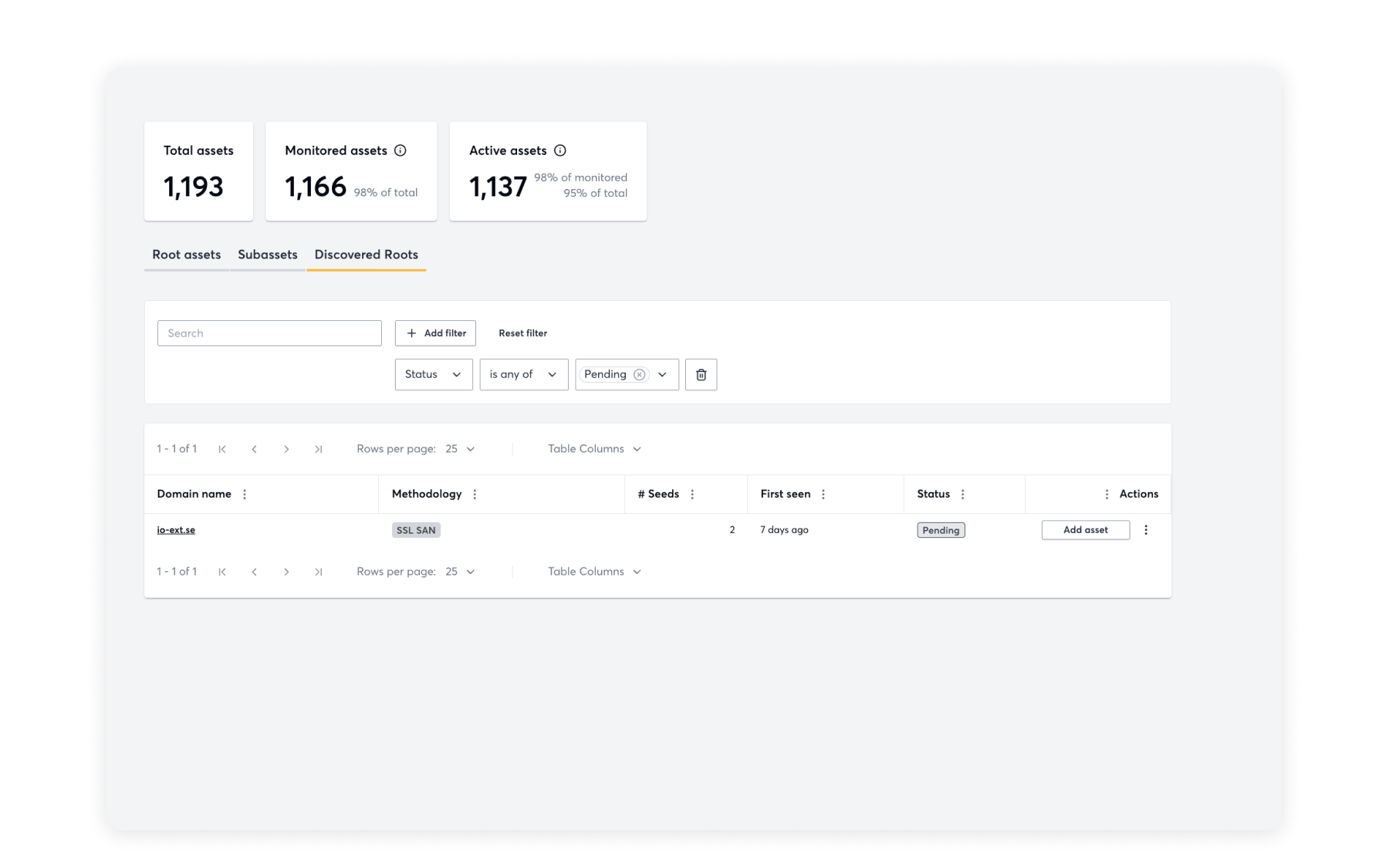
UI example of Apex Discovery in the Detectify tool

Automatically identify apex domains belonging to your organization for a complete external security coverage, and review curated domain suggestions.

What’s new in your dashboard?

We’ve integrated Apex Discovery directly into your Surface Monitoring workflow to make it actionable:

  • A curated candidates list: A dedicated place to review potential apex domains attributed to your organization.
  • One-click confirmation: Confirm a domain and add it as an asset in the same motion, then move straight into ownership verification.
  • Full coverage from day one: The moment you confirm and start scanning a domain, it inherits the same continuous discovery and vulnerability assessment you already rely on for your known assets, with the possibility of always adding configuration on the new root. 
  • Dismiss and refine: Clear out domains that aren’t yours to keep future suggestions focused and relevant.

Get started

The best way to understand your exposure is to see how much of it you didn’t know about. Head to your Detectify dashboard to review the apex domains we’ve attributed to your organization, confirm what’s yours, and bring it under continuous control.

Book a demo to talk to our experts or start a 2-week free trial to see it in action.

The post Introducing Apex Discovery to secure every domain you actually own appeared first on Blog Detectify.

Why traditional DAST Tools fail modern AppSec teams (and how to fix it)

For years, development and security practitioners have treated dynamic application security testing as a critical final safety check before code goes live. However, the external attack surface is expanding faster than mid-sized security teams can realistically manage. 

In this high-velocity environment, legacy DAST tools are increasingly failing to keep pace. When software volume decouples from security headcount, security engineers find themselves operating with persistent uncertainty about unseen exposure. 

The real challenge today is not just finding any vulnerability, but understanding which exposures are actually exploitable and require immediate attention.

The problem with checklist-driven DAST tools

Traditional DAST tools rely heavily on broad vulnerability signatures and static lists of common vulnerabilities and exposures (CVEs). 

This approach leads to a massive structural cost for the industry: alert fatigue. 

Legacy scanners flood development queues with thousands of unverified findings, turning expensive security engineers into manual triagers who spend hours filtering out noise rather than remediating risks. When your DAST tools create more busy work than actual value, development velocity grinds to a halt.

Relying solely on public CVE lists creates severe security blind spots. Public databases are misaligned with modern tech stacks. Only 20% of critical CVEs actually target application components, while 35% of real-world vulnerabilities never receive an identifier at all. Furthermore, legacy testing methods treat applications as static entities. They require intensive manual configuration for each endpoint, creating immediate blind spots the moment a development team spins up a new subdomain, deploys an unmapped cloud resource, or introduces a third-party integration.

Attackers do not follow a static checklist; they perform continuous reconnaissance to target unusual outliers and forgotten assets in the long tail of your attack surface.

Redefining vulnerability testing with payload-based accuracy

To build an AppSec program you can truly stand behind, your DAST tools must evolve beyond point-in-time signature matching toward real-world attacker methodology.

Some tools, like Detectify, replace outdated signature checks with deterministic, payload-based verification. Instead of guessing if a vulnerability exists based on a software version number, our engines execute safe, simulated exploit payloads against live target assets to confirm real-world exploitability.

This approach drives the false-positive rate down (in the case of Detectify, to an unmatched <0.3%), providing security teams with high-fidelity, actionable data they can immediately trust. When a finding enters your workflow, your developers receive clear remediation guidance and proof of exploitability, eliminating the frictional back-and-forth between security and engineering teams.

Combining attack surface monitoring with DAST tools

An effective dynamic scanning strategy cannot operate in isolation; it requires continuous attack surface intelligence

You cannot secure what you do not know you own. Security teams can pair continuous attack surface reconnaissance with deep application crawling and fuzzing to gain both a bird’s-eye overview of their perimeter and the technical depth required to neutralize flaws before exploitation.

Detectify continuously maps and tests your entire external attack surface, discovering all assets, IPs, subdomains, shadow IT, and infrastructure (acquired, for example, through M&As) within minutes of exposure. 

The platform then applies asset classification to prioritize your resources, intelligently recommending exactly where to deploy deep-dive application and API scanning profiles.


Capability Legacy DAST Tools Detectify Platform
Vulnerability intel Static signature databases & public CVEs Multi-source intelligence powered by 400+ ethical hackers & an autonomous AI researcher
Scan accuracy High noise; frequent version-match false positives Deterministic 100% payload-based verification (>99.7% accuracy rate)
Attack surface Requires manual endpoint configuration Continuous, automated asset discovery and mapping
Pipeline readiness Dashboard-heavy; built strictly for human review Developing agent-native workflows. MCP server support

Human-engineered, machine-scaled

Security should run smoothly in the background so your team can focus on building features. Fueled by a global crowdsourced network of elite ethical hackers, Detectify converts newly uncovered exploit techniques into live scanner tests in under 15 minutes. This research-driven intelligence is put to machine scale through a next-generation machine learning fuzzing engine capable of generating up to 922 quintillion payload permutations per vulnerability check.

As engineering organizations transition toward autonomous workflows, DAST tools must adapt to support both human developers and autonomous AI agents. Detectify is deconstructing a decade of scanning expertise into modular micro-utilities to become the deterministic trust layer needed for agentic pipelines. 

Turn uncertainty into clarity, and start scanning your full environment with precision. Start a trial or book a demo

Frequently Asked Questions (FAQ)

Q: Why do traditional DAST tools fail modern AppSec teams?

A: Traditional DAST tools fail modern teams because they rely on static signature databases and version-matching, resulting in high false-positive rates and severe alert fatigue. Furthermore, legacy DAST tools require manual endpoint configuration, which fails to scale alongside automated deployment pipelines and rapidly expanding external attack surfaces.

Q: What should security teams look for in modern DAST tools?

A: Modern DAST tools should offer continuous, automated asset discovery paired with deterministic, payload-based verification. Instead of guessing if a vulnerability exists, next-generation DAST tools safely execute simulated exploits against live assets to confirm real-world exploitability, driving false positives down to less than 0.3%.

Q: How do payload-based DAST tools reduce alert fatigue for developers?

A: Payload-based DAST tools eliminate the frictional back-and-forth between security and engineering by providing high-fidelity, actionable data. Because the tool actively verifies the vulnerability rather than just matching a software version number, developers receive clear remediation guidance alongside verified proof of exploitability.´

Q: Can DAST tools integrate with autonomous AI workflows and pipelines?

A: Yes, next-generation DAST tools are moving away from dashboard-heavy interfaces built strictly for human review. Advanced platforms are deconstructing scanning expertise into modular micro-utilities, offering agent-native workflows, scriptable APIs, and MCP server support to serve as a deterministic trust layer for autonomous AI agents.

The post Why traditional DAST Tools fail modern AppSec teams (and how to fix it) appeared first on Blog Detectify.

❌