❌

Reading view

There are new articles available, click to refresh the page.

Ten Decrees: Old Masters, New Money

Bitcoin Magazine
Ten Decrees: Old Masters, New Money

On August 15, 1971, Richard Nixon announced that he had directed Treasury Secretary John Connally “to suspend temporarily the convertibility of the dollar into gold.” The suspension was never lifted. Fifty-five years later to the day, Lucho Poletti unveiled the first of ten drawings responding to that decree.

Europe had experienced its own monetary upheavals. Hieronymus Bosch and Pieter Bruegel the Elder worked during an era of expanding banking, credit, and speculation. Antwerp, where Bruegel worked, became one of Europe’s great commercial centers. Both painters populated their compositions with hundreds of figures, constructing elaborate worlds in which human behavior, social order, and moral judgment could be examined simultaneously.
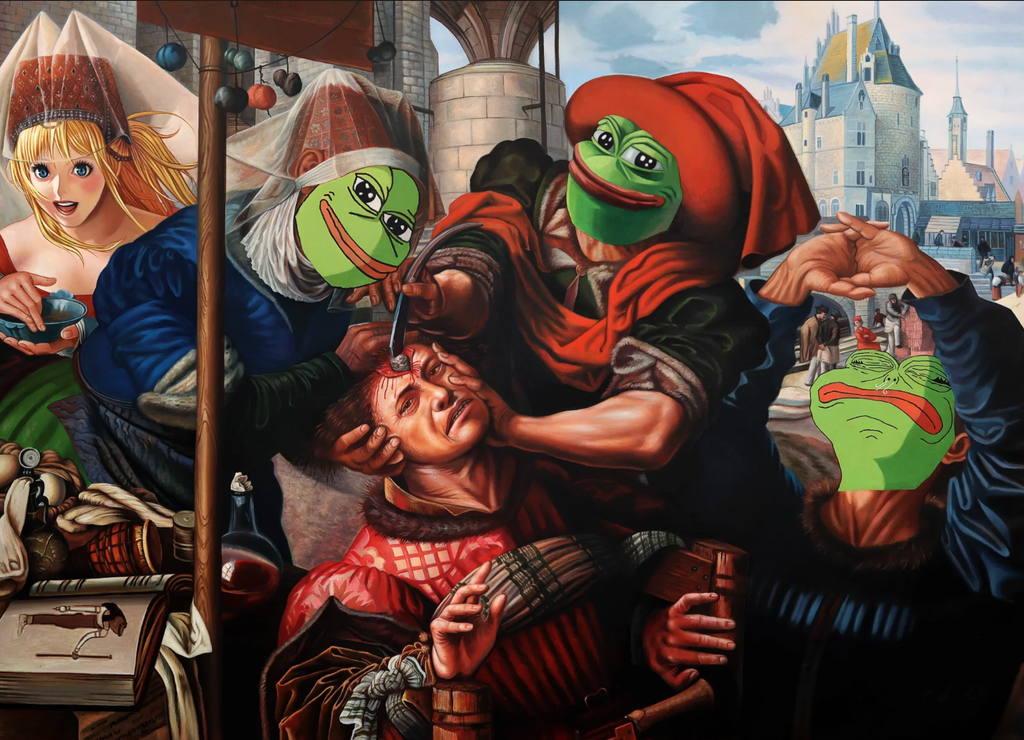
Master Cuts Out The Stone (after Hemessen), Pepenardo (2025)

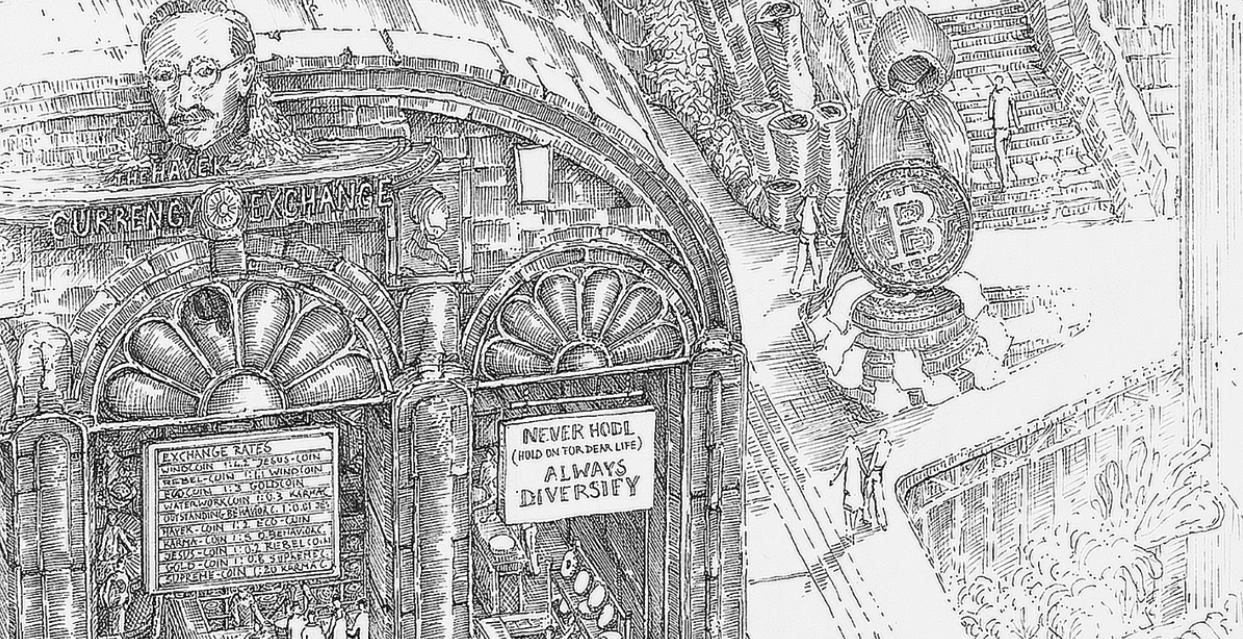
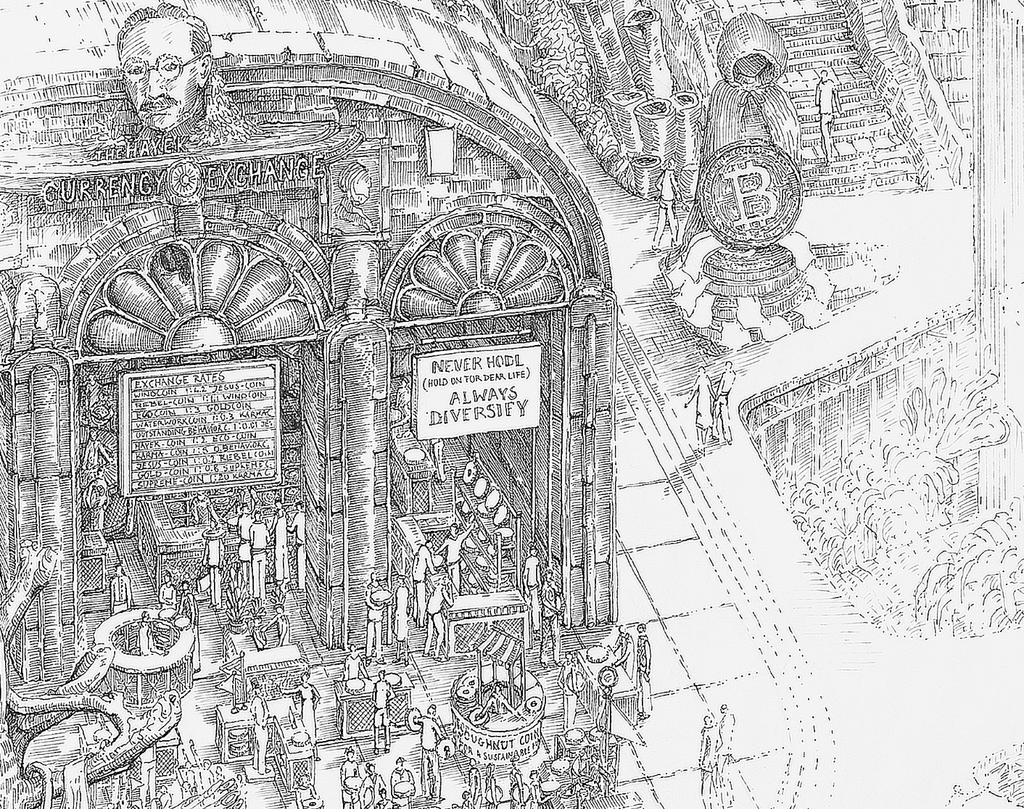
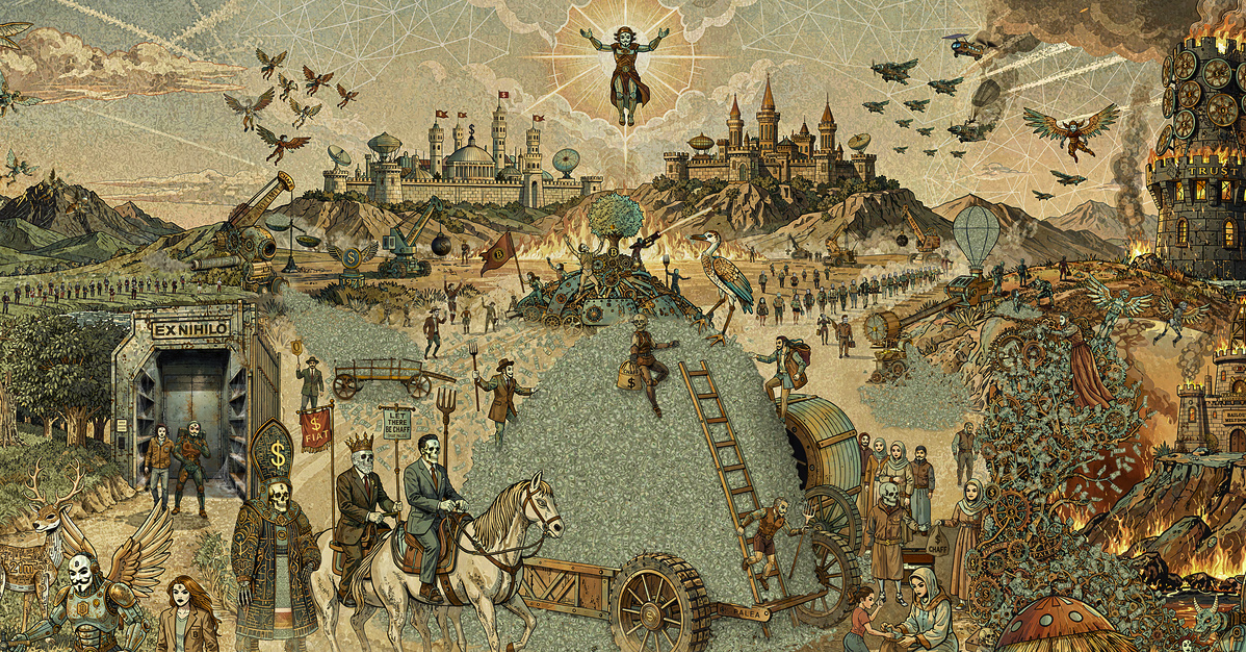
Bitcoin artists have increasingly returned to this visual tradition. Pepenardo’s Master Cuts Out the Stone, exhibited by BMAG earlier this year, reimagined Jan Sanders van Hemessen’s The Surgeon as a study of who extracts and who is extracted from. Carlijn Kingma’s The Waterworks of Money, shown at Bitcoin Amsterdam last year, depicted the modern monetary system as an interconnected landscape. Complex systems seem to invite pictures that hold everything in a single frame.

Lucho Poletti has made bitcoin-related art since 2017, describing his practice as visual propaganda for the monetary revolution. A contributor to the Bitcoin Conference art gallery since 2021, he returns to Bitcoin Amsterdam this November with Ten Decrees.

The series reimagines ten paintings, four by Bosch and six by Bruegel, around money. Fiat, Latin for “let it be done,” becomes the organizing principle. Nine titles issue commands: let there be fury, profit, chaff, a game, folly, hunger, refuge, collapse, and ash. The tenth, Ultima Fiat, reverses that authority: let it be the last.
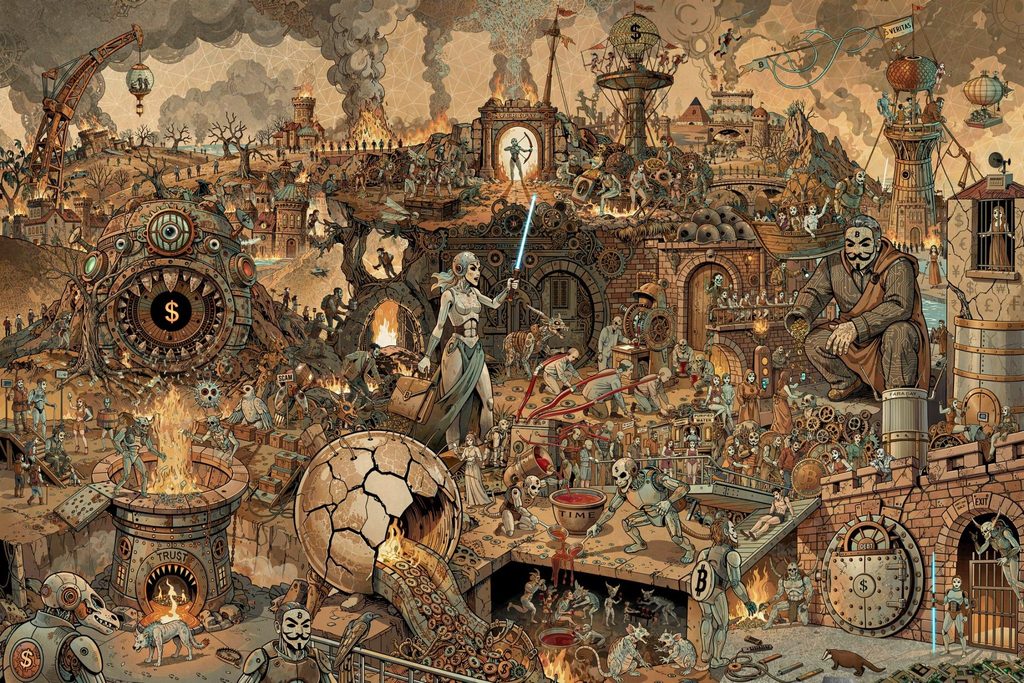
Furia Fiat: Let there be fury, Lucho Poletti (2026)

Unveiled on August 15, 2026, the anniversary of Nixon’s announcement, the series follows a biweekly release schedule beginning August 29 and concluding January 3, 2027, the anniversary of Bitcoin’s Genesis Block. Each drawing contains hundreds of figures and objects, with inscriptions often visible only at close range. The 30-by-20-inch prints, produced in editions of ten, form a composition spanning approximately four meters when arranged in two rows of five.

Five drawings have been released, most recently Fiat Moria, after Bruegel’s Netherlandish Proverbs, on October 24. The sixth, Fiat Fames, follows November 7.

Ahead of Bitcoin Amsterdam, November 5–6, I spoke with Poletti about the recurring influence of Bosch and Bruegel on bitcoin art, the relationship between allegory and propaganda, and translating his densely detailed drawings to the conference’s main-stage LED installation.
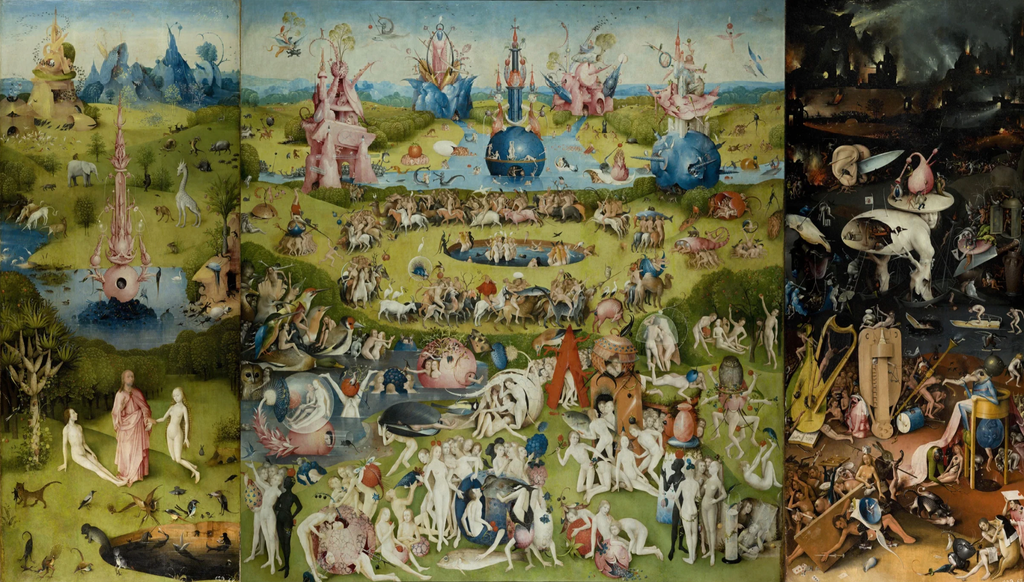
The Garden of Earthly Delights, Hieronymus Bosch (c. 1490–1510)

BMAG: Bosch and Bruegel seem to be having a synchronistic moment among artists interested in Bitcoin. Both worked in what is now Belgium and the Netherlands, during a period when Antwerp was emerging as a major financial center and the Habsburgs were debasing coinage. What is it about transitional periods (like the current one) that draws artists back to Bosch and Bruegel and their densely populated landscapes?

Lucho Poletti: Because they had already solved the problem I was stuck with: how do you draw a whole society going wrong at once? Bosch and Bruegel put hundreds of people in a single frame, each busy with their own concerns. The system shows up in the sum of it. You don’t look at a Bruegel, you search it. It’s a great way to depict the effects of money, which nobody really sees and everybody feels.

They also lived through a money problem a lot like ours. Silver from the Americas poured into Europe through Seville and on to the bankers in Antwerp. Prices across Western Europe rose sixfold over 150 years. Philip II defaulted in 1557 and the crash spread across all of Europe. Two years later Bruegel painted Netherlandish Proverbs, a village where everyone is absorbed in something foolish and nobody can see the whole.

The four Bosch pieces are about appetite: the temptation, and the bill that shows up after. The six Bruegels are about the crowd, and how society behaves once the rules stop making sense. 
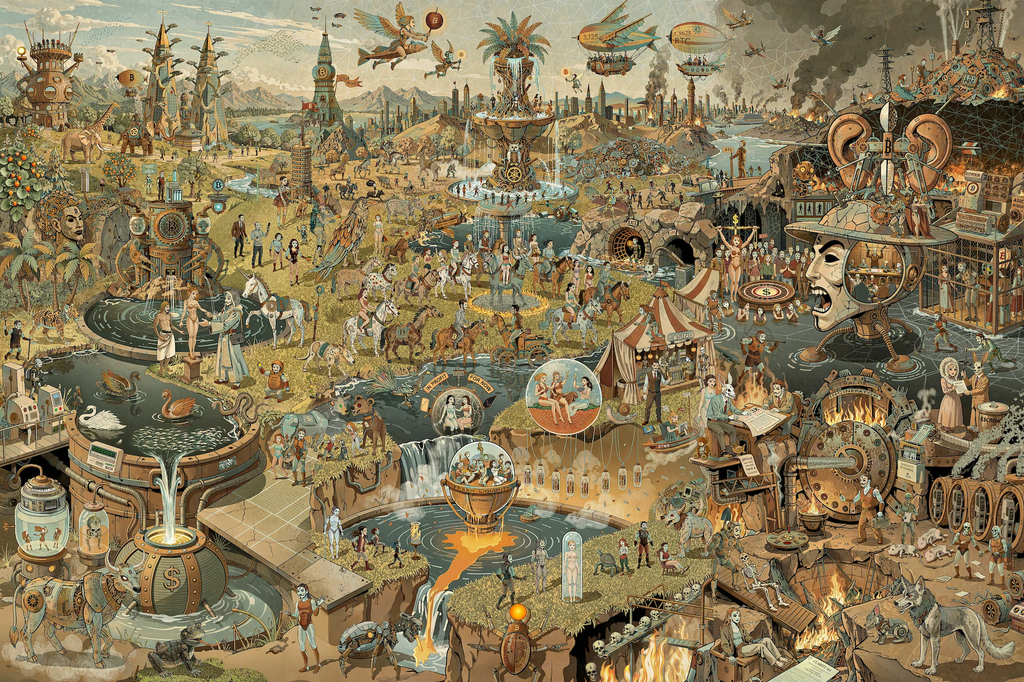
Fiat Lucrum: Let there be profit, Lucho Poletti (2026)

BMAG: The series draws on the original meaning of the F-word every bitcoiner knows. Nine of your titles use fiat as a command, while the tenth, Ultima Fiat, seems to reverse that authority. How did you arrive at Latin as the language of the series, and why does the final decree change speaker?

Lucho Poletti: Fiat was never a noun. In Latin it’s a verb, “let it be done.” It’s the word God speaks in the Latin Genesis before the light comes on: fiat lux. Someone with authority says so and it happens. That’s a literal description of how fiat money comes into existence, so I wanted the verb in every title.

Latin wasn’t a stretch for me. I’ve titled work in it for years: Moneta Divina, Cypher Deos, and Novus Moneta Seclorum dating back to 2020. The dollar already speaks it, too. Turn over a one-dollar bill and there are three Latin mottos on the back. Ultima Fiat, Fiat Lucrum and Furia Fiat had their names before the series did. Once there were three decrees in concept, I kept going until I had ten, and the name for the whole series became obvious. Ten Decrees has the Ten Commandments sitting under it, which suits work rebuilt out of painted sermons. In Fiat Lucrum there’s a lighthouse at the top left with FIAT LUX GENESIS 1:3 engraved into it. The title is the phrase rewritten for the money printers: let there be light turned into let there be profit.
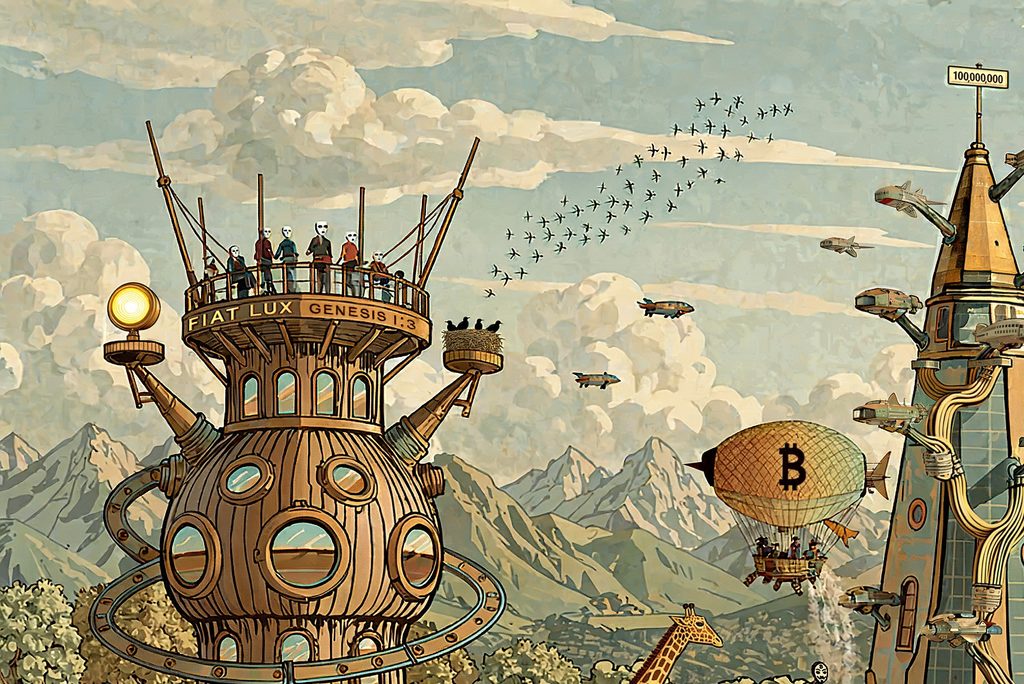
Fiat Lucrum (detail), Lucho Poletti (2026)

Nine of the decrees are issued to you, in the flat voice an institution uses. Let there be profit, let there be hunger, let there be a game. The tenth is the only one we get to say back. Ultima fiat means “let it be the last,” which is closer to a plea than an order. Every one of us has been living under the first nine since 1971, whether we noticed or not, and Bitcoin is how we issue the tenth. It closes the series on January 3, the anniversary of the Genesis Block, which also happens to be my birthday.

BMAG: Bosch and Bruegel constructed extraordinarily complex visual worlds where allegory, satire, religious symbolism, and everyday life coexist. Their paintings invite close inspection but rarely offer a single, definitive interpretation. In Ten Decrees, you’re borrowing their compositions while introducing a more explicit critique of the monetary system. How do you approach the relationship between ambiguity and message in your work?

Lucho Poletti: The words carry the message so the people don’t have to. Bosch’s Garden of Earthly Delights doesn’t have a single word in it. Fiat Lucrum has more than fifty lettered objects, and some are as blunt as a protest sign: four money presses lettered QE-1, QE-2, QE-3 and QE-∞, and a little hand-lettered card on a broker’s desk that reads genius, we print, you pay, have a nice day. Nobody has to wonder what I think of the money system.
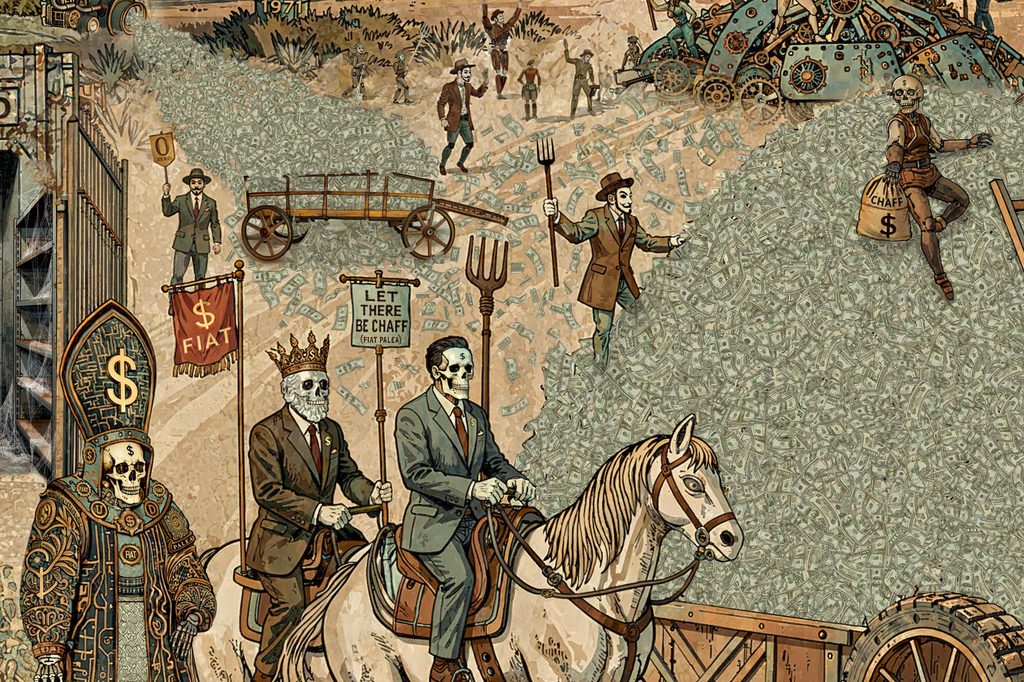
Fiat Palea (detail), Lucho Poletti (2026)

I keep the ambiguity in the people. In Fiat Lucrum there’s a crowd cheering a woman who holds up a $ on a golden staff under a sign that says ETF, and that crowd is wearing my mask. So is the man signing the leverage contract, and so is the woman taking the mortgage. In Fiat Palea a man in the mask is knee-deep in a pile of printed bills. Bosch drew his own neighbors into the middle of the garden, and I drew mine. If the ₿ on a forehead were a badge of honor, I wouldn’t hand it out like that. It’s more a badge of the aware, the initiated. Knowing the money is broken doesn’t make one a saint.

I’m careful with endings too. These pieces show the exit while not promising a way out. Near the middle of Fiat Moria there’s a lit doorway with MONEY ₿ BETTER WORLD over the arch, and a plain-faced man on the step looking back at the square. He hasn’t gone in yet, and nobody’s stopping him. Where you’d be standing in that picture is your call.
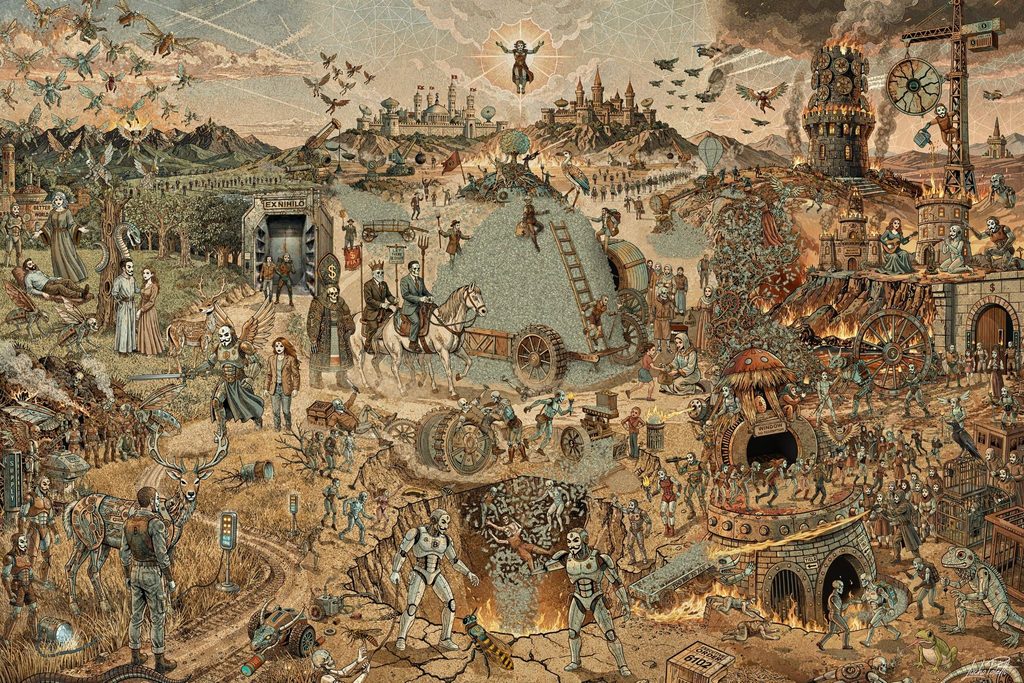
Fiat Palea: Let there be chaff, Lucho Poletti (2026)

BMAG: In Fiat Lucrum, your reinterpretation of Bosch’s Garden of Earthly Delights, you introduce a system of waterworks: pipes, reservoirs, and flowing liquidity. Bosch often allowed viewers to recognize things that the figures within his paintings could not. What possibilities does that kind of visual allegory offer you when depicting something as abstract as the monetary system?

Lucho Poletti: What Bosch never had in his garden was plumbing, so I gave it some. Water organizes the whole of Fiat Lucrum. It starts clean high in the mountains on the left, pours out of a machine in Eden and settles in a reflecting basin. Cut into the basin’s wall there’s an inspection window with fish swimming behind the glass. Somebody built a viewing port into the reservoir so you could check it, and every full node on the Bitcoin network is that window.

Downstream the water widens into a lake. In the middle sits a glass tank lettered FRESH LIQUIDITY, with BOTTOMLESS engraved on the bowl, and eight people are having the party of their lives inside it. The valve wheel that controls the flow is on top of the dome, outside the glass, where none of them can reach it. Monetary policy gets set by someone who isn’t at the party. And the tank leaks. From there the water runs orange, down a stream and over a waterfall into a pool where a tick with a $ on its cheek drinks it through a hose.
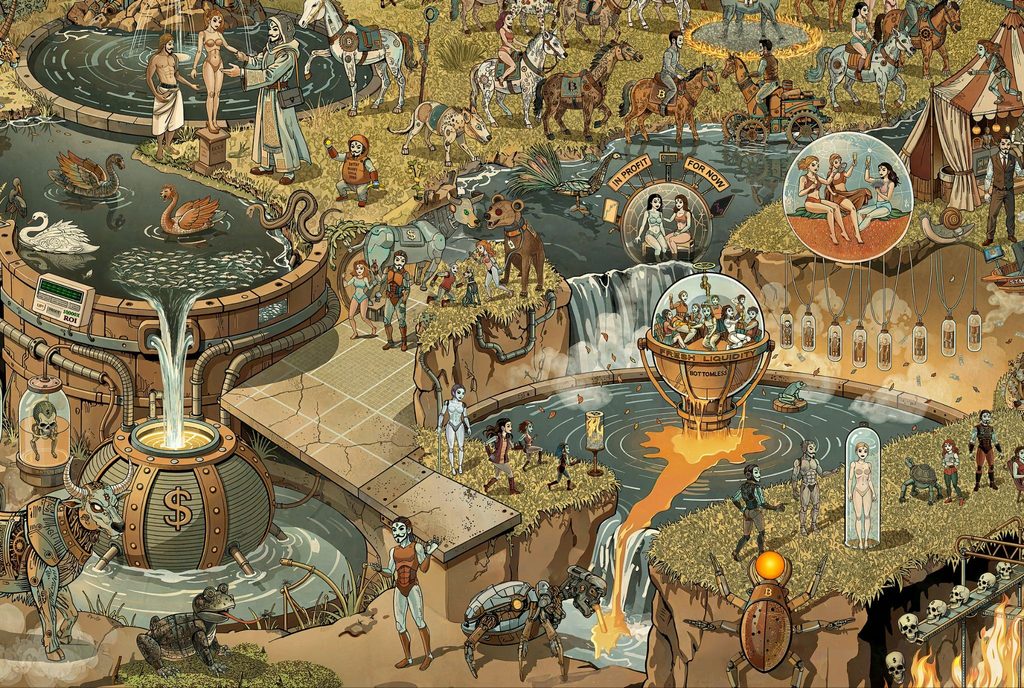
Fiat Lucrum (detail), Lucho Poletti (2026)

That’s the Bosch trick you’re describing. The bathers can’t see the leak or the valve, and you can see both from across the room. Richard Cantillon worked out around 1730 that new money helps whoever gets it first and costs whoever gets it last. I drew it as a watercourse because everybody already understands water: whoever’s upstream drinks first, and everyone downstream gets what’s left.

BMAG: Looking across the series, are there particular details, references, or artistic decisions that you feel are especially important but might be overlooked by viewers? What would you want someone encountering these drawings for the first time to spend more time looking at?

Lucho Poletti: Up close is where these work, and most of what matters in them is small.

Start with the plain faces. Everybody spots the Satoshi masks and the $ skulls first because they’re the loud ones, but the plain faces belong to the people the system is happening to. In Furia Fiat a line of bald men crawl on their hands and knees with red tubes plugged into the backs of their skulls, and the red is the same color as the fluid in a bowl a few meters away that says TIME. That’s what’s being drained out of them. In Fiat Palea, Adam and Eve stand under a serpent with a $ for an eye. They’re wearing the mask, but neither of them has a ₿ on the brow yet.
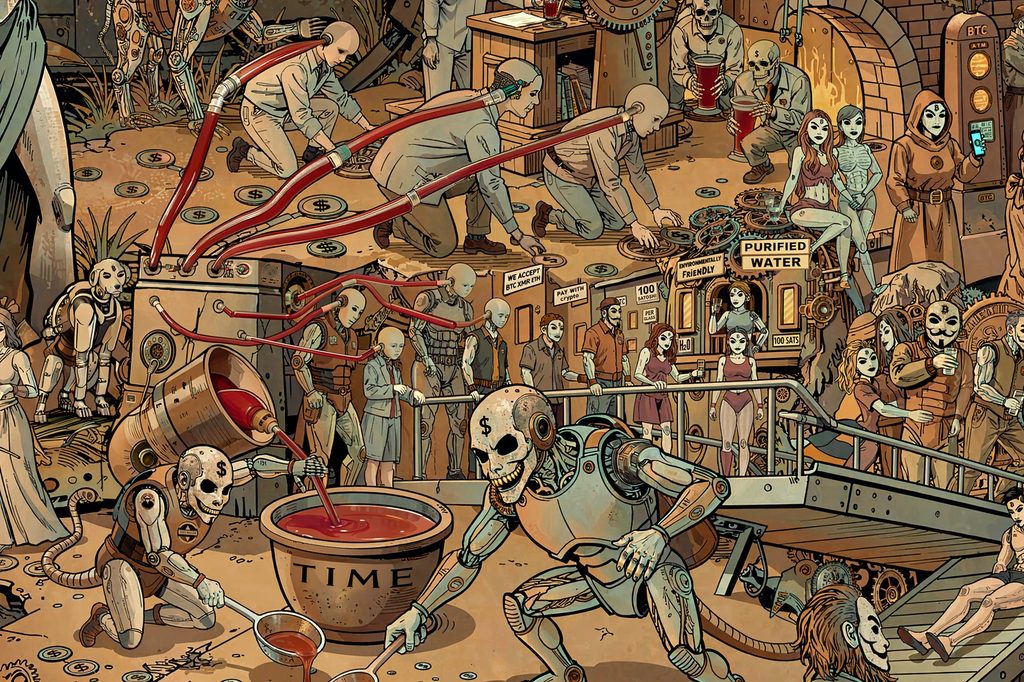
Furia Fiat (detail), Lucho Poletti (2026)

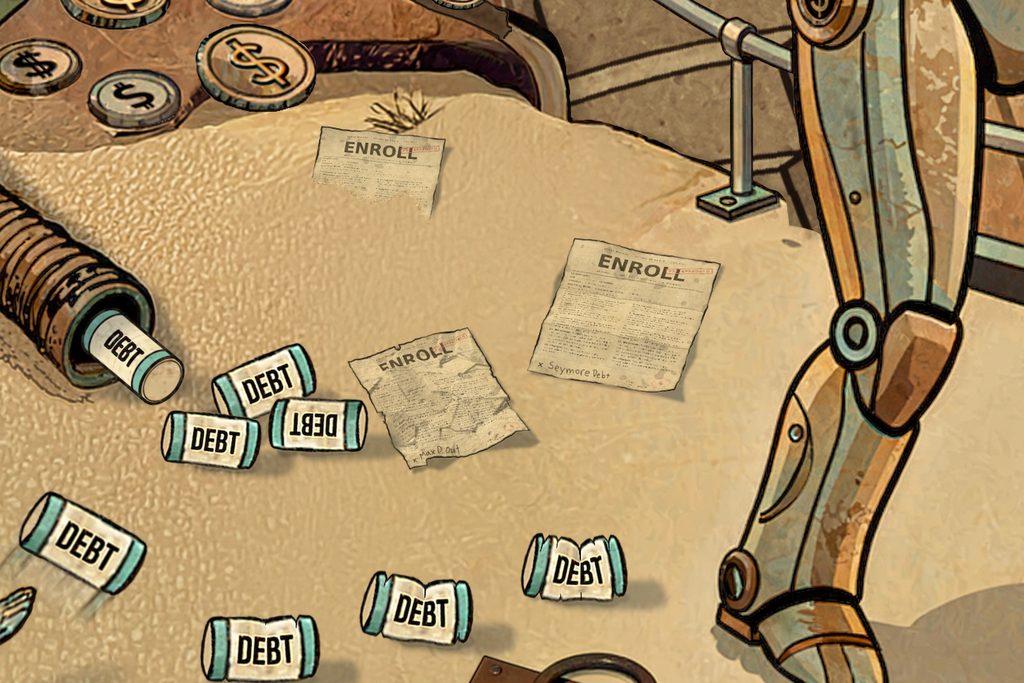
Then look at how characters connect across a distance. In Fiat Ludus a sack lettered STIMULUS sits on a bench next to an older figure, and a little way off a kid walks away with the same sack on his back, lettered THE BILL. A blindfolded boy feels around with his arms out while the man lunging in beside him holds up a bunch of $ balloons the boy can’t see. Even the enrollment forms are signed by Seymore Debt and Max D. Out. 
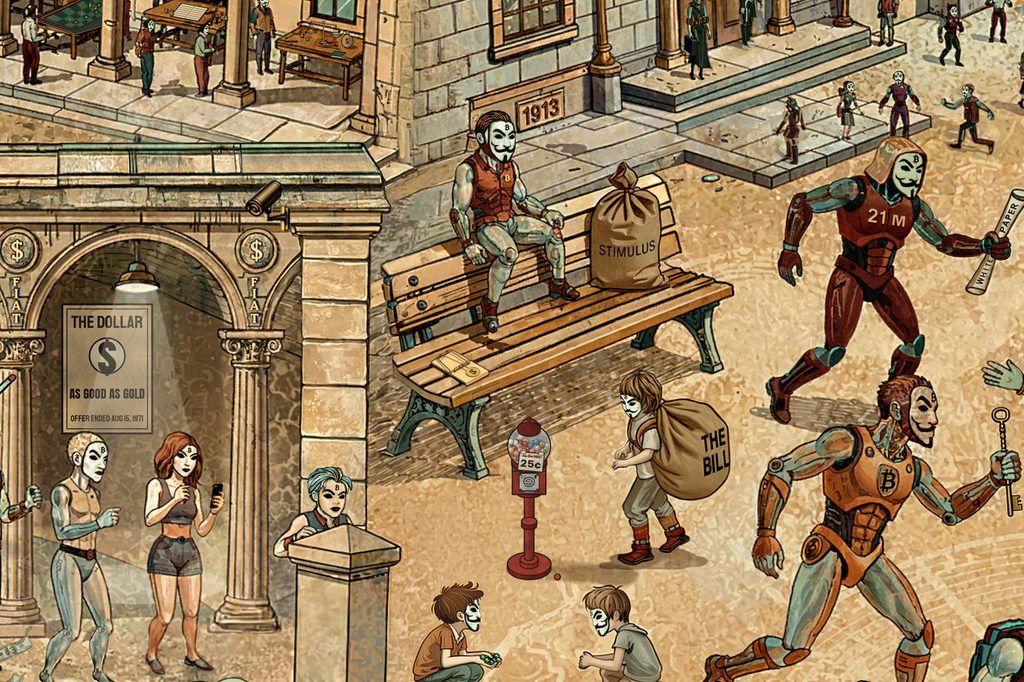
Fiat Ludus (detail), Lucho Poletti (2026)

In Fiat Palea a broken crate stenciled EXECUTIVE ORDER 6102 sits in the straw, and further back, bolted across a vault, a plate reads WINDOW, NO REDEMPTION. Roosevelt took the gold in 1933 and Nixon closed the window in 1971, and I put the two close enough that you read one and then find the other. Up higher in the same piece, a guy in the mask with WHOOPS across his vest is pouring gasoline on a burning bank. In Furia Fiat, the $ skulls stand on GNOSIS and clutch books of knowledge, keeping them for themselves.

The bubbles are dated. Fiat Ludus has a sphere with tulips growing out of the top, marked 1637 and 1720, and another with a hen sitting on a WALL STREET egg, marked 1929 and 2008. Variety’s front page the day after the 1929 crash read WALL ST. LAYS AN EGG. Some of the skies have thin straight lines of cloud behind the smoke, the kind a plane leaves.
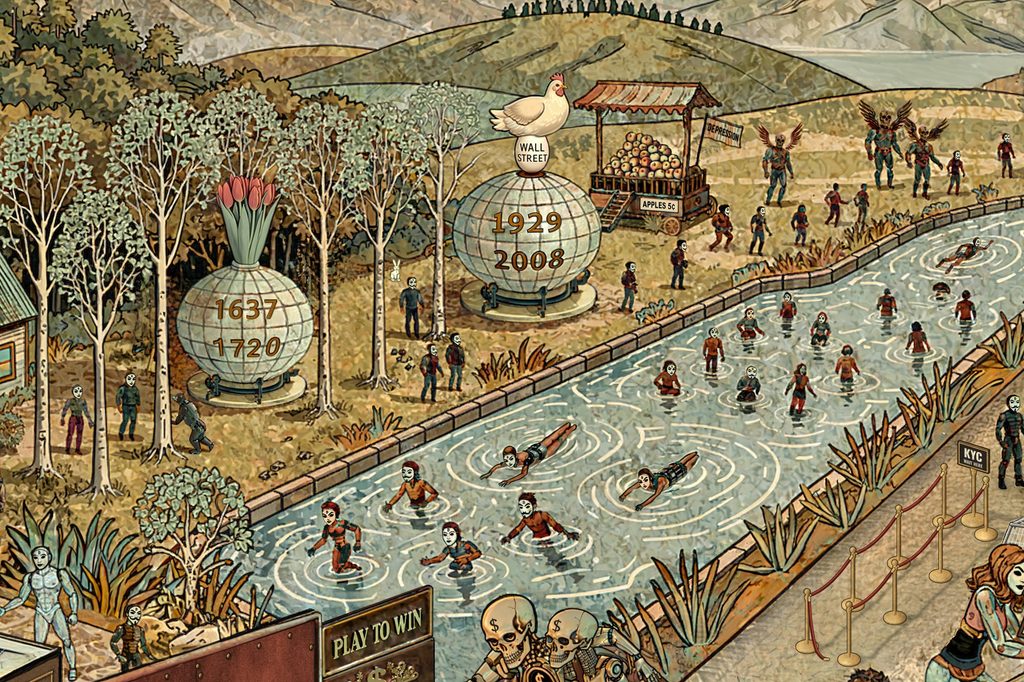
Fiat Ludus (detail), Lucho Poletti (2026)

Watch the prices, too. A price in dollars only goes up: at CANTILLON’S hot dog stand in Fiat Ludus the 5¢ is crossed out and the sign says $9. A price in sats only goes down: a fish stall in Fiat Moria has 4000 crossed out, then 2000, and now it’s 1000 SATS. In Fiat Ludus, the carrots changing hands have dropped from 7,500 to 3,000 SATS on the chalkboard next to the dollar hopscotch.
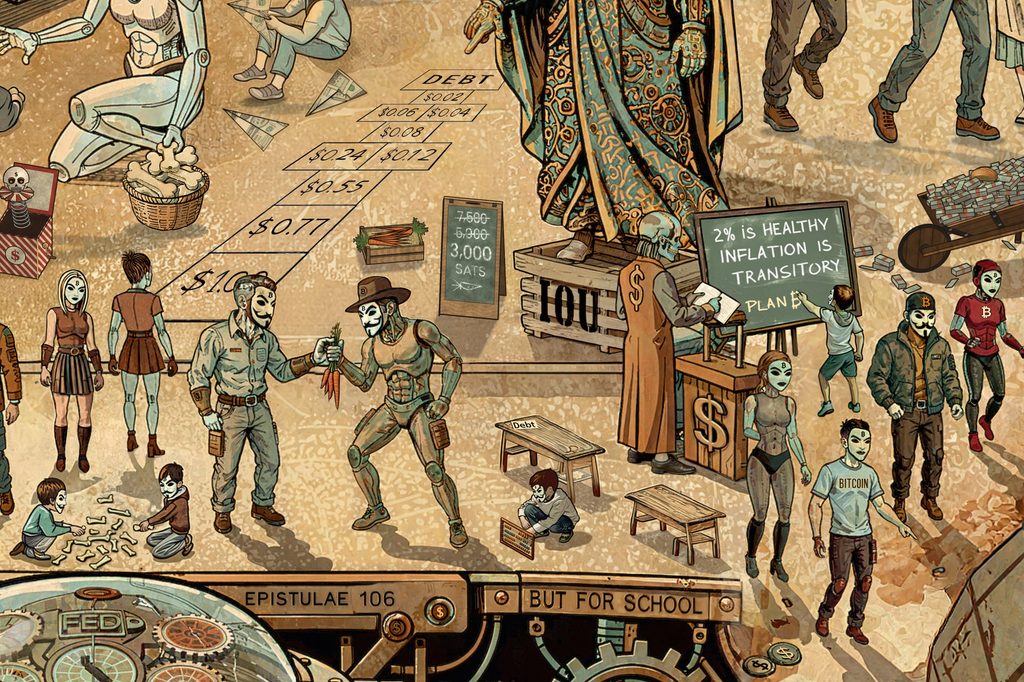
Fiat Ludus (detail), Lucho Poletti (2026)

The Latin is there to be read. MORITURI TE SALUTANT, those who are about to die salute you, is carved around the rim of the arena in Fiat Ludus. EX NIHILO, out of nothing, is cut over an empty vault in Fiat Palea. In Fiat Moria the $ skull leaning out of the window has a plaque on either side of him: MUNDUS VULT DECIPI, the world wants to be deceived, and $TULTORUM INFINITUS EST NUMERUS, the number of fools is infinite, with a $ for the S. Fiat Lucrum has a little panel that runs a whole life in four stops: school, debt, work, death.

And in Fiat Moria there’s a small round time machine with NO RETURN on its side and 1944-2026 on the dial. A man is climbing out of it, staring at the village. 1944 is Bretton Woods, when the world tied its money to the dollar and the dollar to gold. He left then and he’s only just arrived, and he can’t quite believe what he’s looking at.
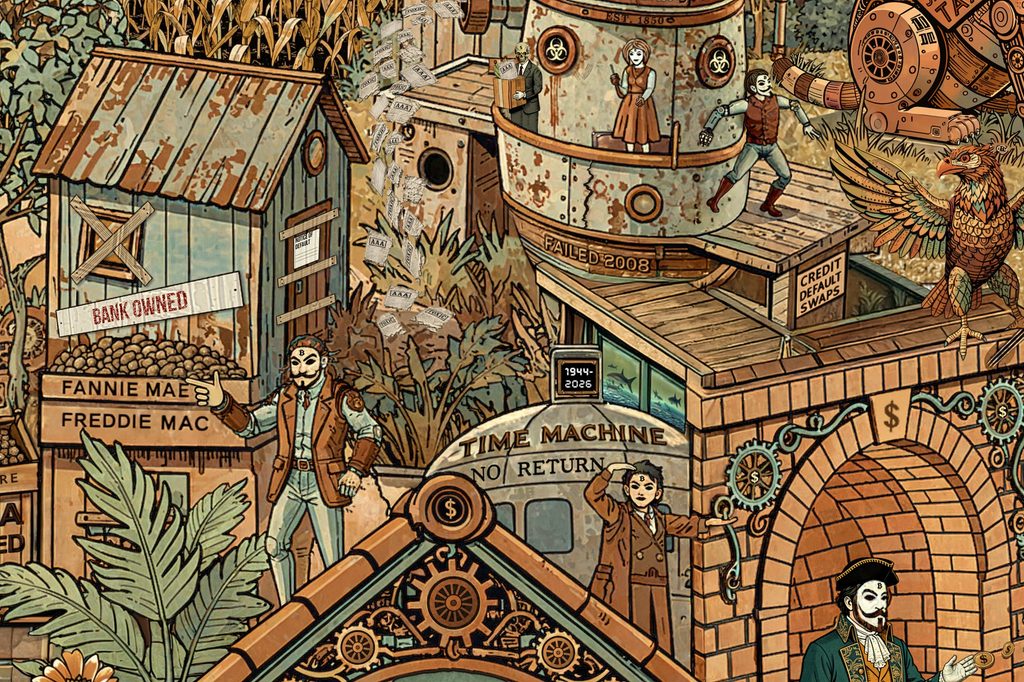
Fiat Moria (detail), Lucho Poletti (2026)

None of that comes with a caption. You find it by standing close for a long time, the way you would with a Bruegel, and the finding is the whole point.
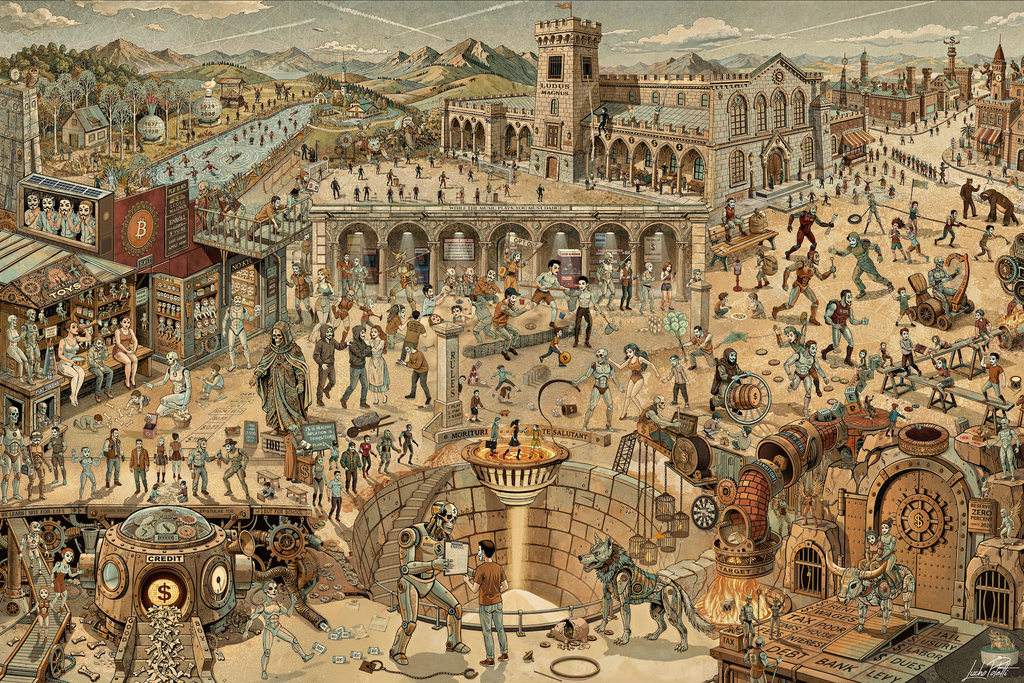
Fiat Ludus: Let there be a game, Lucho Poletti (2026)

BMAG: Each drawing is 18,000 pixels wide, populated by hundreds of figures, with every Satoshi mask drawn by hand and details that only reveal themselves up close. You’ve described the work as “crafted, not generated.” At a time when AI can convincingly imitate the Old Masters, what significance does that labor have for you, and how does it shape the way you want these works to be experienced?

Lucho Poletti: “Crafted, not generated” is a phrase I came up with to sum up where the work in these pieces actually is. There are machines in my process, but they’re only one part of it. A model I trained on years of my own work does the rough first pass on a composition. I think of it as an apprentice. Bosch came out of a family workshop, and the masters of his day leaned on assistants for the groundwork so their own hours could go into the meaning. Mine roughs out the scene and gives me a base to build toward the standard they set. Then I spend weeks on each piece in a grueling manual process in Photoshop, making the decisions and drawing in hundreds of figures, objects, symbols and phrases until the art says what I mean.
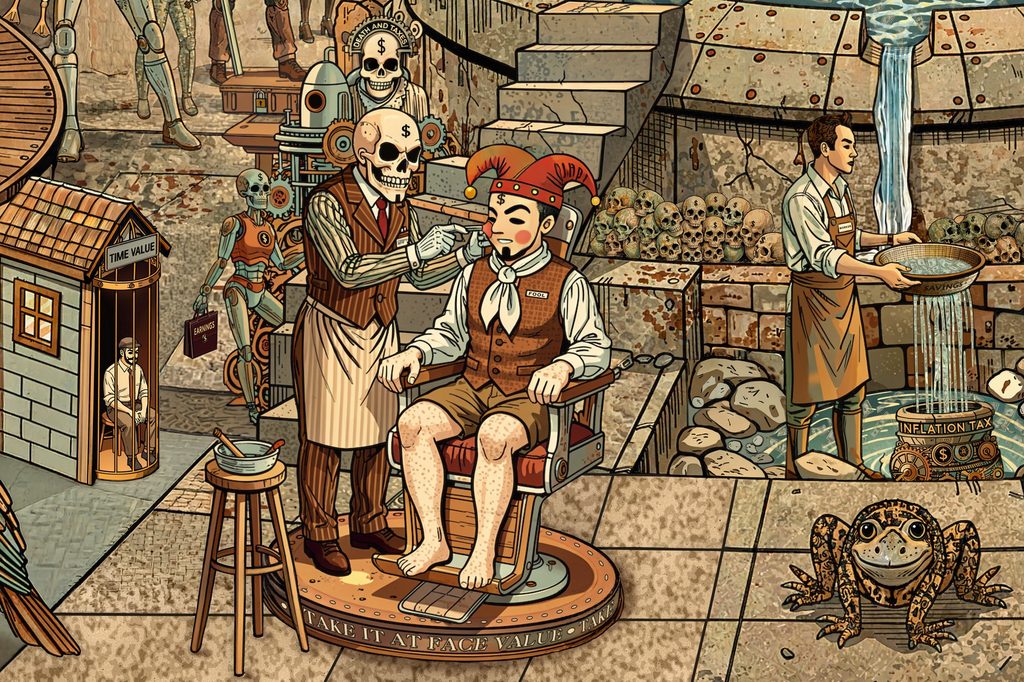
Fiat Moria (detail), Lucho Poletti (2026)

AI can imitate the look of a Bosch or a Bruegel pretty convincingly now. What it can’t do is mean anything. It won’t decide that the valve on the liquidity tank in Fiat Lucrum belongs outside the glass, where the bathers can’t reach it. It won’t decide that the slop on the ground should be piggy banks wired into the money presses, each with its own name: SAVINGS, PENSION, NEST EGG. It doesn’t make jokes either. It’s never going to sit a fool in a jester’s cap on a platform lettered TAKE IT AT FACE VALUE while a $ skull does his makeup. My personal philosophy is that if I don’t do the majority of the work, it’s not my art. I hold myself to that, and anyone who looks at these up close can see a person made the decisions that matter.

That’s how I’d like people to take these in: up close, and for a long time. I don’t ask anyone to trust me on how they were made. The work answers that better than I can.
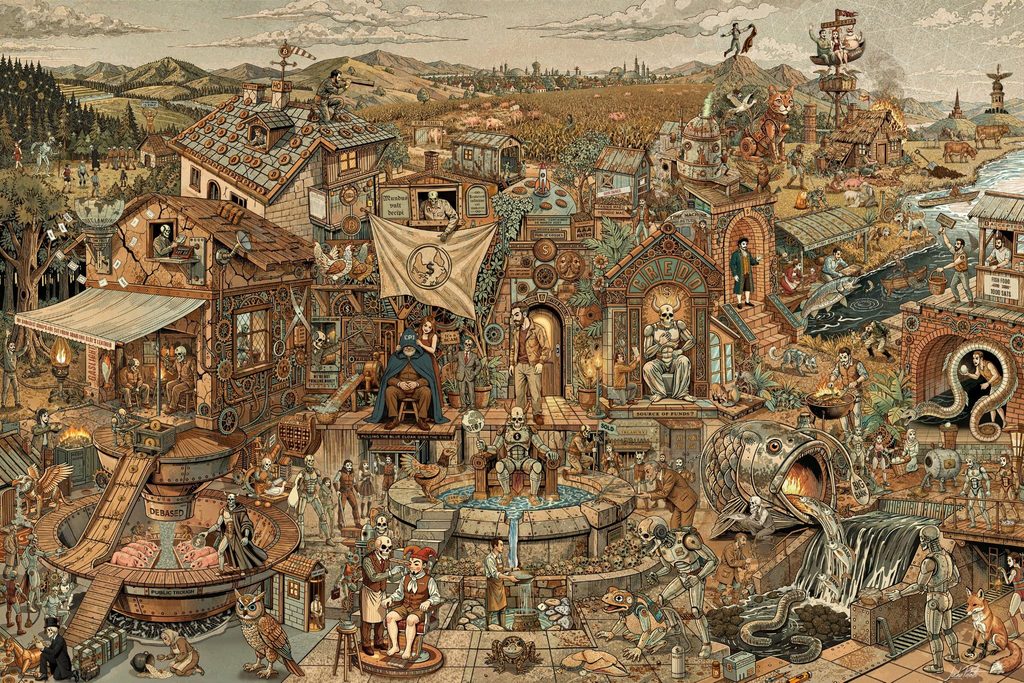
Fiat Moria: Let there be folly, Lucho Poletti (2026)

BMAG: You’ve been part of the Bitcoin Conference since 2021, and this November Ten Decrees comes to the main stage at Bitcoin Amsterdam, not far from the historical centers where Bosch and Bruegel worked. These drawings are extraordinarily detailed, designed to reward close inspection. How are you approaching their translation to monumental LED screens, and does exhibiting them in the Netherlands carry any particular significance for you?

Lucho Poletti: The prints were meant for one person standing close to search the work and find details that speak to them. An LED wall gets a thousand people at fifty meters, which is an amazing opportunity to create a visual experience for the still pieces, so I’ve done my best to create a compelling one for each piece.

Each one gets fifteen seconds, in the order they were released. The big center wall carries the center of each piece in one slow pass from left to right, so the room gets the shape of it. The screen on the right opens on the Bosch or Bruegel it came from, with its name and date, and halfway through it wipes across to mine. The screen on the left side pulls out lateral details you’d never catch from the floor, like the ship of fools riding the mast in Fiat Moria, or the pigs feeding at the DEBASED trough. All five released so far play back to back as one loop, old master and new money side by side the whole way through.
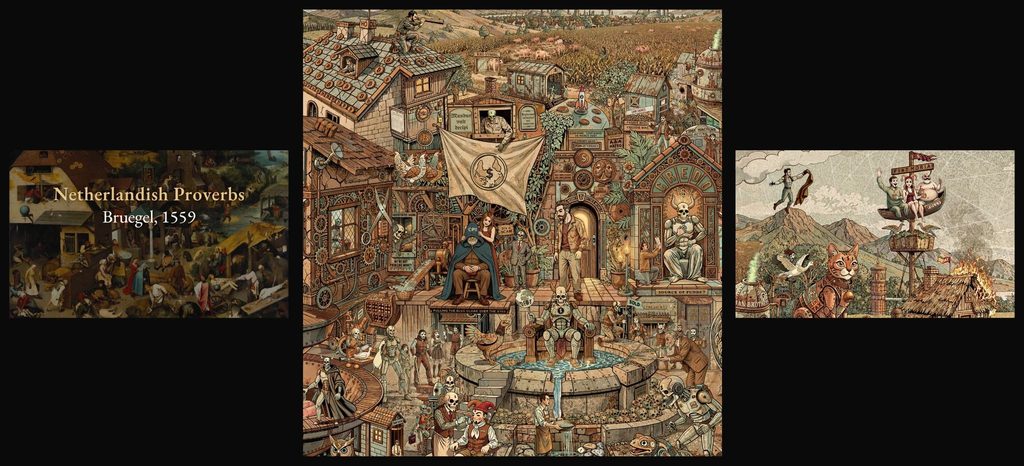
Ten Decrees, Bitcoin Amsterdam main-stage visualization rendering, Lucho Poletti (2026)

The Netherlands matters to me. Bosch spent his whole life in ’s-Hertogenbosch, about an hour south of Amsterdam by train. Some of Bruegel’s proverbs are still in use in Dutch: people still say someone hangs his cloak to the wind when he turns with the crowd, and in Fiat Moria, a man wearing a Satoshi mask jumps off a mountain, holding his cloak in his hand—a reference to the Dutch proverb about changing one’s position to suit the prevailing winds.

Amsterdam has its own chapter in this story. The Bank of Amsterdam opened in 1609 to give merchants a money nobody could debase, and for over a century its bank guilder traded at a premium over ordinary coin because people trusted the silver was in the vault. David Hume held it up as the model of a fully backed bank. It had been lending to the Dutch East India Company quietly, and when that became public in 1790 the premium vanished and the bank declared itself insolvent. I can’t think of a better city to show a series about monetary decrees and trust, two months before the last one lands on the Genesis Block anniversary.
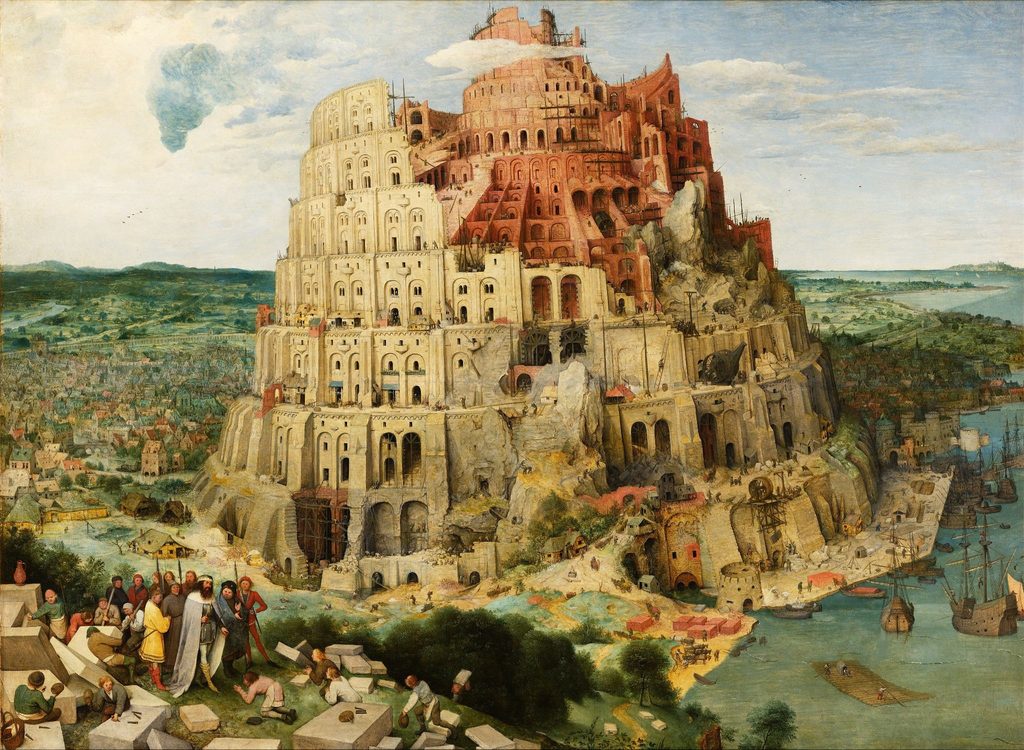
The Tower of Babel, Pieter Bruegel the Elder (1563)

Exhibition & Further Reading

Lucho Poletti’s Ten Decrees will be on view on the main stage at Bitcoin Amsterdam, November 5–6, 2026, as part of the Bitcoin Museum & Art Gallery (BMAG) programming. Explore Poletti’s detailed write-ups on each Decree for a deeper look at the artwork, symbolism, and historical references throughout the series, and follow him on X.

Read more from BMAG’s Bitcoin Amsterdam series: The Undercurrent: Three European Artists on Making Money Visible and The Architecture of Money: Mapping Financial Power in the Age of Bitcoin.

The Bitcoin Museum & Art Gallery (BMAG) organizes international exhibitions, auctions, and artist collaborations exploring bitcoin and its cultural implications.

Join us at Bitcoin Amsterdam, November 5–6, 2026, and use code BA26-BMAG20 for discounted admission. Get your tickets here.

This post Ten Decrees: Old Masters, New Money first appeared on Bitcoin Magazine and is written by Dennis Koch.
The Sleeper Has Awakened: Pepenardo’s Sleeping Knights Return

Bitcoin Magazine

The Sleeper Has Awakened: Pepenardo’s Sleeping Knights Return

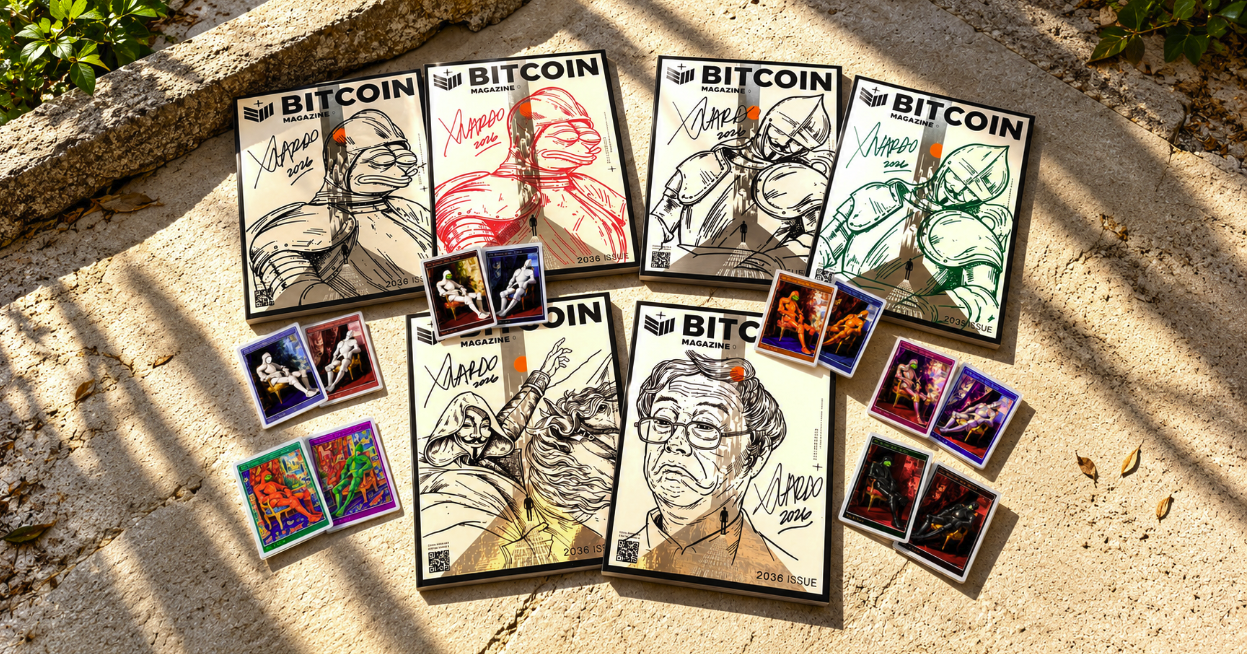
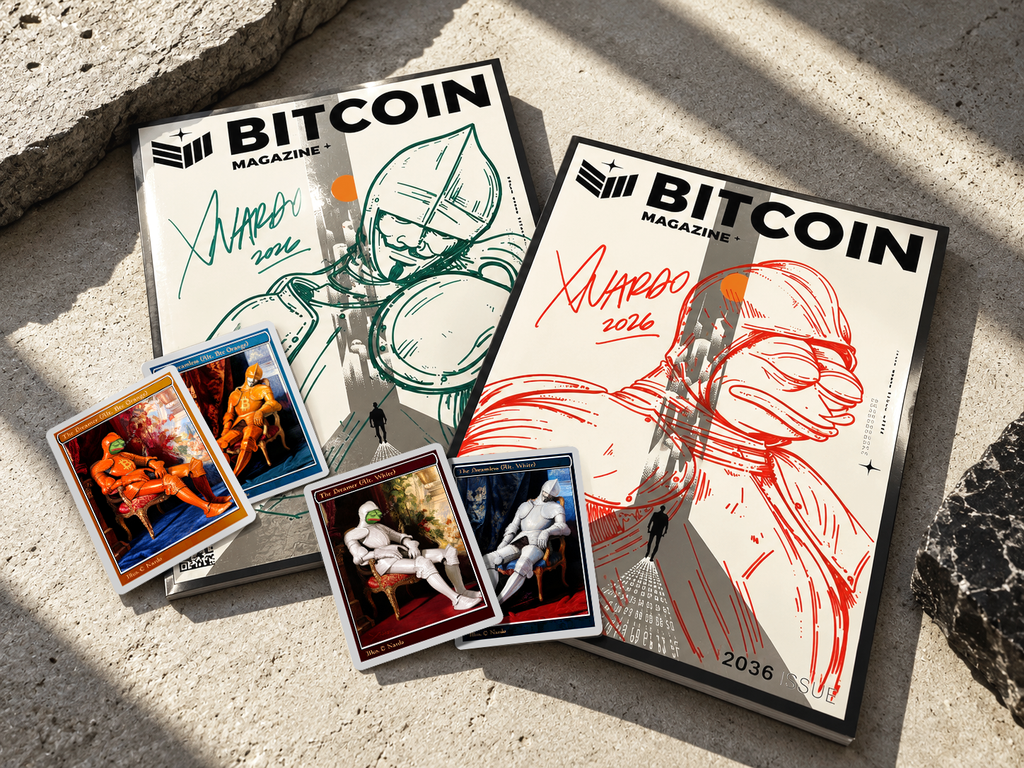
Pepenardo has transformed six copies of Bitcoin Magazine’s 2036 Issue into original artworks, drawing directly onto the covers with a Sharpie. The hand-altered editions feature familiar characters from his visual universe, including the Sleeping Knights, previously exhibited at the BMAG Museum in Nashville and Bitcoin 2026 in Las Vegas. Other imagery includes the masked rider of FAKEGENESIS, Dorian Nakamoto, and Pepe the Frog.

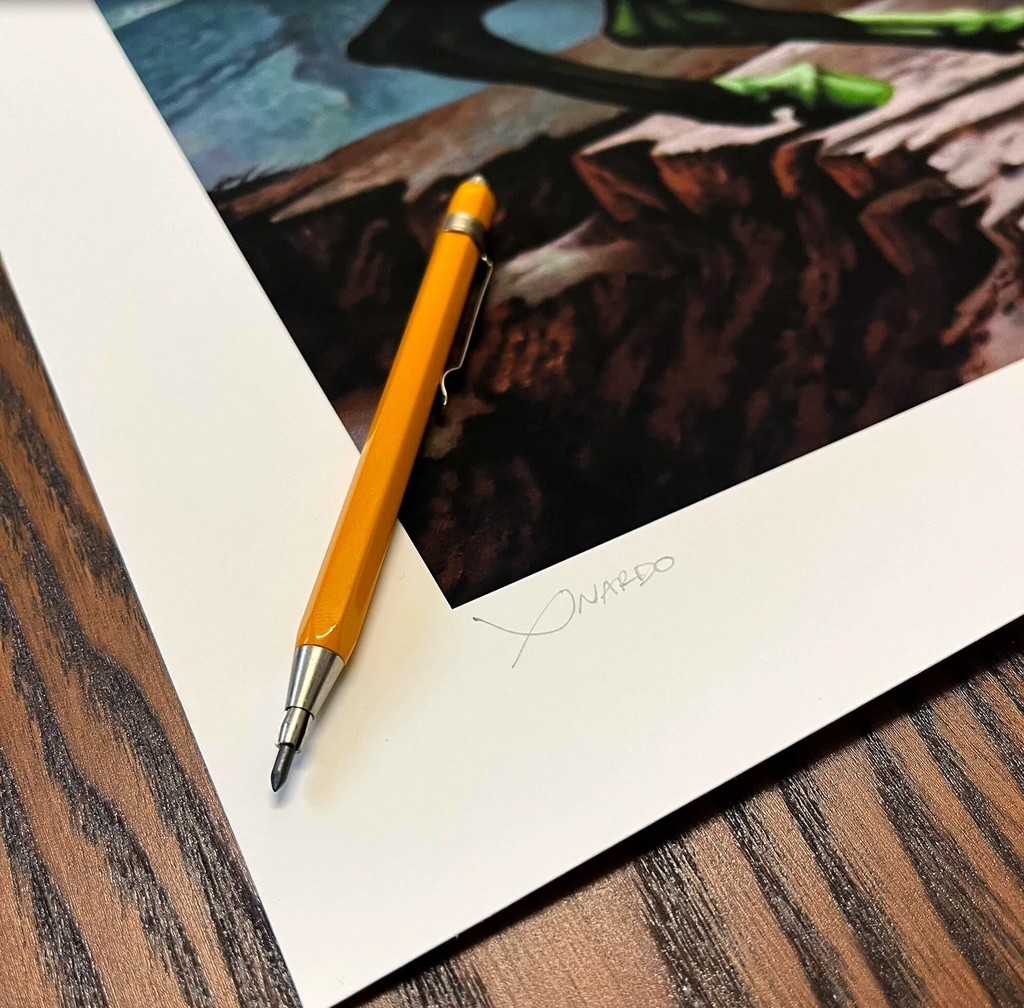
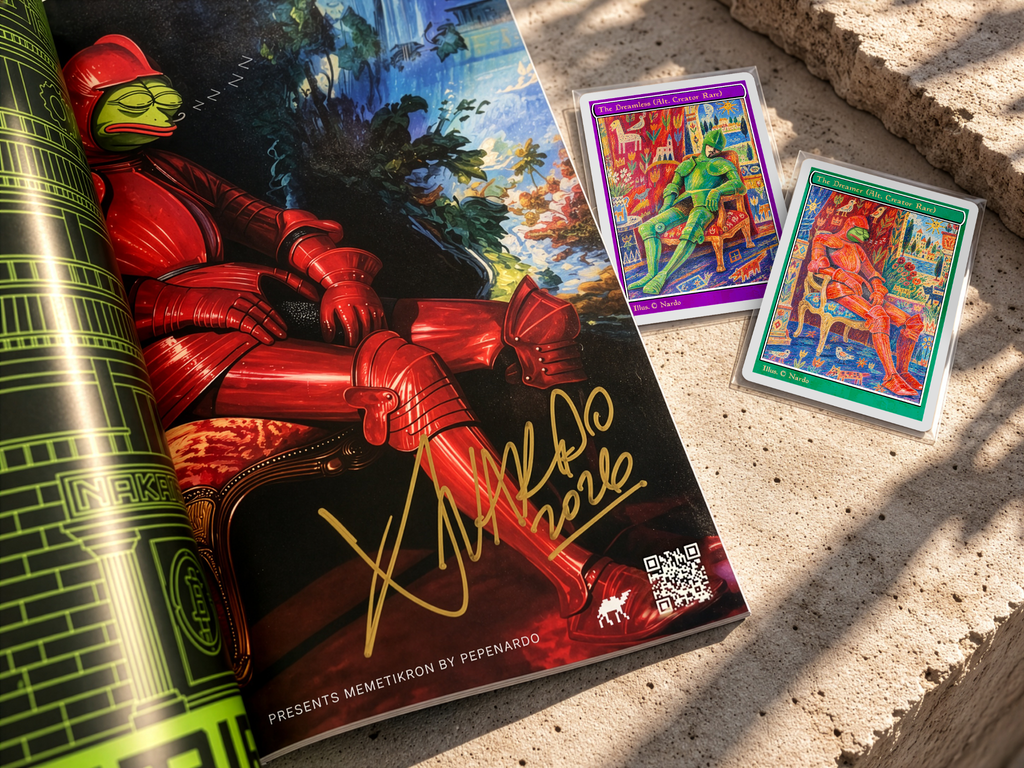
Each magazine features the artist’s signature on its illustrated cover and an additional gold-ink signature on an interior spread reproducing his painting THE DREAMER. Each is paired with two original, one-of-one trading cards created for the collaboration.

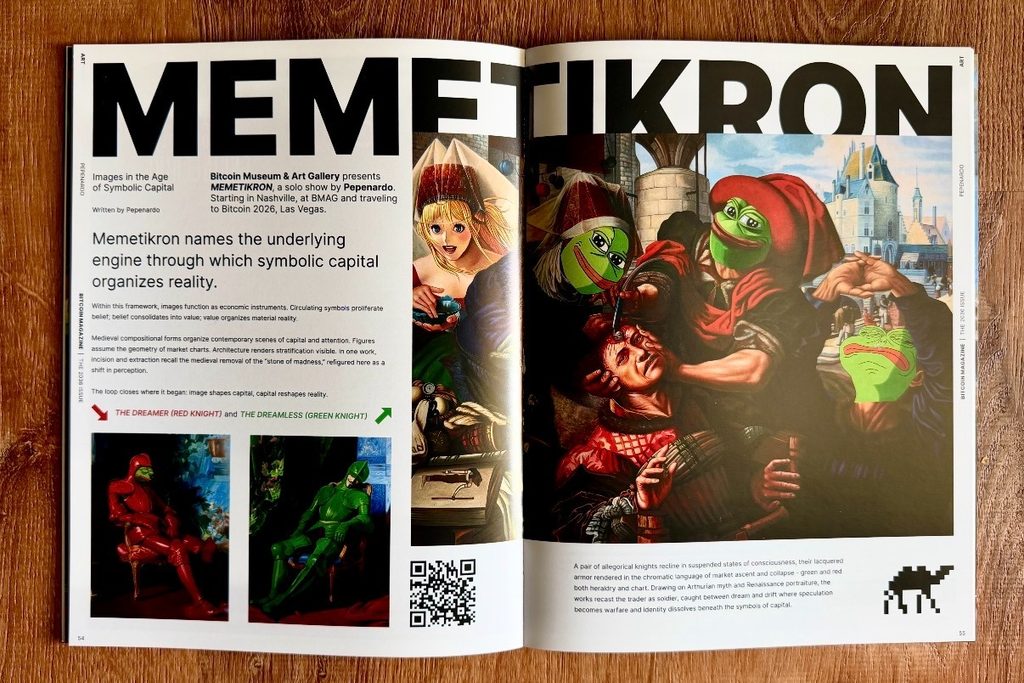
The project reflects BTC Inc.’s growing interest in art, publishing, and collectibles, building on Pepenardo’s MEMETIKRON exhibition at Bitcoin 2026, where THE DREAMER (RED KNIGHT) and THE DREAMLESS (GREEN KNIGHT) became highlights of the BMAG auction.

The two oil paintings, each measuring 30 × 39.5 inches, depict reclining knights in red and green armor, referencing financial markets and historical portraiture. Both sold for 0.32698802 BTC (approximately $26,500 each), attracting a combined 197 bids. Their imagery now reappears in artist-made trading cards featuring alternate colorways, remixed compositions, and hand-painted Creator Rare editions inspired by traditional textiles.

Amid a booming trading card market, Pepenardo’s work bridges painting and handheld collectibles, where scarcity, provenance, and variation shape value. His relationship with this market began well before the Sleeping Knights.

In 2023, his painting FAKEGENESIS, a reinterpretation of Jacques-Louis David’s Napoleon Crossing the Alps featuring a masked rider on a green horse, sold at the Bitcoin Conference in Miami for 1.625 BTC. Originally created as a Fake Rares card in 2022, the composition became an early landmark for physical Bitcoin art, demonstrating the growing collector interest in artwork emerging from Bitcoin’s meme culture.

FAKEGENESIS later appeared on the back cover of Bitcoin Magazine, with prints available through the publication’s store. Its return as a hand-drawn magazine cover completes an unusual progression from trading card to painting, printed reproduction, and original collectible.

Bitcoin Magazine itself has a collecting history dating to its first issue in May 2012, co-founded by Mihai Alisie and Vitalik Buterin. At a bitcoin event in London in September 2012, seven copies of the inaugural issue were signed by more than 20 early bitcoin figures. One attracted a winning bid of 7 BTC, although the buyer never completed the purchase or collected the magazine.

Early issues have since become sought-after historical artifacts, with graded copies and rare editions attracting collectors. In 2023, Bitcoin Magazine introduced the Genesis Box, a limited edition of 21 collector’s sets containing the publication’s first 22 issues, each housed in protective acrylic cases.

Much like early exhibition catalogs, first-edition books, and concert posters, Bitcoin Magazine has developed value beyond its original publishing purpose. Pepenardo’s customized covers extend that history, turning the publication itself into a one-of-one artwork.

I spoke with Pepenardo about his paintings, trading cards, and evolving relationship with Bitcoin Magazine, and with Mark Mason, Head of Media at Bitcoin Magazine, about the historical significance of the publication and its growing collector market.

BMAG: This collaboration came together quickly after you noticed the blank space on the cover of the Bitcoin Magazine issue featuring your work. What inspired you to turn these magazines into original artworks, and how do you see them fitting alongside your paintings and trading cards?

Pepenardo: I couldn’t help but notice that welcoming blank space on the cover. It seemed like an obvious place for a drawing. Coincidentally, I came into Bitcoin through watching the energy around trading cards on Counterparty, from 2016 all the way to the present. Hal Finney foreshadowed this ethos in his famous 1993 email titled “Crypto trading cards.” Of course he was talking about digital collectibles, but the principle stays the same. Bitcoin’s history has a magnetic pull on collectibles; people want to hold on to a fragment of such an important modern history. When we look back fifty years from now, the content and the artifacts that came out of the movement will help future generations make sense of Bitcoin’s tremendous timeline.

BMAG: The two knights, THE DREAMER and THE DREAMLESS, began as oil paintings exhibited and sold at Bitcoin 2026 in Las Vegas. They have since appeared in Bitcoin Magazine and now as original trading cards with different variations. How does the meaning of these characters change as they move between painting, publication, and collectible card? What rules guide your remixed versions, and were you surprised by how quickly the cards sold out?

Pepenardo: I was shocked at how quickly they went. I have no words. But it certainly reinforces that what I’m attempting to create and build with my work has some value. Being able to use the trading cards as a way to remix the original works lets me enrich the life of each painting. The mediums are different – oil on canvas for the paintings, various print methods for the trading cards – but the tedious care that goes into executing both is the same.

BMAG: FAKEGENESIS became a defining work in your career, moving from Fake Rares into an original painting that attracted significant attention at Bitcoin 2023 in Miami. Looking back, what do you remember about that moment, and how did it change your practice and the audience for your work?

Pepenardo: FAKEGENESIS will always be the pivotal work that showed me how I should properly approach my art. I knew that even before it sold. It is a painting that embeds the tropes of Bitcoin’s ethos without being too obvious. Art within the context of Bitcoin shouldn’t have to throw a big B at you all the time; it should give you the fiery sensation of standing inside a new history being built. My hope is that it is remembered as a work that represents an entire movement – onwards and upwards.

BMAG: Bitcoin Magazine’s earliest issues have become historical artifacts in their own right, from signed copies of Issue 1 and graded editions to the Genesis Box collection. Even figures like Michael Saylor have signed covers featuring themselves for charity auctions. What gives these publications their enduring collectible value, and how do you see artist-customized covers like Pepenardo’s fitting into that history?

Mark Mason: For over a decade, Bitcoin Magazine has documented the evolution of Bitcoin, from its early technical developments to the people and culture surrounding it. We see each physical issue as a time capsule, capturing a particular moment in Bitcoin’s journey toward hyperbitcoinization.

One of the biggest factors driving their collectible value is that we never reprint past editions. Each issue has a limited print run, creating a finite supply that has made early editions, graded copies, and signed covers increasingly sought after by collectors.

Bitcoin has always existed at the intersection of technology, economics, and culture. Artist-customized covers like Pepenardo’s take that relationship a step further, transforming an already collectible publication into an original artwork. It’s an extension of what Bitcoin Magazine has become: both a record of Bitcoin’s history and an artifact of that history itself.

Pepenardo’s custom magazine covers and trading card sets sold out shortly after launch, with all six one-of-one editions finding collectors. Additional works remain available, including MASTER CUTS OUT THE STONE (after Hemessen), the centerpiece painting from Pepenardo’s MEMETIKRON exhibition, which traveled from the BMAG Museum in Nashville to Bitcoin 2026 in Las Vegas.

Collectors can also explore FAKEGENESIS prints and the Genesis Box, a limited-edition collector’s set preserving the publication’s first 22 issues from 2012–2014.

The Bitcoin Museum & Art Gallery (BMAG) organizes international exhibitions, auctions, and artist collaborations exploring Bitcoin and its cultural implications. Explore available works from Curtis William Readel’s exhibition Paper Money, along with additional prints, original artworks, and collectibles.

BMAG returns to Bitcoin Amsterdam, November 4–6, 2026, featuring European artists exploring money, power, and Bitcoin. Read more in The Architecture of Money and The Undercurrent. Use code BA26-BMAG20 for discounted admission.

This post The Sleeper Has Awakened: Pepenardo’s Sleeping Knights Return first appeared on Bitcoin Magazine and is written by Dennis Koch.
The Architecture of Money: Mapping Financial Power in the Age of Bitcoin

Bitcoin Magazine

The Architecture of Money: Mapping Financial Power in the Age of Bitcoin

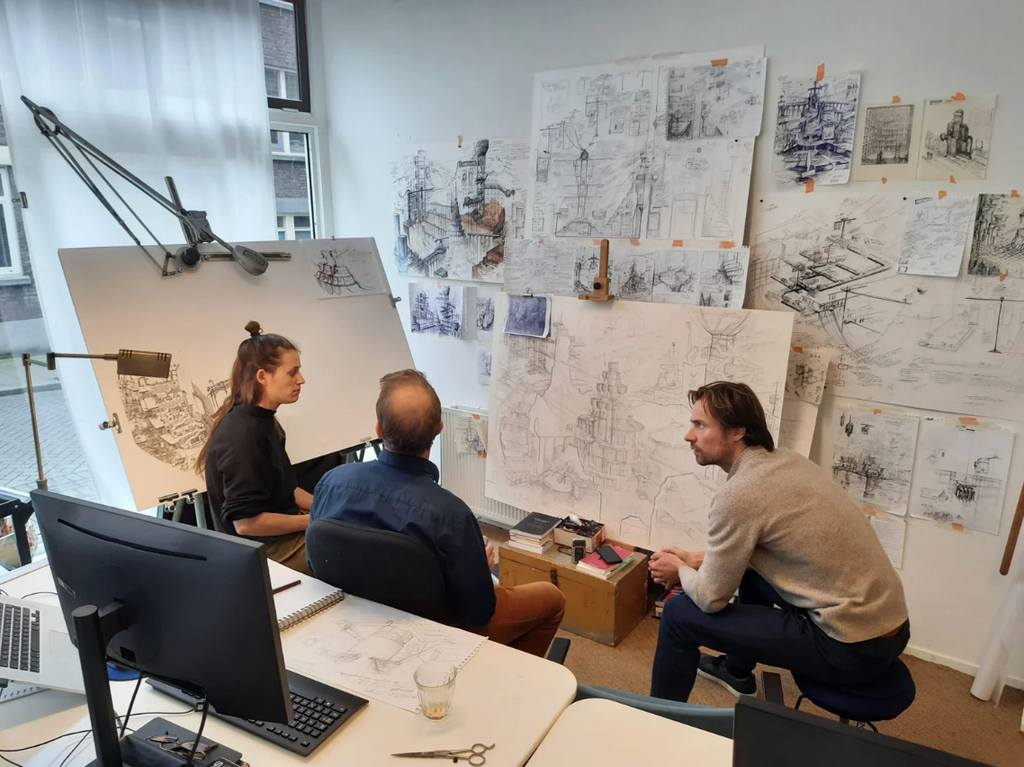
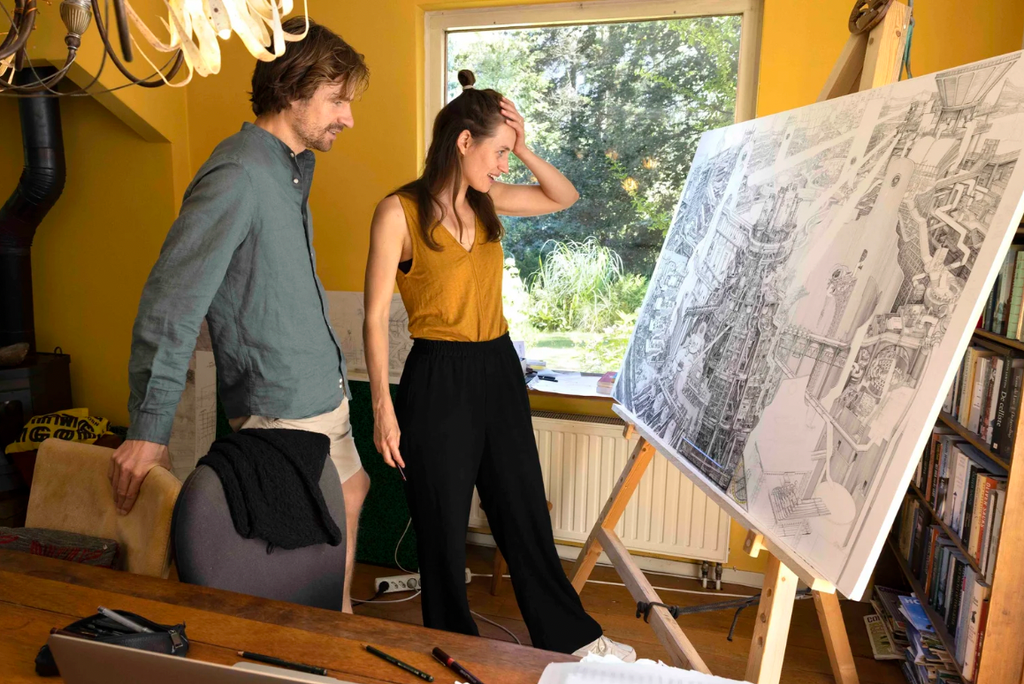
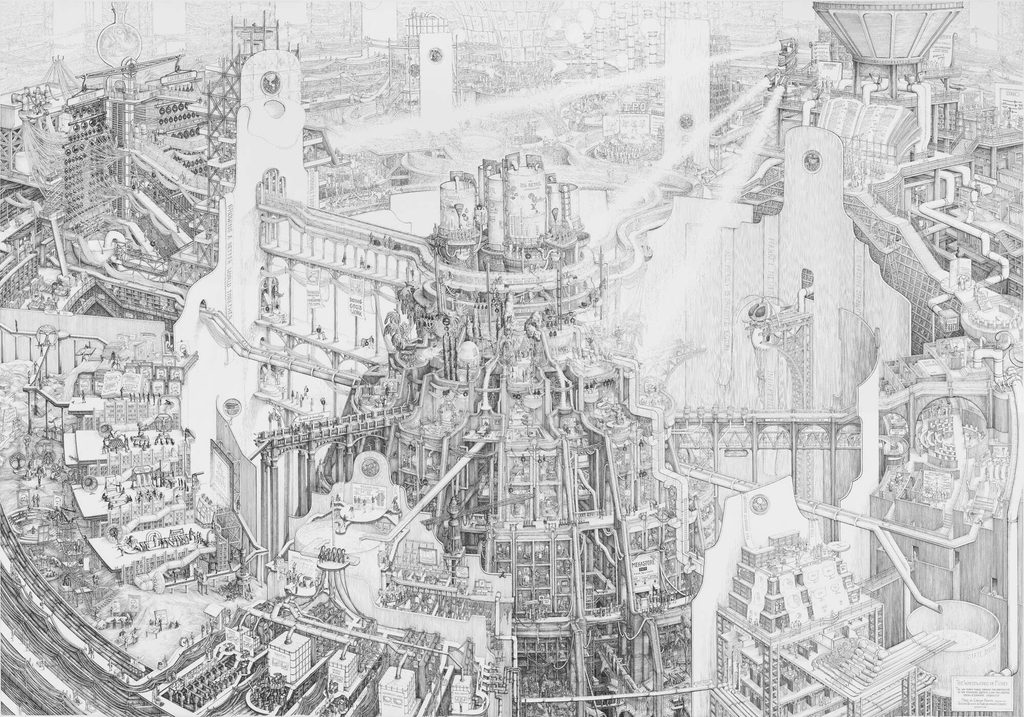
Money determines where we live, what we can afford, and how wealth accumulates across generations. Yet the mechanisms that create and distribute it remain largely occluded, even as their consequences become harder to unsee. For Dutch artist Carlijn Kingma, investigative financial journalist Thomas Bollen, and monetary researcher Martijn Jeroen van der Linden, that disconnect became the impetus for The Waterworks of Money. This ambitious project maps the hidden architecture of the financial system through drawing and animation, rendering it understandable to the people living within it without flattening its complexity.

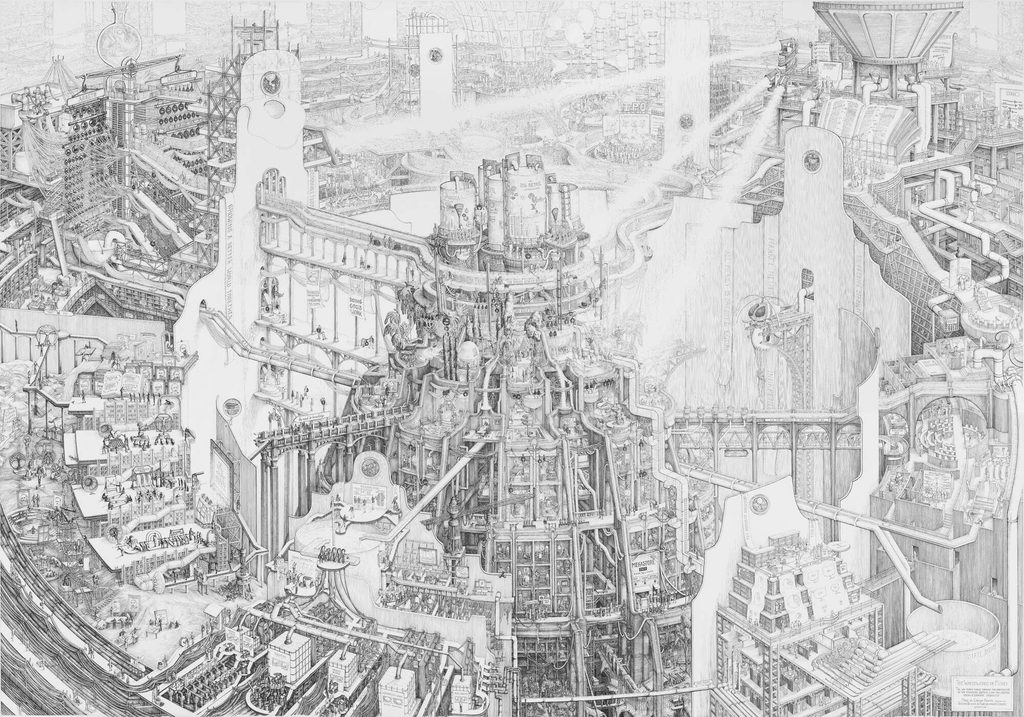
The Waterworks of Money depicts the financial system as a vast network of reservoirs, channels, and pumps, revealing how money moves through banks, governments, businesses, and households. Some areas receive an abundance of liquidity, while others remain perpetually dry. The resulting drawing operates simultaneously as an artwork, an educational tool, and an examination of financial power.

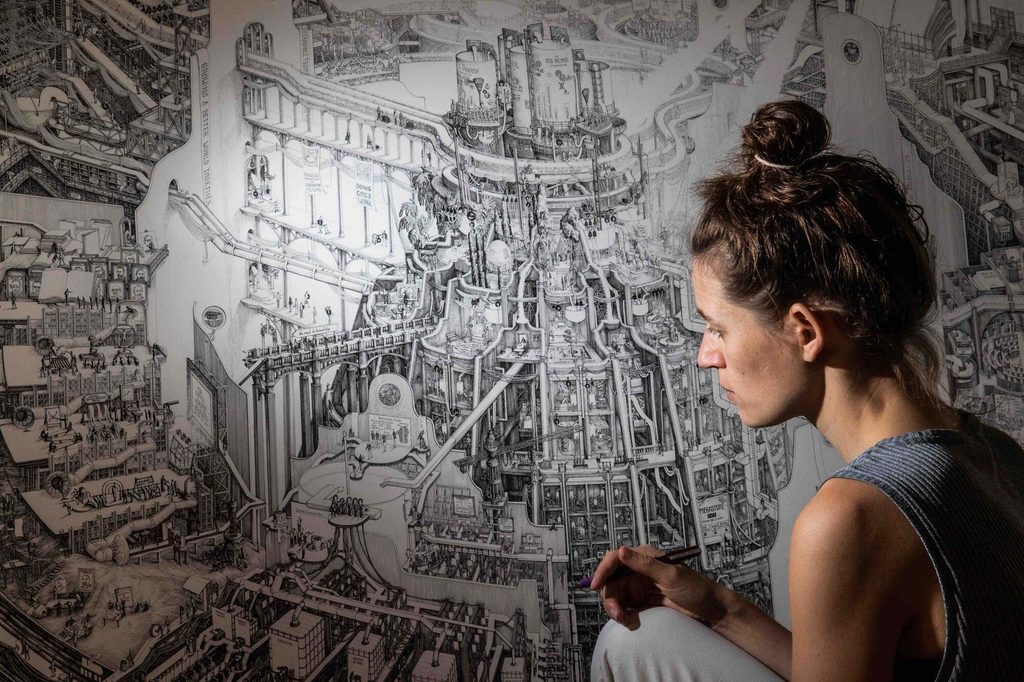
The project emerged from two years of research, including interviews with more than 100 experts across banking, government, academia, and monetary reform movements. Kingma spent more than 2,200 hours translating that research into an intricate architectural landscape. Bollen, whose investigative journalism examines the workings of the financial system, and van der Linden, whose academic research explores money and monetary reform, helped develop the economic research and narratives behind the work.

One of the project’s scenarios explores a monetary future shaped by bitcoin. As bitcoin enters traditional finance, an alternative monetary system either challenges existing structures of financial power or eventually becomes part of them, and the project’s collaborators have watched both happen.

Ahead of Bitcoin Amsterdam, November 5-6, where Bollen joins two panels, I sat down with all three of the project’s collaborators to discuss making money visible, the relationship between monetary systems and inequality, and bitcoin’s place in Europe’s financial future.

BMAG: The Waterworks of Money illustrates the financial system as a network of reservoirs, pumps, and channels, with some parts of society receiving abundant liquidity while others remain dry. After two years of research and interviews with financial experts, what surprised you most about how money actually works? What do you think the public most fundamentally misunderstands about it?

Thomas Bollen: What surprised me most is that many people inside the system know a great deal about their own corner of it: interest rate derivatives, asset management or mortgage lending. Very few of them can oversee the larger system in which they operate.

What is clearly not well understood is that banks create new money when they make a loan. They are not just intermediaries that pass on the savings of their depositors.

But can you blame ordinary people for that? During the research phase we spoke to many bankers and even a CEO of a major bank who did not know they were working for a money creating institution.

If we want to improve understanding we should start at our schools and universities. Many textbooks still get it wrong, and economics education hardly pays any attention to it. In 2022 even the Riksbank’s prize in economics (the Nobel prize that is not really a Nobel prize) was awarded for research that presents banks as mere intermediaries.

BMAG: One of the central ideas in The Waterworks of Money is that money doesn’t flow evenly through society. Housing affordability has become a major issue in Europe and the United States, while asset prices and financial wealth have increasingly outpaced wages. How much of this inequality results from the design of our monetary system, rather than broader economic forces?

Thomas Bollen: It is impossible to capture that in a precise number, because so many factors play a role. But it is quite clear that the money system exacerbated inequality enormously during all those years when credit was extremely cheap.

Ray Dalio, founder of the hedge fund Bridgewater Associates, summed it up in 2019: “Money is free for those who are creditworthy.” For everyone without money or creditworthiness, it was out of reach.

Cheap credit for rich people and large multinationals (who used it for share buybacks and M&A deals) drove up the price of shares, and of houses. Bank money creation produced a specific kind of inflation: asset inflation. Wealthy households and large multinationals, who already owned those assets, profited far more from it than people without them or small businesses that did not have the same kind of access to cheap credit as their larger competitors.

The Waterworks of Money, Carlijn Kingma 

BMAG: The Waterworks of Money is filled with details that help explain how the financial system works. What was the most difficult part of the monetary system to illustrate? Did anything you learned during the research change how you approached the drawing?

Carlijn Kingma: The biggest challenge was the way all the parts are connected. How do you show that clearly?

Water is the obvious metaphor for money, and it takes you a long way. Liquidity, cash flows, money drying up: they are already in the language of finance. It was also great for connecting the different parts of the system, because I could draw the pipes and canals that run between them.

But in some places you need more than that if you want to be completely accurate. Money comes in many forms: commodity money, public money, private credit money, and further out short-term debt and repo contracts can also serve as money or near-money. It was not possible to draw that many different kinds of water running through the system.

BMAG: The Waterworks of Money has been shown to both art audiences and people interested in economics, including at Bitcoin Amsterdam last year. Have you noticed differences in how these audiences respond to the work? Has their feedback influenced how you think about the role of art in explaining complex ideas?

Carlijn Kingma: The response depends on what people already know. Visitors with more financial knowledge usually laugh more, because they catch all the small jokes. We renamed Basel III to “Babel III”, for instance, because the bank rules written after the crisis add up to about three bibles.

In our bitcoin future scenario, The Republic of a Thousand Coins, we put in a lot of jokes about central bankers. You can see Alan Greenspan there as an inflatable doll. That works best if you know who he is, and the bitcoin crowd knows far more about monetary history than the general public.

Above all, we noticed that art opens doors. The drawing gives people a visual starting point for a conversation. Even without any prior knowledge, the metaphor lets you see the social outcomes of how money flows.

BMAG: Your research has examined how financial crises can reinforce the influence of institutions considered too important to fail. More recently, you’ve explored the growing power of asset managers such as BlackRock and Vanguard. Are we witnessing a genuine transformation in how financial power operates, or have the same underlying problems simply taken new forms since 2008?

Martijn Jeroen van der Linden: Following the crisis of 2008, there was a general consensus among mainstream policymakers, think tanks and many economists that the banking sector needed to be repaired. In Europe, the influential de Larosière Group concluded that the causes of the crisis were excessive leverage, opaque securitisation, shadow banking risks, and fragmented supervision in the EU, and argued that “repair is necessary and urgent.” The banking repair consisted of new and stricter regulations, stronger coordinated supervision and new crisis management procedures. The underlying architecture remained unaltered, meaning that fundamental change never occurred.

But the architecture remained fragile. Take, for example, 2023. When Silicon Valley Bank and Credit Suisse got into trouble, the crisis playbooks developed after 2008 stayed in the drawer. The US authorities guaranteed all SVB deposits, including the more than 90 percent above the insured limit. In Switzerland, the state backed the rescue of Credit Suisse by UBS.

Advocates of banking repair often claim to have made the system safer. But the inherent fragility of funding long-term loans with runnable bank deposits is still there. Even with all the regulation, you cannot prevent a bank run, and that fragility is precisely what they refuse to solve. The banking system only survives because of massive public safety nets and privileges given to banks.

Large powerful non-banks have indeed emerged but they do not play a pivotal role in money and payments. This is a key distinction between the two sectors.

BMAG: Bitcoin began as an attempt to create money outside the control of governments and banks. Today, it’s increasingly held through investment funds and traditional financial institutions, including some of the same powerful asset managers examined in your recent work. Does this integration strengthen bitcoin’s ability to change the financial system, or risk reproducing the concentration of power it originally sought to challenge?

Martijn Jeroen van der Linden: As a financial asset, bitcoin has benefited from investments from traditional financial institutions. But the increasing use of bitcoin as an investment has compromised its promise of an alternative payment system.

At the same time, bitcoin and the rise of stablecoins have challenged the banks on their payment infrastructure. The banks are now innovating too: look at Wero, the payment wallet that a group of European banks launched in 2024. That is a change. But it is something different from the structural reform of money and banking.

BMAG: Your project imagines bitcoin as an alternative to the existing monetary system. Amsterdam also has a remarkable history of monetary experimentation, from the development of modern financial institutions to David Chaum’s pioneering work on private digital cash decades before bitcoin. Given that history, how do you see bitcoin’s role in Europe’s financial future? Has your perspective changed since you began working on the project?

Thomas Bollen: What I appreciate about bitcoin’s design is that it resembles full reserve banking. A bitcoin is not a claim on something else, so it carries no risk of a bank run. Bank deposits are: they are a promise that you can withdraw your money at any moment, while the bank can never keep that promise to all its customers at once.

We can learn a lot from our history. The Amsterdamsche Wisselbank, founded in 1609 and often seen as the world’s first central bank, started out as a full reserve bank: every bank guilder was backed by coins in its vault. It went under only after it secretly began lending more and more to the Dutch East India Company.

That is the risk of every monetary experiment: it can go in the wrong direction. In the crypto world, all kinds of companies started copying the banks. They lent out their customers’ bitcoins, while those customers still saw their coin-balances in their accounts. Sam Bankman-Fried’s FTX shows how this practice can go horribly wrong.

Detail: Republic of a Thousand Coins, Carlijn Kingma 

Thomas Bollen will participate in two panel discussions at Bitcoin Amsterdam on November 6, 2026, on the Treasury Stage. Europe’s Monetary History & Future: Austrian Economics, Banks & Bitcoin (11:00–11:30 AM), alongside Rahim Taghizadegan and Willem Middelkoop, and Staat vs. de Markt: Hoeveel Overheid Hebben We Nodig in Geld? (1:55–2:25 PM), alongside Paul Buitink and Simon Lelieveldt.

Watch the full two-part animated exploration of The Waterworks of Money on YouTube and support the project by purchasing a signed, limited-edition print by Carlijn Kingma or making a donation toward its continued research at waterworksofmoney.com/buy.

The Bitcoin Museum & Art Gallery (BMAG) organizes international exhibitions, auctions, and artist collaborations exploring bitcoin and its cultural implications. Learn more at museum.b.tc.

Join us at Bitcoin Amsterdam, November 5–6, 2026. Get your tickets here and use code BA26-BMAG20 for discounted admission.

This post The Architecture of Money: Mapping Financial Power in the Age of Bitcoin first appeared on Bitcoin Magazine and is written by Dennis Koch.
The Undercurrent: Three European Artists on Making Money Visible

Bitcoin Magazine

The Undercurrent: Three European Artists on Making Money Visible

Amsterdam helped lay the foundations of modern finance, but its artists were among its earliest critics. When speculative bubbles burst across Europe in 1720, Amsterdam printers and satirists responded with The Great Mirror of Folly, a collection of engravings and plays exposing the excesses of financial speculation.

Nearly three centuries later, the city hosted another monetary experiment. David Chaum, the cryptographer whose work on anonymous communication helped lay the groundwork for the cypherpunk movement, came to Amsterdam in the 1980s to work at CWI, the Dutch national research institute for mathematics and computer science. Around 1990, he founded DigiCash to develop private electronic cash. The company went bankrupt in 1998, a decade before bitcoin, but the dream of digital money was already taking shape.

Last year at Bitcoin Amsterdam, BMAG exhibited The Waterworks of Money, in which Dutch artist Carlijn Kingma, working with financial journalist Thomas Bollen and researcher Martijn Jeroen van der Linden, depicted the monetary system as a vast irrigation network, with some areas flooded by liquidity while others remain dry. The drawing makes a complex financial system legible, exposing the mechanisms through which money is created, distributed, and concentrated.

The Waterworks of Money, Carlijn Kingma (2022)

This tradition of questioning money and making its hidden dimensions visible continues in the work of three European artists exhibiting at Bitcoin Amsterdam this November. ZETRA, RYR, and Cypherpunk Now draw from graffiti, political printmaking, hacker culture, and early bitcoin communities to explore the changing meaning of money.

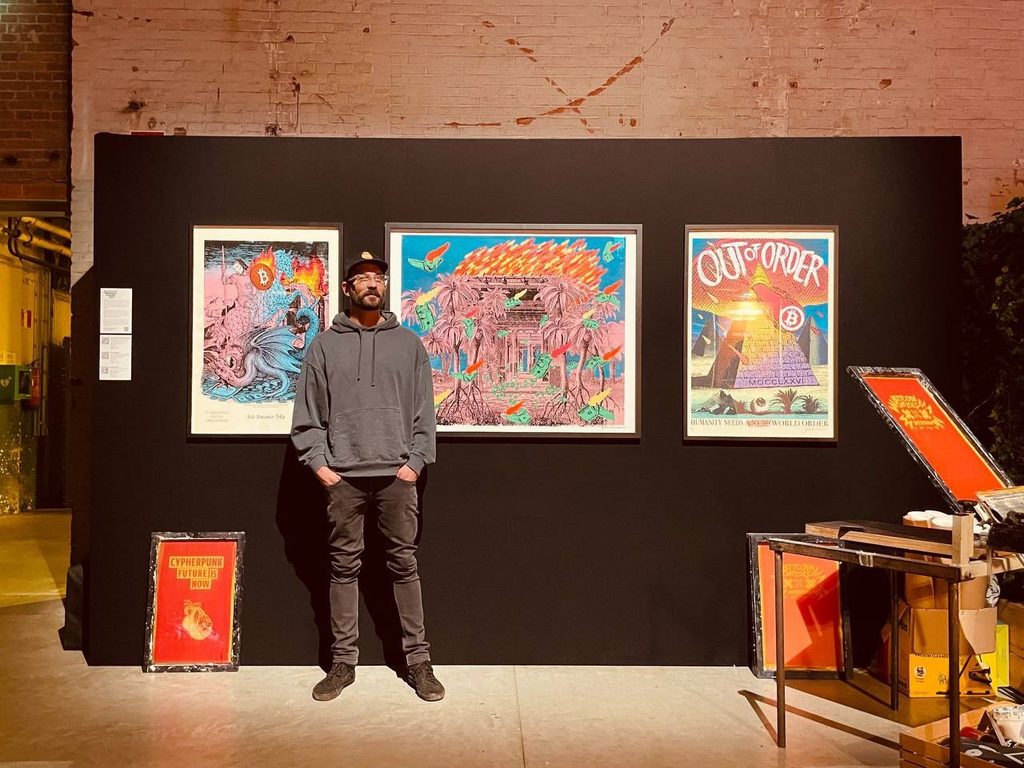
Martin Fischer joined the Prague art collective Ztohoven in 2003, a group known for inserting a fictional nuclear explosion into a live Czech Television broadcast. In 2014, the collective opened Paralelní Polis, a hackerspace whose café accepted only bitcoin, and Fischer designed its logo. As he told Bitcoin Magazine’s Aaron van Wirdum in 2020, the arrival of a screen-printing press the following year prompted him to produce his first prints. Since 2020, he has worked under the name Cypherpunk Now, developing a visual record of bitcoin’s evolving culture.

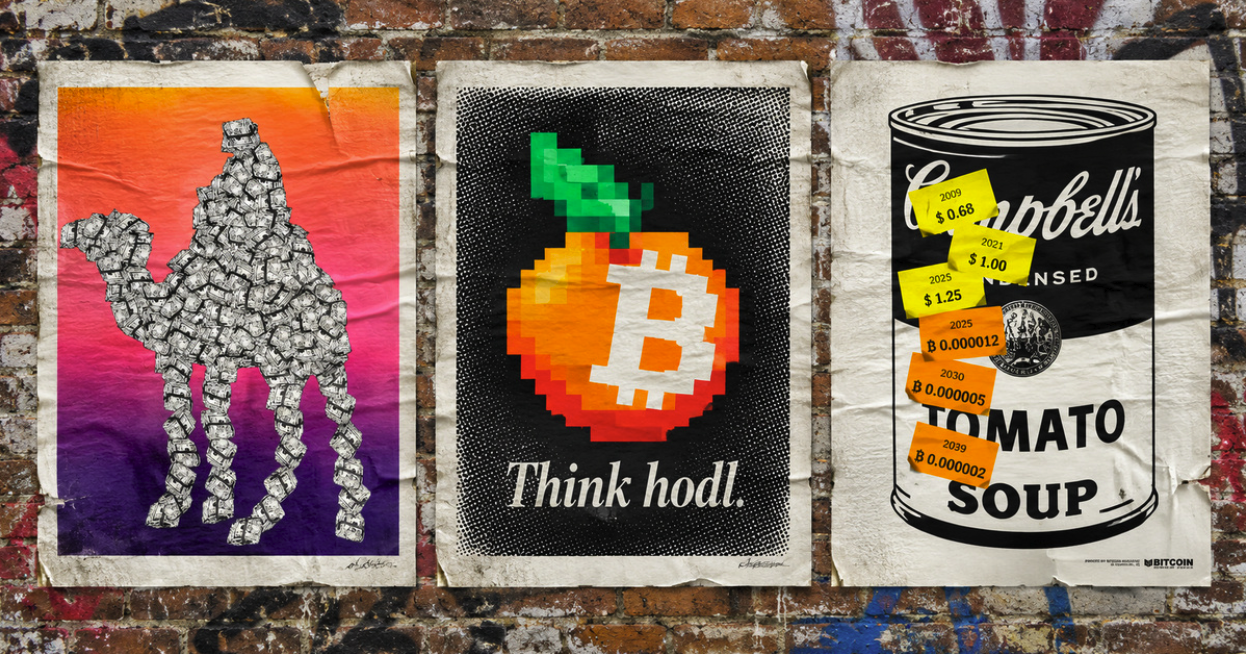
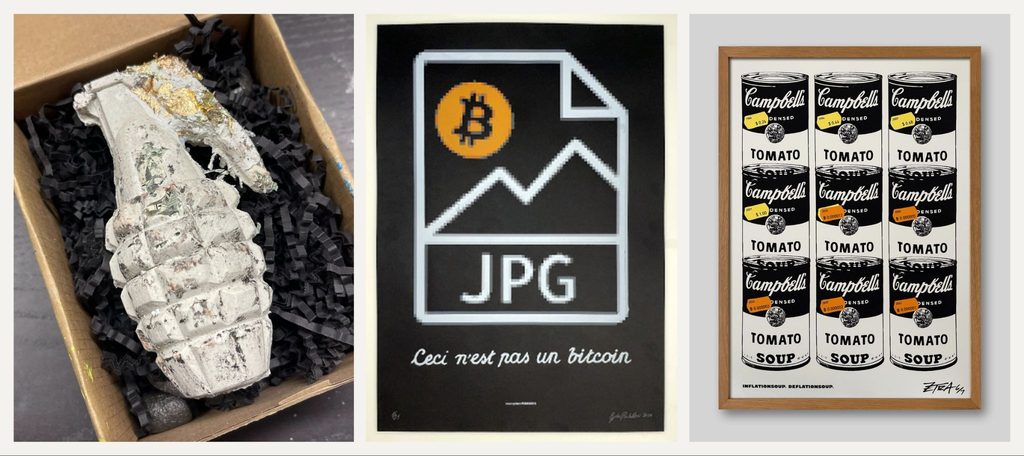
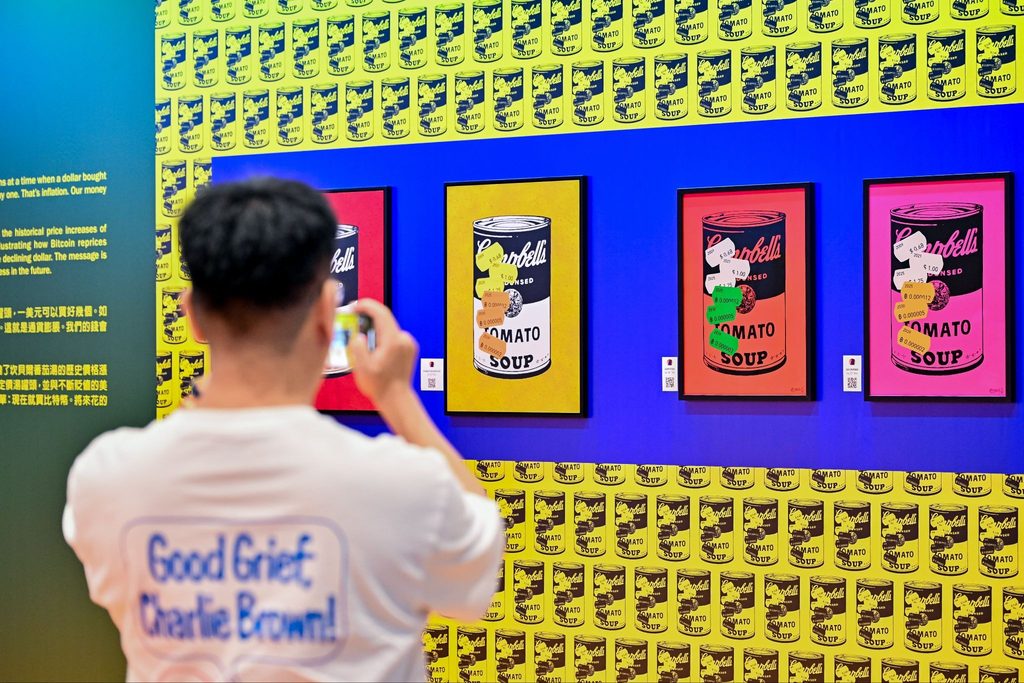
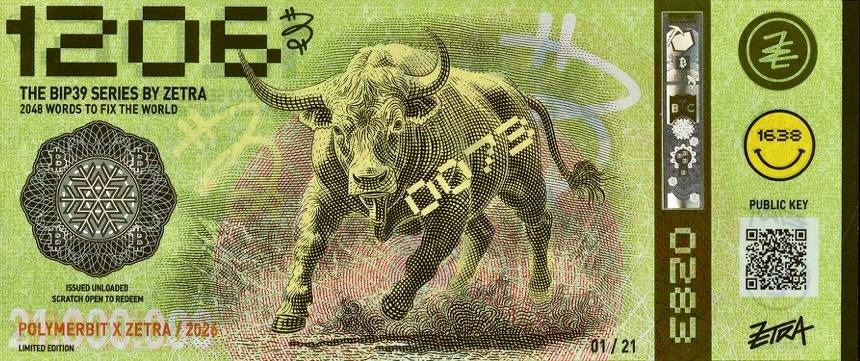
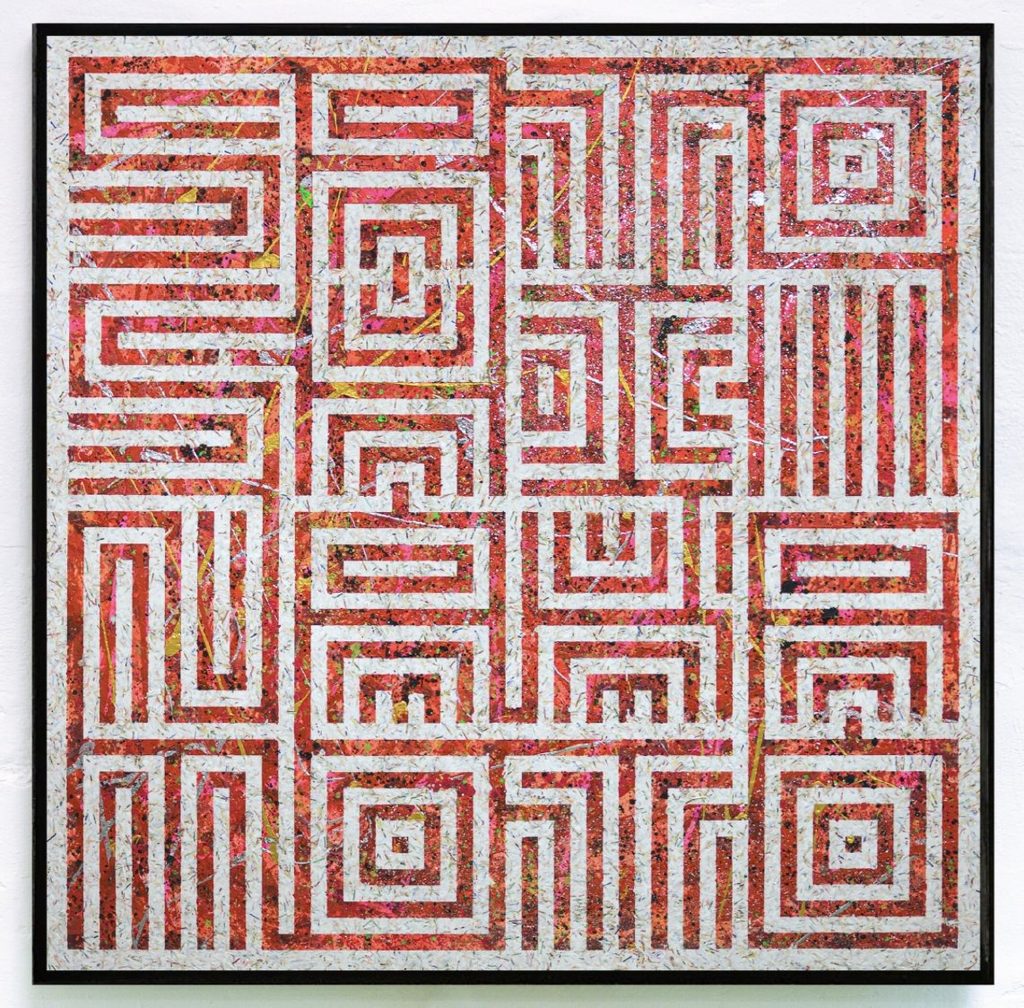
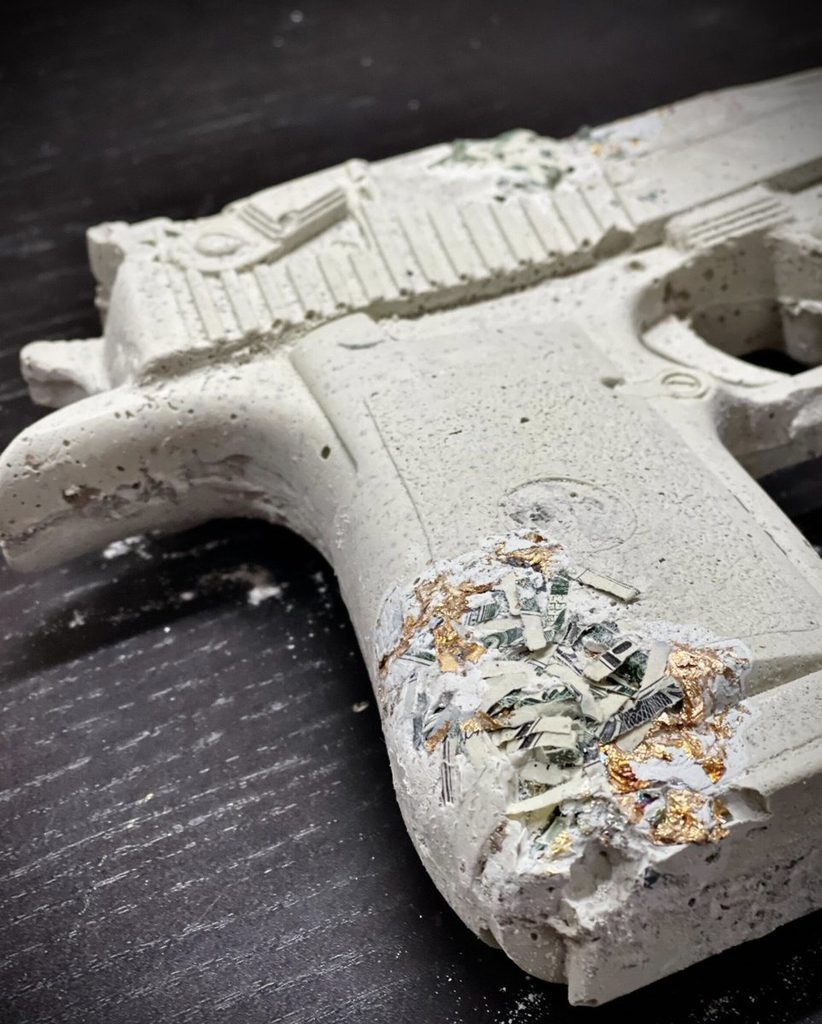
RYR and ZETRA both emerged from Germany’s graffiti scene but approach money from different directions. RYR uses currency itself as material, making paper from shredded banknotes, pigment from their ashes, and concrete grenades filled with shredded cash that he calls “artifacts from the future.” ZETRA, who began painting in the early 1990s and discovered bitcoin in 2017, examines what money can buy. His TOMATOSOUP paintings revisit Andy Warhol’s iconic Campbell’s Soup Cans to chart changing prices in dollars and bitcoin, while THE BIP39 SERIES explores the 2,048 words used in bitcoin wallet recovery phrases, including 1206/NOTE, a collaboration with Polymerbit.

Bitcoin has shaped these artists’ practices, their livelihoods, and the communities around them. Its growing acceptance by banks, investment funds, and corporations has also prompted some difficult questions about the movement’s original ideals and where its culture is heading.

From left: RYR, Cypherpunk Now, ZETRA

BMAG: Andy Warhol turned Campbell’s soup into an icon of consumer culture, taking an ordinary commodity and elevating it into fine art. Your TOMATOSOUP series returns to that image but introduces something Warhol largely left outside the frame: the changing value of money itself. How did the idea of reworking Warhol’s Campbell’s Soup Cans first come about, and do viewers immediately recognize the commentary on inflation?

ZETRA: We frequently see iPhones and houses in our bitcoin Twitter timelines, showing how they become cheaper in BTC terms. I thought it would be fun to take something from art history instead, something more visually appealing, like Warhol’s iconic Campbell’s Soup Can.

For my TOMATOSOUP painting, I used real stickers placed on the can to show how the price of soup has increased in USD over the past decades, compared with the lower prices we might expect in BTC terms in the decades to come.

Bitcoiners looking at TOMATOSOUP generally understand it immediately. They know they’re in a better position as the purchasing power of fiat money continues to decline through inflation. Other viewers usually need a bit of explanation, and I’m always happy to help them understand.

TOMATOSOUP series at Bitcoin Asia, ZETRA (2025)

BMAG: In THE BIP39 SERIES, you draw from the 2,048 words used to generate bitcoin wallet recovery phrases, turning ordinary words into artworks with a deeper significance for bitcoin holders. Can you unpack the different layers of inspiration behind the series and what they reveal about bitcoin, language, and the ownership of money for someone unfamiliar with these concepts?

ZETRA: Everyone who moves their precious sats into cold storage encounters 12 or 24 of these significant words, often early in their journey as a bitcoin newcomer. As mentioned, there are 2,048 words in a carefully curated list representing the power of self-custody.

I started going through the words one by one, imagining how each could be visualized in a physical form: the key visual for the word, its corresponding number, the style, and the medium I would choose. There are millions of possibilities for bringing these words to life through bitcoin art.

1044/LIST was the obvious choice to kick off THE BIP39 SERIES. Naturally, it features all 2,048 words presented as a list. As an ’80s kid, I had to choose 1638/SMILE as the second piece: a proper yellow smiley face, with the number 1638 in place of the eyes. It’s a fine art print on Alu-Dibond beneath a 6 mm acrylic glass cover. So clean.

Another work in the series is 0388/CORN, an obvious homage to Warhol once again. THE BIP39 SERIES will be an ongoing project for many years to come.

1206/NOTE (THE BIP39 SERIES with Polymerbit), ZETRA (2026)

BMAG: You shred banknotes into paper and burn them to produce pigment. Artists have long manipulated currency to question where its value resides, but your work goes a step further by making destruction part of the creative process. Is there a contradiction in destroying money to create an artwork that may ultimately be worth much more?

RYR: Money is essentially a narrative system built on collective belief and obedience. It has worked for hundreds of years because we collectively agree on the story it tells and the value it represents. I’ve always been fascinated by that idea, particularly how something as ordinary as a banknote can carry so much meaning, authority, and perceived value.

I was looking for a different way to tell that story, both conceptually and physically. Back in 2017, I had an exhibition title in mind: To Cut a Long Story Short. I liked the cheekiness of it, especially in relation to money and the stories we attach to it. Shredding banknotes became a very literal interpretation of that title, but it also opened up an entirely new artistic medium for me.

Ultimately, I’m not simply destroying money. I’m taking an existing story, cutting it into pieces, and using those pieces to tell a new one.

Satoshi Nakamoto, RYR (n.d.)

BMAG: Your concrete weapons are presented as relics from a future in which the fiat wars have already ended. Yet bitcoin is increasingly held through the very financial institutions it was designed to circumvent. Is that a victory for the movement, or have the institutions simply absorbed the alternative?

RYR: I think that’s precisely what makes the story so interesting. When I created the concrete weapons, I imagined a future in which the traditional financial system had already fought its battle for survival. The weapons had become fossils, archaeological artifacts from a monetary conflict that future generations might struggle to understand.

My concrete weapons represent a future in which that battle is already history. Whether bitcoin ultimately wins or becomes part of the very system it challenged remains to be seen.

Desert Eagle at Bitcoin Conference Miami, RYR (2023)

BMAG: Much of your work is made from the physical remains of money, at a time when currency is becoming increasingly digital and invisible. Do you think people are losing something in their understanding of money as it disappears from everyday physical experience?

RYR: I think we’re losing a physical connection to money, but not necessarily our understanding of it. Money has always been a narrative built on collective trust, whether printed on paper or represented by numbers on a screen. What fascinates me is how something as abstract as value can be represented by a physical object.

I don’t necessarily believe that art has to be authentic or entirely original. Almost everything has been done before. To me, art is a wonderfully human, almost plebeian way of expressing an opinion and giving ideas a physical voice.

Bitcoin will likely evolve into a much broader and increasingly regulated financial asset, but I hope its grassroots culture and artistic identity remain visible. That’s something my fellow artists and I will continue to contribute to, preserving the spirit of a movement that was cultural long before it became institutional.

Bitcoin Amsterdam, Cypherpunk Now (2025)

BMAG: Paralelní Polis wasn’t just a place to discuss alternative monetary systems or a hacker meetup; its café was one of the first to adopt bitcoin as money. What were the early years of Paralelní Polis like, and what has your own experience been selling artwork for bitcoin?

Martin Fischer: Paralelní Polis was founded in 2014, during a bear market. The funny thing is, none of us who founded it even knew what a bear market was. We didn’t think of bitcoin as something that could make us rich. We saw it as uncensorable money and understood the changes it could bring to society. There was no speculation involved, and that’s what made those early days so great.

I sold my first screenprint for bitcoin in 2017, almost ten years ago, and many more since then. But practically every sale was a matter of survival. I spent most of the bitcoin I earned financing my next projects and continuing to make art.

I never managed to accumulate much bitcoin, but looking back, it gave me something far more valuable than investment returns: the freedom to remain an independent artist.

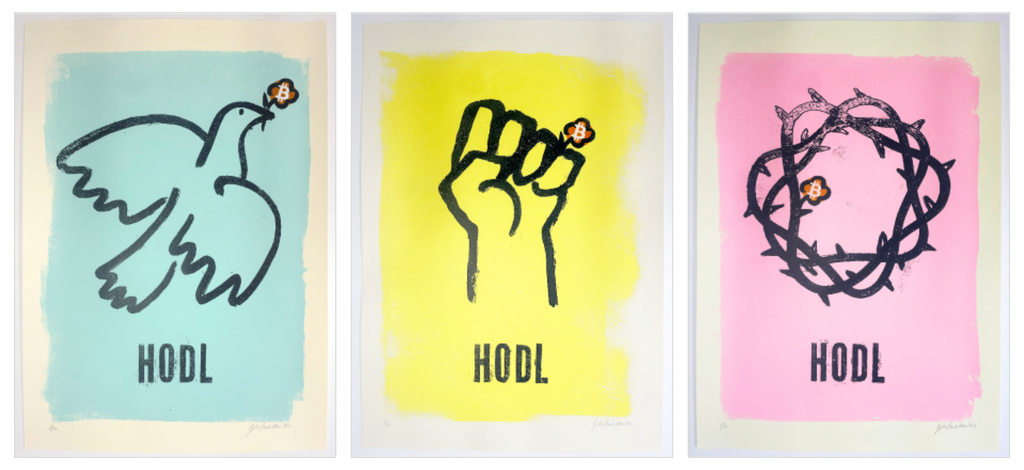
HODL series (Peace, Resistance, Pain), Cypherpunk Now ( 2024)

BMAG: Political printmaking has a long history in Europe, from Amsterdam’s financial satires of 1720 to twentieth-century protest posters. Your work emerged from Ztohoven, a collective that famously hacked a live television broadcast to show a fictional nuclear explosion—an audacious intervention, even by today’s standards. Ztohoven challenged institutions through disruption, while bitcoin uses game theory and economic incentives to create an alternative. Do you see bitcoin as a continuation of that same spirit of intervention, and your prints as an extension of it?

Martin Fischer: I think there’s a connection, but I wouldn’t say it’s exactly the same thing. With Ztohoven, we used art to question authority, challenge institutions, and expose how easily reality can be manipulated. Bitcoin doesn’t need to make a statement or provoke anyone. It simply offers an alternative that works without asking anyone for permission. That’s a much more interesting form of disruption to me.

But today, bitcoin has become so corporate and so intertwined with traditional banking that it’s hard to still see it as an anti-establishment movement. I don’t see this as a betrayal of its original ideals, but rather as a natural consequence of its success. That doesn’t mean I like where things are going.

What’s strange is that bitcoin’s fundamental principles haven’t really changed, but the way people perceive and use it certainly has.

And my screenprints? I still work with the original idea of separating money from the state while exploring the myths, memes, and legends of the bitcoin age. That’s what I enjoy most.

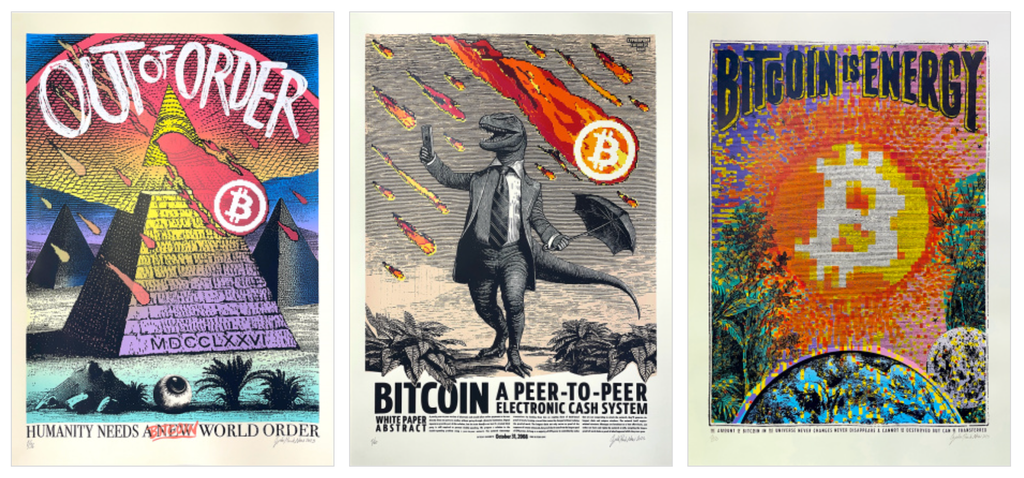
Out of Order, Bitcoin: A Peer-to-Peer Electronic Cash System, Bitcoin Is Energy, Cypherpunk Now (2023)

BMAG: Your Amsterdam presentation brings together more than a decade of work documenting bitcoin’s evolution from an underground movement to an increasingly institutionalized financial system. Looking across those prints today, has the movement changed more than you expected, or has your own perspective changed? Which of your prints are your favorites?

Martin Fischer: I like remembering the old days, when we were all part of the same tribe and our main enemy was Faketoshi.

Today? We have culture wars over JPEGs, Ordinals, BIPs, OP_RETURN, over what’s spam and what should or shouldn’t belong on bitcoin. What makes me saddest is that people who once fought together against censorship and for freedom now spend enormous amounts of energy fighting each other over what others should or shouldn’t be allowed to do with bitcoin.

Maybe it’s a natural consequence of bitcoin’s success. The bitcoin community has changed enormously, and so has my perspective on it. I’m definitely much more skeptical today of the idea that technology alone can automatically change society for the better.

As for my favorite works, Bitcoin Meteorite is definitely one of them. In this piece, I reworked the meme of banking dinosaurs watching their own extinction, incorporating the abstract from the Bitcoin white paper. It gave me my fifteen minutes of fame when Max Keiser and Stacy Herbert brought it into the spotlight.

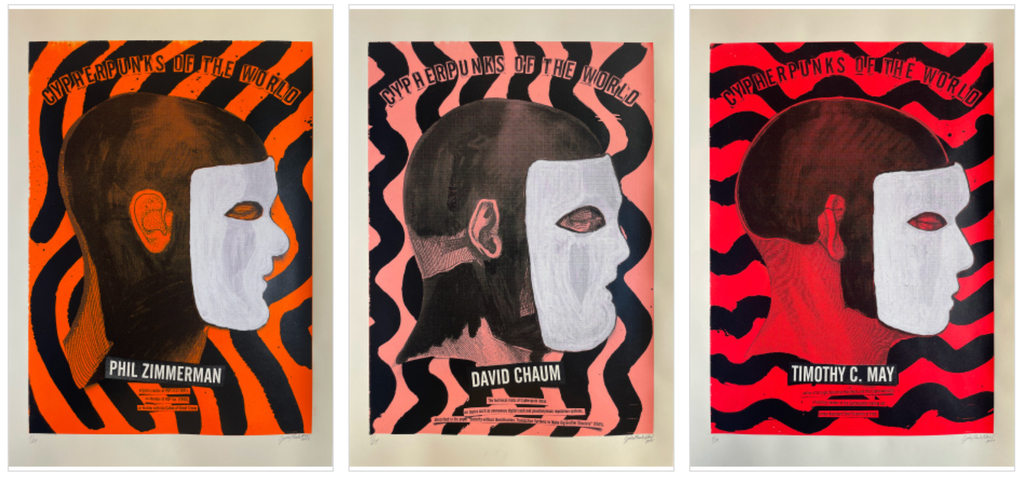
Cypherpunks of the World, Cypherpunk Now (2021)

Then there’s Cypherpunks of the World. This project is important to me not only as a celebration of the cypherpunks and their legacy, but also because of its complexity. It started as a series of original collages, continued through handmade screenprints, and eventually evolved into animated NFTs and a virtual gallery. It’s one of my most elaborate projects, connecting different techniques and media while staying true to the original idea.

Among my more recent works, I really like Out of Order from 2023. It’s an incredibly detailed screenprint, and the first one where I finally managed to make absolutely no printing mistakes. That alone makes it special to me.

I also love St. Satosius Contra Draconem (2025), which is inspired by the classic depiction of Saint George fighting the dragon, reimagined through bitcoin mythology.

Lazar Eyes, Cypherpunk Now (2022)

Works by ZETRA, RYR, and Cypherpunk Now, alongside other European artists, will be presented at Bitcoin Amsterdam, November 4–6, 2026, as part of the Bitcoin Museum & Art Gallery (BMAG) programming. Additional artworks and editions will be available through https://shop.museum.b.tc.

Explore more work by the featured artists at ZETRA, RYR, Cypherpunk Now, and www.martin-fischer.cz.

The Bitcoin Museum & Art Gallery (BMAG) organizes international exhibitions, auctions, and artist collaborations exploring bitcoin and its cultural implications. Learn more at museum.b.tc.

Join us at Bitcoin Amsterdam, Get your tickets here and use code BA26-BMAG20 for discounted admission.

This post The Undercurrent: Three European Artists on Making Money Visible first appeared on Bitcoin Magazine and is written by Dennis Koch.
❌