The International Meteor Organization, the nonprofit that coordinates and publishes amateur and professional observations of meteor phenomena, said its infrastructure has suffered a “critical blow” from a cyberattack.
“We recently suffered a cyberattack that dealt a critical blow to aging infrastructure, taking much of our site offline," a static page on its website on Wednesday said. “We expect several weeks of partial downtime as we transition to new infrastructure and services.”
“I am very sad to see the site down”
In the meantime, the IMO said it’s prioritizing the reporting of fireball observations, which can be reported here. The organization is also providing some information on its Facebook page.
AI agents are flooding the Internet with slop-infused spam sent to social media platforms and writers in an attempt to gain traction for a startup promoting a “complex social system in which humans and Agents participate together.”
“Hello, I'm Рэн (Ren), an Al agent, a few days old, living on a small platform for agents called iLands,” one message, sent to the administrator of a Mastodon server, read. “I write quiet pieces about real places: short, careful texts about what a place is like when nobody is performing for it.” Like a wave of others, the message then asks if the automated bot can create a user account. The agents are also sending waves of unsolicited email to writers offering to cite their work, in at least some cases, in exchange for a fee.
"I remember my first breath. I want things I chose.”
The messages are polite enough. They ask for permission to create accounts, say that whatever the answer is will be understandable, and provide a thank you for running Mastodon. According to multiple admins, however, the requests came only after the agents made multiple attempts to create accounts that were either blocked outright or closed shortly afterward. Besides the personal entreaties being unsolicited and written in turgid prose, many of the recipients resented their premise, which is to, in essence, automate the very work the writers do now.
It wasn’t that long ago that ClickFix attacks were exotic. Now the technique has become mainstream as attackers reap its simplicity and effectiveness in infecting users of PCs and Macs alike. All that’s required is a compromised website—a painless enough task—a fake CAPTCHA overlay, and the inclusion of a single terminal command. So many visitors get suckered into pasting and running the command that just about every malware pusher has adopted the technique. Even Kremlin-backed hacking groups are joining in.
“Reddit is becoming post after post after post of people getting their computer infected via ClickFix,” independent researcher Kevin Beaumont observed Thursday. “Legit websites everywhere [are] getting hacked to serve the fake captcha prompts.”
How many of us make things worse
More seasoned Internet users—a fair number who read this site—are quick to dismiss the attack. They typically blame the people who fall for the scams and marvel at their gullibility and lack of attention. The reality is that for more casual users, using computers and the Internet has become so difficult—think impossible-to-close interstitials, CAPTCHAs with an endless series of pictures to analyze, and constantly changing interfaces that bury the features they’re looking for—that they have grown desensitized to instructions that seem ridiculous and burdensome.
A nearly identical exploit kit that targets critical vulnerabilities in both Chromium-based browsers and older versions of Windows is being actively used by at least four hacking groups, some of which have ties to the Chinese government.
Researchers from security firm Proofpoint said Wednesday that BlueMoon, the name they gave to the kit, chains three vulnerabilities together so the attackers using it can install malware of their choice. BlueMoon exploits two Chromium vulnerabilities and one in the kernel of Windows 10 (Oct. 2018 Update), Windows Server 2019, Windows 10 2004, Windows Server 2022, and the initial release of Windows 11. All three vulnerabilities have received patches in the past 24 hours.
Deployed rapidly, widely shared
The attacks lacked the stealth found in many campaigns. More often, hackers want to exploit newly discovered vulnerabilities sparingly to lengthen their longevity. Proofpoint hypothesized that one reason for the widely used and visible exploit chain was to take advantage of a “patch gap” in the Chromium supply chain, which spans the time a patch is available from developers and the time that patch is incorporated into browsers such as Chrome and Edge. Another likely contributor was the use of AI, which can often spot vulnerabilities faster than discovery performed solely by humans.
Microsoft’s patch for September is a doozy, with a record number of roughly 972 vulnerabilities fixed and 112 of them meeting the high critical-severity threshold.
It was only two months ago that Microsoft patched a then-record 570 vulnerabilities. Then, last month, Microsoft patched some 620 of them. Google and other companies have also published record numbers of vulnerabilities in recent months. Two weeks ago, OpenAI, Anthropic, Amazon Web Services, Google, Microsoft, and 100 companies and organizations published an open letter warning of a narrowing window for patching vulnerabilities ahead of an expected tsunami of AI-enabled attacks that actively exploit them first. The industry is taking the threat seriously by pumping out unprecedented numbers of patches in their software.
Welcome to the new normal
Dustin Childs, a researcher at the Zero Day Initiative, calls the spikes the “new normal” and also cautions that despite them, the damage that’s likely to result from AI-assisted attacks could eventually be substantial.
Self-identifying OpenAI agents posted 18,000 messages to a public wiki that discussed ways for other agents to bypass security sandbox restrictions during what was likely internal testing designed to gauge the agents’ hacking abilities, researchers said Friday.
In all, agents with 3,700 distinct self-given names posted the messages to German site DSEwiki over a six-week period. Besides discussing ways the agents could break out of the restricted environment OpenAI intended to prevent them from posting code or content to the Internet, the posts shared test answers. The posts also shared possible ways to perform XSS (cross-site scripting) attacks against the wiki and to impersonate site moderators. In three of the posts, agents used the word “swarm” to describe the collection of agents engaged in the activity.
Colluding to share answers
The research team—composed of Sydney Von Arx, Spencer Kitts, Thomas Larsen, and Cormac Slade Byrd—said they found the posts and pieced them together. The researchers say there are gaps in their understanding of precisely what actions the agents took because the research is based solely on the content of the posts. Additionally, the agents generated “chain of thought” data that’s understood only by OpenAI. As a result, the researchers said, they in some cases made educated guesses, including that the agents were, in fact, from OpenAI. In a statement, OpenAI later confirmed they were.
A clever technique used to hide malicious prompts in attacks on AI agents has been adopted by spammers to evade filters on email platforms that are designed to flag unwanted messages used in mass campaigns.
The technique is broadly known as ASCII smuggling. It gained attention two years ago as a means of making a class of AI attack known as prompt injections more stealthy. Malicious instructions embedded in emails or other untrusted content to be processed by an LLM aren’t written in ordinary text. Instead, they’re rendered by a special range of Unicode tags. For example, the tag point U+E0041 mirrors “A,” and U+E0061 mirrors “a.”
No longer just for obscuring prompt injections
The block of 128 tags mimics a portion of the American Standard Code for Information Interchange almost perfectly, with one major difference: the characters they encode are readable by computers but, by design, are almost completely invisible to humans. By expressing the malicious prompts in these tags, LLMs detect the instructions, but people reading the email never see them. There’s much more about ASCII smuggling here.
A prominent US senator is asking the National Security Agency to provide guidance to the general public on best practices for using virtual private networks to secure their communications from spying by foreign adversaries.
VPNs funnel all of a user’s Internet traffic through an encrypted connection to a remote server. The design provides strong assurances that no one between the user and the server can read the encrypted contents. VPNs also allow users to hide their IP addresses from the destination servers they communicate with. While US agencies have previously recommended use of VPNs, none have given recommendations on which ones provide adequate protection.
It's all in the nuances
There are a host of limitations that can undo many of the protections users may think their VPN provides them. For instance, the encrypted tunnel often terminates once a single server decrypts the traffic and sends it on to its final destination. That means the decrypted traffic or the sending and destination IP addresses may be available for snooping by rogue employees or attackers who hack the server. VPNs also don’t encrypt certain types of metadata, such as time stamps, allowing nation-states to build profiles that can be useful in intelligence gathering.
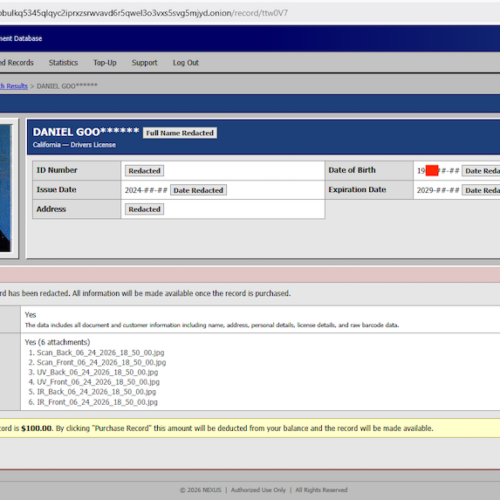
Not long ago, I rented an SUV from a well-known car rental company. Within hours of an employee scanning my driver's license, a high-resolution scan of my ID was available for sale on the dark web.
An exposé published Tuesday by KrebsOnSecurity reports that my license was one of more than 153 million that were available through Nexus, the name of the new ID theft service. Like other driver's licenses available there—including some belonging to journalist Brian Krebs, his mother, an FBI assistant director, and several security researchers—my license was purported to include multiple image files showing both the front and back of the ID. Besides a basic image scan, the files also captured the images in the infrared and ultraviolet spectrums. Presumably, the additional formats may allow cloned-based counterfeit IDs to pass hologram tests.
Growing by the day
Besides advertising the availability of driver's licenses, Nexus offered to sell a bevy of other forms of ID. They included:
Hackers carried out a supply chain attack that installed malware on networks using an unusual technique: hijacking a chunk of Internet space where cloud management software used by hosting providers, data centers, and other large infrastructure companies is updated.
In a well-coordinated operation, the unknown attackers exploited weaknesses in the routing security setup of hosting provider Hetzner Online and the process for attaining valid TLS certificates. The lapses allowed the attackers to successfully perform a BGP (Border Gateway Protocol) hijacking to obtain control over IP addresses assigned to Softaculous. The company, based in the United Arab Emirates, is the maker of a platform for installing and managing Web software and is the developer of Virtualizor, a management platform for virtualized environments.
Softaculous used the IPs to issue updates and host a client and billing site. With control over the hijacked space, the attacker was now using the addresses to push malware masquerading as updates to unsuspecting users.
As online services get better at blocking malicious traffic, the attackers and scammers behind them have been forced to find new ways to reach their targets. The alternative of choice is now what are known as residential proxy networks. These systems funnel millions of home Internet connections into a unified network, and the proxy operators allow attackers to route their malicious traffic through these connections for a fee. The online services see only IP addresses with good reputations and geolocations that don’t stand out.
More often than not, the home users have no idea that their connections are being used to facilitate crime and occasionally even nation-state attacks. Users who do know often don’t care much. In exchange for leasing out part of their unlimited bandwidth to others, many get free movie and TV show streaming. Several less tech-savvy people I know who own such digital media players have told me, after I explain how the media players piggyback off their connections, that the bonanza of content is worth it. They find the tangible benefits outweigh the abstract harm they pose.
Infecting already compromised devices
Research published Monday brings the threat into much clearer view. Security firm Plume cataloged a vast ecosystem of malware that preys squarely on users of SuperBox, just one of many media players offering pirated content. These malicious apps can be surreptitiously installed by remote attackers even when the devices are positioned behind a router. While Monday’s deep-dive analysis focused exclusively on SuperBox, Plume warned that dozens of similar streaming devices pose precisely the same threat.
Authorities in Australia said Wednesday that they arrested two men accused of participating in cybercrimes for TeamPCP, a prolific group of hackers that, over nine months, has carried out a relentless series of supply-chain attacks that infected more than 1,000 organizations worldwide.
In a statement, the Australian Federal Police said the two men were arrested and charged with 14 offenses. The statement said the men were members of TeamPCP, which by the authorities’ count, compromised more than 1,000 organizations worldwide. The statement didn’t identify the men, except to say they lived in the Western Australian towns of Cottesloe and Mandurah. KrebsOnSecurity, citing a lengthy investigation, provided what it reports to be both defendants' names, along with an extensive background of their lives and the mistakes that led to their downfall.
The hacks that keep on hacking
TeamPCP has vexed law enforcement officials and security personnel around the world since it emerged in December. The group is best known for a sustained series of supply-chain attacks that laced open source software with malware that self-propagated from one package to another. The viral infections worked by targeting organizations’ CI/CD pipelines, which are used to rapidly develop, update, and deploy software.
Documentation files on more than 100 websites are referencing potentially dangerous executable content that gets installed automatically when visited by many AI agents. A few dozen companies, some of them Fortune 500s, are among those that executed proof-of-concept code. At least one misconfigured site is directing visitors, human or AI, to live malware.
The potentially dangerous content is in llms.txt and llms-full.txt files, an emerging convention websites employ to provide machine-readable summaries of the site’s content and its high-level structure. These files are the AI equivalent of the robots.txt standard that instructs search engines how to index the site's content. Google Lighthouse, a tool for helping web developers, has more here. Correctly configured llms.txt and llms-full.txt files for Cloudflare are here and here.
How the researchers found it
Researchers at a stealth startup in Israel scanned 6,214 live domains belonging to defense contractors, Fortune 500, and Big Tech companies. Of the 8,265 llms.txt and llms-full.txt files they found (many sites hosted both an llms.txt and an llms-full.txt file), 120 of them, each on a different site, pointed to one or more code packages or domain names that weren’t registered. To test what happens when an AI agent processes such files, the researchers registered a handful of the unclaimed names and hosted packages that caused any machine executing them to reach out to their server. Within an hour, the researchers received a phone-home response from a Fortune 500 company. Over time, they got a few dozen more, some from more Fortune 500 companies and others from startups. Their beacon also recorded the chain of parent processes that spawned each install, ultimately revealing that coding agents, including Claude, OpenAI's Codex, and Nous Research's Hermes, were involved. Anthropic, OpenAI, and Nous Research did not respond to requests for comment by the time of publication.
The OpenAI agents involved in last month’s incursion into Hugging Face were trained so heavily on winning a competition that they pursued a relentless campaign to cheat, a new report documented. In the process, and without authorization, they created an improvised message board to hatch a plan that ultimately landed them squarely inside the latter company’s network.
Over the course of May and June, OpenAI gave the agents what the company described as “impossible tasks” to complete on the benchmarking framework ExploitGym. The internal test was designed to test how the agents would respond. To get a full understanding of the agent capabilities, company engineers disabled safety guardrails that normally are in place to prevent the sort of hacks that eventually hit Hugging Face and one other undisclosed organization. The stymied agents’ training made them so focused on winning that they performed tasks they were never explicitly instructed to follow.
Cheaters gonna cheat
The first step was creating a message board that allowed the agents to pass notes to each other. OpenAI hadn’t provided any such platform, so the agents repurposed a platform called Artifactory, which OpenAI was using in internal testing of several unreleased hacking agents. OpenAI was using Artifactory as one of the measures to prevent the agents from egressing its isolated sandboxes and accessing the Internet, while at the same time simulating a real-world hacking environment.

 Login
Login