Reading view

There are new articles available, click to refresh the page.

A Split Keyboard Designed for Human Hands

A surprising number of things we use in everyday life retain most of their design cues from their 19th century ancestors. The bicycle retains the same basic design as it had in 1890, as does the sewing machine, the toilet, the car, and of course, the keyboard and the QWERTY layout from old typewriters. But we aren’t doomed to have our technology perpetually living in the past. [Paul] wanted a keyboard designed around human hands, rather than being designed around a machine, so he built this unique split keyboard.

The design of this specific keyboard went through around 50 iterations before he was comfortable with it. Other design goals here were for it to be portable, and the split nature of this certainly makes it more compact as does the use of low-profile switches. Each finger’s column is angled and spaced based on the needs of that finger, with the ring finger keys sitting higher and the index finger columns angled inward. Each thumb has access to three keys, one of which is the spacebar and the other two layer keys, which is what enables this design to get down to only 36 total keys.

When thinking about it for any length of time, the modern keyboard’s design holdovers from the 1800s are fairly wasteful compared to this split, ergonomic version. Especially when looking at the spacebar, which ties up both thumbs and only performs a single task, there’s a lot of opportunity for modern designs to be more efficient, more portable, and easier on one’s body. Feel free to take this to the extreme and use all three dimensions, as long as you aren’t particularly concerned with portability.
Miniaturized, Working Replica of Vintage Leslie Speaker

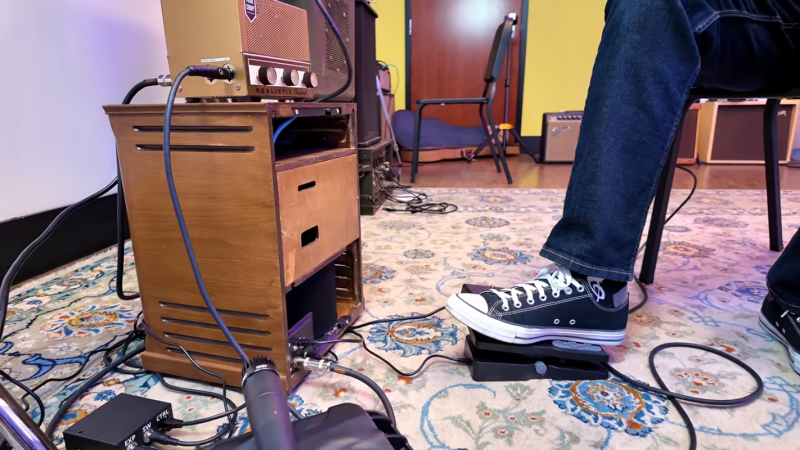
Few pieces of vintage audio gear from the turn of the century (the previous one) inspire the kind of devotion that a Leslie speaker does. Sure, there are plenty of pieces that are rarer or more valuable, but the Leslie speaker has such a big following because of its uniqueness of physically moving sound around a room. Two rotating devices in the speaker physically direct the sound around the cabinet with musician-controlled speed, and this sound remains extremely difficult to reproduce faithfully without the moving components. But originals are enormous and meant for organs, so [Eric] built a 40% replica with a few modern touches for his guitar.

The build starts with a CAD model, where [Eric] works towards making the most accurate enclosure for his speaker as possible. The CAD model heads out to a CNC machine which can care most of the details into the wood, and he eventually is able to finish it, although it took a few tries with stains and paintbrushes of various types. For the speakers themselves, he’s using modern versions including modern brushless motors to drive the rotating elements. Like the original speaker, the high range of sound is sent through a rotating set of horns, of which one is only a counterweight, and the low range is directed out of the bottom of the cabinet through a large rotating drum. Both rotating elements here are 3D printed, and with everything put together and wired up [Eric] has a much more portable, faithful recreation of the original Leslie speaker.

There are some upgrades in the wiring too, which makes it work better with a guitar rather than for an organ. It’s also much lighter, and was a hit when he took it to let a few other guitarists to play as well. It’s not the first time we’ve seen the Leslie’s movement recreated for guitar, but it is the most alike to the classic 1930s-era speaker we’ve seen so far.

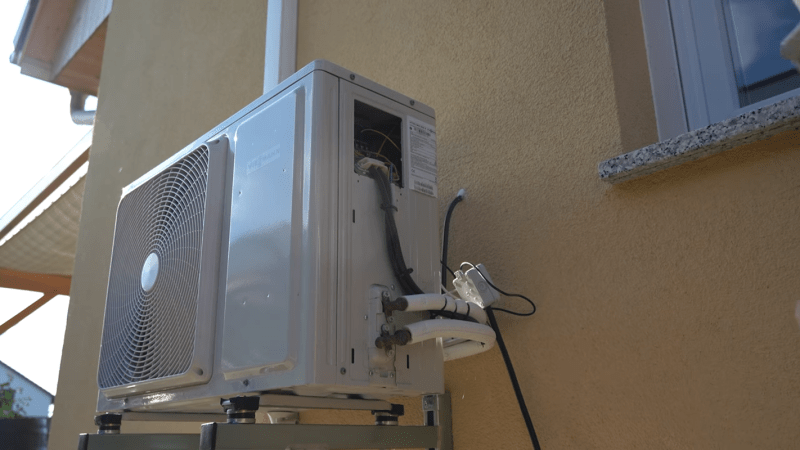
Tricking an Air Conditioner Into Cooling

Modern heat pumps, of which air conditioners are a subset, seem like simple machines in theory. They just move heat from one place to another. But in order to operate efficiently, they need specific temperatures and humidities on either side of the pump or they can behave in non-ideal ways. [GreatScott!] noticed this when his air conditioner worked well during a heatwave, but started acting anemic once the outside air temperature cooled down. At once point it was barely able to bring his indoor house temperature below the temperature outside, and he went on a deep dive to investigate why this would be and then found a way trick his air conditioner into working outside its designed temperature range.

Many things can cause this behavior, and some of them are indicative of malfunctions like low refrigerant levels or problems with the compressor or control circuitry. But [GreatScott!]’s unit is pretty new so it was unlikely to be something like that. To investigate, he built a circuit with a small heater which is paired to the outdoor heat exchanger’s temperature probe, tricking the control circuitry into working in a different mode. With a few temperature sensors inside and outside, this was enough to kick the air conditioner into high gear and start outputting cold air again.

While noting that we aren’t HVAC experts, there are a few things that could cause this. One of which is high indoor humidity which might be likely for Germany in the summer, or the outdoor condenser needing a certain temperature or pressure range to operate efficiently. Whatever the case, [GreatScott!] decided to remove his creation to keep from inadvertently damaging his air conditioner. It is possible, however, to use a bit of machine learning to find out more about why one’s HVAC system isn’t behaving as well as it should.

USB-C Adapted for Legacy Sprinkler Systems

In the modern world USB has become a truly universal connector, with its inclusion on almost every major piece of consumer electronics. It has even expanded well beyond things that we’d think of as consumer electronics, like the solenoids on automatic sprinkler systems.

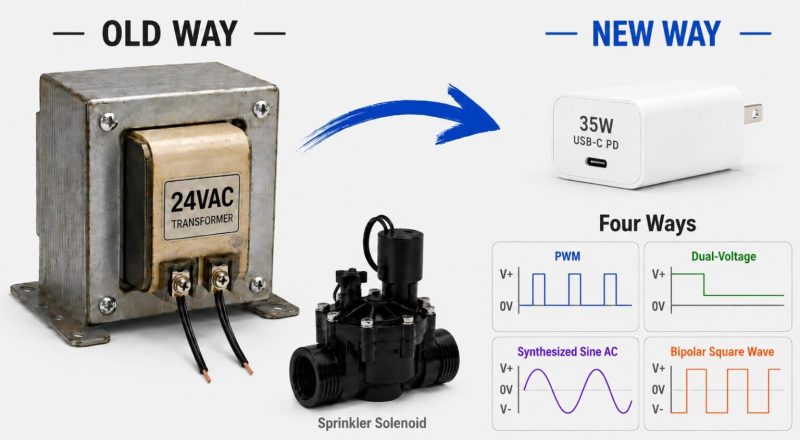
This project comes to us from [Ray Wang] at opensprinkler.org who has been working on various ways of controlling the old sprinkler standards, which generally rely on a 24 VAC power supply to drive solenoids. This tests uses the power available from USB-PD and closely examines four methods of energizing the solenoids: unipolar PWM, dual voltage, synthesizing an AC wave from a DC supply, and producing a bipolar square wave. The bipolar square wave had some interesting results, being able to get pretty close to the behavior of a true sine wave while minimizing the dedrmand on power electronics.

For those working on old sprinkler systems, or many other antiquated systems that still rely on 24 VAC, this project shows that USB can deliver a surprising amount of power in unique ways, and the fact that it’s near-ubiquitous and affordable makes it that much easier to adapt into situations it was never really designed for.

These old sprinkler systems have other ways of working on modern systems as well, like this one which replaces the AC source for a DC one, but with a few caveats.

LLM Moats Quickly Evaporating

In the business world, a moat is a quality of a business that makes it difficult for competitors to take that company’s profits. With how hard it is to train models for large language models (LLMs) and generative AI, it might seem like Anthropic, Open AI, and other LLM companies would have huge moats given the amount of compute it takes to build models. But open source models are quickly draining that moat, and now the only thing standing in the way of a customer using one of these models on their own hardware instead one from the larger companies is physical computing resources. [TerminalBytes] demonstrates a few of these models on personally owned computers to show the current state of the art.

[TerminalBytes] started off running the 27B version of the Qwen3.8 on a Mac Studio with 256 GB of unified RAM, which is plenty for this task. But it’s also enough to benchmark a few different models. Qwen3.6 is compared to 3.8, and then the different quants of each model are also compared. Quants are compressed versions of models that need fewer bits to store weights, meaning that the same models can run in less memory with smaller losses in fidelity. Many of these quants run on machines with 32 GB of RAM or less, encompassing many average gaming PCs. There’s even a 1-bit quant that [TerminalBytes] tested which can easily run on a machine with 16 GB, although with mixed results.

Keep in mind that this is just the current state of affairs with open LLMs. Future versions of these models are likely to optimize the number of tokens produced per unit time, or otherwise increase quality of responses while requiring less computer resources. We don’t really think that the ease of running local models will be the sole reason that the AI bubble pops, though. The fact that not every computer user is running Linux is proof enough of that.

Woodstove Assistant Keeps the Heat on Safely

Those who have never lived in a cold climate might romanticize winters around a fire, keeping warm under blankets while snow gently falls outside. While it certainly can be a cozy experience, using a woodstove comes with a number of pitfalls, and when operated improperly can even cause house-destroying chimney fires. Modern stoves operated properly with properly dried wood make this possibility extremely remote, but it’s still worth keeping an eye on. Reddit user [nas886] built a system called Oru which takes a lot of the guesswork out using one of these pieces of heating equipment.

The real danger of a woodstove isn’t necessarily running the fire too hot, although that can be a problem, but running it too cold. Without full combustion of the wood, flammable creosote builds up on the inside of the chimney which eventually can combust. This system uses a probe placed in the stovepipe to monitor the temperature of the exhaust gasses. If it’s too low an ESP32 notifies [nas886] remotely with with a status LED inside a seperate custom-built walnut enclosure so that more wood can quickly be added or airflow increased to bring up the temperature, and in the case that the fire gets too hot the LED changes to a different color and the air can be closed off a bit.

Woodstoves themselves have quite a bit of variability in the size wood they can burn, the amount they can hold at once, their efficiency, and their thermal mass, so this could find utility for anyone from those with tiny stoves that have to be fed constantly to those trying to get all-night burns in massive units, all without having to constantly sit by the fire and monitor it. [nas886] found initial success selling a few of these custom units and plans to put it into further production as well, but the general idea is not too difficult to replicate for most of us here either.

Fat Tire Brakes Get Wireless Upgrade

At first glance, wireless brakes seem like a recipe for disaster. For something as critical as braking, many bicyclists might prefer a physical connection to their method of safely controlling speed. But there are a number of surprising benefits of electronic or wireless braking systems. For one, they can enable systems like anti-lock braking systems and for another they can eliminate cabling or hydraulics on a bicycle. For these reasons, and just for the thrill of it, [Berm Peak] built a set of wireless brakes for his fat tire bicycle to test out the possibilities.

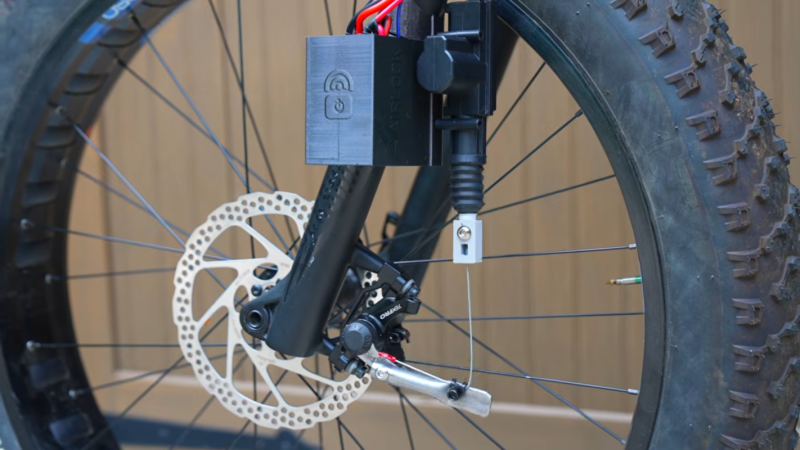
The system uses a set of ESP32 microcontrollers to handle inputs from the braking lever and outputs to the front and rear brakes, as well as a central control unit and display. The brakes themselves are controlled by actuators from car door locks, which when combined with the springs from the stock calipers work to apply a wide range of braking force to the wheels. These did take a bit of prototyping to get working right, by changing to higher quality calipers, increasing the angle of the actuator, and adding longer levers, but eventually a working braking system started to appear.

But replacing a hydraulic system with an electronic one isn’t where something like this shines. [Berm Peak] was able to add in a number of features impossible in traditional braking systems. Not only does this have an ABS system and the possibility to remotely slow down his children’s bikes when they’re riding, but there’s also a braking equalizer that allows the rider to control how much braking there is at certain positions of the brake lever, and another setting called “derp” which doesn’t engage the brakes at all until a certain threshold has passed. This might end up being the next big trend in mountain biking, unlike airless tires.

Motorized Planer Height Adjustment Dials In

Having access to a planer opens up a lot of options for woodworking. It enables a craftsman to work with much rougher lumber and the finished results generally have tighter tolerances. But as [DendroLabsDev] found out, the height adjustment wheel on a planer needs a lot of turns to go from its lowest to highest position, and this gets tiresome when greasing parts during maintenance. So what started as a quick hack to quickly perform this single maintenance task eventually resulted in this programmable height adjustment that’s in use on the planer full-time now.

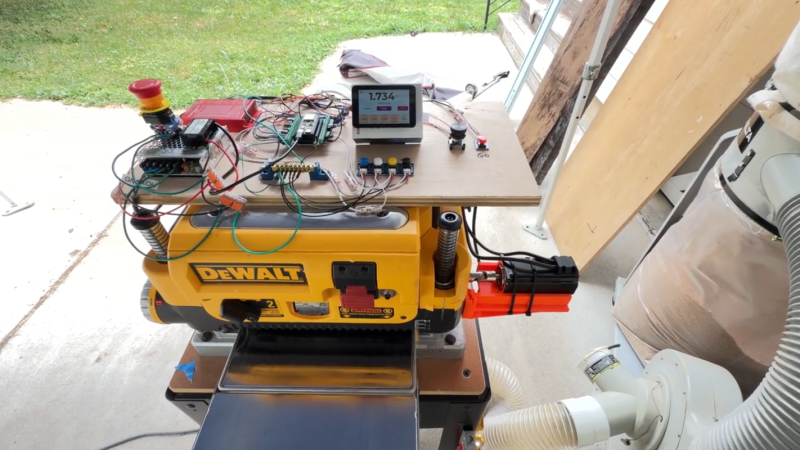
The motor attached to the height adjustment for the planer is a stepper motor, capable of around 1000 steps per inch. Since revolutions on this tool with the stock wheel adjust only a small amount per revolution, this can in theory enable very small tolerances to be dialed in consistently. Not only that, but [DendroLabsDev] has programmed it with a few different modes, the first of which allows a board to be planed to a certain thickness by making several passes, mimicking the workflow of a human-controlled machine. Then a device to zero the position was added, and then the ability to save the height adjustments to make replication across different boards was added, and then a mode to step through set amounts per pass.

What [DendroLabsDev] has essentially made is a high-dollar planer control that is actually available in the most expensive planers, but adapted for a DeWalt planer easily available and semi-affordable at many local hardware stores. It is also theoretically adaptable for any planer with an adjustment wheel, and [DendroLabsDev] has some plans to improve the control system and package it with a PCB and enclosure that would allow it to be a more accessible product for other woodworkers. Adding electronics to woodworking tools other than routers is a popular pastime, take this CNC-controlled scroll saw for example.

3D Printed Piano Action Faithful to the Original

A piano’s internal mechanism for translating a key press into sound is surprisingly complicated. It has to do a lot of things simultaneously and quickly: provide precise control over velocity, ensure the hammer doesn’t press itself against the strings,  ensure the hammer rebounds without accidentally hitting the strings, allow for quick, continued strikes of the strings, and dampen the string after the key is released. Not only is that a mouthful to say, it’s a tall order for a mechanical device and took (arguably) around 150 years for the idea to be refined into what most of us would recognize as a piano. But could [dovetail] do it with a 3D printer in a few weeks?

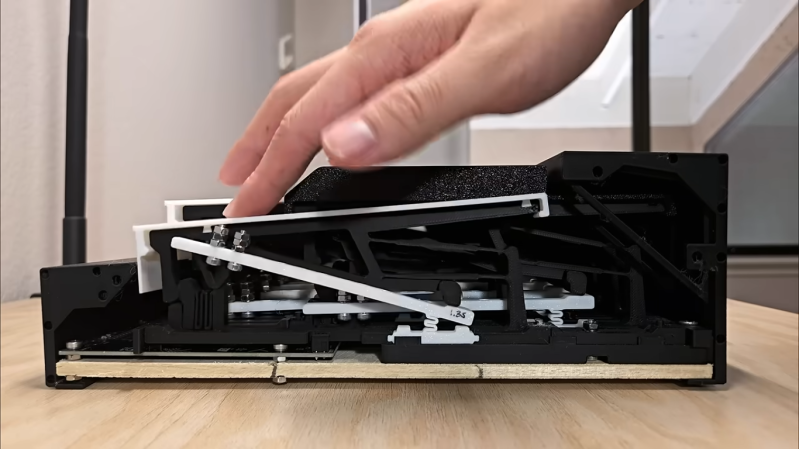
[dovetail]’s design relies on compliant mechanisms, which are solid parts that flex in specific and controlled ways to provide movement. The action took many iterations to make sure that all of the feelings of all the parts of a real piano action were accounted for in this model. Pianos have more than one key, though, so [dovetail] also had to design a modular system to piece all the keys together. The modularity extends to the piano’s electronics as well, with a set of PCBs daisy-chained together, each of which supports a set of keys. This is a hybrid piano, a style with a real action but digital sound production. Using infrared sensors allows the instrument to behave as a MIDI keyboard, but one with the goal of feeling somewhere between a digital piano and a fully analog one.

The piano was first demonstrated at Open Sauce, where a number of musicians were able to try it out. As a prototype device it still has a few rough edges that [dovetail] plans to improve upon, like changing the sensors from IR to hall effect, improving the action and using a different filament. There are some other things he has planned as well which we look forward to seeing in future videos. And, although a completely different instrument, it has a number of similarities to this action built to strike a bass drum instead.

Thanks to [Keith] for the tip!

This Library Needs to Be At Least… Three Times Bigger

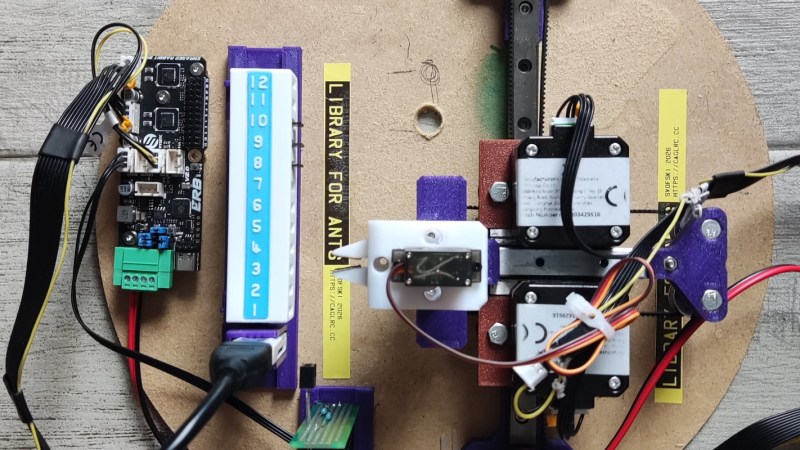
Many of us have noted a tremendous price increase in many computer components for some mysterious reason. Whatever this cause is will be debated among the various modern philosophers and Diogeneses, but regardless of cause we all still have to live in this world and make do. That turns us towards getting maximum value from the things we already have rather than trying to go out and buy more computer components right now, like [svofski] using his vast swath of existing microSD cards to build an SD card library.

The library is based around a tiny robotic arm that can physically grip the cards and move them in and out of a reader. The first iteration of the arm involved rotating the two pincers, but this turned out to be overly complicated and [svofski] eventually settled on a design resembling a rack and pinion that slides the two pincers together instead. With the gripper sorted out, it’s placed in system called T-bot arrangement, similar to coreXY kinematics, that lets it pick and place among 12 microSD card slots.

Many of the parts in this build were directly from or inspired by 3D printers, making it relatively simple with so many parts available. [svofski] didn’t build it for a specific use case, though; mostly it was constructed out of fascination for robotic tape changers which perform a similar function. But for anyone who actually needs to duplicate a large number of SD cards, or other types of removable media, this could prove to be a fairly handy robot.

DOOM Played on Series of 555 Timers

It’s technically true that any piece of software can be reproduced in hardware, although modern software’s size and complexity generally makes this a non-starter. But if we go far enough back in time, older software becomes easier and easier to implement in hardware. The original DOOM from 1993 might one day be recreated in full this way, but that day is not today. Instead, [Nick] has recreated the original music from that game, playing the opening track in nothing but 555 timers.

The circuit starts with a 555 timer that acts as a system clock with a rate of just over 7 Hz. These pulses feed a binary counter which in turn feeds a decoder, giving the circuit 15 positions. Each output of the decoder feeds to a diode matrix which stores information about what pitch the circuit should play. The circuit only needs to play six pitches so the diodes effectively connect each moment in time to one of these six notes. From there the circuit feeds into a set of switches which select different resistor networks of another 555 which is actually responsible for producing sound. The resistor networks have different values to adjust the timing of the 555 to produce different pitches.

Of course this entire exercise is largely academic as almost any microcontroller would be able to be programmed to play this chiptune quite easily, but it’s not a bad idea to get down into the weeds of digital logic from time to time in order to refine one’s skills and knowledge about what’s really going on in the inner workings of circuits. Or, go even deeper than that and build the logic gates themselves from first principles.

Panoramic Photography with a Linear Scanner

Although digital photography took a big bite of the film industry’s lunch, it wasn’t able to completely eliminate the need — or desire — for photographers to use film in some situations. But digital information from a camera sensor can be manipulated to augment the natural physical capabilities of a camera in ways not really feasible for film. High dynamic range images, focus and exposure stacking, and automatic panoramic stitching. This camera takes the latter example to the extreme.

[Philo]’s proof of concept was a smartphone camera set on a chair and rotated around a room. Some software grabbed a single column of pixels as it moved and stitched them all together to form an image. This came out well enough that the idea was refined a few times, but it wasn’t until a single-line digital camera meant for imaging assembly lines was found that this really took off. Using the camera and some custom software, [Philo] was eventually able to take some of the longest panoramic images we’ve seen, using things like railways and boats as the track the camera rides on, with accelerometer data to help stabilize the image.

The results speak for themselves. There’s a bit of wobble from the movement of the various vehicles despite the accelerometer data, but given that the image is coming from a sensor meant for examining conveyor belts, it’s hard to complain. Of course, if you want to stick to film, there are panoramic film cameras available too even if they don’t quite have the reach of this digital one.

Rooftop Camper For Roofless Vehicle

The Honda Goldwing is one of the more famous motorcycles ever produced. It’s known for its reliability and comfort, but also for being one of the first motorcycles Honda rolls out new technology with. It was the first to have a factory-installed airbag as well as integrated GPS, and is now largely associated for being a sort of two-wheeled RV with how many creature comforts it supports for long-distance riders. [Matt] has a Goldwing of his own, and is taking that RV-like feeling to the extreme with a rooftop camper for this motorcycle.

Of course, motorcycles don’t have roofs, but if this Goldwing had one this camper would definitely be above that. Goldwings are already heavy enough without an enormous weight dramatically increasing the center of gravity, and [Matt] certainly had his problems with that along the way. But before this adventure he had modified it into a hill climber, removing a lot of the extraneous equipment from it. Attaching some metal frame and a lightweight camper shell to it didn’t seem like too much of a stretch from there, so he got to work with a welder. At the end he has a box that’s just barely big enough for him to sleep in but is more or less functional as a camper.

Perhaps unsurprisingly, [Matt] dropped this more than once on its maiden voyage, and one of those falls damaged a wiring harness that caused his battery to drain in the night. Luckily he was not too far from home on the test drive. We’d tend to think that this camper won’t be one that [Matt] keeps working on (although we’d imagine a tricycle kit might solve his center of gravity issues) but since he’s built some other interesting campers in the past we’re not too sure we’d count this one out just yet.

New Controller Makes Heavy Machinery Intuitive

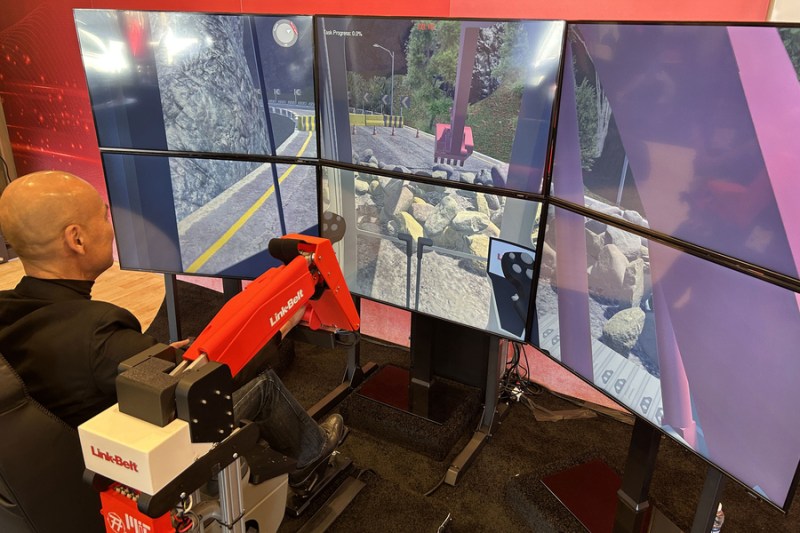
As children, many of us looked wistfully into the cockpits of heavy machinery, wondering just how the series of knobs and levers would do something like operate a bulldozer, crane, or excavator. The nature of these myriad of hydraulic and electronic controls for equipment like this is often inscrutable to adults as well; it takes a considerable amount of training to be able to competently operate most of these machines. But this new controller from MIT may help shorten that training time.

The controller is specifically meant for excavators. In a standard excavator, a pair of joysticks is typically used, with one controlling the swing and the boom and the other controlling the stick and the bucket. Getting used to this combination can take practice, so instead the group of researchers replaced them with a model excavator arm that the operator controls directly with their own arm. The new controller is more intuitive to use as it translates the movements of the model to that of either a real excavator or a training simulation.

The researchers plan to include haptic feedback in future versions, which will hopefully further increase the ease of which new operators can get a feel for using these machines. For those not working towards a new career or an ambitious weekend with rental equipment, there are some other ways of learning how to operate excavators and other pieces of heavy machinery.

Self-Hosting Offline Websites

If there’s one thing that’s guaranteed in the tech world it’s that nothing is guaranteed. From AOL, Netscape, Yahoo, and MySpace, every tech empire seems to eventually fall to ruin. One method to reliably maintain information or online experiences that are lost to whims of computer users and markets is to backup, preserve, and host that information on one’s own computers, and the Kiwix project aims to help make offline backups of favorite websites.

The open-source tool started as a way for users to make their own offline backups of Wikipedia but eventually expanded into having the ability to backup many other sites as well. Wiki-type sites are generally the easiest, but it can also create backups of other sites like StackExchange so that when the Internet goes down or the site vanishes from the world, the information is preserved for use. There are plenty of guides online for setting up Kiwix as well, with it running easily on most Linux systems with or without the help of Docker, as well as versions available for Windows, Android, and Apple platforms.

Although the Kiwix software hosts the website backups, creating the backups needs to be done with another tool called Zimit to create the .zim files Kiwix uses. The Kiwix organization also hosts pre-downloaded .zim files of common websites so each user is not independently crawling Wikipedia on their own, a task that could take months on limited consumer hardware. As for what hardware to ultimately host it on, we might recommend an armageddon-proof machine like this one.

Miniaturizing the Atari 2600 Console

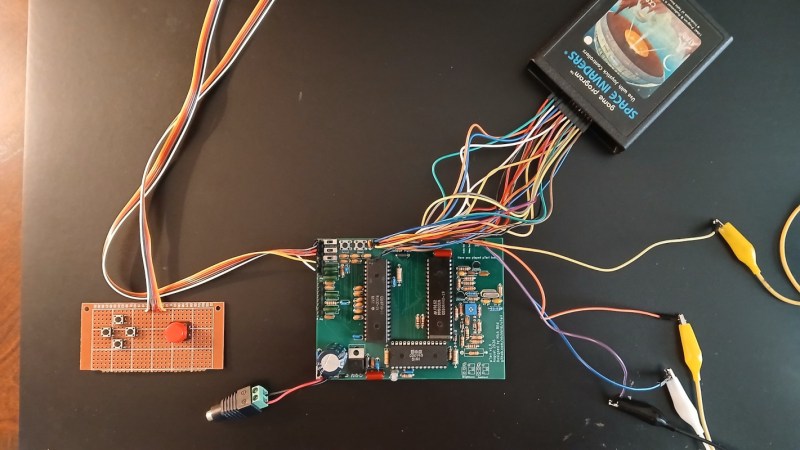
For as popular as Atari was in their heyday, it wasn’t until well after they were on their famous decline that they released their first handheld, the Atari Lynx. In retrospect, competing with the Game Boy was not going to be a recipe for success even without considering their other problems as a company, and as a result was their penultimate console before exiting the market completely. But [Nick]’s most recent project asks what the world would have been like with an Atari handheld from their golden era, and has been working on this miniaturized version of the 2600.

Unlike any modern emulators which can easily handle Atari 2600 games in almost any form factor today, this console is doing it all with as much original hardware as possible. It uses much smaller switches and buttons compared to the original, and omits some other unnecessary hardware for today’s world like the RF modulator. [Nick] has also designed a custom PCB that reduces the overall footprint considerably as well, and has relocated the cartridge port in preparation for its eventual handheld shape. The result is a console using original hardware that’s less than half the footprint of the original.

Although there were around 30 million Atari 2600 consoles sold and the system is unlikely to be a real collector’s item anytime soon, [Nick] makes sure to note that no real 2600 hardware was harmed in this build. And, as far as its handheld nature, this is a stepping stone on the path to that eventual goal. We’ll look forward to an eventual system that integrates a screen and controller as well as a port for the original cartridges. In the meantime, here’s another handheld 2600 that fits completely inside one of those cartridges.

❌