❌

Reading view

There are new articles available, click to refresh the page.

Confidential ZEC trading goes live on Shield

Traders can now buy, sell, and provide liquidity for ZEC while keeping their identity, portfolio, and trading strategies confidential.

Shield has launched the first confidential onchain trading pair for ZEC, allowing users to manage their Zcash alongside other assets in its non-custodial wallet. The new pair gives ZEC holders access to a confidential, non-custodial AMM where they can buy, sell, and provide liquidity without publishing their wallet activity to the market.

The launch expands Shield’s supported markets through its concentrated-liquidity AMM on Aleo. With this launch, Shield adds ZEC support to its non-custodial wallet, allowing users to manage the asset alongside their other supported holdings.

How Zcash protects transaction data

Zcash launched in October 2016 with support for transparent and shielded transactions.

Transparent addresses work much like Bitcoin addresses. Their balances and transaction histories are publicly visible. Shielded transactions encrypt the sender, recipient, and amount, while allowing the network to verify that each transaction follows its rules.

Zcash was the first widespread application of zkSNARKs, demonstrating that a decentralized network could verify transactions without publishing the underlying financial information.

ZEC on Shield

ZEC trades for USDCx in a concentrated-liquidity pool. Traders can move between ZEC and a dollar-denominated asset, and liquidity providers can supply capital within their chosen price ranges.

Shield Swap runs on Aleo, combining publicly verifiable market state with encrypted wallet records. Zero-knowledge proofs allow the network to verify transactions without exposing confidential wallet data.

Traders can inspect prices and available liquidity before confirming a swap. Liquidity providers can evaluate the pool before deciding where to allocate capital. Pool reserves, prices, trade sizes, and fees remain publicly verifiable.

Shield Swap protects your identity, portfolio, and trading strategies. Wallet balances, portfolio composition, and links between trades remain confidential.

Protecting ZEC portfolios

Trading on a transparent chain creates a permanent history associated with wallet addresses. Once an address is associated with a trader, its balances and transaction history become available to anyone following the market.

Fresh addresses can make analysis harder, but trade sizes, timing, and repeated behavior can still provide clues that connect activity. Over time, those connections can reveal how a trader builds a position, rebalances a portfolio, or moves capital between assets.

Shield Swap addresses this exposure. Public market data does not provide a direct view into each participant’s wallet and broader portfolio.

For ZEC holders, this means access to onchain trading without making their wallet history part of the market information available to competitors.

Providing liquidity for ZEC/USDCx

The ZEC/USDCx pool lets traders move between ZEC and a dollar-denominated asset. Liquidity providers choose the price ranges in which they want their capital to be available for trading and earn fees when their liquidity is used.

This gives providers control over how they allocate capital. A narrower range concentrates capital around selected prices. A wider range makes liquidity available across more prices. Providers can adjust their positions as market conditions and their objectives change.

ZEC in your Shield wallet

Shield’s non-custodial wallet now supports ZEC. Users can manage ZEC alongside other supported assets and connect their wallet to Shield to trade or provide liquidity.

A 1-click banner prompt moves assets into the wallet’s shielded balance so they are ready to trade. Wallet balances are held in encrypted records, and users retain control of their keys and funds.

Shield currently covers Aleo network fees for swaps. The liquidity-provider fee is included in the quote before the user approves the trade.

ZEC/USDCx trading is available on Shield. Early access is open to eligible organizations and individual market participants.

Visit swap.shield.fi to access the market or shield.fi/docs for documentation.

Shield is a technology provider. It is not a broker, dealer, or registered intermediary, and does not provide investment, legal, tax, or other advice of any kind. Participants act on their own account and remain responsible for their trading decisions and compliance with applicable law.

MEXC and Hacken Launch AI Trading Safety Handbook to Promote Safer AI Adoption

Mutsamudu, Comoros, October 28, 2026 – MEXC, a pioneer in 0-fee digital asset trading, and blockchain security, compliance, and regulatory assurance partner Hacken, have released the MEXC × Hacken AI Trading Safety Handbook, providing practical guidance on how users and platforms can use and deploy AI-assisted and automated trading tools more safely, from research and decision support through trade execution.

The handbook follows the recent MEXC AI Trading Report, which found strong interest in AI alongside clear demand for greater control. In MEXC’s 2026 survey, willingness to use automated trading rose from 55% to 71.8% when limits on funds, positions, leverage and losses were introduced.

As AI takes a more active role in trading, the handbook emphasizes that safety cannot rely on the AI model alone. AI-facilitated actions should be checked against separate permissions, financial limits and risk controls before execution. It covers risks including credential exposure, excessive permissions, manipulated data and unintended execution, while outlining practical safeguards for both users and platforms.

For users, the handbook sets out five safety checks: Ask, Verify, Limit, Control and Review. For platforms, it outlines five principles: Guard, Limit, Approve, Controls and Test. Together, they provide a practical framework for expanding the use of AI while keeping appropriate controls in place.

“AI can make trading more accessible and efficient, but greater capability should come with stronger safeguards,” said Vugar Usi Zade, CEO of MEXC. “At MEXC, we want users to benefit from innovation, while taking a measured approach to AI adoption. Our People First principle means giving users access to new capabilities without losing sight of control, transparency and risk.”

““AI agents will soon place more orders than people do. Trust in them should be earned the way smart contracts earned it: through independent controls, continuous red-teaming and evidence anyone can verify.”,” said Dyma Budorin, CEO and co-founder of Hacken. “This handbook is intended to raise awareness of those risks and provide practical support for both users and platforms. As adoption grows, platforms will need to test these safeguards continuously and strengthen them as new risks emerge.”

MEXC and Hacken hope the handbook can serve as a practical reference for users and platforms as AI becomes more deeply integrated into trading, helping raise risk awareness and support safer, more responsible adoption across the industry.


About MEXC

Founded in 2018, MEXC is a leading global multi-asset trading platform built as your 0-fee gateway to infinite opportunities. Serving users across 170+ markets, MEXC provides simple and efficient access to crypto, stocks, tokenized assets, derivatives, and a growing range of TradFi-linked opportunities through one account and one gateway.

With 0 trading fees, deep liquidity, broad asset coverage, and a high-performance trading experience, MEXC is designed for retail users who want to discover earlier, act faster, and trade with fewer barriers. As crypto and traditional finance continue to converge, MEXC is committed to making global opportunities more accessible, helping users trade freely and MEXCmize every opportunity.

MEXC Official Website| X | Telegram |How to Sign Up on MEXC


About Hacken

Hacken is a security and assurance partner for financial institutions and the infrastructure they rely on: exchanges, ecosystems, custodians, banks, asset managers, and tokenization platforms. Hacken’s AI security work includes AI agent security audits and red-teaming of AI systems.

Founded in 2017, Hacken has 60+ engineers and more than 1,500 clients across industries, including the European Commission, ADGM, Ethereum Foundation, Societe Generale-Forge, MetaMask, and Bybit.

Hacken website | X | LinkedIn


For media inquiries, please contact MEXC PR team: media@mexc.com


SUN.io Completes 52nd Buyback and Burn: Total SUN Burned Surpasses 685M as SunSwap Accelerates Ecosystem Integrations

Through its recurring buyback and burn program, SUN.io continues to channel protocol revenue from SunSwap, SunPump, and SunX into SUN token value accrual, while accelerating SunSwap’s cross-platform integrations to reinforce decentralized liquidity. 

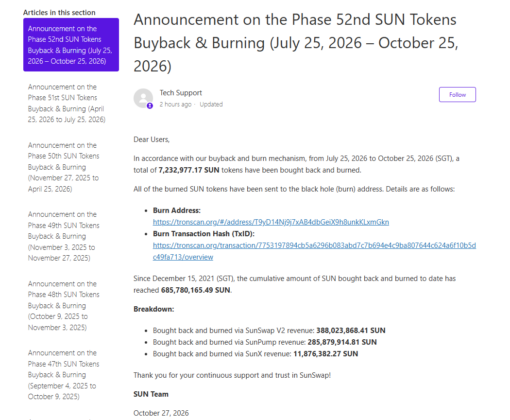
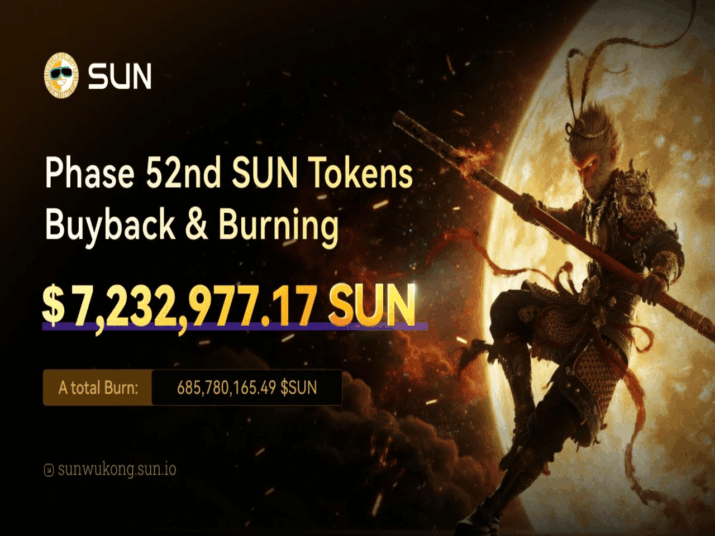
SUN.io, the core DeFi liquidity infrastructure on the TRON network, has successfully executed its 52nd SUN token buyback and burn on October 27, removing more than 7.23 million SUN from circulation.

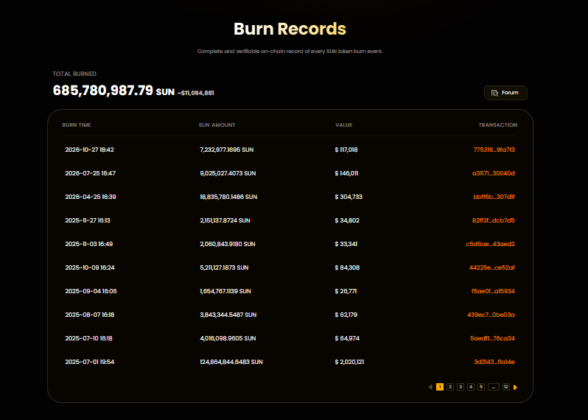
This round marks the platform’s 52nd consecutive burn, bringing the cumulative total to over 685 million SUN tokens, valued at more than $11 million. The recurring, uninterrupted buybacks and burn cycle steadily reduces the circulating supply of SUN, underscoring the protocol’s long-term commitment to sustainable ecosystem growth.

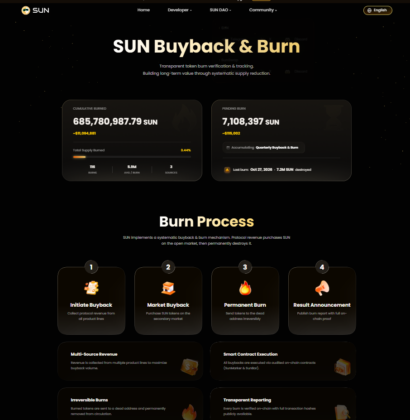
To guarantee complete on-chain transparency, SUN.io has launched a dedicated public dashboard for its SUN token buyback and burn program. The portal provides real-time access to program design, key metrics, funding sources, and detailed on-chain records for each burn round, enabling community members to verify the data at any time.

Alongside the ecosystem value accrual from its periodic token burns, SUN.io is rapidly expanding its product footprint—most notably through strategic integrations with its flagship DEX, SunSwap. The platform has recently completed full-stack technical integrations and formed deep strategic partnerships with on-chain trading aggregator Ave.ai, leading multi-chain wallet TokenPocket, and cross-chain liquidity protocol Symbiosis.

These partnerships not only broaden SunSwap’s user reach and unlock the potential of its underlying DEX architecture, but also deliver more affordable token swapping and liquidity services with fewer frictions for DeFi participants across the broader TRON ecosystem.


685M+ SUN Burned: Building a Traceable Value Loop Across the SUN Ecosystem

Since the launch of its buyback and burn program in 2021, SUN.io has maintained a consistent execution schedule across multiple market cycles. The first 52 burn rounds executed so far have removed up to 700 million SUN from circulation—representing over $11 million in value and approximately 3.44% of the total token supply. This outstanding track record has helped mitigate the impact of short-term market volatility while rallying SUN holders and ecosystem builders under a clear, dependable value thesis and sustainable roadmap.

According to the Announcement on the 52nd SUN Token Buyback and Burn (July 25, 2026—October 25, 2026), SUN.ioexecuted 7,232,977.17 SUN (over 7.23 million SUN) during this time period.

The cumulative burn volume since the initial round on December 15, 2021 has surpassed the 685 million mark to 685,780,165.49 SUN.

All capital deployed for the buyback was funded by protocol revenues generated across SUN.io’s three core verticals. Burn contributions by vertical are:

  • SunSwap V2: 388,023,868.41 SUN
  • SunPump: 285,879,914.81 SUN
  • SunX: 11,876,382.27 SUN

This multi-stream composition demonstrates that value capture spans the full SUN.io ecosystem. As protocol revenues generated across SunSwap V2, SunPump, and SunX are continuously channeled into the buyback and burn reserve, organic growth in any single vertical translates into direct support for the token’s value accrual.

This creates a self-reinforcing flywheel where ecosystem revenue growth continues to fuel protocol buybacks, which in turn contract circulating supply and drive long-term token value accrual.

Every buyback operation adheres strictly to on-chain transparency standards, with transaction hashes for each execution indexed publicly to guarantee a traceable, verifiable paper trail for community audit.

On top of this, the platform’s dedicated SUN Buyback & Burn dashboard further institutionalizes the commitment to transparency by centralizing core metrics, execution workflows, revenue allocation breakdown, and historical on-chain transaction records. It shows cumulative burn volumes, upcoming burn accruals, execution rules, and revenue allocations across all verticals. With every historical transaction mapped directly to on-chain addresses for verification, the entire buyback and burn process remains subject to ongoing community audit, reinforcing trust in the platform’s transparent value loop.

Backed by verifiable on-chain records and real-time reporting on the official SUN Buyback & Burn dashboard, SUN.io is delivering on its multi-cycle deflationary commitment through radical transparency. By establishing an unbroken, auditable pipeline—routing protocol revenue directly into permanent token burns—the platform reinforces predictable, long-term value accrual for SUN holders.

Live metrics from the dashboard confirm that cumulative on-chain burns have crossed 685 million SUN (approx. $11 million), permanently retiring 3.44% of the total circulating supply. Meanwhile, buyback momentum remains strong, with the latest cycle securing an additional 7.1 million SUN ready for burning.

As the SUN.io ecosystem scales, protocol revenue streams expand alongside it, strengthening the reserve earmarked for future buybacks. This sustained, fully transparent value-return loop provides a robust foundation for the token’s long-term value accrual.


SunSwap Accelerates Ecosystem Integrations to Fuel Growth Across TRON’s DeFi Landscape

Alongside the continuous rollout of its buyback and burn program, SUN.io is ramping up its product expansion and ecosystem infrastructure. SunSwap, the platform’s core DEX, has made significant headway in its strategic partner program, completing end-to-end technical integrations with on-chain trading aggregator Ave.ai, leading multi-chain wallet TokenPocket, and cross-chain liquidity protocol Symbiosis.

These partnerships span three core dimensions: aggregated trading entry points, high-traffic wallet access, and cross-chain liquidity routing. Together, they expand SunSwap’s user reach, giving TRON DeFi users lower-friction access to deep liquidity and seamless token swaps.

The SUN.io team is actively onboarding more third-party platforms, extending SunSwap’s integration footprint across a broader array of Web3 consumer touchpoints.

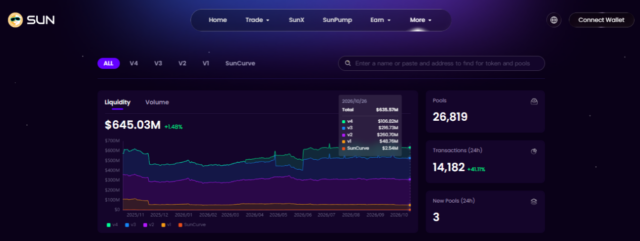
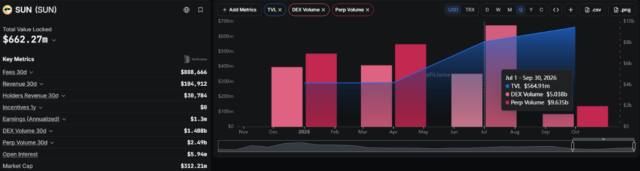
The platform’s core operating metrics exhibit the same momentum. As of October 26, on-chain data shows SunSwap‘s total value locked (TVL) approaching $645 million across more than 26,800 active liquidity pools. Network throughput remains steady, with daily on-chain transactions topping 14,000 and average daily trading volume holding above $50 million—solidifying the ecosystem’s leadership in the industry.

Growth extends beyond SunSwap, with SUN.io‘s broader product suite maintaining sharp upward momentum—most notably across its derivatives arm. According to DeFiLlama, total trading volume across all SUN.io product lines approached $15 billion in Q3 2026. Spot DEX trading contributed over $5 billion, while perpetual contract (perp) volume neared $9.7 billion, up roughly 25% quarter-over-quarter from the ~$7.75 billion performance in Q2.

The combined progress of SunSwap’s ecosystem integrations and multi-product volume growth points to a broader shift: SUN.io‘s full-stack liquidity infrastructure now serves a much wider range of on-chain trading needs beyond spot trading, creating a DeFi product matrix where multiple business lines grow in tandem.

On the incentives front, JustLend, the lending platform in the JUST ecosystem, joined forces in July with core TRON-based projects and Binance Web3 Wallet to roll out the $4.5 million TRON DeFi Summer campaign. Participants who supply liquidity to the dedicated SUN pool on JustLend can earn additional boosted yields. The campaign is currently running Season 3 (S3), where APYs in the SUN pool reach up to 25%, offering users a compelling option to co-build ecosystem liquidity while earning on-chain returns.

Between the token-burn feedback loop, volume expansion across core business lines, and active partner-incentive campaigns, SUN.io is activating a clear growth flywheel: infrastructure upgrades drive transaction volume, business growth feeds value back to users, and that value attracts further ecosystem expansion.

Looking ahead, SUN.io, as core DeFi liquidity infrastructure for the TRON ecosystem, plans to continue its buyback and burn program, channeling protocol revenue generated by ecosystem growth into the underlying value of the SUN token. On the product side, the platform will continue securing cross-platform integrations, deepening SunSwap’s liquidity, refining the end-to-end user experience, and broadening its product lineup. With ecosystem partners on board, SUN.iowill keep expanding its cross-platform integrations and deliver transparent and efficient infrastructure that supports the long-term on-chain growth of TRON DeFi and the diverse trading needs of users worldwide.


SUN Team

Singapore

service@sun.io

Justin Sun Prize Partners With MathDB, Led by Caltech Professor Tony Yue Yu, on 50-Problem Pilot

Geneva, Switzerland — October 26, 2026 — The Office of Justin Sun today announced a pilot program for the Justin Sun Prize in collaboration with MathDB, a mathematical research platform developed by Caltech Professor Tony Yue Yu and his team. 


The Justin Sun Prize was established to become the “Nobel Prize of the AI Era,” responding to the profound transformation of scientific research and incentives in the new era in a more decentralized, formalized and machine-driven way. Problem-level awards can reach $1 million, subject to the applicable award terms and eligibility requirements. 


The collaboration introduces a submission and review process through MathDB. MathDB will accept solution submissions, verify Lean formalizations and review expository materials, while the Justin Sun Prize will separately assess eligibility, attribution, priority and applicable award terms.


“AI is changing the speed at which mathematics can be explored, but speed alone is not scientific progress,” said Justin Sun, founder of the Justin Sun Prize. “The opportunity is to create a framework where human insight and machine intelligence can work together without compromising rigor. Working with MathDB brings mathematical discovery and machine-verifiable proof into the same process, which we believe can help define a more rigorous model for future discoveries.”


The pilot covers 50 problems across four award levels, with problem-level prize pools up to $1 million, depending on the problem. The highest tier includes P versus NP, the Riemann Hypothesis, Yang-Mills Existence and Mass Gap, the Hodge Conjecture, Global Langlands functoriality and the Birch and Swinnerton-Dyer Conjecture, among others. The full list of participating problems and applicable award terms will be available through MathDB and the Justin Sun Prize.


All awards are subject to full eligibility verification, compliance with anti-money laundering (AML/sanctions) laws, and official program rules available at https://www.hejustinsun.com/prize.


To broaden the reach and impact of advanced research, the MathDB pilot program will reward not only solutions to mathematical problems but also engaging and accessible communication of those solutions. The reward is divided into three categories: 50% for the mathematical solution, 30% for Lean formalization and 20% for qualifying exposition.


MathDB is a large-scale community database of mathematical definitions, theorems, conjectures and open problems, with the aim of making mathematical knowledge easier to organize, connect and build upon. The project incorporates Lean formalization and automated proof-verification capability alongside mathematical explanations and supporting research materials. Professor Tony Yue Yu from California Institute of Technology, together with his team, will be leading the scientific aspects of the pilot.


“Solving a fundamental math problem often leads to much more than an answer to the original question,” said Yu. “The process can reveal unexpected connections, introduce powerful tools and open entirely new directions of research. These developments can have an influence that extends across generations and disciplines. The Justin Sun Prize celebrates this spirit of exploration by drawing attention to challenging problems, supporting researchers who pursue them, and encouraging public dissemination of knowledge. Our collaboration with the Justin Sun Prize is grounded in the belief that pursuing fundamental research through decentralized, rigorous and verifiable approaches can accelerate the pace of discovery and scientific progress, and contribute to the advancement of human civilization.”


The full list of participating problems, submission requirements and review procedures will be available through MathDB (https://mathdb.com/) and the Justin Sun Prize (https://www.hejustinsun.com/prize).


About the Office of Justin Sun

The Office of Justin Sun supports Justin Sun’s global business, philanthropic and public initiatives across technology, blockchain, artificial intelligence, scientific research, investment, art and space exploration. 


Justin Sun is the Ambassador and former Permanent Representative of Grenada to the World Trade Organization and the Founder of TRON. TRON is the leading blockchain for the stablecoin revolution, processing over $13 trillion in volume since its inception. In the world’s emerging markets, people rely on USDT on TRON to access the global financial system.


A protégé of Alibaba founder Jack Ma, Sun has been recognized internationally for his work in the digital asset industry, including a Forbes cover profile in April 2025 and multiple appearances on the Forbes 30 Under 30 list. In August 2025, he flew aboard Blue Origin’s NS-34 mission, becoming the 712th person in history to travel to space. His broader interests span technology, investment, philanthropy, art, gaming, and space exploration.


Office of Justin Sun Contact:

info@hejustinsun.com 


About Justin Sun Prize 

The Justin Sun Prize is an academic initiative established by Justin Sun to support advances in mathematics, formal verification, and AI-assisted scientific discovery. The prize is decentralized and built around the principle that mathematical work should be judged by the strength, rigor, and verifiability of the proof itself, not the prestige or reputation of those submitting it.


Justin Sun established the prize in his own name as a long-term commitment to return wealth created through mathematics and technology back to mathematics itself. Its legacy is intended to be defined by the body of work it recognizes and the laureates whose discoveries stand the test of time. The prize links clearly defined mathematical challenges to machine-verifiable proof. Its guiding principles are openness, public benefit and open-source access.


Visit https://www.hejustinsun.com/prize for more information. 


Media Contact:

media@hejustinsun.com

JST Buyback & Burn Upgrade: GasFree Revenue and $20.34M Surplus Injected as JUST’s Ecosystem Trio Solidifies JST Token Value

Summary: 

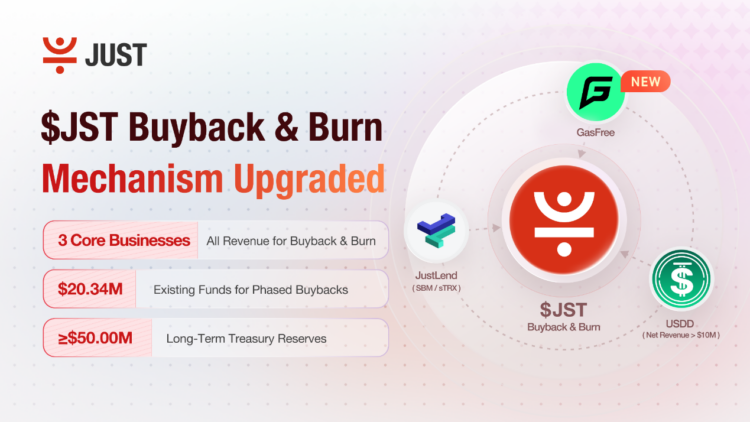
The upgraded JST Buyback and Burn program features the following highlights:

  • $50M Treasury Reserve Cushion: Establishes a safety buffer for sustainable ecosystem operations.
  • Expanded Funding Sources: Integrates GasFree revenue alongside JustLend and USDD to cover 100% of JUST core products.
  • ~$20.34M Capital Injection: Unlocks legacy surplus funds to be released in phases for future buybacks.
  • JUST DAO Execution: Complete on-chain execution with full transparency and open-source verification.

Following its recent brand refresh on October 23, JUST—the flagship on-chain DeFi infrastructure on TRON—officially unveiled its upgraded JST Buyback & Burn initiative that strengthens the value-accrual framework of the native governance token. Building on previous funding sources from JustLend and USDD, the upgraded mechanism incorporates business revenue from GasFree while allocating $20.34 million in capital surplus to future token repurchases. These changes diversify the protocol’s revenue base and set a structured process for deploying surplus capital.

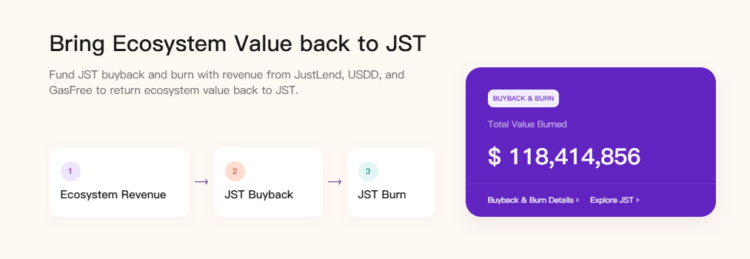
The updated framework expands JST buyback funding from a dual-revenue stream (i.e., JustLend and USDD) to a more robust three-pillar model (i.e., JustLend, USDD, and GasFree), reinforced by phased injections of existing funds. Beyond simply adding capital, this upgrade ensures that growth in each JUST product line directly accrues to JST’s underlying value. It underscores JUST’s long-term commitment to token value accrual while tightly aligning protocol incentives with JST holders and the broader community.


JST Buyback & Burn Upgraded: $50M Safety Cushion, GasFree Revenue Integration, and $20.34M Surplus Injection

As the native governance token of the JUST ecosystem, JST’s underlying value support and utility mechanisms have always been a central focus for the community. With the successful completion of the 5th buyback and burn on October 16, Phase 1 of the JST Buyback and Burn program concluded smoothly, paving the way for the upgraded mechanism alongside JUST’s broader brand refresh.


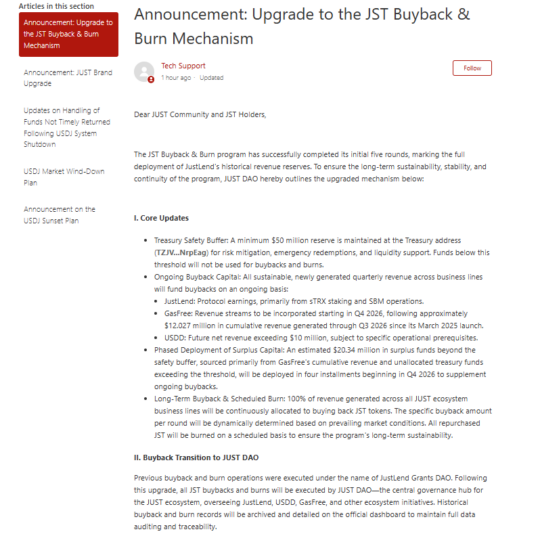
According to the Announcement: Upgrade to the JST Buyback & Burn Mechanism, the newly updated framework outlines key structural arrangements across five core areas, establishing clear risk boundaries while securing a more stable and predictable capital foundation for future buybacks:

  • $50M Treasury Safety Floor: A baseline reserve of at least $50 million will be maintained long-term to manage risk scenarios, guarantee liquidity, and ensure protocol solvency under extreme market conditions.
  • More Diversified Funding Sources: The upgraded model integrates GasFree revenue alongside existing JustLend and USDD streams, extending buyback capital across all three core JUST product lines. Specific sources now include revenue from JustLend’s sTRX staking and SBM, GasFree income, and the USDD protocol revenue exceeding the $10 million threshold.
  • Structured Surplus Capital Deployment: All protocol funds above the $50 million treasury reserve floor are dedicated entirely to JST buybacks. An initial $20.34 million—sourced from cumulative GasFree earnings and surplus treasury reserves above the safety floor—has been unlocked, and will be deployed across four buyback rounds starting in Q4 2026.
  • Buyback & Burn Execution: The protocol is adopting a “continuous buyback, periodic burn” approach. Funded by 100% of revenue across all product lines, open-market buybacks will adjust dynamically to prevailing market depth and liquidity, with accumulated tokens burned on a regular schedule.
  • On-Chain Governance: All buybacks and burns will be executed by JUST DAO. Key financial figures will be disclosed to the community on a regular basis, and every transaction will remain fully verifiable on-chain. 

Compared to Phase 1, this upgrade introduces three structural shifts:

  1. Clearer capital boundaries. The $50 million reserve floor creates a solvency backstop while defining the boundaries of capital eligible for buybacks. 
  2. More diversified funding sources. Rather than relying primarily on JustLend and USDD, integrating GasFree extends revenue capture across the entire JUST ecosystem. Meanwhile, deploying roughly $20.34 million in surplus funds across future tranches smooths buyback execution and ensures an orderly transition between mechanism phases. 
  3. Streamlined execution under unified governance. By adopting a “continuous buyback, periodic burn” strategy, the consolidated JUST DAO (formerly JustLend DAO) takes full operational ownership of buybacks and burns. This aligns governance and execution under a single authority, matching JUST’s brand consolidation and holistic governance roadmap. 

In essence, the updated mechanism follows a clear tripartite playbook: secure the downside, deploy surplus capital, and compound with organic growth. It first anchors ecosystem stability with the $50 million reserve floor, primes buyback momentum by releasing roughly $20.34 million in surplus funds, and then hands the baton to ongoing revenues from all three verticals—turning JST buybacks into a sustainable, business-backed deflationary engine.


GasFree Poised to Become the Second Growth Engine for JST Buybacks After JustLend

The integration of GasFree revenue represents the key highlight of this mechanism upgrade. Scheduled to begin capital allocations in Q4 2026, GasFree has demonstrated strong cash-flow generation and is positioned to become the second growth engine for JST buyback funding after JustLend. 

Built on TRON, GasFree is a native gasless solution that lets users pay transaction fees directly with the tokens they transfer, removing the friction of holding TRX or other native tokens just to move funds. By enabling single-asset fee settlement, GasFree eliminates one of the most stubborn usability hurdles in on-chain transfers. The service currently supports gasless transfers for both USDT and USDD. 

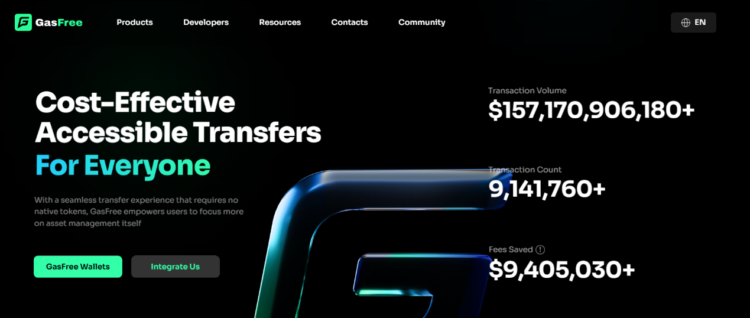
Operationally, GasFree’s user base and network activity continue to climb at a rapid pace. As of October 23, GasFree has processed over $157.1 billion in cumulative stablecoin transfer volume across more than 9.14 million transactions, serving an aggregate user base exceeding 500,000 unique addresses. This surging operational momentum provides the solid backing for GasFree to consistently fuel the buyback pool and establish itself as JST’s second major growth engine. 

From a revenue standpoint, GasFree’s profitability is backed by hard data. It has proven to be a vital growth engine since its March 2025 rollout, generating approximately $12.03 million in cumulative revenue through Q3 2026. This performance underpinned the recent extraction of roughly $20.34 million in surplus funds, sourced directly from GasFree’s accrued earnings and surplus treasury holdings above the reserve floor. 

As GasFree’s financial contribution accelerates, JST’s buyback-and-burn model enters a new stage of multi-business synergy. The token’s value-accrual mechanism is now deeply tied to the growth of the broader JUST ecosystem and fully synchronized with the protocol’s multi-product expansion.


Diversified Value Accrual: JUST’s Core Products Unite to Back JST

 Under the updated mechanism, GasFree revenue is now directly allocated to JST buybacks, alongside qualifying net revenue from USDD. This marks a pivotal evolution: JST burns no longer rely solely on JustLend. Instead, they are fueled by a diversified, multi-product revenue base spanning JustLend, USDD, and GasFree. 

This multi-pronged funding approach mirrors the broader JUST rebrand. Moving forward, JustLend, USDD, and GasFree unite under a single brand and user gateway—with JUST DAO steering cross-product governance, ecosystem synergy, and sustainable tokenomics for JST. 

JST serves as the native governance token for the entire JUST ecosystem. Through this unified rebrand and the rollout of JUST DAO governance, JST’s value foundation now spans the protocol’s core utility layers: lending and resource markets via JustLend, decentralized stablecoin infrastructure via USDD, and gasless transfer settlement via GasFree. JST is no longer anchored to a single product line; its value capture is directly tied to the growth of the entire ecosystem.

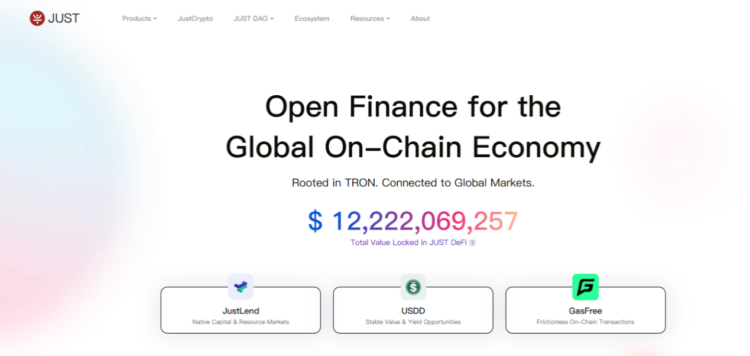
 As a pillar of TRON’s financial infrastructure, JUST commands roughly $12.2 billion in Total Value Locked (TVL)—consistently securing nearly half of the network’s total liquidity, with all three business pillars holding leading positions in their respective verticals. 

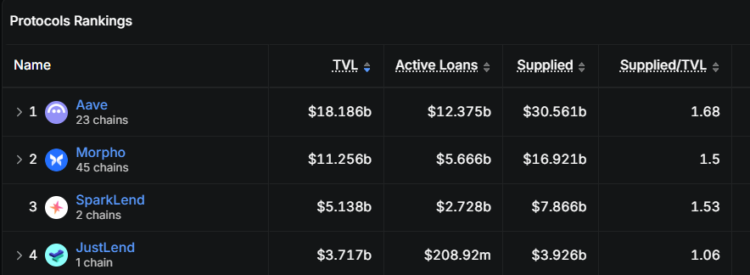
Among them, JustLend remains foundational: having fully funded the initial phase of JST buybacks and burns, it now provides the core yield baseline under the upgraded mechanism. As of October 23, JustLend’s TVL surpassed $7.13 billion, with its supply-borrow market (SBM) driving approximately $3.71 billion, cementing its status as a global DeFi lending leader. In the staking sector, total TRX staked has crossed 9.83 billion. At the same time, through sTRX-powered Energy solutions, JustLend has become a primary Energy gateway for the TRON network, scaling both on-demand Energy purchases and long-term rental services.

Meanwhile, GasFree continues to scale as a key revenue driver. In late September, GasFree partnered with Binance Web3 Wallet to introduce TRC-20 USDT gas fee delegation. Users can now pay network fees directly in USDT without needing to hold TRX. Securing integration with a Tier-1 wallet validates GasFree’s business model and significantly expands its addressable market and fee-generation capacity.


JUST Team 

Singapore

media@just.network

Paybis Adds iDEAL, BLIK, Multibanco and EPS for Buying Crypto in Europe

Customers in the Netherlands, Poland, Portugal and Austria can now buy crypto on Paybis through a banking app or a payment reference, with no card details needed. The four methods are the first wave of 13 local payment methods Paybis is adding.

Riga, Latvia October 23, 2026 — Paybis, a global crypto exchange and payment infrastructure provider, today added four local payment methods for buying crypto in Europe. Customers can now pay with iDEAL in the Netherlands, BLIK in Poland, Multibanco in Portugal and EPS in Austria. Cards and bank transfers remain available, but they are no longer the only options.

  • Four new local payment methods live today: iDEAL, BLIK, Multibanco and EPS.
  • No card details needed: customers confirm payment in their banking app or pay a Multibanco reference.
  • More than 90 cryptocurrencies are available, including Bitcoin, Ethereum, Solana and USDC.
  • First wave of 13 local payment methods; Paybis will support more than 30 ways to pay once all are live.

Local payment methods at national scale

The four methods operate at scale in their home markets. BLIK had 21.6 million active users in Poland at the end of June 2026, according to its operator, Polish Payment Standard. iDEAL processed more than 1.5 billion transactions in 2025 and handled 71% of online purchases in the Netherlands, according to the Dutch Payments Association. The Multibanco network has around 13,000 machines across Portugal, according to SIBS. EPS is offered by more than 11,000 online shops in Austria.

Four methods, four markets

Bank selection and confirmation in a banking app

Limit per payment: EUR 50,000

Six-digit code from a banking app

Limit per payment: PLN 50,000

Payment reference, paid at an ATM or in a banking app

Limit per payment: EUR 5,000

Bank selection and confirmation in online banking

Limit per payment: EUR 10,000

Simple crypto, paid locally

Each method works the way it does for any other online payment in its market. The customer chooses the method at checkout and confirms the payment through their bank, or pays the Multibanco reference. No card details are needed. The crypto goes to the customer’s Paybis Wallet or to any external wallet address. Customers can choose from more than 90 cryptocurrencies, including Bitcoin, Ethereum, Solana and USDC.

“Europe does not pay one way. A customer in Amsterdam reaches for iDEAL, a customer in Warsaw reaches for BLIK, and neither should need a card to buy crypto,” said Innokenty Isers, CEO and Founder of Paybis. “Now customers in the Netherlands, Poland, Portugal and Austria can pay the way they already pay for everything else online. Our philosophy is making crypto easy, and adding local payment methods market by market is how we do that.”

What comes next

iDEAL, BLIK, Multibanco and EPS are the first of 13 local payment methods Paybis is adding. Bancontact, KBC/CBC Bank and Belfius Pay in Belgium and Bancomat Pay in Italy follow in the next wave. Swish, Przelewy24, Vipps and MobilePay come after that. Once all are live, Paybis will support more than 30 ways to pay.

About Paybis 

Paybis makes crypto simple for individuals and enterprises. Established in 2014, the company combines a trusted crypto exchange and wallet for buying, selling, swapping and holding over 90 cryptocurrencies, with award-winning crypto-fiat infrastructure. That infrastructure lets businesses transfer capital globally without traditional payment friction.

In 2026, Paybis was recognized as Best Crypto Payment Provider, a testament to its expansive global reach, rapid onboarding protocols, and the deep expertise of the 200 dedicated professionals who drive its operations.

Processing more than $6 billion annually, Paybis is one of the most efficient platforms for acquiring and transacting in digital assets. This commitment to operational excellence is why Paybis maintains one of the highest ratings for crypto companies on Trustpilot, and why 7 million users and hundreds of the world’s fastest-growing enterprises consistently rely on its services.

Media contact

Paybis Press Office

Email: pr@paybis.com

HTX Research Publishes Crypto Market Outlook Ahead of the 2026 U.S. Midterm Elections

HTX Research, the dedicated research arm of HTX, has published a new report titled Crypto Market Outlook Before and After the 2026 U.S. Midterm Elections.

The report finds that while the midterm elections may reshape policy expectations for the next two years, short-term crypto pricing remains governed by inflation, financing costs, and capital flows. Its base case for the period before and immediately after the vote is one of elevated volatility, repeated repricing, and divergence across assets, rather than a sustained rally driven by a single political narrative.

The report examines how the upcoming elections may affect the pace of crypto legislation, regulatory oversight, and asset pricing. It covers the current macro and funding environment, policy implications under different congressional outcomes, election sensitivity across major crypto asset categories, conditional market scenarios, and a framework of indicators for monitoring developments from the pre-election period through the first half of 2027.

The full report is available at: https://square.htx.com/htx-research-latest-report-crypto-market-outlook-before-and-after-the-2026-u-s-midterm-elections/ 

*The above content  is not an investment advice and does not constitute any offer or solicitation to offer or recommendation of any investment product.


About HTX Research

HTX Research is the dedicated research arm of HTX Group, responsible for conducting in-depth analyses, producing comprehensive reports, and delivering expert evaluations across a broad spectrum of topics, including cryptocurrency, blockchain technology, and emerging market trends. Committed to providing data-driven insights and strategic foresight, HTX Research plays a pivotal role in shaping industry perspectives and supporting informed decision-making within the digital asset space. Through rigorous research methodologies and cutting-edge analytics, HTX Research remains at the forefront of innovation, driving thought leadership and fostering a deeper understanding of evolving market dynamics. Visit us. 

Connect with HTX Research Team: research@htx-inc.com

TRON Settles $2.2T in Q3, Captures 73% of All Stablecoin Volume as First TRX ETF Launches: CoinDesk and Nansen

Geneva, Switzerland, October 22, 2026 — TRON reinforced its position as a leading blockchain network for stablecoin settlement in the third quarter of 2026, with trillions in transaction volume, record USDT supply, growing payment card adoption, and the debut of the first U.S. spot staked TRX exchange-traded fund (ETF), according to independent research reports from CoinDesk Data and Nansen.


CoinDesk 

CoinDesk’s TRON Network Quarterly Report: Q3 2026 provides a technical assessment of the TRON network from July to September 2026. The findings span network and ecosystem developments, core on-chain metrics, and DeFi activity across lending and decentralized exchanges (DEX).


Key Insights from CoinDesk:


  • Stablecoin Settlement: TRON accounted for approximately 73% of stablecoin transfer volume at the end of Q3 2026, the highest share among blockchain networks.
  • Stablecoin Market Share & USDT Growth: USDT on TRON reached an all-time high of just over $92.7 billion in Q3 2026, lifting TRON’s share of the total USDT market to a 2026 high of 50.6% in mid-September. TRON’s share of total stablecoin market capitalization also rose to 30.2%. 
  • Crypto-Card Payments & DeFi Activity: TRON ranked first among chains by crypto-card payment volume in Q3 2026, capturing a 27.5% share worth approximately $638 million as total card volumes grew 60.5% QoQ to $2.32 billion. Total value locked (TVL) on the network rose 26.6% QoQ to $5.7 billion with lending the largest sector at 68%, and JustLend active loans up from $127M to $199M.


Read the full report from CoinDesk here.


Nansen

Nansen’s TRON Quarterly Report: Q3 2026 examines the network’s settlement scale and on-chain behavior over the quarter. It covers stablecoin settlement volume, transaction and address activity, institutional developments, and how users and transactions are distributed across labeled entities on TRON.


Key Insights from Nansen:

  • Stablecoin Settlement at Scale: TRON settled $2.21 trillion in stablecoins in Q3 2026, with average daily settlement rising 3.9% to $24.05 billion. Cumulative transaction volume on the network also surpassed $30 trillion as of September 23.
  • User Growth & On-Chain Activity: TRON’s user base continued to grow in Q3 2026, with average rolling monthly active addresses up 9.8% QoQ to 18 million, while the network processed an average of 11.68 million successful transactions per day.
  • Expanded Institutional Access: Canary Capital launched the Canary Staked TRX ETF (TRXS), the first U.S. spot staked TRX ETF, on September 9, and TRON DAO rang the Cboe closing bell on September 29 to mark its debut. Anchorage Digital also added native TRX staking and TRC-20 custody as the second phase of its TRON integration.


Read the full report from Nansen here. 


Across both reports, TRON’s third quarter showed a network growing in volume and in reach at the same time. Stablecoin settlement continued to climb, everyday spending through crypto cards accelerated, and new regulated products gave institutions a direct path to TRX. With that foundation in place, TRON enters the final quarter of 2026 as a settlement network that is increasingly accessible to retail users and institutions alike.


About TRON DAO

TRON DAO is a community-governed DAO dedicated to accelerating the decentralization of the internet via blockchain technology and dApps.


Founded in September 2017, the TRON blockchain has experienced significant growth since its MainNet launch in May 2018. Today, TRON hosts the largest circulating supply of USD Tether (USDT) stablecoin, which currently exceeds $94 billion. As of October 2026, the TRON blockchain has recorded over 410 million in total user accounts, more than 15 billion in total transactions, and over $28 billion in total value locked (TVL), based on TRONSCAN. Recognized as the global settlement layer for stablecoin transactions and everyday purchases with proven success, TRON is “Moving Trillions, Empowering Billions.”


TRONNetwork | TRONDAO | X | YouTube | Telegram | Discord | Reddit | GitHub | Medium | Forum

Media Contact

Yeweon Park

press@tron.network 

Exchange Tokens Are Being Redesigned Around One Question: How Do You Stop People Leaving?

Exchange Tokens Are Being Redesigned Around One Question: How Do You Stop People Leaving?

The airdrop cycle of 2024 and 2025 produced a repeatable pattern, and everyone in the market can recite it. A protocol announces a points programme. Volume climbs. Wallets multiply. The token generates, the airdrop lands, and within weeks a large share of the supply has been sold and a large share of the activity has moved to whichever protocol announced points next.

The mechanism worked exactly as designed. It bought attention and volume for a period, at a price paid in supply. What it did not buy was anything that stayed after the payment stopped.

Perp DEXs have been the most aggressive users of this playbook, and they now have the most reason to move past it. The sector is no longer small enough for growth-at-any-cost to be the only objective: on-chain perpetual volume has climbed from roughly 2% of the total perpetuals market in January 2024 to over 10% by early 2026, with monthly volumes crossing a trillion dollars, and the centralised share of open interest falling from 96.4% at the start of 2025 to 86.5% by April 2026 according to CoinGecko’s research. A sector at that scale is competing for retention, not for first attention.

The token designs now being published reflect that. Three shifts are worth tracking.

Shift one: governance weight you can’t buy

The first design change is separating the tradeable asset from the governance asset.

In the standard model, one token does both jobs: it trades on the open market and it votes. The consequence is that voting power is purchasable at any moment, including immediately before a contentious vote, and including by someone with no interest in the protocol beyond the outcome of that vote. Governance attacks of this shape have been executed repeatedly.

The alternative is a non-transferable staking derivative. Stake the liquid token, receive a governance token that cannot be sold, lent or borrowed. Voting weight then has to be accumulated by locking, which means it can only be held by parties who have accepted the opportunity cost of holding.

EVEDEX’s published design for $EVE follows this shape. Staked EVE converts one-to-one into stEVE, which is non-transferable and carries the voting rights in the EVEDEX DAO. It is a straightforward mechanism, and its main effect is to make governance capture expensive in time rather than merely expensive in capital.

Shift two: exit costs that decay rather than cliff

The second change is in how unstaking works, and it is more consequential than it sounds.

Lockups have traditionally been binary. Funds are locked for a term, then they are not. This produces the unlock-cliff dynamic familiar from every vesting chart: nothing happens for months, then a large tranche becomes liquid on a known date, and the market prices it in advance.

The newer approach makes exit continuously available but progressively priced. Under the $EVE design, unstaking runs linearly across a year, updating continuously, and holders can withdraw the unlocked portion at any point. Exiting early carries a penalty of up to 50%, declining linearly to zero as the period completes.

Shift three: rewards indexed to revenue, not to emissions

The third shift is the most important and the least visible in marketing material.

Emissions-funded staking rewards are circular. The protocol pays stakers in newly issued tokens, the yield looks attractive, more tokens are staked, and the source of the yield is dilution of the same holders receiving it. The advertised APY is a number the protocol chooses, not a number it earns.

Revenue-indexed rewards work differently. The $EVE design explicitly does not express staking rewards as a fixed annual rate; returns are tied to protocol fee generation and to each staker’s share of total staked supply. That produces a lower and more variable headline number, which is commercially unhelpful and analytically honest. It also means the token’s return profile is a function of whether the exchange actually does business — which, for a venue reporting more than 74,000 registered traders and monthly volume above $15B, is at least a testable proposition.

What these designs still don’t solve

None of this addresses the central asymmetry, which is allocation.

$EVE has a fixed supply of 100 million, with 31% to treasury and DAO, 18% to the core team, 15% to partnerships, 12% to liquidity provision and vaults, 10% to seed and private rounds, 8% to network incentives and 6% distributed retroactively to early users based on accumulated points and badges. That 6% figure is roughly in line with what comparable programmes have distributed, and it is worth stating plainly: retroactive community allocations in this sector are small relative to insider allocations, and elegant staking mechanics do not change that arithmetic.

The other unresolved question is timing. The $EVE token generation event is scheduled for a window of approximately six to eighteen months after mainnet launch — a range wide enough that the market conditions at TGE are unknowable, and unlock schedules for team and investor tranches are the detail that will determine how the design performs in practice.

The direction of travel is real, though. Exchange tokens are being built to reward staying rather than to reward arriving. Whether the mechanisms hold when the first serious drawdown tests them is the part nobody can model in advance.

Visit https://evedex.com/, and follow EVEDEX on X, Telegram and Discord.

U.S. Earnings Season Heats Up as MEXC TSLA Stock Futures Weekly Volume Jumps 101%

Mutsamudu, Comoros, October 22, 2026 – MEXC, a pioneer in 0-fee digital asset trading, has released the latest trading data for TSLA Stock Futures. Trading volume reached approximately 137 million USDT during October 12–18, more than doubling from approximately 67.84 million USDT the previous week. The surge coincided with Tesla’s unveiling of its next-generation Roadster on October 15, ahead of SpaceX’s and Tesla’s quarterly earnings announcements.


MEXC TSLA Futures Volume Doubles Ahead of Earnings

Trading activity in MEXC TSLA Stock Futures picked up sharply in the second half of October 12–18, pushing weekly volume to approximately 137 million USDT, up from 67.84 million USDT during October 5–11. The increase came as investors prepared for quarterly earnings announcements from Tesla and SpaceX, alongside renewed attention to Tesla following the Roadster unveiling. Of the approximately 204 million USDT traded over the two weeks, nearly two-thirds came during October 12–18, highlighting the sharp increase in trading activity ahead of the earnings announcements.


Ahead of the season’s key reporting dates, TSLA had already become one of the MEXC Stock Futures contracts with the most notable rise in trading activity.


Tesla Unveils New Roadster Ahead of Quarterly Earnings

On October 15, Tesla unveiled its next-generation Roadster at a SpaceX test facility in Texas. The prototype demonstrated a cold-gas thruster system developed with SpaceX, highlighting the technological ties between the two Elon Musk-led companies.


The two publicly traded enterprises led by Elon Musk reported quarterly earnings in tandem. On October 20 ET, SpaceX released its second quarterly report since going public, with third-quarter revenue rising 161% year over year to approximately $14.6 billion, ahead of market expectations, and its shares gained about 6.6% in after-hours trading. The following day, Tesla reported its third-quarter 2026 results, with a gross margin of 19.6% and adjusted earnings per share ahead of market expectations.

One Account for the Full Earnings Cycle

From product launches and pre-earnings expectations to post-earnings price moves, MEXC users can trade both TSLA and SPCX Stock Futures from a single account, with no need to transfer funds between platforms. MEXC Stock Futures are available for trading 24/7, and TSLA Futures offer leverage up to 100x with the lowest fees in the market (0% maker / 0.02% taker). Actual fees are displayed on the trading page.

MEXC currently offers more than 400 Stock and Index/ETF Futures, covering U.S. equities as well as Korean stocks such as Samsung and SK hynix, Japanese stocks such as KIOXIA, and selected Hong Kong-listed stocks. During the earnings season, MEXC is also running its TSLA Fever campaign, featuring a total prize pool of 500,000 USDT. Details are available on the official event page.


Access More Finance on MEXC

Throughout the U.S. earnings season, MEXC will continue to roll out content and campaigns around key corporate earnings releases. Backed by a product lineup spanning crypto assets, U.S. stocks, indices, and ETFs, MEXC remains committed to its “Access More Finance” brand vision, helping users connect with broader financial markets from a single platform.


About MEXC

Founded in 2018, MEXC is a leading global multi-asset trading platform built as your 0-fee gateway to infinite opportunities. Serving users across 170+ markets, MEXC provides simple and efficient access to crypto, stocks, tokenized assets, derivatives, and a growing range of TradFi-linked opportunities through one account and one gateway.


With 0 trading fees, deep liquidity, broad asset coverage, and a high-performance trading experience, MEXC is designed for retail users who want to discover earlier, act faster, and trade with fewer barriers. As crypto and traditional finance continue to converge, MEXC is committed to making global opportunities more accessible, helping users trade freely and MEXCmize every opportunity.


MEXC Official Website| X | Telegram |How to Sign Up on MEXC

For media inquiries, please contact MEXC PR team: media@mexc.com


Source


Risk Disclaimer:

This content does not constitute investment advice. Given the volatility of financial markets, including digital assets, tokenized assets, and traditional financial products, investors should carefully assess market conditions, underlying asset fundamentals, and potential financial risks before making any investment or trading decisions.

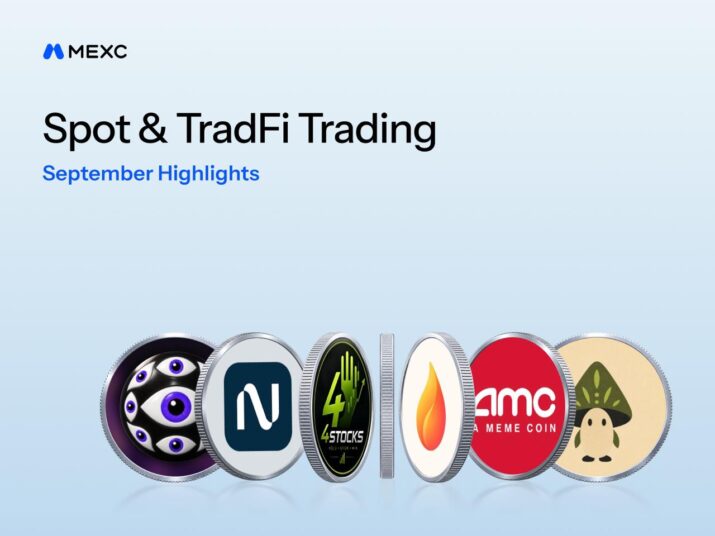
MEXC’s New-Token Trading Volume Rises 77% in September as Stock-Related Trading Expands Into On-Chain New-Token Markets

Mutsamudu, Comoros, October 22, 2026 – MEXC, a pioneer in 0-fee digital asset trading, has released its September trading data. New-token and TradFi spot trading volumes rose 77% and 78% month over month, respectively, while tokenized U.S. stock trading volume increased 81%. Stock Meme projects also took the top two spots by new-token spot trading volume, as stock-related trading expanded into on-chain new-token markets.


In September, the number of newly listed tokens on MEXC increased 15% month over month, while the number of users trading new tokens grew 27%. Seven of the top 10 new tokens by spot trading volume made their exchange debut on MEXC, highlighting the platform’s coverage of trending early-stage assets. Stock Meme projects 4STOCK and MEMEROBINHOOD together accounted for approximately 38% of the top 10’s combined trading volume, underscoring the activity around stock-related themes in new-token trading.


Beyond stock-themed meme tokens, tokenized stocks are also being used as quote assets for on-chain new token trading pairs. Four Stock Meme projects, including MEMEROBINHOOD, SI, MOO, and 4STOCK, ranked among the top 10 gainers. Together, they accounted for approximately 67% of the ranking’s total trading volume. EMBER and BREW, two tokens associated with token launch platforms, also ranked among the top 10 new tokens by spot trading volume. Both platforms support trading pairs between new tokens and stock-related assets. These developments suggest that the convergence of stocks and crypto assets is moving beyond stock tokenization into a broader range of on-chain trading use cases. Of the five distinct Stock Meme projects that appeared across the two rankings this month, three run on Robinhood Chain, an emerging public blockchain.


Echoing activity in the new-token market, MEXC’s tokenized U.S. stock trading volume rose 81% month over month in September, accounting for approximately 66% of the increase in TradFi spot trading volume. Growth extended beyond a handful of assets: more than half of the tokenized U.S. stocks saw their trading volumes at least double. The number of tokenized U.S. stocks in the top 10 by TradFi spot trading volume rose from three in August to five in September. MRVL and META entered the ranking, with trading volumes up 212% and 152%, respectively.


Circle-related trading activity also appeared across both MEXC’s tokenized U.S. stock and new-token markets. On September 16, Circle launched the mainnet of its own blockchain, Arc. ARGUS, the token of a launch platform on Arc, was listed on MEXC the same day and ranked among the month’s top 10 new tokens by spot trading volume. During the same month, trading volume for tokenized U.S. stock CRCL rose 103% month over month, placing it fourth by TradFi spot trading volume.


To drive user participation, MEXC held xStocks Gala, a tokenized U.S. stock trading campaign, in September. The campaign attracted nearly 100,000 registrations, with average daily trading volume exceeding $3.4 billion during the event. By combining popular assets with trading incentives, MEXC further lowered barriers to participation in the tokenized stock market.


MEXC CEO Vugar Usi said, “The convergence of stocks and crypto assets is changing how users participate in markets. A single market theme can drive trading activity in both tokenized U.S. stocks and on-chain new tokens. Through 0-fee trading and broader asset coverage, MEXC aims to help users capture cross-market trading opportunities on one platform.”


About MEXC


Founded in 2018, MEXC is a leading global multi-asset trading platform built as your 0-fee gateway to infinite opportunities. Serving users across 170+ markets, MEXC provides simple and efficient access to crypto, stocks, tokenized assets, derivatives, and a growing range of TradFi-linked opportunities through one account and one gateway.


With 0 trading fees, deep liquidity, broad asset coverage, and a high-performance trading experience, MEXC is designed for retail users who want to discover earlier, act faster, and trade with fewer barriers. As crypto and traditional finance continue to converge, MEXC is committed to making global opportunities more accessible, helping users trade freely and MEXCmize every opportunity.


MEXC Official Website| X | Telegram |How to Sign Up on MEXC

For media inquiries, please contact MEXC PR team: media@mexc.com


GRVT Burns 1.1 Million Tokens as Countdown to Grvt 2.0 Begins

The discretionary buyback represents close to 1% of circulating supply and precedes four planned product milestones culminating in Grvt 2.0.

Road Town, British Virgin Islands, October 22, 2026 – Grvt, a self-custodial trading platform built on its own zero-knowledge (ZK) chain, announced that the Foundation’s token issuer has completed its first GRVT token buyback, purchasing and burning 1.1 million GRVT tokens on the open market.

The transaction permanently removed close to 1% of GRVT’s circulating supply at the time of purchase. It marks the first of five milestones ahead of the planned launch of Grvt 2.0 at the end of November 2026.


A discretionary buyback with on-chain verification

The Foundation’s token issuer intends to conduct further buybacks on a monthly basis. Each transaction remains entirely at the issuer’s discretion, with no predetermined purchase amount or guaranteed schedule.

Buybacks are executed through an independent execution partner, with purchased tokens transferred to a designated burn address and permanently removed from circulation.

The transactions can be independently verified through the public buyback dashboard, which records the number of tokens purchased and burned, the percentage of circulating supply represented, cumulative burns and on-chain transaction hashes.

“The GRVT token is an important part of the ecosystem we are building,” said Hong, co-founder and CEO of Grvt. “We welcome the issuer’s buybacks as a demonstration of its long-term commitment to the ecosystem and community. Grvt is expanding its products and markets, and the issuer’s buybacks sit alongside that as a supportive mechanism aimed at reducing circulating token supply.”

Grvt outlines four product milestones

The announcement follows GRVT’s token generation event in July 2026 and precedes a series of planned launches.

Grvt Earn, scheduled for the end of October, will introduce yield opportunities backed by tokenized fixed-income assets, with target yields of up to 11%. Returns are expected to derive from underlying asset cash flows, including interest, premiums and invoice-related income. Asset-supplying partners will be announced at launch. Target yields are not guaranteed.

Stable Funding Perps, scheduled for November, will introduce perpetual futures linked to commodities, stocks, foreign exchange and indices. The contracts are planned to carry zero trading fees and use once-daily funding. Grvt aims to list more than 1,000 markets by the end of December 2026.

Yield as Margin, also scheduled for November, will allow eligible Grvt Earn balances to support trading positions while continuing to accrue yield, subject to applicable product terms and risk parameters.

Grvt 2.0, scheduled for the end of November, will consolidate these capabilities into a single self-custodial app, alongside a new name, visual identity and the company’s 2027 roadmap.

Addressing idle capital

The expansion follows a survey of Grvt traders conducted earlier in 2026. Six in ten respondents reported keeping at least a quarter of their capital on the platform idle, while many reported moving funds elsewhere to pursue yields of 8% or more.

Grvt’s upcoming products aim to reduce the separation between earning yield and deploying capital for trading.

“Traders shouldn’t have to choose between putting their capital to work and keeping it ready to trade,” Hong said. “Grvt 2.0 is designed around a single self-custodial balance that can support both activities.”

Founded in 2022, Grvt currently supports perpetual futures across approximately 200 cryptocurrency and real-world asset markets.

The GRVT token launched in July 2026 and confers no ownership, profit or other economic rights.

Further details are available in the full announcement.

About Grvt

Grvt is a self-custodial trading platform operating on its own zero-knowledge chain. The platform supports cryptocurrency and real-world asset perpetual futures and is developing products that allow eligible balances to earn yield while supporting trading activity.

Learn more at grvt.io.

Media contact

Lesner Head of Marketing, Grvt lesner.chua@grvt.io


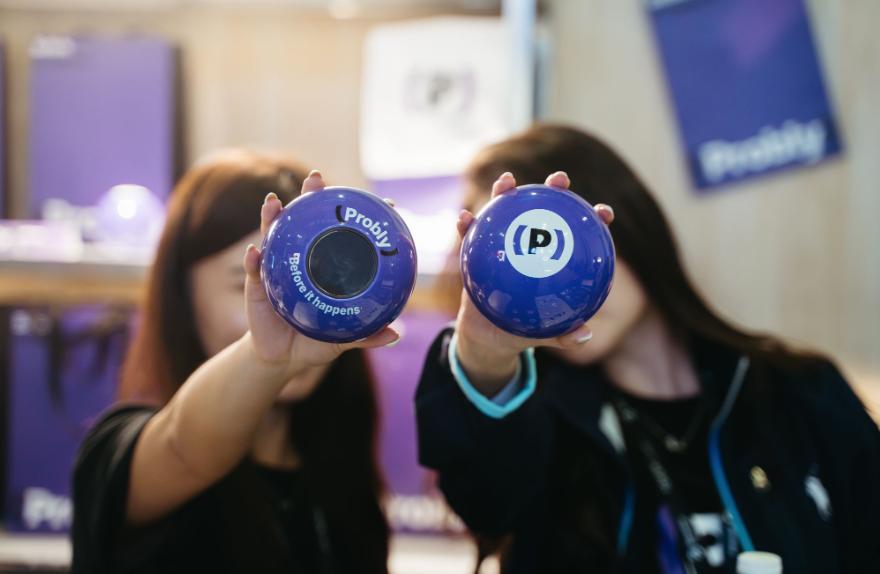
Probly Wraps Up TOKEN2049 Singapore and WHALE3RA, Strengthening Its Presence in On-Chain Prediction Markets

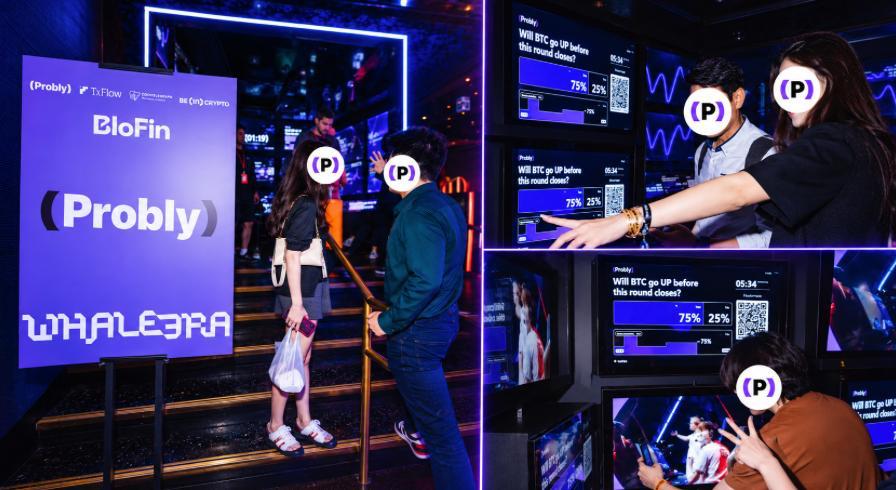
The British Virgin Islands, Road Town, October 2026 — Probly, an on-chain prediction market for sports, politics, crypto, finance, and global events, has concluded its participation as a Gold Sponsor of TOKEN2049 Singapore and co-host of the WHALE3RA Afterparty alongside BloFin, TxFlow, and other ecosystem partners.


Across TOKEN2049 week, Probly connected with traders, builders, infrastructure teams, partners, and Web3 communities around the growing role of prediction markets as a way to express views on real-world events.

The week also gave Probly an opportunity to introduce its approach to prediction markets to a broader crypto-native audience: simple access, broad market coverage, self-custody USDC, peer-to-peer trading, and verifiable on-chain settlement.

From Market Opinions to On-Chain Signals

Prediction markets are increasingly becoming an interface for turning expectations about future events into market signals. For Probly, TOKEN2049 provided an opportunity to bring that idea directly to an audience already accustomed to trading changing market conditions, information, and expectations.

The name Probly comes from “probably,” the word people use when the outcome of an event remains uncertain. It is also inspired by P(A), the mathematical notation used to represent the probability of an event.


Probly currently supports 5,100 events and 47,000 markets across Sports, Geopolitics, Crypto, Finance, Economy, and Politics. The platform also offers 172 active live markets for same-day trading, including high-frequency Crypto “Up or Down” rolling markets across BTC, ETH, SOL, and XRP.

Probly is the first prediction market application developed through TxFlow Improvement Protocol 3 (TIP3). Settlement through TxFlow enables on-chain settlement, automatic USDC payouts, and no manual claim step.

Bringing the Prediction Market Conversation to WHALE3RA

Probly also co-hosted WHALE3RA at MARQUEE Singapore during TOKEN2049 week alongside BloFin, TxFlow, and other ecosystem partners.


The event brought together traders, builders, funds, exchanges, infrastructure teams, and Web3 communities, giving Probly an opportunity to engage directly with many of the audiences shaping the next generation of crypto products.


For Probly, these conversations reinforced an important direction for the product: prediction markets should not be limited to occasional major events. They can become a more active interface for following changing information, forming a view, and trading expectations as events develop.

What Comes Next for Probly

Following TOKEN2049 Singapore, Probly will continue developing its prediction market experience around accessibility, broader event coverage, frequent trading opportunities, and transparent on-chain infrastructure.

The company will also continue working with ecosystem and infrastructure partners as it develops new ways for users to express views on future outcomes through on-chain markets.


TOKEN2049 and WHALE3RA marked another step in bringing Probly’s core idea to a wider audience: uncertainty is everywhere, and markets can make collective expectations around what happens next more visible, transparent, and useful.

Before It Happens.

About Probly

Probly is a prediction market built on TxFlow L1 through TxFlow Improvement Protocol 3 (TIP3). It turns views about future events into continuously updated market signals across sports, crypto, economics, news, culture, weather, and other real-world categories.


Probly combines real-time markets, broad event coverage, fully on-chain settlement, and self-custodied USDC infrastructure. Its mission is to make collective expectations more immediate, transparent, and useful by converting uncertainty into a price.

Media Contact

Probly PR Team

Email: torygarcia@probly.com

Website: https://www.probly.com/en 

X: @ProblyHQ

Important Notice

This announcement is provided for general informational purposes only. It does not constitute an offer, solicitation, recommendation, or invitation to enter into any transaction, event contract, any transaction, event contract, derivative, or other product, derivative, or other product. Nothing in this announcement constitutes investment, financial, legal, or trading advice. References to market information, probability indicators, settlement infrastructure, or product functionality should not be interpreted as a recommendation to participate in any market. References to third-party companies, platforms, and products are provided solely for general industry context. They do not imply affiliation, endorsement, or partnership except where expressly stated.


Probly’s availability, functionality, event coverage, account features, wallet support, and eligibility requirements may vary by jurisdiction. Access is subject to applicable laws, regulations, product rules, geographic restrictions, and eligibility requirements. No person should access or use the application in a jurisdiction where doing so would be prohibited or would require an authorisation that has not been obtained.


BitTorrent Ushers in Next-Gen Web3 Infrastructure with Strategic Rebrand and Inaugural BTT Burn

The first round of BTT repurchased with decentralized service revenue has been completely burned, as BitTorrent leverages its reimagined architecture to pivot toward Web3 and AI infrastructure. 


BitTorrent, a cornerstone of decentralized infrastructure in the TRON ecosystem, entered a new phase of growth driven by dual engines: the rollout of its long-term BTT buyback-and-burn strategy and a comprehensive brand upgrade.

Central to this strategic overhaul, the long-term BTT buyback-and-burn commitment has officially translated into tangible action. Following its announcement on July 6 and subsequent scheduled repurchases, BitTorrent transferred the first round of BTT—funded by 100% of decentralized service revenue—to a burn address on October 16, successfully completing its inaugural burn cycle. Coming on the heels of the recurring buyback-and-burn mechanisms established for JST and SUN, this marks another major positive development for the TRON ecosystem in deepening its token deflationary model and value accrual.

Concurrently, BitTorrent released a brand-new official whitepaper, marking a comprehensive brand upgrade. Directly answering the demands of the Web3 and generative AI era, this upgrade establishes a powerful tripartite architecture. It brings together the BitTorrent Mainnet for peer-to-peer content distribution, BTTInferGrid as the decentralized compute layer, and BTTC for cross-chain interoperability, Layer 2 scaling, and on-chain settlement. With the native BTT token serving as the unified economic engine across the entire network, BitTorrent is delivering an open, efficient, and durable infrastructure for the decentralized AI frontier.

The rollout of these twin initiatives marks BTT’s evolution from a standard utility and governance token into a revenue-backed deflationary asset, underscoring BitTorrent’s steadfast commitment to long-term value creation. Crucially, it launches the BitTorrent ecosystem into a self-reinforcing flywheel of sustainable growth, direct value accrual, and strategic expansion.


Inaugural BTT Buyback & Burn Completed: 100% Decentralized Revenue Powers Deflationary Flywheel

The rollout of this long-term buyback-and-burn program marks BitTorrent’s most decisive step yet to refine its tokenomics and reinforce ecosystem value.

BitTorrent set this long-term roadmap in motion on July 6, introducing a sustainable, revenue-backed deflationary model. Under this framework, 100% of all decentralized business revenue is channeled directly into BTT buybacks and burns, executed systematically across each calendar quarter. Moving past short-term, marketing-driven buybacks financed by outside capital, this structure creates genuine value capture driven purely by real business performance.

In line with this schedule, BitTorrent completed its inaugural buyback using Q3 2026 revenue from its decentralized services. On October 16, a total of 21,621,611,570,729.6 repurchased BTT tokens, valued at approximately $7,600,907, were sent to the black-hole burn address. Trackable via transaction hash 4d9596617780e329bbd4e644ee0dffd780ec4cf3749f324d03eb98157eb04ae5, this irreversible on-chain burn permanently removes the tokens from circulation, providing the market with transparent and verifiable proof of deflation.

To guarantee end-to-end transparency and traceability, BitTorrent has set a rigorous benchmark for on-chain disclosure. Alongside the brand upgrade, a dedicated BTT buyback-and-burn dashboard is now live on its official website. Going forward, burn figures and corresponding on-chain records will be published on this page around the middle of the first month of every subsequent quarter, offering the market a transparent, predictable deflationary schedule.

Market reception has been overwhelmingly positive. Recent trading data shows strong upward momentum, with BTT posting an impressive gain of approximately 30.3% over the trailing three months as of October 15. This rally highlights investor confidence in BitTorrent’s operational cash flow and long-term prospects, confirming that this revenue-driven deflationary model has sparked a powerful engine for BTT’s value growth.

Fueling this long-term deflationary mechanism is BitTorrent’s ambitious expansion into distributed networks, cross-chain interoperability, and AI compute. This widening business footprint creates a fully self-sustaining commercial loop. As utility expands, the buyback initiative ignites a powerful flywheel that bridges revenue generation, token deflation, value distribution, and network growth. Stronger business operations and independent revenue streams provide an ever-growing financial base for BTT buybacks. In return, the rising intrinsic value of the token organically attracts more global nodes and developers, fueling the next massive leap in network adoption.


BitTorrent Reborn: A New Blueprint for Web3 and AI Infrastructure

BitTorrent is rewriting its DNA. Driven by a new whitepaper and a massive tokenomics upgrade, the protocol has officially transcended its legacy boundaries. Now firmly anchored as the definitive infrastructure for Web3 and AI applications, this strategic evolution transforms BitTorrent’s multi-tiered network into a powerhouse of deep, cross-layer synergy and structural vitality. 

The explosive rise of generative AI and Web3 has hit a structural wall: sluggish data delivery, fractured compute power, and punishing on-chain settlement fees. BitTorrent confronts this bottleneck head-on. Under an evolved strategic narrative, the new whitepaper re-engineers BitTorrent’s stack from the ground up, unifying its core capabilities into a cohesive infrastructure. It decisively positions BitTorrent as a comprehensive infrastructure ecosystem spanning content distribution, decentralized compute, and on-chain scaling and settlement, driven by a tripartite synergy uniting the BitTorrent Mainnet, the BTTInferGrid decentralized compute network, and the BTTC scaling network.   

Within this reimagined architecture, individual verticals no longer operate in silos; they function as interlocking gears. BitTorrent Mainnet acts as the ecosystem’s primary gateway and data distribution layer, driving peer-to-peer content delivery to connect global users, nodes, and bandwidth at scale. In tandem, the newly integrated BTTInferGrid powers the decentralized compute layer, matching distributed GPU capacity with active demand to deliver elastic, cost-efficient, and verifiable AI inference for developers and dApps. Bridging these layers, BTTC anchors Layer 2 scaling, cross-chain interoperability, and settlement across networks like TRON, Ethereum, and BNB Chain. Leveraging EVM compatibility, low gas fees, and high-frequency throughput, it executes service settlements, node staking, reward distributions, and cross-chain payments. Unifying the entire network, the native BTT token serves as the core economic engine, covering critical utilities across resource payments, gas fees, node incentives, staking, and governance.

Uniting distributed content delivery, decentralized compute, on-chain execution, and tokenomics, the reborn BitTorrent stands as an open infrastructure network built for the Web3 and AI frontier. The strategic integration of an AI compute tier decisively drives BitTorrent beyond data routing into high-value intelligent processing and full-stack solutions. Each product line operates as an independent service tier for users and developers while integrating via standardized interfaces and the BTT tokenomic engine. Together, they establish a closed-loop infrastructure pipeline spanning data distribution, compute execution, outcome verification, and on-chain settlement.

Above all, BitTorrent’s next chapter comes down to its community and the builders. The updated whitepaper refines BTT governance, putting real decision-making power and tangible economic rewards directly into the hands of the community. That philosophy comes alive through a 100% decentralized buyback-and-burn model, ensuring that every dollar earned by the network is transparently returned to token holders and ecosystem contributors.

Backing its Web3 and AI evolution with an ongoing BTT buyback-and-burn model marks a defining leap for BitTorrent. It confirms strong profitability and durable business foundations, laying down a direct blueprint to lead decentralized infrastructure. With its value-capture flywheel running at full speed, BitTorrent moves into the future of Web3 and AI with fresh momentum, an open architecture, and lasting staying power.


BitTorrent Team

Singapore

bttc_support@bittorrent.com

JUST Completes 5th JST Buyback & Burn: Over 170M Tokens (~$23.53M) Burned Ahead of Major Deflationary Upgrade

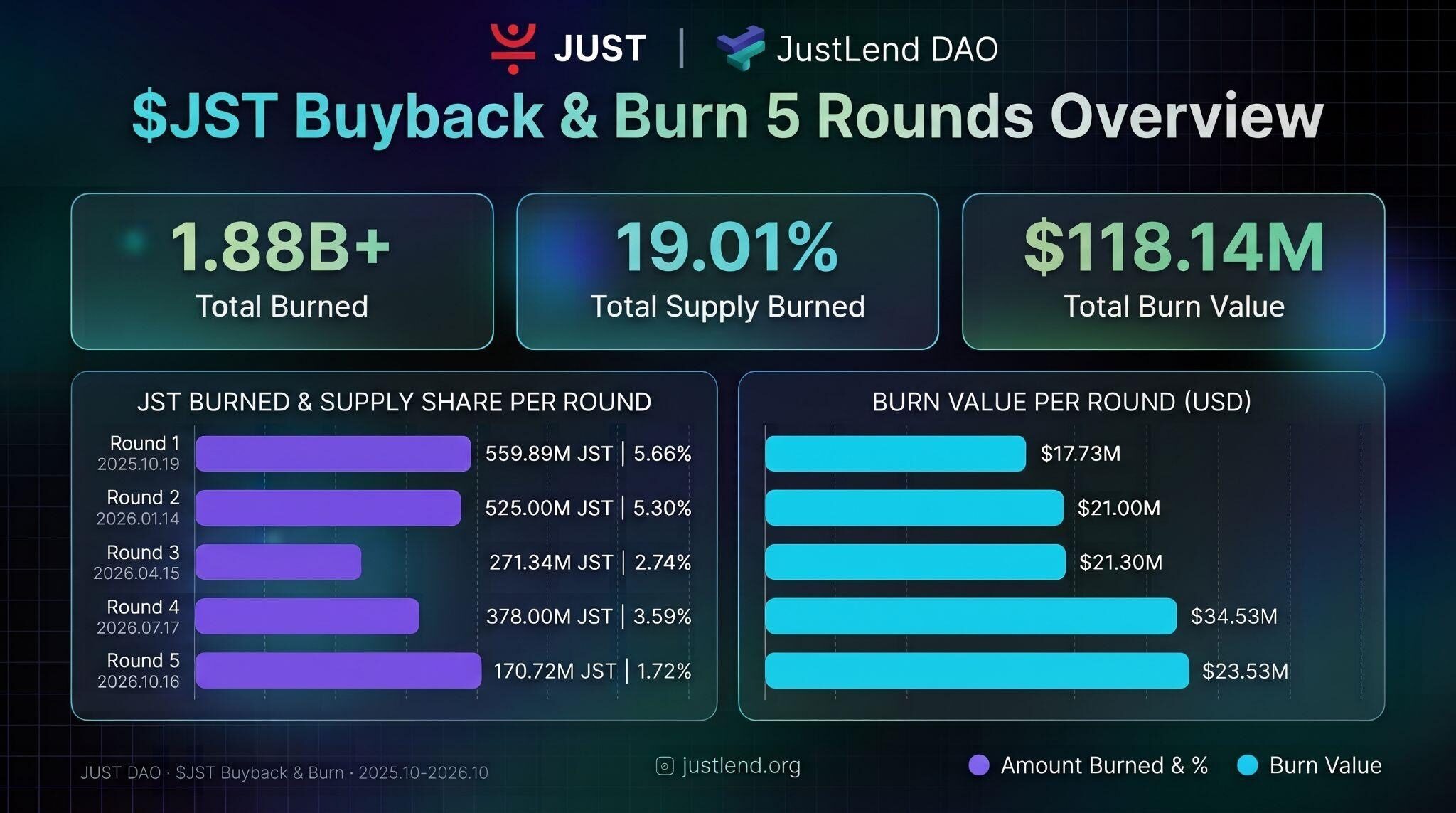
Over the past year, JUST has completed five consecutive large-scale buyback-and-burn rounds, permanently removing 1.88B JST tokens from circulation and pushing cumulative deflation toward 19%. Following this milestone, the buyback and burn mechanism is set to undergo a comprehensive upgrade.


On October 17, JUST, the leading DeFi infrastructure in the TRON ecosystem, announced the completion of its fifth buyback and burn of its native token JST as scheduled. Over 170M JST were burned in this round (approx. 1.72% of total supply), backed by nearly $23.53M in capital deployed—all funded directly by JustLend DAO’s net operating revenue.

Over the past five rounds, a total of 1.88B JST tokens have been burned, driving the cumulative deflation rate past 19% with over $100M revenue deployed.

JST has reached a key operational milestone following this latest burn: the remaining 70% of JustLend DAO’s initial treasury reserves has been fully deployed according to the original plan. This marks the successful completion of the first phase , paving the way for a major mechanism upgrade.


170M+ Tokens (~$23.53M) Burned in JST’s Fifth Buyback Round

According to the official announcement released, the fifth JST buyback and burn was successfully completed. As a routine buyback for Q3 2026, a total of 170,723,144 JST tokens (approx. 170M) were burned, representing about 1.72% of the total token supply, with a total value exceeding $23.53M.

Maintaining similar levels of burn scale and capital investment to the previous four rounds, this burn round continues the stable, predictable execution cadence of JST buybacks and burns.

Looking further into the source of funds, the funds  invested in this buyback and burn came entirely from JustLend DAO’s net operating income, specifically composed of two parts: the remaining $10.34M from JustLend DAO’s existing income and the $9.28M QoQ increase in Q3’s net income.

In terms of quarterly revenue performance, JustLend DAO’s Q3 net income remained steady compared to previous quarters. With quarterly earnings consistently anchored at the eight-figure ($10M+) level, the ecosystem’s core revenue streams continue to prove their resilience.

At the same time, deploying the remaining 70% of the initial revenue reserve means that the early-stage treasury reserve plan has officially reached its conclusion—setting the stage for a brand-new phase of the buyback program.


One Year, Five Burns: JST’s Price Soars 300% with $100M Deployed from JustLend DAO’s Revenue

From its launch in October 2025 to the fifth round on October 16, 2026, the JST buyback and burn mechanism has completed one full year of operation across five consecutive burn rounds. A total of approximately 1.881B JST tokens have been burned, representing a cumulative deflation rate of > 19% with more than $100M deployed from JustLend’s revenue.

A breakdown of the five buyback and burn executions is as follows:

– Round 1 (October 19, 2025): Burned ~559M JST (~5.66% of total supply), with ~$17.72M deployed.

– Round 2 (January 14, 2026): Burned ~525M JST (~5.3% of total supply), with ~$21M deployed.

– Round 3 (April 15, 2026): Burned ~271M JST (~2.74% of total supply), with ~$21.3M deployed.

– Round 4 (July 17, 2026): Burned a total of ~355M JST (~3.59% of total supply), with ~$34.59M deployed. In addition to the routine quarterly buyback, this round incorporated dedicated burn funds from USDJ’s historical stability fees (~$10.39M) for the first time.

– Round 5 (October 16, 2026): Burned ~170M JST (~1.72% of total supply), with ~$23.53M deployed.


In terms of operational intensity, the execution of five consecutive rounds in a single year—averaging roughly $20M per round, with over $100M committed from real protocol earnings and nearly one-fifth of the total token supply burned—places JST among a select tier of buyback programs rarely seen in the DeFi sector.

This continuous execution has transformed the buyback from a series of short-term news catalysts into a permanent value engine. Rather than acting as an isolated marketing tactic, the program transmits its impact systematically through a five-pillar chain: Capital Foundation—Execution Assurance—Transparency & Trust—Deflationary Scarcity—Market Feedback, cementing a durable foundation for long-term valuation.

On the capital foundation, JST buybacks rely directly on authentic business cash flows. Except for the historical USDJ stability fee allocation in Round 4, every dollar of the $100M+ deployed across all five rounds originated directly from JustLend DAO’s organic operating earnings.

In execution assurance, both capital scale and operational cadence have been uncompromisingly delivered. Single-round commitments began at $17.72M in Round 1, stabilized around $20M thereafter, and reached $34.59M in Round 4. Throughout all five quarters, every burn landed strictly on schedule—free from delays, disruptions, or arbitrary cuts.

For transparency and trust, every buyback follows the standard procedure of “pre-disclosed rules, on-schedule execution, and verifiable on-chain proof”, backed by immutable on-chain transaction records and open official disclosures.

In deflationary impact, around 1.881B JST tokens have been burned across five rounds, contracting total supply from 9.9B down to ~8.02B—a nearly 19% reduction that continuously compounds structural scarcity.

Ultimately, market feedback validates the mechanism through synchronized gains in both token price and market cap. CoinGecko data shows JST climbing steadily from its ~$0.03 low in October 2025 to an October 10 peak of $0.142—a 300%+ year-to-date surge marking a new high since 2022—while circulating market cap surged past $1B.

This closed-loop flywheel—fueled by authentic revenue, reliable execution, complete transparency, structural deflation, and market validation—has elevated the buyback program far beyond short-term hype, solidifying it as the central pillar sustaining JST’s long-term economic value.


Buyback Mechanism Poised for Comprehensive Upgrade as Capital Sources Diversify

 With five consecutive rounds now complete, the JST buyback program arrives at a watershed moment: the first phase officially concludes, setting the stage for a new upgraded phase.

Looking back at the initial phase, the framework was initially structured to draw backing jointly from JustLend DAO and USDD. Under the original terms, USDD’s cross-chain ecosystem revenue was to feed into the buyback pool once cumulative earnings hit $10M—a threshold not yet reached. Consequently,  this early phase operated primarily on JustLend DAO’s accumulated treasury reserves alongside the increment in quarterly net revenue. Specifically, the $59M+ reserve earmarked at inception under the plan of “30% upfront, 70% in phased tranches” has now been fully deployed across five rounds. This signifies that the initial phase has smoothly achieved its objectives, clearing the path for  the comprehensive upgrade.

As outlined in the JST Q1 2026 financial report released in April, the upgraded JST buyback  mechanism will broaden capital sources beyond the existing framework by incorporating revenues from new business streams such as GasFree, providing deeper and more diversified funding for ongoing buybacks.

With the upgraded phase around the corner, JST’s long-term deflationary momentum and value-return capabilities are poised to enter an even more sustainable and predictable cycle. For specific plans regarding capital allocation, execution cadence, and ecosystem integrations under this upgraded mechanism, follow JUST’s official X account @JUST_DAO for the latest updates.


JUST Team

Singapore

media@just.network


DSA Joins Nacha Payments Innovation Alliance Fall Meeting to Discuss the Future of Digital Payments

Washington, D.C., October 18, 2026 — The Digital Sovereignty Alliance (DSA), a nonprofit organization dedicated to advancing clear and ethical public policy, research, and education related to emerging technologies, participated in Nacha’s Payments Innovation Alliance Fall Meeting, where DSA Senior Policy Advisor Molly Woodman joined industry leaders to discuss emerging technologies, regulatory developments, and the future of domestic and global payments.


Held October 14-16 at the InterContinental Chicago Magnificent Mile in Chicago, Illinois, the three-day meeting brought together stakeholders from across the financial services and payments industries to exchange insights, address operational challenges, and explore opportunities for innovation. Discussions focused on evolving payment technologies, regulatory considerations, and practical approaches to navigating an increasingly complex financial landscape.


As part of the Alliance’s ongoing initiatives, Woodman facilitated discussions surrounding the newly launched Next-Gen Currency Project Team, a project co-led by Nacha and DSA. The team explores the global use of digital assets, including stablecoins and tokenized deposits, for money movement. Its work focuses on developing tools to bridge digital assets and traditional payment systems, tracking regulatory developments, identifying operational implications, and providing educational resources to the payments industry.


Throughout the meeting, participants also examined practical challenges facing financial institutions as emerging technologies reshape payment systems. Topics included expectations for financial institutions regarding agentic payments, the reliability of multifactor authentication methods as technology evolves, and emerging approaches to Know Your Agent (KYA) frameworks. Discussions highlighted the importance of industry collaboration in addressing operational uncertainties and developing workable solutions as regulatory frameworks continue to evolve.


“It’s been encouraging to watch financial institutions brainstorm together on how to build some continuity in areas where regulation hasn’t caught up yet,” said Molly Woodman, Senior Policy Advisor at DSA.


DSA’s participation reflects its ongoing commitment to supporting informed policy discussions and collaboration across the financial services and emerging technology sectors. Through its involvement in the Next-Gen Currency Project Team and broader industry engagement, DSA works to advance approaches that support responsible innovation, regulatory clarity, and the integration of emerging technologies into the evolving payments landscape.


About the Digital Sovereignty Alliance

The Digital Sovereignty Alliance (DSA) is a nonprofit social welfare organization committed to advocating for public policies that support ethical innovation in decentralized technologies, blockchain, cryptocurrency, Web3, and artificial intelligence. DSA conducts research, organizes educational events, and promotes policies that prioritize public welfare and digital sovereignty.


Media contact

Maghan Lusk

info@discoverdsa.org 

Bitcoin’s Quantum Transition Won’t Stop at Bitcoin

HONG KONG, October 18, 2026 – As quantum computing advances, the challenge extends beyond Bitcoin’s cryptography to the financial infrastructure built around it.

Quantum computing is emerging as one of Bitcoin’s long-term security challenges. A sufficiently powerful quantum computer could theoretically compromise the digital signatures protecting Bitcoin transactions, potentially exposing funds associated with vulnerable public keys.

While no publicly demonstrated quantum computer is currently capable of such an attack at scale, the implications extend beyond Bitcoin itself. As Bitcoin becomes increasingly integrated into decentralized finance (DeFi) through tokenized assets such as Wrapped Bitcoin (WBTC), a future cryptographic transition would affect not only the Bitcoin network, but also the financial infrastructure built around it.

The question is no longer simply whether Bitcoin can become quantum-resistant, but whether the broader ecosystem can evolve alongside it.

Beyond the Bitcoin Network

Bitcoin’s transition to quantum-resistant cryptography would require more than introducing new signature schemes. Wallets, exchanges, custodians and infrastructure providers would need to adapt their systems, potentially migrating existing BTC holdings to new security standards.

Proposals such as BIP-360 reflect ongoing efforts to explore Bitcoin’s future cryptographic architecture. Yet coordinating adoption across a decentralized ecosystem could take years.

For tokenized Bitcoin, the challenge becomes more complex. Even if Bitcoin adopts quantum-resistant cryptography, the custody systems, smart contracts and networks supporting tokenized assets would still require independent security assessments.

Securing Bitcoin itself does not automatically secure everything built around it.

WBTC and the Next Generation of Bitcoin Infrastructure

As an established tokenized Bitcoin asset in DeFi, WBTC illustrates the scale and complexity of securing Bitcoin across multiple financial ecosystems.

With 116,000 WBTC in circulation, representing approximately $9.5 billion in Bitcoin-backed assets, WBTC’s infrastructure supports Bitcoin liquidity across lending protocols, decentralized exchanges and multiple blockchain networks.

Backed 1:1 by BTC held in custody, WBTC’s long-term resilience depends not only on Bitcoin’s underlying cryptography, but also on reserve security, custody operations and the infrastructure supporting minting and redemption.

A future quantum-resistant transition could require custodians to evaluate their key-management systems, migrate underlying BTC reserves and maintain operational continuity throughout the process.

Against this backdrop, WBTC is preparing to migrate to new Custodian Bitcoin Deposit Addresses (CBDAs) as part of its custody infrastructure management. Bitcoin address management is relevant to long-term security because public-key exposure can influence vulnerability to potential quantum attacks. However, the security implications depend on address types and transaction histories, and address migration alone does not establish quantum resistance.

WBTC has also publicly announced its exploration of a multi-custodian reserve model, aimed at reducing custody concentration risk and strengthening operational resilience. While diversification does not directly address quantum vulnerabilities, it could provide greater flexibility as security standards evolve, depending on implementation.

Together, these initiatives highlight the importance of both reserve security and operational resilience as Bitcoin’s financial ecosystem expands. Neither replaces the need for quantum-resistant cryptography, but both illustrate the infrastructure considerations involved in preparing for future changes.

Preparing for the Next Era

The timeline for quantum computing remains uncertain, but preparing for potential cryptographic changes is a long-term challenge for the entire Bitcoin ecosystem.

For WBTC, this means considering how custody arrangements, reserve management and supporting blockchain infrastructure could evolve alongside Bitcoin’s security standards.

Bitcoin’s quantum transition may begin with cryptography, but its success will depend on the resilience of the infrastructure connecting Bitcoin to the wider financial ecosystem.

About WBTC – Bitcoin’s Passport to DEFI WBTC is the new Bitcoin standard. A singular identity for Bitcoin across multiple chains. It brings Bitcoin into environments where speed, capital efficiency, and scale are essential, while maintaining fidelity to Bitcoin’s original principles. There is no second. WBTC stands alone in its role, trusted, verifiable, and engineered for a multichain world. Media Contact: nadia.song@wbtc.network | Website: wbtc.network

Disclaimer: Information provided is for information purposes only and is not financial advice. No representation or warranty has been made as to the content, accuracy, timeliness, suitability or completeness of such information. Participation in DeFi carries risks, always do your own research.

❌