Login
Login
Why Inaccurate Reporting Hurts Forex Brokerages and How CRM Integration Solves It
Running a forex brokerage means making hundreds of decisions every day.
→ Which marketing channel is bringing quality traders?
→ How many leads are converting?
→ Which clients need more attention?
→ Are sales teams following up at the right time?
The answer to these questions depends on one important factor: Accurate Reporting.
A data error in a report may seem like a small issue, but for a brokerage, it can affect revenue, customer relationships, compliance, and future growth.
For example, imagine your sales dashboard shows that a campaign generated 1,000 leads. But after checking manually, you find that 300 leads were duplicates or incomplete. Your team has already spent time and money following inaccurate information.
This is where Forex CRM integration becomes valuable. By connecting your CRM with other business systems, you can bring customer data into one place, reduce reporting mistakes, and get a clearer picture of your brokerage performance.
In this article, we will explore why inaccurate reporting creates challenges for forex brokers and how CRM integration helps build a stronger business operation.
Inaccurate Reporting in Forex Brokerages: Problems and CRM Solutions
Accurate reporting is the backbone of a successful forex brokerage. Business owners depend on reports to understand lead performance, track sales activities, monitor client behavior, and plan future growth.
But when reports are inaccurate, it creates confusion across the business. Teams may work with different information, managers may make decisions based on incorrect numbers, and opportunities may be missed.
Let’s look at the common reporting problems forex brokers face and how CRM integration provides practical solutions.
Problem 1: Manual Data Entry Creates Reporting Errors
Many forex brokerages still depend on employees to update customer details, lead information, payment records, and sales activities manually.
While this process may work at a smaller scale, it becomes difficult to manage as the business grows. A simple mistake, such as entering the wrong client status or missing an update, can affect multiple reports.
Solution: Automated Data Management
A Forex CRM integration reduces dependency on manual updates by automatically collecting and organizing information from connected systems.
When client details, lead activities, and transaction information are updated automatically, reports become more accurate, and teams spend less time fixing data errors.
Problem 2: Disconnected Systems Create Data Gaps
Forex brokers usually use multiple platforms to run their operations, including trading systems, payment gateways, marketing tools, and customer support software.
When these platforms work separately, information becomes scattered. The marketing team may have one set of lead numbers, while the sales team works with another. This makes it difficult to understand the actual business performance.
Solution: Connecting All Business Data in One CRM System
CRM integration connects different platforms and brings important information into one central location.
Instead of checking multiple systems, business owners and teams can access a complete view of customer data, sales activities, and business performance from a single platform.
Problem 3: Delayed Reports Slow Down Decision Making
The forex industry moves quickly. Business owners need updated information to understand customer activity, marketing results, and revenue performance.
When reports are delayed, decisions are often made using old information. This can result in missed opportunities and slower responses to business changes.
Solution: Real Time Reporting and Updated Insights
A connected CRM system provides faster access to updated business information.
With accurate and timely reports, brokers can quickly identify:
- Which marketing campaigns are performing well
- Which leads need follow-up
- How sales teams are performing
- What actions can improve customer engagement?
Problem 4: Duplicate and Incomplete Customer Records
Forex brokers often receive leads from different sources, including websites, advertisements, referrals, and partner networks.
Without proper data management, the same trader may appear multiple times in the system, or important customer details may be missing.
This affects lead reports, sales tracking, and customer analysis.
Solution: Centralized Customer Profiles
CRM integration creates a single customer profile by combining information from different sources.
This helps brokers maintain cleaner records and gives teams a complete understanding of each trader’s journey, from registration to account activity.
Problem 5: Limited Visibility Into Sales and Client Performance
Without connected reporting, business owners may struggle to answer important questions:
- Which sales channels bring the best traders?
- How quickly are leads being followed up?
- Which clients need more attention?
- Which team members are delivering better results?
Without clear answers, improving performance becomes challenging.
Solution: Better Tracking and Performance Reports
A Forex CRM provides detailed reports on leads, sales activities, and customer interactions.
Managers can track performance more effectively and identify areas where their teams can improve.
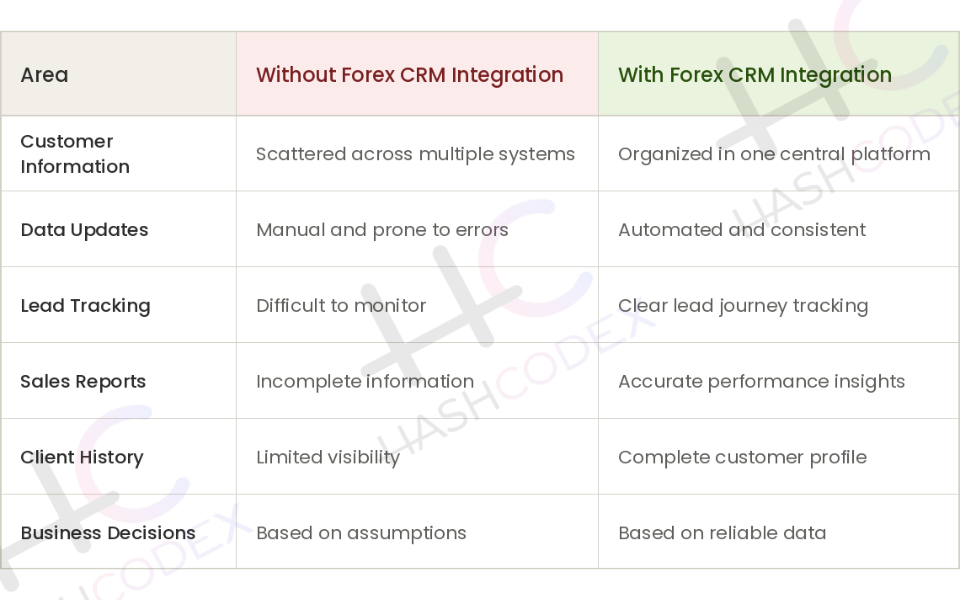
Quick Comparison: Before vs After Forex CRM Integration
Choosing the Right Forex CRM Integration Approach
Every forex brokerage has different requirements. A small broker and a large multi-region brokerage may need different solutions.
Before selecting a CRM integration approach, consider these factors:
1. Compatibility With Existing Platforms
Your CRM should connect smoothly with your current systems, including trading platforms, payment solutions, and marketing tools.
s well with your existing setup reduces operational challenges.
2. Data Security
Forex businesses handle sensitive customer information. Choose an integration approach that focuses on protecting client data and controlling access.
3. Reporting Features
A good Forex CRM Software should provide useful reports that support business decisions.
Look for features such as:
- Sales reports
- Client activity reports
- Lead tracking
- Performance dashboards
- Custom reporting options
4. Scalability
Your brokerage may grow over time. The CRM system should support increasing numbers of clients, employees, and transactions.
Choosing a scalable solution prevents the need for frequent system changes in the future.
5. Ease of Use
A powerful system is only useful when teams can use it properly.
Choose a CRM integration that is simple for sales, support, and management teams to understand.
Conclusion
Accurate reporting plays a major role in the success of a forex brokerage. When reports contain incorrect information, business owners may lose valuable opportunities, make poor decisions, and struggle to deliver a good customer experience.
The solution is not simply collecting more data. It is about managing data correctly.
Forex CRM integration helps brokers connect their systems, reduce reporting errors, improve sales visibility, and understand their clients better.
For forex businesses looking to grow, having better information is a competitive advantage. With the right integration approach, brokers can make smarter decisions, improve operations, and build stronger relationships with traders.
Why Inaccurate Reporting Hurts Forex Brokerages and How CRM Integration Solves It was originally published in Coinmonks on Medium, where people are continuing the conversation by highlighting and responding to this story.