
❌

Reading view

There are new articles available, click to refresh the page.

eenk Provides eInk, ESP32 Powered Text Adventures
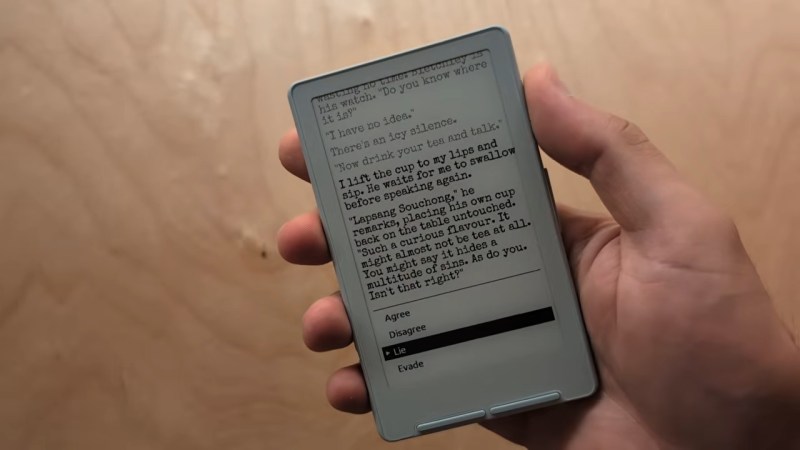
There’s a niche genre of text adventure that’s halfway between a traditional novel and a videogame. Think Zork if it had an extra few novels worth of words of well-crafted story to go with the action. [t0mg] is a fan of such adventures, and also quite enjoys carrying around his palm-sized ESP32 powered Xteink e-ink reader, so decided to create a project to merge the two interests, called eeink.

The Xteink readers have gotten popular lately because their modest internals and size make them very affordable. Not to mention hackable, since they’re basically an ESP32-C3 e-ink dev board that comes with a nice case and battery. The X4 Pro notably comes with an ESP32-S3 which means a lot more RAM, but this project targets both that and the X3/X4 that use the C3 version. Using the C3 means working within some rather stringent limits, as Xteink didn’t spring for any PSRAM, so [t0mg] had less memory to work with than folks did in the 80s.

This project is specifically focused on adventures using the scripting language ink, and comes with its own IDE called eenky to roll your own choose your own adventure book. It’s all on GitHub under an MIT license, and if you want to see it in action there’s a demo video embedded below.

Speaking of Zork, it wasn’t just the first commercial text adventure; it brought some important technological innovations, too.
Β 

Running Zork On The Steam Controller

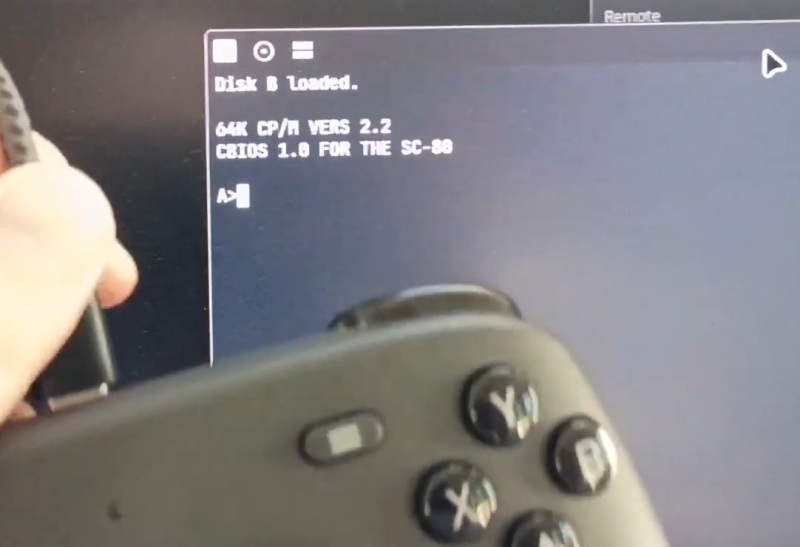
The Steam Controller is a device capable of many interesting feats. It’s intended to act simply as an input device, and yet, it can run games all on its own. As [Owen Feldman] has demonstrated, by having the Steam Controller play Zork.

[Owen] took quite an interesting route to get the there: he wrote a Rust program to emulate the Intel 8080 CPU and CP/M, as one does. This was ported to the Steam Controller, which emulates the CPU and memory on its own internal processor. I/O is streamed over USB, since the Steam Controller lacks a keyboard or screen. The CP/M disk lives in the controller, but the Zork disk data is streamed over USB as well.

If you’re wondering how [Owen] got all this running on the controller, he explains on his personal website. He used what appears to be an undocumented tool included with Steam that allows flashing firmware on the device. Helpfully, Valve also include the original firmware in the same folder, unsigned and only relying on a simple CRC checksum. [Owen] bricked his controller a couple times experimenting with this tool and loading his own firmware, but all came good in the end.

The Steam Controller is probably the oddest device to run CP/M for a while, but heyβ€”it’s a neat party trick. Not much is going to top the auto-docking hack from a few months ago, though.

❌