❌

Reading view

There are new articles available, click to refresh the page.

Fed Chair Warsh: No Bailout for Crypto Industry in Crisis

Bitcoin Magazine
Fed Chair Warsh: No Bailout for Crypto Industry in Crisis

Federal Reserve Chair Kevin Warsh told the House Financial Services Committee on July 14 that the central bank will decline to rescue the cryptocurrency industry in a crisis, a message he delivered during his first semiannual monetary policy testimony as chair.

The exchange came from Rep. Brad Sherman (D-CA), a longtime crypto skeptic, who asked whether the Fed would backstop failing digital-asset firms the way it supported money market funds in 2008. Warsh rejected the premise. β€œWe do not want to be in the bailout business, full stop,” he said. He added, β€œWe want to be in a position where we’re not bailing out anybody, including crypto.”

Warsh, who took office May 15 and presided over his first FOMC meeting in June, framed the stance through his own history.Β 

As a Fed governor under Chairman Ben Bernanke, he helped design the 2008 rescue effort. β€œI still have the scars from the 2008 financial crisis,” he said. β€œThat is not something we want to repeat.” He argued that the post-crisis bailouts bred moral hazard, and he wants to spare digital assets the same fate.

For a market that spent years seeking legitimacy alongside traditional finance, the comments draw a hard line. Warsh, described as the first crypto-native Fed chair, has treated Bitcoin as a gauge rather than a ward of the state. During his nomination hearing he called Bitcoin β€œnot a substitute for the U.S. dollar,” and he has used its price as a thermometer for whether monetary policy sits in the right place.

Warsh chimes in on the GENIUS Act rules deadline

The warning lands days before a pivotal deadline. Rules to implement the GENIUS Act, the stablecoin law enacted in 2025, are due Saturday, and Warsh confirmed the Fed is β€œracing” to publish its proposals on time.

The statute pays stablecoin holders ahead of other creditors when an issuer fails and requires full reserves behind each coin. With the stablecoin market near $310 billion, Sherman pressed the point that a run on one issuer could spread across the sector.

Warsh declined to offer an absolute pledge. He told lawmakers the Fed would act to limit β€œextraordinary” risks over the next four years, language that leaves room for intervention in a systemic event. American Banker noted that he declined to rule out any future step-in.

At the Senate Banking Committee the following day, Warsh urged banking regulators to coordinate on GENIUS Act rulemaking to prevent regulatory arbitrage, a race that lets firms hunt for the lightest oversight.Β 

He paired that call with a defense of Fed independence on monetary policy and a pledge to shrink a balance sheet that sits near $6.7 trillion.

The takeaway for crypto is a market-discipline era: the Fed will set the rules of the road, yet firms that overreach will bear the cost of their own failures. For an industry that courted federal backing, Warsh’s message asks it to stand on its own.

This post Fed Chair Warsh: No Bailout for Crypto Industry in Crisis first appeared on Bitcoin Magazine and is written by Micah Zimmerman.

Bitcoin Price Jumps Over $65,500 on Soft Inflation DataΒ 

Bitcoin Magazine

Bitcoin Price Jumps Over $65,500 on Soft Inflation DataΒ 

The Bitcoin price jumped over $65,500 on Wednesday after US inflation data showed that producer prices fell in June.Β 

Data from the Labor Department showed that the Producer Price Index posted its biggest decline in 14 months. The PPI, excluding food and energy, fell 0.3% in June, according to Bureau of Labor Statistics numbers.Β 

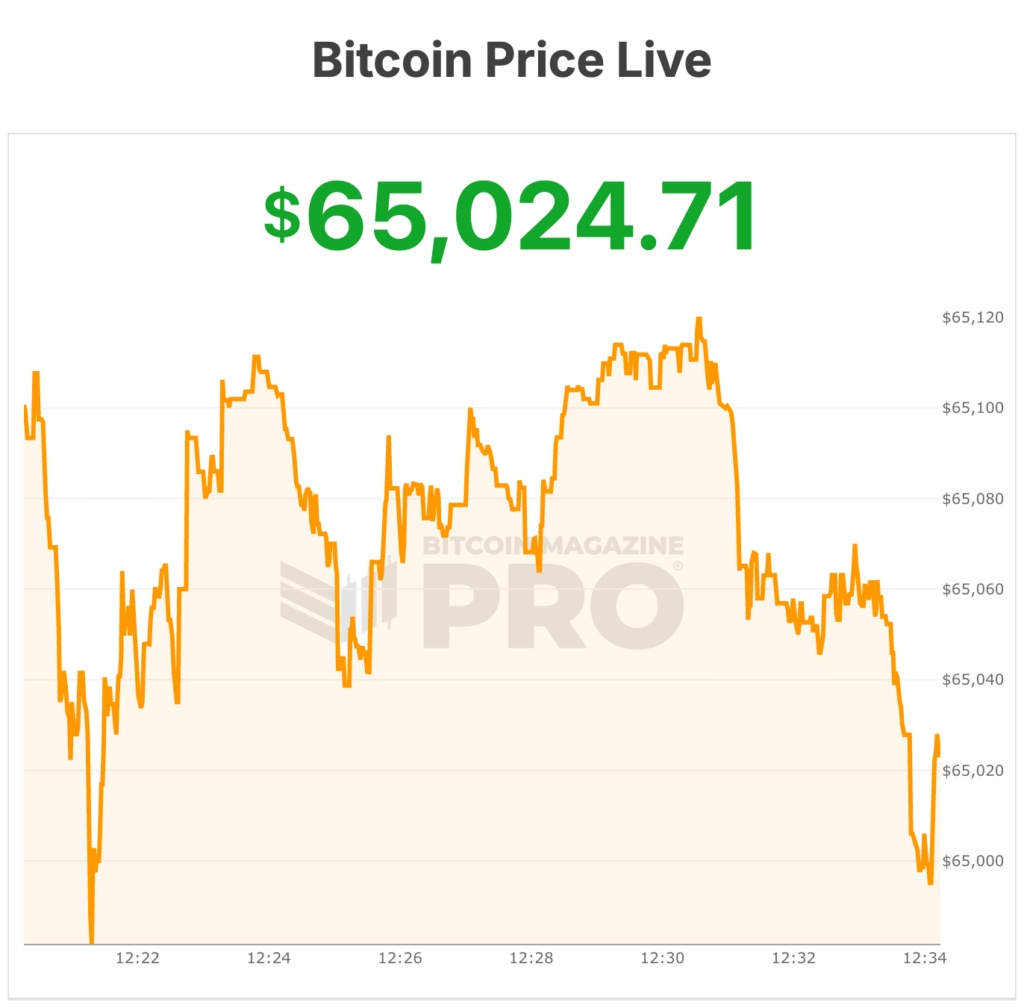
Bitcoin’s price was recently trading at $64,943, a 2% 24-hour jump.Β 

The Bitcoin price has typically surged when signs inflation is cooling emerge as investors then expect a bigger chance of lower interest rates. Crypto, stocks and other β€œrisk-on” assets have in the past done well in a low-interest rate environment.Β 

Still, the cooling inflation does not take into account the latest escalation in the US-Iran war: President Trump this week said the US would take control over the Strait of Hormuz.Β 

On Wednesday, the US leader vowed to intensify the bombing until Tehran stops attacking ships in the Strait of Hormuz and agrees to open the waterway.Β 

β€œWe’re going to hit [Iran] very hard the night after,” President Trump told Fox News on Tuesday. β€œAnd then next week it gets really bad for them because next week comes the power plants.”

β€œThe only way you can negotiate with these people is through strength,” he added.Β 

Bitcoin’s price has faced increased volatility since the US and Israel attacked Iran on February 28, with the leading cryptocurrency dropping hard on initial reports of war.

Since the start of the year, the leading cryptocurrency has shed nearly 30% of its value, and is now close to 50% below the $126,080 record it notched in October.Β 

Downwards pressure has been added to the Bitcoin price as US investors fast cashed out of spot exchange-traded funds throughout the month of June as inflation uncertainties and a boom in artificial intelligence-related stocks has led speculators to put their cash elsewhere.

JUST IN: Bitcoin rips to $65,374 πŸš€ pic.twitter.com/j0mRcD6SMY

β€” Bitcoin Magazine (@BitcoinMagazine) July 15, 2026

Bitcoin price jumps on cooler inflation numbers

Figures released on Tuesday from June’s Consumer Price Index also showed that inflation appeared to be easing in the US, also leading to a jump in the Bitcoin price.Β 

Over a seven-day period, Bitcoin’s price has traded from $61,507 to as high as $65,501.Β 

Traders are now keeping an eye on what new Federal Reserve Chair Kevin Warsh β€” who’s typically been an inflation hawk in the past β€” will do while leading the central bank.Β 

The new Chair told congress this week that the Federal Reserve has β€œno tolerance for persistently elevated inflation,” and that policy makers at the bank share β€œa resolute commitment to restoring price stability.”

Kevin Warsh was sworn in as the new central bank chief in May. The former Federal Reserve governor has said he wanted to lower the cost of borrowing but markets initially priced him in as a hawk β€” someone who would raise interest rates to tackle inflation.Β 

At the time of writing, the bitcoin price is near $65,000.

bitcoin price

This post Bitcoin Price Jumps Over $65,500 on Soft Inflation DataΒ  first appeared on Bitcoin Magazine and is written by Mathew Di Salvo.

The awkward timing of the Xbox CEO’s new Federal Reserve gig

Xbox CEO Asha Sharma. (File Photo)

Which is worse, sailing your superyacht through the city where your company just made mass job cuts, or getting named to a U.S. Federal Reserve panel on jobs and productivity three days after announcing thousands of layoffs?

It might not be a full Zuck, but Microsoft Xbox CEO Asha Sharma is getting lots of attention, and not in a good way, for the latter this week.

Sharma was named Thursday to co-lead a new Federal Reserve β€œProductivity and Jobs” task force, charged with assessing the economic impact of AI and other new technologies on the labor market. Her co-leaders: Marc Andreessen, the venture capitalist and vocal AI booster, and Stanford economist Charles I. Jones, who is currently on leave at Anthropic, maker of the Claude AI chatbot.

The gaming press, as you can imagine, is having a field day. The headline from Kotaku sums it up: β€œXbox CEO Will Advise Federal Reserve On Jobs After Mass Layoffs.”

PC Gamer, for its part, noted that the task force is supposed to represent a β€œcommitment to price stability and maximum employment.” However, that’s the Fed’s broad mandate, as described by Chairman Kevin Warsh. It’s actually not the specific mission of the Productivity and Jobs task force, which is narrower: assessing what AI and other new technologies are doing to the economy.

In a separate sign of the backlash, Microsoft communications chief Frank Shaw took to X on Friday to knock down claims that the Xbox cuts were made to replace employees with foreign workers, calling it β€œbad information” and noting that the H-1B visa figures being cited are company-wide renewals, not Xbox-specific. He also pointed out that Sharma is β€œan American born, raised, and educated CEO, from Wisconsin.”

Also lost in the coverage of the Fed appointment is the fact that Sharma is less than five months into the job, having taken over as Xbox CEO in February with a mandate to turn around and preserve a gaming division that spent more than $20 billion over five years while its core revenue shrank. The restructuring announced this week is a key part of that effort.

What’s more, it’s hard to imagine that this is the timing Microsoft or Sharma wanted. Announcements like this are often outside the control of the participants. The Federal Reserve sets its own schedule.

Still, it’s tough timing for an executive who announced plans this week to cut 3,200 gaming jobs β€” about 1,600 immediately, with the rest over the coming year β€” amounting to roughly 20% of Xbox’s workforce. Sharma herself called it the most significant restructuring in the division’s history.

Meta CEO Mark Zuckerberg’s superyacht Launchpad, for the record, is currently cruising the waters off Juneau, Alaska, a full 900 miles from Seattle.

❌