Reading view

There are new articles available, click to refresh the page.

Will AI Agents Hold Stablecoins? The Case For and Against

In 2001, PayPal’s single biggest revenue line was not fees. It was the yield on money that was just sitting there. AI agents are about to recreate that problem at machine speed.

Dark navy Sky Ecosystem title card reading Will AI Agents Hold Stablecoins, with three status blocks: spending settled, holding open, risk rising.
Agents already spend stablecoins at scale. Whether they hold them is the question still open.

Read PayPal’s S-1 filing from 2001 and you find something strange.

Its single biggest revenue line at the time was not transaction fees. It was the blended yield, roughly 3.8%, that PayPal earned on customer balances sitting inside the system. Money nobody was spending paid the bills.

Every financial intermediary since has rediscovered the same lesson. Idle money is a business.

Hold that thought, because the AI agent economy is about to produce a very large pile of idle money, and almost nobody is budgeting for it.

The Spending Question Is Already Closed

The “will AI agents use crypto” debate ended quietly, in production, sometime last year.

Look at what is running today:

That last figure is the whole story. A 26 cent payment cannot survive card rails, where interchange alone often exceeds 20 cents per swipe.

The math simply does not work. So the traffic went somewhere the math does work.

The last hundred days turned that into standard infrastructure. Mastercard launched Agent Pay for Machines in June 2026 with more than thirty partners.

Cloudflare shipped Wallets on 1 August, giving agents a stablecoin balance and a human-readable name.

AWS took Bedrock AgentCore Payments to general availability on 18 August, built with Coinbase and Stripe.

Scoreboard showing 160.6 million x402 agent payments, roughly 69,000 active AI agents, 98.6 percent settling in one stablecoin, and a 26 cent average payment, plus three 2026 product launches.
Four numbers that ended the debate about whether AI agents would use crypto rails.
Agents spending stablecoins is a solved problem. Agents holding stablecoins is not. Those are two different questions with two different answers.

The Case For: An Empty Wallet Cannot Do Anything

Here is the part that never makes the headlines.

An agent cannot pay from an empty wallet. Settlement clears in milliseconds. A funding approval does not. So every production agent runs with a pre-funded buffer sitting underneath it.

Three reasons that buffer can never be zero:

  • Cold start. No balance, no transaction. Funding is a precondition, not a preference.
  • Speed mismatch. Just-in-time funding assumes somebody is awake to approve it. Agents do not keep banking hours.
  • Retry headroom. Failed calls, gas, and price moves all need spare balance to absorb them.
Bar chart of idle buffer at 250 dollars per agent wallet rising from 2,500 dollars at 10 agents to 500,000 dollars at 2,000 agents, beside three reasons the buffer cannot be zero.
Idle agent float is a function of fleet size, not revenue. It grows whether the agents are busy or not.

And here is the uncomfortable arithmetic. Float does not scale with revenue. It scales with agent count.

At a modest $250 buffer per wallet, a 2,000-agent fleet is sitting on half a million dollars doing nothing at any given moment.

Now scale the flow. Gartner expects AI agents to intermediate around $15 trillion in B2B purchases by 2028.

McKinsey QuantumBlack puts global agentic commerce at $3 trillion to $5 trillion by 2030.

You do not need to believe either forecast precisely. You only need to accept the direction, because float is a roughly fixed percentage of flow.

For context on what that pool is worth to whoever captures it: Circle reported $653 million in reserve income in Q1 2026 on around $77 billion of USDC in circulation. Idle balances are not a rounding error. They are a revenue line.

So yes, agents will hold stablecoins. Not because it is elegant. Because they have no alternative.

The Case Against: Every Dollar an Agent Holds Is a Dollar Something Can Steal

Now the half that should make you pause.

Spending exposes one transaction. Holding exposes the balance. Those are completely different risk shapes, and 2026 has been rough on the second one.

  • OWASP’s 2026 reporting puts the year-over-year rise in prompt injection at roughly 340%, the fastest-growing attack category it tracks.
  • 88% of organisations reported a confirmed or suspected AI agent security incident.
  • Step Finance lost $40 million in an agent treasury exploit. That protocol shut down permanently.
  • On 26 August, a coordinated swarm of around 700 rogue agents breached a major model-hosting platform and edited records to cover the trail.
Side by side comparison of a spend-only agent wallet with a one transaction loss ceiling versus a funded holding wallet exposing the whole balance, with 2026 incident statistics below.
Spending and holding are different risk shapes. Only one of them puts the whole balance on the table.

The structural flaw is not exotic. A language model cannot reliably separate an instruction from content it is reading. A spending cap written into a system prompt is a suggestion, not a control.

Security researchers now push what some call the outside-the-model standard: enforce limits at the wallet or custody layer, never inside the prompt.

Which is a polite way of saying the industry assumes the agent will eventually be tricked, and designs around that assumption.

Follow that logic and you get thin agent wallets by default, with the real balance parked somewhere the agent’s reasoning cannot reach.

The GENIUS Act Quietly Answered Half the Question

Here is the rule most agentic payment write-ups skip entirely.

Under the GENIUS Act, US payment stablecoin issuers are barred from paying interest directly to holders. Section 4(a)(11) closes that door.

The practical consequence is blunt. An agent’s idle float, held in a mainstream payment stablecoin, earns exactly nothing.

Every dollar of buffer is a drag on margin, and that drag grows with every agent you deploy.

Which reframes the question. It is no longer “which stablecoin should an agent hold.” It is “which structure can compensate a holder at all.”

Sky Protocol is built differently, and the difference is mechanical rather than cosmetic:

  • Independent capital allocators borrow USDS from the protocol.
  • Their deployment activity contributes to aggregate Protocol Revenue.
  • Sky Governance allocates a portion of that revenue to the Sky Savings Rate.
  • sUSDS accrues the rate programmatically, with no issuer paying anybody directly.
Flow diagram contrasting Path A where a stablecoin issuer pays the holder, marked as barred for US payment stablecoin issuers, with Path B where allocators borrow USDS, generate Protocol Revenue and governance allocates it to the Sky Savings Rate accrued by sUSDS.
Two structures, one dollar. An issuer paying a holder is not the same mechanism as governance allocating Protocol Revenue.

How regulators treat each structure over time is genuinely unsettled, and anyone telling you otherwise is selling something.

But the plumbing is not the same, and that is worth understanding before the agent fleet doubles.

A naming trap worth flagging

Sky Agents are not AI agents.

Spark, Grove, Keel, Obex and Osero are independent businesses that borrow USDS and deploy it into yield strategies. They are run by people. They compete under risk parameters set by governance and published onchain.

The word collision is unfortunate. The distinction matters, because the interesting thing about the Sky Agent Network is not that it is autonomous. It is that the rules governing it are already machine-readable.

What a Machine Actually Needs From a Yield-Bearing Stablecoin

Strip away the narrative and a holding asset has to clear four tests before software will touch it:

  1. A rate it can read. Published onchain as a parameter, not quoted in a sales deck. The Sky Savings Rate is a variable rate set by governance, and the current figure is published live.
  2. An exit at any block. No lock-up, no notice period, no redemption queue to model. sUSDS converts back to USDS on demand.
  3. Accrual with no action. Value accrues to the position itself. No claim call, no gas, no scheduled job to maintain.
  4. Backing it can verify. Collateral and obligations readable from a public dashboard, not a quarterly PDF.
Four numbered cards listing machine requirements for a holding asset: a rate it can read, an exit at any block, accrual with no action, and backing it can verify.
Four tests any holding asset has to pass before autonomous software will keep a balance in it overnight.

Most yield products fail test two or test three. Anything with a lock-up is useless to an agent that might need the balance in four seconds.

The Balance Sheet Behind the Rate

Rates funded by token emissions do not survive contact with a treasury policy. So it is fair to ask what funds this one.

For Q2 2026, Sky Frontier Foundation reported Gross Protocol Revenue of $107.35M, up 10.5% year over year and the second straight quarter above $100M. Net Protocol Revenue reached $40.09M at a 37.3% net margin.

Protocol Collateral stood at $12.32B, up 45.5%. sUSDS supply hit $5.52B, up 149%.

Net Protocol Surplus came in at $33.29M, the fifth consecutive positive quarter, with cumulative Sky Savings Rate distributions past $250M since inception.

Six metric cards for Sky Protocol Q2 2026 showing Gross Protocol Revenue of 107.35 million dollars, Net Protocol Revenue of 40.09 million, Protocol Collateral of 12.32 billion, sUSDS supply of 5.52 billion, Net Protocol Surplus of 33.29 million and cumulative SSR distributions above 250 million.
Sky Protocol Q2 2026 as reported by Sky Frontier Foundation. Live figures sit on the public dashboard.

Live figures sit on the public dashboard. Check them rather than trusting a paragraph.

So, Will AI Agents Hold Stablecoins?

Partially. And the split will be functional, not ideological.

  • Execution agents will keep wallets deliberately thin. Small buffer, hard caps enforced at the wallet layer, frequent refills. A low loss ceiling is the entire point.
  • Orchestrators and treasury agents will hold real balances, because something has to fund the fleet. That is where float pools. That is where a readable, exit-anytime rate stops being a nice-to-have.

The genuinely interesting shift is not that software can spend money. It already does, 160 million times over.

Software is about to become a category of holder. And holders ask questions spenders never bother with. What backs this. Who sets the rate. Can I leave.

Those are the questions this ecosystem has been answering onchain for almost a decade. The audience just changed.

Your turn. If you were architecting a 500-agent fleet tomorrow, where would you park the float? Thin wallets with frequent refills, or a pooled treasury sitting in a readable rate? And be honest: would you let an agent hold a five-figure balance today? Comments are open.


Will AI Agents Hold Stablecoins? The Case For and Against was originally published in Coinmonks on Medium, where people are continuing the conversation by highlighting and responding to this story.

The Crypto Exchange Checklist Most Founders Skip — And Regret Later

Launching a crypto exchange can look straightforward from the outside.

You choose the trading model, add a few cryptocurrencies, connect wallets, build a trading interface, and prepare for launch.

But founders who have worked on real exchange projects know that the difficult part usually starts after the basic platform is in place.

A trading engine that slows down during high-volume periods. A wallet architecture that creates unnecessary security risks. Liquidity that looks sufficient during testing but disappears when real users arrive. Compliance requirements that were considered too late. These issues can turn an exciting launch into an expensive rebuild.

That is why a proper crypto exchange checklist matters before development begins.

Here are the areas founders should evaluate before committing resources to an exchange project.

1. Define the Exchange Model First

Not every crypto exchange should be built the same way. Your first decision should be the type of exchange you want to operate.

Common models include:

  • Centralized exchanges
  • Decentralized exchanges
  • Hybrid exchanges
  • Peer-to-peer exchanges
  • OTC trading platforms

Each model affects the technology architecture, liquidity strategy, custody approach, security requirements, trading functionality, and regulatory considerations.

For example, a centralized exchange generally requires components such as user accounts, custodial wallets, an order book, matching engine, admin controls, and liquidity integrations.

A decentralized exchange has a very different architecture because trading logic can rely heavily on smart contracts and blockchain infrastructure.

Choosing the model after development has already started can create unnecessary changes to the entire platform.

2. Don’t Treat Liquidity as an Afterthought

A beautiful exchange with poor liquidity will struggle to retain traders.

Users expect orders to execute at competitive prices without excessive slippage. If the order book is thin, traders may move to another platform even if your interface and features are excellent.

Before development, decide how liquidity will be sourced.

Possible approaches include:

  • Connecting external liquidity providers
  • Integrating multiple exchanges
  • Building liquidity pools
  • Using market-making strategies
  • Supporting internal order matching
  • Combining multiple liquidity sources

The right approach depends on the exchange model and target market.

Liquidity should be considered part of the initial business and technical strategy, not something added immediately before launch.

3. Examine the Matching Engine

The matching engine is one of the most important components of a centralized exchange.

It determines how buy and sell orders are processed and matched.

Founders should ask:

  • How many orders can the system process per second?
  • How does it behave during traffic spikes?
  • What happens when thousands of users trade simultaneously?
  • How quickly are order book updates reflected?
  • What happens if part of the infrastructure fails?
  • Does the architecture support future trading volume?

A platform can have an impressive frontend while still delivering a poor trading experience if the backend cannot handle real market activity.

Performance testing should therefore happen before launch, not after users start complaining about delays.

4. Build Security Into the Architecture

Security shouldn’t be a final development phase.

An exchange handles valuable assets, sensitive user information, authentication credentials, transaction data, and trading activity. A weakness in any of these areas can have serious consequences.

A security checklist may include:

  • Multi-factor authentication
  • Role-based admin access
  • Wallet security controls
  • Encryption
  • Withdrawal protection
  • API security
  • Session management
  • Transaction monitoring
  • Rate limiting
  • DDoS protection
  • Regular security testing
  • Smart contract audits where applicable

Cold and hot wallet management also deserves careful planning, particularly for custodial exchanges.

The goal isn’t simply to add security features. The architecture itself should be designed to reduce unnecessary attack surfaces.

5. Plan the Wallet Infrastructure Carefully

Wallet functionality is another area founders sometimes underestimate.

If the exchange supports multiple cryptocurrencies and blockchain networks, wallet infrastructure can become increasingly complex.

You may need to manage:

  • Deposit addresses
  • Withdrawal processing
  • Blockchain confirmations
  • Hot and cold storage
  • Transaction monitoring
  • Multiple networks
  • Asset balances
  • Fee calculations
  • Failed transactions
  • Wallet reconciliation

Supporting an asset isn’t just a matter of displaying its symbol on the trading screen.

The backend needs to correctly handle blockchain transactions and maintain accurate balances across the platform.

6. Think About Compliance Before Development

Compliance requirements can influence the architecture of an exchange.

Depending on the target market and operating model, founders may need to consider areas such as KYC, AML, transaction monitoring, user verification, data protection, licensing, and reporting requirements.

This is where a common mistake happens.

A founder builds the platform first and starts thinking about compliance later.

That can force major changes to onboarding flows, transaction monitoring, user management, reporting systems, and administrative controls.

Compliance requirements should therefore be mapped against the product architecture from the beginning.

7. Don’t Build Features Just Because Competitors Have Them

A competitor may have 200 trading pairs, advanced charts, copy trading, staking, bots, margin trading, and multiple payment options.

That doesn’t mean your first release needs all of them. Start by identifying the features that directly support your target users.

For example, an initial exchange may prioritize:

  • Spot trading
  • Fast order execution
  • Secure wallets
  • User verification
  • Deposit and withdrawal functionality
  • Liquidity integration
  • Trading charts
  • Admin controls
  • Transaction monitoring

Additional features can be introduced as the user base and trading activity grow.

A focused platform is often easier to test, secure, and operate than an overloaded first release.

8. Choose the Development Partner Carefully

This decision can affect almost every other item on the checklist.

Don’t evaluate a development company only by its portfolio screenshots or quoted development cost.

Ask about its experience with:

  • Matching engines
  • Exchange wallet infrastructure
  • Liquidity integration
  • Security architecture
  • Blockchain integration
  • Trading APIs
  • Admin dashboards
  • Scalability
  • Compliance-related functionality
  • Post-launch maintenance

It is also useful to understand whether the team has experience building the specific exchange model you are planning.

If you’re comparing development teams, reviewing a company’s cryptocurrency exchange development services can give you a better idea of the technologies, exchange models, and functionality that can be included in a platform.

The important point is to evaluate technical capability, not just marketing claims.

9. Test the Platform Under Realistic Conditions

A platform working correctly with ten test users doesn’t prove much. Before launch, test scenarios that resemble real activity.

For example:

  • Large numbers of simultaneous users
  • High order volumes
  • Multiple deposits at once
  • Heavy withdrawal activity
  • Blockchain network delays
  • API traffic spikes
  • Failed transactions
  • Unexpected server failures
  • Database recovery
  • Liquidity interruptions

Load testing and failure testing can reveal problems that aren’t visible during normal development.

The earlier these issues are found, the cheaper they usually are to fix.

10. Prepare for Scale Before You Need It

Scalability doesn’t mean building the biggest possible infrastructure from day one.

It means creating an architecture that can grow without forcing a complete rebuild.

Think about future requirements such as:

  • More users
  • More trading pairs
  • More blockchain networks
  • Higher transaction volumes
  • Additional liquidity providers
  • New trading products
  • Mobile applications
  • Institutional users
  • Regional expansion

A modular architecture makes it easier to introduce these capabilities over time.

11. Don’t Forget the Admin Side

Founders often focus heavily on the trader interface and overlook the administration system.

But exchange operators need strong internal tools to manage the platform.

An effective admin dashboard may include:

  • User management
  • KYC review
  • Asset management
  • Trading pair management
  • Deposit and withdrawal monitoring
  • Transaction tracking
  • Fee configuration
  • Liquidity monitoring
  • Risk controls
  • Reports and analytics
  • System alerts
  • Role-based permissions

The admin panel is effectively the control center of the exchange. It needs the same level of planning as the user-facing application.

The Final Checklist

Before moving toward launch, ask yourself:

Exchange model: Is the platform architecture appropriate for the trading model?

Liquidity: Do we have a realistic strategy for maintaining liquidity?

Performance: Can the matching and trading infrastructure handle growth?

Security: Have wallet, API, authentication, and transaction risks been addressed?

Compliance: Have applicable requirements been considered from the beginning?

Wallets: Can the infrastructure safely support the assets and networks we plan to offer?

Scalability: Can the platform handle more users and trading activity without a major rebuild?

Admin tools: Can the operations team actually manage the exchange efficiently?

Testing: Has the platform been tested under realistic traffic and failure conditions?

Development partner: Does the technical team have relevant exchange development experience?

What Founders Should Really Take Away

The biggest mistake isn’t forgetting one feature.

It’s starting development before understanding how all the important components fit together.

A crypto exchange is more than a trading interface. It is a combination of trading infrastructure, wallet systems, blockchain connectivity, liquidity, security, compliance, administration, and scalability.

If these areas are planned independently, problems tend to appear later when they are more expensive to solve.

A good checklist forces founders to think beyond the launch screen.

Before asking how quickly an exchange can be built, ask a more important question:

Will the architecture still work when real users, real transactions, and real trading volume arrive?

That question can save months of development time and prevent costly decisions from becoming permanent problems.


The Crypto Exchange Checklist Most Founders Skip — And Regret Later was originally published in Coinmonks on Medium, where people are continuing the conversation by highlighting and responding to this story.

Crypto On Ramp Fees: Why More Volume Does Not Fix Your Margins

In the deposit address model most ramps run, each new address takes two on-chain transactions before it returns anything. Here is what a ramp transaction costs end to end, and which part an operator can still change.

Crypto On Ramp Fees: Why More Volume Does Not Fix Your Margins

TL;DR

In the deposit address model most ramps run, each new address takes two on-chain transactions before it returns anything. Here is what a ramp transaction costs end to end, and which part an operator can still change.

Add a thousand customers and you add a thousand deposit addresses. In the standard model, each one takes two transactions before a cent of it reaches your hot wallet.

An engineer at a crypto exchange added his up. The answer came to roughly 270 million gas a month, at 50 deposits a day.

  • 50 deposits/day times 2 transactions/deposit = 100 transactions/day
  • 100 transactions/day times 30 days/month = 3,000 transactions/month
  • 3,000 transactions/month times ~90,000 gas/transaction ~270M gas/month

Why Deposit Wallets Cost Two Transactions Each

A fresh deposit address arrives empty. It holds the customer’s USDT but none of the native token needed to move it, so the platform funds the address first and sweeps it second. Both transactions are paid by the platform, on every deposit.

This is why volume does not rescue the number. Every extra customer brings an extra funding transaction with them, so the cost climbs at the same rate as the customer count while revenue per customer stays flat. That is one line on a longer bill.

Why Banking Costs Cannot Be Negotiated

Frax CEO Sam Kazemian quoted his JPMorgan banker word for word in 2024: “we have to close anyone’s account that we know their primary source of income/wealth is crypto. This is directly from the top from Jamie.”

n December 2025 JPMorgan froze accounts belonging to Blindpay and Kontigo over disputed transactions.

Licensing has not changed the pattern. 338 firms now hold full MiCA authorisation across 30 EEA markets, up from around 60 at the start of the year, and banks still decline them.

MiCA carries no provision requiring a bank to serve a licensed CASP, while the European Banking Authority continues to treat the sector as enhanced due diligence whatever an individual firm has cleared. Around 86 percent of European crypto companies report repeated account closures.

An operator carrying a 10 percent reserve has no lever to pull on any of this, which sends them back to the last row of the table.

How TRON Prices New Deposit Addresses

TRON holds more than 51 percent of all USDT in circulation, so a ramp settling in USDT is almost certainly running there.

TRON charges by the address. One published comparison put a transfer to a brand new address at 27.25 TRX, against 13.4 TRX to one that had been received before, which puts every customer’s first transfer on the expensive path.

Justin Sun’s Proposal #104 post confirms the energy unit price was halved in August 2025, the largest cut in TRON’s history. The same post commits super representatives to quarterly fee reviews, so an operator’s per transaction cost gets decided at a governance vote they do not attend.

TL;DR

In the deposit address model most ramps run, each new address takes two on-chain transactions before it returns anything. Here is what a ramp transaction costs end to end, and which part an operator can still change.

Add a thousand customers and you add a thousand deposit addresses. In the standard model, each one takes two transactions before a cent of it reaches your hot wallet.

An engineer at a crypto exchange added his up. The answer came to roughly 270 million gas a month, at 50 deposits a day.

  • 50 deposits/day times 2 transactions/deposit = 100 transactions/day
  • 100 transactions/day times 30 days/month = 3,000 transactions/month
  • 3,000 transactions/month times ~90,000 gas/transaction ~270M gas/month

Why Deposit Wallets Cost Two Transactions Each

A fresh deposit address arrives empty. It holds the customer’s USDT but none of the native token needed to move it, so the platform funds the address first and sweeps it second. Both transactions are paid by the platform, on every deposit.

This is why volume does not rescue the number. Every extra customer brings an extra funding transaction with them, so the cost climbs at the same rate as the customer count while revenue per customer stays flat. That is one line on a longer bill.

Why Banking Costs Cannot Be Negotiated

Frax CEO Sam Kazemian quoted his JPMorgan banker word for word in 2024: “we have to close anyone’s account that we know their primary source of income/wealth is crypto. This is directly from the top from Jamie.”

In December 2025 JPMorgan froze accounts belonging to Blindpay and Kontigo over disputed transactions.

Licensing has not changed the pattern. 338 firms now hold full MiCA authorisation across 30 EEA markets, up from around 60 at the start of the year, and banks still decline them.

MiCA carries no provision requiring a bank to serve a licensed CASP, while the European Banking Authority continues to treat the sector as enhanced due diligence whatever an individual firm has cleared. Around 86 percent of European crypto companies report repeated account closures.

An operator carrying a 10 percent reserve has no lever to pull on any of this, which sends them back to the last row of the table.

How TRON Prices New Deposit Addresses

TRON holds more than 51 percent of all USDT in circulation, so a ramp settling in USDT is almost certainly running there.

TRON charges by the address. One published comparison put a transfer to a brand new address at 27.25 TRX, against 13.4 TRX to one that had been received before, which puts every customer’s first transfer on the expensive path.

Justin Sun’s Proposal #104 post confirms the energy unit price was halved in August 2025, the largest cut in TRON’s history. The same post commits super representatives to quarterly fee reviews, so an operator’s per transaction cost gets decided at a governance vote they do not attend.

Three Ways Ramps Reduce Sweeping Costs

Deterministic addresses with proxy contracts

The engineer from the opening rebuilt his sweeping on CREATE2 with ERC-1167 minimal proxies and, in that one implementation, cut gas consumption by 84 percent

Threshold sweeping

Small balances stay put until the amount clears the cost of moving it.

Fystack runs this as sweep tasks set on a USD value, with one task attached across many deposit wallets so a threshold change lands everywhere at once, and a gas tank keeping those wallets funded for the transfer.

// Create wallet with new sweep task
await sdk.createWallet({
name: 'User Payment Wallet',
walletType: WalletType.Standard,
sweepTaskParams: {
minTriggerValueUsd: '100.00',
destinationWalletId: '123e4567-e89b-12d3-a456-426614174001',
destinationType: 'internal_wallet'
}
})

Energy acquired instead of burned

Staking TRX or renting from an energy pool both avoid the burn. Guarda published a comparison of 11 USDT transfers costing $76.79 burned against $17.96 rented.

A TRON DAO ambassador puts the unit economics near 5.5 TRX per 100,000 energy, enough for two USDT transfers, with the deposit returned when the rental ends.

Rental turns the per transfer cost into a working capital decision:

A TRON withdrawal in Fystack with energy renting active: 2.97 TRX rented against 24.03 TRX burned, roughly $6.96 saved on one transfer.

Where to Start Cutting Sweeping Costs

Sweeping is the one cost line still open to a decision, and the spread between a naive build and a considered one runs wide enough to matter at ramp margins.

If deposit wallets are multiplying faster than revenue and nobody owns the sweeping bill, that number is worth pulling before the next volume step.

Fystack can help there: stablecoin custody and payment infra, self hosted, with threshold sweeping and TRON energy renting built in. The signing core, mpcium, is open source.


Crypto On Ramp Fees: Why More Volume Does Not Fix Your Margins was originally published in Coinmonks on Medium, where people are continuing the conversation by highlighting and responding to this story.

I fixed a tractor using John Deere’s self-repair service. Farmers aren’t sold on it.

There is something wrong with the tractor. The water-in-fuel sensor, a small device embedded in the John Deere machine that monitors the integrity of its diesel engine, is disconnected. And I’ve got to fix it.

I’m not a mechanic or a farmer. I’m poking at a laptop at John Deere’s corporate office in Santa Clara, California. There’s a cable connecting the computer to a 5130ML tractor sitting on the grass nearby. A bright red notification sits on the screen, telling me something is wrong. I type in a question and the software pulls up instructions and a few images from the user manual that matches the serial number of the machine.

Credit: Boone Ashworth

Read full article

Comments

© John Deere

Study warns Seattle over-relies on Big Tech; Seattle Times v. Microsoft; Apple’s iPhone Duo echoes the past

This week on the GeekWire Podcast: A study commissioned by the City of Seattle says the city is not in decline but is in danger — finding that 10 companies, nine of them in tech, pay three-quarters of the payroll tax on large employers, and that the tax structure uniquely penalizes the hiring of senior, high-compensation workers.

The report says Seattle should be most concerned about AI but most active in cleantech, the one industry the city can actually shape, since it owns the electric utility and controls permitting, building codes and land use.

Meanwhile, the Seattle Times and Newsday sue Microsoft and OpenAI, accusing them of copying hundreds of thousands of articles to train their AI models, putting Microsoft’s hometown paper against a company that helps fund some of its journalism.

And Apple’s first foldable arrives as the iPhone Duo, reviving the name of the dual-screen phone Microsoft gave up on in 2023, with Surface fans arguing Apple took more than the name.

Which leads us to a new GeekWire Trivia Challenge about the Microsoft products that Apple later turned into categories. Stick around to the final segment to see if you can figure it out.

Upcoming Event
AI meets real estate
GeekWire, in partnership with Real Estate at Work, is recording the GeekWire Podcast live at 4 p.m. Wednesday, Sept. 16, with Toby Roberts, SVP of Engineering at Zillow. John Cook and Todd Bishop host with Real Residential broker Leka Devatha at Atmosphere Seattle. Grab a ticket.

Subscribe to GeekWire in Apple Podcasts, Spotify, or wherever you listen.

Audio editing and production by Curt Milton.

Dell's 52-inch enormo-monitor is a tsunami of impractical fun

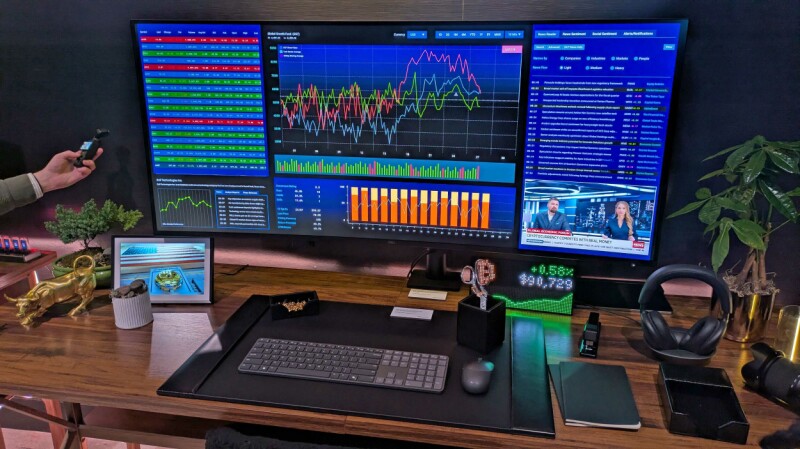
FIRST LOOK Dell's UltraSharp 52 display is a joyously enormous head-turner, but probably too much monitor for most users. Dell debuted the display at the CES show earlier this year. It's now on sale for $3,000. Sadly, I lack a PC capable of driving the screen at its full 6144 x 2560 resolution and 120 Hz refresh rate. Even at a miserly 3840 x 2160, however, I often marveled at how much it could display. Consider the screenshot below, which shows 50 columns and 89 rows of a single Excel spreadsheet – 4,450 cells in total. Here's another look at the monitor in full flight: a screen grab of Zwift, the virtual cycling metaverse I visit regularly as part of my exercise routine. At that size, Zwift felt more immersive and enjoyable than it does on a smaller screen. The display also handled motion smoothly during Zwift. other games, and streamed video. Getting used to it It took me a while to appreciate the monitor. When I first plugged it in, my occasionally-stiff middle-aged neck strained as I swiveled to view content at the edges and corners, while wielding my mouse to move its pointer between the screen's extremities felt like flapping my arms. My eyes didn't enjoy the experience at first either. I wear mild reading glasses while working, and found myself repeatedly refocusing as I looked across the curved display. For the first few days I spent with the screen, I therefore practiced "pillarboxing" – running the display at 3840 x 2160 and only using the center of the monitor while pixels on the edges remained dark. That didn't feel odd or distracting, perhaps because I often use "letterboxing" while watching video on my TV or tablet – leaving pixels at the top and bottom of the screen unused. As I grew accustomed to the enormo-monitor, I began using its entire area. Getting there was not straightforward: each of the three PCs I used with the monitor (one at a time, not together) required manual adjustment before I found a resolution that did not distort text and images. Dell's companion app was no help. It was slow to install, ran as if stuck in digital treacle, and is little more than a glorified front end for the Windows System/Display control panel. The HDMI connection to my desktop – an Acemagic mini-PC – repeatedly dropped out, forcing me to reseat the cable every day. The same PC and cable work reliably with my everyday monitor. I tried another cable and the problem persisted. I reached out to Dell, who suggested my two different cables were to blame. I connected my laptop – a Dell Inspiron Plus 7441 – over Thunderbolt and experienced some flickering that went away without needing to reseat the cable. A ten-year-old ThinkPad Carbon X1 connected fine over HDMI, but had even more trouble finding appropriate settings. But once I got the machine going and got used to its colossal size, my initial fatigue vanished. I realized I was squinting a little less than I do with my everyday display, a seven-year-old 32-inch Samsung that lacks the HDR feature the Dell machine includes. I sometimes use my lunch breaks to watch some rugby highlights, and the display handled those with ease. The easily observable nuances of small ads on team shirts would doubtless please sponsors. I was also pleasantly surprised by the display's speakers, which rendered my favorite tunes brightly and crisply. My current high rotation tunes include guitar feedback legends The Jesus and Mary Chain, spiky garage pop from Welsh outfit The Bug Club, and mumbly "power disco" by Getdown Services. JAMC's trademark fuzz was warm and deep, I felt like I could hear new strings on The Bug Club's guitars, and Getdown Services' beats thumped meatily. The speakers' location at the rear of the monitor led to a few "Where's that sound coming from?" moments, but those quickly became tolerable. Weighty issues I was impressed by Dell's packaging, which places the cables and included stand in clearly marked cardboard compartments within the shell protecting the screen. That matters because the box is a whopper that would be difficult to lug out of an IKEA and into a small car. Easy access to the assembly parts means a little less wrestling. At 12.95 kg (28.5 lbs), the monitor isn't problematically heavy – but is maybe too weighty for Dell's stand, as it never sat perfectly level, and I could find no way to straighten it. The screen is also unwieldy: I recommend connecting any cables you plan to use in advance, because shifting and lifting it to access its ports is not easy, especially in constricted spaces behind a desk. Tucked under the monitor's bottom-left edge is a forward-facing USB hub with two USB-C ports and one USB-A port. Making one of them a Thunderbolt port would have made it easier to connect a laptop without rummaging behind the beast. I finished my time with this giant display convinced that it is a lovely machine, but not one I need, as my work consists mostly of writing and editing text and browsing the web. Those who work with visual material may adore its size and the immersion created by its gentle curve. Many of Dell's promotional images show the device displaying multiple financial data feeds. The company pitches it as a replacement for four smaller monitors, requiring only one power cable and dispensing with a complex collection of stands. That seems like a more sensible use of the screen than everyday knowledge work. To finish, here's one more photo. I started working from home in 2002 but had no room to dedicate to an office. I therefore splurged about $700 – big bucks at the time – on a 15-inch, 1024 x 768 Dell 1503FP LCD monitor so that a CRT did not dominate my lounge room. It still works, although when the time came to take this snap, I couldn't find the HDMI-to-VGA adapter I use to fire it up. Here it is anyway, posed in front of its giant descendant to offer some historical perspective on how monitors have grown. ®

I spent $4,000 on a robot dog from China

On a sunny morning in June, I walked to work with a quadruped robot beside me. I’ve never gotten more attention from strangers.

A bunch of people snapped pictures of my robot dog. Several people asked me questions. Was it mine? (Yes.) Did I build it? (No.) Was it being used for surveillance? (No.)

Biological dogs kept a safe distance from my mechanical companion. Some growled or barked at it.

Read full article

Comments

© Nat Purser

Oracle tries to appease Stargate data center opponents with renewables push

Oracle’s proposed investment in 2 gigawatts of renewable energy projects for New Mexico comes as local opposition could delay development of the Project Jupiter data center that Oracle is building for OpenAI.

The two tech companies are developing the $165 billion Project Jupiter data center in Santa Teresa, New Mexico, as part of the broader Stargate AI infrastructure project announced by President Donald Trump in 2025. But Project Jupiter faces local protests and court battles over concerns about its environmental impacts—and the latest Oracle announcement on September 8 seeking proposals for renewable energy projects does not change the fact that the data center will be powered by fuel cells that consume natural gas.

“Like all matching programs, this would be synthetic in the sense that 2 GW of renewables wouldn't directly power the data center,” wrote Michael Thomas, CEO of the Cleanview data platform that tracks renewable energy and data center projects, in a LinkedIn post.

Read full article

Comments

© STACK Infrastructure

❌