As easy as the Sun is to observe, it’s simultaneously very hard to study due to how extreme the conditions are, even on the surface of a rather unassuming star. One of these study topics is the interaction between the Sun’s plasma and magnetic field, as this drives much of the dynamism of the Sun’s surface layer (i.e., the photosphere). Recent observations by the 4-meter solar telescope in Hawaii have now led to interesting new findings, as detailed in a paper in Nature by [David Kuridze] et al.
Despite popular portrayal, this photosphere is not a boiling liquid, but rather pockets of plasma at various temperatures. The plasma moves within the magnetic field and convective movements that create the ‘boiling’ pattern, which gives the illusion of a boiling liquid surface.
Within this photosphere, [Kuridze] et al. were able to observe Kelvin-Helmholtz instabilities, which are fluid instabilities caused by velocity shearing in either a continuous fluid or due to a velocity difference between two fluids. This is also observed in clouds in Earth’s atmosphere, where they cause the billowing effect, somewhat similar to watching a boiling liquid.
In a MURaM simulation (see heading image), these findings were confirmed, showing how these instabilities drive the transport of plasma in the Sun’s photosphere.
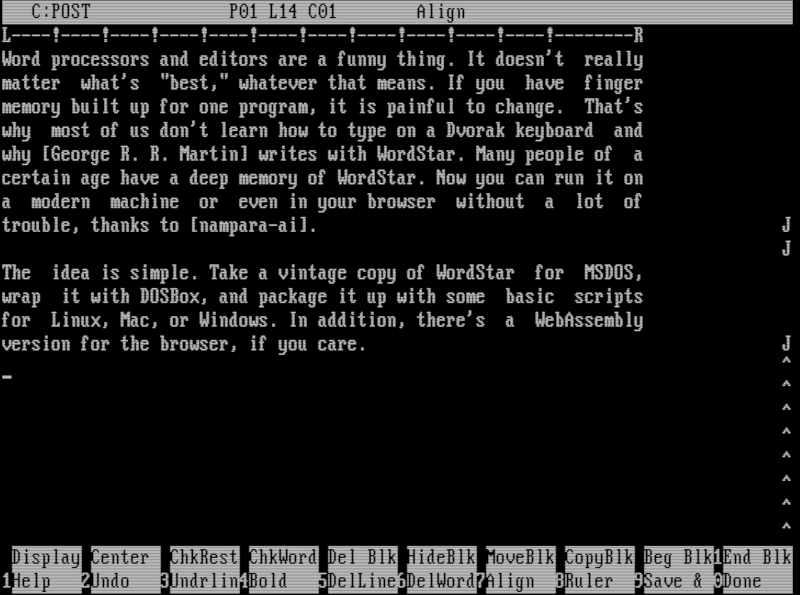
Word processors and editors are a funny thing. It doesn’t really matter what’s “best,” whatever that means. If you have finger memory built up for one program, it’s painful to change. That’s why most of us don’t learn how to type on a Dvorak keyboard and why [George R. R. Martin] writes with WordStar. Many people of a certain age have a deep memory of WordStar. Now you can run it on a modern machine or even in your browser without a lot of trouble, thanks to [nampara-ai].
The idea is simple. Take a vintage copy of WordStar for MSDOS, wrap it with DOSBox, and package it up with some basic scripts for Linux, Mac, or Windows. In addition, there’s a WebAssembly version for the browser if you’re into that sort of thing.
On Linux, the wordstar.sh file grabs the current directory and sends it to launch.sh. This script makes sure everything is ready, builds a DOSBox config file from a template, and launches everything. The only problem is that it doesn’t correctly resolve symlinks if you want a link on your path. Luckily, that’s easy to fix:
#!/usr/bin/env bash
 # Run me to launch WordStar 4.0 on Linux:  ./wordstar.sh
DIR="$(realpath "$0")"
DIR="$(dirname $DIR)"
cd "$DIR"
DIR="$(pwd)"

#DIR="$(cd "$(realpath "$(dirname "$0"))" && pwd)"
"$DIR/native/lib/launch.sh"
Practical? No. Irreplaceable? Not really. You could run WordStar under RunCPM or set up DOSBox yourself. You can even find a sort of modern version to run, if you prefer. But for just a quick way to get it running easily, it is hard to beat. If you want to play with the web version, it is easy to navigate to the web subdirectory and run Python:
python3 -m http.server 5309
Then you can point your browser to http://localhost:5309, and you are in business. Or, get a flavor for it from [TigerClawTV]’s walk-through video below.
Zillow and Redfin settled an antitrust case with the Federal Trade Commission and five states Monday, just as a trial was set to begin, agreeing to undo part of a $100 million partnership that the government said effectively paid Redfin to stop competing in apartment rental advertising.
The companies, both based in Seattle, have been rivals in online real estate and related services for the better part of two decades, expanding into rentals to build their businesses beyond the market for single-family homes. The FTC alleged the deal combined two of the three largest online apartment listing services against one main competitor, CoStar’s Apartments.com.
The proposed settlement requires Redfin, now owned by Rocket Cos., to relaunch its apartment advertising operation within six months — hiring a general manager, a sales force and a trained customer support team, while committing to spend millions of dollars to grow the business.
Redfin faces fines if it misses deadlines, and must report regularly to the FTC on its progress.
Zillow’s apartment listings will still appear on Redfin.com, Rent.com and ApartmentGuide, and Redfin will keep syndicating them, so Zillow is holding onto the audience it gained in the 2025 deal. The companies say the syndication will run through at least 2030.
What ends is the exclusive nature of the partnership: As part of the FTC settlement, Redfin is no longer barred from selling its own advertising alongside those listings, or from doing business on its own with the property managers shifted to Zillow under their original deal.
Zillow also must help Redfin rebuild. Under the order, which runs 10 years, Zillow is required to give Redfin employee information so it can recruit Zillow workers, waive any noncompete or anti-poaching agreements blocking those hires, and let apartment advertisers locked into Zillow contracts renegotiate without penalty for nine months after Redfin relaunches.
The companies will also pay the states $2 million in costs and fees, according to Washington Attorney General Nick Brown, who co-led the five-state coalition.
Zillow said the partnership “will continue unchanged,” and framed the standalone advertising products both companies plan to launch in 2027 as added flexibility for property managers.
“This resolution is a win for renters and multifamily housing providers,” said Michael Sherman, general manager and senior vice president of Zillow Rentals, in a statement. He said the partnership has brought “more leads and leases to property managers and more options to renters,” and that the standalone products will let Zillow “do even more to support the marketplace.”
The FTC offered its own take: “Today’s settlement unwinds an agreement under which Zillow paid Redfin $100 million to stop competing and hand off all its customers to Zillow,” said Daniel Guarnera, director of the FTC’s Bureau of Competition. “This kind of payment to a competitor to exit a market and stop competing violates the antitrust laws.”
FTC Chairman Andrew Ferguson called it “a complete victory for the American people” in a thread on X early Monday. He added, “This anticompetitive agreement is now history under our proposed settlement.”
Guarnera said the settlement “delivers better, quicker, more certain results” than the agency would have been able to achieve if it had gone to trial and prevailed.
“Today’s settlement will restore competition by paving the way for Redfin to re-enter the market as a stronger competitor,” Brown said in a statement. “Most importantly, consumers will have more choices and won’t be subjected to illegally manipulated prices.”
The FTC and state cases were consolidated last year. Zillow and Redfin moved to dismiss in January, and U.S. District Judge Anthony Trenga denied that motion in May, according to Real Estate News. However, the FTC’s case had met resistance in July, when Trenga denied its request to declare the deal presumptively unlawful, finding genuine disputes of material fact.
Redfin called the outcome “a significant win for Redfin and consumers across the country.”
“This agreement allows us to maintain our rental partnership with Zillow through at least 2030, while building and investing in a standalone rentals business of our own,” a spokesperson said, adding that renters “will continue to have access to the rental inventory they rely on today.”
The proposed settlement, announced Monday morning, requires court approval.
Updated with details from Washington AG Nick Brown.
Seattle-based online real estate company Zillow Group laid off more than 500 employees Tuesday, about 7% of its global workforce, its second and largest round of cuts this year.
The layoffs are about “ensuring we have a disciplined cost structure and getting more efficient, with the right people in the right positions,” Zillow Group CEO Jeremy Wacksman said in a company blog post announcing the cuts. He said the decision reflects “both the strides we’re making in our strategy and the reality of what is required of us to grow at scale.”
He added, “Continuing to grow at scale requires us to work differently than we do today.”
Wacksman told real estate executives at the T3 Leadership Summit in April that Zillow employees were being retrained to use AI in their jobs, with gains that “are small, but they’re compounding,” as reported by Real Estate News.
Zillow told GeekWire the cuts were not driven by AI. “Today’s changes are about better positioning Zillow for the path ahead, which includes having the right people in the right roles and being able to move faster,” a company spokesperson said.
The company didn’t disclose which teams were affected, how many of the cuts will hit its Seattle headquarters, or what severance employees will receive.
Zillow Group will report second-quarter earnings Wednesday afternoon. The company’s business has been growing, defying a sluggish housing market. Its first-quarter revenue rose 18% year-over-year to $708 million, while the residential real estate industry grew 2%, according to NAR. Net income climbed to $46 million from $8 million a year earlier.
Wacksman indicated Tuesday that the company is still bucking the trend: “We continue to outperform the category, despite a housing market that has been essentially flat,” he wrote.
However, the company has been spending nearly as fast as it has been growing, on rental listings, loan officers for Zillow Home Loans, advertising and legal bills. Execs told investors in May that the spending would ease up in the second half of the year. Cutting payroll is one way to make that happen, and Zillow’s earnings guidance tomorrow could reflect that.
As for those legal bills: Zillow is headed to trial later this month in an FTC antitrust case over the $100 million deal the company struck in early 2025 to become the exclusive provider of multifamily rental listings on Redfin’s websites.
Zillow cut about 200 jobs in January, but characterized those as performance-related and part of its annual review cycle. It had 7,058 employees as of March 31, down just 10 positions from the end of 2025, meaning it had largely backfilled January’s cuts before Tuesday.
It’s part of a wave of cuts and consolidation in real estate portals and property tech. CoStar has cut its Homes.com inside-sales team by nearly 40% in recent months. Better founder Vishal Garg stepped down as CEO Monday as the mortgage company pushed to cut costs.
Along with its flagship Zillow portal, Zillow Group’s brands include Trulia, StreetEasy, HotPads and Out East, plus agent software products Follow Up Boss, ShowingTime and dotloop.
Updated after publication with additional details from Zillow.

 Login
Login