Reading view

There are new articles available, click to refresh the page.

European Union grants US request to restrict satellite images of Iran War region

The European Union has begun delaying the release of satellite images showing shipping lanes near the Strait of Hormuz by 24 hours. The move comes in response to an earlier US government request and coincides with the Trump administration ramping up the war with Iran once again.

The unusual change in the free and open data policy for Europe’s Copernicus Earth observation program was revealed by Space News, which reviewed a copy of the decision made by the Council of the EU on July 13. The ordered delay applies to images taken by Sentinel-1 and Sentinel-2 satellites and covers the Gulf of Oman region that includes shipping lanes leading to and from the contested Strait of Hormuz.

The US government first requested that the European Union restrict Copernicus satellite imagery on May 26, according to the decision document seen by Space News. That request occurred during a shaky ceasefire period for the war that began on April 8 and ended on July 8, when the US military resumed a broader campaign of military strikes following an announcement by President Donald Trump.

Read full article

Comments

© European Union | Copernicus Sentinel-2

Astronomers May Have Discovered First Moon Outside Our Solar System

Astronomers studying the star system CD-35 2722 may have found the first known moon-like object outside our solar system. The classification is unusually tricky, however, because it orbits a brown dwarf rather than a planet, making it clearly an "exosatellite" but forcing scientists to rethink where the line between planet, moon, and failed star should be drawn. Space.com reports: The star CD-35 2722 is located around 73 light-years away and has around half the mass of the sun. It is orbited by a "failed star" or brown dwarf. These stellar bodies get their unfortunate nickname because they form like other stars but fail to gather enough mass to trigger the fusion of hydrogen to helium in their cores. In terms of mass, brown dwarfs are more massive than the largest gas giant planets, but smaller than the smallest stars, usually with around 13 to 80 times the mass of Jupiter, or around 0.013 to 0.08 times the mass of the sun. The newly discovered object in CD-35 2722 is certainly moon-like, but rather than orbiting a planet as the moons in the solar system do, it orbits the system's brown dwarf. "This system is somewhat hard to define using solar-system-based words like 'planet' and 'moon.' The exosatellite is clearly massive enough to be a planet, but it does not orbit a star, though it orbits an object that orbits a star," team leader Kevin Hoy of the Universidad Diego Portales and the Millennium Nucleus of Young Exoplanets and their Moons (YEMS) in Chile, said in a statement. "Being the third wheel in this system makes us want to call it a moon, even if it is nothing like the small, rocky moons we have in our system." The team currently isn't able to definitively claim this object in CD-35 2722 is an exomoon, because that would require really nailing down a new definition of what a moon is. "The satellite we report is a giant gaseous body orbiting a highly massive companion, itself several times the mass of Jupiter. We have a clear delineation between the planets and the sun in the solar system, so defining things like moons is simple," team member Alice Zurlo of the Universidad Diego Portales said. "In the CD-35 2722 system, where we are blurring the lines between stars, planets, and moons, the whole thing becomes more complicated to describe." Zurlo and colleagues can, however, confidently claim this is an exosatellite, meaning it is a first-of-its-kind detection no matter what the future holds for its classification. The findings have been published in the journal Nature.

Read more of this story at Slashdot.

This is the world's most advanced robotic servicing satellite—that we know about

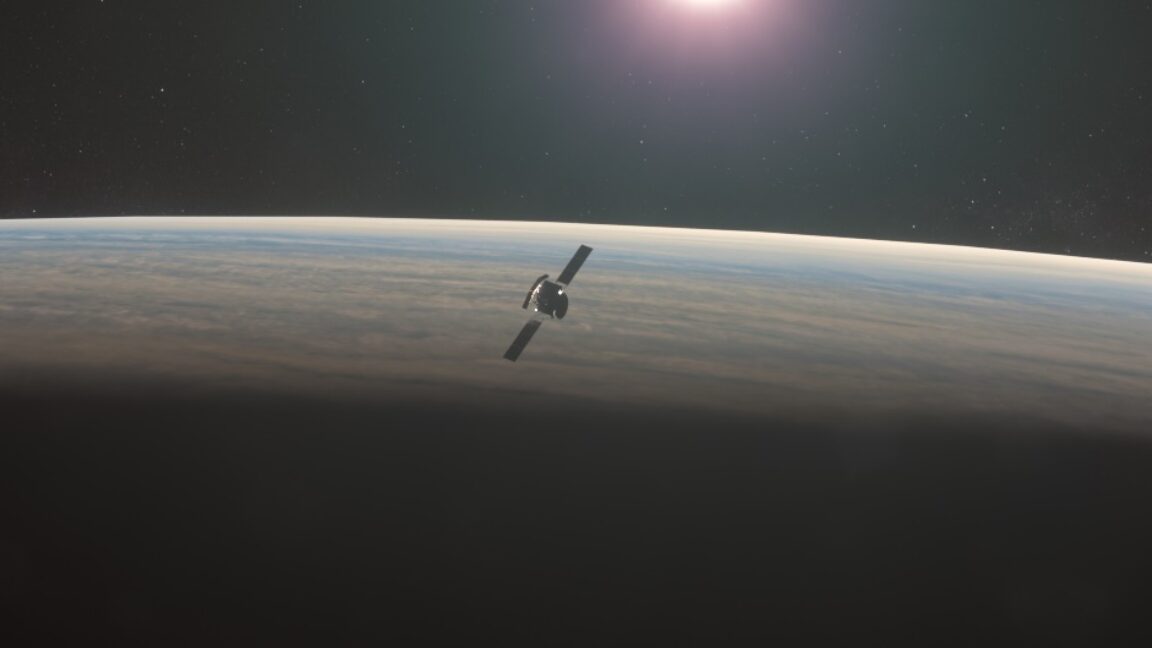
A spacecraft fitted with two flexible robotic arms is on the way to geosynchronous orbit after launching earlier this week on a SpaceX Falcon 9 rocket, kicking off a planned decade-long mission to open new frontiers in satellite servicing.

The Mission Robotic Vehicle, owned and built by Northrop Grumman, rocketed into orbit from Cape Canaveral Space Force Station in Florida on Tuesday. Three small propulsion pods, each functioning as standalone spacecraft, accompanied the MRV aboard the Falcon 9 rocket.

The Falcon 9 deployed all four payloads within about an hour of liftoff. It will take about a year for the satellites to maneuver from their initial elliptical drop-off orbit into a circular orbit more than 22,000 miles (nearly 36,000 kilometers) over the equator. At this altitude, the MRV and the three Mission Extension Pods (MEPs) will travel in lockstep with Earth's rotation, operating in the same kind of orbit as numerous civilian and military communications satellites, missile warning platforms, and a growing number of spy satellites.

Read full article

Comments

© US Navy/Sarah Peterson

Rocket Report: Lightning strikes in China; Starship launch on deck

Welcome to Edition 9.04 of the Rocket Report! We've had to wait an extra week for SpaceX to get its 13th Starship test flight off the ground. A last-second abort on July 16 led engineers to roll the booster back to its hangar in South Texas to swap out engines. Starship is now back on the launch pad. Liftoff is set for Friday evening. A flawless launch and reentry will put SpaceX on the cusp of an orbital flight later this year. Ars will have a comprehensive recap story after the completion of the test flight.

As always, we welcome reader submissions. If you don't want to miss an issue, please subscribe using the box below (the form will not appear on AMP-enabled versions of the site). Each report will include information on small-, medium-, and heavy-lift rockets, as well as a quick look ahead at the next three launches on the calendar.

India's first private rocket reaches orbit. Indian space officials celebrated the debut flight of Skyroot Aerospace’s Vikram-1 rocket, India’s first fully commercial satellite launcher, as a “grand success” Saturday after an on-target climb into a 280-mile-high orbit following liftoff from an island spaceport in the Bay of Bengal, Ars reports. The Vikram-1 lifted off from India’s primary spaceport on Sriharikota Island around midday local time. The launch was delayed more than a half-hour to resolve a last-minute technical problem. The countdown resumed, culminating in the command to ignite Vikram-1’s solid-fueled first stage booster to propel the rocket off the launch pad.

Read full article

Comments

© Zhou Quan/VCG via Getty Images

GE Aerospace, Magellan sign deal for Canada Gripen engines

GE Aerospace and Magellan Aerospace Corporation announced Wednesday they have signed a memorandum of understanding to establish maintenance, repair and overhaul capabilities in Canada for the F414-GE-39E engine that powers the Saab JAS 39 Gripen E fighter, an agreement the companies explicitly tied to whether the Canadian government actually decides to buy the Gripen for […]

Next Space Force chief throws cold water on the idea of space privateers

In the early years of the United States, when the nascent US Navy was still getting its sea legs, several presidents used privateers to capture or destroy enemy warships when armed naval vessels were unable to do so.

President John Adams was one of the most vigorous proponents of commissioning private vessels for national ends. His administration issued letters of marque and reprisal during the so-called "Quasi-War" with France in the final years of the 18th century. These letters created the legal distinction between privateering and piracy.

One of the letters signed by Adams, dated November 1799, authorized the use of a merchant ship to "subdue, seize, and take any armed French vessel" found near US coastal waters of "elsewhere on the high seas." France also routinely used privateers against US shipping at the time.

Read full article

Comments

© MPI/Getty Images

NASA Sets Coverage for Astronaut Chris Williams, Crewmates Return

D4_2071158_20251127T124233_R_2025-11-27 12-42-38.NEF
The Roscosmos Soyuz MS 28 spacecraft is pictured in November 2025 shortly after docking to the International Space Station’s Rassvet module.
Credit: NASA

Editor’s Note: This advisory was updated on July 23, 2026, to reflect changes to the mission timeline. 

NASA astronaut Chris Williams and Roscosmos cosmonauts Sergey Kud-Sverchkov and Sergei Mikaev are wrapping up their 241‑day mission aboard the International Space Station.

The crew and its Soyuz MS-28 spacecraft will undock from the orbiting laboratory’s Rassvet module at 3:03 a.m. EDT Sunday, July 26, heading for a parachute-assisted landing at 6:25 a.m. (3:25 p.m. local time) on the steppe of Kazakhstan, southeast of Dzhezkazgan.

NASA’s live return coverage will stream through a variety of platforms. Learn where to watch online:

https://www.nasa.gov/live

Williams and his crewmates will complete 3,856 orbits and travel more than 102 million miles before returning to Earth. The flight marks the first mission for Williams and Mikaev and the second for Kud‑Sverchkov.

After landing, the crew will fly by helicopter to Karaganda, Kazakhstan, where recovery teams are based. Williams then will return to NASA’s Johnson Space Center in Houston, while Kud‑Sverchkov and Mikaev head back to their training base in Star City, Russia.

NASA’s live return coverage is as follows (all times Eastern and subject to change based on real-time operations):

Saturday, July 25

9:40 a.m. – Coverage of the Space Station Expedition 74/75 change of command ceremony begins.

Kud‑Sverchkov will transfer command of the orbital complex to NASA astronaut Jessica Meir. Expedition 75 officially begins when Soyuz MS‑28 undocks.

11:10 p.m. – Coverage of crew farewells and hatch closing begins.

11:30 p.m. – Hatch closing

Sunday, July 26

2:30 a.m. – Coverage of undocking begins.

3:03 a.m. – Undocking

5:15 a.m. – Coverage of deorbit and landing begins.

5:31 a.m. – Deorbit burn

6:25 a.m. – Landing

For more than 25 years, people have lived and worked continuously aboard the International Space Station, advancing scientific knowledge and making research breakthroughs not possible on Earth. The space station helps NASA understand and overcome the challenges of human spaceflight, expand commercial opportunities in low Earth orbit, and build on the foundation for long-duration missions to the Moon, as part of the Artemis program, and to Mars.

To learn more about International Space Station research, operations, and its crews, visit:

www.nasa.gov/station

-end-

Joshua Finch / Jimi Russell
Headquarters, Washington
202-358-1100
joshua.a.finch@nasa.gov / james.j.russell@nasa.gov

Leah Cheshier / Anna Schneider
Johnson Space Center, Houston
281-483-5111
leah.d.cheshier@nasa.gov / anna.c.schneider@nasa.gov

Pentagon awards Rocket Lab $266 million for suborbital launches

The Pentagon’s Space Systems Command awarded Rocket Lab USA a $266 million contract for suborbital launch services, according to a Department of War contract announcement, covering 12 confirmed launches with an option for six more, all to be conducted from the Pacific Spaceport Complex on Kodiak Island, Alaska, through the end of 2028. The contract […]

Shape-shifting mirrors on NASA’s new space telescope could unveil Jupiters like our own

When NASA’s Nancy Grace Roman Space Telescope launches, as early as the end of next month, it will attempt one of astronomy’s most precise disappearing acts to date. The telescope will carry the first space-bound “active” coronagraph, an instrument that effectively erases most of the light from a star during photography.

It will allow astronomers to take the first pictures of planets orbiting other stars that are similar to those in our solar system. Ultimately, it could pave the way for a future mission that could snap the first photos of Earth-like worlds.

“I hope it’s remembered for it being that critical stepping stone for … finding Earth 2.0,” says Brandon Creager, the instrument’s lead mechanical engineer at NASA’s Jet Propulsion Laboratory (JPL).

Named after Nancy Grace Roman, NASA’s first chief of astronomy, this new telescope will carry a roughly 300-megapixel wide-field camera that will enable it to capture images about 100 times larger than the Hubble Space Telescope’s widest exposures at a similar resolution.

These capabilities will help astronomers unpack the mysterious identities of dark matter and dark energy—and to detect around 100,000 new exoplanets, planets outside our solar system, whose presence can be inferred from the way they distort the starlight of more distant stars. Javier Viaña, a research scientist at Harvard who has had two projects selected for Roman’s highly competitive first year of observing, compares the leap to moving from “interviewing a handful of people” to “conducting a global census.”

Another camera will use the coronagraph, blocking out a star’s light as it observes one stellar system at a time. The instrument will allow astronomers an unprecedented look at the space around stars, enabling them to see smaller, dimmer, and more close-in exoplanets. “It’s giving us the ability to see planets that we haven’t been able to physically see before,” says Creager.

The anatomy of a vanishing trick

Coronagraphs in space aren’t new. But earlier incarnations, such as those currently aboard Hubble and the James Webb Space Telescope, use a stationary system to block a star’s blinding light. The approach does help, but it’s a bit like putting your thumb over a flashlight while searching a dark room for a firefly. Though the bulb vanishes, stray glare can still escape and overwhelm the light of the insect. Inside a telescope, that glare can come from light leaking around the edges of machinery or from minuscule imperfections in mirrors and coatings that can scatter starlight into speckles. All this can hide, or even impersonate, a planet.

Roman’s coronagraph, however, will attempt something completely unseen in space telescopes until this year: Before each observation, it will measure that leftover light and try to suppress it, a technique known as active wavefront control.

The telescope is able to do this because it contains two deformable mirrors. Each has a 48-by-48 checkerboard of actuators (tiny pistons) beneath a thin, deformable sheet of glass. Applying a small amount of voltage makes the actuators contract and tug their patches of mirror slightly backward, like thousands of microscopic fingers delicately sculpting a surface.

The effect is very subtle: Each patch of mirror can deform by up to 0.5 micrometers, or about one-fourth the size of an E. coli bacterium, and in increments as small as approximately 10 picometers. That’s about a tenth the diameter of a hydrogen atom, says Ilya Poberezhskiy, the instrument’s project systems engineer at JPL.

The actuators allow the mirrors to create an “active wavefront,” where each component is moved to the perfect position to cancel out incoming waves of unwanted light—a bit like a pair of noise-canceling headphones, but for light instead of sound. The “canceled-out” light creates a “doughnut-shaped region around the star where we suppress starlight and where we’re hoping to see exoplanets,” says Poberezhskiy.

Compared with current space-based coronagraphs, the system is expected to improve sensitivity to exoplanets against the glare of their host stars by a factor of up to 1,000, revealing planets that would have been far too faint to detect before.

Like Hubble and JWST, Roman also uses masks, patterned plates placed in the path of the light that are designed to block the photons that run into them. One tool in Roman’s mask arsenal is “silicon grass,” a thicket of microscopic spikes on some masks that can be used in certain configurations to absorb photons so they don’t bounce around the telescope and accidentally reach a detector.

Light entering the forest bounces deeper and deeper between the blades and gets trapped instead of reflecting back toward the camera. “Once the light gets into there, it never gets out,” Poberezhskiy says. The mirrors and masks form a succession of gates and hedges to guide as much of the preserved planetary light as possible toward the final detector.

Alien Jupiters

This elaborate setup could open a new chapter in the direct imaging of exoplanets. Nearly all exoplanets photographed so far are oversize youngsters that are nothing like the residents of our solar system: several times the mass of Jupiter, still glowing with the heat left over from their birth, and orbiting tens or hundreds of times farther from their star than the Earth is from the sun. This is because they are relatively easy to see. Their size, warmth, and distance from their parent star makes them shine brightly in infrared light, far away from the worst of the stellar glare.

Roman, however, could directly image a true Jupiter analogue—a planet similar to Jupiter in mass and circling a sunlike star a few times farther out than Earth is from our sun. Unlike the hot Jupiters we can see now, this one would be a much more mature gas giant like ours, primarily reflecting its parent star’s light after billions of years of cooling instead of heavily emitting its own.

Astronomers have been able to infer the existence of such planets from the gravitational wobble they impart to the star. Roman instead will collect starlight reflected from the planet itself. “We’re not looking at the star. We’re not looking at the effect of the planet on the star,” says Meredith MacGregor, a professor of astronomy at Johns Hopkins who has also secured an observing program. “We are actually looking at the planet, and that is super powerful.”

Once this instrument becomes available, it will become the scientists’ turn to do their jobs. “I’m honestly a little terrified about how we’re all going to deal with it, because I think it’s just so much data,” MacGregor says. “I think people will legitimately still be working on Roman data for decades.”

But don’t expect to see a 4K photo of an alien Jupiter in the coming months. Roman will not be able to resolve such a planet into a solid globe—at best, it will likely resemble a smattering of pixels. Still, that will be enough, MacGregor says, as Roman can then use the coronagraph to get information on the various wavelengths of light from the planet, which can tell astronomers about its atmospheric chemistry.

“You’re taking something that’s a point of light and turning it into an actual world,” she says, “because if you know that about its atmosphere, now you know something about the surface of the planet and the possibility of life being on that planet, right? So that’s a big step.”

During its first observations, scientists and engineers will see whether they can hold a star at the very center of the coronagraph’s masks, shape the mirrors, “dig” the dark doughnut (as Poberezhskiy describes it), and then maintain everything as the spacecraft moves through space and actively changes temperature.

The results will inform NASA’s proposed Habitable Worlds Observatory, the daydream of many an exoplanet astronomer, which will in theory be able to separate the light of an Earthlike planet from that of a sunlike star, over 10 billion times brighter.

Creager, who has worked on the instrument since 2018, is proud of the achievement: “Not too many people get to say, ‘I built something and it’s taking a picture of a planet that’s at a star that’s 50 light-years away or 100 light-years away.’” He imagines the moment he and his team will be able to look at the first image as it arrives: “Yes, we did that.” While the planet may show up only as a tiny dot, Roman’s achievement will be the darkness engineered around it.

Mars Society and South Seattle College strike a deal to build a simulated space habitat

Two analog astronauts trudge toward the Mars Society’s Mars Desert Research Station in Utah. (Mars Society Photo)

The Mars Society is planning to build a Pacific Northwest research station suitable for simulating missions to the moon or Mars, in partnership with South Seattle College.

The nonprofit space advocacy group announced today that its executive director, James L. Burk, and the college’s president, Monica Brown, have signed a 10-year memorandum of agreement establishing the partnership.

The plan calls for the Mars Society to lease land on the college’s 87-acre West Seattle campus and build the research station, contingent on funding. Both parties will raise funds from aerospace companies and other donors to support construction, with the goal of opening the station at the start of the 2027-2028 academic year.

The agreement provides for the creation of a joint space studies curriculum and certificate program; a student capstone project and internship program tied to industry partners; and a regional workforce pipeline and community engagement effort.

The Seattle facility would be the third analog research station operated by the Mars Society, joining the Flashline Mars Arctic Research Station on Canada’s Devon Island and the Mars Desert Research Station in Utah.

Those two stations were built more than two decades ago to reflect the designs for Mars habitats. They provide opportunities for teams of researchers to test the tools and techniques that future astronauts might use for extraterrestrial exploration. During their missions, the researchers live and work under simulated Mars conditions. For example, they’re required to put on simulated spacesuits every time they venture outside their habitat.

Burk said the Seattle research station will reflect NASA’s growing emphasis on moon exploration as a precursor to crewed Mars missions, as well as South Seattle College’s traditional emphasis on workforce training. “For more than two decades, the Mars Society has operated analog research stations in the Utah desert and the Canadian Arctic that have shaped how humanity will live and work on other worlds. Bringing that capability to an urban community college campus is something new, and it is deliberate,” he said.

“The moon and Mars programs the federal government has now committed to are going to need a workforce we have not trained for in 50 years,” Burk said. “South Seattle College knows how to train people for the industries that actually build things. That approach is exactly what we need for preparing for planetary surface operations on the moon and Mars.”

South Seattle College’s main campus spans 87 acres in West Seattle. (South Seattle College Photo)

The analog research projects would build upon the college’s existing training programs. For example, students learning about electric vehicle maintenance and repair could work on projects involving battery-powered rovers and drones. Students in the college’s culinary arts program could contribute to research into growing vegetables in space environments.

“South Seattle College has a long tradition of meeting our region’s workforce needs in aerospace, applied science, and skilled trades,” Brown said. “This partnership extends that tradition, and this initiative reflects our commitment to exploring bold, future-oriented opportunities that expand access, inspire imagination, and ensure our students are prepared to lead in emerging industries.”

The Mars Society is headquartered in Colorado but has plenty of Pacific Northwest connections. The Seattle chapter was created in 1998, shortly after the national organization was founded. Burk, a former Microsoft project manager, lives and works in North Bend, Wash.

During a 2023 podcast interview, Mars Society President Robert Zubrin — who earned his Ph.D. in nuclear engineering from the University of Washington — said the Pacific Northwest was “perhaps at the top of the list” of potential sites for a Mars Technology Institute. Today’s announcement appears to be consistent with Zubrin’s assessment of the region.

In its news release, the Mars Society noted that the Pacific Northwest “hosts one of the largest concentrations of commercial space activity in the United States.” The society specifically cited Jeff Bezos’ Blue Origin space venture, SpaceX’s Starlink satellite factory and L3Harris Technologies’ Aerojet Rocketdyne facility in Redmond.

To raise public awareness of the Seattle project, the Mars Society said it plans to install an inflatable mockup of a research habitat in South Seattle College’s Aviation Maintenance Technology facilities this summer. The society also hinted at more to come, saying that there’s “a public event in the works.”

Interlune extracts helium-3 from ordinary helium, demonstrating a process it plans to use on the moon

Mechanical engineer Sam Heyd, Chief Technology Officer Gary Lai and chemical engineer Brenden Pelkie operate the Cold Capture system in Interlune’s Cryogenic Lab at the company’s Seattle headquarters. (Interlune Photo)

Seattle-based Interlune says it has managed to produce 99% pure helium-3 from a standard supply of industrial-grade helium, marking a milestone for a technology that the company aims to use on the moon.

The process, known as Cold Capture, could be profitably used on Earth even before Interlune begins lunar mining operations.

Only 0.000137% of the world’s helium exists in the form of helium-3, as opposed to the much more common helium-4 isotope. But helium-3 is uniquely suited for use as a refrigerant for quantum computers. It can also be used in radiation detectors, medical scanners and eventually fusion reactors.

Because of its rarity and utility, the price of helium-3 can range as high as $20 million per kilogram ($9 million per pound). Interlune is betting on the proposition that helium-3 is more abundant and easier to access on the moon, due to the lunar surface’s exposure to the solar wind. If Interlune’s business model works out, the company will be able to turn a profit by delivering lunar helium-3 to Earth for industrial applications.

Interlune’s first objective was to show that Cold Capture could work as advertised. The process uses cryogenic distillation to separate helium-3 from ordinary helium at temperatures approaching absolute zero.

“Capturing helium-3 from existing helium sounds deceptively simple,” Gary Lai, Interlune’s chief technology officer, said in a news release. “But helium-3 and ordinary helium are almost chemically identical, making them extraordinarily difficult to separate. Cold Capture exploits subtle physical differences between the two isotopes at cryogenic temperatures to recover helium-3 in a process designed to scale.”

Interlune demonstrated Cold Capture at a small scale in early 2025, and received a $1.25 million small-business grant from the Department of the Air Force last November to scale up the technology for commercial production.

Based on the experiments conducted since then, Interlune projects that its technology could triple the current domestic production rate of helium-3.

“Every liter of helium produced in the world contains trace amounts of helium-3,” said Rob Meyerson, co-founder and CEO of Interlune. “Cold Capture plugs into existing helium liquefaction plant infrastructure to recover that helium-3 and turn it into a valuable product.”

Interlune has already struck deals with the U.S. Department of Energy and Maybell Quantum to deliver shipments of helium-3. The first shipments are likely to come from terrestrial sources of helium, courtesy of Cold Capture.

Meanwhile, the company is following a step-by-step plan for lunar prospecting and production. A camera designed to estimate lunar levels of helium-3 is due for delivery to the moon late this year aboard Astrobotic’s Griffin-1 lander.

That mission, known as Crescent Moon, is expected to open the way for a NASA-supported experiment called Prospect Moon in 2028. The experiment will test methods to extract gases such as helium-3 and hydrogen from lunar soil and rocks.

Follow-up missions could focus on harvesting hydrogen for rocket fuel and other lunar power applications, while also collecting helium-3 for delivery to Earth.

Interlune was founded in 2020 and reported raising $18 million in seed capital in 2024. This January, the company announced an additional $5 million investment offering aimed at advancing key technical milestones.

TerraByte AI expands its ‘Earth Search Engine’ with satellite imagery partnership and interactive features

U.S. map with sites of wildfires, earthquakes and other natural phenomena pinpointed
An interactive map displays the sites of wildfires, earthquakes and severe weather events, with links to satellite imagery. (Credit: TerraByte)

Two months after emerging from stealth mode, TerraByte AI is using artificial intelligence and a new partnership to upgrade its “Earth Search Engine.”

The startup, which maintains operations in Seattle as well as San Francisco, has just rolled out a TerraByte News service that pinpoints wildfires, earthquakes and severe weather events on an interactive map. Users can follow links to access news reports, social media posts and satellite views related to selected events.

The satellite views include open-source images from NASA’s Earth observation system as well as Europe’s Sentinel satellites. And now the database also features high-resolution pictures provided through a newly announced partnership with Texas-based SkyFi. The partnership gives TerraByte’s users access to SkyFi’s self-service Earth intelligence platform, which offers satellite and aerial imagery from more than 300 sources at prices as low as $15 per image.

“In May, when we came out of stealth, we made the planet searchable,” TerraByte CEO Rishi Madhok told GeekWire. “Now, the moment you find something, you can hold the imagery in your hands within a day. The next step is making Earth intelligence as routine as a web search — you ask, you see, and then you act.”

Madhok and Fuxun Yu, TerraByte’s chief technology officer, founded the company last year as a follow-up to their work on geospatial data analysis at Microsoft. They developed search tools that can recognize features of interest in satellite images and deliver data-driven insights in response to natural-language queries.

TerraByte’s digest entry for “Forest Fires in France” combines satellite imagery and news reports. (TerraByte Graphic)

Over the past couple of months, TerraByte’s team has grown from three to five employees, Madhok said. “Our goal is to grow the team even further this year, because we are seeing a lot of traction from users since we came out of stealth,” he said.

“A lot of traction is coming from insurance [companies], from the government, from mining, from other areas where there is the possibility to see things,” he said. “And finance, right? A lot of quant firms and hedge funds want to see all of this activity coming in.”

One key application involves emergency response. “Our big focus is on catastrophes, particularly wildfires,” Madhok said. “Our vision is that anybody should be able to track this — not limited to just journalists, but including everyone who is living in those areas and wants to see what’s going on.”

Madhok expects the revenue-sharing partnership with SkyFi to open up new opportunities. “I’m happy to say that we have customers who are paying us,” he said. “From that perspective, we’re already doing well.”

Advances in AI are creating still more opportunities. “Now you can do searches not just using text, but using images, which we call visual search,” he said. “Let’s say you’re searching for a certain kind of vessel, and it’s very hard for you to describe it in natural language. You can just take a screenshot of it, upload it, and within seconds it will literally search for what you were looking for.”

Looking ahead, Madhok and his teammates plan to add people power to the power of AI.

“This is the first version of a platform that we’re going to release, and we obviously want to learn more from our users,” he said. “We want this platform to become crowdsourced, so that people who are local to a region can add more information from that perspective, because then it starts becoming more powerful. We don’t want just TerraByte to be the owner of this.”

Madhok shared a video on LinkedIn that shows how TerraByte’s platform can quickly find high-resolution imagery of a shipwreck in Washington state’s Possession Sound:

Establishing Crew Exposure Limits of Martian Dust

Two holes are visible in the rock, nicknamed “Rochette"
This image taken by NASA’s Perseverance rover on Sept. 7, 2021, PDT (Sept. 8, EDT).

Background

Human exploration of Mars will expose crews to a persistent, fine particulate environment whose physicochemical properties and health implications remain only partly understood. Because no samples of authentic Martian airborne dust have been returned to Earth, NASA must rely on lunar dust toxicology, Martian regolith simulants, and extensive rover/lander geochemical and mineralogical datasets to develop an initial, risk‑informed Permissible Exposure Limit (PEL). The Johnson Space Center (JSC) Lunar and Martian Dust Risk Custodian, the JSC Toxicology group, and the OCHMO Standards team worked together to draft a preliminary standard for incorporation into NASA-STD-3001 NASA Spaceflight Human-System Standard, Volume 2: Human Factors, Habitability, and Environmental Health.

The Martian Dust Limit Working Group was assembled to review this draft standard and associated evidence. Across two working sessions in February 2026, panel members reviewed mission architecture drivers, the current scientific understanding of Martian dust composition, and the toxicological evidence base supporting the establishment of a Mars dust PEL. Discussions emphasized the critical interplay between dust standards and Mars mission design elements including Extravehicular Activity (EVA) cadence, dust ingress characteristics, and the performance of habitat environmental control systems; these features highlight the need for a limit that is conservative, verifiable, and adaptable as the Mars architecture evolves. Panel members for the Working Group were David Damby, Claire Horwell, Brian Hynek, Shaunna Morrison, and Joyce Tsuji; NASA presenters were Katie Borremans, Elizabeth Rampe, and Torin McCoy; the OCHMO organizers/moderators were Douglas Ebert, David Francisco, and Kim Lowe. The Working Group meetings were also attended by members of Space Medicine and Operations group and JSC Toxicology.

The Martian Dust Limit Working Group Primary Goals

Evaluate NASA’s proposed derivation of this initial standard

The panel concluded that NASA’s approach to deriving a 30‑day continuous PEL of 0.1 mg/m³ is reasonable and appropriately conservative for early short‑stay missions. This value originates from the established lunar 30‑day PEL (0.4 mg/m³), reduced by a 3x database uncertainty factor to account for knowledge gaps in Martian dust toxicity, higher iron content, amorphous constituents, and differences between simulants and actual dust. Members supported this framework, noting that a continuous limit applied using measured time‑weighted averages is more practical than making assumptions tied to fixed dust clearance rates given the diversity of spacecraft designs. They also acknowledged that near‑term exposures will be peak‑driven (e.g., post‑EVA suit ingress) and therefore recommended that the standard explicitly address the need to manage short‑duration spikes.

Identify chemical constituents requiring further scrutiny

The panel affirmed that overall dust mass remains the primary near‑term engineering concern, but several chemical constituents warrant attention. Chromium 6+, manganese, and perchlorate were all considered low‑risk in the context of inhaled Martian dust, provided the overall dust PEL is applied (see below). However, perchlorate was recommended for broader agency‑level exposure management across multiple intake routes (e.g., ingestion due to in situ crop growth). Iron was discussed in detail due to its high abundance in Martian regolith and its potential to generate Reactive Oxygen Species (ROS), though current toxicology shows no clear link between iron‑driven ROS and pulmonary harm; still, knowledge gaps led the panel to prioritize iron for further study and potential Spacecraft Maximum Allowable Concentration (SMAC) development. Arsenic was judged unlikely to pose meaningful risk at present.

Weigh the merits of an overall dust limit versus separate SMACs

Chemical constituents embedded within Martian dust were evaluated with respect to whether independent SMACs are warranted. Based on rover observations indicating predominantly trivalent chromium, low airborne perchlorate, and manganese concentrations well below conservative SMAC thresholds at the proposed PEL, the group agreed that the overall dust limit is likely sufficiently protective for expected 30‑day missions. However, panel members advised that SMACs be maintained for select constituents such as perchlorate and manganese for mission‑planning crosschecks. From the requirement perspective, an overall Martian dust PEL approach was favored for practicality and clarity, with constituent-specific SMACs retained or developed only where they add tangible operational value.

Refine the standard’s technical language for operational use

The working group also refined the standard language to ensure clarity and consistency in implementation. Members recommended that the limit apply to a specified time‑weighted average measurement period but also making it explicit that the requirement is for protection during continuous exposure. They encouraged incorporation of peak‑exposure management within the rationale, and highlighted uncertainties related to iron content, nanophase iron, and oxidative potential so that future revisions can incorporate emerging scientific insight.

Martian Dust Contamination Limits

The new requirement established for NASA-STD-3001 is as follows:

[V2 6253] The system shall limit the concentrations of Martian dust particles less than 10 μm in size in the habitable atmosphere below a 24-hour time-weighted average of 0.1 mg/m3 during exposure scenarios lasting up to 30 days in duration.

Conclusions

Taken together, the working group’s deliberations reinforce that an initial Martian dust standard must balance conservatism with operational feasibility while accommodating architectural and scientific uncertainty. The proposed requirement provides a defensible, evidence‑informed foundation for design, verification, and risk communication. As additional Martian data and toxicological research become available, this standard should be periodically revisited to ensure continued protection of crew health during human exploration of Mars.

For more information on the results of the working group, see link to the special publication below:

❌